
A great many executives don't look impaired from the outside. They keep the calendar moving, answer late-night messages, carry the boardroom presence everyone expects, and still feel oddly brittle underneath it all. Sleep gets lighter. Irritability shows up faster. A routine negotiation feels charged for reasons that don't quite make sense.
That pattern often gets mislabeled as burnout, pressure, or a rough season. Sometimes it is. Sometimes it's also unresolved trauma shaping attention, trust, emotional regulation, and coping in ways that high performers can hide for a long time.
For adults in senior leadership, the question usually isn't whether they value mental health care. The question is whether treatment can match the level of discretion, sophistication, and continuity their lives require. In a high-end residential setting, trauma therapy for adults can be structured around privacy, clinical depth, and real-world demands, including secure access to phones and laptops, private rooms, and a treatment plan built for people who can't disappear from their responsibilities.
Trauma Therapy as a High-Performance Strategy
A senior leader can keep delivering at a high level and still feel their range shrinking. Meetings take more effort. Conflict lingers in the body long after the conversation ends. Clear judgment gets replaced by fast threat-scanning, second-guessing, or a need to control every variable.
That is often the moment trauma therapy becomes relevant.
For high-achieving adults, trauma treatment is not separate from performance. It works more like maintenance for the operating system behind performance itself. If the nervous system is stuck in protection mode, talent is still there, experience is still there, and discipline is still there. But more energy gets diverted to vigilance, emotional containment, and recovery. The result can look like burnout from the outside while feeling like constant internal friction from the inside.
Trauma therapy aims to reduce that friction. As treatment progresses, many professionals are better able to stay steady under pressure, think with less distortion when stakes rise, and recover more quickly after stress. For an executive, those changes matter because unresolved trauma often shapes leadership indirectly. It can alter how feedback is heard, how risk is interpreted, and how much uncertainty the mind can tolerate before it shifts into defense.
A useful clinical rule is simple. If a capable person keeps solving external problems while feeling increasingly dysregulated internally, trauma deserves careful assessment.
In an executive setting, the therapy itself also has to fit reality. Privacy needs to be protected. Career continuity needs to be considered. Treatment should be precise enough to address trauma without treating the person as if they have to step out of adult responsibility altogether. In a discreet residential program, that can mean private accommodations, clear confidentiality protocols, and structured windows for necessary communication so the person can do meaningful clinical work without feeling professionally erased.
Sleep often sits near the center of this picture. A leader may say, "I can function on five hours," much like a company may say a server is fine while it keeps overheating. Functioning is not the same as running well. Resources that help optimize professional performance with sleep can support recovery because trauma and sleep disruption tend to reinforce each other.
Seeking treatment in this context reflects discernment. It shows a willingness to address the hidden drivers that keep performance costly, even when success on paper still looks intact.
Recognizing Unresolved Trauma in High Achievers

Trauma doesn't always announce itself in obvious ways. In high achievers, it often wears the mask of competence. The person still performs, still produces, still leads. But the internal cost rises, and certain patterns start repeating.
What trauma can look like at work
A clinician may describe hypervigilance. An executive may experience it as an inability to delegate, a need to check every detail personally, or a feeling that relaxing control is dangerous.
A therapist may ask about emotional numbing. In professional language, that can feel like losing connection to the mission, going flat during wins that used to matter, or struggling to feel anything but pressure.
A trauma response can also look like:
- Compressed patience: Small mistakes from staff trigger outsized frustration.
- Overreading threat: Neutral feedback sounds like attack.
- Fragmented concentration: A board meeting is underway, but part of the mind is elsewhere.
- Compulsive productivity: Rest feels unsafe, so work becomes the only acceptable state.
- Strategic self-medication: Alcohol, stimulants, or sedatives become tools to power through or finally shut down.
None of those automatically proves trauma. But when they persist, especially after a distressing event, a painful history, or a period of repeated stress exposure, they deserve a closer look.
Why success can hide the problem
High performers are often rewarded for traits that can overlap with trauma adaptations. Intensity may be praised as commitment. Emotional distance may get mistaken for composure. Relentless self-reliance may look like leadership strength.
That's where people get confused. They assume trauma should make someone visibly nonfunctional. In reality, many adults become more externally disciplined while feeling more internally exhausted.
A person can be impressive and unwell at the same time.
A useful question isn't, “Is this bad enough to count?” A better question is, “What is this pattern costing in clarity, relationships, and peace?”
Signs that deserve a clinical assessment
The following patterns often justify a trauma-informed evaluation in a private executive program:
| Pattern | How it may show up professionally |
|---|---|
| Persistent reactivity | Sharp responses, difficulty recovering after conflict |
| Trust disruption | Micromanagement, isolation, reluctance to rely on others |
| Avoidance | Delaying key conversations, steering away from specific topics or places |
| Body-based stress | Tension, restlessness, inability to settle even off the clock |
| Substance reliance | Using alcohol or other substances to regulate mood, sleep, or stress |
When these patterns begin shaping leadership style, family life, or substance use, trauma therapy for adults stops being a vague mental health idea. It becomes a practical next step.
Evidence-Based Trauma Therapies for Lasting Change
The most effective trauma treatment isn't random conversation. In a strong clinical program, it's structured, targeted, and chosen according to how the person processes threat, memory, emotion, and stress. For executives, it often helps to think of treatment as systems repair. The goal is to reduce the power of past experiences that keep disrupting present performance.
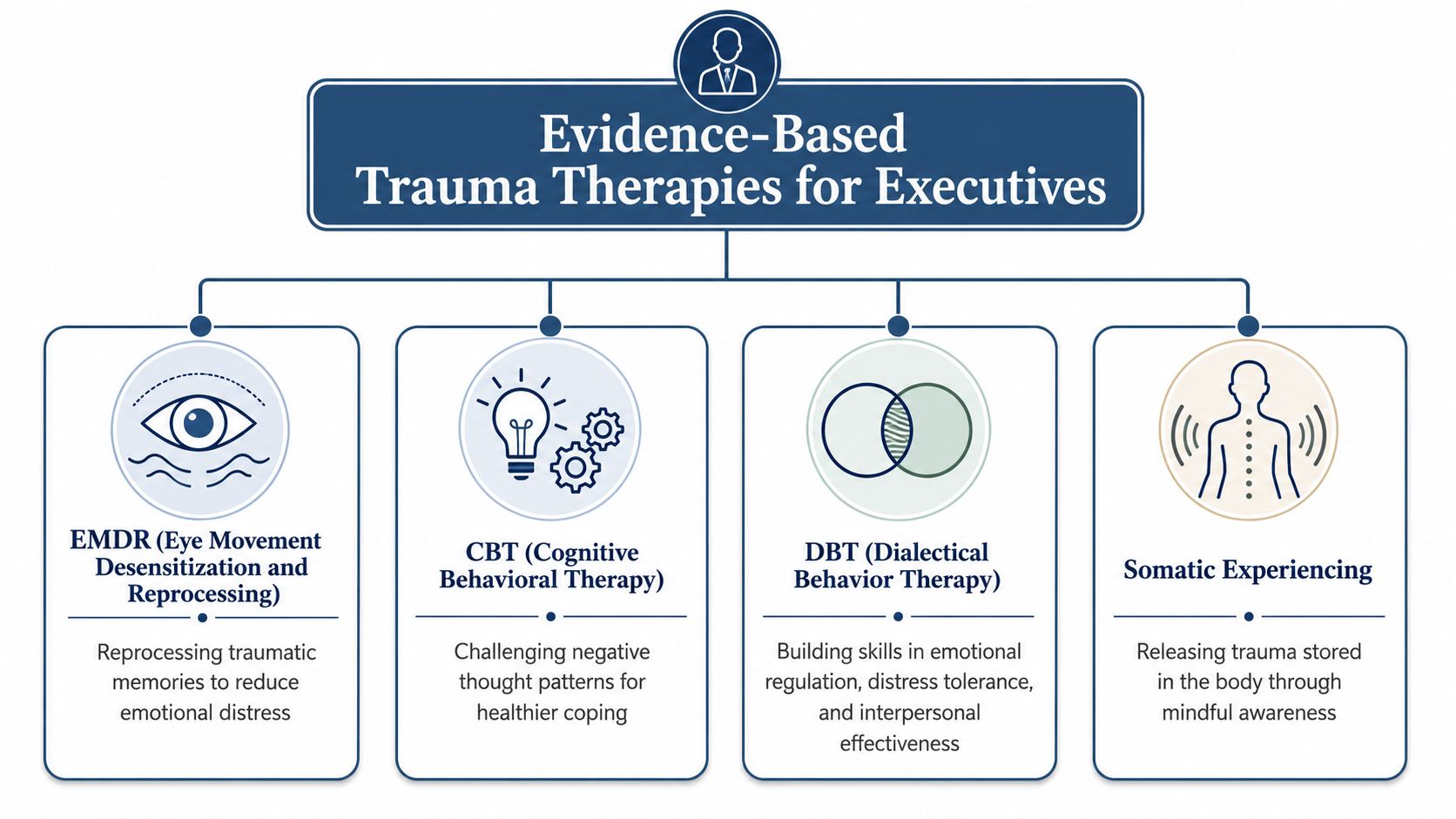
The field is quite clear on the core first-line options. The three trauma-focused psychotherapies with the strongest empirical support are Prolonged Exposure, Cognitive Processing Therapy, and Eye Movement Desensitization and Reprocessing, and they are strongly recommended by APA and VA/DoD guidelines over medication alone according to this summary of evidence-based trauma treatment options.
EMDR as memory reprocessing
EMDR is often the easiest to misunderstand. It isn't hypnosis, and it isn't passive. It guides a person to revisit distressing material while using bilateral stimulation such as eye movements, taps, or sounds. The working aim is to help the brain reprocess a memory that has remained emotionally and physiologically “stuck.”
For an executive, a simple analogy is this. A file exists in the system, but it keeps crashing active operations because it was never properly integrated. EMDR helps the brain store that file differently so it no longer hijacks the whole platform.
CPT as cognitive debugging
Cognitive Processing Therapy, or CPT, examines the beliefs that trauma can lock into place. After a traumatic event, adults may start operating from assumptions such as “I'm not safe,” “People will betray me,” or “If I let my guard down, something bad happens.”
That process resembles debugging faulty code. The therapist and client identify trauma-shaped rules, test them, and replace them with thinking that's more accurate and less punishing. For professionals, this can directly affect leadership behavior, conflict response, and self-criticism.
Readers who want a plain-language overview of this style of care can explore trauma-informed therapy for adults in residential treatment.
Prolonged Exposure and body-based work
Prolonged Exposure, or PE, helps a person confront trauma-related memories and reminders in a controlled, safe therapeutic setting. Avoidance tends to keep trauma active. PE reduces that cycle by helping the brain learn that remembering isn't the same as being in danger right now.
Programs may also include somatic work and DBT-informed skills. Somatic approaches focus on how trauma lives in the body through tension, shutdown, restlessness, and dysregulated arousal. DBT skills help with distress tolerance, emotional regulation, and interpersonal effectiveness. Those tools can be especially useful when a client needs practical ways to stay steady during demanding work communication.
The right modality isn't chosen by trend. It's chosen by fit, formulation, and clinical skill.
What executives should expect
An individualized program doesn't force every client into the same method. It assesses trauma history, substance use, dissociation, current stress load, and readiness for deeper processing. In some cases, the work starts with stabilization. In others, structured trauma processing begins sooner.
For adults who need dual-diagnosis residential care, one option is Reflections, a California-licensed, Joint Commission-accredited program that integrates trauma treatment with psychiatric and substance use care in a private residential setting.
The key point is simple. Effective trauma therapy for adults is active treatment, not vague support. It's designed to create lasting change in how memory, emotion, and behavior interact.
Integrating Trauma Care with Co-Occurring Substance Use
Many professionals don't start with the words “I have trauma.” They start with “drinking has gotten harder to control,” or “sleep medication has become essential,” or “there's no off switch anymore.” In executive life, substance use often begins as performance management. It later becomes survival management.
That's why treating only the substance problem usually misses the foundation. If alcohol, stimulants, or sedatives have been serving as regulation tools for trauma-related distress, then removing the substance without treating the trauma leaves the original driver in place.
Why integrated treatment works better
An integrated dual-diagnosis model addresses both conditions at the same time. Detox may be necessary first if a person is physically dependent. But the clinical work can't stop there. The same treatment team needs to understand how trauma, stress physiology, sleep disruption, shame, and substance use are feeding one another.
This is especially important for adults who appear highly functional. Professional success can delay recognition of how serious the cycle has become. A person may still close deals, lead teams, and maintain public credibility while privately depending on substances to regulate panic, anger, or emotional numbness.
According to the clinical review in integrated trauma and substance use treatment, integrating trauma-focused interventions into substance use disorder treatment is highly effective and more cost-efficient long-term, as it addresses the root cause of the dependency, leading to profound and lasting change for patients with co-occurring disorders.
What this looks like in practice
In a luxury residential setting, integrated care often includes:
- Medically managed withdrawal: Safe monitoring during detox when appropriate.
- Trauma-informed psychotherapy: Therapy that understands substance use as a coping function, not just a bad habit.
- Psychiatric review: Careful medication evaluation, with restraint and precision rather than reflexive overprescribing.
- Skills training: Tools for cravings, triggers, emotional flooding, and relationship strain.
- Relapse prevention built around trauma triggers: Planning that goes deeper than avoiding bars or deleting phone numbers.
For executives, the benefit is coherence. They don't have to split themselves into separate problems for separate providers. The addiction story, trauma history, and current functioning are treated as one clinical picture.
A practical overview of this overlap appears in PTSD and alcohol addiction treatment considerations.
If substance use has become the bridge between stress and relief, trauma treatment is often the work that makes lasting sobriety possible.
That's why trauma therapy for adults with co-occurring addiction needs more than comfort and privacy. It needs clinical integration from day one.
The Executive Treatment Experience in a Luxury Setting

For senior professionals, the treatment environment matters because context affects compliance. An executive who won't enter a chaotic, impersonal setting may fully engage in a private residence where confidentiality, order, and comfort are built into daily life.
In a true luxury program, the value isn't marble counters or polished branding. It's the level of personalization around clinical access, discretion, and continuity. High-end executive rehab programs can cost over $1,000 per day, with some facilities reaching $3,500 daily, and that pricing reflects personalized clinical teams and continuous access to advanced care rather than décor alone, as outlined in this overview of executive luxury rehab costs and structure.
What professionals usually care about most
The first concern is often privacy. High-profile clients need assurance that treatment will remain confidential from colleagues, clients, and the public. Private rooms matter here, not just for comfort, but for containment, decompression, and sensitive calls when permitted.
The second concern is career continuity. Some executives can't vanish entirely for weeks. In the right residential model, residents may keep their electronics, including phones and laptops, with clinically appropriate boundaries that allow them to remain engaged with essential responsibilities rather than abandoning them.
The third concern is the peer and staff environment. Professionals tend to engage more fully when they're treated with respect, spoken to directly, and cared for by a highly credentialed multidisciplinary team rather than a generic one-size-fits-all system.
A day in a discreet residential rhythm
A typical day may include individual therapy, psychiatry, trauma-focused groups, somatic or mindfulness work, movement, nutrition support, and carefully protected time for urgent professional obligations. Private rooms in both detox and rehab can make that schedule feel manageable rather than overwhelming.
A luxury setting can also simplify logistics before admission. For clients traveling under medical or privacy constraints, a private medical transport services guide can help families understand options for secure transfer planning.
The point isn't indulgence. It's reducing avoidable friction so the client can do the hard psychological work.
Why environment affects outcomes
When a program understands executives, it won't shame ambition or demand that a person stop being who they are. It will help them separate healthy drive from trauma-fueled overcontrol. Comfort, privacy, excellent food, quiet surroundings, and responsive staff create the conditions for sustained engagement.
That's especially relevant in private-pay care for C-suite leaders, founders, attorneys, physicians, and other working professionals who expect a high standard in every area of life. In that context, trauma therapy for adults becomes more accessible because the setting no longer feels like a threat to identity, status, or obligations. It feels like a contained place to recover judgment, stability, and range.
How to Evaluate a Premier Trauma Treatment Program
A CEO would not approve a major acquisition based on a polished pitch deck and a beautiful lobby. Trauma treatment deserves the same discipline. If you are considering private-pay care, the question is not whether a program looks impressive. It is whether the clinical operation can protect privacy, keep treatment focused, and help a high-functioning adult do meaningful trauma work without unnecessary disruption to career and family life.
In executive care, quality is often easiest to spot in the first phone call. Clear answers usually reflect a clear treatment model. Vague reassurance often means the program sells calm more effectively than it delivers clinical rigor.
Requirements to confirm
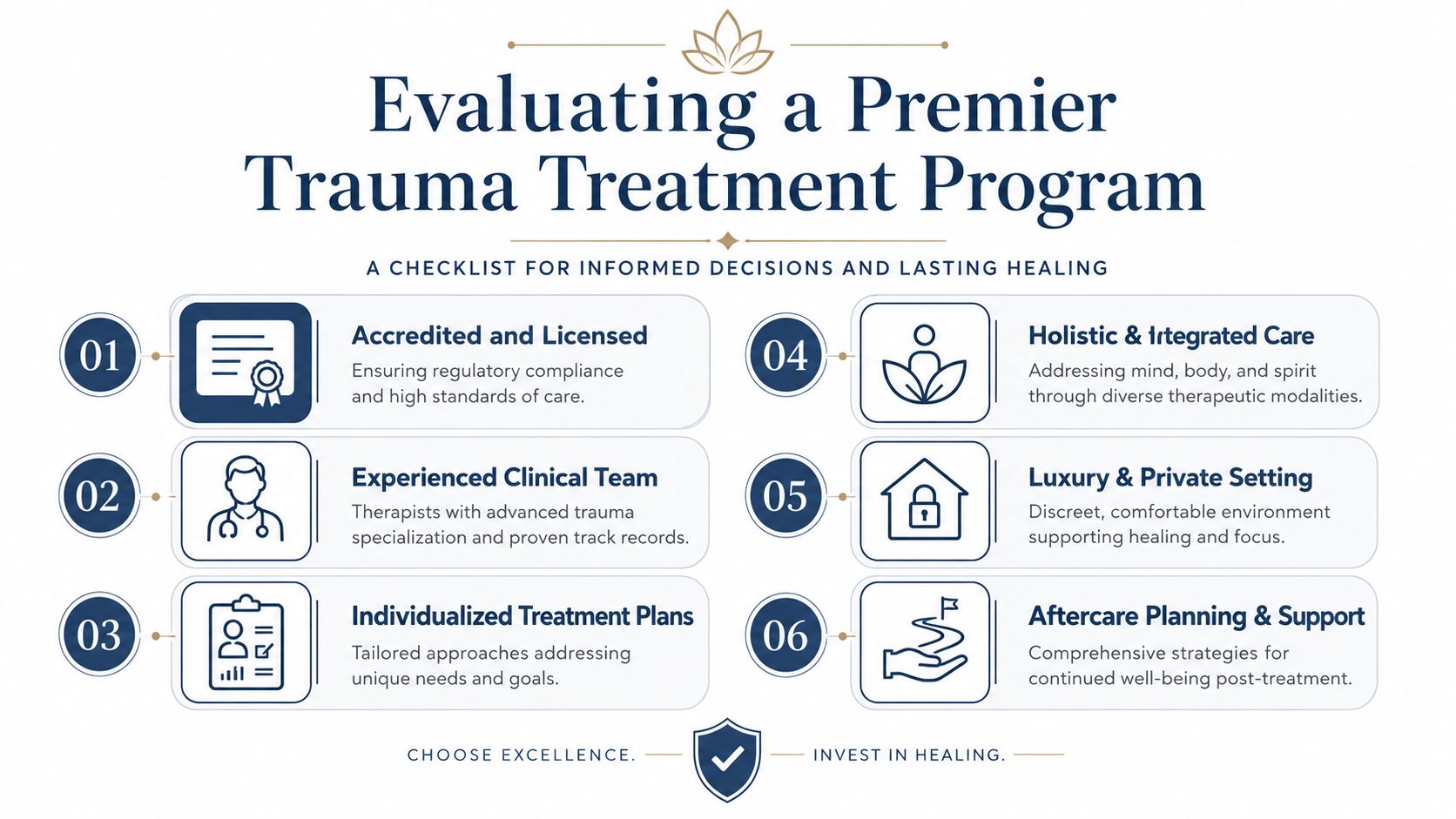
A strong executive trauma program should answer these questions directly:
- Accreditation and licensing: Is the facility properly licensed, and does it hold recognized accreditation such as Joint Commission status?
- Clinical depth: Are trauma services delivered by experienced clinicians with advanced specialization, or spread loosely across general staff?
- Dual-diagnosis capability: Can the team treat trauma, psychiatric symptoms, and substance use together?
- Private accommodations: Are private rooms available in both detox and residential rehab?
- Technology policy: Can residents maintain access to phones and laptops within a defined structure?
- Individualized planning: Is care adapted to the person's trauma history, current role demands, and psychiatric profile?
Those details show how the program functions under pressure.
Questions worth asking on the first call
The first call should feel less like a sales conversation and more like a case review. Use direct questions. They separate polished hospitality from real clinical quality.
| Question | Why it matters |
|---|---|
| Who designs the trauma treatment plan? | This shows whether care is led by licensed clinicians or built from a standard template. |
| How do you handle co-occurring substance use? | Trauma care and addiction care need to work together, or treatment can stall. |
| What is the policy on electronics? | Executives need a concrete answer about access, limits, and clinical boundaries. |
| Are private rooms standard? | Privacy affects sleep, regulation, and willingness to participate honestly. |
| How do you protect confidentiality? | High-profile clients need operational safeguards, not broad promises. |
| What happens after residential treatment? | Return-to-work planning and continuing care shape whether gains hold once pressure resumes. |
Ask for specifics about staffing, scheduling, communication rules, and what happens when a client becomes emotionally flooded, avoidant, or tempted to leave early. A good program can explain its process in plain language.
What a premium investment should actually buy
Cost should buy more than comfort. It should buy access to skilled clinicians, coordinated case management, psychiatric care that matches the complexity of the case, and a treatment structure that works for adults with serious responsibilities.
For trauma treatment, case coordination matters for a simple reason. Therapy is only one part of recovery. Work demands, family strain, legal concerns, medication issues, and relapse risk can all interfere with progress if no one is helping the client address them in a connected way. The Trauma Recovery Center model, summarized in research on trauma recovery centers and case management, points to the value of coordinated case management and engagement support rather than assuming therapy sessions alone are enough.
That same principle applies in executive treatment. The strongest programs understand that a founder, physician, attorney, or senior leader may need trauma therapy that is clinically deep and operationally realistic. The work should be protected, private, and structured well enough that the person can stay in treatment long enough for change to take hold.
Common Questions from Professionals About Trauma Therapy
A senior executive can lead a board meeting, answer 200 emails, and still feel a surge of panic in a quiet room at night. That mismatch confuses many high performers. Outward function stays intact long after the nervous system has started paying a price.
That is why professionals usually begin with operational questions. They are not avoiding the underlying concern. They are testing whether treatment can protect privacy, preserve career continuity, and make clinical sense for a person whose life cannot cease abruptly.
Can an executive still manage business obligations in residential care
Often, yes, within clear clinical limits.
In a setting built for working adults, some residents keep structured access to phones and laptops for time-sensitive responsibilities. The goal is not constant availability. The goal is selective continuity. A good program helps the client separate true responsibilities from habits of overcontrol, then build rules around both.
That boundary work matters. For many executives, learning what can be delegated is part of treatment, not a distraction from it.
How is confidentiality protected
Confidentiality should be treated like risk management. The details matter.
A serious program should be able to explain who can access records, how staff communication is handled, what protections exist for high-profile clients, and how privacy is maintained in daily living spaces. Private rooms can reduce exposure and allow a person to stabilize without feeling watched during detox or residential care.
For executives, physicians, attorneys, founders, and public-facing leaders, this is not vanity. It is one of the conditions that makes honest treatment possible.
Will trauma therapy force immediate disclosure of everything
No. Skilled trauma therapy is paced with care.
Early treatment often focuses on safety, regulation, and trust before deeper processing begins. A useful analogy is physical rehabilitation after a serious injury. You do not start by loading full weight onto the damaged area. You restore stability first, then increase the work as the system can tolerate it.
That approach is often what allows high-achieving adults to stay engaged. They do not need pressure to perform emotionally. They need a method that respects how trauma affects the brain, the body, and the pace of change.
How long does it take to see results
The timeline depends on the type of trauma, how long it has been present, and whether substance use, sleep disruption, anxiety, or depression are also involved.
Some adults notice early gains in sleep, irritability, concentration, or physical tension before they feel dramatic emotional relief. That can be reassuring. Progress does not always begin with a breakthrough conversation. Sometimes it begins with fewer startle responses, less dread on Sunday night, or the ability to sit through a difficult meeting without going numb or becoming reactive.
As noted earlier, certain evidence-based trauma treatments can work more efficiently than many professionals expect. Complex trauma usually takes longer than a single-incident event, but effective care is often more structured and more targeted than people fear.
Is residential treatment only for people in visible crisis
No. Many strong candidates are still performing well in public.
They are meeting deadlines, closing deals, seeing patients, or managing teams while drinking more than they want to, sleeping poorly, staying on edge, or cycling between overcontrol and emotional shutdown. From the outside, they look disciplined. Internally, the system is running hot all the time.
Waiting for obvious collapse is rarely wise. The better time to enter treatment is when the person can still choose it with clarity, before symptoms start making those choices for them.
The ideal time to enter treatment is when insight appears, not when damage becomes impossible to hide.
Reflections provides luxury residential dual-diagnosis care for adults who need trauma treatment in a discreet, clinically advanced setting. The program includes private rooms in detox and rehab, appropriate access to electronics for ongoing work obligations, and treatment from a highly credentialed multidisciplinary team. Professionals who need confidential trauma therapy for adults can learn more through Reflections.