
The call usually comes after a bad week, not a dramatic collapse. A CEO is still answering emails, a partner is covering for missed meetings, and someone in HR or legal is trying to figure out whether a residential stay can happen without blowing up the entire month. That's the executive drug rehab question, not whether a place looks polished in photos, but whether it can handle clinical risk, privacy, and work continuity at the same time.
| Criterion | Luxury Executive | Standard Private | Publicly Funded |
|---|---|---|---|
| Clinical depth | Strong dual-diagnosis focus, medical oversight, structured therapy | Can be solid, but varies widely by program | Often limited by demand and program capacity |
| Privacy | High discretion, private rooms, controlled access | Better than public care, but not always fully private | Lowest privacy, higher exposure to shared settings |
| Work continuity | Electronics access can be built into care with guardrails | Sometimes allowed, often inconsistent | Usually not designed for ongoing work obligations |
| Family involvement | Private sessions and education are often built in | May exist, but usually less structured | Frequently limited by staffing and access |
| Fit for executives | Strong fit when co-occurring disorders and confidentiality matter | Good for some, not all | Usually the wrong fit for this use case |
What Executive Drug Rehab Actually Means
A CEO facing a 30-day stay is not asking for a spa. They're asking whether treatment can contain withdrawal risk, stabilize mood, and keep the rest of life from imploding. Executive drug rehab means a program built for that reality, not just a nicer room and better coffee.
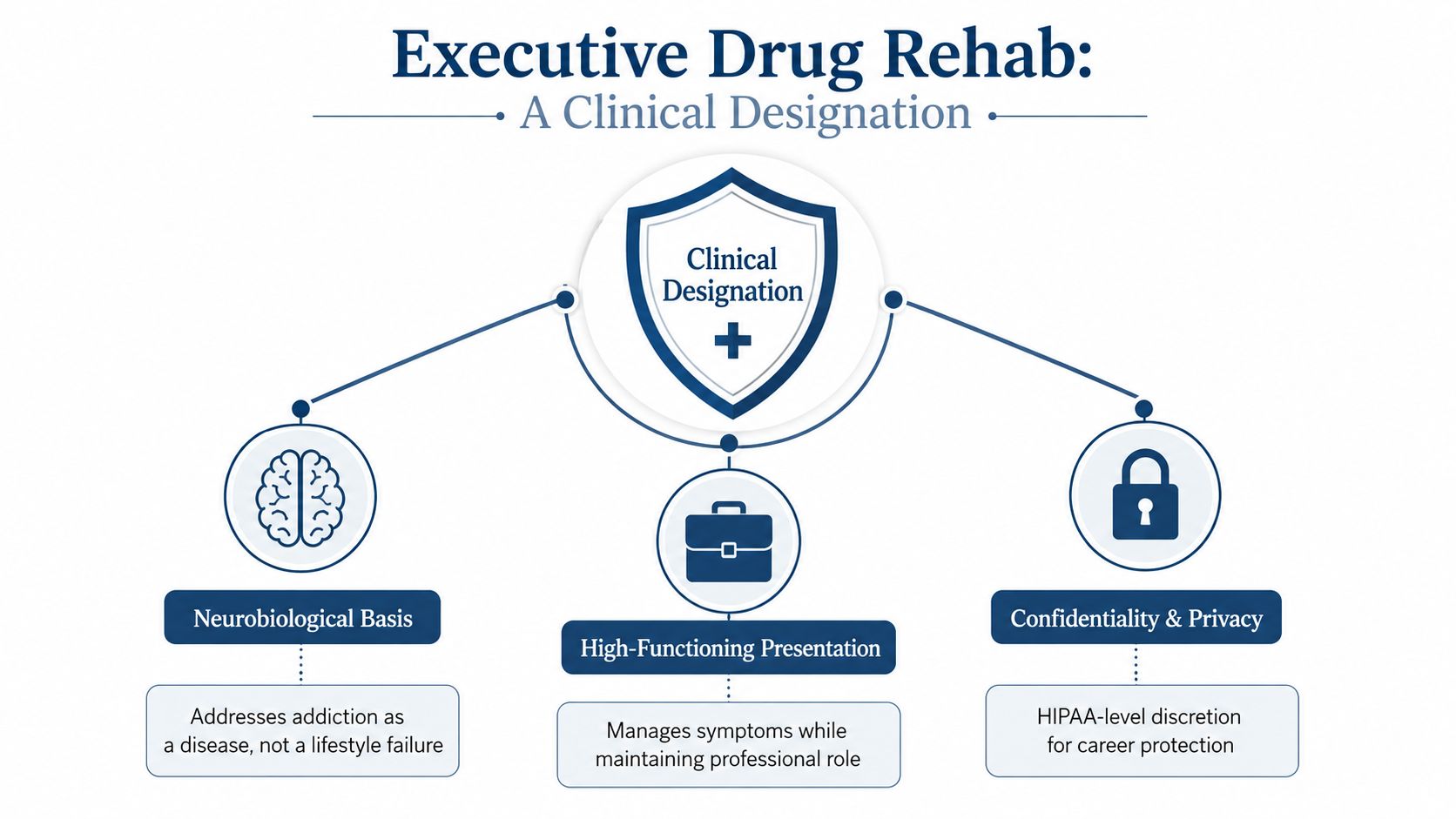
Clinical designation, not status symbol
The label matters when the person needs real clinical work. High-functioning adults often use alcohol or drugs to manage anxiety, trauma, insomnia, depression, or pressure that never fully shuts off. If the program only treats the substance use and ignores the driver underneath, the stay becomes expensive containment instead of recovery.
A credible luxury residential setting should do three things well. It should treat co-occurring disorders with depth, protect privacy with real operational controls, and keep a path open for necessary work obligations without letting work dominate treatment. That is a different model from a generic inpatient stay that expects complete disengagement from life.
Practical rule: If a program can't explain how it handles dual diagnosis, device access, and family communication in the same conversation, it's not really executive-ready.
The distinction matters for people who can't afford a sloppy handoff. Referring attorneys and HR partners should look for programs that combine medical detox capability, structured psychotherapy, and a continuum beyond discharge. Reflections fits that model as a luxury executive rehab option for adults who need private, clinically serious care.
What to hear on the admissions call
The right admissions team answers in specifics. They should be able to describe who leads care, how privacy is protected, how device use is managed, and what the first week looks like. Vague answers are a red flag, because executives don't need a sales pitch. They need a plan.
The best executive programs also make room for family involvement without turning it into a side feature. In serious dual-diagnosis care, the family is often part of the clinical problem and part of the solution. That's why a strong program talks about boundaries, communication, and relapse risk from the start, not after discharge.
Comparing Luxury, Standard Private, and Public Rehab
The wrong comparison is price alone. The right comparison is what each setting can realistically deliver for a working professional with co-occurring symptoms, a demanding job, and people depending on them. For that use case, privacy, staffing depth, and continuity planning matter more than décor.
What actually separates the tiers
Luxury executive rehab earns its premium when the resident needs a higher level of discretion and coordination. Private rooms reduce exposure and protect dignity. Structured work access can keep a career from collapsing mid-treatment. Most important, strong clinical teams can work on the substance use and the mental health layer at the same time.
Standard private programs can still be effective, but the experience is less consistent. Some offer excellent therapy and medical care, while others focus on comfort without much clinical depth. Publicly funded programs serve an essential role, but they're generally built for access and volume, not for the discreet, highly individualized demands of a corporate leader.
A premium setting is justified when the client needs treatment that protects employment, reputation, and family stability while still doing hard clinical work.
Executive Rehab Tiers Compared
| Criterion | Luxury Executive | Standard Private | Publicly Funded |
|---|---|---|---|
| Dual-diagnosis depth | Built around co-occurring care | Depends on the facility | Often uneven or limited |
| Private rooms | Typically standard | Sometimes available | Uncommon |
| Electronics access | Often structured and allowed | Sometimes allowed | Usually restricted |
| Work continuity | Designed into the model | Inconsistent | Usually not a core feature |
| Family sessions | Often private and structured | May exist | More limited |
| Referral suitability | Strong for executives and high-profile adults | Good for many private-pay patients | Better for access than specialization |
The U.S. rehab market is big because the gap is big. The industry is estimated at $42 billion annually, with 5.2% average yearly revenue growth projected through 2025 to $53 billion source. That growth reflects unmet need, not a luxury fad. The same source notes that in 2018 only 11% of the estimated 21 million Americans in need of treatment received care, which shows how much demand still goes unserved.
For attorneys and HR leaders, the takeaway is simple. Luxury care is worth the premium when the client's recovery depends on a setting that can absorb clinical complexity and preserve professional continuity. If that's not the need, paying for luxury is wasted money.
Dual-Diagnosis Care for High-Functioning Adults
High-performing adults often present well and still need intensive treatment. They can run meetings, close deals, and manage teams while also carrying trauma, anxiety, depression, bipolar symptoms, or borderline traits that make substance use feel necessary. Treating only the addiction misses the mechanism.
Why the mental health piece can't be an afterthought
For many executives, the drug or alcohol use is a coping strategy, not the root problem. That means the clinical team has to assess what's driving the pattern and treat that driver directly. CBT, DBT, ACT, MI, individual psychotherapy, and intensive groups are the right tools when the case is complex, because they address thought patterns, emotional regulation, avoidance, and motivation instead of just asking for abstinence.
Medication also belongs in the conversation when it's clinically appropriate. In a credible residential setting, medication-assisted withdrawal and medication optimization are not extras, they're part of stabilizing the person enough to do the work. A program without psychiatric depth is usually underpowered for a high-functioning adult with a long history of self-medication.
If placement is still being debated, a useful external guide is dual diagnosis placement from Integrity Together, because it frames the basic question correctly, whether the person needs addiction care alone or a co-occurring-disorder track.
What credible staffing looks like
The staffing mix tells the truth. A serious luxury program should have psychiatrists, PhD-level psychologists, LMFTs, certified addiction counselors, and adjunctive therapists who coordinate with one another. If those roles are present but siloed, the resident gets fragments, not a treatment plan.
Reflections' mental health and substance abuse treatment reflects that dual-diagnosis model in a residential luxury setting. That matters because working professionals rarely have one clean issue. They have overlapping symptoms, stress, and relapse triggers that need coordinated care.
The common mistake is assuming polish equals competence. It doesn't. For this population, the right question is whether the program can treat the addiction, the psychiatric condition, and the professional pressure in one integrated plan.
Electronics Access and Work Continuity in Treatment
Device access is not a perk for executives, it's often a clinical accommodation. A managing partner, physician, founder, or in-house executive may need limited access to keep fiduciary, legal, or operational obligations from spiraling. The mistake is giving full freedom without structure, because that turns residential treatment into a hybrid work retreat.
How responsible device access should work
A serious program sets guardrails. That usually means scheduled check-ins, designated work blocks, and device-free therapy hours so treatment stays the priority. The resident keeps cell phone and laptop access, but the team controls when and how that access happens.
The point isn't convenience. It's preserving the person's ability to remain accountable in life while still doing the work of recovery. If a program says it allows electronics but can't explain boundaries, group rules, or staff oversight, the policy is too loose to trust.
Clinical standard: Work access should serve treatment, not compete with it.
Programs also need to distinguish between genuine obligation and avoidance. Some people can't disappear for a month. Others are using work as a socially acceptable escape from discomfort. Good clinical staff can tell the difference quickly, and they should push back when work becomes a defense against treatment.
For a practical frame on the operational side, work from rehab is the kind of topic an admissions team should be able to discuss plainly. The question is whether the treatment schedule can hold both accountability and recovery without letting either one collapse.
Executives should ask one direct question during intake. “How do you keep device access from undermining therapy?” If the answer is specific, the program understands the population. If the answer is vague, the resident will probably spend too much time managing emails and not enough time changing behavior.
Family Sessions Workshops and Continuing Engagement
Families are not background support in executive rehab. They're part of the treatment system, especially when the resident is a spouse, parent, or business leader whose drinking or drug use has already rearranged the household. Luxury programs do this better when they treat family work as therapy, not customer service.
What good family involvement looks like
The first step is usually a private family session with the primary therapist. That gives the clinician a chance to hear the family's pattern, clarify boundaries, and identify enabling without turning the conversation into a blame session. After that, educational workshops can teach the family how addiction works, how relapse risk shows up, and how to communicate without escalating conflict.
Reflections' family model includes private sessions and monthly educational workshops, which is the right direction for executive care because it gives relatives structure instead of leaving them to guess. When the clinical team brings family in early, the resident usually comes home to a clearer system, not the same chaos with nicer language.
What relatives should ask for
Relatives should ask how the program handles boundaries, relapse planning, and communication frequency. They should also ask whether the family receives guidance on what to do after discharge if warning signs show up. A strong program won't just say “family involvement matters.” It will explain exactly how it's operationalized.
Useful family topics include:
- Enabling and rescue patterns: Families need to know where support ends and protection begins.
- Boundaries after discharge: The resident needs clear rules, not emotional improvisation.
- Communication during treatment: The family should know when to reach out and when to step back.
- Relapse planning: Everyone should know the response before a crisis happens.
One more point matters here. Families are often the first gatekeepers, not secondary observers. Programs that ignore them are missing a major part of the decision-making process before admission and a major relapse-prevention resource after discharge.
Choosing 30 60 or 90 Days for Executive Recovery
A short stay can work when the issue is narrow. It usually fails when the person has co-occurring symptoms, a complicated job handoff, and a family system that needs resetting. The more complex the picture, the less credible the “quick reset” fantasy becomes.
How to think about length
A 30-day stay is the minimum useful window for stabilization, detox support, and initial behavioral work. It can be appropriate when the person needs a contained interruption, but it's rarely enough for deep dual-diagnosis change. 60 days gives more room for therapeutic repetition, work-boundary adjustment, and family engagement. 90 days is the strongest fit when symptoms are severe, the person has relapsed repeatedly, or the professional and family logistics are tangled.
The data point that matters here is completion and continuity. Among all discharges in 2019, 42% of substance use treatment episodes ended in completed treatment, while another 22% were transferred to further substance use care source. That supports a staged model, because rehab often ends with transition, not finality.
Match stay length to the real burden
The goal isn't to pick the longest stay by default. It's to match treatment duration to the actual burden of the case. A founder with recent relapse, insomnia, and family strain needs more runway than a professional who needs detox, structure, and a clean step-down plan.
A useful way to decide is straightforward.
- 30 days: Best for lower complexity, urgent stabilization, and limited leave flexibility.
- 60 days: Best for moderate co-occurring symptoms and a serious but manageable work transition.
- 90 days: Best for complex dual diagnosis, repeated relapse, or high-conflict family systems.
Shorter stays look efficient until the resident returns home unprepared.
The right luxury program doesn't pretend discharge ends recovery. It builds continuing care, alumni support, and flexible follow-up into the plan so the transition doesn't undo the work. That's where the residential stay proves its value, not just during admission, but in what happens after the door closes.
Accreditation Licensing and How to Vet a Program
Credentials matter because executives need less hype and more proof. A glossy website can hide weak medical coverage, vague staffing, or a program that isn't equipped for detox. The fastest way to separate serious care from marketing is to ask direct verification questions.
What accreditation and licensure should tell the buyer
Joint Commission accreditation signals that the program has undergone a recognized quality review process. State licensure confirms it is legally allowed to operate. Both matter, but they're not interchangeable, and neither one alone proves the program can handle a complex co-occurring case well.
The best programs combine those markers with clear clinical infrastructure. That includes a medical director, dual-diagnosis capability, and a defined level of care. If a program can't explain its detox capability or can't name the qualifications of the people treating the resident, that's a problem.
The admissions checklist that cuts through noise
Ask these questions and listen for concrete answers.
- What accreditations and licenses are current? The answer should be specific and easy to verify.
- Who provides psychiatric care? Titles matter, but so does actual availability.
- Is medical detox available on site or coordinated safely? A vague answer is not acceptable.
- How is co-occurring care documented and tracked? Serious programs can explain the process.
- What happens after discharge? There should be a continuing care plan, not a vague goodbye.
There's also a quiet red flag to watch for. If the language is all lifestyle, wellness, and comfort, but thin on clinical detail, the program is probably selling atmosphere more than treatment. Referrals from attorneys and HR partners should not rely on vibes.
A high-end residential program should be able to answer the same questions in 15 minutes every time. If it can't, it shouldn't be on the shortlist.
Who Luxury Executive Rehab Is Actually For
Luxury executive rehab is the right move for adults who need high-discretion, dual-diagnosis care without disappearing from their entire life. That includes executives, founders, attorneys, physicians, and other high-earning professionals who need structured electronics access, private rooms, and a real clinical team. It also fits families who want meaningful involvement instead of being sidelined.
It's overkill for someone with mild misuse and no meaningful psychiatric complexity. It's also not the right fit when intensive outpatient care can handle the case safely. The decision should be based on acuity, not ego.
For the right person, the value is clear. Private rooms in detox and rehab, device access with guardrails, family engagement, and a strong dual-diagnosis team make treatment realistic instead of disruptive. That's the entire point.
Referring attorneys and corporate HR partners should ask for a confidential assessment when the person's substance use is colliding with performance, reputation, or family stability. Reflections provides private luxury residential care for co-occurring disorders, with clinically managed detox when appropriate, electronics access, and structured family involvement. For a direct conversation about fit, visit Reflections and request an admissions review that matches the case to the right level of care.