
A managing partner has stopped sleeping, a founder is answering emails from the bathroom, or a senior executive is hiding escalating alcohol, stimulant, opioid, or prescription-drug use from a board and family. The person needs treatment, but disappearing into an institution with shared rooms, rigid communication bans, and shallow psychiatric coverage feels impossible.
That's why the search for the best addiction treatment centers in California shouldn't begin with ocean views, chef-prepared menus, or a glossy property tour. For high-end clients, the right question is whether a center can deliver private, discreet, clinically integrated care while preserving enough work continuity to keep a career from collapsing.
Luxury has a legitimate purpose when it supports privacy, complex dual-diagnosis treatment, and sustained engagement. It becomes clinical theater when amenities distract from missing medical coverage, weak medication policies, or vague discharge planning. Families comparing what separates luxury rehab centers need a framework that distinguishes comfort from competence.
What Sets a Luxury California Rehab Apart in 2026
Consider an executive who can authorize a major transaction but can't authorize a personal leave of absence. A confidential residential admission must protect the person's dignity, accommodate professional responsibilities, and address the underlying depression, trauma, anxiety, bipolar symptoms, or other psychiatric concerns that may be intensifying substance use.
A high-end program earns its price through clinical precision and operational discretion, not through decoration. Private rooms in detox and rehabilitation, a highly accredited clinical team, structured access to phones and laptops, and coordinated psychiatric and addiction care can remove practical barriers that cause professionals to delay treatment. Those features matter because a client who remains engaged in care has a better chance of completing the clinical work.
The best program is the one that can explain, in writing, how it keeps a private-pay executive safe, clinically engaged, and professionally connected.
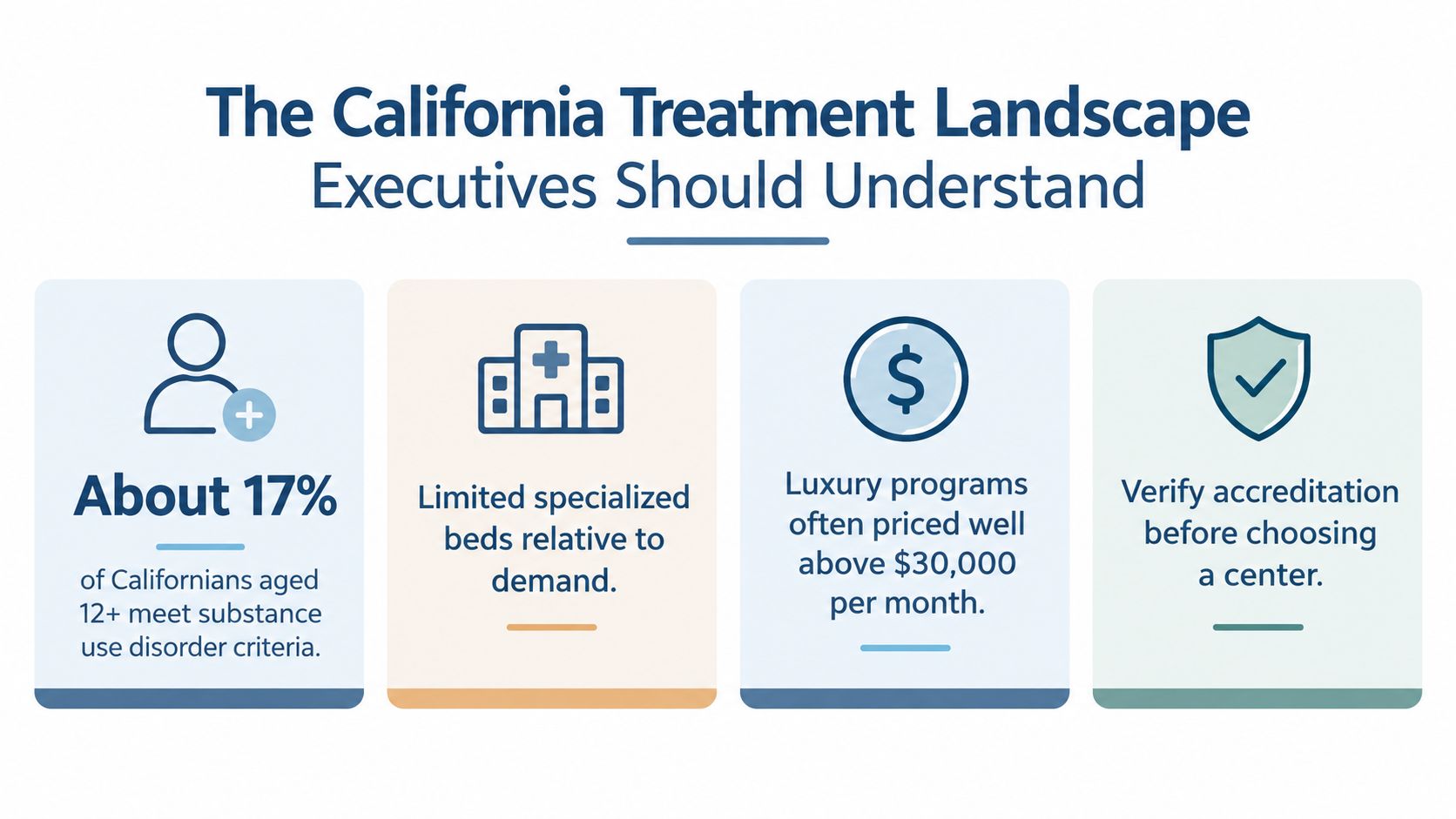
California's luxury market includes settings with different levels of medical oversight. A residential property may look exceptional while lacking the capability to manage medically complicated withdrawal, medication changes, or co-occurring psychiatric instability. A serious buyer should therefore ask for the program's license, level-of-care designation, accreditation status, staffing model, medication policy, and transition plan before discussing the view from the bedroom.
A discreet referral may also require careful travel planning. Families coordinating private transportation can review wholesale private jet sourcing as one logistical resource, while keeping the treatment decision anchored in clinical fit rather than arrival experience.
The strongest executive programs allow residents to maintain appropriate contact with work, family, and legal advisers. That doesn't mean unlimited access without boundaries. It means the center has clear rules for device security, scheduled communication, clinical interruptions, confidentiality, and rest.
The rest of the decision should follow that standard. A facility can be expensive and still be the wrong choice if it can't integrate psychiatric care, evidence-based medication, family work, and continuing support after discharge.

The California Treatment Landscape Executives Should Understand
California's treatment demand is broad, and executive clients shouldn't assume that a premium program only needs expertise with alcohol or opioids. Approximately 5.6 million Californians aged 12 and older, representing 17% of that age group, met criteria for a substance use disorder during 2022–23. Only about 10% of people with a past-year substance use disorder received treatment, according to the California Substance Use Almanac data reported through SAMHSA.
That treatment gap has a direct implication for private-pay families. Access to a residential bed is not the same as access to a clinically appropriate residential bed, and a newly available bed doesn't guarantee psychiatric integration, medication support, privacy, or a schedule that accommodates leadership responsibilities.
The substance profile also demands breadth. SAMHSA's 2023 California Treatment Episode Data Set recorded 121,730 treatment admissions among people aged 12 and older. Amphetamines were the primary substance in 31.1% of admissions, other opiates in 19.5%, alcohol alone in 13.5%, alcohol combined with a secondary drug in 12.9%, heroin in 9.0%, and marijuana in 8.1%. These are admissions, not unique individuals, but they show why a center built around one substance category isn't enough for a complex professional case. The same source reports that state- or county-contracted program admissions fell 20% between fiscal years 2018–19 and 2022–23.
A premium center should be prepared for mixed substance use and psychiatric complexity, not just the diagnosis presented during the first phone call.
The public system also illustrates why treatment quality involves more than residential surroundings. In California's 2016–17 state fiscal year, publicly monitored substance-use-disorder services recorded more than 160,000 admissions, representing approximately 120,000 unique beneficiaries, while about 186,000 unique beneficiaries received services during the year. Outpatient drug-free care accounted for 40% of admissions, residential treatment for 22%, detoxification for 17%, narcotic-treatment-program maintenance for 16%, and intensive outpatient treatment for 5%, as documented in the California treatment system report.
That distribution matters for executives because residential treatment should connect to detox, outpatient care, psychiatric services, and continuing care. A private-pay program may offer a more controlled and confidential setting, but it still needs a complete clinical pathway.
The Quality Markers That Actually Define a Best-in-Class Center
A luxury setting earns consideration only after it clears the regulatory and clinical fundamentals. California requires facilities providing 24-hour nonmedical residential alcohol- or drug-recovery services to adults to hold a current license from the Department of Health Care Services before operating or advertising those services. Licensed adult treatment facilities must also hold at least one applicable DHCS level-of-care designation or an American Society of Addiction Medicine level-of-care certification consistent with the services offered, according to California DHCS facility licensing requirements.
The following table is a due-diligence tool, not a ranking of facilities.
| Marker | Best-in-class expectation | Generic luxury setting |
|---|---|---|
| California authorization | Current DHCS license and a level-of-care designation that matches the advertised services | Licensing details are difficult to confirm or discussed only after admission |
| External clinical accountability | Joint Commission behavioral-health accreditation with policies for client rights, respectful treatment, and information protection | Broad claims about accreditation without a clear scope |
| Withdrawal capability | ASAM-aligned medically monitored care when withdrawal risk requires 24-hour medical monitoring and structured clinical intervention | A comfortable residence that sends medically complex clients elsewhere |
| Psychiatric integration | Qualified psychiatric clinicians can assess symptoms, manage medications, and coordinate care with addiction treatment | Therapy is available, but psychiatric coverage is limited or unclear |
| Medication for opioid-use disorder | Evidence-based medication, including buprenorphine or other appropriate options, is evaluated and managed onsite when clinically indicated | Medication access depends on an outside referral or is discouraged without clinical justification |
| Treatment model | CBT, DBT, ACT, MI, individual psychotherapy, intensive groups, and family work are integrated into an individualized plan | A menu of therapies is advertised without a clear treatment rationale |
| Privacy | Private rooms, controlled visitor and communication policies, and documented handling of sensitive clinical information | Privacy is presented as a design feature rather than an operational standard |
| Continuing care | Discharge planning identifies clinicians, medications, appointments, family supports, and relapse-risk responses | Aftercare is described as an optional alumni benefit |
Joint Commission behavioral-health standards are particularly relevant to high-profile clients. The standards address protection of clinical and case information, authorized disclosure, safeguards against unauthorized access, and written policies supporting client dignity and respectful treatment, as described in the Joint Commission behavioral-health standards resource.
For medically complicated detox, buyers should ask whether the center can provide an ASAM-aligned Level 3.7 setting when indicated. This level is intended for moderate-to-severe withdrawal or high complication risk and involves 24-hour medical monitoring and structured clinical interventions. Published descriptions include nursing supervision seven days per week and 24 hours per day, along with 24-hour availability of medical services, as outlined in this summary of ASAM residential treatment levels.
A private room cannot compensate for absent medical infrastructure. Nor can a beautiful campus compensate for a program that can't explain who manages psychiatric medications at night, how withdrawal scores guide decisions, or where a client goes if acuity exceeds the program's capacity.
What a Luxury Dual-Diagnosis Stay Actually Looks Like
A clinically serious stay begins with assessment, not a lifestyle itinerary. The team evaluates substance use, withdrawal risk, psychiatric symptoms, medical history, medications, trauma, family dynamics, work demands, and immediate safety concerns. That assessment determines whether clinically managed medication-assisted withdrawal, residential rehabilitation, psychiatric medication optimization, or another level of care is appropriate.
During detox, the client should receive structured monitoring and access to medical and psychiatric professionals appropriate to the presenting risk. Private rooms support rest, dignity, and confidentiality in both detox and rehabilitation, but they remain one part of the care environment. The treatment team must still coordinate medication decisions, sleep, nutrition, symptom changes, and transition planning.
A day built around clinical priorities
After stabilization, the resident typically follows an individualized schedule led by a multidisciplinary team. Individual psychotherapy addresses the personal drivers of substance use. Intensive groups create repetition, feedback, and peer accountability. Family sessions help relatives understand boundaries, communication, relapse risk, and the difference between support and rescue.
Evidence-based approaches can include CBT, DBT, ACT, motivational interviewing, trauma-focused work, and psychiatric medication management. Complementary services such as mindfulness, meditation, somatic work, equine therapy, art and music therapy, fitness, massage, and nutrition can strengthen regulation and engagement, but they should sit on top of the clinical plan rather than replace it.
A program should explain how each modality serves the client's goals. “Wellness” is not a treatment plan unless clinicians can connect it to sleep, emotional regulation, physical health, trauma recovery, or relapse prevention.
Work continuity with guardrails
Executives often need to retain access to cell phones and laptops. A program that permits electronics can help a client manage essential career, family, or legal obligations without forcing an abrupt professional crisis. The policy should include scheduled communication windows, privacy controls, secure connectivity, limits during therapy or medical care, and a plan for urgent interruptions.
Reflections describes a model of private residential dual-diagnosis care that combines individualized treatment with balanced engagement in work, school, and loved ones. Families and clinicians can review its residential dual-diagnosis treatment approach when evaluating whether the operating model fits the client.
The arc beyond admission
Residential treatment commonly unfolds over 30 to 90 days, depending on clinical need and progress. Early work focuses on stabilization and accurate diagnosis. The middle phase develops coping skills, emotional regulation, medication routines, relationship repair, and sober decision-making. Later work tests the plan against real responsibilities and prepares the client for the next level of care.
Discharge should include continuing clinicians, medication management, family involvement, relapse-risk planning, and alumni or recovery support. A center that treats discharge as an administrative event has missed the point of residential care.

Why Electronics Access Is a Real Differentiator, Not a Perk
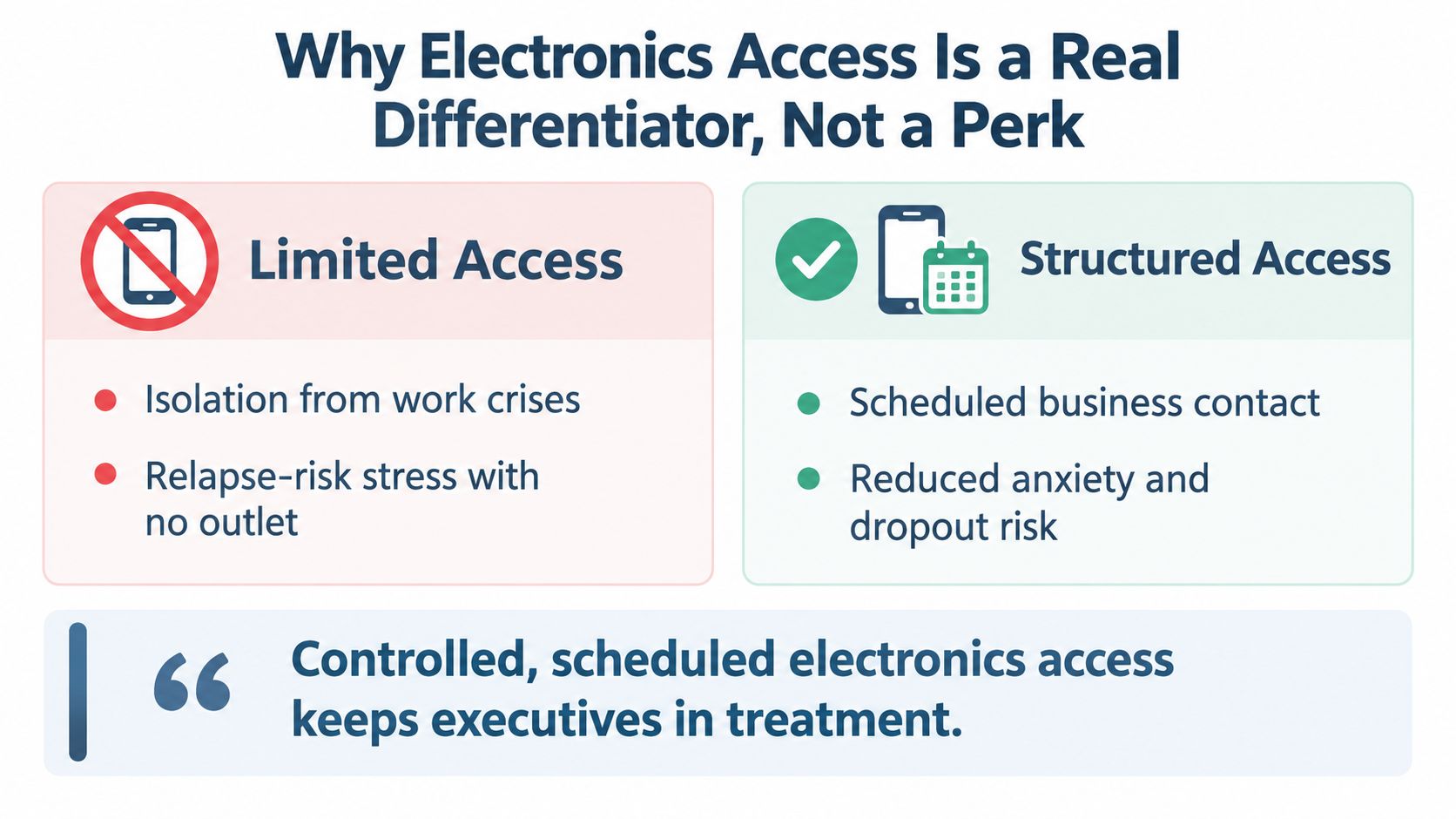
Many residential programs confiscate electronics entirely. That policy may simplify supervision, but it can also create acute anxiety for an executive responsible for employees, clients, family finances, legal matters, or a company in crisis. The alternative isn't unrestricted screen time. The alternative is a controlled system that treats professional continuity as part of engagement.
A private room, structured electronics access, and an accredited clinical team separate a genuine executive program from a luxury-marketed setting.
The distinction is operational. Staff must know when a resident can communicate, how devices are stored or secured, which networks are permitted, how confidential information is protected, and what happens when a business issue interrupts therapy. The program must also protect other residents from unwanted exposure and keep clinical encounters private.
Joint Commission standards reinforce the importance of protecting clinical and case information, limiting disclosure to authorized circumstances, controlling unauthorized access, and maintaining policies that support dignity. For an executive, that standard should extend into practical questions about visitor procedures, shared spaces, staff communication, photography, records, and device use.
Questions for the admissions call
A family shouldn't accept “yes, electronics are allowed” as a complete answer. The caller should request the policy and ask:
- Device control: Are phones and laptops kept by residents, stored securely, or checked in during clinical programming?
- Communication windows: Are work calls scheduled, and can urgent matters be escalated without disrupting treatment?
- Network security: How does the center protect confidential professional and clinical information?
- Privacy rules: What prevents other residents, visitors, or staff from recording or sharing identifying information?
- Clinical boundaries: Who decides when a device must be set aside for withdrawal management, psychiatric stabilization, or therapy?
- Family access: How are spouses and designated supports included without exposing private clinical details?
A credible program will answer consistently across admissions, clinical, nursing, and operations staff. If one person promises unrestricted access while another describes a blanket ban, the policy is not mature enough for a high-stakes professional admission.
Electronics access also supports retention by reducing the perceived cost of entering treatment. The client still needs boundaries, sleep, therapy attendance, and recovery time. Structured access recognizes that a working professional's responsibilities don't disappear at the front gate.
Why the Most Expensive Option Is Not Automatically the Best Match
The highest price often buys privacy, staff attention, private accommodations, and a more controlled environment. It doesn't automatically buy medication access, psychiatric depth, or a functioning continuing-care system. A less showy center with reliable clinical infrastructure can be a safer choice than a more expensive property that treats co-occurring illness as a secondary service.
California's Department of Health Care Services awarded more than $21 million to 59 licensed residential programs to launch or expand onsite medication-assisted treatment, demonstrating that residential access to evidence-based opioid-use-disorder medication remains an active system-development issue rather than a universal feature. The same DHCS announcement describes state-funded projects supporting 6,919 residential beds and 27,561 outpatient slots, but additional capacity still doesn't prove that a specific program has an opening, accepts the client, or can manage complex psychiatric needs. These figures and the treatment expansion context appear in the DHCS announcement on residential medication-assisted treatment.
Retention beats enrollment
A MAT program should be evaluated by continued engagement, not by how many people start medication. A federal evidence review defines retention as continued medication engagement for at least three months and found that retention across MAT studies ranged from 19% to 94% at three months. The review also associated longer-term MAT with better outcomes, while finding mixed evidence for specific retention interventions, as reported in the federal review of medication-assisted treatment retention.
For a residential center, the practical questions are direct:
- Medication continuity: Can eligible clients receive buprenorphine or another evidence-based medication onsite?
- Follow-up measurement: Does the program track medication-management and continuing-care engagement at 30, 90, and 180 days after discharge?
- Psychiatric coordination: Does a psychiatrist or qualified prescriber coordinate medication changes with therapy and recovery planning?
- Family participation: Are relatives taught how to support medication adherence, overdose prevention, boundaries, and early warning signs?
- Transition ownership: Is a named clinician responsible for the handoff to outpatient prescribers and therapists?
Experience data should be granular
Testimonials tend to reward comfort and interpersonal warmth, but they rarely show whether treatment planning, care coordination, or discharge preparation worked. California-aligned Treatment Perceptions Surveys measure access, quality and appropriateness, therapeutic alliance, care coordination, and perceived outcomes on a five-point scale. A 2024 youth survey reported 92% overall satisfaction among 124 respondents, while one adult implementation collected 2,377 surveys across 91 programs and received 1,766 completed responses, according to the San Diego County Treatment Perceptions Survey materials.
The useful request isn't a single satisfaction score. Buyers should ask for response rates, domain-level results, trends over time, participation in treatment planning, care coordination, and perceived outcomes. Those signals reveal whether the center's luxury experience is clinically relevant.
How to Choose and Refer With a Clear Shortlist
The shortlist should contain programs that can document, rather than merely describe, the following:
- Authorization: Current California DHCS license and an appropriate DHCS or ASAM level-of-care designation.
- Clinical accountability: Joint Commission behavioral-health accreditation and clear privacy procedures.
- Medical capability: Onsite MAT evaluation, psychiatric coverage, and withdrawal management matched to risk.
- Executive fit: Private rooms in detox and rehabilitation, plus a written electronics policy.
- Continuity: A named aftercare plan covering medications, therapy, family participation, and relapse-risk response.
The executive should schedule a confidential clinical assessment and disclose the actual work constraints, not a simplified version designed to secure admission. The spouse or family member should request written benefits, prior-authorization rules, exclusions, deductibles, and network information. California law requires state-regulated plans to cover behavioral-health treatment across levels of care, including residential treatment, and may require out-of-network coverage at in-network cost when adequate in-network care isn't available, as explained in the California behavioral-health parity explainer.
The referring clinician or attorney should insist on a clinical-to-clinical handoff, medication reconciliation, consent procedures, and a written discharge pathway. For families working through behavior change, Fluidwave's guide to lasting change can provide a broader behavioral context, but it shouldn't replace a licensed clinical assessment.
Reflections offers California-licensed, Joint Commission-accredited residential dual-diagnosis care, private rooms, clinically managed medication-assisted withdrawal when appropriate, psychiatric integration, structured electronics access, and treatment plans that commonly span 30 to 90 days. Its luxury rehab in California model is a relevant option for executives, families, and referral professionals applying these criteria.
Reflections provides discreet private-room detox and residential rehabilitation for adults who need coordinated substance-use and mental-health care without abandoning essential work and family responsibilities. Visit Reflections to request a confidential assessment and verify clinical fit, electronics policies, medication support, and continuing-care planning before admission.