

A founder can see the warning signs in the calendar before anyone else does: missed meetings, late-night decisions made under the influence, and the growing effort required to keep colleagues from noticing. A physician, attorney, or executive weighing residential treatment may fear that stepping away will damage the career they're trying to protect. The more urgent question is whether continuing without care puts health, judgment, and professional responsibilities at greater risk.
A residential stay can create privacy and structure while giving a person time to address substance use and mental health together. For professionals who need to remain involved in essential work, a program's policies on electronics, private rooms, and planned communication matter, but they don't replace clinical care. A discreet burnout recovery coach from Acheloa Wellness, Inc. may also help someone think through work stress and support needs alongside treatment.
When a 90 Day Stay Fits an Executive Life
A 90-day residential episode can make sense when substance use, psychiatric symptoms, or repeated difficulty sustaining recovery call for more than short-term stabilization. For an executive, the value isn't only spending longer away from work. It's having a structured period to assess what's driving the crisis, begin treatment, and build a credible plan for returning to professional responsibilities without treating work access as the measure of recovery.
The clinical case for this duration has a basis beyond marketing convention. The National Institute on Drug Abuse says individuals with substance-use disorders need at least three months of treatment to significantly reduce or stop drug use. That doesn't make a 90-day stay a guaranteed cure, or the right choice for everyone. It does support considering an extended residential phase when clinical complexity, psychiatric needs, or relapse risk make a brief episode an inadequate plan. (NIDA's treatment guidance explains the basis for that benchmark.)
For a CEO or other senior professional, the decision should weigh health and career continuity together. A program that accommodates appropriate access to a phone or laptop may help manage essential obligations, but treatment still needs to protect time for assessment, therapy, medication review, and rest. Confidentiality, work boundaries, and the ability to step back from daily pressures should be discussed before admission.
Advisor's view: A longer stay is a planning option, not a badge of seriousness. The right question is whether the clinical team can explain what the time will be used to accomplish.
The decision deserves a careful look at the clinical rationale, the program's actual daily structure, the fit of 30, 60, or 90 days, and the care arranged for after discharge. Those details matter more than the number printed on a brochure.
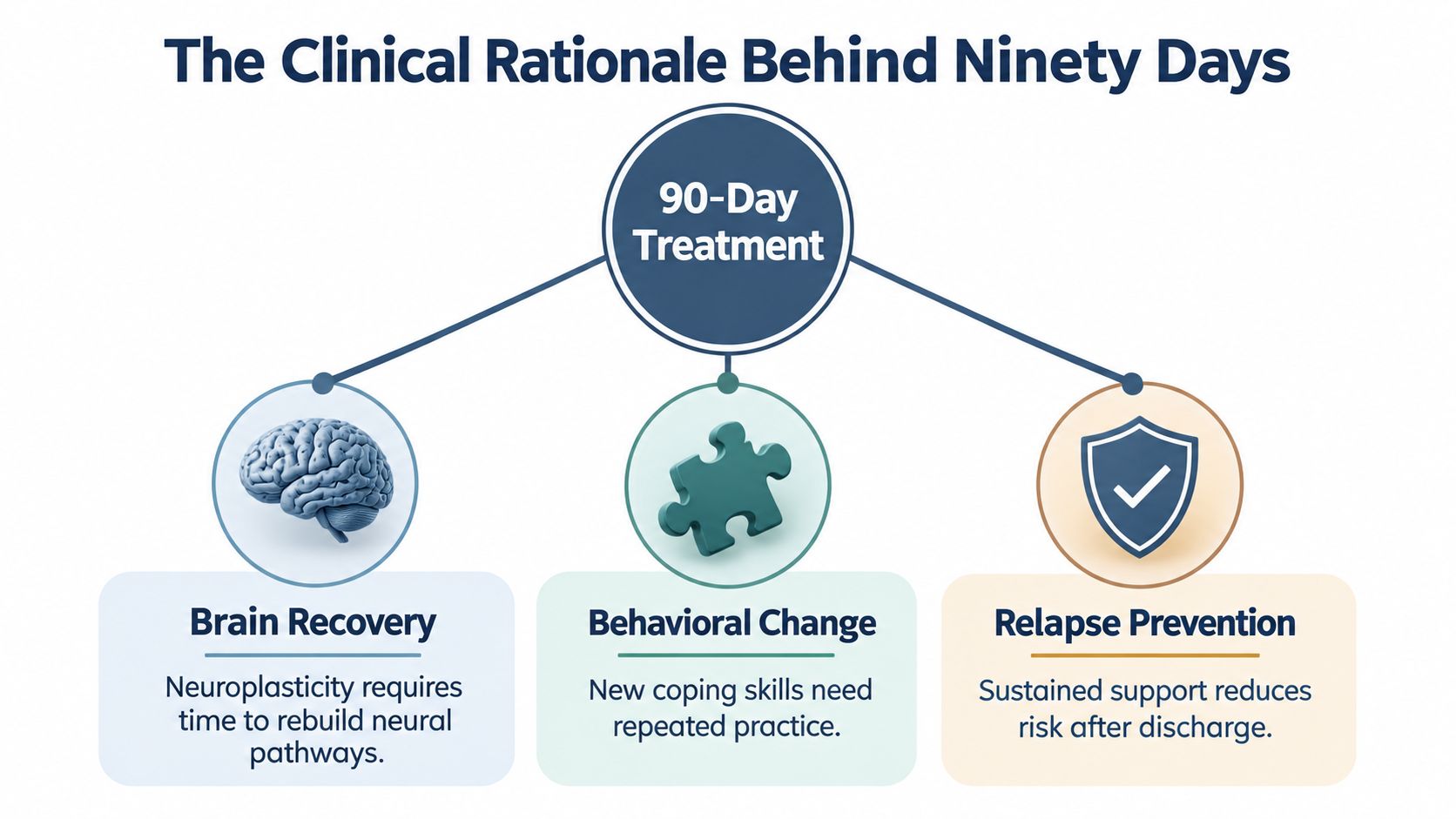
The Clinical Rationale Behind Ninety Days
NIDA's guidance gives a 90-day residential episode a clinical rationale: people with substance-use disorders generally need at least three months of treatment to significantly reduce or stop drug use, and treatment lasting less than 90 days is generally described as having limited effectiveness. NIDA also notes that longer participation can improve outcomes, while substantially longer treatment may be needed to maintain positive results. (NIDA's clinical overview treats duration as part of effective care, not a fixed prescription.)
The practical argument is cumulative. A residential treatment team may need time to assess withdrawal and psychiatric needs, review medication, identify triggers, teach coping strategies, and help a client practice those strategies in a structured setting. These are distinct clinical tasks. A short stay may address immediate stabilization, but it may not leave enough time to work through each need or see how a person responds as treatment proceeds.
Longitudinal findings also support looking beyond a brief episode. A 2008 summary reported that, among 1,605 cocaine users, 35% of participants treated for 90 days or fewer reported drug use in the following year, compared with 17% of those treated for more than 90 days. The same summary described NIDA-funded DATOS research involving 549 people with multiple problems in addition to drug use: people who left long-term residential treatment before 90 days had relapse rates similar to those who stayed only one or two days, while relapse rates declined progressively after the 90-day point as treatment continued. These findings show an association with longer engagement, not a guarantee that a particular number of days will produce abstinence. (NIDA's research summary describes these treatment-duration findings.)
For a professional managing medication changes alongside therapy, it can help to separate the expected response to a psychiatric medication from the wider treatment plan. A plain-language resource on Pristiq response time expectations can inform that discussion, but medication decisions belong with the treating prescriber.
Thirty, Sixty, or Ninety Days Compared
A shorter stay can be appropriate when a clinical assessment supports it. The number of days should follow the needs of the person, not a preselected package. For a professional considering a residential program, the key distinction is whether the available time can address the relevant treatment goals and prepare a workable transition.
| Length | Typical Fit | Dual-Diagnosis Capacity | Best Use |
|---|---|---|---|
| 30 days | A focused residential episode when assessment indicates a narrower set of needs | May begin coordinated care, though time for psychiatric assessment and sustained therapy can be limited | Stabilization and early treatment, with continuing care arranged from the start |
| 60 days | A bridge when needs call for more than an initial stay but don't require a longer residential phase | Offers more room for medication follow-up, therapy, and coordination | Continued treatment with progress reviewed against specific goals |
| 90 days | A planning option when clinical complexity or ongoing risk calls for extended residential support | Can allow a longer period for integrated psychiatric and substance-use treatment | Sustained therapeutic work and a transition plan tied to progress |
The table is a guide for discussion, not a rule that classifies every person by severity. A clinician should consider withdrawal needs, psychiatric symptoms, earlier treatment experiences, the recovery environment, and the person's ability to use support after discharge. Work responsibilities belong in the conversation too, but they shouldn't substitute for a clinical assessment.
A 30-day episode may be enough for one person to stabilize and begin treatment, while another may need more time to address co-occurring symptoms and practice coping skills. A 60-day stay can provide additional room for that work. A 90-day plan may be appropriate when goals require a longer residential phase, but a program should be able to explain what additional time is intended to accomplish. For a broader explanation of how duration relates to treatment planning, see how many days it may take to break an addiction.
Use milestones, not labels: before admission, ask what will be reviewed at each stage, how the care team will communicate progress, and what would justify extending or ending the stay. That approach protects against both premature discharge and clinically redundant days.
Inside a Day at a Luxury Residential Program
A professional needs to see how the day is structured, not just hear that a program offers individualized care. The schedule should make clear when clinical work happens, how psychiatric needs are followed, and where rest and appropriate work contact fit. A sample schedule can provide a starting point for a more specific conversation with admissions.
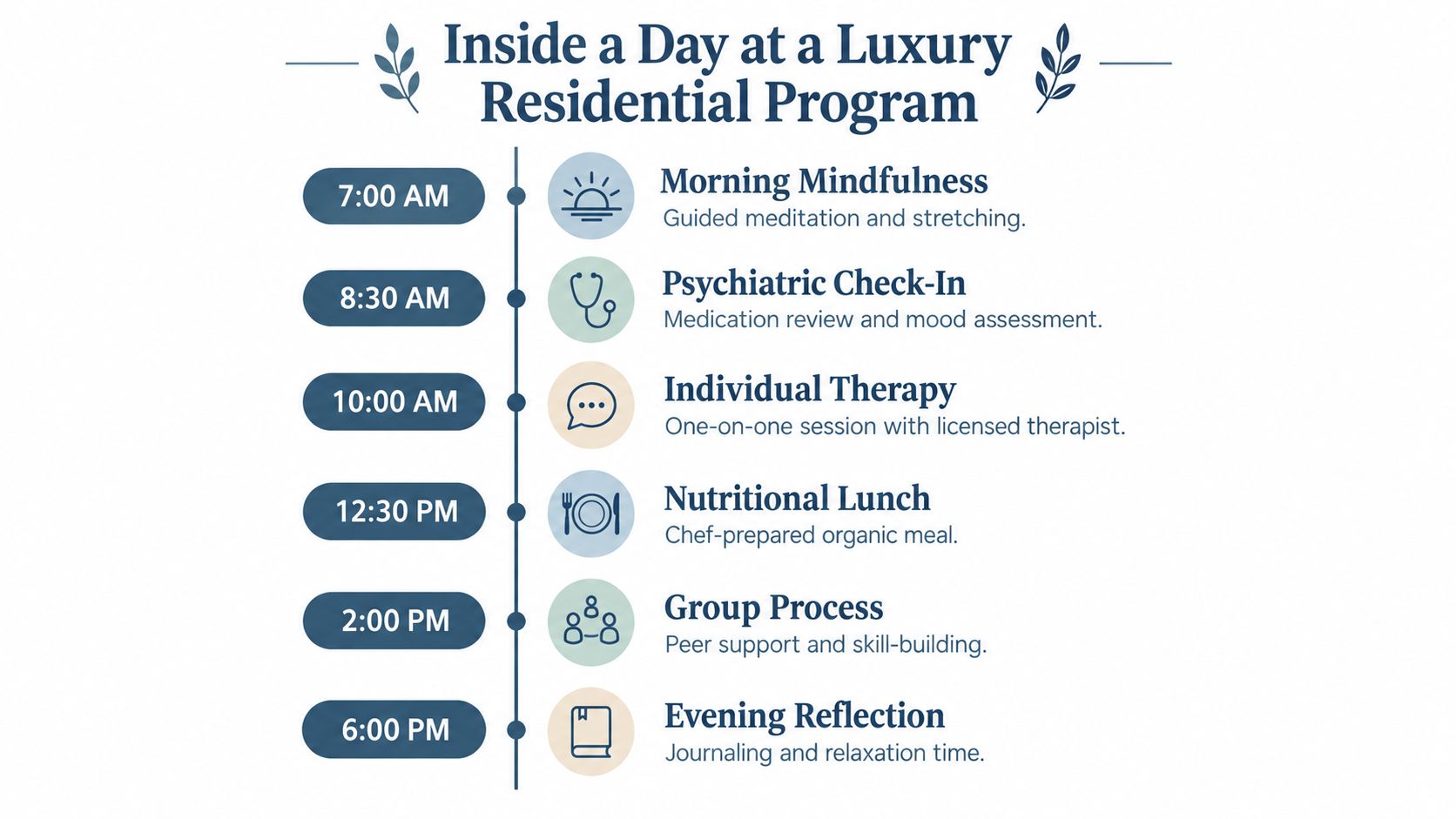
A representative day might begin with mindfulness or gentle movement, followed by a psychiatric check-in or medication review. Individual therapy can give a client private time to work through personal concerns. Group sessions can support peer connection and allow practice with communication and coping skills. Depending on the treatment plan, therapy may include approaches such as cognitive behavioral therapy, dialectical behavior therapy, acceptance and commitment therapy, or motivational interviewing.
Midday can include meals and clinical programming, while later blocks may involve group work, exercise, or other experiential activities. Family sessions and educational programming can be scheduled as part of the broader treatment rhythm. A credible program should explain which services are available and how they're chosen for a client, rather than implying every modality is provided to every resident.
Electronics access is a meaningful operational question for executives, but it needs guardrails. A phone or laptop can support essential work, family contact, and practical coordination; unstructured access can also make it harder to focus on treatment. Ask what the policy permits, when devices can be used, and how residents and the clinical team protect treatment time. Private rooms and access to electronics are separate features, and neither answers whether the care itself is strong.
Ask for the real schedule: A program should be able to describe a typical day and explain how it changes when a resident's clinical needs change.
Why Dual Diagnosis Changes the Whole Plan
When substance use and mental health conditions occur together, treatment should address both as part of one coordinated plan. SAMHSA identifies integrated treatment as the preferred model for co-occurring disorders and reports that it can improve substance-use outcomes, psychiatric symptoms, functioning, quality of life, and other important areas of care. (SAMHSA's guidance on co-occurring disorders describes the integrated approach.)
This matters for professionals whose outward performance can obscure serious distress. Anxiety, depression, trauma-related symptoms, or other psychiatric concerns may coexist with substance use, but a treatment team shouldn't assume what's present based on job title or presentation. It needs a sound assessment and a shared formulation, meaning a clear account of how the person's mental health and substance use may affect each other and what care will address both.
In practical terms, the same team should coordinate psychiatric assessment, psychotherapy, substance-use counseling, medication management, and family involvement. If one clinician focuses on substance use while another treats mental health without communication, the client can be left carrying the burden of connecting the dots. Integrated care makes those responsibilities explicit.

A longer residential episode can create room for coordinated work, but length alone doesn't create integration. A strong plan tracks progress in psychiatric stability, substance-use risk, day-to-day functioning, and readiness for the next level of care. The team should also explain how medication changes are monitored and how the family can participate appropriately.
For a closer look at the combined approach, dual-diagnosis drug treatment is a useful starting point. The central question remains practical: can the program show who coordinates each part of care and how the team revises the plan when needs change?
How to Tell a Real Luxury Program from a Marketing Brochure
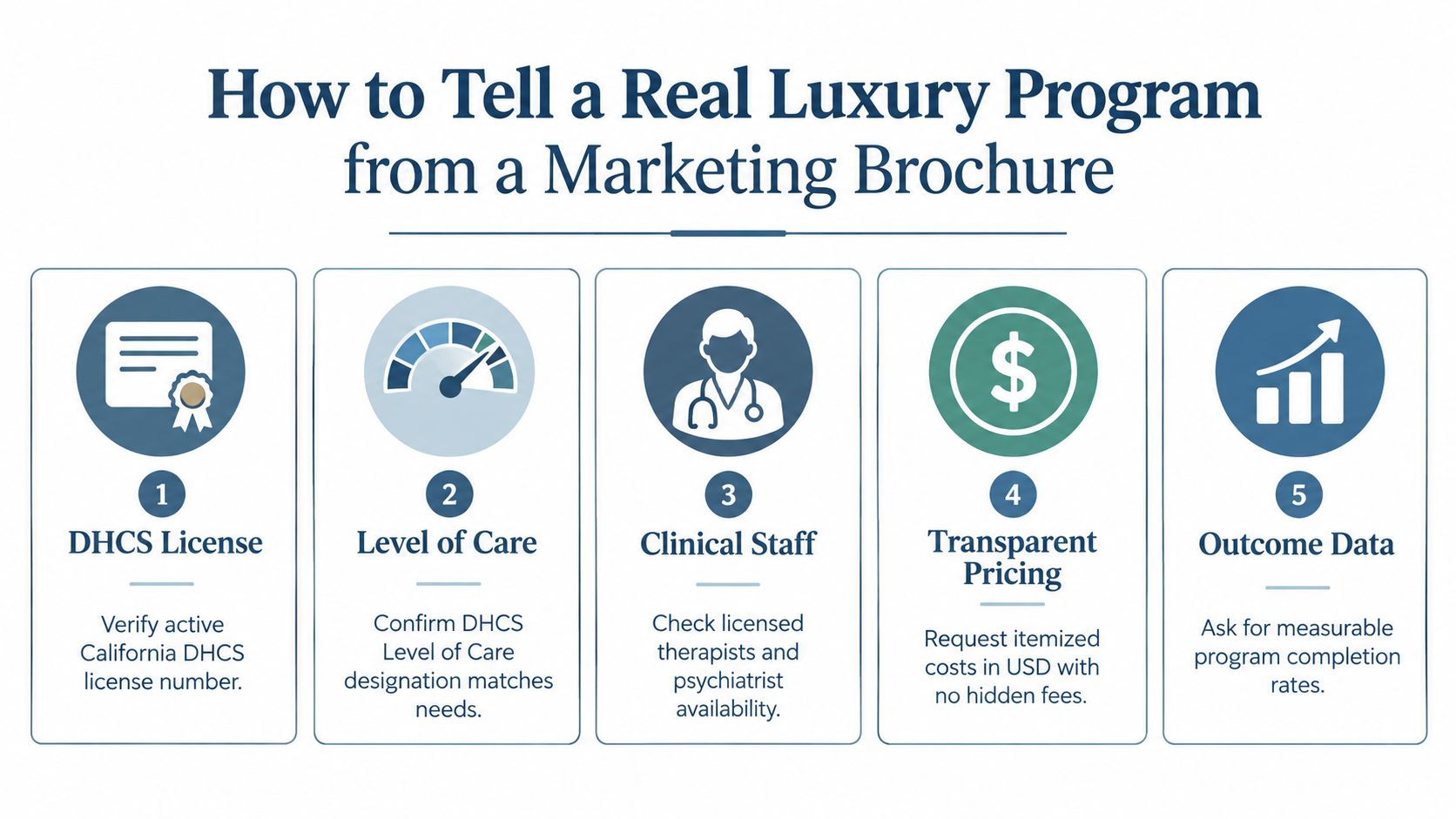
Luxury amenities can support comfort, but they don't establish clinical quality. A buyer evaluating executive care should verify licensing, accreditation, clinical staffing, and the actual policies that matter during residential treatment. In California, DHCS says it has sole authority to license facilities providing residential nonmedical services to adults recovering from alcohol- or other-drug-related problems. Licensed adult recovery facilities must also obtain a DHCS Level of Care Designation or an applicable residential ASAM level-of-care certification consistent with their services. (California DHCS facility licensing guidance outlines these requirements.)
Joint Commission behavioral-health accreditation provides another external framework. The Commission describes an onsite survey conducted by trained surveyors, and its provider information says accredited organizations undergo a review at least every three years against national standards covering areas such as safety, quality, leadership, emergency planning, facilities, and hiring practices. (The Joint Commission's behavioral-health accreditation information and provider directory guidance explain the scope of this review.) Accreditation is not proof that every individual clinician has a particular degree, that residents have private rooms, or that devices are permitted. Those features need direct confirmation.
Questions to bring to admissions
- Licensing and level of care: Ask for the current California license and the applicable level-of-care designation or certification. Confirm that it matches the services being considered.
- Accreditation scope: Verify that accreditation is current and covers the relevant residential, detox, or dual-diagnosis services.
- Clinical leadership: Ask who conducts psychiatric assessments, who manages medication, and which licensed professionals provide therapy. Confirm credentials and availability directly.
- Room and device policies: Request written confirmation of private-room availability in both detox and rehabilitation, along with the rules for phones and laptops.
- Family participation: Ask what family sessions and education are offered, who can take part, and how the program handles confidentiality.
- Costs and outcomes: Request a clear written account of fees and ask what program-completion and follow-up information is available. Don't assume a luxury price proves a treatment result.
High staff-to-client ratios and access to experienced clinicians may matter to a person seeking discreet, individualized care, but a brochure's wording isn't enough to verify either. Ask how often the client meets with each clinician, how the team collaborates, and who is responsible for urgent concerns. If a program serves executives, it should answer work-access questions without promising that treatment can be fitted around an unrestricted work schedule.
Admissions, Detox, and the Missing Day Ninety One Plan
Discreet admissions begin with clear answers about assessment, records, travel, and communication with an employer or family. A prospective resident should ask who receives updates, what authorizations are required, and how the program handles confidential information. If work must be handed over, a short, planned transition is usually more useful than trying to manage every professional obligation during treatment.
Detox questions deserve direct clinical answers. Ask what medical oversight is available, who evaluates withdrawal and psychiatric needs, what happens if a resident needs a higher level of medical care, and how the team decides when the transition to rehabilitation is appropriate. A private room can offer privacy, but it isn't a substitute for the level of monitoring a person needs.
The most consequential planning often concerns the period after discharge. SAMHSA describes substance-use and mental disorders as chronic conditions in which symptoms or relapse can recur, and identifies long-term follow-up as important. Continuing care may include medication checks, counseling, peer support, relapse-prevention services, and ongoing psychiatric and suicide-risk assessment. (SAMHSA's continuing-care guidance supports planning beyond residential treatment.)
A practical transition plan should be specific before discharge:
- Appointments: Confirm outpatient therapy and psychiatry follow-ups, with dates and providers identified.
- Medication continuity: Clarify prescriptions, monitoring, and who handles questions after the residential stay.
- Safety planning: Document what to do during a crisis and who to contact.
- Family preparation: Explain how relatives can support recovery while respecting the client's privacy and boundaries.
- Work and technology: Agree on a realistic work re-entry plan and sort out telehealth access.
- Follow-up ownership: Name the person responsible for checking that the handoff happens.
Families looking for a structured transition can review aftercare planning. The core standard is simple: day ninety-one shouldn't begin with a scramble to find care. Planning for continuity should start at admission and be revised as the resident's needs become clearer.
Cost, Privacy, and Choosing the Right Length of Stay
A longer stay isn't automatically better care. A 2025 VA Inspector General review found that community residential providers commonly kept veterans for the full standardized 45-day authorization, even when VHA clinicians reported that the entire stay wasn't always clinically necessary. The review also reported average residential-treatment costs of about $2,766 per day and $129,382 per veteran in fiscal years 2023–2024. (The VA Inspector General review makes the trade-off clear: continued stay should have a clinical rationale, not merely a preset timetable.)
Private-pay buyers should apply the same discipline. Ask the clinical team to define what progress it expects to assess, such as psychiatric stabilization, response to medication, work on relapse triggers, family functioning, and placement in continuing care. The point isn't to demand a guaranteed outcome or a rigid deadline. It's to understand why the proposed duration fits the person's needs and how the plan changes if progress is faster or slower than expected.
A credible program should welcome a review of length of stay. If the explanation for more time is only that longer is always better, ask for a clearer clinical rationale.
Before committing, get the financial and operational details in writing. Request an itemized estimate, clarify what services are included, and ask what happens if the care team recommends a different duration. A general guide to whether insurance covers therapy can help frame coverage questions, but the program and insurer should confirm the details that apply to a specific policy and level of care.
Privacy and work access also deserve a direct cost-benefit discussion. Confirm whether private rooms are available in both detox and rehabilitation, what electronics policies allow, and how the program protects clinical time despite work demands. A premium setting may offer practical advantages for a professional, but those advantages matter only when they sit alongside an appropriate level of care and a dependable post-residential plan.
Reflections offers California-licensed, Joint Commission-accredited residential care for adults with co-occurring mental health and substance-use disorders, with individualized programs that can include private rooms, appropriate electronics access, and continuing care. Executives and families weighing a 90-day stay can visit Reflections to discuss clinical fit, privacy, work boundaries, and the transition plan before making a decision.