

A partner calls a private rehabilitation provider after midnight. The request sounds simple: discreet care, a credible clinical team, a private room, and enough access to a phone and laptop to keep a company, fund, or practice from appearing unattended. Underneath that request sits a harder question: what would treatment need to accomplish for recovery to hold after the executive returns to the same calendar, pressure, travel, and relationships?
A substance use disorder treatment plan should answer that question clinically. It shouldn't be a polished intake summary or a brochure translated into therapeutic language. It should connect assessment findings to diagnoses, measurable goals, interventions, medication decisions, family participation, review dates, and criteria for changing the level of care.
When a High-Profile Career Meets the Decision to Get Help
The first call from a founder, partner, physician, or senior executive rarely focuses only on abstinence. The caller wants to know who will see the records, whether the client can retain a phone, whether urgent work can be handled, and whether treatment will respect professional obligations without allowing those obligations to undermine care.
Those concerns are legitimate. They also reveal why a generic treatment plan template fails high-profile clients. A plan built around attendance alone won't address board meetings, public exposure, family authority, travel, medication continuity, or the cognitive load of leading an organization while stabilizing from substance use and a co-occurring psychiatric condition.
The need is substantial. In 2023, SAMHSA reported that 48.5 million people aged 12 or older, or 17.1% of the U.S. population, had a substance use disorder during the prior year, while only about 14.6% received substance use treatment (SAMHSA's 2023 national survey data). The implication for an executive is direct: access matters, but the first available placement isn't automatically the right clinical match.
What the document must do
A functional plan is a living decision tool. It records the problems that require treatment, the risks that determine intensity, the interventions assigned to each problem, and the evidence clinicians will use to continue, reduce, or increase care.
A provider should be able to show how the plan addresses:
- Assessment: Medical, psychiatric, substance-use, withdrawal, relapse, and environmental factors.
- Diagnosis: Substance use disorders and co-occurring conditions that influence treatment.
- Goals: Specific outcomes, such as sleep stabilization, medication adherence, craving reduction, or safer family communication.
- Interventions: Individual therapy, groups, psychiatric care, medication management, recovery support, and family work.
- Review criteria: Observable evidence that supports step-down, continued residential care, or escalation.
- Continuity: Named clinicians, prescriptions, appointments, crisis procedures, and support after discharge.
A luxury setting should provide privacy and comfort, but those features don't substitute for clinical mechanics. Private rooms, appropriate electronics access, and an executive schedule belong in the plan only when clinicians explain how they support engagement without increasing risk.
| Document Element | Clinical Treatment Plan | Marketing Brochure |
|---|---|---|
| Assessment | Identifies risks, diagnoses, and level-of-care needs | Describes an intake experience |
| Goals | Defines measurable clinical outcomes | Uses broad promises about recovery |
| Interventions | Assigns specific services to identified problems | Lists therapies without decision logic |
| Medication | Explains selection, monitoring, and continuity | Mentions medication as a feature |
| Privacy | Documents consent, access, and disclosure procedures | Uses general language about discretion |
| Review | Sets criteria for changing care intensity | Presents a fixed program calendar |
Executives and families should ask to review a redacted example of the actual plan before committing. They should also separate clinical confidentiality from broader legal and reputational concerns. For readers dealing with an alcohol-related legal issue in Illinois, a practical resource on Illinois DUI record protection can help clarify a separate legal question without confusing it with treatment-record privacy.
Assessment and Diagnosis as the Foundation
An executive can look stable in the boardroom and still need a higher level of care by night. That is why assessment has to do more than assign a label. It has to show what is driving risk, what can be managed privately, and what cannot.
Start with placement and safety. Then build the diagnosis that will direct care once immediate withdrawal and medical concerns are contained. The ASAM Criteria overview gives clinicians a practical structure for that call across six dimensions: biomedical issues, intoxication or withdrawal risk, emotional and behavioral conditions, readiness to change, relapse potential, and recovery environment. Used correctly, those dimensions do not produce paperwork. They produce decisions.
What matters is the clinical driver attached to each finding. A driver explains why the client needs a certain intensity of care and what has to change first. Withdrawal risk may require monitored stabilization. Severe insomnia can block participation until psychiatric and behavioral treatment starts. A chaotic home setting may force a housing or family intervention before any return to routine is realistic. For a working professional who needs confidentiality, this step is where the team decides what work access is clinically safe and what would only preserve appearances while risk rises.
Diagnosis comes next, but diagnosis is still not the finish line. It should organize treatment around specific priorities:
- stabilizing withdrawal symptoms;
- improving medication adherence;
- reducing overdose risk;
- restoring sleep;
- regulating trauma-related affect;
- strengthening readiness for change;
- rebuilding a safe recovery environment.
Do not let job title distort the clinical picture. A client may still make meetings while hiding escalating use, panic, suicidal thinking, impaired judgment, or early withdrawal. The treatment plan should document functional capacity truthfully, not reward concealment.
Families and referral sources often confuse success with stability. A clear substance use disorder diagnosis guide helps separate diagnostic criteria from assumptions based on income, reputation, or performance. Co-occurring anxiety, depression, trauma symptoms, and mood instability should be treated at the same time. Waiting usually leaves the engines of continued use untouched.
Goals, Interventions, and the Luxury Clinical Toolkit
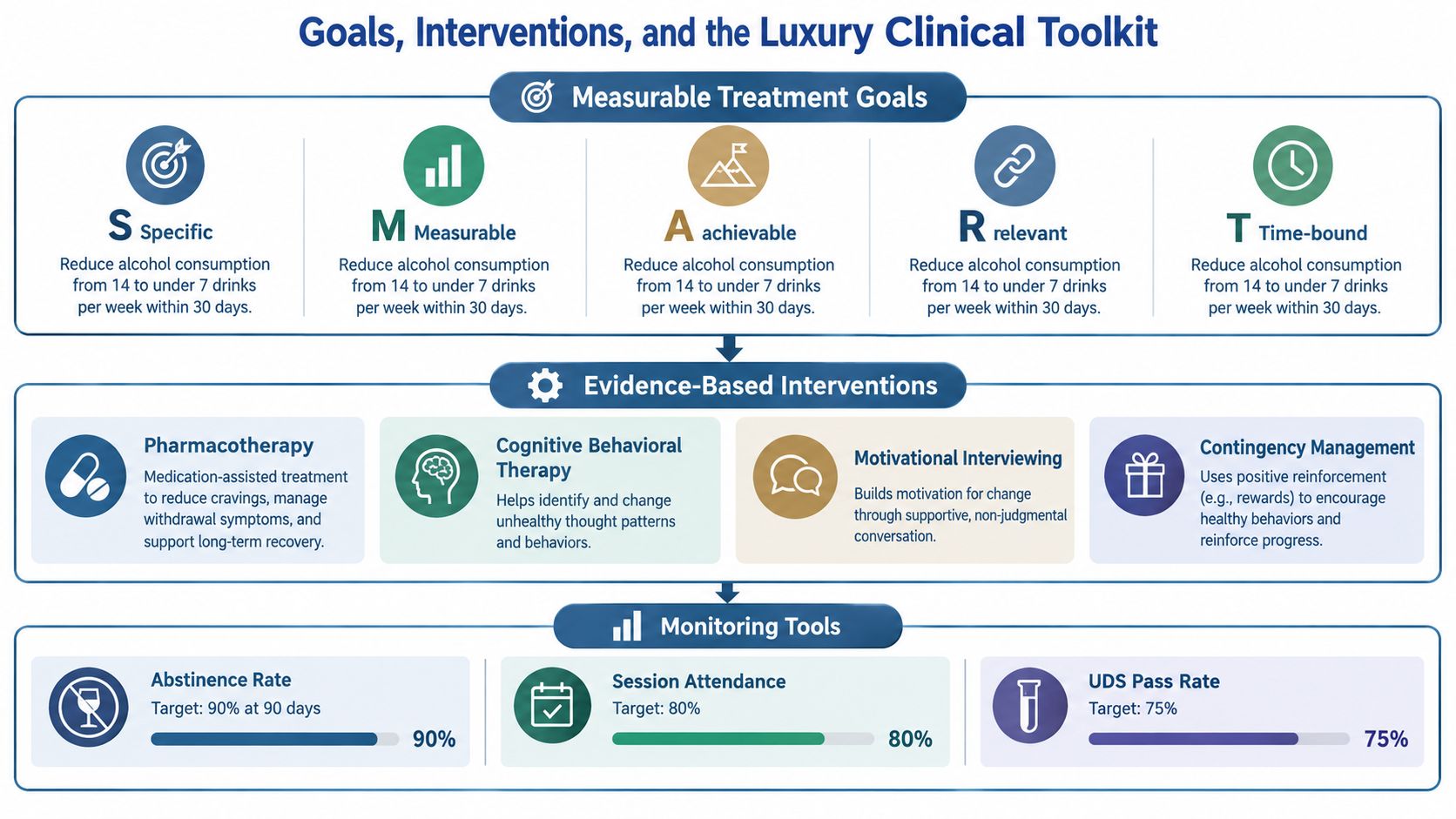
A serious treatment plan works as a decision tool, not a filing requirement. If a client needs to protect a public role, keep working where clinically appropriate, and stay private, the plan still has to tell the team what problem is being treated, what intervention will be used, what the client is expected to practice, and how progress will be judged. Otherwise, everyone fills in the gaps with preference, image management, or wishful thinking.
Write goals that can direct care on a hard day. “Improve recovery” is useless. A goal tied to alcohol-related insomnia should specify sleep stabilization, the review of current medications, structured sleep work, cognitive behavioral therapy, and daily monitoring. If cocaine use predictably follows conflict with a board member, partner, or employee, the plan should target that chain directly with trigger mapping, emotion-regulation skills, motivational interviewing, and a pre-use contact protocol.
The toolkit should then match the mechanism of the problem.
CBT belongs in the plan when distorted thinking, cue-driven behavior, and repetitive use patterns are keeping the disorder in motion. DBT is the better fit when the client loses control under stress, escalates quickly in relationships, or needs practical methods for distress tolerance and emotional regulation. ACT helps when the client knows what matters but keeps acting against those values. Motivational interviewing should be used to address ambivalence without turning every session into an argument about compliance.
Then there is the work that executives often need most. Individual psychotherapy gives space to address shame, grief, status threat, secrecy, family strain, and the private narratives that keep substance use protected. Intensive groups matter too, but they should add repetition, feedback, and accountability. They should not become a convenient substitute for individualized care.
Luxury care is not a longer menu. It is a better matched one. Mindfulness, meditation, art and music therapy, somatic work, equine work, fitness, massage, and clinical nutrition can help with stress regulation and reconnection to the body when they serve the formulation. They do not replace psychiatric care, psychotherapy, medication management, or recovery planning.
Family work should be written into the plan with the same precision. Private sessions can address boundaries and communication. Structured education can prepare relatives to respond to warning signs without running the client's recovery.
Medication Decisions That Shape the Plan
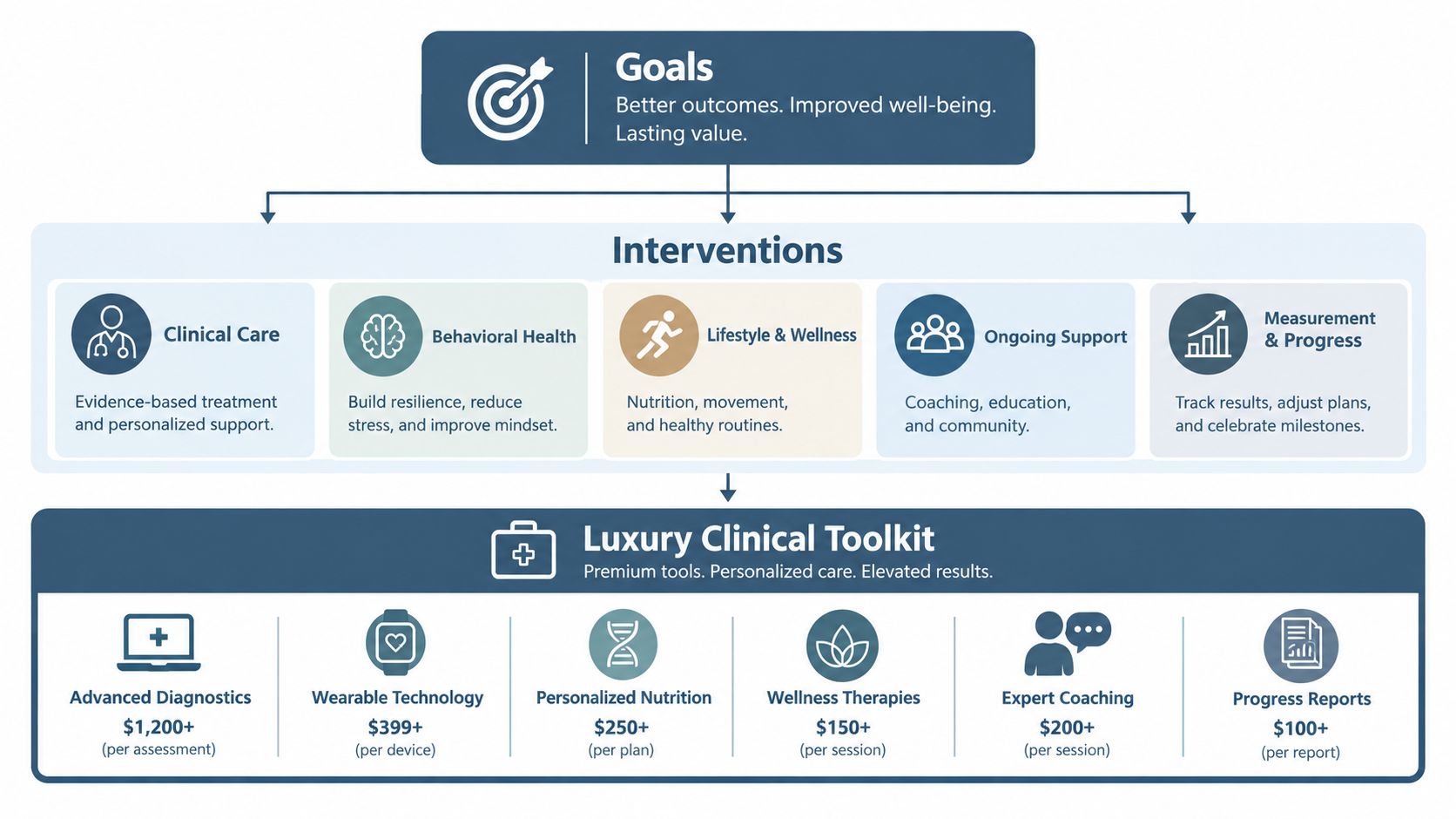
A medication decision changes the whole treatment architecture. For an executive who must keep working, protect privacy, and avoid preventable destabilization, the wrong choice can disrupt sleep, cognition, travel, pain care, and adherence. The right choice supports function while reducing risk.
For opioid use disorder, SAMHSA lists buprenorphine, methadone, and naltrexone as FDA-approved options. For alcohol use disorder, SAMHSA lists acamprosate, disulfiram, and naltrexone as common medications, used alongside counseling as part of whole-person care (SAMHSA treatment options).

Executives often arrive with a simple request: keep medications to a minimum. That request deserves respect, but it should not drive the case formulation by itself. In opioid use disorder, medication can lower overdose and illness risk. Ending treatment can increase danger as tolerance drops. A high-end plan documents that discussion clearly, including the client's preference, the clinical tradeoffs, the monitoring strategy, and the conditions that would trigger a change.
Medication selection should be tied to actual operating realities, not ideology. Review current and past substance use, withdrawal pattern, overdose risk, liver function and other medical issues, pregnancy potential where relevant, pain needs, work schedule, travel demands, psychiatric prescriptions, interaction risk, craving intensity, relapse history, and the client's treatment preference.
One more distinction matters. Medically managed withdrawal handles the acute problem. It does not create ongoing recovery by itself. The treatment plan should spell out who manages the next phase, how side effects will be tracked, how adherence will be reviewed, and how prescribing continues after discharge. Families often understand the logic faster when clinicians explain how medication-assisted treatment combines counseling with medication in one coordinated approach.
Dual Diagnosis, Trauma, and the Root-Cause Frame
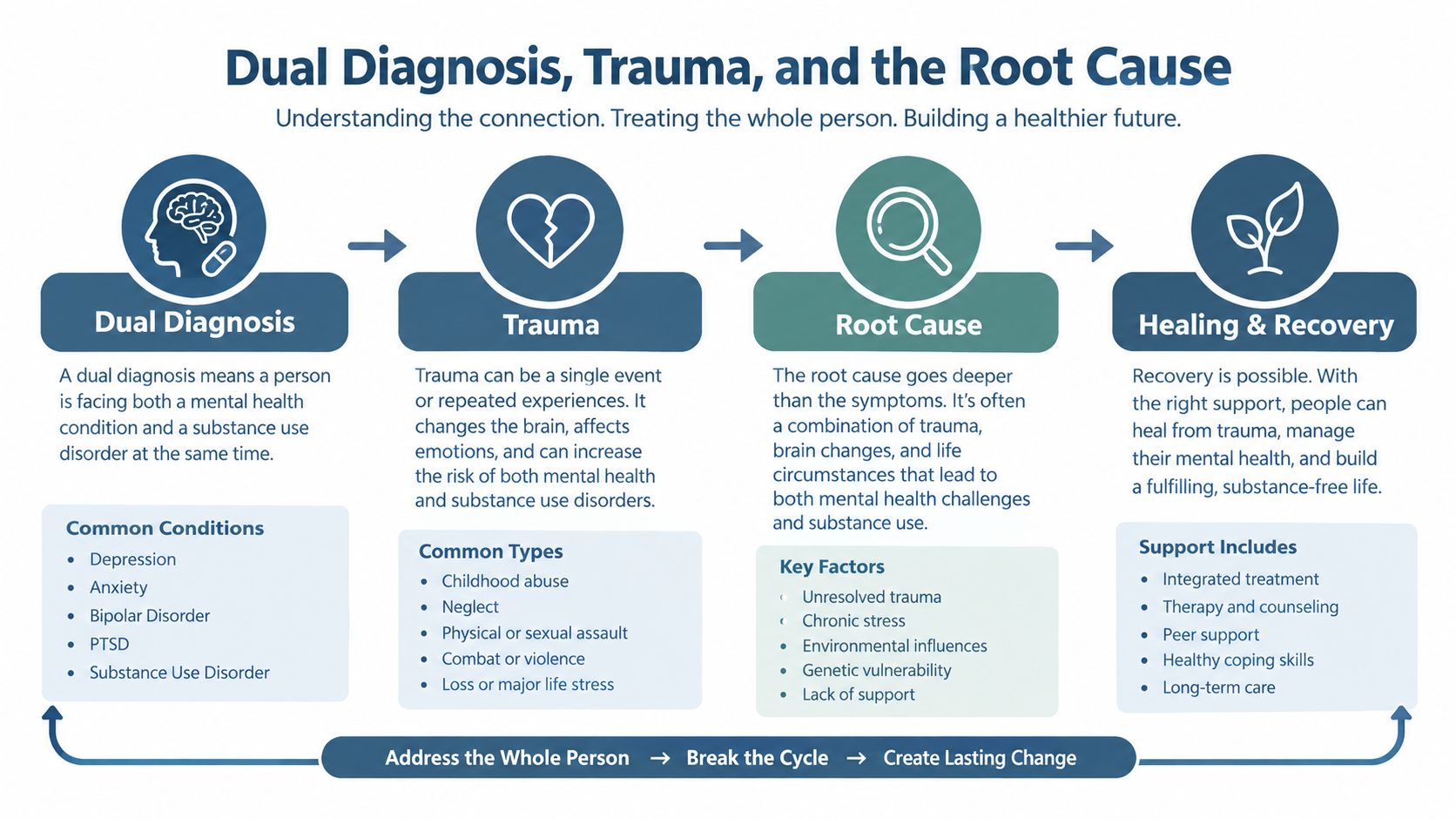
An executive can look stable in meetings and still be using alcohol, pills, or other substances to contain panic, grief, trauma cues, depression, or mood swings. Treating those as separate tracks is a clinical mistake. The treatment plan has to function as one decision framework, because each condition changes how the other presents, what destabilizes the client, and what the team should do next.
That changes sequencing. If sleep is collapsing, panic is escalating, or mood symptoms are volatile, psychiatric stabilization comes first. If the client cannot regulate affect without shutting down, dissociating, or reaching for a substance, trauma work starts with safety, pacing, and distress-tolerance skills. As use drops, depression, shame, and traumatic recall often become easier to see, so the plan needs active monitoring instead of assuming improvement equals stability.
For executives who need confidentiality and some continuity of work, fragmented care is especially risky. The psychiatrist, psychologist, LMFT, addiction counselor, and adjunctive therapists should be working from one shared formulation with one set of priorities. Specialty differences are useful. Conflicting explanations are not.
A strong plan spells out the mechanics: which psychiatric symptoms raise craving or relapse risk, which trauma responses require stabilization before deeper processing, which therapies fit the client's current capacity, why any medication change is being made, who reviews progress, and which warning signs trigger a higher level of care.
Trauma-informed care is disciplined care. It protects the client from being flooded, keeps treatment from turning into repetitive disclosure, and builds enough safety and trust for deeper work to help rather than destabilize.
What a Real Luxury Plan Looks Like in Practice
A useful example follows the client's clinical drivers rather than treating a calendar as the treatment. A 30-to-90-day residential episode might begin with clinically managed sub-acute detox, move into intensive residential programming, and continue toward outpatient or other structured care as risks resolve.
The accommodations should be documented because they affect engagement. A private room in both detox and rehabilitation can support sleep, dignity, and confidential clinical work. Appropriate access to a cell phone and laptop can allow limited career responsibilities, but the plan should define when electronics are available, what work is clinically acceptable, and when the team can restrict access if it interferes with stabilization.
A practical plan record
| Treatment Phase | Plan Focus | Executive-Specific Documentation |
|---|---|---|
| Stabilization | Withdrawal monitoring, medical review, psychiatric assessment | Electronics limits, emergency work contacts, private-room needs |
| Residential treatment | Individual therapy, groups, medication optimization, family work | Protected work blocks that don't replace treatment |
| Consolidation | Relapse-prevention practice, trauma stabilization, discharge preparation | Travel, board-calendar triggers, family communication |
| Continuing care | Prescriber follow-up, therapy, recovery support, alumni connection | Flexible scheduling and crisis escalation procedures |
Family workshops and private sessions should appear as interventions, not optional amenities. Individual therapy should address the client's formulation, while groups provide structured practice and feedback.
Progress reviews should ask whether the dimensional drivers have changed. Unresolved withdrawal risk, unstable mood, unsafe housing, or persistent relapse potential may justify continued intensity. Resolved drivers may support a step-down to outpatient therapy, medication management, recovery housing, or another continuing-care service.
Confidentiality, Accreditation, and Private-Pay Mechanics
Privacy requires specific questions. A provider should explain which records are protected, who can access them, how consent works, and what happens in an emergency. General promises of discretion aren't enough for an executive whose career, licensure, litigation exposure, or public profile may be affected.
42 CFR Part 2 restricts disclosure of substance use disorder patient records held by federally assisted programs, generally requiring written patient consent or a court order. HHS updated the rule through a February 8, 2024 final rule aligning aspects of Part 2 with HIPAA and HITECH (HHS explanation of the Part 2 final rule). The protection isn't a guarantee of anonymity, and it doesn't automatically establish policies for phones, laptops, visitors, or employer communication.
Verify the provider, then verify the bill
Accreditation claims should be checked against the organization's behavioral-health scope. The Joint Commission's standards address privacy of clinical and case information, authorized disclosure, protection against unauthorized access, and written policies concerning patient rights (Joint Commission behavioral-health standards). Accreditation supports organizational oversight, but it doesn't prove that a program offers every preferred accommodation.
Private-pay families should request a written financial explanation before admission. Questions should cover:
- what detox, residential, psychiatric, therapy, and medical services include;
- which services are billed separately;
- whether out-of-network benefits may apply;
- whether a single-case agreement is possible;
- whether HSA or FSA funds can be used for eligible expenses;
- how extensions, medication, laboratory services, and continuing care are handled.
A premium setting should make both the clinical plan and the financial plan understandable before treatment begins.
Aftercare, Continuing Care, and the Real Finish Line
Discharge isn't the finish line. It's the point at which the plan must survive contact with the client's actual life, including travel, confidential work demands, family tension, sleep disruption, and the next high-pressure board calendar.
SAMHSA's 2025 national guidance describes specialty SUD care as including pharmacotherapy, medical services, recovery support, transitional services, and ancillary services, framing discharge as one phase of coordinated continuing care rather than an endpoint (SAMHSA national guidance for specialty SUD care).
The warm handoff standard
A strong plan names the people and actions involved after residential care. It shouldn't tell a client to “follow up with outpatient providers” without confirming who those providers are and when contact will occur.
The handoff should include:
- a confirmed prescriber and therapist;
- medication supply and pharmacy contingencies;
- a written transfer summary with consent;
- crisis and overdose-response planning;
- family consent procedures;
- instructions for missed appointments;
- criteria for returning to a higher level of care;
- a recovery schedule compatible with work or school;
- continuing-care and alumni options.
The team should also define how it will distinguish relapse from medication withdrawal, an emerging mood episode, severe sleep loss, or an acute trauma response. Those conditions may require different interventions, and a vague discharge plan leaves families guessing at the moment decisions matter most.
For clients and referral professionals evaluating the next phase, continuing care after residential treatment should be treated as part of the original plan, not an administrative afterthought.
A program deserves serious consideration when it can show the full chain: individualized assessment, integrated dual-diagnosis treatment, justified medication decisions, protected privacy, measurable review criteria, and a documented warm handoff. Reflections offers private residential dual-diagnosis care, clinically managed withdrawal support, psychotherapy, psychiatric care, family programming, appropriate electronics access, and continuing-care planning for adults balancing recovery with professional responsibilities. Families and executives can visit Reflections to discuss whether its private-pay model and clinical structure fit the person's needs.