

Medication-assisted treatment is a combined approach that uses FDA-approved medications together with counseling or behavioral therapy to treat substance use disorders, especially opioid use disorder, and treatment often lasts months to years rather than days. For many professionals, that's exactly why it works. It creates enough stability to recover without asking a high-performing life to collapse first.
The reader searching what is medication assisted treatment is often not looking for a textbook definition. More often, this is a CEO, founder, physician, attorney, or family office principal who has kept everything functioning from the outside while something private has become harder to control. Work is still getting done. Meetings are still happening. The calendar still looks intact. But sleep is deteriorating, alcohol or opioids have become less optional, and the space between “manageable” and “dangerous” is narrowing.
That person usually doesn't need a simplistic answer. They need a clinically precise one.
Medication-assisted treatment, often called MAT, is not a fallback for people who have “failed” at recovery. In a serious executive treatment setting, it's often the opposite. It's an advanced medical strategy used when the brain and body need stabilization so the person can benefit from therapy, make sound decisions, and start functioning from something other than craving, withdrawal, secrecy, or fear.
For high-achieving adults, that distinction matters. The right treatment plan should protect health first, while also accounting for privacy, reputation, and the practical reality that some professional responsibilities can't be ignored for weeks at a time.
A Discreet Solution for High-Achieving Professionals
The pattern is familiar in executive care. A senior leader starts using more than intended, often in a way that can be rationalized for a long time. A medication originally taken after surgery becomes part of the workday. Evening drinking shifts into a requirement for sleep. Performance may stay high enough to delay consequences, which only deepens the illusion of control.
What finally breaks the pattern usually isn't a dramatic collapse. It's accumulation. Missed details. Increasing irritability. Risky self-medication during travel. A spouse noticing emotional absence. A board-level leader realizing that every important decision now happens through a fog of withdrawal, sedation, or compulsive anticipation.
Why MAT fits an executive reality
MAT is often well suited to this population because it is medical, structured, and outcome-oriented. It doesn't ask a professional to white-knuckle through detox and hope insight appears later. It addresses the neurobiological instability first, then uses that stability to support therapy, psychiatric care, and behavioral change.
For professionals who need privacy, discretion matters just as much as clinical quality. The right setting should allow treatment to happen in a contained, confidential environment where health can be addressed without unnecessary exposure. That's one reason many families look for discreet confidential rehab for executives in California when they begin evaluating options.
Recovery for executives rarely fails because they lack intelligence. It fails when treatment ignores the realities of pressure, access, image, and responsibility.
What doesn't work
A few approaches repeatedly create problems for high-functioning adults:
- Short detox without a plan: Physical withdrawal may ease, but cravings, anxiety, and relapse risk often remain.
- Shame-based messaging: Professionals already know the stakes. Condemnation doesn't improve outcomes.
- One-size-fits-all rehab: Executives with complex psychiatric, occupational, and family demands need individualized care.
- Medication without therapy: Stabilization helps, but it doesn't resolve burnout, trauma, depression, or compulsive coping.
MAT works best when it's handled as part of a larger clinical strategy, not as an isolated prescription.
What Medication Assisted Treatment Truly Means
The most useful way to understand MAT is to think of it as clinical scaffolding. When a building is unstable, the first priority is support. Not because support is the finished structure, but because no meaningful rebuilding can happen safely without it.
That's what medication does in treatment. It supports the brain and body during a period when withdrawal, craving, fear, and impaired judgment can overpower insight.
The medication is support, not the whole program
Medication-assisted treatment is a combined clinical model using FDA-approved medications with counseling and behavioral therapies. For opioid use disorder, the standard medications are methadone, buprenorphine, and naltrexone. Their job is to reduce withdrawal, blunt cravings, normalize brain chemistry, or block opioid euphoria.
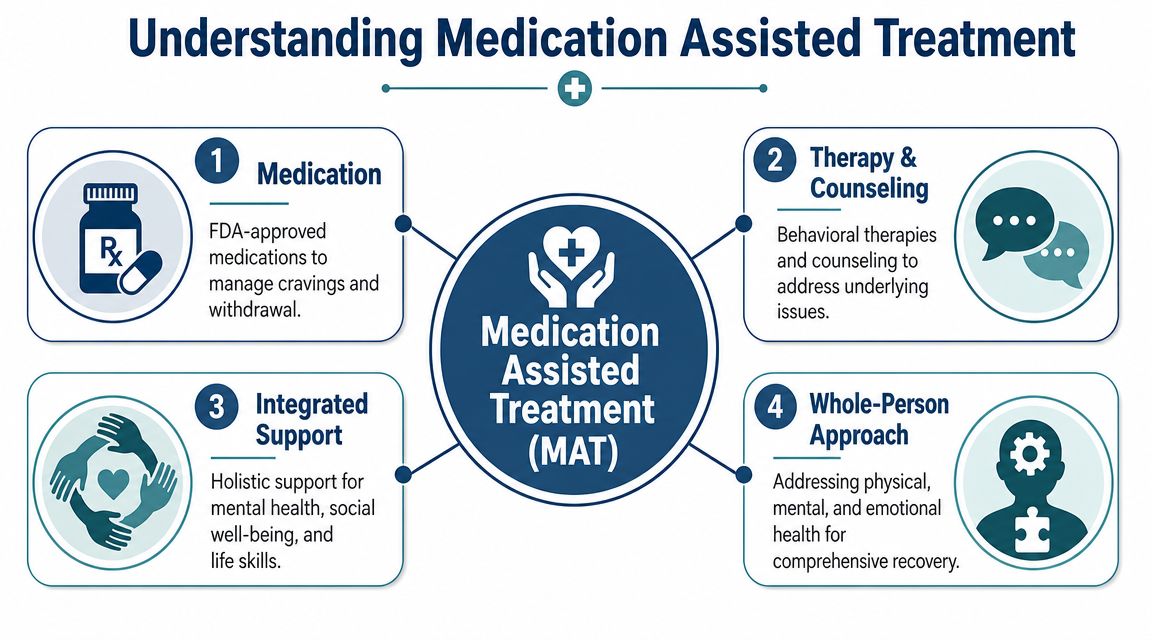
Those functions matter more than many families initially realize. A person in active withdrawal or intense craving often can't engage fully in psychotherapy. They may be physically present in treatment while mentally absorbed by discomfort, urgency, or obsession. Once symptoms settle, the person can participate in the work that builds recovery.
What MAT is designed to accomplish
A strong MAT plan usually aims to create three conditions:
Physiological stability
The person is no longer fighting uncontrolled withdrawal or persistent drug-seeking pressure.Cognitive access
Attention, judgment, and emotional regulation improve enough for therapy to be useful.Therapeutic readiness
The individual can begin confronting the deeper drivers of use, including trauma, anxiety, depression, grief, perfectionism, or chronic stress.
That's why the “assisted” part of MAT shouldn't be misunderstood as minor. It is the assistance that makes higher-level treatment possible.
Why this matters in executive treatment
Professionals often ask whether medication means the person isn't doing the necessary work. In quality care, the opposite is usually true. Proper medication support often allows the therapeutic work to begin.
A senior executive who is no longer cycling between withdrawal and relief can participate in individual therapy, tolerate difficult conversations, sleep more predictably, and think with greater clarity. That creates room for more advanced treatment planning, including psychiatric evaluation, relapse analysis, family work, and structured re-entry planning.
For readers exploring treatment options for opioid dependence specifically, opioid rehab at Reflections describes how medication support can fit into a broader residential model.
The Gold Standard Medications in an Executive MAT Program
When people ask what is medication assisted treatment, they often want to know one practical thing first. Which medications are used, and how are they different?
In executive treatment, these medications are best understood as a portfolio of clinical tools. They are not interchangeable in every case. Selection depends on substance history, prior treatment attempts, overdose risk, psychiatric profile, motivation, medical status, and the level of structure the person needs.
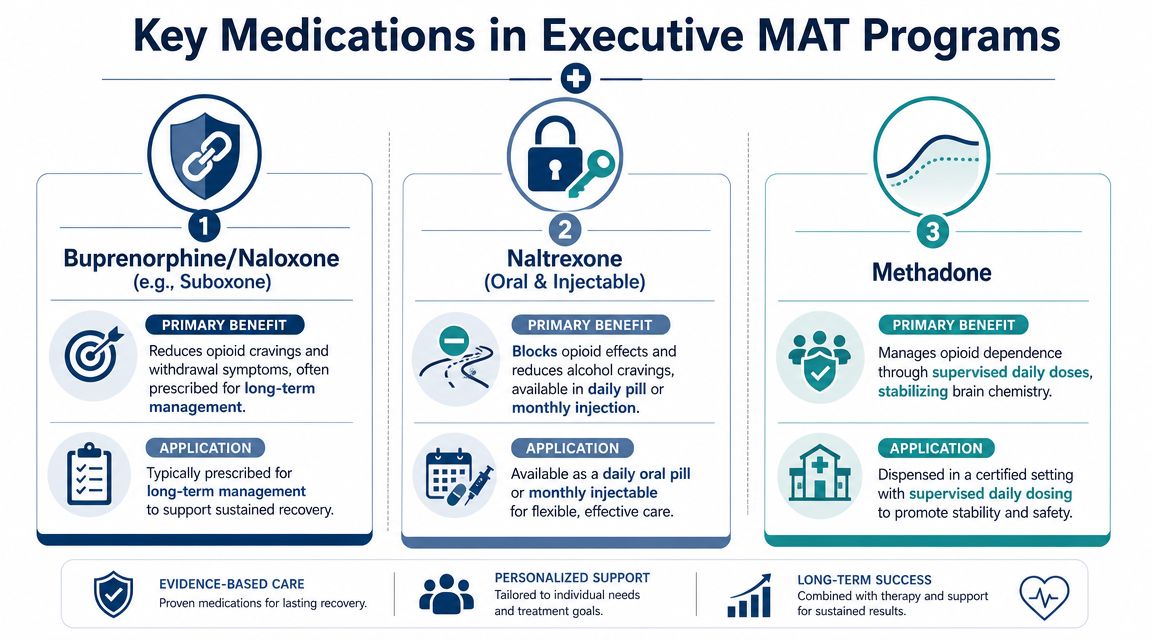
A practical comparison
| Medication | Primary role | What executives should know |
|---|---|---|
| Buprenorphine | Helps reduce opioid cravings and withdrawal | Often useful when stability is needed without the disruption of unmanaged withdrawal |
| Methadone | Stabilizes opioid dependence through supervised dosing | Can be appropriate when structure and consistent symptom control are essential |
| Naltrexone | Blocks opioid effects and can reduce alcohol cravings | Often attractive to professionals who want a non-opioid option after detox is complete |
Buprenorphine
Buprenorphine is commonly used for opioid use disorder. In plain terms, it helps reduce withdrawal symptoms and cravings so the person is not locked in a constant cycle of physical distress and compulsive relief-seeking.
For a working professional, that matters because chaos is often the enemy of compliance. If a person feels physically steadier, they are more likely to participate in therapy, communicate openly, and stick with treatment decisions instead of reacting moment by moment to discomfort.
Methadone
Methadone has long been used in opioid treatment and remains an important option in the right clinical scenario. It can provide steady receptor-level support for people who need a high degree of stabilization.
This is not usually a decision made casually. It requires thoughtful medical oversight and an honest assessment of severity, history, and prior responses to treatment. In some cases, that higher level of structure is exactly what makes recovery possible.
Clinical judgment matters: The “best” medication is the one that fits the person's biology, history, and treatment setting, not the one that sounds most acceptable socially.
Naltrexone
Naltrexone works differently. Rather than reducing withdrawal through opioid receptor activity, it blocks opioid effects and can also be used to reduce alcohol cravings. That makes it a distinct option, especially for individuals who have already completed detox and want relapse protection built into the plan.
For executives, its appeal is often conceptual as much as clinical. Some prefer a medication that doesn't function like an opioid treatment agonist and instead creates a blockade against return to use.
What the strongest comparative evidence supports
For opioid use disorder, the strongest comparative evidence in the provided sources comes from a study of 40,885 adults. In that study, only buprenorphine or methadone was associated with a reduced risk of both overdose and serious opioid-related acute care utilization at 3 and 12 months follow-up, according to the comparative effectiveness study in JAMA Network Open.
That finding is important because it pushes the conversation away from ideology and toward outcomes. Medication choice should be guided by evidence and individual fit, not stigma.
Families helping manage a loved one's treatment often also need practical systems at home. A concise outside resource on medication management tips for caregivers can be useful when medication adherence, communication, and oversight become part of family recovery planning.
Beyond Medication An Integrated Path to Lasting Recovery
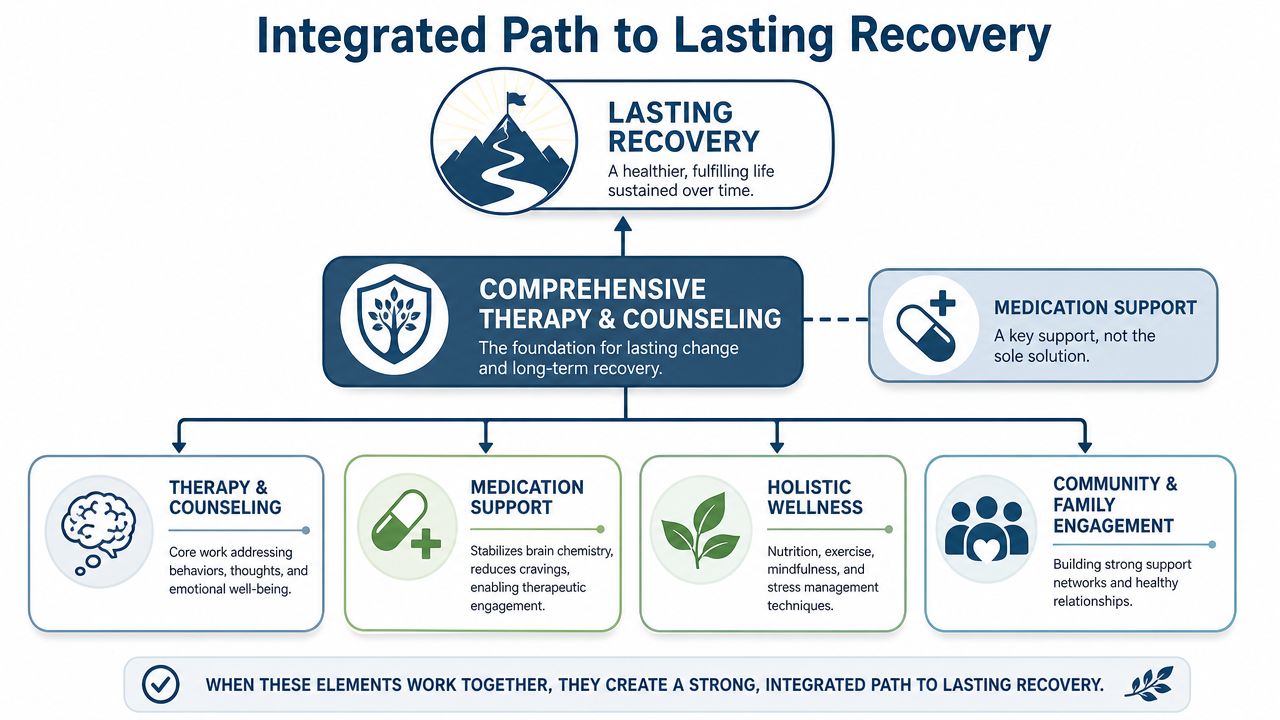
Medication can stabilize a person. It cannot, by itself, teach emotional regulation, repair a marriage, process trauma, or change the reflex to use substances under pressure. Lasting recovery comes from integration.
That matters even more with executives, because high-functioning people often have complex defenses. They can intellectualize. They can negotiate around discomfort. They can perform insight without allowing real vulnerability. Medication may lower the physiological noise, but therapy is where evasiveness gets challenged and replaced with durable change.
Why retention matters
A systematic review of MAT programs found average 12-month retention of 54.3%, with 48.3% for buprenorphine and 56.6% for methadone. Studies with follow-up beyond 24 months reported retention of 74.5% or greater, as described in this systematic review of treatment retention and outcomes.
Retention matters because treatment only works when the person stays engaged long enough to benefit from it. In executive populations, dropout often happens when early distress, shame, or logistical pressure collides with an unrealistic expectation of rapid recovery. MAT can help hold the person in treatment long enough for deeper work to take hold.
What integrated care actually looks like
In a high-end residential setting, integrated MAT should include more than medication visits. It should connect the medical plan to a full clinical program, including:
- Individual psychotherapy: Focused work on the specific drivers behind substance use.
- Dual-diagnosis care: Evaluation and treatment for anxiety, depression, trauma, bipolar symptoms, burnout, or other co-occurring conditions.
- Behavioral therapies: Approaches such as CBT and DBT that help the person change thought patterns, impulse responses, and coping habits.
- Family involvement: Private sessions that address secrecy, enabling, mistrust, and communication failures.
- Executive reintegration planning: Support for boundaries, scheduling, stress exposure, and return-to-work decisions.
A program such as integrated mental health and addiction treatment reflects this broader model. The medication supports the plan. It doesn't replace it.
The role of whole-person treatment
Executives rarely struggle with substance use in a vacuum. The surrounding pattern may include overwork, insomnia, untreated ADHD traits, chronic anxiety, grief, or relational isolation. Whole-person care matters because the person's life has to become more livable without substances.
That's why treatment often includes structured sleep support, nutrition, movement, mindfulness, and practical stress management, alongside psychotherapy and medication oversight. For families or professionals also sorting out attention issues without immediately defaulting to medication, this outside guide for adults navigating ADHD can add useful context to a broader mental health discussion.
Medication can reduce the urgency to use. Therapy must answer the harder question of why the person needed the substance in the first place.
Addressing Common Myths and Stigmas About MAT
Many professionals hesitate to consider MAT because the cultural narratives around it are outdated. The stigma is often strongest among people who are otherwise highly rational. They may accept medication for blood pressure, sleep apnea, or depression, but view addiction treatment through a moral lens.
That misunderstanding delays care.

Myth one, this is just replacing one addiction with another
This is one of the most common objections, and it confuses physiological dependence with addiction. Dependence can occur with many prescribed medications. Addiction involves compulsive, harmful use despite consequences, loss of control, and persistent preoccupation.
MAT, when properly prescribed and supervised, is designed to reduce destabilizing withdrawal and compulsive use patterns so a person can regain behavioral control. That's treatment. It isn't the same thing as chaotic substance misuse.
Myth two, medication means the person isn't really sober
This belief is often rooted in ideology rather than medicine. A person taking prescribed treatment to support recovery may be more stable, more honest, more emotionally available, and more behaviorally accountable than they were during an abstinence-only attempt driven by craving and fear.
Recovery is measured in functioning, integrity, and sustained behavioral change. It isn't disqualified by evidence-based medical care.
Myth three, MAT should be brief
The CDC notes that MAT often lasts months to years, and warns that tapering too early can raise relapse and overdose risk, according to the CDC overview of medication-assisted treatment. That guidance matters because premature discontinuation is often driven by discomfort with the idea of staying on medication, not by sound clinical timing.
A rushed taper may satisfy stigma. It doesn't necessarily protect the patient.
Myth four, using medication means the case is severe or hopeless
In reality, MAT is often a sign that the treatment team is thinking clearly and using the full range of available tools. It can be the most measured, least theatrical, and most medically appropriate decision in the room.
For a C-suite professional, that framing matters. The goal isn't to prove toughness. The goal is to choose the treatment strategy most likely to protect life, restore judgment, and support long-term recovery.
Finding Executive MAT Care That Protects Your Career and Privacy
A good MAT program and an executive-level MAT program are not always the same thing. Clinical competence is essential, but professionals also need a setting that understands visibility, confidentiality, and the practical demands of leadership.
The right environment should make treatment feel organized, not chaotic. Private rooms matter. Calm surroundings matter. Clear communication matters. So does the ability to maintain appropriate connection to work when necessary.
What to look for in a high-end program
When evaluating options, several criteria deserve close attention:
- Accreditation and licensing: Look for a properly licensed program with recognized accreditation standards.
- Depth of clinical staff: A strong team should include psychiatry, licensed therapists, addiction specialists, and dual-diagnosis capability.
- Medication oversight: MAT decisions should be medically supervised and individualized, not automatic.
- Private setting: Executives often need privacy for both emotional safety and reputational reasons.
- Electronics policy: Some professionals need access to phones or laptops for limited, appropriate work obligations.
- Aftercare planning: The program should prepare the person for re-entry, not just discharge them.
Where luxury and clinical rigor should meet
In this niche, luxury should not mean indulgence detached from treatment. It should mean a setting that reduces noise, preserves dignity, and supports full clinical engagement. Private accommodations, discreet transportation, personalized scheduling, and thoughtful case management aren't superficial extras for this population. They often make the difference between entering treatment and postponing it.
One example is Reflections, a California-licensed, Joint Commission-accredited residential provider that offers dual-diagnosis care, private rooms, clinically managed medication-assisted withdrawal when appropriate, and appropriate access to electronics for clients balancing treatment with work obligations.
Questions worth asking before admission
A serious executive or family office should ask direct questions:
- How is privacy protected from intake through discharge?
- Who manages psychiatric and addiction medications?
- Can the client maintain limited business continuity if clinically appropriate?
- How are co-occurring conditions evaluated?
- What happens after residential care ends?
Those questions tend to reveal quickly whether a program understands executive treatment or only markets to it.
Actionable Next Steps FAQs for Professionals and Families
How long does MAT usually last
There isn't a fixed timeline that fits every person. MAT is often a longer-term strategy, and the duration should be based on clinical stability, relapse risk, functioning, and readiness, not impatience or stigma. Any taper should be carefully supervised.
Can a professional stay connected to work during treatment
In the right executive-focused setting, yes. Some residential programs allow appropriate access to phones and laptops so clients can manage essential responsibilities without turning treatment into another work sprint. The treatment team should help define boundaries so career continuity doesn't undermine recovery.
How is privacy handled
Privacy should be addressed at every level: admissions process, room assignments, communication protocols, medication handling, family contact, and discharge planning. High-profile professionals should ask specifically about confidentiality procedures rather than assuming them.
Is MAT only for opioid use disorder
MAT is most commonly discussed in relation to opioid use disorder, but medication can also play a role in alcohol treatment depending on the clinical picture. The right question isn't whether medication is categorically good or bad. It's whether it fits the person's diagnosis, risk profile, and treatment goals.
What should families do first
Families usually help most by moving from panic to structure:
- Get a clinical assessment: Don't rely on guesswork or promises to cut back.
- Clarify priorities: Safety, privacy, and appropriate level of care come first.
- Choose a program carefully: Look for dual-diagnosis depth, medication capability, and executive accommodations.
- Prepare for continuity: Work coverage, family communication, and aftercare planning should be arranged early.
For professionals or families considering discreet residential care, Reflections provides private-pay dual-diagnosis treatment in a confidential California setting, including private rooms, clinically managed medication support when appropriate, and structured accommodation for essential work communication. For a high-performing adult whose life still looks intact from the outside, that kind of care can offer a path to recovery that protects both health and professional continuity.