
A senior executive can hold a board meeting, answer emails at midnight, and still feel unsettled when the next drink, pill, or line starts to feel less like a choice and more like part of the routine. That quiet shift is often what brings someone to a substance use disorder diagnosis, not a dramatic collapse, but a pattern that no longer resets on its own.
For high-performing professionals, the confusion is usually practical, not abstract. The core question is whether the pattern has crossed from stress management or social use into a medically recognized condition, and whether it can be evaluated without blowing up a career, a family schedule, or a hard-won reputation. A careful substance use disorder diagnosis gives structure to that question. It doesn't hand out a moral verdict, it maps what's happening, how severe it is, and what kind of care truly fits.
That distinction matters because modern clinical language treats substance use disorder as a continuum, not a simple yes-or-no label. The older abuse-versus-dependence split was replaced in DSM-5 with one diagnosis built around real-world behavior, impairment, and risk, which is a better fit for the messy way people present in clinic. For someone weighing evaluation, that means the point isn't to “prove” a problem, it's to understand what's already showing up and decide what level of help is warranted.
Practical rule: A diagnosis is useful when it changes the plan. If it clarifies severity, identifies hidden co-occurring issues, and matches treatment intensity to the actual burden, it's doing its job.
When a High Performer Starts Wondering
The first warning sign is rarely an obvious crisis. More often, it's a professional who notices that the usual guardrails are slipping, the bottle empties faster than planned, the prescription refill feels essential, or the week never quite feels normal without a reset ritual after hours. Those moments can be easy to rationalize, especially when work still gets done and no one else seems alarmed.
That's exactly why clinicians don't define SUD by appearance alone. A person can be polished, effective, and still meet criteria for a disorder if the pattern includes loss of control, continuing use despite harm, or repeated attempts that don't stick. A diagnosis is meant to answer a practical question, whether the use is creating a syndrome that needs treatment, not whether the person “looks like” someone with a problem.
For executives and other professionals, shame often delays evaluation more than symptoms do. The concern becomes, “If this is real, what happens next?” A good assessment is built to answer that safely and confidentially, with attention to work demands, family obligations, and the need to stay functional while getting clear on what's going on. Reflections frames that kind of evaluation within a luxury residential setting for professionals who can't disappear from their lives, and its executive-focused program page outlines how that setting is structured Reflections executive rehab.
The term “addiction” still shows up in everyday speech, but clinical language has moved toward substance use disorder because it's more precise. It describes a condition that can be mild, moderate, or severe, and that range matters because the right response to early loss of control is not the same as the response to entrenched impairment. A formal diagnosis doesn't lock someone into an identity, it creates a usable clinical map.
Why the label is less important than the pattern
A polished routine can hide a lot. Someone may still lead meetings, travel, and meet deadlines while privately needing substances to get through the morning, the afternoon slump, or the emotional aftermath of work.
That's why the question is never, “Can this person function?” It's, “What does functioning now cost, what's being lost, and what happens when use stops or is cut back?” Those are the questions that turn a vague concern into a legitimate diagnostic inquiry.
What a Substance Use Disorder Actually Is
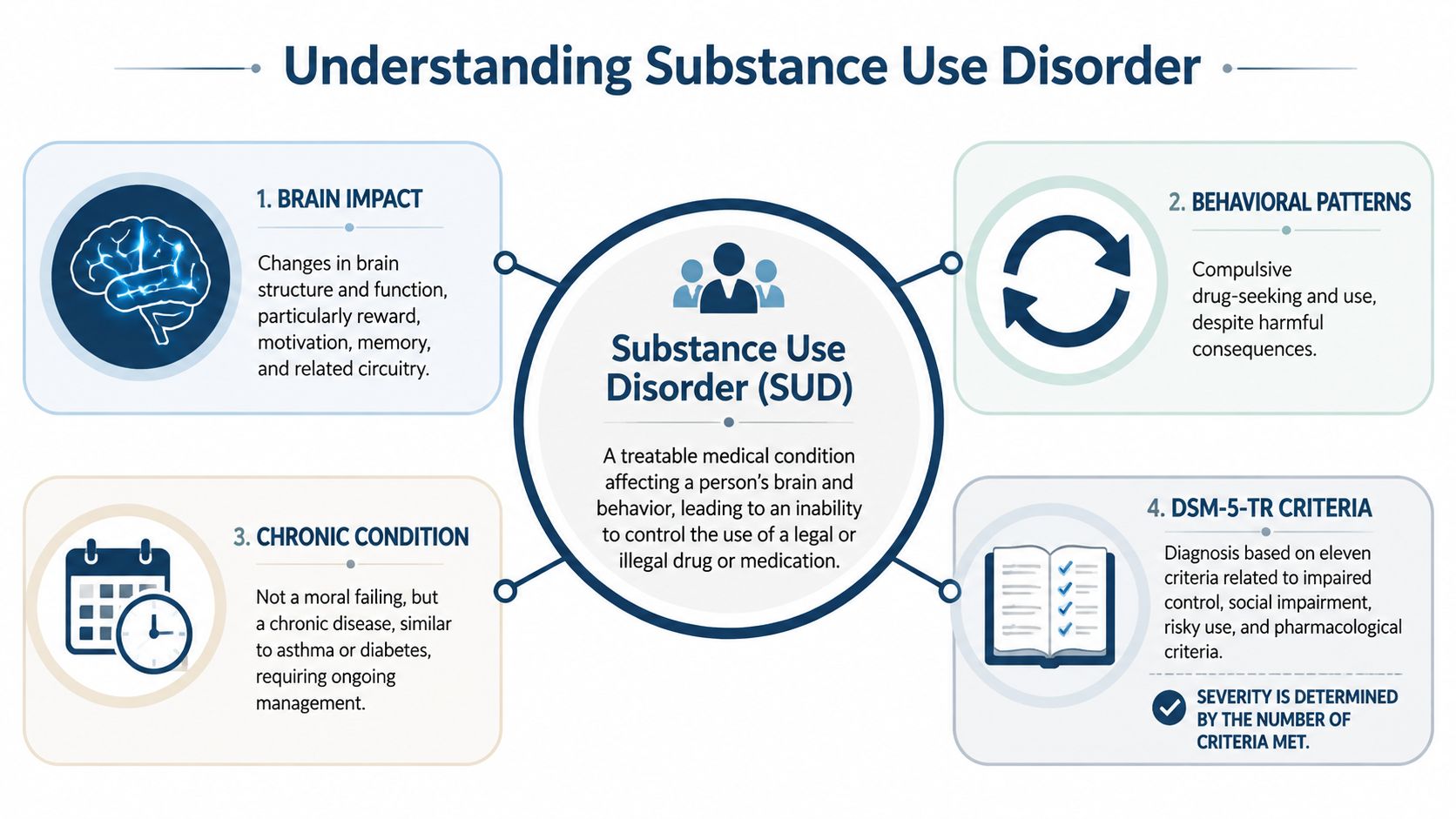
A substance use disorder is a treatable medical condition that affects brain and behavior and shows up as continued use despite harm. The simplest way to understand it is as a thermostat that has been recalibrated. The person is no longer responding to ordinary cues in the usual way, because reward, stress, memory, and habit systems are pulling harder than judgment or intention.
DSM-5-TR treats that condition as a single diagnosis with 11 criteria, grouped into four domains, rather than two separate categories. That change made the diagnosis more clinically useful because real patients don't arrive in neat bins labeled “abuse” or “dependence.” They present with mixtures of craving, role strain, tolerance, withdrawal, and continued use despite consequences, and the clinician has to assemble the picture from those pieces.
The DSM-5 revision also removed the old legal-problems criterion and added craving. That matters because legal trouble is not required for the syndrome, and craving is often one of the most clinically revealing signs of impaired control. The diagnostic logic shifted away from moral or legal fallout and toward the actual pattern of compulsion, impairment, and risk.
For a reader trying to self-orient, a traffic-light analogy is useful. Green means use isn't driving consequences. Yellow means the pattern is starting to intrude on sleep, judgment, mood, work, or relationships. Red means the use is no longer just a behavior, it's a syndrome with recurring harm and loss of control.
A lab result can show exposure. It can't show the whole syndrome.
Reflections' overview of understanding addiction fits this framing because it pairs behavioral patterns with the medical reality of ongoing management understanding addiction. The point is not to reduce a person to a label, it's to recognize when the label helps guide care.
The Eleven Criteria and Severity Specifiers
DSM-5-TR groups the 11 criteria into impaired control, social impairment, risky use, and pharmacologic features. A diagnosis requires at least 2 criteria within 12 months, then severity is marked as mild, moderate, or severe based on how many are present. That count is not meant to shame anyone, it's how clinicians match treatment intensity to disease burden.
How the domains show up in everyday life
Impaired control is where the person notices the substance is getting harder to steer. That can look like using more than intended, spending a long time getting, using, or recovering, repeated unsuccessful attempts to cut down, or craving that keeps intruding on concentration and decision-making.
Social impairment shows up when the substance starts taking priority over obligations. Work performance can slip, relationships become strained, and important roles get neglected even though the person knows the damage is accumulating.
Risky use means continuing despite danger. That might be driving after drinking, combining substances, or using in ways that create obvious risk even after the person has had enough information to know better.
Pharmacologic features are the body's adaptation to repeated exposure. Tolerance and withdrawal belong here, and they can make a person feel trapped because stopping suddenly is uncomfortable or destabilizing.
| Domain | Example Criteria | What It Can Look Like |
|---|---|---|
| Impaired control | More use than intended, unsuccessful cutbacks, craving | A professional plans to have one drink after dinner and ends up finishing the bottle |
| Social impairment | Role failure, interpersonal conflict, reduced activities | Missed deadlines, strained marriage, less interest in exercise or family time |
| Risky use | Use in hazardous situations, continued use despite harm | Taking sedatives before driving, or drinking despite clear consequences |
| Pharmacologic features | Tolerance, withdrawal | Needing more to get the same effect, or feeling unwell when stopping |
How severity changes the clinical interpretation
Mild means 2 to 3 criteria, moderate means 4 to 5, and severe means 6 or more. The value of that split is practical. It helps clinicians decide whether the person needs outpatient therapy, a higher-touch dual-diagnosis setting, detox, or residential care.
Edge cases matter. Prescription medication misuse can still meet criteria even when the drug was originally legitimate. Weekend-only use can also be clinically significant if it leads to repeated impairment, escalating tolerance, or failed attempts to control it. The pattern, not the calendar, determines the diagnosis.
Clinical shortcut: One criterion can be alarming, but it doesn't make the diagnosis. Clinicians count the total pattern across the full year, then ask what level of support fits.
Screening Tools and the Limits of Testing
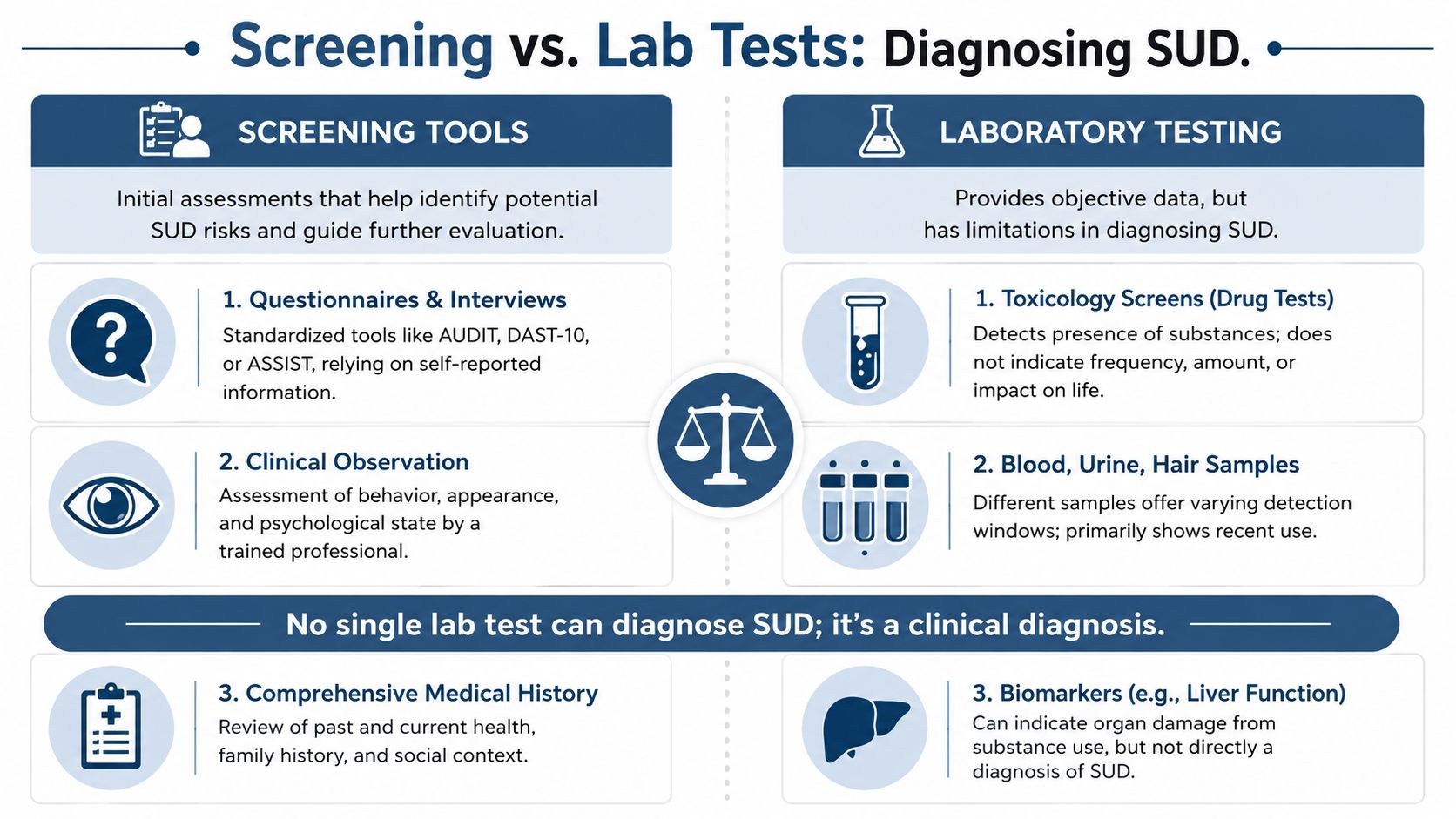
Many people expect a diagnosis to come from a blood draw or urine panel. That's understandable, but it's not how substance use disorder diagnosis works. A toxicology test can help detect current use or support monitoring, but it does not show impairment, craving, role failure, or the broader behavioral syndrome that DSM-5-TR requires.
That's why screening and diagnosis are different steps. Screening asks whether there's enough concern to dig deeper. Diagnosis asks whether the full pattern meets clinical criteria and what severity specifier applies. A positive screen should prompt a more complete assessment, not be mistaken for the final answer.
A straightforward way to read the common screens is by purpose. CAGE is a brief alcohol-focused screen. AUDIT is stronger for alcohol risk patterns. DAST is used for drug-related concerns. TICS-2 and the NIDA Quick Screen are quick entry points that help flag whether a more in-depth interview is needed. Each one can be useful, but none of them replaces a clinician's evaluation.
What testing can and can't answer
A urine screen may show recent use. A blood test may show current intoxication or exposure. A saliva test may support near-term detection. None of those answers the bigger clinical question, whether use is causing persistent dysfunction or meeting DSM-5-TR criteria.
An evaluation is the next step when the screening result, the history, or the person's own concern suggests that the pattern is more than occasional. That evaluation usually includes substance history, mental health symptoms, medications, medical issues, and social context. For a high-functioning professional, it also needs to account for work demands, privacy concerns, and what level of structure is realistic.
Reflections' intake model includes in-depth substance use assessment, plus complete medical history, physical exam, and thorough mental health assessment, which is the kind of layered review this diagnosis requires. That matters because the diagnostic answer is rarely just “yes” or “no.” It's usually a more nuanced picture of use, function, risk, and the supports needed next.
Bottom line: Testing can support the story. It can't tell the whole story.
Why Co-Occurring Mental Health Changes the Picture
In real clinics, substance use and mental health symptoms rarely travel alone. Depression, anxiety, PTSD, and bipolar symptoms can blur the picture because they may push someone toward self-medication, but they can also mimic the consequences of substance use. Fatigue, irritability, sleep disruption, concentration problems, and emotional volatility can come from either side of the equation.
That's why dual-diagnosis evaluation matters so much. SAMHSA reported that in 2024, 61.5 million adults experienced any mental illness, and 31.5% of them also met criteria for a substance use disorder, down slightly from 33.3% in 2023 (SAMHSA's 2024 mental illness and SUD data summary). Independent clinical literature also reports a stronger lifetime overlap among people with psychiatric disorders than among those without them, which reinforces what clinicians see in practice, psychiatric symptoms and substance use often amplify each other.
Why that overlap changes diagnosis
A person with panic symptoms might drink to quiet arousal, then develop tolerance and withdrawal that look like worsening anxiety. Someone with PTSD may use to blunt intrusive memories, but the substance use can deepen avoidance and make trauma treatment harder to start. Bipolar symptoms can add another layer, because the mood cycling itself can complicate judgment, sleep, and impulse control.
This is why some experts argue for a staging model rather than a narrow symptom count alone. A useful formulation includes psychiatric comorbidity, medical burden, trauma history, chronicity, motivation, adherence, and psychosocial stability. In plain language, the clinician needs to know not only how many criteria are present, but what kind of person is presenting, what else is happening in the nervous system, and how much structure the next step should provide.
For professionals who want a deeper look at how dual-diagnosis is framed clinically, the resource on outpatient rehab for dual diagnosis in DFW is a relevant point of comparison because it centers the same overlapping psychiatric and substance concerns.
Reflections' page on define co-occurring disorders fits here too, because the diagnosis often turns on whether the substance is primary, secondary, or part of a bidirectional pattern that needs integrated care. That integrated lens is especially important for executives and high-achieving professionals, where symptoms can be masked by competence for a long time.
When mood, trauma, and substance use are all active, treating only one of them usually leaves the rest of the mechanism untouched.
From Diagnosis to a Treatment Plan That Fits
A representative evaluation often begins discreetly. A confidential intake screens for immediate safety concerns, use patterns, medication history, and whether withdrawal risk is present. From there, a multidisciplinary team reviews the DSM-5-TR criteria, evaluates mental health symptoms, and decides whether the person needs detox, residential care, or a less intensive setting.
A useful next question is whether treatment can respect career reality. For some executives and professionals, the answer is yes, but only in a setting that combines privacy, structure, and enough clinical intensity to handle dual diagnosis properly. The plan may include individual therapy, group work, medication review, and a sober environment that reduces daily decision fatigue while the diagnostic picture is clarified.
How clinicians translate diagnosis into care
The treatment plan usually reflects severity, not just the presence of a diagnosis. Mild presentations may be appropriate for outpatient therapy when there's stable support and low medical risk. Moderate or severe cases often call for more structure, especially if there's co-occurring depression, trauma, anxiety, or medication dependence.
Therapy choices are matched to the clinical picture. CBT can target distorted thinking and high-risk routines. DBT is often useful when emotion regulation or impulsivity is a major driver. ACT and motivational interviewing can help with ambivalence and values-based change, especially for people who are still managing work obligations and need a plan they can follow.
For a clear comparison of therapy styles, an article on evidence-based therapy choice can be useful as a practical reference point. In a real program, the choice isn't about branding, it's about matching the intervention to the symptom pattern and the person's level of readiness.
Reflections is one option for that kind of setting because it offers private rooms, electronic access for appropriate work continuity, medically managed detox when indicated, and a 30 to 90 day residential framework with dual-diagnosis care. Those details matter because the diagnostic answer only helps if the treatment environment can hold the complexity of the case.
The right plan feels specific. It accounts for severity, co-occurring symptoms, and the life the person still has to manage.
Practical Next Steps for Patients and Families
The safest first move is a confidential evaluation, not a self-judgment. A professional who suspects a problem can ask directly whether the program offers substance use screening, full assessment, and dual-diagnosis capability. Those are the markers that separate a generic intake from a clinically meaningful workup.
Families should ask different questions. They need to know whether the program includes family education, private sessions, and a clear communication structure, because loved ones often destabilize care when they're kept at the edges. They should also ask how the team handles co-occurring mood, trauma, or anxiety symptoms, since a substance-only lens is too narrow for many high-acuity cases.
Questions worth asking before admission
- Does the team provide both mental health and substance use assessment? That matters because dual diagnosis changes the treatment plan.
- Are rooms private? Privacy can be essential for executives, public figures, and anyone managing reputation-sensitive work.
- Can limited work obligations be handled responsibly? For some professionals, access to electronics is part of a realistic plan, not a luxury add-on.
- Is detox available on site or through a coordinated medical pathway? That's important when withdrawal or medication dependence is part of the picture.
- How long does the residential phase typically run? A 30 to 90 day window is common in structured residential care, and that duration gives room for stabilization, evaluation, and therapy.
The right level of care is usually residential when use is intertwined with psychiatric symptoms, the home environment won't support change, or the person keeps cycling through short-lived attempts to cut back. Outpatient care can be appropriate for some, but it's not the right answer when the diagnosis suggests high acuity, significant relapse risk, or the need for round-the-clock containment.
For readers looking at a luxury dual-diagnosis pathway, Reflections is one place that combines credentialed clinical care, private accommodations, family involvement, and appropriate electronics access in a residential setting. That combination is often what makes treatment possible for a person who still needs to remain professionally anchored.
If the pattern described here feels familiar, the next step is a confidential assessment, not a private promise to handle it later. Visit Reflections to explore a dual-diagnosis residential path that can address substance use, co-occurring mental health symptoms, and the practical realities of executive life with discretion and clinical structure.