

A chief executive arrives at treatment after months of telling colleagues that the drinking is “under control” and telling family members that the anxiety is “just work stress.” Sleep has deteriorated, decisions take longer, and alcohol now seems necessary before difficult meetings. Earlier attempts addressed the anxiety without changing the drinking, or focused on alcohol without treating the fear beneath it. Neither approach held.
That pattern illustrates why a dual diagnosis treatment team matters. Dual diagnosis means a person has at least one mental health disorder and at least one substance use disorder, with each condition potentially intensifying the other. For executives and high-profile professionals, the right program must protect privacy and professional responsibilities, but its central value rests in clinical integration, verified credentials, and coordinated accountability, not upscale surroundings alone.
Why One Condition Is Rarely the Whole Story
The executive in this example might receive a prescription for anxiety, attend a few counseling sessions, and return to the same cycle of pressure, sleeplessness, drinking, shame, and renewed anxiety. If the clinicians don't share information or formulate one plan, each provider sees only part of the problem. A psychiatrist may observe escalating symptoms, while an addiction counselor sees increasing alcohol use, and neither fully understands how one is driving the other.
SAMHSA reported that among 51.1 million U.S. adults with any past-year mental illness in 2019, 9.5 million also had a substance use disorder, approximately 18.6% of adults with mental illness (SAMHSA's co-occurring disorders guidance). The figure supports a practical conclusion for families evaluating residential care: co-occurring conditions are common enough that a program should be designed for simultaneous assessment and treatment, rather than treating addiction and mental health as unrelated admissions.
What dual diagnosis means in practice
A dual diagnosis isn't a third diagnosis. It describes the clinical reality of two conditions interacting within one person. Anxiety can increase reliance on alcohol. Withdrawal can intensify panic and insomnia. Trauma symptoms can complicate medication decisions, while substance use can obscure whether mood changes reflect an underlying disorder, intoxication, withdrawal, or medication effects.
A treatment team must therefore ask connected questions:
- What is happening psychologically? The team assesses mood, anxiety, trauma, cognition, safety, sleep, and functioning.
- What is happening with substance use? Clinicians examine patterns, cravings, tolerance, withdrawal risk, consequences, and readiness for change.
- How do the conditions influence each other? The formulation connects symptoms rather than placing them in separate files.
- What can the client sustain? Treatment must account for family responsibilities, leadership demands, privacy, and the person's readiness to engage.
Families may also benefit from specialized educational material when symptoms overlap. A resource on OCD and depression from Refresh Psychiatry & Therapy can help clarify why related psychiatric symptoms may require careful differentiation rather than casual labeling.
Practical rule: A private room may support dignity and concentration, but only a coordinated clinical team can connect the symptoms that brought the client through the door.
The evaluation question is not just whether a facility has a psychiatrist, therapist, or attractive accommodations. It is whether those professionals operate as one team, with shared responsibility for psychiatric assessment, addiction treatment, medication safety, family involvement, and continuing care.
Understanding the Integrated Care Model
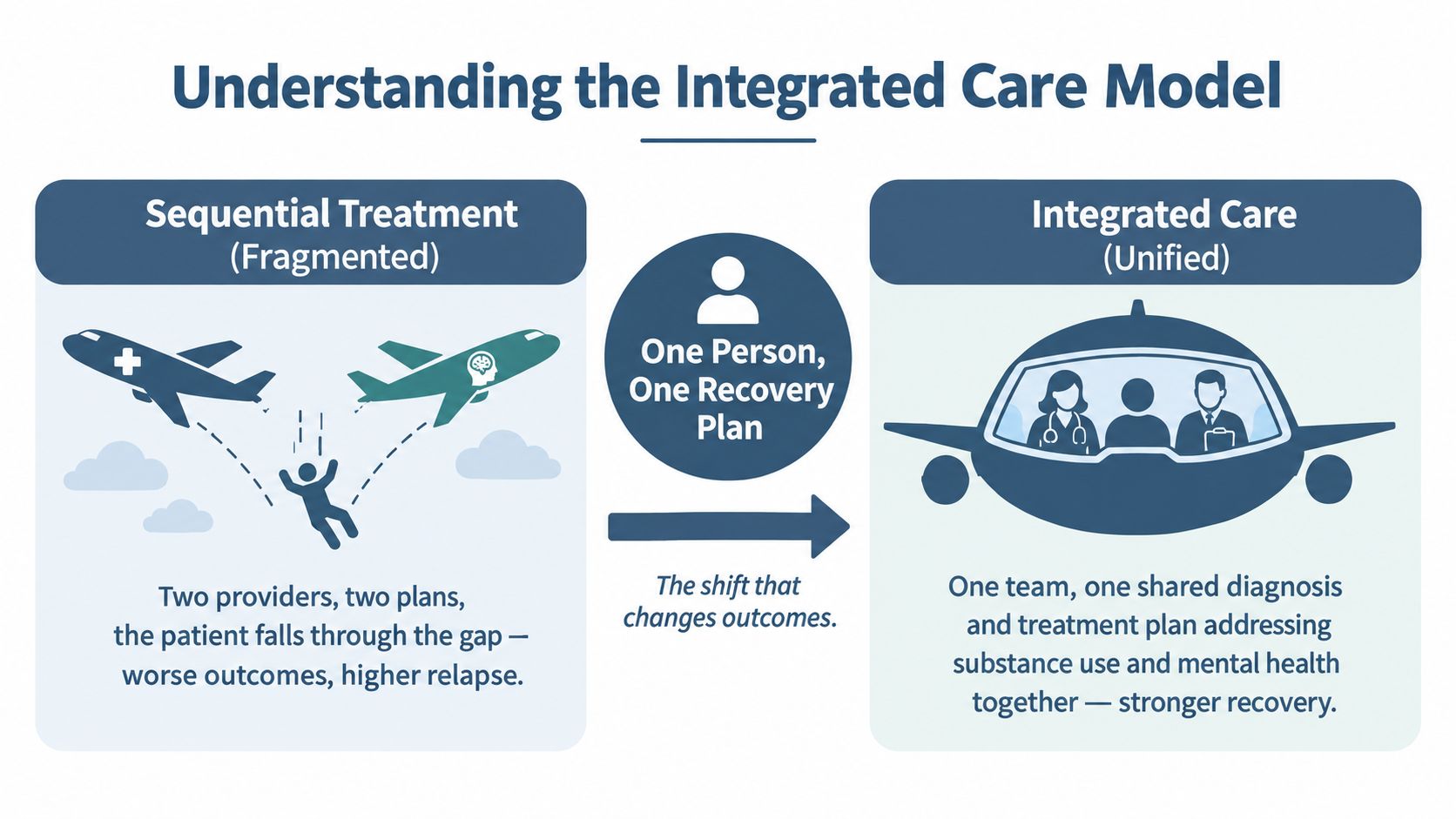
Treating co-occurring disorders sequentially is like assigning two pilots to fly separate planes while carrying the same passenger. One pilot handles anxiety, the other handles alcohol use, and the passenger is left trying to explain what happened in the other cockpit. Integrated care puts the clinicians in one cockpit, working from one formulation and one recovery plan.
SAMHSA identifies integrated care as the preferred model for co-occurring disorders. Clinicians address both conditions together, adapt interventions to the client's stage of readiness, and move through engagement, stabilization, active treatment, relapse prevention, and continuing care (SAMHSA's integrated treatment issue brief).
Why sequential treatment creates blind spots
A disconnected system may require a client to become abstinent before receiving meaningful psychiatric therapy. Another program may stabilize mood while leaving cravings and relapse triggers to a later referral. That sequence can fail when withdrawal affects sleep and mood, when anxiety drives substance use, or when a medication changes a client's alertness and motivation.
Shared clinical responsibility reduces the chance that clinicians misattribute intoxication, withdrawal, trauma, mood instability, or medication effects to the wrong disorder. A single team can compare observations from nursing, psychiatry, psychotherapy, groups, and family sessions before changing the plan.
What the shared plan contains
A credible integrated plan should identify:
- The working formulation, including psychiatric symptoms, substance-use patterns, medical considerations, trauma history, and safety risks.
- The immediate clinical priorities, such as withdrawal monitoring, stabilization, sleep, medication review, or engagement.
- The interventions for both conditions, rather than a substance-use plan with mental health added later.
- The measures of progress, including psychiatric symptoms, cravings, substance use, sleep, safety, medication adherence, and functional recovery.
- The handoff responsibilities, so continuing care isn't left to a vague discharge recommendation.
Motivational interviewing has a specific place during engagement. It helps clinicians work with ambivalence instead of demanding that a client arrive fully convinced, emotionally ready, and immediately comfortable with every treatment decision.
Historically, mental health and addiction services often operated in parallel or sequential systems. Integrated care reflects a shift toward coordinated, person-centered, recovery-oriented treatment, where the executive isn't forced to become the project manager of separate providers. A practical explanation of this approach is also available through dual-diagnosis drug treatment guidance.
Who Sits on a Dual Diagnosis Treatment Team
A luxury program can list many disciplines and still deliver fragmented care. The important question is what each professional is qualified to do, how that role fits the formulation, and whether the team shares decisions instead of passing the client from office to office.
Psychiatrist
The psychiatrist leads or participates in psychiatric assessment, differential diagnosis, medication management, and risk evaluation. In a residential setting with clinically managed sub-acute detox, the psychiatrist also helps oversee withdrawal-related decisions and determines whether medication changes are appropriate and safe.
Typical credentials include a medical degree, psychiatric residency training, state licensure, and, where applicable, board certification. Families should ask who evaluates the client at admission, who reviews medications, how drug interactions are assessed, and how the psychiatrist communicates with therapists and nursing staff.
Medication management shouldn't operate as a separate service line. The team needs to monitor response, adherence, side effects, sedation, sleep, cravings, and changes in mood or anxiety. A client's request to remain productive at work also makes medication timing and cognitive effects clinically relevant.
PhD-level psychologist
A psychologist commonly contributes psychological testing, diagnostic clarification, individual psychotherapy, and treatment planning. PhD-level training may support advanced assessment and evidence-based therapy, although families should still verify state licensure and the clinician's experience with co-occurring disorders.
Depending on the client's needs, psychotherapy may include CBT, DBT, ACT, trauma-informed work, and motivational approaches. The psychologist helps translate insight into behavioral change, such as identifying the thought pattern that precedes drinking after a difficult board meeting and practicing a different response.
The role is broader than providing private sessions. A psychologist should communicate meaningful observations to the rest of the team, identify barriers to engagement, and help determine whether apparent improvement reflects genuine stabilization or temporary symptom suppression.
Licensed marriage and family therapist
A licensed marriage and family therapist, or LMFT, focuses on relationships and systems. The executive's symptoms affect a spouse, children, business partners, and trusted colleagues, while family conflict may reinforce isolation, secrecy, or substance use.
An LMFT may conduct family sessions, provide psychoeducation, examine communication patterns, and help establish boundaries around privacy, financial decisions, work contact, and crisis response. The therapist doesn't turn family members into monitors. Instead, the work clarifies how loved ones can support recovery without taking over clinical responsibilities.
Certified addiction counselor
The addiction counselor brings focused expertise in substance-use assessment, recovery planning, cravings, triggers, relapse prevention, and group treatment. Credential names vary by jurisdiction, so a family should ask which certification or license the counselor holds and whether the credential includes supervised clinical practice.
This professional often leads substance-use groups and uses motivational interviewing to explore ambivalence. The counselor may help a client map the sequence from pressure to insomnia to alcohol use, then develop alternatives that can function in an executive's real environment.
A counselor shouldn't work in isolation from psychiatry. Withdrawal symptoms, medication effects, trauma responses, and cravings can overlap, and the counselor's observations may change the broader treatment plan. Families researching the role may find a useful starting point in guidance on finding a substance use specialist.
Adjunctive therapists and wellness clinicians
Adjunctive professionals can support the core treatment plan through mindfulness, meditation, somatic work, equine therapy, art and music therapy, fitness, massage, and nutrition. These services may help a client regulate stress, reconnect with the body, practice routine, and discover non-substance-based ways to manage discomfort.
They shouldn't be presented as substitutes for psychiatric care, psychotherapy, or addiction counseling. Their value depends on clinical fit and communication. A nutrition professional may identify how irregular eating affects sleep and medication tolerance, while a fitness clinician may help rebuild routine without turning exercise into another performance demand.
| Team Role | Typical Credentials | Primary Responsibility |
|---|---|---|
| Psychiatrist | Medical degree, psychiatric training, state licensure, possible board certification | Psychiatric assessment, medication management, safety review, and withdrawal oversight |
| PhD-level psychologist | Doctoral psychology degree, state licensure, advanced assessment and therapy training | Psychological assessment, individual psychotherapy, and diagnostic formulation |
| Licensed marriage and family therapist | Graduate degree, supervised clinical training, LMFT licensure | Family systems, relationship patterns, communication, and family sessions |
| Certified addiction counselor | Jurisdiction-specific addiction counseling credential or license | Substance-use assessment, recovery skills, groups, cravings, and relapse prevention |
| Adjunctive therapists | Discipline-specific licenses, certifications, or professional training | Mindfulness, somatic, experiential, fitness, nutrition, and complementary support |
The table is useful only if a program can identify the actual professionals, credentials, scope of practice, and communication process behind each role.
How the Multidisciplinary Team Works Together
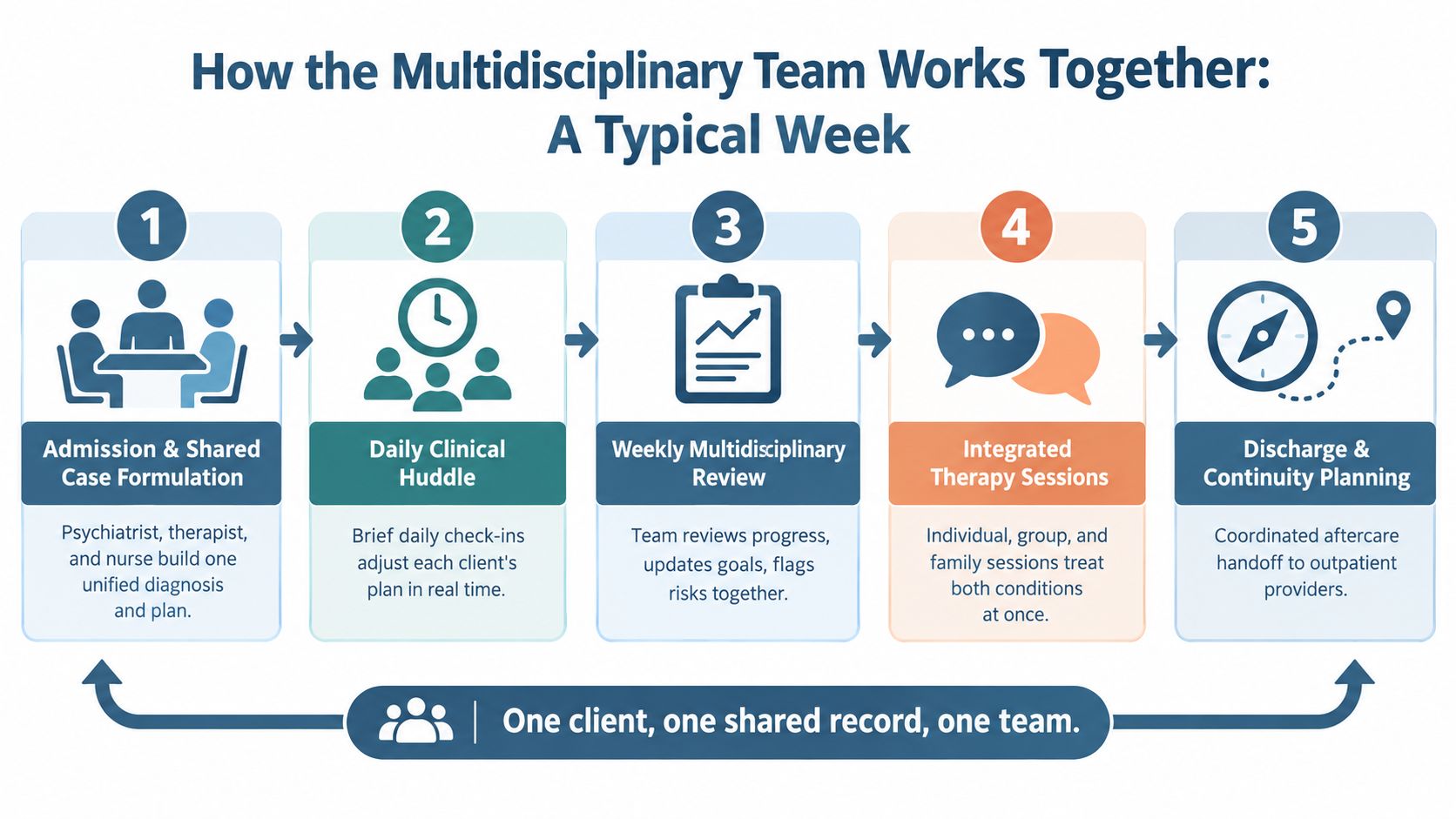
A multidisciplinary team becomes clinically meaningful through its workflow. At admission, the psychiatrist, therapist, nurse, and addiction professional should build a shared case formulation, not four independent summaries. The formulation should connect psychiatric symptoms, substance use, medical needs, safety concerns, work pressures, and family context.
A week in coordinated care
Daily clinical huddles allow staff to identify changes that shouldn't wait for a formal meeting. A nurse may report poor sleep and increased agitation. The psychiatrist can review whether withdrawal, medication effects, or emerging mood symptoms require attention, while the therapist examines what happened emotionally before the change.
During the weekly treatment-team meeting, clinicians review one care plan and update goals together. A medication decision belongs to the prescriber, but the decision should be informed by nursing observations, therapy responses, group participation, cravings, and the client's ability to function.
A short example shows the difference. An executive becomes more alert after a medication adjustment but begins arguing with a spouse during scheduled calls. The psychiatrist reviews the medication response, the psychologist explores emotional regulation, the LMFT examines the family pattern, and the addiction counselor checks whether conflict is increasing cravings. Each professional owns a different task, but the client receives one coordinated response.
Coordination that respects professional life
Private-pay programs often have the resources to build more individualized schedules, but a high-end setting still needs discipline. Appropriate access to electronics can allow a resident to manage selected career obligations, while the team protects therapy, sleep, medication monitoring, and recovery work from becoming subordinate to business demands.
Family sessions should also be scheduled with intention. Family members need clear consent boundaries, realistic communication expectations, and practical education about warning signs and crisis planning. A polished program that cannot explain who attends these meetings, what information can be shared, and how decisions are documented hasn't demonstrated integration.
SAMHSA's evidence review reports that programs adhering closely to the Integrated Treatment model produce better substance-use outcomes than low-fidelity implementations (SAMHSA's evidence review). Fidelity means following defined principles of integrated, multidisciplinary, stage-matched care. It doesn't mean offering the largest menu of therapies.
A useful operational test is whether a client can identify one plan, one lead contact, and one explanation for how changes are communicated. Further detail on the multidisciplinary team approach can help families frame those questions before admission.
How to Evaluate a Luxury Dual Diagnosis Program
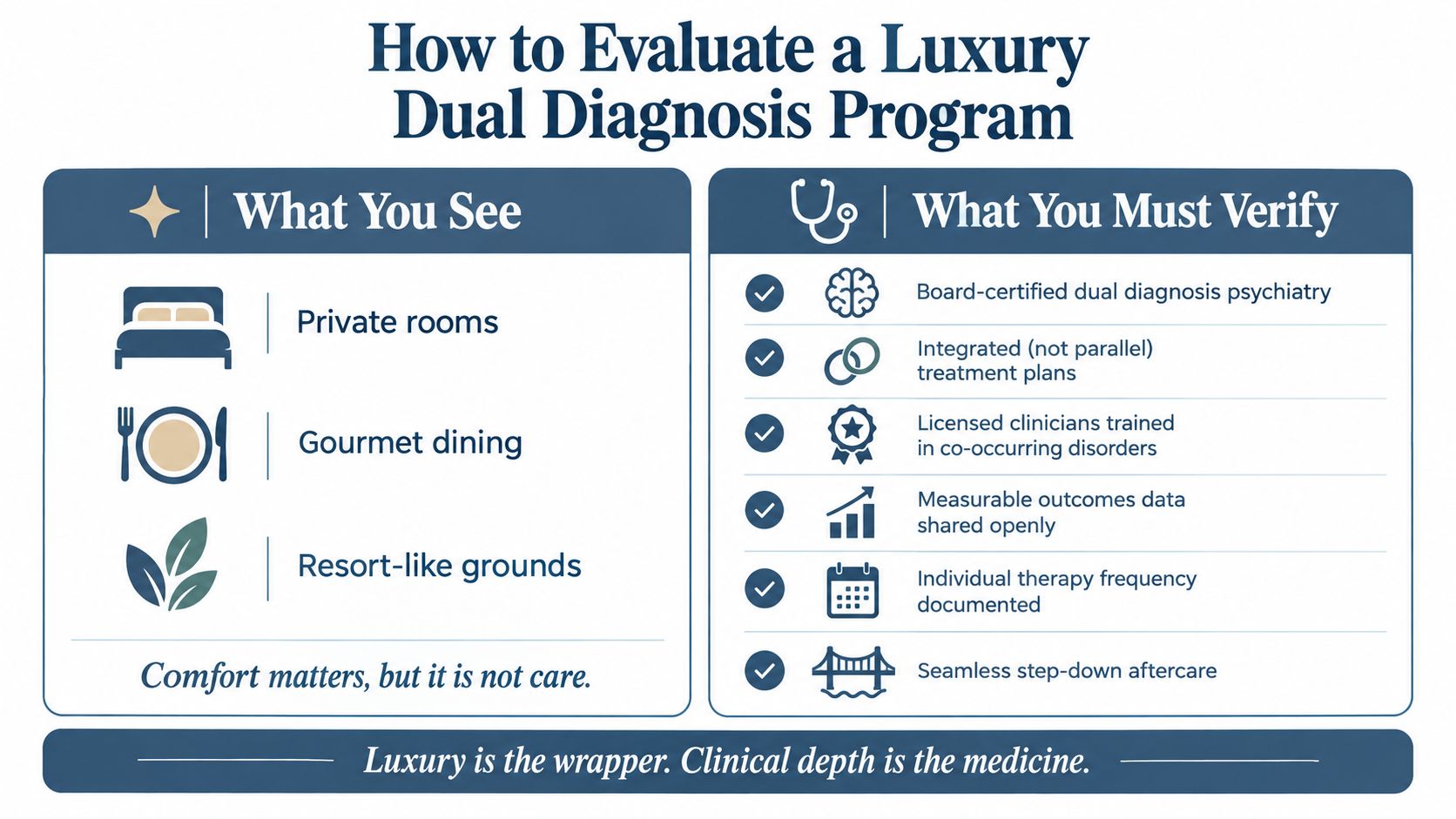
Luxury is visible. Clinical integration often isn't. Private rooms, gourmet dining, attractive grounds, and permission to use a laptop may improve comfort and discretion, but none proves that the clinicians share a formulation or know who owns a medication decision.
Verify the clinical foundation
Joint Commission behavioral-health accreditation covers dual-diagnosis and mental-health programs, as well as addiction-treatment services that include residential, outpatient, partial-hospitalization, and detoxification programs. Its standards span care, treatment and services, medication management, patient safety, records, and individual rights (Joint Commission behavioral-health accreditation scope).
That matters because accreditation addresses systems that protect clients from preventable failures. Families should verify the provider's current status directly, then ask how the applicable standards appear in daily operations.
A serious review should include these questions:
- Who provides care? Request names, roles, licenses, certifications, and relevant experience with co-occurring disorders.
- Who owns the case? Ask whether one clinical leader coordinates the full plan from detox through residential rehabilitation.
- Is treatment concurrent? The answer should describe how psychiatric symptoms and substance use are assessed and treated together.
- How are medications managed? Ask who prescribes, who monitors response and interactions, and how the team handles changes.
- How is family involved? Request a clear explanation of consent, private sessions, education, and communication boundaries.
- What happens after discharge? Ask for the warm-handoff process, medication reconciliation, follow-up timing, crisis planning, and continuing support.
Examine substance over appearance
A program serving executives should also explain its electronics policy without presenting work access as a substitute for treatment. Appropriate cell phone and laptop use can support essential professional obligations, but clinicians must determine how work affects sleep, stress, therapy attendance, and recovery.
Families should request a sample treatment schedule, an explanation of private-room arrangements, and a description of how detox differs from rehabilitation. Detox focuses on withdrawal management and stabilization. Residential rehabilitation addresses ongoing psychiatric, behavioral, relational, and recovery needs.
A provider that offers private rooms for all residents in both detox and rehabilitation may meet an important privacy preference, but the family still needs evidence of staffing, documentation, medication systems, patient rights, emergency procedures, and outcome monitoring. The price can justify a higher level of scrutiny, not a lower one.
What Integrated Care Looks Like for a Working Executive
A senior leader enters a residential program after recognizing that alcohol, panic, insomnia, and constant availability have become one problem. The program is structured for a 30-to-90-day stay, with clinically managed sub-acute detox when appropriate and a residential rehabilitation phase that combines psychiatric care, individual psychotherapy, intensive groups, and adjunctive therapies.
During detox, the psychiatrist evaluates withdrawal risk, reviews current medications, and establishes a safe plan. Nursing staff observe sleep, mood, physical symptoms, and changes in presentation. The addiction counselor begins identifying triggers and readiness, while the therapist assesses anxiety, trauma, and the emotional function of substance use.
The client has a private room, which supports rest and confidential calls. Appropriate access to a cell phone and laptop allows participation in essential work obligations, but the team helps set boundaries so that a late-night executive crisis doesn't replace clinical engagement. The point isn't to keep the client working at full intensity. It is to preserve selected responsibilities while treatment remains the priority.
The rehabilitation phase
Once stabilized, the client moves into deeper work. The psychologist uses individual psychotherapy to address anxiety, perfectionism, avoidance, and emotional regulation. The addiction counselor leads groups focused on cravings, relapse prevention, and recovery behaviors. The LMFT helps the spouse understand the cycle without turning the relationship into a surveillance system.
Adjunctive clinicians add mindfulness, somatic work, fitness, nutrition, or creative therapies when those interventions fit the treatment plan. A family workshop can be arranged around professional demands, with the team explaining warning signs, communication boundaries, medication questions, and the next stage of care.
The executive's work obligations become clinical information, not an inconvenience. A board conflict may reveal a trigger. A difficult call with a partner may expose a communication pattern. The team uses those moments to practice responses that can transfer into the client's actual life.
Reflections provides a California-licensed, Joint Commission-accredited residential setting with a multidisciplinary team that includes psychiatrists, PhD-level psychologists, LMFTs, certified addiction counselors, and adjunctive therapists. Its model includes private rooms, appropriate electronics access, clinically managed sub-acute detox when appropriate, residential rehabilitation, family involvement, and continuing care. Families should still verify that any provider's current credentials, accreditation status, staffing, and policies match the client's needs.
After Residential Care and the Questions to Ask First
Discharge is a clinical phase, not an administrative event. The team should arrange a warm handoff, reconcile medications, provide a written crisis plan, confirm rapid follow-up, and explain how alumni or peer support will work. Outcome checks at 30, 60, and 90 days can review symptoms, substance use, medication adherence, functioning, safety, and connection with continuing providers.
Among adults with co-occurring mental illness and substance-use disorder in 2025, 42.6% received neither type of service and only 12.7% received both mental-health and substance-use care (the reported 2025 service-use summary). That gap makes continuity a quality outcome in itself, not merely an administrative detail. Fragmented providers, confidentiality concerns, incompatible records, and work demands can undermine an excellent residential plan.
Families should ask who owns the case after discharge, who can adjust medications, how consent affects communication, and what happens when relapse warning signs appear. Guidance on continuing care after treatment can help frame that conversation. The core principle is simple: a dual-diagnosis program should be judged by the integration of its team, not by the thread count of its linens.
Reflections offers private, Joint Commission-accredited dual-diagnosis care for executives and other professionals, with multidisciplinary clinical treatment, private rooms in detox and rehabilitation, appropriate electronics access, family involvement, and structured continuing care. Families seeking discreet treatment built around coordinated psychiatric and addiction care can visit Reflections to learn more and discuss whether the program fits the client's clinical and professional needs.