
A chief executive is halfway through a difficult board meeting when the familiar signs appear: fingers tapping beneath the table, attention narrowing, breathing becoming shallow, and a racing mind preparing for every possible objection. The same pattern can surface during a therapy session, a video call from residential treatment, or a conversation about substance use that demands sustained emotional control. For a high-functioning professional, the challenge is not just reducing discomfort. It's finding a discreet, clinically responsible way to stay present without turning a coping tool into another form of avoidance.
Fidgets for adults with anxiety can serve that narrow purpose. A ring, smooth stone, textured band, or quiet hand tool may give restless energy somewhere to go while a person listens, works, or practices a therapeutic skill. The evidence doesn't support treating these objects as cures, and the right choice matters greatly in dual-diagnosis care. Discreet tactile support works best when it remains subordinate to assessment, therapy, medication management when appropriate, and a structured recovery plan.
Why Discreet Self-Regulation Matters for Executives
The executive in the boardroom may appear composed while pressing a thumb against a cufflink, twisting a pen, or digging fingernails into a palm. Visible distress can feel professionally costly, particularly for a person whose role requires authority, negotiation, and rapid decisions. In residential treatment, the same concern may continue. A client can be committed to recovery and still want to protect privacy while managing work obligations, family responsibilities, and emotionally demanding clinical conversations.
A discreet tactile object offers a practical middle ground. It doesn't announce anxiety to colleagues, interrupt a meeting, or require a visible breathing exercise. Its value is functional rather than performative. The person can notice the sensation, return attention to the speaker, and remain engaged with the task rather than automatically reaching for a phone, overworking, or using a substance to dampen internal activation.

Privacy without disengagement
The distinction between self-regulation and concealment matters. A fidget shouldn't be used to hide escalating symptoms from a treatment team or to avoid discussing panic, trauma, cravings, or withdrawal. It can be a quiet bridge between noticing distress and using a fuller clinical strategy.
People seeking a deeper understanding of body-based regulation may also benefit from educational material on autonomic nervous system balance. That context helps explain why a tactile cue may feel useful without implying that a small object can independently reset the nervous system or resolve an anxiety disorder.
Reflections states that it is a California-licensed, Joint Commission-accredited residential provider focused on adults with co-occurring mental health and substance use disorders. Its executive-oriented model includes private accommodations and controlled electronics access for residents managing limited career obligations, according to its description of the program at Reflections.
Practical rule: The best discreet fidget is the one that supports participation, not the one that makes distress invisible.
Private rooms and appropriate clinical boundaries can reduce unnecessary exposure while allowing a resident to practise coping skills in realistic conditions. For an executive, that combination matters. Treatment shouldn't require abandoning every professional responsibility, but career continuity also shouldn't become a reason to remain emotionally unavailable to care.
What the Evidence Shows About Fidgets for Anxiety
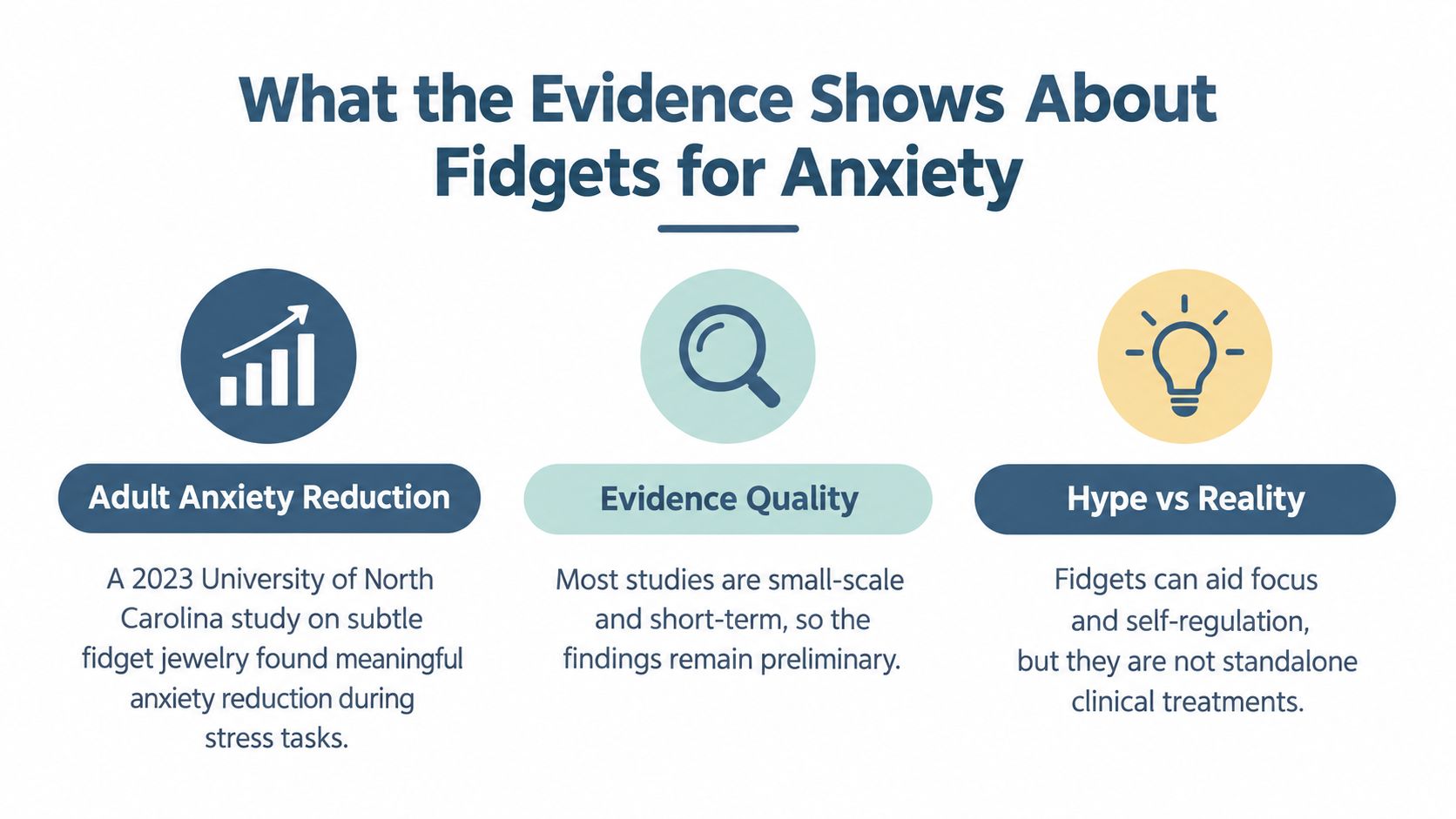
The adult evidence is promising in places, but it isn't strong enough to justify confident treatment claims. A 2023 University of North Carolina study tested 51 healthy adults who were randomly assigned to wear either a fidget ring or a placebo non-fidget ring for one week. At post-test, the fidget-ring group reported lower anxiety, with a very large reported effect size, while the placebo group showed no change, as described in the published study.
That design deserves attention. It used a randomized comparison and repeated daily surveys of anxiety, stress, attention, and engagement rather than relying only on a single moment in a laboratory. It also examined a wearable format that fits naturally into professional life. Still, the participants were healthy adults rather than a clinical population, the sample was small, and the outcomes relied on self-report. Those limits make it difficult to assume that the same result applies to executives with panic symptoms, trauma-related anxiety, major depression, ADHD, or substance-use disorders.
Subjective calm is not the same as clinical improvement
A person may feel calmer while using a tactile object, yet still have persistent avoidance, sleep disruption, compulsive reassurance seeking, or impairment at work. Those experiences can coexist. The practical question isn't whether a fidget feels pleasant. It's whether the tool helps the person remain present long enough to use a clinically useful response.
The evidence is also mixed. A 2025 controlled study in adults with ADHD found that fidget devices didn't significantly reduce self-rated anxiety or improve physiological stress markers during an anxiety-inducing task. The study reported no significant differences in heart rate, heart-rate variability, or intrinsic fidgeting between the fidget-ball group and the comparison group, and concluded that the device didn't improve self-regulation in that setting, according to this review of the adult anxiety evidence.
That result doesn't prove that every fidget fails. It shows why context, device type, diagnosis, and the person's intention matter. Fidgets for adults with anxiety should therefore be framed as adjunct coping aids, not standalone interventions. They may support grounding or attention shifts for some people, but they aren't established treatments for anxiety and shouldn't replace psychotherapy, medical evaluation, or substance-use care. A relevant clinical resource on grounding techniques for anxiety can help place tactile tools within a broader coping plan.
Discreet Fidget Options Suited to Clinical and Professional Settings
A professional setting imposes stricter requirements than a bedroom or informal living room. The tool must be quiet, visually unobtrusive, easy to clean, and unlikely to compete with the meeting, therapy exercise, or person speaking. A large object that demands visual attention may create more distraction than relief, even if it feels satisfying in private.
The most useful comparison is sensory rather than brand-based:
| Fidget category | Sensory profile | Professional suitability | Main trade-off |
|---|---|---|---|
| Tactile ring | Repetitive finger movement with limited visual demand | Strong for meetings, travel, and video calls | May become an automatic ritual rather than intentional grounding |
| Smooth stone | Pressure, temperature, and weight in the palm | Quiet and easy to conceal | Can be misplaced and may invite repetitive rubbing without awareness |
| Textured band | Light rubbing or rolling against the fingers or wrist | Suitable when appearance resembles ordinary jewelry | Texture may irritate sensitive skin |
| Compact manipulation tool | Buttons, ridges, rotations, or resistance | Useful in private settings and selected therapy work | Some mechanisms click, draw attention, or encourage visual focus |
| Soft squeeze object | Compression and release for muscular tension | Better for private offices, travel, or scheduled breaks | Larger shapes can look conspicuous and may become a constant escape behavior |
Match the tool to the anxiety pattern
Rumination often calls for a simple, repetitive sensation that doesn't require problem-solving. A smooth stone or rotating ring may offer enough sensory input to mark the present moment while the person follows a conversation.
Restless hands may respond better to pressure and release. A compact squeeze object can be useful before a presentation or during a private decompression period, but it may be unsuitable in a quiet therapy group if movement becomes noticeable.
Auditory sensitivity or distraction makes silent tools the priority. Any click, snap, or magnetic movement can pull attention away from a speaker and may affect other residents in a shared clinical environment.
Oral habits require particular caution in substance recovery. A person who bites pens, skin, or nails may ask about an oral sensory substitute, but hygiene, dental health, choking risk, and the possibility of compulsive substitution should be reviewed with the treatment team rather than assumed to be safe.
The most executive-appropriate option is usually the least interesting-looking one. A neutral ring or smooth object that can be used below the camera line is often more practical than a brightly colored device with multiple functions. The selection should reflect the intended setting, not the novelty of the object.
Safety Considerations for Dual Diagnosis and Substance Recovery
The assumption that fidgets are universally harmless deserves scrutiny. A tactile tool can support attention, but it can also become a way to avoid emotional contact, suppress information during assessment, or replace a substance-related ritual without addressing the underlying need. In dual-diagnosis treatment, the question is never only whether an object feels calming. The team must ask what behavior the object is reinforcing.
A client in early recovery may use a fidget during a craving discussion, trauma narrative, or medication-assisted withdrawal. That can be appropriate if the tool helps the client stay in the room and follow the intervention. It can become counterproductive if the person uses it to dissociate, shut down, avoid eye contact, or refuse to notice rising symptoms that require medical attention.

When a fidget helps
A licensed clinician may approve a fidget when it supports a defined objective, such as:
- Maintaining attention: The resident can listen, answer questions, and recall the discussion more effectively.
- Reducing harmful habits: The tool interrupts skin picking, nail biting, or object chewing without creating a more disruptive behavior.
- Practising grounding: The resident identifies texture, pressure, temperature, and breathing while remaining oriented to the present.
- Managing transitions: The object helps during a meeting, phone call, or move from individual therapy to a group setting.
When the tool needs review
A treatment team should reassess fidget use when the resident becomes distressed without it, uses it continuously during every emotionally difficult conversation, or reports that it eliminates awareness of cravings without improving decision-making. Excessive manipulation can also increase agitation, especially when the device is visually complex, noisy, or associated with compulsive checking.
Medication-assisted withdrawal and medication optimization require clinical oversight. A fidget cannot assess intoxication, withdrawal severity, medication effects, suicidality, or trauma activation. It shouldn't be presented as a substitute for medical care, psychotherapy, or a safety plan.
A coping tool is clinically useful when it expands a person's ability to participate. It becomes avoidance when it narrows what the person can tolerate without it.
The safest approach is collaborative. The resident, therapist, psychiatrist, and addiction professionals can agree on when the tool is permitted, what outcome it should support, and how they'll know whether it's helping. That structure protects the client from turning a discreet object into private self-medication.
How to Choose and Use Fidgets in Therapy and Daily Life
Selection should begin with the anxiety pattern, not with appearance or novelty. A person who becomes trapped in verbal rumination may need a quiet repetitive motion. Someone who experiences muscular tension may prefer pressure and release. A person who dissociates may need a grounding object used alongside orientation prompts rather than a device that absorbs attention.
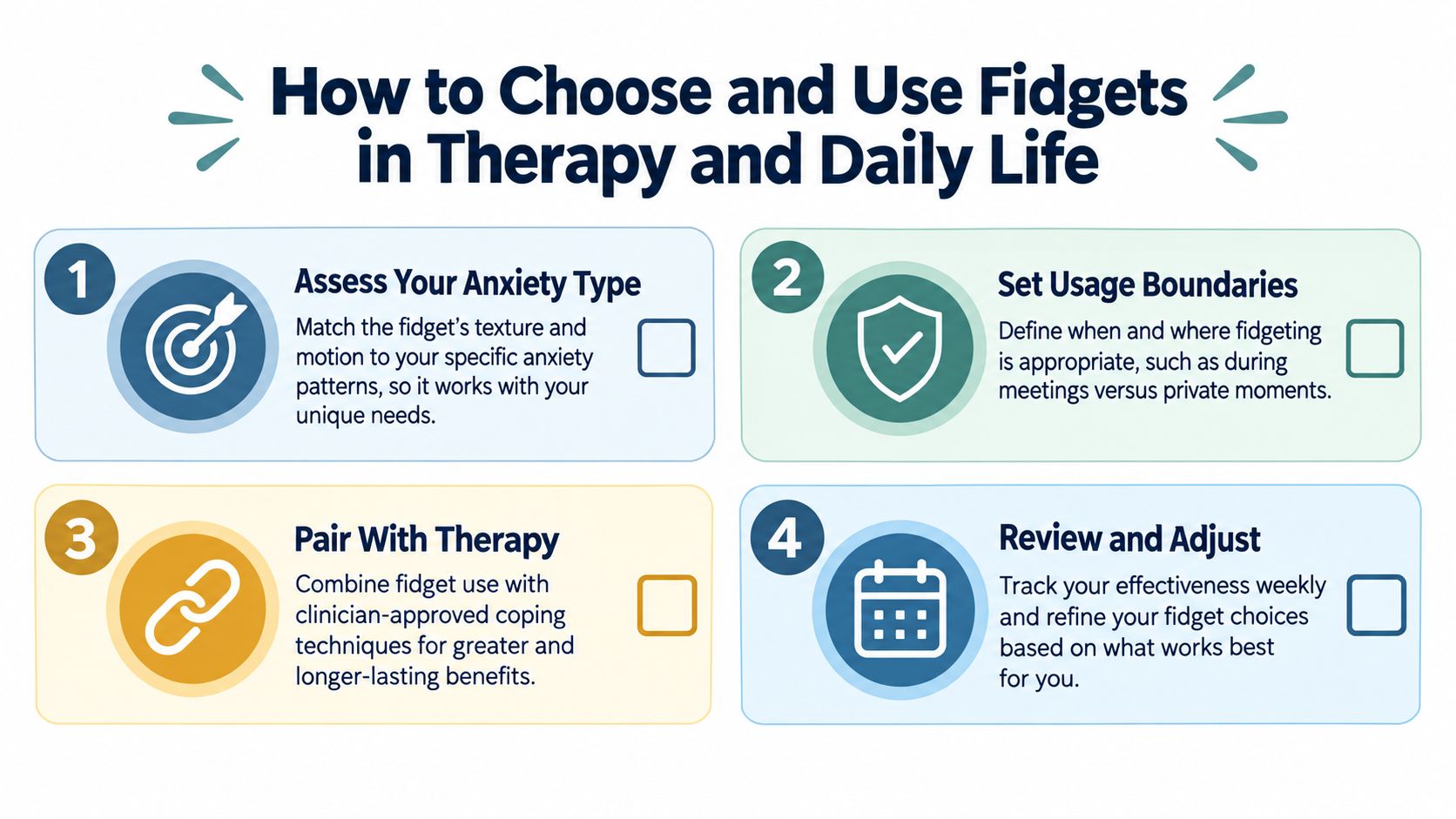
A practical process has four steps:
- Assess the trigger. Identify when the tool would be used, such as during presentations, travel, therapy, recovery meetings, or difficult phone calls. Note whether the main issue is restless movement, intrusive thought, sensory overload, or an urge to escape.
- Choose the smallest effective sensory input. Start with a quiet, neutral object that doesn't require visual monitoring. If it creates more distraction than stability, change the texture, resistance, or movement.
- Define boundaries. Decide whether the fidget is appropriate during a meeting, a group exercise, a medication appointment, or a private decompression period. A boundary prevents automatic use from becoming the only response to discomfort.
- Review the result. After use, ask whether the person stayed engaged, completed the task, and used another coping skill. A weekly review can reveal whether the tool is supporting progress or merely postponing difficult work.
Pair tactile support with active treatment
A fidget has more clinical value when paired with a skill. During cognitive behavioral therapy, the person might hold a smooth object while identifying an anxious prediction and testing its accuracy. During mindfulness practice, the person might notice texture and pressure, then deliberately widen attention to sounds, breathing, posture, and the surrounding room. During exposure-based work, the clinician may decide whether tactile support helps the client remain present or weakens the learning process by functioning as a safety behavior.
People seeking individualized support outside residential care can explore anxiety counselling for individuals as part of a broader professional plan. The goal isn't to accumulate coping objects. It's to build a flexible response that still works when the preferred object isn't available.
Career continuity also needs boundaries. Reflections says appropriate access to personal electronics, including cell phones and laptops, is allowed so residents can maintain career, school, and family obligations, with device use governed by clinical boundaries rather than unrestricted use, according to its description of electronics access in treatment. That arrangement can complement tactile grounding, but emails and fidgets shouldn't become ways to avoid therapy participation.
Guidance for Clinicians, Families, and Continuing Care
For clinicians working with executives in accredited dual-diagnosis treatment, a fidget should be assessed by its function, not its finish or price. Ask what preceded its use, what changed during the interaction, and whether the client remained engaged afterward. A concise record can capture the trigger, selected tool, intended skill, observed response, and any sign of avoidance, escalation, or intoxication-related risk.
The clinical question is whether the object supports participation. Attention means the client can follow the discussion and recall the agreed plan. Affect requires closer observation: tactile use may help the person tolerate emotion, or it may accompany numbness and disengagement. Substance risk also matters. An object may interrupt a harmful habit, yet become a compulsive substitute that deserves review.
Generalization separates a useful aid from a dependency. Can the client use breathing, cognitive restructuring, grounding, or interpersonal skills when the preferred object is unavailable? A reported sense of calm is relevant, but it is a subjective response, not evidence that anxiety, substance-related behavior, or functioning has improved. Clinicians should track participation, behavior, relationships, and work capacity over time rather than treating the fidget itself as the outcome.
Families can apply the same standard at home without policing every movement or treating a ring or stone as proof of recovery. Ask whether the tool helped the person stay present, communicate clearly, or use a planned coping strategy. This supports autonomy while keeping difficult conversations open. Families affected by disrupted trust or household stability may also use a mental health support groups guide for education and connection. Community support does not replace individualized treatment.
Accreditation gives referral sources and families a quality framework beyond polished surroundings. The Joint Commission describes an on-site survey that measures compliance with its standards and relevant CMS and OSHA standards in its accreditation overview. That review does not guarantee a particular result, but it offers a meaningful basis for evaluating residential care.
Continuing care should preserve the clinical logic established in treatment. Some clients may step down into structured inpatient therapy for anxiety before resuming full work obligations. Aftercare may then include psychotherapy, medication review when appropriate, family work, relapse-prevention planning, and recovery support. Boundaries for fidget use should travel across treatment, work, family life, and outpatient care, with safety reviewed if the object becomes compulsive, conceals worsening symptoms, or interferes with emotional processing.
Conclusion and Executive Takeaways
Fidgets for adults with anxiety have a defensible but limited role. A discreet ring, stone, band, or quiet tactile tool may help an executive remain engaged during a stressful moment, particularly when the object is paired with grounding, mindfulness, cognitive work, or another clinician-approved strategy. The adult evidence remains mixed, and one positive small study shouldn't be treated as proof of treatment-level anxiety reduction.
Fidgets are insufficient when they replace assessment, medication oversight, psychotherapy, withdrawal management, trauma work, or recovery planning. They also require review when they become compulsive, conceal worsening symptoms, or prevent emotional processing.
For high-performing professionals, the strongest model combines privacy, clinical accountability, individualized treatment, and practical continuity. A tactile object can support that model, but it can't carry it. Its value comes from helping the resident participate more fully in care and daily responsibilities while the accredited clinical team addresses the conditions beneath the visible restlessness.
Reflections provides private-room detox and residential rehabilitation for adults seeking high-end, confidential dual-diagnosis care, with an experienced clinical team and appropriately governed access to phones and laptops for essential career obligations. To discuss how discreet coping tools can fit within individualized treatment for anxiety and substance-use recovery, visit Reflections.