
A senior executive can spend years making difficult decisions under pressure while avoiding the one decision that would expose personal vulnerability. The board sees composure, colleagues see availability, and family members may see irritability, distance, or a nightly reliance on alcohol to come down from the day. By the time residential treatment becomes unavoidable, the clinical question isn't only how to stop substance use. It's how to create enough safety for an accomplished adult to examine trust, intimacy, conflict, and emotional regulation without feeling stripped of autonomy.
Attachment based therapy offers a framework for that work. It doesn't replace detoxification, medication management, relapse prevention, or treatment for depression, anxiety, trauma, or other mental-health conditions. Instead, it helps a treatment team understand what happens when closeness feels threatening, when help feels humiliating, or when alcohol and drugs become a dependable way to regulate distress.
What Attachment Based Therapy Actually Means
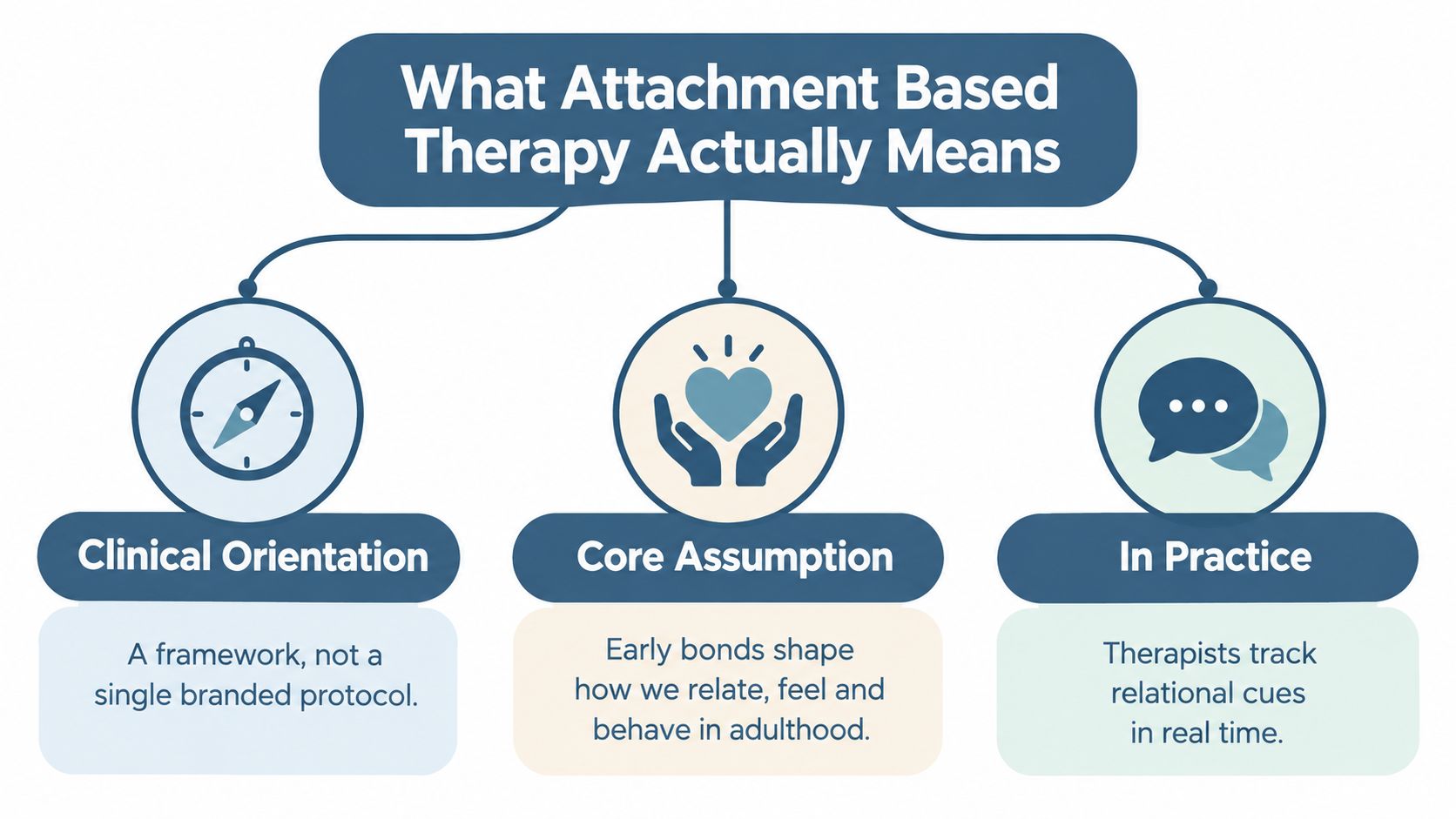
Attachment based therapy is best understood as a clinical orientation, not a single branded protocol. The therapist pays attention to how a client seeks safety, responds to dependence, handles conflict, interprets silence, and manages emotional closeness. Those observations shape the therapeutic relationship and the broader treatment plan.
A founder who can negotiate a complex transaction but cannot tolerate a partner's disappointment may not lack insight. A chief executive who dismisses every clinician's recommendation may be protecting autonomy learned under earlier conditions of unreliable care. Another professional may appear highly engaged while using alcohol each evening to avoid loneliness, shame, or unprocessed fear.
Attachment theory proposes that early caregiver relationships influence expectations about safety, emotional regulation, intimacy, and help-seeking. That doesn't mean childhood determines adult behavior, or that every difficulty traces back to a parent. It means the nervous system and the mind develop working assumptions about whether other people can be trusted, whether needs will be met, and whether vulnerability carries a cost.
A working framework, not a fixed label
Clinicians may use secure, anxious, avoidant, and disorganized attachment patterns as starting points. These patterns aren't diagnoses, personality verdicts, or excuses. A person can seek reassurance in one relationship, withdraw in another, and function securely with a trusted colleague.
The practical work involves noticing patterns without turning them into identity. A therapist might ask what a client expected to happen after disclosing a mistake, why a family conversation became intolerable, or how a craving changed after an argument. The answers can reveal mechanisms that purely cognitive work might not capture immediately.
Attachment based therapy overlaps with trauma-informed care because both approaches prioritize safety, collaboration, choice, and attention to the client's nervous-system responses. A stable therapeutic relationship matters in both. For readers exploring developmental trauma therapy, the central distinction is that attachment work focuses especially on relational expectations and the ways those expectations appear in treatment.
Practical rule: A secure therapeutic relationship isn't created by warmth alone. It requires predictable boundaries, clear explanations, appropriate challenge, and prompt repair when trust is strained.
The Theory Behind the Work
The field began with the work of British psychiatrist John Bowlby and Canadian-American psychologist Mary Ainsworth. Their collaboration began in 1950 at London's Tavistock Clinic, where Ainsworth worked with Bowlby from 1950 to 1953. Bowlby later presented formal statements of attachment theory to the British Psychoanalytic Society in three landmark papers, “The Nature of the Child's Tie to His Mother” in 1958, “Separation Anxiety” in 1959, and “Grief and Mourning in Infancy and Early Childhood” in 1960. These milestones are documented in the historical account of Mary Ainsworth's work.
Ainsworth's Baltimore project, conducted from 1962 to 1967, helped establish observational methods for evaluating infant-caregiver attachment. Her research contributed to the identification of secure, avoidant, and resistant or ambivalent patterns. The clinical value today isn't historical nostalgia. It lies in the idea that early relationships can influence how a person predicts safety, interprets distance, regulates emotion, and decides whether to seek help.

Theory becomes observable in the room
An executive with an avoidant pattern may describe treatment as a transaction and become distant when the therapist asks about fear. A client with anxious tendencies may seek frequent reassurance, then interpret an ordinary scheduling change as rejection. A person with disorganized experiences may want closeness and fear it at the same time, producing rapid shifts between disclosure and withdrawal.
A skilled clinician doesn't respond mechanically. The therapist may slow the pace, make the treatment rationale explicit, clarify what will happen next, and avoid forcing emotional exposure before stabilization. If a rupture occurs, the therapist names it and works to understand it rather than pretending the alliance remains intact.
This is also why information about healing from childhood trauma can be useful for families and referring professionals, provided it is applied carefully. Attachment history can inform a formulation, but it shouldn't become a universal explanation for addiction, depression, or every strained relationship.
For a high-responsibility professional, the theory has a direct operational implication. Treatment must preserve dignity and agency while making relational patterns visible. The clinician's task isn't to make the client dependent on therapy. It is to help the client tolerate appropriate dependence, communicate needs, repair conflict, and use support without surrendering judgment.
Techniques a Skilled Therapist Uses
Attachment based therapy becomes useful when it changes what happens in real interactions. The therapist observes the client's language, pace, posture, omissions, and response to challenge, then uses those moments as clinically relevant information rather than treating them as interruptions.
Guided emotional narration
Many high-functioning clients can describe events with precision but struggle to identify the feeling beneath the account. A therapist might ask a founder to revisit a board disagreement slowly:
- Event: What did the board member say?
- Meaning: What did that comment suggest about the client's competence or status?
- Emotion: Was the first response anger, fear, shame, or disappointment?
- Action: Did the client attack, withdraw, work late, or begin drinking?
This sequence builds reflective functioning. It helps the client consider internal states in self and others without immediately converting emotion into action.
The work may occur in individual psychotherapy, family sessions, or carefully structured groups. The format changes, but the purpose remains consistent: make automatic relational responses observable enough to evaluate.
Rupture and repair
A client may feel misunderstood when a therapist challenges a familiar defense. Instead of moving past the moment, the clinician can ask what the client heard, what was expected, and what response would have felt safer. That conversation models accountability without humiliation.
Mentalization develops through this process. A partner who says, “My adult children never respect me,” may be invited to consider several possibilities without abandoning the client's experience. Perhaps the children are angry, frightened, overwhelmed, or responding to repeated broken promises. The point isn't to excuse anyone. It is to widen the interpretation before choosing a response.
Family sessions can then test new behavior. A client may practice acknowledging impact, setting a boundary without threat, or tolerating silence without filling it with control. Experiential approaches can supplement verbal work when direct discussion becomes too intellectualized. Some clients find structured animal-assisted experiences meaningful, and resources on the healing nature of horses offer context for that kind of adjunctive work.
The therapeutic relationship is not a rehearsal for perfect relationships. It is a controlled setting in which trust, limits, disappointment, and repair can be examined safely.
What the Evidence Actually Shows
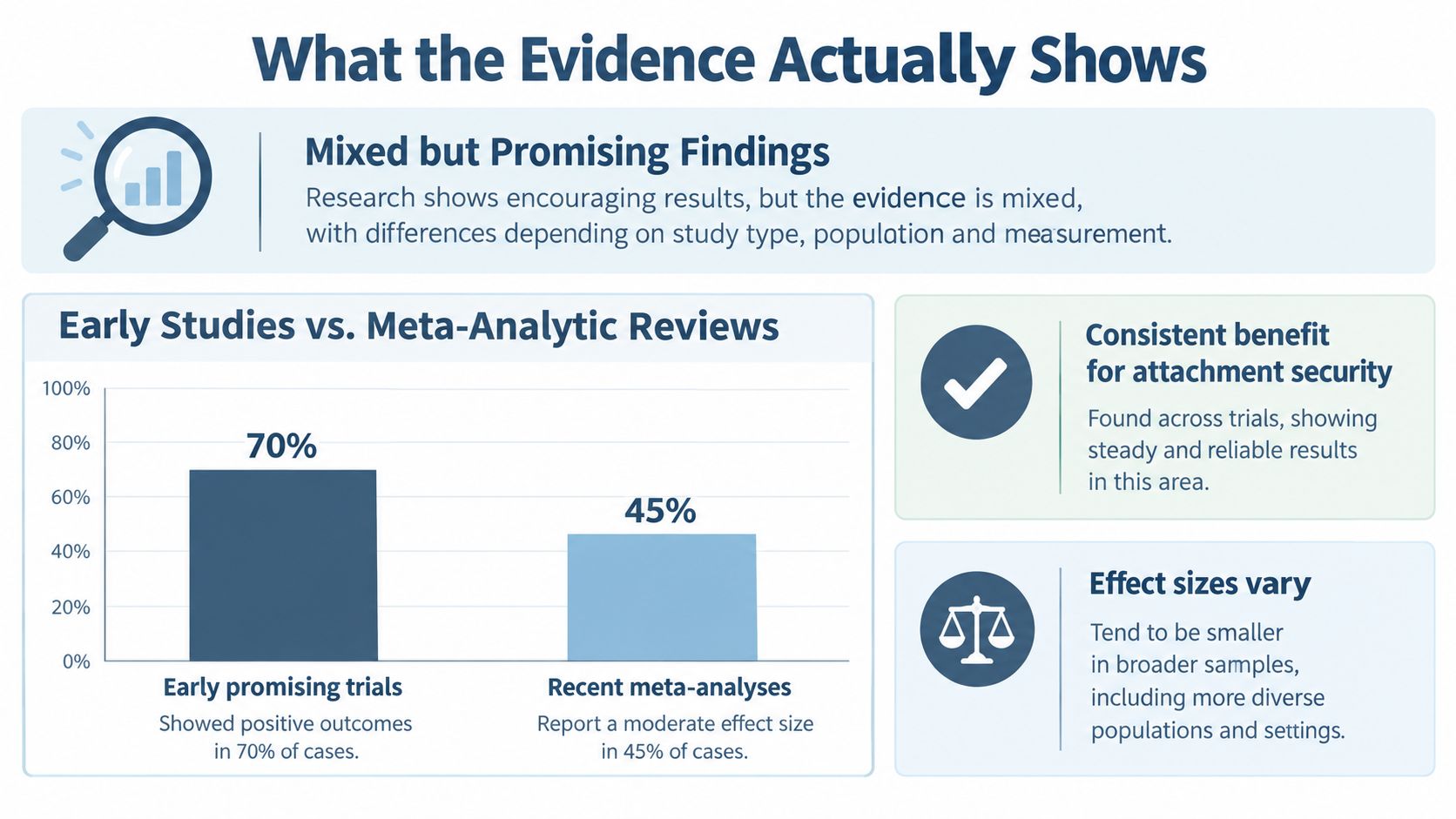
For an executive considering residential treatment, the evidence supports careful use, not inflated promises. An early study of Attachment-Based Family Therapy assessed 16 adolescents with major depressive disorder. Immediately after treatment, 13 adolescents, or 81%, no longer met criteria, compared with 7 of 15, or 47%, in a wait-list condition. On the Beck Depression Inventory, 62% of treated adolescents scored 9 or lower, compared with 19% of wait-list participants. At six-month follow-up, 87% of the treated sample no longer met criteria for major depressive disorder. These results are described in a peer-reviewed clinical review of attachment-based family therapy (source review).
The early findings are encouraging, but they do not predict outcomes for every client. A 2023 systematic review and meta-analysis of family therapy for adolescents with depression or suicidal ideation included nine studies involving 786 participants for depressive symptoms. The pooled Hedges' g was 0.08, with a 95% confidence interval from −0.10 to 0.25, which includes no effect. A later meta-analysis of four ABFT randomized controlled trials found no statistically significant advantage over comparator conditions for suicidal ideation or depressive symptoms. The pooled effect for suicidal ideation was g = 0.40, with a 95% confidence interval from −0.12 to 0.93.
What adult data adds
A meta-analysis of 36 psychotherapy studies involving 3,158 patients found that pretreatment attachment characteristics predicted posttreatment improvement with a small-to-moderate effect. The reported association was ρ = 0.17, with a standardized mean difference of d = 0.35, a 95% confidence interval of 0.13 to 0.22, and p < 0.001 (meta-analysis of attachment in psychotherapy).
The clinical interpretation remains modest. Secure attachment tends to accompany better starting and ending outcomes, while insecure attachment may signal difficulty trusting clinicians or using interpersonal support. Attachment style does not determine prognosis.
A high-quality residential program should track symptoms, substance use, attendance, family engagement, alliance ruptures, and discharge readiness. For an executive, that measurement also protects against polished but vague promises. Attachment-informed formulation is supported. Promising that attachment change alone will resolve trauma, depression, or addiction is not.
Why Attachment Work Matters in Dual Diagnosis
A senior executive may finish a difficult board meeting, return to an empty hotel room, and reach for alcohol before identifying the feeling underneath. Substance use can become a private way to manage loneliness, shame, conflict, emotional flooding, or fear of dependence. Alcohol may provide rapid decompression after sustained interpersonal demands. Stimulants or other substances may temporarily support control, energy, or emotional distance. The addiction still requires direct treatment, while an attachment-informed formulation clarifies the substance's role in the person's relational system.
A clinician may trace the cycle as follows:
- Attachment threat: criticism, perceived rejection, abandonment fear, or loss of control.
- Affect dysregulation: anxiety, anger, shame, numbness, or agitation.
- Craving or use: short-term relief, distance, or a sense of control.
- Interpersonal fallout: secrecy, broken trust, withdrawal, conflict, or professional impairment.
- New threat: consequences intensify the original fear and restart the cycle.
The map identifies intervention points without excusing use. Cognitive behavioral therapy can challenge interpretations and build alternative behaviors. Dialectical behavior therapy can strengthen distress tolerance and emotion regulation. Acceptance and commitment therapy can connect behavior with values. Motivational interviewing can address ambivalence without treating resistance as a character flaw. Attachment work helps the team judge how each method may be experienced by a client whose trust, privacy, and status make therapeutic dependence especially difficult.
Individual formulation matters
The evidence does not support treating insecure attachment as a simple cause of addiction. A peer-reviewed review describes insecure attachment as a risk factor in longitudinal findings, while noting that substance use can damage close relationships and that results vary by attachment pattern, substance, comorbidity, and age group (review of attachment and substance use).
A later focused review found mixed relationships among insecure attachment, treatment motivation, therapeutic alliance, and dropout, with context shaping the effects (recent review of attachment-focused psychotherapy). One study found that attachment-security grouping explained approximately 6% of additional variance in treatment adherence after sex and psychiatric comorbidity were controlled. That finding supports monitoring retention and alliance, not predicting recovery from an attachment category.
Clients considering dual-diagnosis drug treatment should expect attachment work to complement stabilization, medication management, relapse prevention, and evidence-based psychotherapy. A premium program should also protect confidentiality while addressing the relational patterns that keep treatment difficult to use.
Inside a Luxury Residential Program
A premium residential program should translate clinical sophistication into a setting that protects concentration, privacy, and therapeutic engagement. For an executive, that may include private rooms for every resident in both detox and rehabilitation, a quieter environment during early stabilization, and clear policies that allow appropriate access to cell phones and laptops so career obligations can be handled without allowing work to displace treatment.
Residential care is extended treatment rather than a short appointment model. The National Institute on Drug Abuse describes residential programs as inpatient care that usually lasts from a few weeks to a few months, with longer stays also possible. Programs may combine individual and group counseling, medication for substance-use and other health conditions, mutual-support access, and referrals to continuing care at discharge (NIDA treatment overview).

Coordinated care without clinical silos
Attachment-informed treatment works best when the team coordinates rather than creating a separate therapy track that ignores medical risk. A high-end program may bring together PhD-level psychologists, psychiatrists, licensed marriage and family therapists, certified addiction counselors, and adjunctive therapists. Their work can integrate CBT, DBT, ACT, motivational interviewing, individual psychotherapy, intensive groups, mindfulness, meditation, somatic approaches, art and music therapy, fitness, massage, nutrition, and equine or other experiential modalities.
Private family sessions and educational workshops can help relatives understand boundaries, relapse warning signs, communication patterns, and appropriate support. Remote participation may be possible, but the provider should clarify scheduling, consent, privacy, and whether family involvement is clinically safe.
Work continuity also deserves a written policy. The New York State Department of Health identifies vocational rehabilitation as a core service in many programs and reports that treatment can improve employment possibilities by as much as 40 percent (employment and addiction treatment guidance). That source doesn't establish that unrestricted electronics improve outcomes, so access should remain structured, clinically appropriate, and provider-specific.
Treatment lengths at Reflections typically range from 30 to 90 days, followed by continuing care, alumni programming, and flexible services. The important question isn't whether residential care feels luxurious. It's whether comfort, privacy, career coordination, and clinical structure help the client remain engaged long enough to build a sustainable transition.
How to Choose the Right Provider
Marketing language can make attachment-informed care sound interchangeable across programs. Due diligence should focus on who delivers treatment, how the program sequences care, and what happens when a client struggles with trust or wants to leave.
Joint Commission accreditation provides a concrete quality signal because an on-site survey evaluates compliance with performance standards intended to improve patient safety and quality. Its behavioral-health scope includes addiction treatment, mental-health services, and residential treatment. Accreditation indicates external review of care-delivery systems, not proof of superior outcomes, exclusivity, or a particular level of luxury (Joint Commission behavioral-health standards).
Questions that expose clinical substance
A prospective client or referring professional should ask for direct answers, not broad assurances.
| Area to Evaluate | What to Ask | Why It Matters |
|---|---|---|
| Clinical sequencing | How does the team decide when to prioritize stabilization, motivational interviewing, medication, trauma processing, or attachment exploration? | Emotional exposure before safety and medical stability can increase distress or disengagement. |
| Clinical team | Who provides psychotherapy, psychiatric care, addiction counseling, family work, and medication management? | Credentials and role clarity show whether care is coordinated. |
| Outcome monitoring | Which symptoms, substance-use risks, alliance concerns, attendance patterns, and discharge goals are tracked? | Attachment formulation should guide measurable treatment decisions. |
| Family programming | Are private family sessions and educational workshops available, and how does the team assess whether participation is safe? | Family involvement can support recovery, but it isn't appropriate in every relationship. |
| Electronics policy | Can residents use phones and laptops, during which periods, and how are work demands balanced with treatment? | Executives need continuity without turning residential care into remote office life. |
| Privacy | How are consent, permitted disclosures, emergency exceptions, employer inquiries, family contact, and media requests handled? | Executives face reputational exposure that requires specific communication controls. |
| Accreditation | What entity is accredited, what settings are covered, and is the status current? | The accreditation must apply to the actual services being considered. |
SAMHSA identifies federal confidentiality protections for substance-use-disorder treatment records maintained by federally assisted programs (SAMHSA laws and regulations). Those protections concern records and disclosures. They don't automatically guarantee anonymity, private rooms, or an undisclosed admission. A provider should explain its procedures before admission, not after a privacy concern arises.
Reflections is one California-licensed, Joint Commission-accredited option offering private residential dual-diagnosis care, multidisciplinary treatment, appropriate electronics access, family programming, and continuing-care planning. Prospective clients should still verify current policies, accreditation details, clinical fit, and privacy procedures directly.
Frequently Asked Questions
How much attachment work can happen during residential treatment?
Meaningful progress can begin during a 30 to 90 day residential stay, but attachment patterns usually develop over time and require continued practice. Residential care can establish safety, identify relational triggers, and begin repair work. Continuing care determines whether new behaviors survive ordinary family and professional pressures.
What if a client doesn't trust the team?
The therapist shouldn't demand immediate trust. The team can clarify boundaries, explain decisions, invite disagreement, and examine ruptures without punishment. Trust is built through repeated predictable behavior, not through forced disclosure.
Can family members participate remotely?
Often, remote sessions may be possible, but the provider must confirm scheduling, consent, privacy, technology policies, and clinical appropriateness. Family participation should support recovery rather than expose a client to coercion or unsafe contact.
How does attachment based therapy interact with medication?
It complements psychiatric assessment and medication management. Medication may address symptoms or withdrawal risk while attachment-informed therapy examines relational triggers, emotion regulation, and help-seeking. Neither approach should be presented as sufficient for every dual-diagnosis case.
What outcome should an executive expect?
The practical aim is not a permanent label change or effortless emotional security. It is improved capacity to recognize activation, tolerate vulnerability, repair conflict, use support, protect recovery, and make values-consistent decisions under pressure.
Reflections provides private-room detox and residential rehabilitation for executives and working professionals, with multidisciplinary dual-diagnosis treatment, appropriate electronics access, family involvement, and continuing-care planning. Visit Reflections to discuss whether its attachment-informed approach and confidential residential setting fit the client's clinical, professional, and personal needs.