
A senior executive can look polished in the boardroom and still feel unraveled the moment the room goes quiet. The calendar stays full, the title still matters, and the email inbox still moves, yet the body is reacting as if danger never ended. That split between outward success and private strain is where developmental trauma therapy becomes relevant, because the problem often isn't weakness or poor discipline, it's a nervous system shaped by repeated early adversity.
High-achieving adults usually don't present as “traumatized” in the obvious sense. They present as overcontrolled, chronically exhausted, reactive in close relationships, or dependent on substances, sleep aids, or work itself to stay functional. The work has to be private, structured, and serious enough for a person who cannot afford sloppy care or vague promises.
Recognizing Developmental Trauma in High-Achieving Adults
A managing director arrives in treatment after months of sleeplessness, a short fuse with colleagues, and a marriage that feels fragile even though the family appears stable from the outside. Nothing in the recent quarter explains the intensity of the reaction. The more conventional the success story looks, the easier it is for developmental trauma to stay hidden.
That happens because many professionals are excellent at building compensatory systems. They overperform, intellectualize, minimize, or stay busy enough that nobody sees the undercurrent of panic, shame, or relational fear. The symptom pattern can look like anxiety, depression, perfectionism, substance use, or a persistent sense of being on alert, even when the person has already tried standard therapy and “coping skills” without durable relief.
Practical rule: if a person can lead a team but cannot tolerate feedback, intimacy, uncertainty, or silence without dysregulation, the issue may be developmental rather than situational.
The clinical clue is not the job title, it's the way stress lands. Developmental trauma often shows up as a chronic mismatch between outward competence and internal regulation, which is why high-functioning adults are often missed until relationships, health, or work demands become unmanageable. For readers who want a broader adult-therapy lens, this trauma therapy for adults framing is useful because it keeps the focus on functioning, not just symptom labels.
A strong program does not ask whether the person “has trauma” in the simplistic sense. It asks whether repeated early adversity still organizes attention, attachment, self-worth, sleep, substance use, and conflict response. In practice, that is the difference between treating surface symptoms and treating the pattern that keeps recreating them.
Understanding Developmental Trauma Versus Other Trauma Disorders
A senior executive can look composed in a board meeting and still have a trauma pattern that shows up the moment the room gets quiet. Developmental trauma is shaped by repeated or chronic adversity during sensitive periods of child development, and expert review literature describes it as disrupting attachment, safety regulation, and later cognitive, emotional, and behavioral control. That broader injury pattern helps explain why many adults with developmental trauma do not fit a clean PTSD-only picture.
The overlap with PTSD is real and clinically important. In a national clinician survey summarized in 2023, comorbidity between developmental trauma disorder, or DTD, and PTSD was reported at 52.4% for adult criteria and 59.9% for child and preschool criteria (Joseph Spinazzola, 2023 summary). That means the conditions are intertwined, not neatly separate. A person can have traumatic stress symptoms and still need a very different treatment map because the root problem is layered and developmental. In adult residential care, that distinction matters because the treatment plan has to support ongoing professional responsibilities while the nervous system is still learning how to stay regulated.
What makes the pattern different
DTD is often expressed across multiple domains at once. Emotional dysregulation can sit next to somatic reactivity, cognitive distortions, behavioral impulsivity, identity confusion, and relational sensitivity. That is why a client may look steady in meetings but fall apart in intimacy, or stay sober during the workweek and relapse when shame or conflict spikes. High-functioning adults often hide this pattern by relying on competence, control, and overwork, which can delay care until stress starts breaking through the surface.
A useful way to think about the distinction is this:
- Single-incident PTSD often centers on one identifiable event and the memory network around it.
- Developmental trauma tends to be woven into the person's baseline sense of safety, self, and connection.
- Complex PTSD frameworks help describe some of that territory, but they still do not fully capture the range of developmental sequelae described in newer clinical literature.
One additional clue is prevalence in treatment settings. In a clinical sample of 271 children ages 8 to 18, 27% met criteria for DTD, and another study of 133 children found DTD in 21% of maltreated children and 15% of at-risk children (Joseph Spinazzola, 2023 summary). Those figures matter because they show the condition is not rare, especially in populations already carrying other psychiatric concerns. Adult-focused findings point in the same direction. In a study of 100 adults who had lived with childhood abuse or neglect, about two-thirds showed some form of adult attachment insecurity, which is one reason relationship strain often remains central long after the original trauma is over.
For adults, the practical takeaway is direct. If the person's symptoms cluster around chronic shame, unstable attachment, emotional flooding, shutdown, self-attack, or relationship instability, a trauma label alone is too narrow. The treatment plan has to account for developmental injury, not just memory recall, and it has to do so in a way that lets the person keep working, parent if needed, and preserve enough stability to return to real life with more capacity.
The Phased Treatment Model for Complex Trauma Recovery
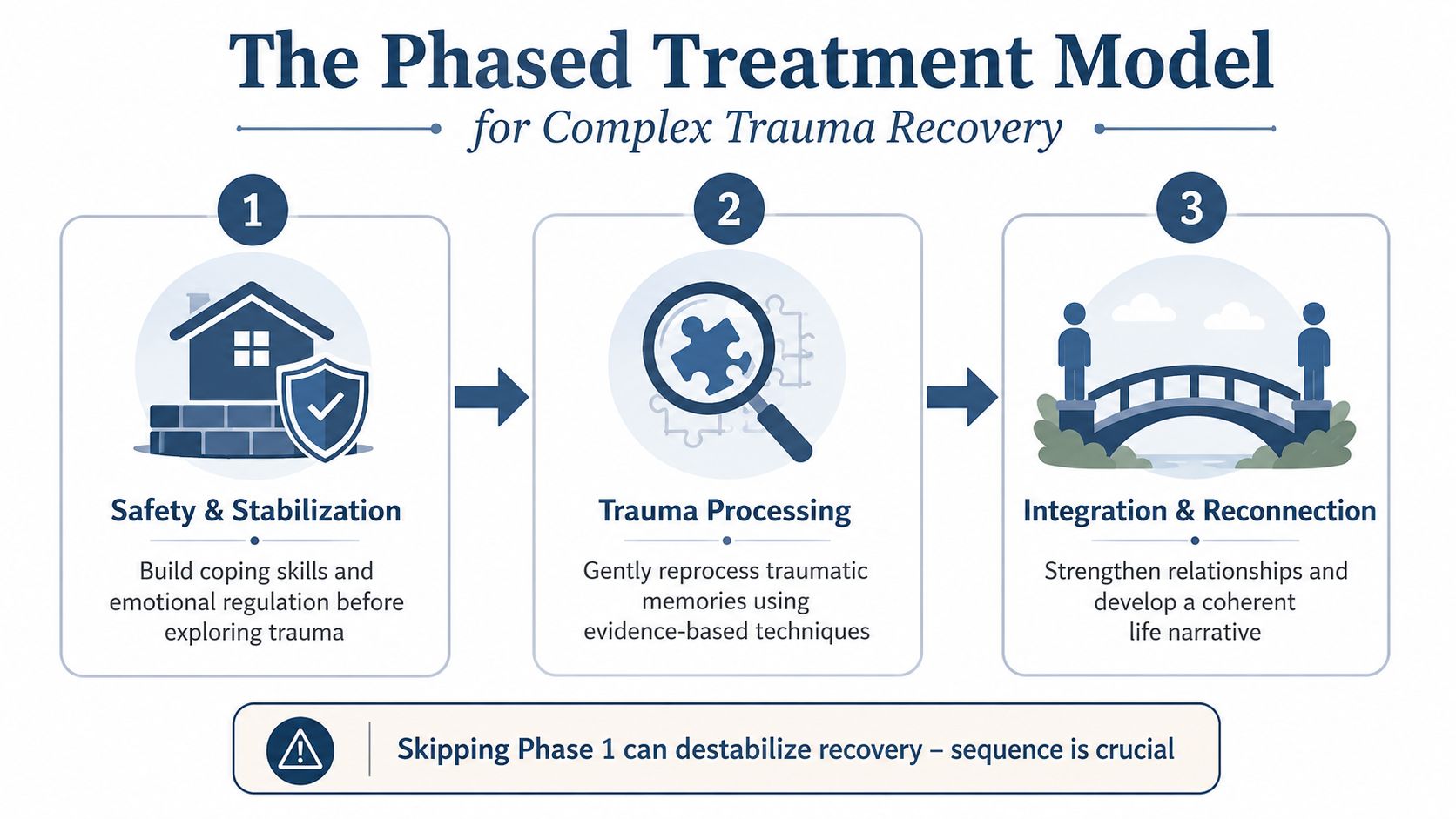
A luxury residential program should not start with trauma processing on day one. The phase model for complex developmental trauma moves through safety, self-regulation, self-reflective information processing, integration of traumatic experience into the life narrative, reengagement with relationships, and enhancement of positive affect (NCTSN complex trauma guidance). That sequence exists because unstable regulation can make direct trauma work backfire.
For executives, the pacing can feel slower than a productivity model. It is usually what allows treatment to work. A person who enters therapy with dissociation, impulsivity, or autonomic overload will not benefit from being pushed into raw exposure too soon. Stabilization is not avoidance. It is the clinical condition that makes deeper work possible while the person keeps enough steadiness to manage career obligations, family responsibilities, and the strain of returning to high-stakes decision-making.
What phase one really looks like
The first phase is about restoring enough control that the nervous system can stay present. In residential care, that often means grounding, distress tolerance, identifying feelings accurately, tracking body cues, and practicing communication that reduces conflict instead of escalating it. Families may notice the person becoming more organized and less reactive before any major trauma narrative has been touched.
Grounding and vagus nerve work can support that early stabilization, and resources like calm your nervous system naturally may supplement, not replace, clinical care.
A simple clinical rule applies here.
If the client cannot stay within a workable arousal range, the session should slow down.
That principle matters in a high-end setting where privacy, rooming, and schedule flexibility shape the treatment experience. An adult professional cannot always disappear from life for months, so the program has to be structured enough to support recovery without adding unnecessary disruption. The trade-off is real. More support and more containment usually mean slower trauma processing, but they also reduce the chance that the person leaves treatment more activated than when they arrived.
What phase two and three add
Once regulation improves, treatment can move toward processing and integration. That does not mean forcing someone to relive every painful detail. It means helping the client build a coherent story, connect current triggers to earlier learning, and repair the relational templates that still organize adult behavior. In a private, upscale residential environment, that work may happen alongside individual therapy, skills groups, and family sessions rather than in a single standalone method.
A body-based option can be useful when the person's trauma shows up somatically. For readers who want a closer look at that approach, somatic experiencing at Reflections is one example of how a residential setting can address nervous-system activation without rushing the process.
Evidence-Based Therapy Approaches for Developmental Trauma
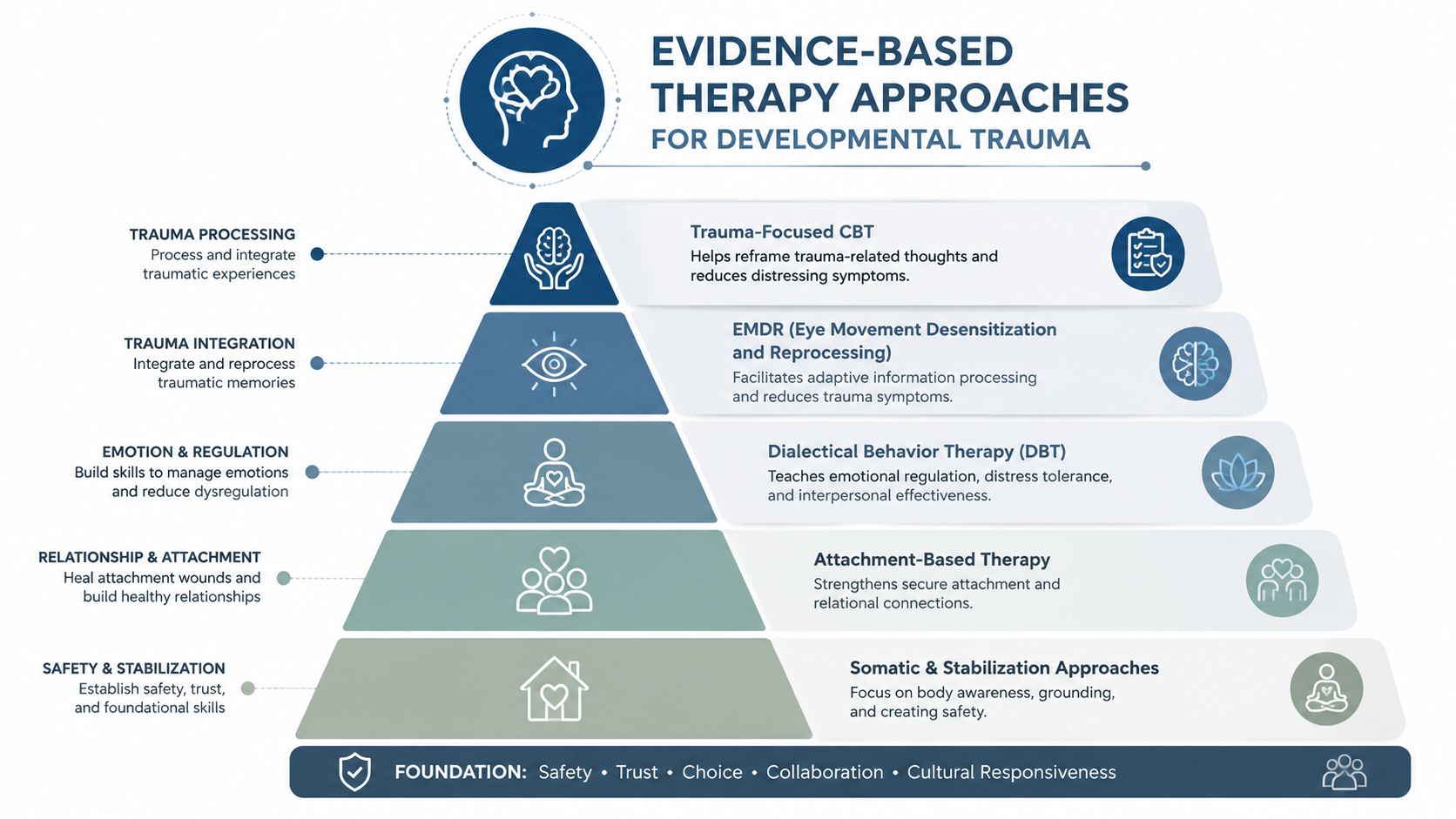
Different symptom profiles call for different tools. The strongest programs do not treat every trauma presentation with the same protocol, because developmental trauma often includes attachment injury, affect instability, and body-based hyperarousal that need more than insight alone. The goal is not to collect modalities, it is to match the intervention to the problem.
Matching the method to the symptom
TARGET is one of the clearest manualized models for adults who need something concrete. It explicitly organizes treatment around trauma processing and emotion regulation, using the FREEDOM sequence to help clients choose an adaptive focal point, recognize triggers, and reappraise emotion, beliefs, goals, and options (TARGET model). For a high-functioning adult, that structure can be easier to use than open-ended processing because it turns diffuse reactivity into a sequence of decisions.
Trauma-focused CBT adaptations are often useful when distorted beliefs are driving behavior, especially self-blame, danger scanning, and rigid control. EMDR, when adapted for developmental trauma rather than a single event, can help reprocess memories that still trigger body-level threat responses. Somatic therapies are a better fit when the person's symptoms are more physical than verbal, such as shutdown, agitation, nausea, or chronic tension.
Clinical caution: standard protocol work can move too fast for clients whose coping style is built on perfectionism or emotional suppression.
Why attachment and regulation still matter
Attachment-based therapy is not optional for developmental trauma. Early relational disruption leaves behind expectation patterns about trust, dependence, and repair, so treatment has to address relationship itself, not just symptoms in the abstract. For adults, this often shows up as a difficulty tolerating closeness, feedback, or loss of control.
A helpful adjunct for reflective work outside session is structured journaling, but only when it supports regulation rather than rumination. A resource such as shadow work journaling prompts anxiety can be useful if it's used to notice patterns, not to spiral into self-analysis.
Multidisciplinary care matters because developmental trauma does not stay in one lane. Medication optimization may support sleep, mood, or impulsivity, while psychotherapy handles meaning, behavior, and relational repair. In a well-run residential program, those layers are coordinated so the client is not left managing a fragmented care plan.
Integrating Trauma Therapy with Dual-Diagnosis Residential Care
A senior executive may arrive saying the alcohol or drug use is the problem, while the underlying pattern is years of managing shame, sleep disruption, and relational strain with substances. Developmental trauma and substance use often show up together, and residential treatment works better when trauma therapy and addiction care are built into one plan instead of split into separate tracks that compete for attention. For professionals who need discretion and continuity, that coordination can determine whether they enter care now or keep postponing it.
Reflections offers one example of that model. The setting includes private rooms and access to electronics, which lets residents stay connected to essential work responsibilities while still participating in treatment. It also provides clinically managed medication-assisted withdrawal and medication optimization when appropriate, which matters when trauma symptoms and substance use are both active. For a working adult, those details are not luxuries, they are the difference between entering care and delaying it again. For more on how integrated treatment supports both conditions, see our guide to dual-diagnosis treatment for trauma and addiction.
Why structure protects career continuity
Adults in demanding roles often need a program that respects real-world obligations without turning treatment into a side project. The right residential environment lets them participate in therapy, family work, and medical stabilization while keeping a basic connection to their professional life. That balance lowers resistance to admission because the person does not have to choose between health and total professional disappearance.
Family involvement also matters more than many executives expect. Private sessions and educational workshops can reduce conflict, clarify boundaries, and help relatives understand why the person is not “more stressed” but recovering from a deeper developmental injury. That support becomes especially relevant when relapse risk or emotional volatility affects the home environment.
A practical care plan often includes:
- Stabilization first, especially when withdrawal, sleep disruption, or mood instability are present.
- Trauma work in phases, so the person can stay functional while material is processed.
- Integrated supports, such as mindfulness, art therapy, and equine work, when they help the client stay regulated and engaged.
- Continuing care, because residential progress needs a bridge into outpatient life.
The time frame also matters. Treatment lengths commonly range from 30 to 90 days in residential settings at Reflections, followed by continuing care and alumni support. That gives enough runway to do meaningful work without pretending that a short stay solves years of dysregulation.
Choosing the Right Developmental Trauma Treatment Program
A strong developmental trauma program should be judged by what it can do, not by branding language. Accreditation matters, clinical leadership matters, and outcome measurement matters because adults with complex histories need more than a comfortable room and a vague promise of healing. The program should also show that it can treat the whole person, not just the diagnosis.
Questions worth asking before admission
A serious evaluation usually starts with the basics:
- Is the program Joint Commission accredited? That signals an external quality standard.
- Who leads the clinical work? Look for PhD-level oversight and a multidisciplinary team.
- What modalities are used for trauma, regulation, and dual diagnosis?
- How is progress measured from admission to discharge?
- What happens after residential care ends?
The program should also be explicit about whether it specializes in developmental trauma therapy or only offers generic trauma services. That distinction matters because developmental trauma often requires staged care, family work, and a slower pacing strategy than single-event trauma treatment.
Evidence of real structure is more persuasive than marketing language. A residential study of the Developmental Trauma and Attachment Program found statistically significant symptom decreases from admission to discharge, with medium effects across PTSD symptoms, and nearly one in three participants achieved clinically significant change while two in five improved without reaching that threshold (JCAD study). That's the kind of outcome language a thoughtful program should be willing to discuss plainly.
What to watch for
Programs should be transparent about flexibility for working adults, privacy, and continuing care. They should also be able to explain why they use a phase model, how they handle dual diagnosis, and how they support clients who can't afford a treatment plan that ignores career obligations. If those answers are vague, the fit is probably weak.
There is also a practical distinction between high comfort and high quality. A private room, discreet setting, and the ability to stay connected to work are helpful, but they only matter if the clinical team can manage trauma, addiction, and regulation together. For a professional with a full life to return to, that integration is the core requirement.
Frequently Asked Questions About Developmental Trauma Therapy
How long does treatment take? Residential care commonly runs for 30 to 90 days in luxury dual-diagnosis settings, but the timeline depends on how much stabilization is needed before trauma processing can safely begin. If sleep, substance use, or dissociation are still active, the first phase may take longer than the person expects.
Can a professional keep working during treatment? In a high-end residential setting, yes, to a limited and structured degree. Access to electronics and private rooms can make it possible to keep up with essential obligations without turning recovery into a nonstop workday, but the clinical team still has to protect treatment time.
Is medication part of the plan? Sometimes. Medication optimization and clinically managed withdrawal can support the therapy process when symptoms or substance use make regulation too difficult to achieve through psychotherapy alone. The goal is usually minimal, effective pharmacology rather than medication for its own sake.
What does success look like? It usually means fewer crises, better emotional regulation, less relational reactivity, and a more coherent sense of self. In residential outcomes research, improvement is common, but clinically significant change is achieved by a subset, which is why realistic expectations matter.
How does someone know they're ready to step down? The person should be able to tolerate distress, use grounding skills, communicate needs more clearly, and stay engaged without constant external containment. If those capacities are still fragile, a gradual transition is smarter than a rushed discharge.
Reflections offers residential dual-diagnosis care in a private, upscale setting, with trauma-focused treatment, family involvement, and support for working adults who need discretion and continuity. For professionals who want serious developmental trauma work without losing sight of career and family obligations, Reflections is a place to start the conversation.