

Effective BPD treatment for high-performing professionals usually requires a 30–90-day episode of integrated care, particularly when substance use is involved. DBT has reduced suicidal behavior and hospitalization in controlled research, but the strongest programs combine clinical fidelity, accredited systems, privacy controls, and enough flexibility for responsible professional continuity.
An executive may still be answering board messages from a hotel room while managing volatile relationships, escalating alcohol or medication use, and emotional reactions that feel impossible to contain. Public visibility makes the decision harder. Treatment must be clinically serious without creating unnecessary disruption, exposure, or loss of control.
Luxury alone doesn't answer the central question. The right treatment centers for borderline personality should show how clinicians assess risk, coordinate psychiatric and addiction care, measure progress, protect records, and plan the return to work. Amenities matter, but they come after safety, model fidelity, and continuity.
What Executives Should Look for in BPD Treatment
A chief executive arrives for an admissions consultation after a difficult quarter. The company remains stable, the calendar is full, and professional performance looks intact. Outside work, fear of abandonment, rapid shifts between idealizing and rejecting others, impulsive substance use, and prolonged emotional distress are affecting relationships and judgment.
That pattern requires more than a private setting with attractive amenities. Choose a program that can treat borderline personality disorder alongside addiction, trauma, PTSD, depression, or anxiety through one coordinated plan. Ask how clinicians assess overlapping conditions, manage risk, and transfer responsibility between psychiatric, psychological, and addiction professionals. Residential care may provide the structure needed for stabilization, but the program must also explain what happens after discharge.

Clinical structure comes before comfort
A credible center should name its treatment model, define each clinician's responsibilities, and show how individual therapy, group work, psychiatric care, and substance-use monitoring operate together. NICE recommends at least two coordinated treatment modalities, such as individual and group therapy, within a structured program built around an explicit theoretical framework shared by clinicians and the client. The guidance also calls for regular therapist supervision and outcome tracking across BPD symptoms, self-harm, substance and alcohol use, depression, and wider functioning. The NICE guidance for borderline personality disorder sets a useful clinical benchmark.
Ask how the program handles trauma and PTSD. Trauma work should not displace immediate safety planning, emotion regulation, or relapse prevention. A discreet environment can reduce exposure and support rest, yet privacy has value only when it protects focused treatment rather than disguising an unstructured wellness experience.
Flexibility must remain clinically accountable
Professional continuity can work when the treatment team sets clear limits for devices, work communication, meetings, and rest. Access to a laptop or phone is not automatically therapeutic. Clinicians should determine whether work contact affects sleep, emotional regulation, medication adherence, or participation, then document the agreed boundaries.
Ask these questions before admission:
- Work access: Can residents maintain limited professional contact without weakening treatment?
- Clinical coordination: Who integrates addiction treatment with BPD care, and who holds overall responsibility?
- Discretion: Which staff members manage communications, visitors, records, and transportation?
- Family participation: How are partners, relatives, or trusted advisers involved when appropriate?
- Transition planning: Which clinicians and supports remain available after residential care?
Practical rule: A luxury setting should make serious treatment easier to tolerate, not make weak treatment appear more credible.
For an executive, select the program that can protect dignity and professional privacy while delivering structured clinical work. The brochure matters less than the treatment model, accountability, coordination, and clear boundaries that staff can demonstrate before admission.
Evaluating Clinical Credibility and Accreditation
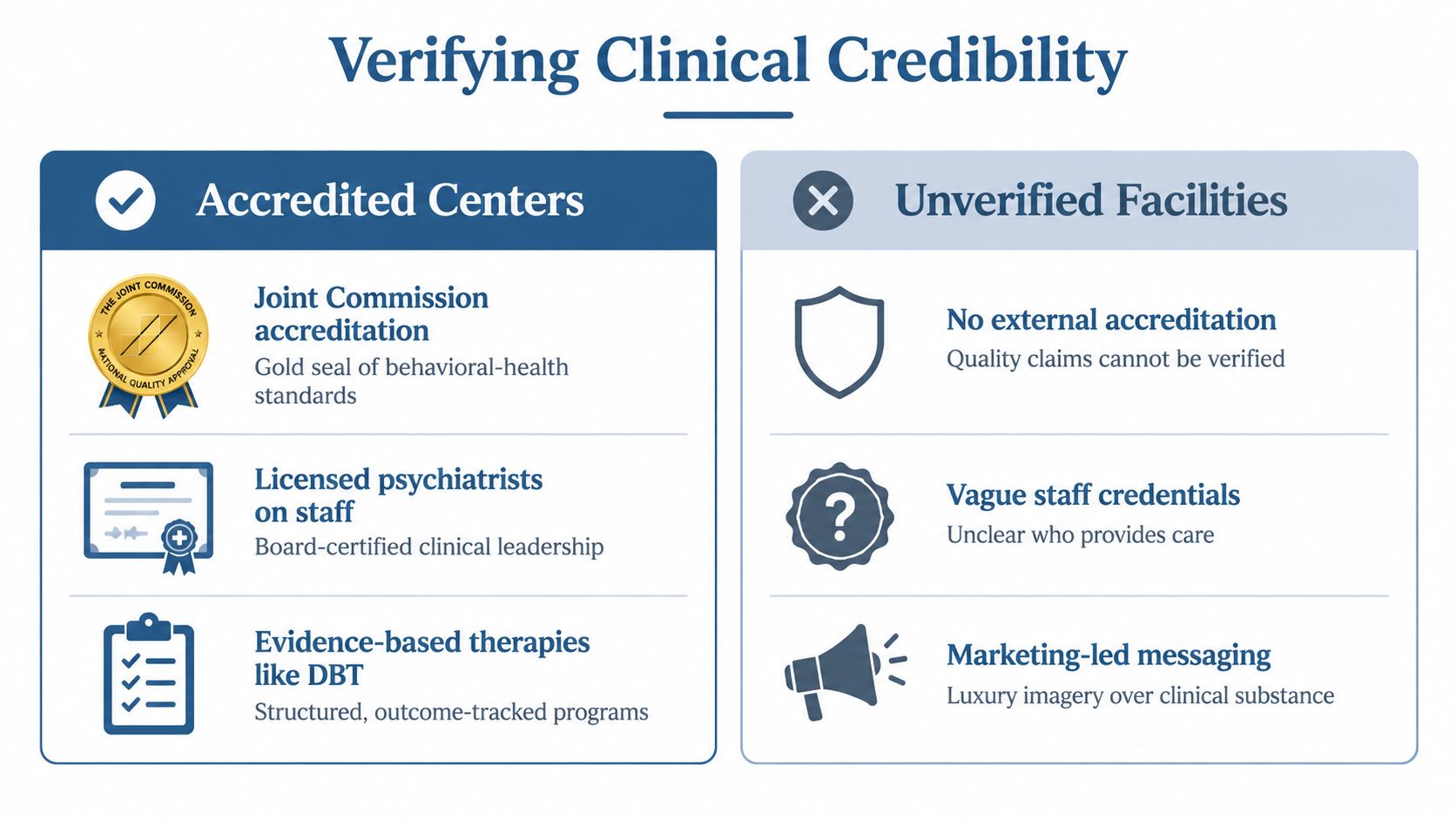
Clinical credibility requires evidence. Families and referring professionals should examine external review, licensed clinical leadership, defined treatment protocols, supervision, and outcome measurement. Photographs, testimonials, and claims of exclusivity do not establish clinical quality.
Joint Commission behavioral-health accreditation applies to residential, outpatient, partial-hospitalization, detoxification, addiction, dual-diagnosis, and mental-health programs. Accreditation includes an on-site survey, during which surveyors assess compliance with applicable care and safety standards. The award lasts three years, making it a time-limited organizational review rather than a permanent endorsement. The Joint Commission behavioral-health accreditation guide explains the survey and accreditation framework. For how Reflections interprets this process, see what Joint Commission accreditation means for behavioral health programs.
What accreditation can and cannot establish
Accreditation confirms that an organization has undergone external evaluation of relevant systems. It does not guarantee a particular outcome for every resident, demonstrate that residential care is medically necessary, or prove that the program delivers DBT with fidelity. Those questions require a separate clinical review.
Use the admissions conversation to request specific evidence:
| Claim under review | Evidence worth requesting |
|---|---|
| Accredited behavioral-health program | Current accreditation status and applicable service scope |
| Evidence-based BPD treatment | Named modalities, therapist qualifications, supervision, and treatment schedule |
| Integrated addiction care | Substance-use assessments, withdrawal protocols, medication management, and relapse-prevention planning |
| Clinical effectiveness | Measurement of symptoms, self-harm, substance use, depression, functioning, retention, and follow-up |
| Executive discretion | Written privacy procedures, access controls, communication rules, and authorization practices |
A facility should identify who delivers treatment, how clinicians receive supervision, and how outcomes are recorded. Detailed answers give families and referring clinicians a basis for determining clinical fit. Vague assurances leave the decision dependent on marketing.
Outcome measurement should reflect real risk
BPD care requires more than a symptom checklist. The treatment team should monitor behavioral risk, substance and alcohol use, mood, functioning, and engagement with the program. These measures show whether a resident is becoming safer and more capable in daily life, rather than reporting temporary relief alone.
Use evidence carefully. The DBT evidence review and randomized-trial summary reports that a two-year randomized trial found participants receiving DBT were approximately half as likely to make a suicide attempt as those receiving community treatment from expert clinicians, while also requiring less hospitalization for suicidal ideation. The review covered 20 randomized controlled trials involving 1,375 participants, finding a medium effect on overall BPD severity, with an effect size of 0.59, and a small-to-medium effect on self-injury, with an effect size of 0.40. The DBT evidence review and randomized-trial summary supports benchmark-based communication rather than promises of universal remission.
Accreditation, measured outcomes, and a transparent clinical model provide a more reliable credibility test than luxury branding. For executives, that distinction protects professional continuity from being mistaken for clinical excellence.
DBT Fidelity and Dual-Diagnosis Integration
A weekly skills group doesn't automatically constitute DBT. Executives and families should distinguish between a program that uses DBT terminology and one that organizes treatment around DBT principles, therapist supervision, coordinated care, and measurable behavioral targets.
A credible program should explain how individual therapy, skills training, between-session support, psychiatric care, and consultation among clinicians work together. The DBT program information can help referring professionals identify the components that deserve attention during an admissions review, including the difference between a structured model and a loose collection of techniques.
Compare the treatment pathways honestly
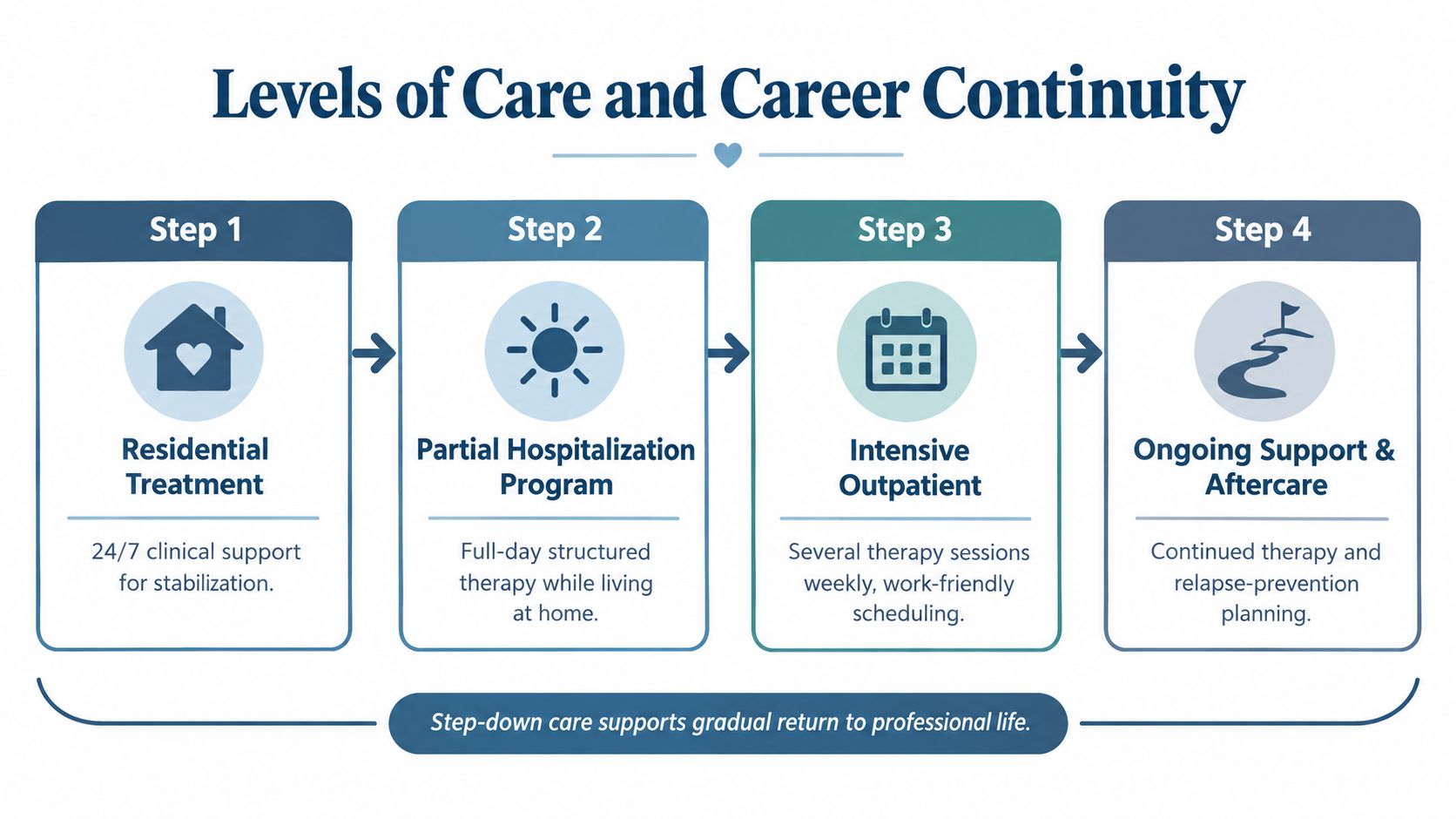
Residential treatment offers the greatest environmental containment. It can be appropriate when substance use, withdrawal concerns, self-harm, severe functional impairment, unstable housing, or repeated crises make ordinary outpatient care unsafe or ineffective. The trade-off is interruption of normal routines and greater separation from professional responsibilities.
Partial hospitalization provides intensive daytime treatment while the resident lives outside the program. This can preserve more independence, but it depends on a safe and stable living environment, reliable transportation, and the ability to manage distress outside scheduled care.
Intensive outpatient treatment can suit a professional who is medically stable, has dependable housing, and can attend several structured sessions each week. It supports work continuity more directly, but it offers less containment during acute emotional or substance-related destabilization.
Hybrid or telehealth care can reduce travel and maintain access when geography, privacy, or work demands create barriers. It also introduces risks involving missed sessions, privacy at home, technology access, crisis escalation, and dropout. A 2025 telehealth DBT study reported self-harm participation falling from 80% before treatment to 28% afterward, while 38% of participants dropped out, illustrating why retention and crisis planning must be measured alongside symptom change. The telehealth DBT findings and implementation discussion provide useful context.
Addiction care must stay inside the same pathway
Separate treatment tracks create avoidable gaps. A resident may learn emotion-regulation skills in one setting while substance use is monitored somewhere else, leaving the most dangerous triggers untreated. Integrated care places substance-use assessment, relapse-prevention planning, medication decisions, cravings, interpersonal conflict, and emotional dysregulation within one coordinated plan.
The clinical team should also ask how missed sessions, renewed substance use, self-harm urges, and requests to leave are handled. A rigid program may lose engagement, while an overly permissive program may fail to contain risk. Effective adaptation preserves the core treatment model while adjusting scheduling, communication, family involvement, and therapeutic pacing to the resident's capacity.
More intensive care isn't automatically more effective if the format causes disengagement.
The relevant questions are direct:
- Which DBT components are delivered, and how often?
- Who supervises the therapists?
- How are self-harm and substance-use outcomes tracked?
- What happens after a missed session or positive substance screen?
- How does the team coordinate psychiatric, addiction, trauma, and family work?
- What retention and follow-up measures does the program share?
The right pathway is the one that combines safety with participation. For a working professional, clinical sophistication includes knowing when to intensify care and when flexibility will produce better engagement.
Levels of Care and Career Continuity
Residential placement should follow clinical need, not exclusivity. Australian national guidance states that most BPD treatment should occur through community mental-health services, while inpatient care is generally reserved for short-term crisis intervention involving high suicide risk or medically serious self-harm. It also recommends concurrent, integrated treatment when BPD occurs alongside substance use, mood, anxiety, or eating disorders. The national BPD clinical guideline supports a measured pathway rather than assuming that a longer admission produces better care.
Step 1 Assess the actual reason for admission
Start with medical and psychiatric safety, functional impairment, withdrawal risk, housing, continuity of care, and the ability to address BPD and substance use together.
Consider two executives with similar diagnoses. One has escalating suicidal intent after medically serious self-harm and needs immediate crisis stabilization before any planned residential episode. The other has no acute danger, but deteriorating work performance, strained relationships, increasing substance use, and poor capacity to attend standard appointments. The first requires containment and medical oversight. The second may qualify for intensive outpatient care, provided the schedule, monitoring, and clinical access offer enough structure.
That distinction prevents a luxury setting from becoming the reason for admission. The team should document why the proposed level is safer and more workable than community treatment, intensive outpatient care, partial hospitalization, or a short inpatient stay.
Step 2 Match structure to professional demands
Executives should ask whether the program permits controlled electronics access, protected work periods, and communication with necessary professional contacts. Professional continuity can support identity and responsibility when it remains subordinate to treatment and does not increase agitation, sleep disruption, or avoidance of therapy.
Set the boundaries in writing. The plan may define limits on meetings, protected therapy times, rules for urgent business communication, and a process for reviewing whether work contact remains clinically appropriate. A program that promises unrestricted access without assessing its effect on recovery is offering convenience, not individualized care.
Step 3 Demand a measurable transition plan
A strong discharge plan identifies the next clinicians, therapy frequency, medication follow-up, substance-use monitoring, family supports, crisis contacts, and relapse-prevention strategies. It should state how the resident will move from residential treatment to partial hospitalization, intensive outpatient care, outpatient therapy, or ongoing support.
Consistent with the guidance referenced earlier, brief interventions of fewer than three months should not be presented as a complete BPD treatment episode. The NICE's treatment recommendations reinforce the need to plan continuity rather than treat discharge as the endpoint. A 30–90-day residential episode can be reasonable when it includes outcome measurement, active handover, and scheduled step-down care.
Step 4 Review the program's accountability
Before admission, families and referring clinicians should request evidence of therapist supervision, family involvement, outcome tracking, emergency utilization, self-harm frequency, substance-use outcomes, completion of core DBT components, and follow-up engagement. Ask who receives the data, how often it is reviewed, and what triggers a change in care level.
Career continuity is a clinical planning issue. The right program protects professional obligations only when that protection supports safety, participation, and durable recovery.
Privacy, Discretion, and Executive-Specific Needs
A public executive may need treatment without exposing a diagnosis, family conflict, or leave of absence to colleagues. Confidentiality affects whether care can begin safely, whether relatives can participate openly, and whether the executive can resume professional duties without an avoidable disclosure.
Accredited behavioral-health organizations must protect health information. Disclosure requires the individual's authorization unless the law permits otherwise, and the organization should maintain written policies governing access, use, and disclosure. The Joint Commission behavioral-health standards sampler outlines the relevant privacy and information-security framework. Learn how these requirements are operationalized at Reflections in its HIPAA compliance standards.

Ask for controls, not reassurance
An executive or family representative should request specific answers about:
- Authorization procedures: Who may receive updates, and how are permissions recorded?
- Record security: How does the program limit access to clinical records and treatment plans?
- Communication rules: How are calls, emails, visitors, transportation, and professional contacts handled?
- Staff access: Which employees can view identifying information, and how is access monitored?
- Discharge coordination: How are records transferred to community clinicians with the resident's authorization?
Privacy standards establish a baseline, not absolute secrecy. Accreditation alone does not create executive-specific arrangements. Before admission, the facility should explain its access controls, staff procedures, communication rules, and incident response. Staff should answer precise questions directly rather than rely on general assurances.
Clinical excellence and discretion must support each other
A private room can limit unnecessary exposure, but it cannot replace psychiatric oversight, integrated addiction treatment, or a clear risk plan. Electronics access can preserve work and family contact when clinically appropriate, provided the program sets boundaries. An elegant setting may reduce practical friction, yet it does not demonstrate that treatment fits the person's risks.
Use a clear sequence. Confirm that the program can manage the presenting risks. Verify accreditation, clinical leadership, DBT structure, dual-diagnosis capability, and outcome measurement. Then review privacy policies, room arrangements, electronics rules, family participation, and professional communication. Each accommodation should support treatment participation.
Reflections is a California-licensed, Joint Commission-accredited luxury residential setting for adults with co-occurring mental-health and substance-use disorders. It offers private rooms in residential and detox programs, appropriate electronics access, multidisciplinary care, DBT, medication-supported withdrawal when clinically indicated, and continuing-care planning for professional and family responsibilities. Its team includes PhD-level psychologists, psychiatrists, LMFTs, addiction counselors, and adjunctive therapists. Treatment lengths typically range from 30 to 90 days.
Executives, families, and referring clinicians can assess whether Reflections' private residential and detox care, integrated BPD and addiction treatment, electronics policy, and continuing-care planning fit the individual's clinical and professional needs. Visit Reflections to begin a confidential conversation about admissions and clinical fit.