

At 11 p.m., a managing partner closes a board deck and reaches for the last email. An old voicemail appears in the thread. The pulse spikes, the room feels unsafe, and the next morning's presentation becomes another exercise in hiding symptoms behind competence.
ACT therapy for PTSD deserves serious consideration here. Acceptance and Commitment Therapy doesn't ask a high-performing professional to abandon identity, responsibility, or ambition. It builds psychological flexibility, so distressing thoughts, physical surges, avoidance, and shame stop dictating every important decision.
When an Executive Finally Says Enough
An executive may seek treatment after sleep deteriorates, alcohol becomes a nightly reset, concentration narrows, or an ordinary disagreement feels like an attack. Meetings still happen. Contracts still get signed. Public composure remains intact while private decisions increasingly revolve around triggers.
A skilled trauma clinician starts with the practical consequences. The first conversation should assess regulation, judgment, relationships, sleep, substance use, and values instead of demanding a diagnostic identity before trust has formed.
ACT changes the relationship with distress
ACT is a third-wave cognitive-behavioral model grounded in Relational Frame Theory. Its central premise is demanding but useful: painful thoughts and feelings do not have to disappear before a person can act effectively. The client learns to experience them as survivable internal events rather than instructions.
Trauma therapy can become heavily focused on narrative. That approach has a place when explicit memory processing is clinically appropriate, yet it can frustrate an executive who already analyzes every conversation, decision, and failure. ACT directs attention toward the avoidance patterns operating today.
A client may learn to say, “The memory is here,” without concluding, “The memory determines what happens next.” The distinction preserves choice while acknowledging the trauma's seriousness.
Why the model fits high-functioning clients
ACT does not require detailed disclosure on the first day. Treatment can begin with present-moment awareness, willingness, values clarification, and behavioral patterns while the clinician evaluates readiness for trauma processing. This pacing suits professionals who need privacy and a plan that respects existing responsibilities.
The model also fits dual-diagnosis care. Alcohol, stimulants, compulsive work, and emotional shutdown may all serve as attempts to escape internal distress. ACT identifies both the immediate relief and the longer-term cost, without reducing the client to a substance-use label.
Practical rule: A treatment plan should preserve the client's dignity and agency while making avoidance impossible to ignore.
A premium residential setting can support that balance through private rooms, discreet clinical care, structured routines, and controlled access to electronics. Device use can be structured and phased according to treatment level and clinical readiness, rather than prohibited universally. Executive-oriented residential care may also provide private accommodations, work-compatible planning, and case-by-case electronics access. Ask for the written policy before admission, including when devices are available, who approves access, and how clinical priorities override work demands.
Values clarification gives the work a practical direction. The question is not merely how to reduce symptoms, but which professional, partner, parent, or leader the client intends to be while difficult internal experiences remain present.
ACT allows a professional to keep meaningful responsibilities in view while undertaking deeper treatment. The goal is to prevent trauma from setting the calendar, relationships, and decisions by default.
The Six Core Processes of ACT Explained Simply
ACT uses six overlapping processes to develop psychological flexibility. They aren't a rigid staircase. A clinician may move between them several times in one session, depending on whether the client is fused with a thought, avoiding a sensation, disconnected from the present, or unclear about what matters.
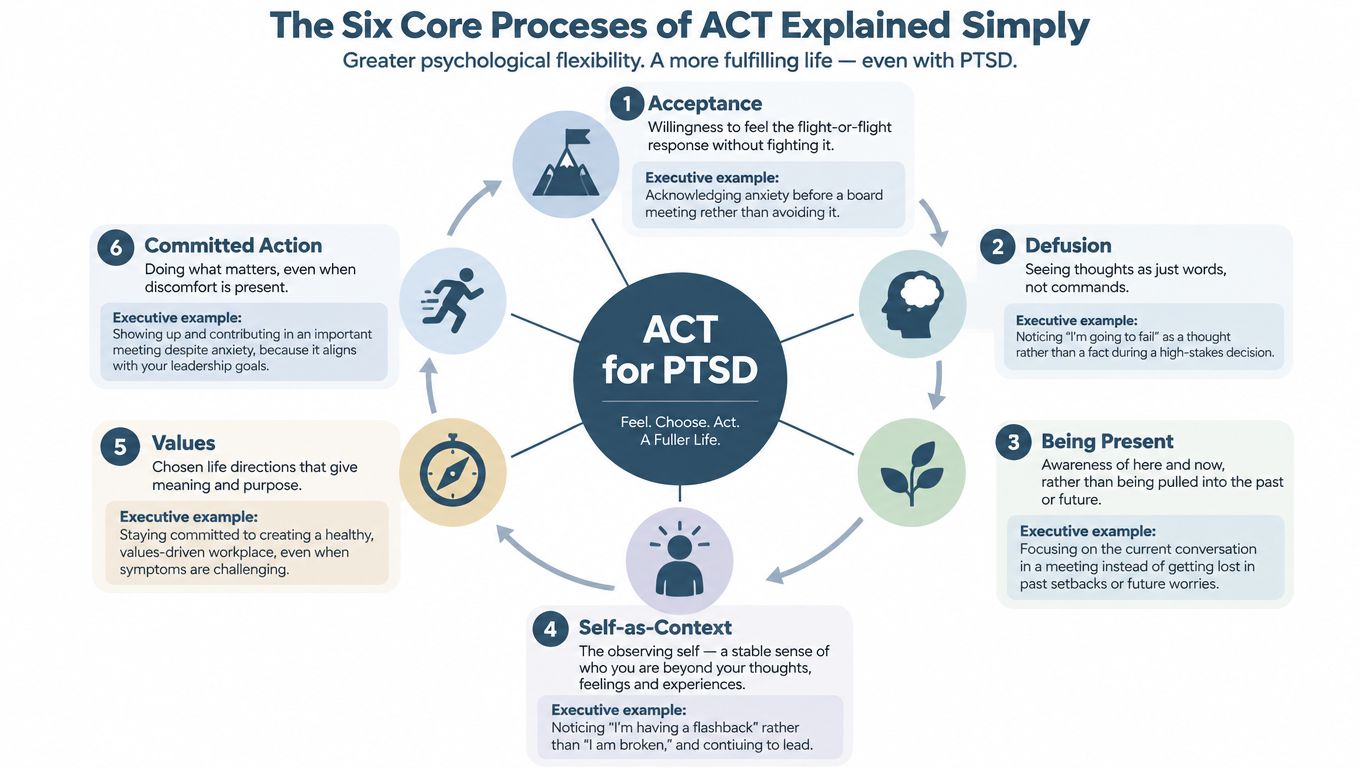
Acceptance
Acceptance means making room for internal experiences without immediately trying to suppress, escape, or medicate them. It doesn't mean approving of trauma or surrendering to fear.
An executive might notice the flight-or-fight surge before a keynote, feel both feet on the floor, and allow the sensation to rise and fall without taking an unnecessary sedative or canceling the event. The clinician watches for pacing problems. Too much intensity too soon can become flooding, not therapeutic willingness.
Cognitive defusion
Cognitive defusion creates distance from thoughts. Instead of treating “My reputation will collapse” as a fact, the client notices, “The mind is producing a reputation-collapse story.”
That small linguistic shift can interrupt automatic behavior. The thought remains present, but it no longer has unquestioned authority.
Present-moment awareness
Present-moment awareness brings attention back to what is happening now. During a tense email exchange, the executive may notice a clenched jaw, shallow breathing, and a racing prediction about retaliation before replying.
The point isn't to become calm on command. The point is to create enough awareness for a deliberate response rather than an impulsive one.
Self-as-context
Self-as-context separates the observing self from the content of experience. The client can acknowledge that one part carries trauma, shame, or vigilance without defining the whole person by those experiences.
For a chief executive or founder, this distinction is powerful. The part that survived trauma isn't the entire person, and it isn't the only part capable of leadership, intimacy, judgment, or repair.
Values clarification
Values clarification identifies chosen directions rather than inherited obligations. A client may discover that being a present parent, measured leader, or steady mentor matters more than meeting every external performance demand.
Values aren't goals with a finish line. They guide choices when symptoms remain uncomfortable.
Committed action
Committed action turns values into observable behavior. The client might schedule a protected family dinner, delegate a decision instead of controlling it, or attend a recovery group despite discomfort.
A plain-language overview of ACT principles can also help clients understand how the model applies across emotional concerns, including the resource mind-body ACT for depression. For a residential perspective, treatment planning can be explored through acceptance and commitment therapy at Reflections.
What the Clinical Evidence Actually Shows
The evidence supports ACT as a serious PTSD intervention, but it doesn't justify inflated promises. A 2024 meta-analysis included 11 studies and found a moderate, statistically significant post-treatment effect on trauma symptoms, with Hedges' g = -0.423, a 95% confidence interval from -0.605 to -0.240, and low heterogeneity of I² = 25.75% (2024 trauma-related ACT meta-analysis).
A 2025 systematic and meta-analytical review identified 25 studies overall, with 20 included in the meta-analysis. It reported a large mean effect size of 1.274, with a 95% confidence interval from 0.906 to 1.643, for reducing PTSD-related symptoms and related outcomes (2025 ACT review for PTSD). That scale matters because the field has moved beyond isolated pilot work toward quantitative synthesis across clinical populations and study designs.
A separate review also described a randomized trial involving 40 U.S. veterans, with 21 participants receiving ACT and 19 receiving person-centered therapy. The ACT group showed significant improvements in PTSD symptoms, social relationship quality, mindfulness, valued living, and experiential avoidance through post-treatment and follow-up (review of PTSD interventions and veteran trial).
How to interpret the evidence
The data support ACT as an evidence-based primary or adjunct option, especially when avoidance, anxiety, shame, and functional impairment dominate the presentation. They don't establish ACT as a universal replacement for every trauma-focused method, and executive-specific samples remain limited.
| Therapy | PCL-5 Effect Size | Functional Improvement | Best-Fit Profile |
|---|---|---|---|
| ACT | Moderate to large effects are reported in the available trauma evidence | Strong emphasis on valued living, flexibility, and social functioning | High avoidance, anxiety, shame, or resistance to detailed trauma narration |
| Standard trauma-focused therapy | Established symptom-focused approach | Often targets trauma symptoms and functional recovery together | Clients ready for structured trauma processing |
| Integrative residential care | Depends on the selected modalities and clinical delivery | Can coordinate trauma, substance use, sleep, and medication needs | Complex presentations requiring coordinated treatment |
A 2026 narrative synthesis reported stronger effects for interpersonal trauma than military trauma, while dissociation findings remained mixed and under-measured. That distinction should influence assessment, not marketing language. ACT is a rational choice when a clinician can measure response, adapt the plan, and integrate other trauma methods when the case demands more direct memory work.
ACT Exercises Used in Real Trauma Work
ACT exercises should feel concrete, not inspirational. A competent clinician introduces the exercise, watches the client's arousal, debriefs the response, assigns a manageable practice, and checks the result at the next session.
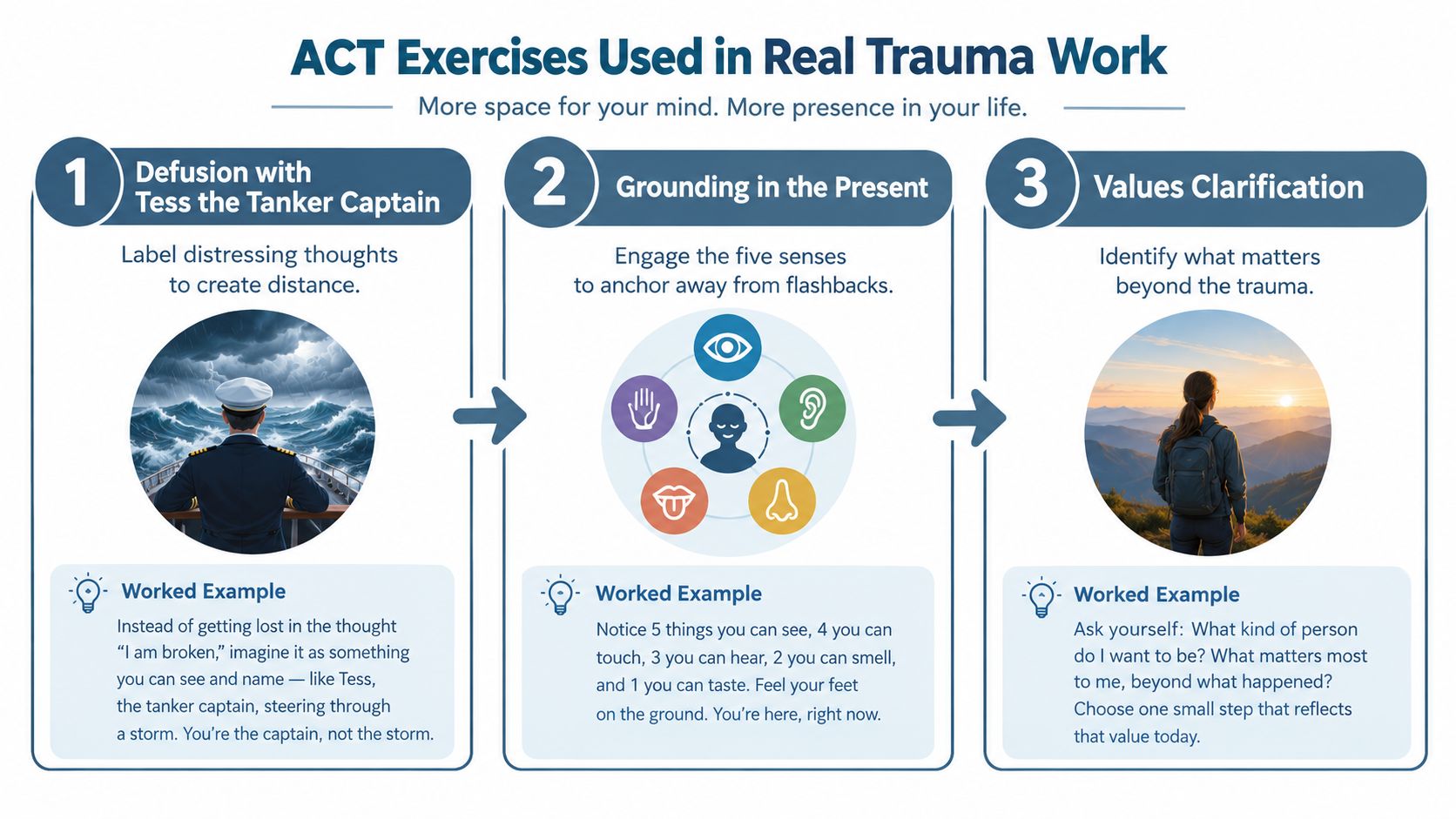
Defusion with Tess the tanker captain
A therapist may give an intrusive image a name, such as Tess the tanker captain. The client notices the recurring broadcast as a mental event rather than a present emergency.
An executive who sees the thought “I am broken” can picture Tess steering through rough water, then label the experience: “There's the tanker broadcast.” The client doesn't argue with the image or prove it wrong. The exercise ends by mentally closing the laptop on the broadcast mid-sentence and returning attention to the room.
The clinician looks for experiential avoidance disguised as productivity. If the client immediately checks email, intellectualizes, or jokes away the image, the therapist slows down and names the maneuver. If dissociation appears, the exercise becomes shorter and more sensory.
Grounding in the present
Grounding anchors attention to current sensory information. The client may identify the chair's pressure, the temperature of the room, a nearby color, the sound of an air system, and the taste of water.
This isn't a demand to relax. It establishes orientation when flashback material pulls attention backward. A clinician may ask the client to state the date, location, and present safety facts before continuing.
Values clarification and committed action
Values work may begin with a 90-minute card-sort and top-ten ranking exercise. The client separates inherited family expectations from personally chosen directions, then examines whether current behavior serves those directions.
The next step is a values-to-behaviors worksheet. Three weekly micro-behaviors might include ending work at an agreed time for a family meal, delegating one decision that doesn't require personal control, and attending a recovery appointment without rescheduling for a business conflict.
A typical session includes:
- Psychoeducation: The clinician connects the exercise to avoidance, flexibility, or values.
- Practice: The client completes the exercise in the room.
- Debrief: Therapist and client identify what appeared, including shame, numbness, agitation, or dissociation.
- Homework: The client chooses a small behavior linked to a stated value.
- Next-session check-in: The therapist reviews what happened, what the client avoided, and what adjustment is needed.
Residential treatment makes these practices easier to repeat because the schedule provides structure without requiring the client to perform recovery alone after a difficult session.
Where ACT Fits Among Trauma-Focused Therapies
No single trauma modality wins every clinical decision. The right choice depends on the dominant mechanism, the client's readiness, the presence of substance use, and whether explicit memory reconsolidation is the immediate priority.
| Dimension | ACT | EMDR | CPT | Prolonged Exposure |
|---|---|---|---|---|
| Time to symptom reduction | Often begins with present-focused regulation and behavioral change | Can target distress linked to traumatic memories directly | Focuses on trauma-related beliefs and interpretations | Uses structured exposure to trauma memories and reminders |
| Exposure intensity required | Can begin without detailed trauma narration | Requires engagement with trauma material in a structured format | Requires examination of trauma meanings and beliefs | Requires direct, repeated exposure work |
| Fit for clients resisting imaginal exposure | Strong initial fit | Depends on readiness and stabilization | Moderate fit when the client can examine beliefs | Poor initial fit when exposure refusal is central |
| Fit with high-functioning professionals | Strong when values, identity, and work obligations need integration | Useful when explicit memory processing is indicated | Useful when guilt, shame, or rigid beliefs drive impairment | Useful when avoidance responds to structured exposure |
| Evidence base strength | Emerging and increasingly quantitative | Established for trauma treatment | Established trauma-focused approach | Established trauma-focused approach |
ACT is usually the better primary framework when avoidance is dominant, anxiety or chronic pain complicates the picture, or the client needs a present-focused approach before detailed narration. It becomes particularly useful when a professional understands the trauma intellectually but continues to organize behavior around not feeling it.
EMDR may be the stronger single-modality choice when explicit memory reconsolidation is central. CPT can be valuable when guilt, shame, or rigid interpretations maintain symptoms. Prolonged Exposure can be appropriate when the client is ready for direct exposure and can tolerate the structure.
ACT also works well as an adjunct. If another trauma method stalls because the client repeatedly avoids homework, ACT can build willingness and values-based motivation. A broader overview of nontraditional care models can be found in alternative wellness centers explained, but executive clients should still judge any program by clinical credentials, measurable treatment planning, and dual-diagnosis capability.
Residential referral decisions should also account for trauma-informed delivery, which is outlined in trauma-informed therapy at Reflections. The question isn't which acronym sounds most complex. It's which method addresses the mechanism keeping the client stuck.
The Hard Cases and What ACT Can and Cannot Do
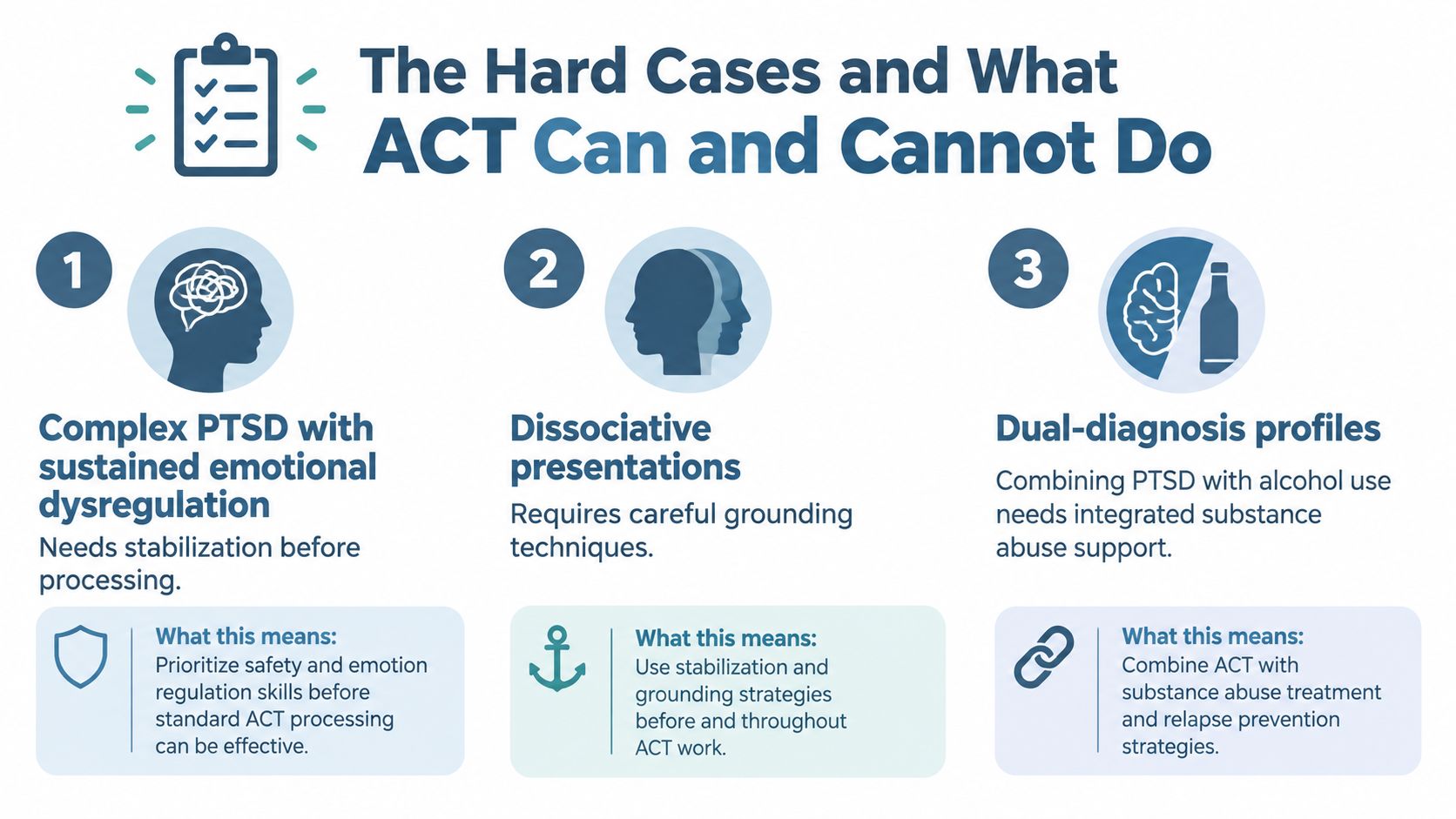
ACT is powerful, but standard delivery underperforms when clinicians mistake willingness for readiness. Complex PTSD with sustained emotional dysregulation, dissociative presentations, and active substance-related instability require more than a worksheet and a values discussion.
The clinical literature remains especially incomplete around dissociation and co-occurring substance use. A recent synthesis described consistent improvement in psychological flexibility and social functioning, but dissociation findings were mixed and under-measured. Earlier reviews of PTSD with alcohol-use disorder found promising ACT results, although the overall literature remained small and often nonrandomized.
Three situations requiring adaptation
- Complex PTSD: Emotional volatility may make values work feel abstract or threatening. Stabilization, sleep support, distress-tolerance skills, and relationship safety should come before demanding trauma processing.
- Dissociative presentations: Defusion can accidentally increase distance from experience if the client is already detached. The therapist should use orientation, sensory grounding, shorter exercises, and frequent checks for presence.
- Dual diagnosis: ACT can address avoidance and shame, but it cannot safely replace medical management for active alcohol withdrawal, stimulant withdrawal, or stimulant-induced psychosis.
What high-acuity residential care changes
A capable program phases treatment rather than forcing every client into the same trauma sequence. Stabilization skills may come first, followed by carefully titrated exposure, modified defusion, addiction medicine collaboration, and integration with DBT, somatic approaches, or neurofeedback when clinically indicated.
Protocol adjustment is necessary when there is SI or HI escalation, acute withdrawal, medication-cross-reaction risk, severe sleep disruption, or rapid loss of behavioral control. In those situations, the immediate priority is safety and medical coordination, not completing a preferred ACT exercise.
ACT is a powerful tool, not a universal answer.
A high-end setting should say this plainly. Credibility comes from knowing when ACT fits, when it needs support, and when another intervention must take the lead.
Choosing an Executive-Level ACT Program
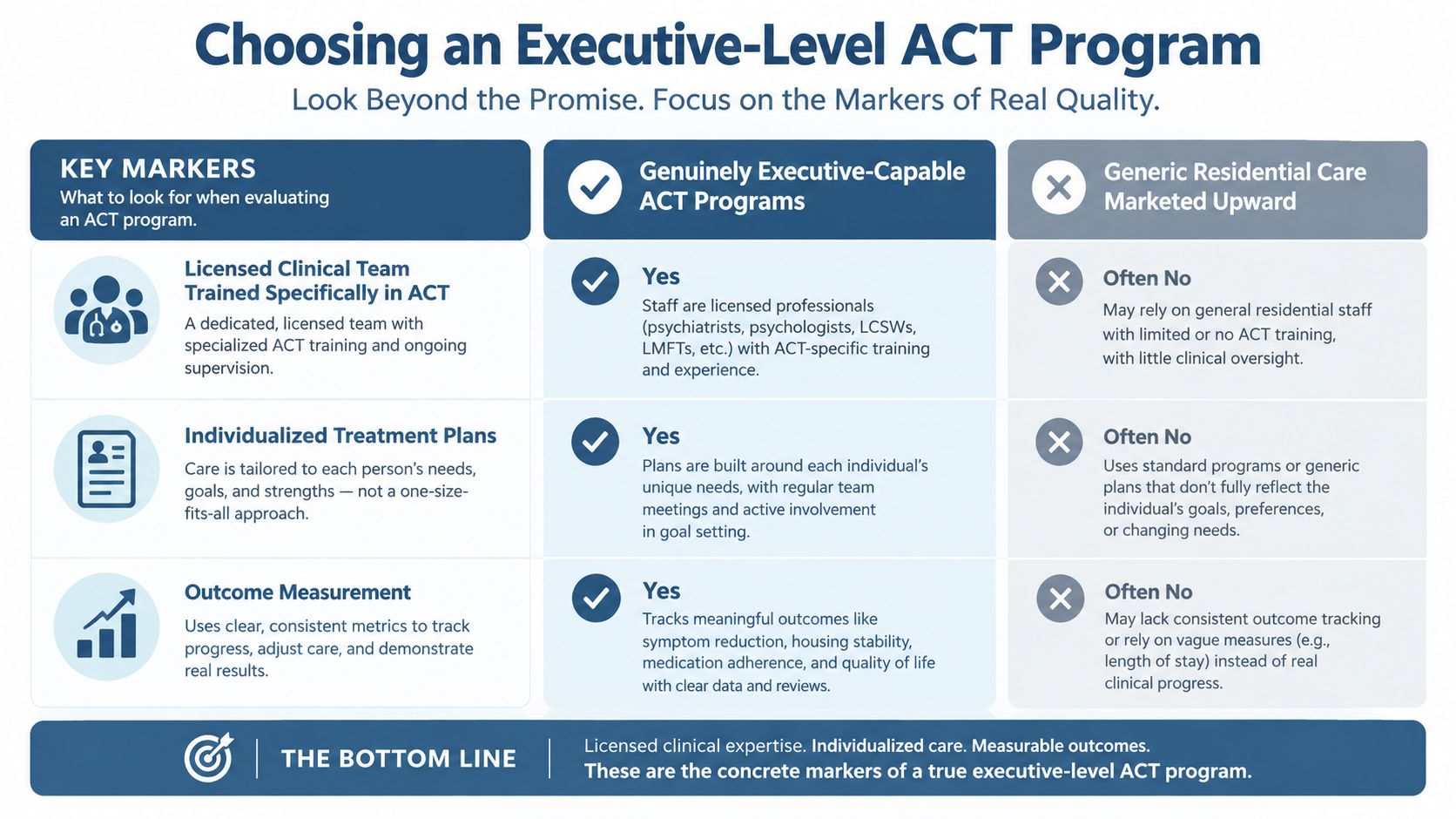
An executive-capable program is more than a generic residential setting with upgraded furniture. It should provide licensed clinicians trained specifically in ACT, experience with complex trauma and high-functioning clients, and a treatment plan that connects psychological work to real decisions at work and home.
Private rooms matter because privacy supports sleep, decompression, and confidential work obligations. Electronics access should be controlled, scheduled, and clinically appropriate, not handled through either blanket confiscation or unrestricted distraction. A program serving professionals should explain exactly how phone and laptop use is supervised.
Quality markers to verify
- Clinical training: Ask whether clinicians have formal ACT training and direct experience with trauma, substance use, dissociation, and executive populations.
- Individual treatment intensity: Ask how often individual ACT sessions occur and who leads them.
- Integrated psychiatry: Confirm access to psychiatric assessment for mood, sleep, medication, and substance-related concerns.
- Outcome measurement: Ask whether the program uses ACT-consistent measures such as the AAQ-II and VLQ, rather than relying only on satisfaction surveys.
- Modality flexibility: Determine whether EMDR, CPT, DBT, or other trauma interventions can be integrated when indicated.
- Confidentiality terms: Review privacy procedures, device rules, family involvement, and communication boundaries before admission.
Cost and privacy should be discussed directly. Private-pay care can offer a more individualized environment, but the admissions team should explain what treatment includes, how family participation works, how electronics are managed, and what continuing care follows residential treatment.
Reflections provides private residential rooms in detox and rehabilitation, controlled electronics access, dual-diagnosis treatment, and ACT among its evidence-based modalities. Its PTSD and trauma treatment program can be evaluated alongside any other program by asking the same questions about clinical credentials, individualized care, psychiatric support, and continuity after discharge.
Reflections offers discreet, private-room residential care for executives and professionals managing PTSD alongside substance use, anxiety, mood, or sleep concerns, with structured electronics access that supports appropriate career continuity. Visit Reflections to discuss whether its ACT-informed, dual-diagnosis program matches the clinical needs and privacy requirements of the prospective resident.