

A chief executive can be in a private residential program, medically stable, and still be one difficult call away from destabilization. A board meeting approaches, a partner sends an unwelcome message, sleep becomes fragmented, and familiar anxiety begins to merge with cravings, impulsivity, or trauma responses. The executive may have access to a phone and laptop for legitimate work obligations, but that access also keeps professional pressure within reach.
For high-profile professionals with co-occurring mental-health and substance-use disorders, a crisis intervention plan must protect more than immediate physical safety. It must also account for clinical risk, family communication, professional discretion, decision-making capacity, and the practical realities of returning to a demanding role. A plan that sits in a file and cannot be activated discreetly is not a meaningful safety system.
Crisis for High-Profile Professionals
A chief executive in private residential treatment receives a late message from a business partner. The executive has kept limited contact with the board, delegated operational decisions, and retained a laptop for approved work. Within minutes, panic, shame, racing thoughts, and an urge to use substances to regain control can emerge.
The immediate reaction is only one part of the risk. An impulsive email, unexplained absence, confidential disclosure, or misleading account to family can affect the executive's health and professional standing. Staff responding in a conventional setting may rely on a generic form or begin escalation without deciding who should be contacted first, what information may be disclosed, or how the response will affect the person's role.

Dual diagnosis changes the risk picture
High-profile executives often face overlapping clinical pressures rather than one isolated symptom. Anxiety may intensify cravings. Poor sleep may impair judgment. Withdrawal, medication changes, trauma-related dissociation, depression, or manic symptoms can change how the person interprets an ordinary business event. The plan should therefore describe observable behavior and decision-making changes, not only diagnostic labels.
A useful plan separates risk into clearly recognizable stages:
- Early changes, including missed meals, rising irritability, unusual secrecy, reduced sleep, or repeated checking of work messages.
- Intermediate risk, such as unplanned contact with a substance source, refusal of clinical support, impulsive financial decisions, or increasing agitation.
- Acute danger, including intoxication, severe withdrawal symptoms, threats of self-harm, violence risk, inability to meet basic needs, or loss of capacity to participate in safety decisions.
Each stage requires a defined response. The primary clinician may intervene when early changes appear. A structured clinical review may be appropriate as risk increases. Emergency services may be required when immediate danger or medical instability is present.
The historical Crisis Intervention Team model developed in Memphis illustrates the value of coordinated response. In its early research, specialized officers handled 95% of 100 mental-disturbance calls in Memphis, compared with 28% in Birmingham and 40% in Knoxville. Memphis officers transported 75% of specialized-response cases to a treatment location, compared with 20% in Birmingham and 42% in Knoxville. The same source reports that officer injuries declined from one injury per 28,571 events before implementation to one per 142,857 events afterward, a seven-fold reduction. Law-enforcement referrals to emergency psychiatric services also increased by 42% during the program's first four years. These findings support a practical conclusion: named contacts, treatment destinations, and defined escalation routes are safer than improvisation. (Research on specialized crisis responses)
Privacy belongs inside the clinical plan
For an executive, privacy planning includes more than restricting the medical record. The team should determine how the person travels, which entrance is used, who may approach them, how messages are screened, and which family or professional contacts have permission to receive updates. Treatment and transportation may also require general planning principles related to security for high-profile guests, particularly when public visibility creates additional risk.
Career continuity must be addressed without allowing work obligations to override safety. A designated representative can manage approved communications, while clinicians decide when the executive can resume contact or make consequential decisions.
Practical rule: define the first call, the permitted disclosure, the safe destination, and the point at which immediate safety takes priority over reputation or business continuity.
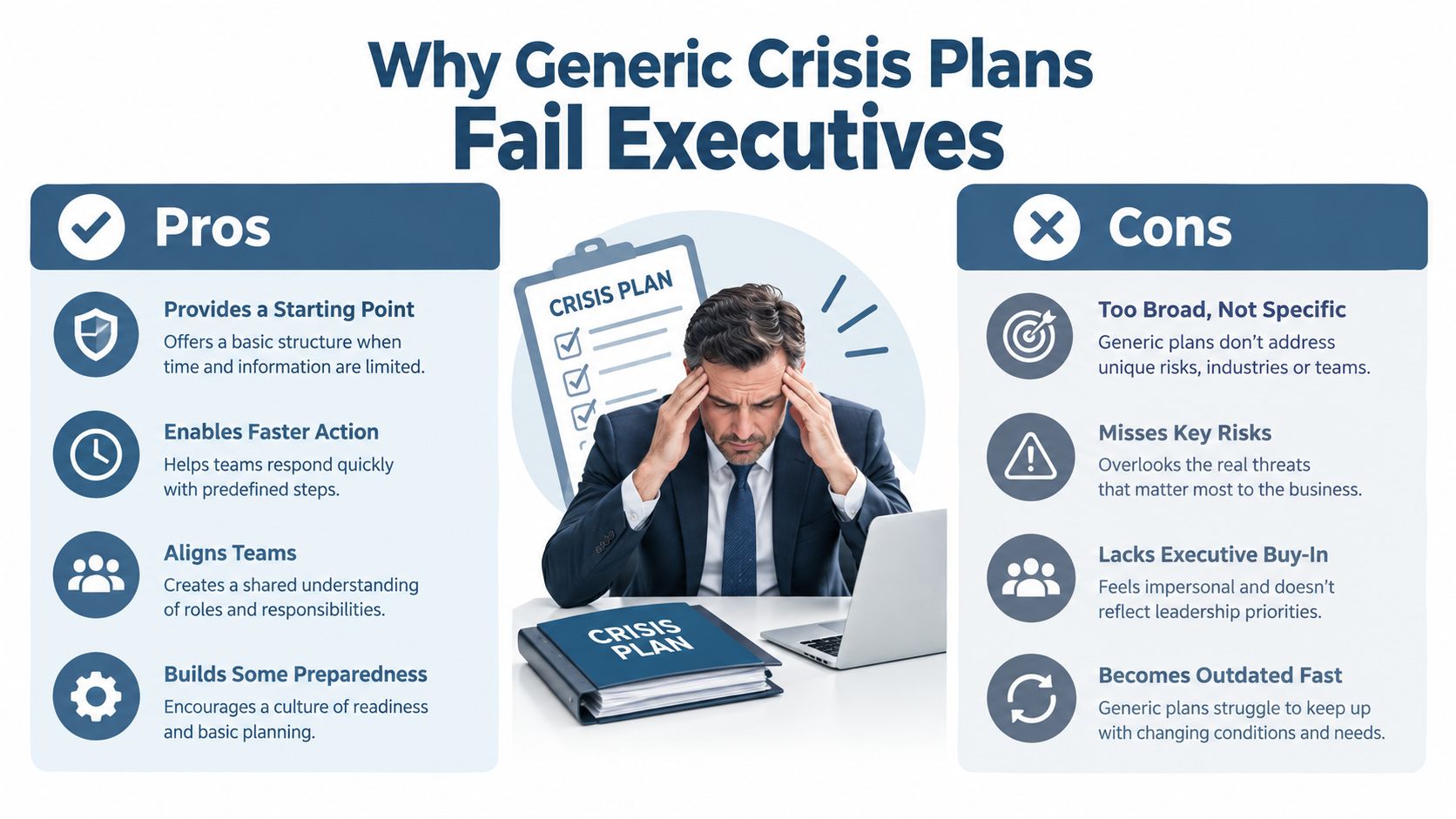
Why Generic Crisis Plans Fail Executives
A generic plan often fails because it describes an idealized patient rather than a real operating environment. “Call the therapist” isn't an adequate instruction if the therapist is unavailable, lives in another time zone, or cannot respond during a board meeting. “Contact family” is equally incomplete if family members have different levels of consent, live far away, or don't know how to respond when intoxication or withdrawal changes the person's behavior.
The problem isn't that written plans lack value. The problem is that a document alone isn't the intervention. A rapid evidence synthesis of randomized controlled trials found that, in an English trial lasting 15 months, 13% of participants who created joint crisis plans with a care coordinator, psychiatrist, and project worker were admitted involuntarily, compared with 26% of those who received information leaflets alone. The reported relative risk was 0.48, with a 95% confidence interval of 0.24 to 0.95 and a p-value of 0.03. A separate Dutch trial reported the same 13% versus 26% difference in court-ordered admissions. Across four randomized trials, the pooled result indicated a 23% reduction in compulsory-admission risk, with a relative risk of 0.77 and a 95% confidence interval of 0.60 to 0.98. (Rapid evidence synthesis of joint crisis plans)
The form versus the operating system
A static plan tends to record what should happen. A functional plan specifies who does what when conditions change. That distinction matters for an executive whose crisis may unfold across a residence, aircraft, office, hotel, family home, or treatment setting.
An acute-hospital psychiatric-care audit found plans documented for 69% of patients after assessment and 52% at discharge, but co-creation was documented for only 15% after assessment and 40% at discharge. Written copies were documented for 0% after assessment and 33% at discharge. These findings challenge the assumption that completion equals usability. (Audit of crisis-plan implementation in acute psychiatric care)
For an executive, usability should be tested rather than assumed. The individual should be able to explain the warning signs, identify the activation point, name reachable contacts, and locate the current version without searching through an electronic record during distress.
Responsibility must be shared
Personal responsibility remains important. The resident needs to recognize early changes, communicate openly, use agreed coping strategies, and accept clinical help when risk rises. Yet system responsibility is just as important. A person experiencing intoxication, withdrawal, dissociation, severe depression, or impaired judgment may not be able to carry out a plan reliably.
A recent patient-safety investigation identified variation in crisis assessment, transport, liaison psychiatry, and onward support, with additional barriers in rural and dispersed areas. It also described situations in which people in acute crisis were expected to manage their own safety despite impaired ability to do so, while families reported that crisis plans weren't consistently considered during admission and discharge decisions. (Patient-safety investigation into urgent and emergency mental-health care)
A high-end program should therefore build backup pathways, not place the entire burden on the executive or family. A primary clinician, backup clinician, residential nursing contact, emergency destination, transportation option, and authorized family contact should each have a defined role.
Practical rule: A plan is not ready for discharge until the client and the response team can describe what happens when the client can't, won't, or doesn't know how to use it.
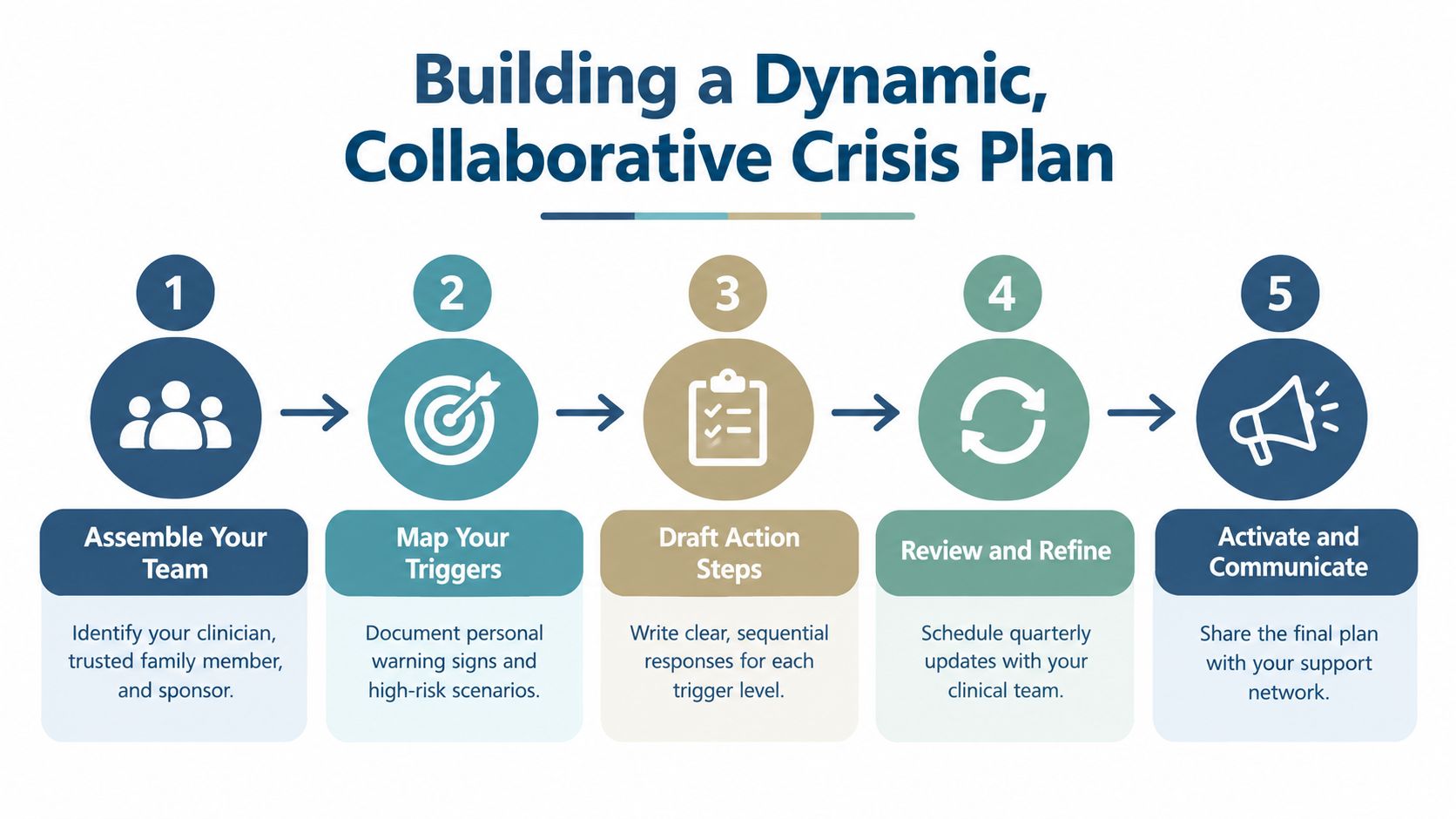
Building a Dynamic, Collaborative Crisis Plan
The strongest crisis intervention plans are co-created, rehearsed, and revised. The clinical team should use the executive's own language, identify the situations that carry the greatest risk, and translate abstract concerns into observable actions.
Start with the person, not the template
The first meeting should include the resident, the primary clinician, relevant medical staff, and the people the resident has authorized to participate. A trusted family member, sponsor, executive assistant, or outpatient provider may have valuable information, but inclusion must follow consent and clinical appropriateness.
The team should ask:
- What changes appear before a crisis becomes visible to others?
- Which work events reliably increase anxiety, shame, anger, or cravings?
- What happens during intoxication, withdrawal, medication nonadherence, or trauma activation?
- Which forms of contact feel supportive, and which feel intrusive?
- Which people can reach the executive quickly and respond calmly?
- What information may be shared with each person?
The answers should be written in the resident's language. “Feels off” may be meaningful if the plan defines what that means in practice, such as three nights of disrupted sleep, repeated urgent messages, or sudden withdrawal from meals and clinical sessions.
Use an ordered response sequence
The Stanley–Brown framework provides six ordered components: identify personal warning signs, use internal coping strategies, seek people or settings for distraction, contact trusted individuals who can help resolve the crisis, contact clinicians or emergency services, and reduce access to lethal means. For a dual-diagnosis resident, the sequence should also address substance access, medication safety, withdrawal concerns, dissociation, and impaired capacity. (Safety-planning intervention evidence and framework)
The sequence should be concrete:
- At the first warning sign, the resident pauses nonessential business communication, uses an agreed grounding strategy, and alerts the designated clinician.
- When risk escalates, the clinician conducts a direct assessment, reviews medication and substance-use factors, and brings in the authorized support person.
- When the resident can't maintain safety, the team follows the documented emergency route, including the preferred treatment destination and transportation process.
- After stabilization, the clinical team records what happened, identifies the missed signal, and updates the plan.
The purpose isn't to give the executive control over every clinical decision. It is to reduce ambiguity when judgment is under pressure.
Rehearse before discharge
A plan should be tested through realistic scenarios. A clinician might simulate an alarming board message, a missed medication dose, a return of cravings after a family conflict, or a delayed flight that leaves the executive without the usual support network. The team then checks whether the resident knows what to do and whether each contact can respond as expected.
A short debrief often reveals weaknesses that a signature won't expose. The plan may contain an outdated number, a vague emergency threshold, or an assumption that a family member can provide transportation. These gaps should be corrected before discharge, not after the next crisis.
Executives managing public communications may also benefit from reviewing general principles of SME crisis communications help so that clinical escalation and responsible professional communication don't conflict. Any external communications process must remain subordinate to clinical safety and authorized privacy limits.
A residential team may also coordinate with family members before treatment begins through a structured intervention planning resource, provided the process remains clinically supervised and respectful of the individual's rights.
Luxury Care Standards and Privacy Protection
A senior executive may disclose suicidal thinking, relapse patterns, trauma, or medication concerns only after the treatment team demonstrates disciplined information handling. Privacy in residential treatment enables earlier risk identification and more accurate planning. It also protects the executive's professional reputation while the team addresses clinical needs and career obligations.
Accreditation offers a practical governance framework for evaluating that environment. Joint Commission behavioral-health standards apply to organizations providing addiction treatment, residential services, and detox programs. An onsite survey evaluates the applicable parts of the organization, rather than focusing on one clinician or unit. Accreditation is awarded for a three-year period. An organization seeking initial accreditation must have provided care to at least three individuals, with at least two active when the initial onsite survey occurs. The standards address privacy, medication management, human resources, performance improvement, records of care, patient rights, emergency management, and life safety. (Joint Commission organizations eligible for accreditation)
Amenities must operate alongside safeguards
Private rooms and quiet surroundings support rest, dignity, and confidential conversations. They provide value only when the program also controls medication administration, emergency response, infection prevention, life-safety systems, clinical documentation, and performance review.
| Residential expectation | Executive-focused application |
|---|---|
| A written emergency procedure | Named decision-makers, backup contacts, preferred destinations, and transportation contingencies |
| Confidential records | Controlled access, defined authorization, and careful communication with family, employers, and outside providers |
| Medication administration | Prescription reconciliation, monitoring for misuse, and a response to missed or refused doses |
| Residential staffing | Clear clinical coverage and a process for urgent concerns outside scheduled sessions |
| Discharge paperwork | A current plan explained, rehearsed, and transferred to authorized continuing-care providers |
SAMHSA guidance recognizes a person's right to personal privacy and private treatment records, including after leaving care. It also recognizes private communication, access to telephone and mail, and visits during established hours. Clinically justified restrictions should be documented in the treatment plan and explained to the resident. (SAMHSA patient-rights guidance)
Technology requires defined boundaries
A luxury program serving working professionals may permit residents to keep phones and laptops during detox and rehabilitation. Controlled access can support family contact, urgent career obligations, and a measured return to leadership responsibilities. It can also expose the resident to triggering messages, disrupted sleep, financial pressure, and impulsive communication.
The written protocol should state when devices are available, who can help pause access, which work categories are permitted, and how clinicians respond when technology begins to destabilize recovery. That structure preserves autonomy while giving the team a clear response to deteriorating judgment or increased risk.
Facilities reviewing privacy procedures can also examine principles related to confidentiality for house call care, particularly discreet communication and information handling. For a California-licensed, Joint Commission-accredited provider such as Reflections, privacy planning can be integrated with dual-diagnosis treatment, private rooms, clinically managed withdrawal, medication optimization, and structured electronics access. Internal procedures should align with applicable law, documented consent, and clinical judgment, as outlined in the facility's HIPAA compliance standards.
Integrating Family and Technology into the Plan
For a chief executive whose condition is changing during a board cycle, family involvement must protect safety, judgment, and professional privacy at the same time. A spouse, adult child, sibling, or trusted adviser may identify changes the executive minimizes. That person should receive a defined role, not responsibility for clinical care, medication management, or confronting an intoxicated relative alone.
A private family session establishes those limits before pressure rises. The executive specifies what may be shared, the clinical team describes observable warning signs, and authorized relatives receive written escalation instructions. The plan should separate supportive contact from a request for professional assistance and from an emergency requiring immediate intervention. Clear permissions also reduce the chance that a family member delays action to protect the executive's reputation.

Family roles should be explicit
A practical protocol answers five questions:
- Who receives an early-warning call? Name the person most likely to respond calmly and protect confidentiality.
- Who contacts the clinical team? One designated relative limits conflicting accounts and duplicated messages.
- What happens if the executive refuses help? State when immediate danger permits an emergency response without relying on continued consent.
- What should relatives avoid? Arguing about blame, promising secrecy, transporting an unsafe person alone, or allowing reputation concerns to delay urgent care can increase risk.
- How will family members protect themselves? They need permission to leave an unsafe situation and obtain professional support when the crisis exceeds their role.
Family education should address altered presentation during substance use or acute distress. Irritability, confusion, withdrawal, impulsivity, and unusual confidence may appear as a business conflict or personality dispute. Relatives need criteria for recognizing a clinical change and a direct route to help.
Device access should serve recovery
Phone and laptop access should support defined recovery and work objectives. An executive may review limited business matters, attend a scheduled call, communicate with children, or coordinate a staged return to leadership duties. The care team may also require notification controls, delegated decision-making, protection from late-night work, or staff-held devices during acute escalation.
A written protocol can include a device pause signal, a defined work window, and a trusted delegate who filters urgent messages. It should prohibit major financial, employment, or relationship decisions during intoxication, severe sleep loss, or acute emotional activation. These safeguards preserve career continuity while preventing work from becoming a route around treatment or a source of renewed risk.
Technology supports communication. Clinicians and authorized support persons must assess changes directly, document the response, and activate the next level of care when risk increases. For high-profile executives, that process should use agreed channels, limited disclosure, and rapid coordination so privacy remains protected while safety decisions receive appropriate attention.
Continuity of Care and Documentation Protocols
Discharge can expose risks that residential structure had contained. An executive returns to a demanding calendar, familiar access to substances or medications, unresolved family dynamics, and constant professional scrutiny. Without a current, carefully documented handoff, the crisis intervention plan may fail during the first difficult week at home.
The transition record should give the next provider a clear clinical and operational picture. It should cover warning signs, effective coping strategies, medication decisions, substance-use risks, trauma-related responses, authorized contacts, emergency preferences, and conditions requiring escalation. It should also specify what the executive does not want shared and what may be disclosed during an emergency.
Documentation should follow the person
A reliable handoff requires direct communication between the residential team and continuing-care providers, with the resident's authorization. Sending a packet without confirming receipt leaves missing context unresolved. The receiving clinician should understand which symptoms preceded the last crisis, how the resident responded to interventions, and which assumptions treatment disproved.
The record should identify approved communication channels, responsible contacts, and the current version of the plan. For high-profile professionals, those details protect privacy during urgent coordination without making confidentiality a reason to delay care.
Update the plan after medication changes, relapse, hospitalization, or a major psychosocial event. Review it when the executive changes residence, travels for work, assumes a new leadership role, or loses access to a previously reliable support person.
Quality systems protect continuity
Joint Commission behavioral-health standards address performance improvement, emergency management, medication management, records, patient rights, and life safety in residential settings. They also require organizations to protect health information and prevent unauthorized access, use, or disclosure. (Joint Commission behavioral-health standards sampler)
Those principles should shape discharge review. A provider should confirm that the plan was created collaboratively, that the client can explain it, that authorized contacts are reachable, and that the receiving team has the latest version. Clinical leaders should examine near misses and failed handoffs, treating documentation as a safety system rather than clerical work.
Measurement should extend beyond suicidal thoughts. The safety-planning meta-analysis found reductions in suicidal behavior without a significant effect on suicidal ideation, supporting separate tracking of attempts, emergency use, treatment engagement, and means safety. (Meta-analysis of safety-planning-type interventions)
Professional continuity matters, but it cannot conceal clinical deterioration. A documented system makes that trade-off visible and gives each authorized participant a defensible next step.
Taking the Next Step Toward Secure Recovery
A high-quality crisis intervention plan begins with a private clinical conversation, not a discharge signature. The executive, primary clinician, medical team, and authorized support person should identify warning signs, define escalation thresholds, establish communication boundaries, and rehearse the response.
The plan should then be tested against realistic pressures, including an urgent board issue, a family conflict, travel disruption, cravings, missed medication, or impaired capacity. The facility should document the outcome, correct gaps, and arrange a direct handoff to continuing-care providers.
For an executive seeking treatment, the immediate question is simple: can the plan be understood and activated when judgment, privacy, and professional pressure are all under strain? If the answer isn't clear, the plan needs more work.
Reflections provides private residential dual-diagnosis treatment, medically managed withdrawal when appropriate, private rooms, accredited clinical care, family education, structured electronics access, and continuing-care planning for executives and high-profile professionals. Visit Reflections to discuss a confidential assessment and begin developing a crisis intervention plan aligned with clinical safety, privacy, and career continuity.