
An executive can spend years protecting confidential information, then hesitate to enter treatment because a single careless disclosure could reach a board member, colleague, journalist, or client. That concern is rational. For high-profile professionals, privacy affects not only personal dignity, but also leadership continuity, family stability, professional relationships, and the willingness to seek help at all.
Luxury residential treatment should therefore treat HIPAA compliance standards as the federal floor, not the finished product. A private-pay executive program needs disciplined access controls, discreet communication, secure technology, trained staff, and a physical environment designed around confidentiality. The following framework explains what the rules require and what discerning families should expect beyond the legal baseline.
Why Privacy Matters When Executives Enter Treatment
A chief executive may be considering detox while still answering messages about a transaction, a partner may be managing a major practice while seeking help for anxiety and substance use, or a family may be arranging residential care for a public-facing professional. The question usually isn't whether treatment is needed. It's whether treatment can happen without exposing a vulnerable moment to people who have no legitimate reason to know.
That fear can delay care. It can also lead families to evaluate facilities through the wrong lens, focusing only on amenities while overlooking who can access records, how staff communicate, whether vendors handle protected health information, and what happens when a resident uses personal electronics. True discretion is an operating discipline, not a promise printed on an admissions page.
HIPAA establishes a national privacy baseline for individually identifiable health information held or transmitted by covered entities and their business associates. Individuals generally have the right to review and obtain copies of their protected health information in a designated record set, and the Privacy Rule creates a federal floor that facilities must meet, as explained in HHS privacy safeguards guidance. A luxury program should add stronger internal practices without weakening those rights.
Privacy has clinical consequences
Residents disclose more effectively when they trust the environment. Executives often need to discuss substance use, trauma, mood symptoms, relationship strain, medication history, and professional pressure with unusual candor. If they believe a conversation might travel through informal staff channels, shared devices, unsecured messaging, or visible records, clinical honesty can suffer.
Families assessing a program should review its written confidentiality practices before admission, including its approach to maintaining confidentiality. The strongest facilities explain how privacy works during intake, medication management, family contact, care coordination, transportation, and discharge planning.
Reputation protection requires more than HIPAA
HIPAA governs covered entities and business associates, but an executive's privacy expectations often extend further. A facility should control unnecessary disclosure of a resident's presence, limit casual conversations in common areas, train every employee on role-specific conduct, and establish a clear response process for suspected incidents.
Resources addressing how to protect executive privacy can help families think beyond the medical record itself. The practical standard is simple: staff should disclose only what an authorized purpose requires, to the people who need the information, through channels the organization can control.
Practical rule: A facility that cannot explain its privacy workflow in plain language isn't ready to manage a high-profile admission.
Understanding the Core HIPAA Rules for Behavioral Health
An executive enters residential treatment with clinical notes, medication records, billing details, family messages, and discharge documents moving through different hands. HIPAA compliance standards determine who may use that information, how electronic records must be protected, and what a facility must do after an unauthorized disclosure.
The Privacy Rule governs permitted uses and disclosures of protected health information, or PHI. The Security Rule protects electronic PHI, while the Breach Notification Rule addresses incidents involving unsecured PHI. The Privacy Rule applies to health plans, clearinghouses, and healthcare providers conducting standard electronic transactions, as described in the documented HIPAA regulatory timeline.
Behavioral health records can disclose mental health and substance use information together. A luxury residential program should therefore apply strict access controls, verify every request, and prevent casual exposure in shared workspaces. HIPAA sets the federal floor. High-profile residents also require practical controls around private rooms, personal electronics, work access, and communication channels.
The regulatory timeline matters
HIPAA was enacted in 1996, then developed through federal rules that became enforceable in stages. HHS issued the final Privacy Rule in December 2000. Compliance began on April 14, 2003, with April 14, 2004 applying to small health plans. HHS issued the final Security Rule in February 2003. Compliance began on April 20, 2005, with April 20, 2006 applying to small health plans, as recorded in the HIPAA history reference.
These dates show that HIPAA operates as an enforceable national framework for confidentiality, integrity, and availability, not as a general promise to respect privacy.
What each rule means inside treatment
-
Privacy Rule: Staff may use or disclose PHI for treatment, payment, and healthcare operations when the rules permit it. Reasonable safeguards still apply, and many disclosures must be limited to the minimum necessary information. A therapist, nurse, billing employee, and outside provider should receive access suited to their roles.
-
Security Rule: The rule covers ePHI created, received, maintained, or transmitted electronically. Facilities must select administrative, physical, and technical safeguards based on their risks. That includes systems used for clinical documentation, remote work, scheduling, and approved communications.
-
Breach Notification Rule: A facility must assess incidents involving unsecured PHI and follow applicable notification obligations when a breach occurs. Access monitoring, encryption, incident records, and a defined response chain give staff clear direction under pressure.
A serious program coordinates intake, clinical care, technology administration, leadership, and vendors. The goal is consistent protection throughout treatment, including controlled electronics, discreet room arrangements, and authorized work access.
The Three Safeguard Layers That Protect Patient Information
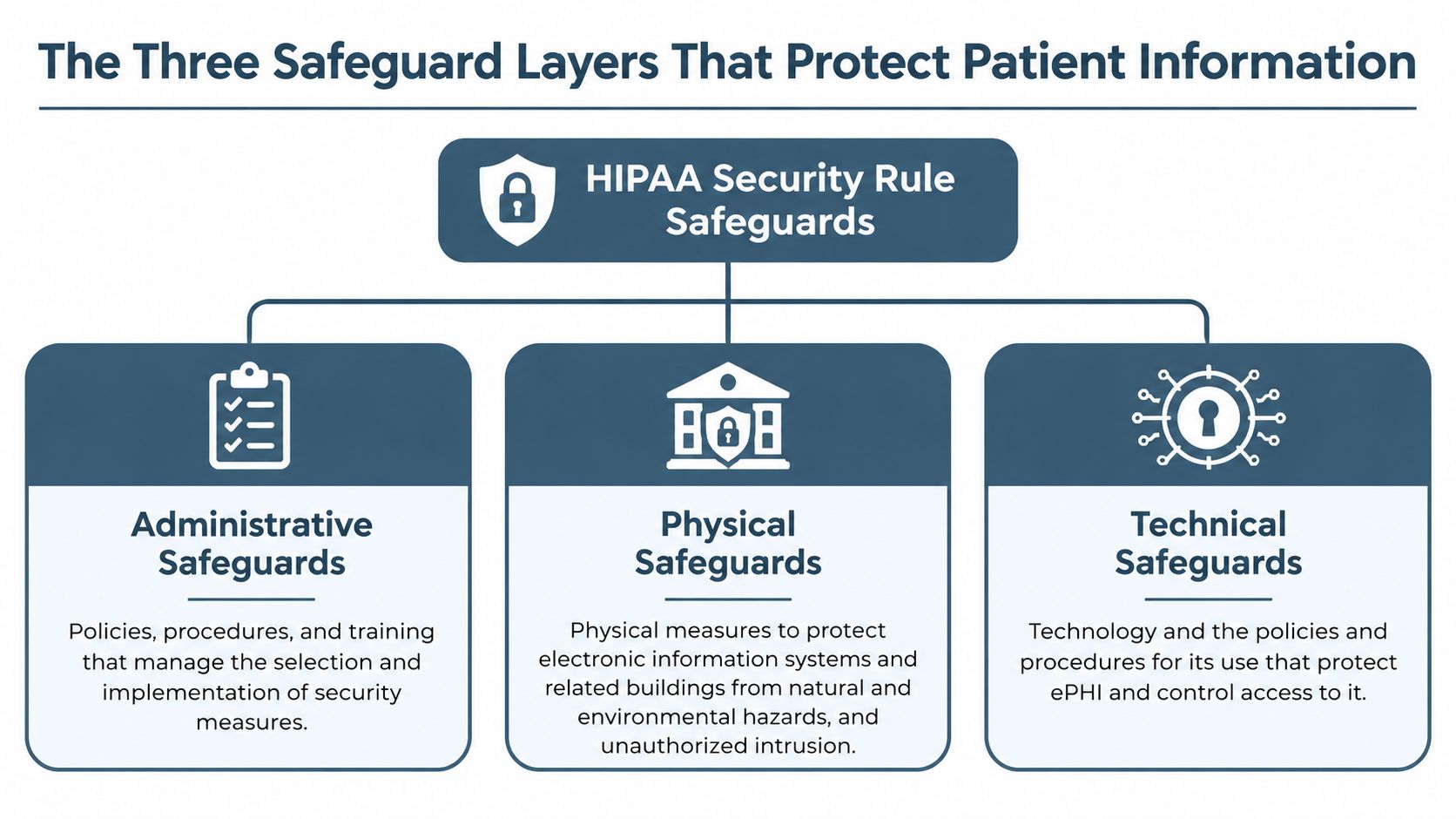
The Security Rule uses three connected safeguard layers: administrative, physical, and technical. HHS describes them as appropriate safeguards for the confidentiality, integrity, and availability of ePHI, and the framework is risk-based rather than checklist-based, as summarized in guidance on the three safeguard layers.
A luxury residential setting makes the interaction visible. A strong policy can't compensate for careless device handling. Advanced encryption can't fix excessive staff access. A secure building can't protect a record sent through an uncontrolled channel.
Administrative safeguards set the rules
Administrative controls determine who does what, under which circumstances, and with what oversight. A high-end facility should maintain a current risk analysis, written privacy and security policies, workforce training, contingency planning, incident procedures, and vendor oversight.
Role-based access matters. A clinician may need a complete clinical picture, while a scheduling employee may need only appointment information. Staff should understand how to discuss residents in hallways, verify callers, manage family requests, document releases, and escalate suspected privacy events.
Physical safeguards make discretion visible
Physical security includes controlled facility access, protected workstations, secure record storage, visitor procedures, and appropriate device and media handling. In a residential program, the physical layer also includes how staff conduct handoffs, where sensitive conversations occur, and whether screens or printed documents can be seen by unauthorized people.
Device disposal deserves deliberate attention. A facility reviewing secure processes for retired computers, drives, and other media may consult Beyond Surplus ITAD for clinics as part of its vendor due diligence. The operational point is broader than disposal itself. Every device containing ePHI needs a documented lifecycle from assignment through retirement.
Technical safeguards control access and evidence
Technical controls include unique user access, authentication, encryption, audit logging, integrity protections, and transmission security. Encryption under HIPAA is an addressable implementation specification, so an organization must either implement it or document a reasonable, risk-based alternative. Common industry implementations include AES-256 for data at rest and TLS 1.2 or higher for data in transit, aligned with NIST guidance, as discussed in HIPAA encryption guidance for clinical applications.
A luxury program should also review access logs, investigate unusual activity, revoke access promptly when roles change, and test whether backups and contingency procedures work. The standard isn't a compliance folder that looks complete. It's a working system that can show what happened, who accessed information, and how the organization responded.
How Luxury Facilities Exceed Baseline HIPAA Requirements
HIPAA doesn't require every resident to receive a private room. It also doesn't require hospitals, doctors, or treatment centers to build private or soundproof rooms, according to guidance on shared rooms and HIPAA safeguards. A facility that offers private rooms is making a deliberate service and privacy investment, not merely checking a federal requirement.
For executives, that distinction matters. Private rooms in both detox and residential rehabilitation can reduce incidental exposure, support rest, and give residents a controlled space for sensitive calls. They don't replace staff discipline, secure records, or appropriate communication practices, but they create a stronger physical foundation.
Baseline compliance versus premium discretion
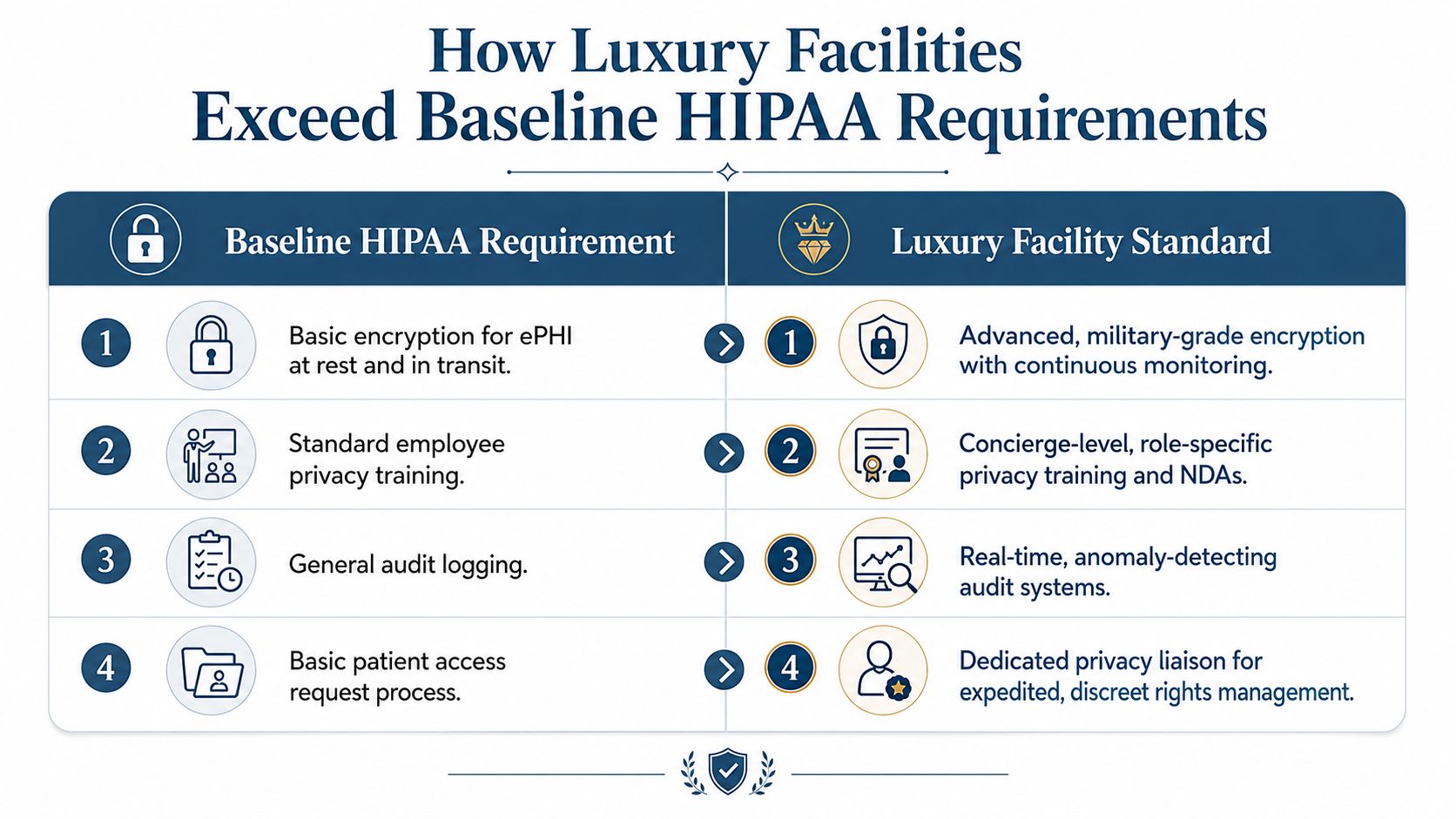
Baseline compliance asks whether a facility has appropriate safeguards and limits permitted disclosures. A higher standard asks harder questions:
-
Who can identify the resident? Admissions, clinical, billing, transportation, and household staff should understand what information their roles require and what they must not disclose.
-
How are conversations managed? Staff should control voice volume, timing, location, screens, printed materials, and handoffs, especially when treatment, payment, or family matters are discussed.
-
How is access documented? Systems should record relevant activity and support review when a resident or privacy officer needs answers.
-
How are vendors governed? Outside services that handle PHI should be assessed, contractually managed, and included in the facility's privacy perimeter.
A high-end program should also offer a privacy conversation before arrival. The resident and family can identify preferred contacts, work-related boundaries, approved disclosures, communication windows, and situations requiring additional discretion. This individualized plan turns a general policy into a practical operating standard.
Work access needs guardrails
Allowing an executive to keep a laptop or phone can support continuity, but unrestricted connectivity can introduce privacy risks. The facility should define how residents connect to work, how staff communicate clinical information, which networks are appropriate, and how personal devices stay separate from facility systems.
The right question isn't whether electronics are allowed. It's whether the program has designed a controlled way for residents to remain professionally engaged without placing PHI on unmanaged channels or exposing their treatment status to outsiders.
Patient Privacy Rights and How to Exercise Them
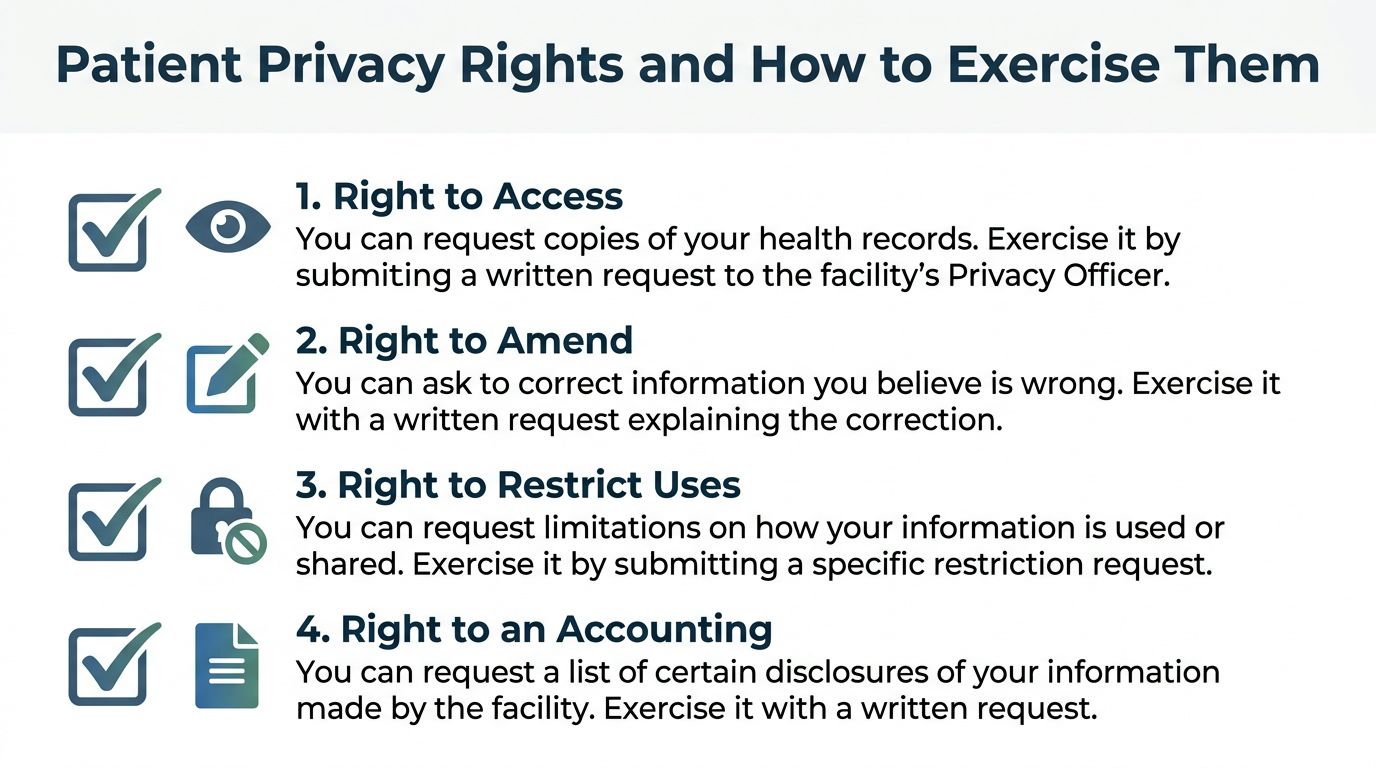
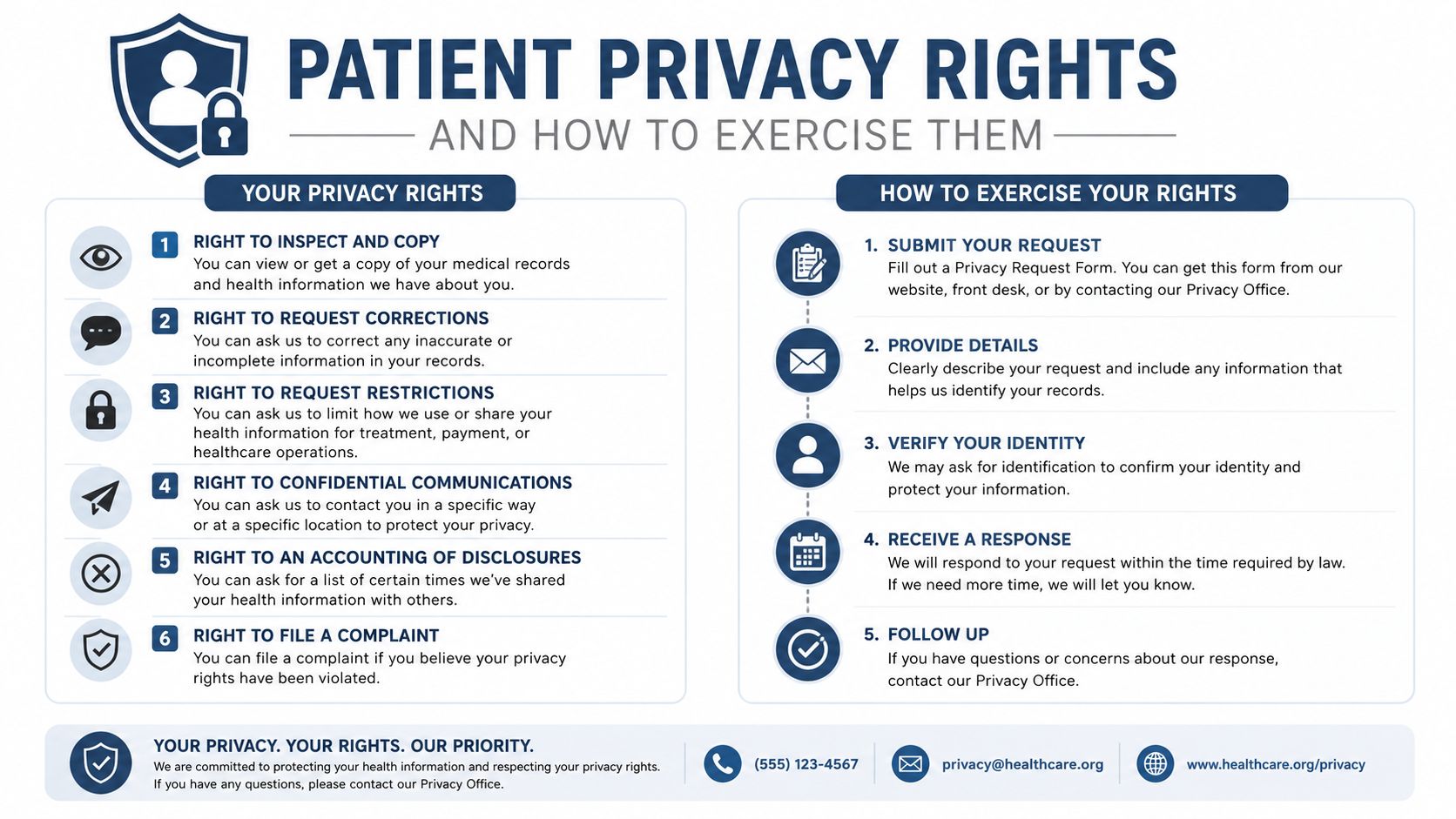
A resident shouldn't have to rely on a facility's reputation to understand what happens to personal health information. HIPAA protects individually identifiable health information held or transmitted by covered entities and business associates, and people generally have the right to review and obtain copies of PHI in a designated record set. The federal standard is a floor, so a luxury provider may offer more discretion and service without offering less than the law protects.
Access and correction
A resident can request access to the designated record set and obtain copies of information maintained for the individual. In practice, the request should identify the records sought and follow the facility's documented process. A privacy liaison can make this interaction more discreet for an executive who doesn't want requests discussed through ordinary administrative channels.
If a record contains information the resident believes is inaccurate or incomplete, the resident can request an amendment. The request should explain the disputed information and the proposed correction. The facility then processes the request under its privacy procedures, preserving the record's integrity rather than altering clinical documentation.
Restrictions and disclosure review
A resident may request restrictions on certain uses or disclosures of PHI. The request should be specific, especially when it concerns family members, employers, referring professionals, or care coordination. Treatment, payment, and healthcare operations can involve permitted disclosures, but staff still need to apply reasonable safeguards and minimum-necessary principles where required.
A resident can also request an accounting of certain disclosures. That review helps clarify how information moved outside ordinary treatment operations and gives the resident a practical way to evaluate whether the facility's communication practices match its promises.
Complaints and family participation
Families can ask how authorization forms work, who has been designated to receive updates, and how the facility handles requests from employers or colleagues. They shouldn't assume that a spouse, assistant, attorney, or business partner automatically receives information. The resident's permissions and the applicable HIPAA rules control the response.
If a resident believes privacy has been mishandled, the facility should provide a clear internal complaint route through its Privacy Officer or designated contact. A credible program welcomes specific questions, documents concerns, investigates them, and explains corrective action without minimizing the resident's experience.
Common Questions About Electronics and Work Access in Treatment
Executives often need a treatment setting that accommodates professional obligations. Reflections allows residents to keep electronics such as cell phones and laptops during treatment, with appropriate access to work, school, and loved ones described in its rehab program allowing cell phones. That policy can support continuity, but it doesn't eliminate the need for boundaries.
Does HIPAA cover a resident's personal phone?
Generally, HIPAA Rules don't protect the privacy or security of health information accessed through or stored on a person's personal cell phone or tablet. HHS explains that the rules apply when PHI is created, received, maintained, or transmitted by covered entities and business associates, as summarized in guidance on HIPAA and personal devices.
That distinction is important. A resident's private work email or personal notes aren't automatically a facility's HIPAA record. The facility's responsibility centers on its own systems, staff communications, clinical documentation, and any PHI it sends to or receives from the resident's device.
What should an executive ask about work access?
A serious admissions conversation should address the following:
-
Network separation: The facility should explain whether resident connectivity is separated from systems used for clinical records.
-
Staff communication: The program should identify approved channels for appointment details, medication questions, family updates, and care coordination.
-
Device boundaries: Residents should understand what information must not be copied, photographed, downloaded, or forwarded through personal devices.
-
Professional privacy: Staff shouldn't confirm a resident's presence, treatment status, or schedule to an employer, assistant, colleague, or caller without appropriate permission.
-
Therapeutic balance: Work access should support recovery rather than allow professional demands to control the treatment environment.
Private rooms make confidential calls easier, but they don't secure the information discussed. Residents should use judgment with speakerphone, shared screens, video meetings, printed materials, and work conversations that reveal treatment details.
A phone policy is only as private as the communication practices surrounding it.
Evaluating a Facility Before You Commit to Treatment
Families should ask for specifics before choosing a luxury residential program. General assurances about confidentiality aren't enough for a C-suite admission.
A facility should be able to describe:
-
Accreditation and clinical governance: Confirm the program's licensing, accreditation, clinical leadership, and staff credentials. Families can review what Joint Commission accreditation means and ask how oversight affects daily operations.
-
Privacy ownership: Identify the Privacy Officer or equivalent contact, the complaint process, and the procedure for investigating suspected incidents.
-
Access control: Ask how role-based permissions, authentication, audit logs, staff departures, and vendor access are managed.
-
Physical discretion: Verify room arrangements, visitor controls, medication discussions, transportation procedures, and protection of printed records.
-
Work and electronics: Ask how phones and laptops connect, what staff can see, and how residents can maintain professional obligations without mixing personal devices with facility systems.
-
Business associates: Request an explanation of how outside billing, technology, laboratory, transportation, and clinical partners are evaluated and governed.
A major breach can trigger enforcement. In 2021, OCR received 609 breach notifications involving unsecured PHI affecting more than 500 individuals each, affecting 37,182,558 individuals in total, and OCR reported $5,125,000 in monetary penalties, according to coverage of the OCR annual HIPAA report. Those figures describe the scale of enforcement exposure, but for an executive, the personal cost of an individual disclosure may be immediate and difficult to reverse.
Decision standard: Choose the facility that can demonstrate privacy in procedures, staffing, technology, and physical design, not the one that uses the most reassuring language.
Reflections provides private rooms in both detox and rehabilitation, a highly accredited clinical team, dual-diagnosis care, and appropriate electronics access for residents who need balanced engagement with work and loved ones. Families seeking discreet residential care for an executive or working professional should visit Reflections to discuss admissions, privacy practices, clinical fit, and how treatment can be structured around recovery without sacrificing responsible professional continuity.