

An executive can spend the morning leading a board meeting, the afternoon negotiating a major transaction, and the evening using alcohol, stimulants, sedatives, or another substance to quiet memories and emotions that never received clinical attention. Colleagues may see composure, decisiveness, and sustained performance. At home, the same person may be managing hypervigilance, shame, insomnia, panic, emotional numbness, or the growing fear that professional control is beginning to disappear.
Trauma informed addiction treatment addresses both realities. It treats substance use as a serious disorder while examining the psychological injuries, nervous-system responses, and relationship patterns that can keep relapse active. For C-suite leaders and high-profile professionals, the standard must include clinical depth, privacy, structured access to work, and an environment where difficult psychological work can happen without unnecessary exposure or disruption.
The Hidden Cost of Trauma in High Performers
Clinical intake often starts with a different vocabulary entirely: burnout, sleep management, performance pressure, or the need to “switch off” after an unusually demanding day. That language may reflect a professional's identity and responsibilities, but it can also obscure a developing substance use disorder. Repeated reliance on alcohol, medication, or another substance becomes a private regulation system, reducing distress temporarily while leaving the underlying trauma untreated.
For a chief executive, business performance may remain strong while alcohol use at night becomes increasingly difficult to control. A partner may notice irritability and withdrawal before colleagues see any change. The executive may recognize that particular conflicts, losses, or reminders trigger an urgent need to drink, use medication outside its intended purpose, or disconnect in another way. Treatment focused only on stopping the substance can therefore miss the psychological function that made the behavior compelling.
Trauma is not limited to one obvious event. It may involve abuse, violence, neglect, profound loss, chronic instability, or any experience that overwhelmed a person's capacity to feel safe. Clinical signs can include avoidance, emotional reactivity, dissociation, distrust, intrusive memories, and a persistent sense of threat. In high-performing adults, those signs may be concealed by overwork, control, perfectionism, and visible professional achievement.
Why competence can conceal clinical risk
Executives often bring strong problem-solving skills and a history of succeeding under pressure. Those strengths can support recovery, yet they can also help a person conceal deterioration for years. A polished presentation does not establish emotional stability, and a successful career does not rule out post-traumatic symptoms or a substance use disorder. Concealed shame can keep both the symptoms and the substance use out of view, as discussed in this analysis of shame and addiction.
SAMHSA's clinical guidance on trauma and substance use treatment states that more than half of people seeking substance abuse treatment report one or more lifetime traumas. The guidance also explains that unrecognized trauma symptoms can weaken treatment engagement, contribute to premature termination, and increase relapse risk. State-level guidance, citing the National Epidemiologic Survey on Alcohol and Related Conditions, similarly describes trauma as highly prevalent among people with substance-related disorders.
Clinical rule: If substance use repeatedly follows a trauma-related trigger, treating the substance without treating the trigger leaves the relapse pathway intact.
Why generic rehab can fall short
A program built around confrontation, rigid compliance, or a uniform schedule may intensify shame and defensiveness. It can also force a professional to choose between appearing committed to treatment and maintaining necessary responsibilities. A premium residential setting can address that trade-off through clinical structure, discreet operations, carefully defined communication access, and enough privacy for difficult psychological work.
A trauma-responsive environment asks practical questions:
- What does the person need to feel physically and emotionally safe enough to participate?
- Which situations activate the urge to use?
- How can clinicians build tolerance for distress without encouraging avoidance?
- Which boundaries protect treatment while preserving appropriate professional continuity?
Privacy matters because fear of exposure can delay care or prevent disclosure. A private room, discreet admission process, and clinicians who can discuss trauma without reducing the person to a diagnosis support fuller participation. For C-suite leaders, the service must accommodate demanding schedules and reputational concerns without allowing work to control treatment. Sustainable recovery requires more than abstinence during a protected stay. It requires safer responses when pressure, conflict, grief, or traumatic reminders return.
The Clinical Case for Concurrent Dual Diagnosis Care
Treating trauma and addiction in separate stages can appear orderly, but it doesn't always match the way symptoms interact. Substance use may intensify PTSD symptoms, while PTSD-related insomnia, anxiety, avoidance, and emotional pain may increase the urge to use. A concurrent model allows clinicians to stabilize substance use while directly addressing the psychiatric conditions that can undermine recovery.
A quasiexperimental study of women receiving urban community-based addiction treatment found that the trauma-informed intervention group had significantly better drug abstinence at six and twelve months and greater reductions in PTSD and mental health symptom severity than the comparison group, as reported in the published study on integrated trauma-informed addiction treatment. The importance for executive care is practical. If PTSD symptoms continue to drive avoidance, agitation, or emotional shutdown, abstinence alone may not provide enough protection when the person returns to complex professional and family demands.
What the review-level evidence supports
A 2022 systematic review and meta-analysis examined concurrent trauma-focused treatment alongside substance use disorder care. Across seven studies involving 544 participants, PTSD severity at post-treatment favored the integrated approach, with a standardized mean difference of -0.36 and a 95% confidence interval from -0.64 to -0.08, according to the systematic review and meta-analysis of trauma-focused treatment for co-occurring PTSD and substance use disorders.
The effect was modest, but statistically significant. The review found no evidence that trauma-focused treatment intrinsically worsened substance-use outcomes. That supports the use of integrated protocols, including exposure-based or cognitive therapies, when clinicians apply appropriate assessment, pacing, stabilization, and monitoring.
Why sequential care can create avoidable gaps
A staged approach may postpone trauma work until an arbitrary point in recovery. That delay can leave the person coping with the very symptoms that make abstinence difficult. Conversely, trauma processing without adequate medical and behavioral stabilization can exceed a client's capacity and compromise participation.
Concurrent care doesn't mean every intervention begins at full intensity on the first day. A skilled team may start with withdrawal management, sleep support, grounding, motivational interviewing, psychiatric assessment, and skills for emotional regulation. As stability improves, clinicians can introduce trauma-focused work at a pace that protects engagement without treating trauma as permanently off-limits.
Clinical documentation also matters. A multidisciplinary team needs a clear record of triggers, medication responses, safety concerns, treatment decisions, and changes in functioning. Structured psychiatry documentation software can support continuity when psychiatrists, psychologists, therapists, nurses, and addiction professionals coordinate care.
The central distinction is between integrated treatment and unstructured intensity. Concurrent dual-diagnosis care works when the team understands the interaction between PTSD, depression, anxiety, withdrawal, cravings, and professional stress. It doesn't work when a facility uses “trauma-informed” as a label without the staffing, assessment, documentation, and clinical judgment needed to apply it.
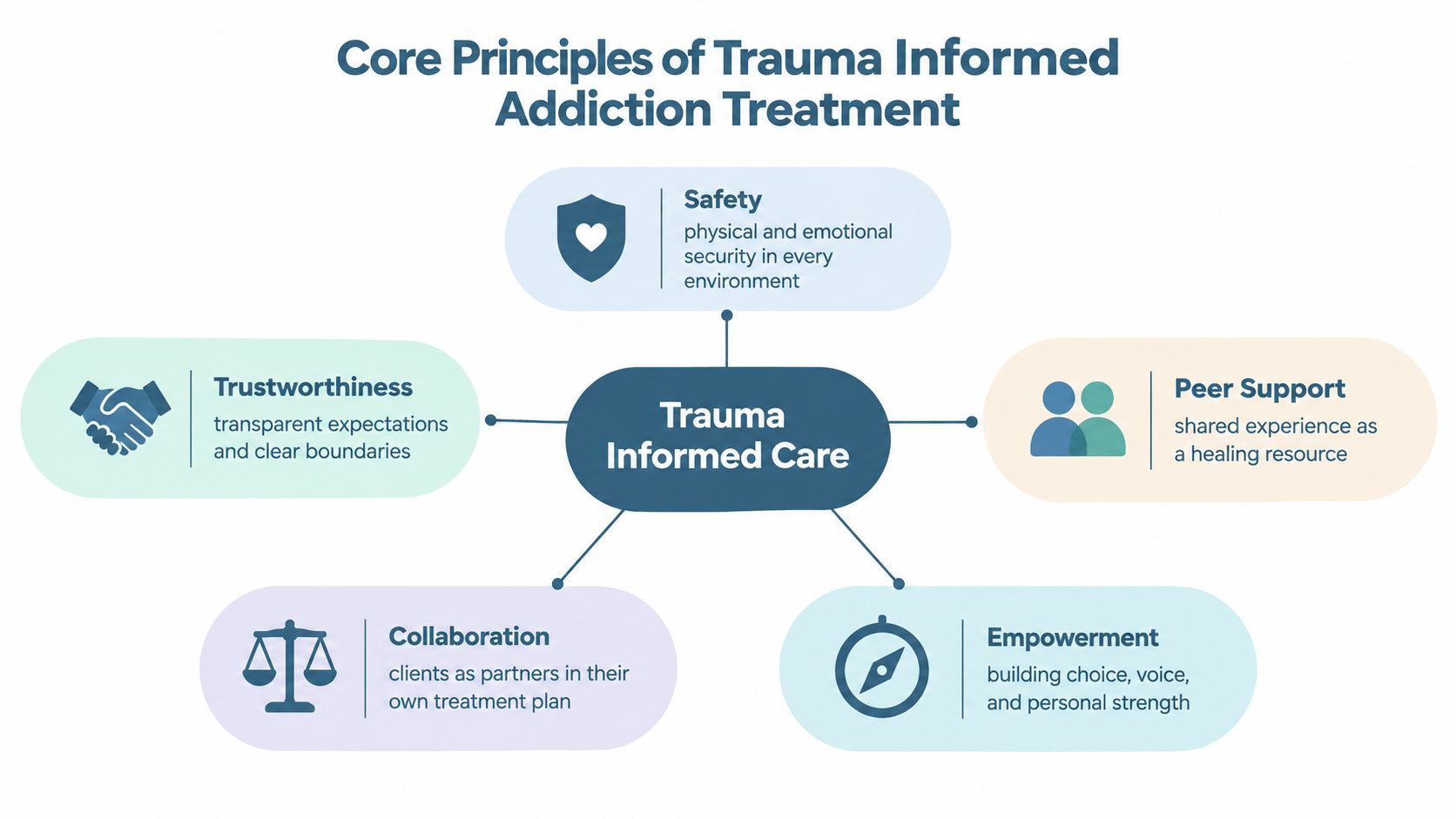
Core Principles of Trauma Informed Addiction Treatment
Trauma-informed care becomes meaningful when it changes daily decisions. It affects how staff conduct intake, how clinicians obtain consent, how groups handle disclosure, how medication changes are explained, and how a resident can express disagreement without being shamed or dismissed.
The framework rests on several operating principles. Each principle should be visible in the program's policies, staff behavior, and treatment planning, not only in its marketing language.
Safety comes before disclosure
A resident can't perform deep psychological work while remaining unsure about privacy, physical boundaries, medication decisions, or emotional exposure. Intake should establish what will happen, who will be involved, how emergencies are handled, and which choices remain with the resident.
Safety includes more than a calm building. It includes predictable communication, respectful language, appropriate clinical observation, and the ability to pause or modify an intervention when distress rises. A private room can support decompression, but it doesn't replace a clear safety plan or competent psychiatric care.
Trustworthiness requires transparency
Trauma can make authority, uncertainty, and loss of control especially difficult. Clinicians build trust by explaining the purpose of an assessment, describing likely benefits and risks, and avoiding surprises wherever possible. They also acknowledge limits rather than promising outcomes that no responsible provider can guarantee.
A strong treatment plan identifies who is responsible for each part of care. The resident should understand how the medical team approaches withdrawal, how therapists select modalities, when family members may participate, and how professional communication is managed.
Peer support needs boundaries
Group therapy can reduce isolation and help residents recognize patterns without requiring one person to carry the entire burden of disclosure. The group must still protect confidentiality, discourage coercive storytelling, and recognize that shared experience doesn't make every intervention appropriate for every resident.
High-performing professionals may initially resist peer settings because they're accustomed to privacy, leadership, and control. A carefully facilitated group gives them a structured place to practice honesty, receive feedback, and observe recovery behaviors in other adults.
Collaboration restores agency
Clinicians bring expertise. Residents bring lived knowledge of their symptoms, responsibilities, relationships, and goals. Treatment planning improves when both forms of knowledge shape the work.
That may involve choosing between appropriate therapeutic approaches, agreeing on the sequence of goals, identifying useful family involvement, and defining reasonable work boundaries. Collaboration isn't the absence of clinical authority. It is the use of authority transparently and proportionately.
Empowerment turns insight into behavior
CBT can help a resident identify thoughts that intensify shame or threat. DBT can build distress tolerance, emotional regulation, and interpersonal effectiveness. EMDR may be considered when the clinical team determines that the resident has sufficient stability and readiness for trauma processing. These modalities work best when the resident understands the rationale and can participate actively.
A trauma-informed team also uses motivational interviewing, mindfulness, somatic work, and carefully structured individual therapy to connect insight with behavior. The aim isn't to force a dramatic emotional breakthrough. It is to help the resident develop choices that remain available during a difficult meeting, a family conflict, a sleepless night, or a traumatic reminder.
For an executive, personal agency may look like identifying a trusted delegate, rehearsing a response to a triggering email, or learning to request support before a craving becomes an emergency. The clinical method must translate into life outside the treatment setting. Further context on the model appears in this guide to trauma-informed addiction treatment.
Elevating Recovery Through Luxury and Privacy
Luxury is clinically relevant when it removes barriers that would otherwise keep a professional from entering treatment or participating fully. It becomes clinically irrelevant when it functions as decoration around weak assessment, limited staffing, or vague programming.
A standard institutional environment may provide appropriate care, but it can also expose residents to shared sleeping arrangements, limited privacy, crowded common spaces, and a setting that feels disconnected from the demands of executive life. A premium residential program can offer private rooms, calm surroundings, discreet operations, and individualized scheduling while maintaining the structure required for recovery.
Privacy creates room for honest work
Private rooms for residents in both detox and rehabilitation allow a person to decompress without having to perform wellness for peers. That separation can be especially important during medically managed withdrawal, psychiatric stabilization, and the early stages of trauma assessment. It doesn't mean isolation. Clinical staff still need regular contact, observation, and access to the resident when care requires it.
Comfort also affects willingness to remain engaged. Thoughtful nutrition, fitness, massage, meditation, art and music therapy, and carefully supervised experiential work can support a broader recovery routine. Somatic and equine approaches may help some residents notice physical activation, boundaries, trust, and regulation in ways that purely verbal treatment doesn't always reach.
Amenities must serve the treatment plan
A private setting can lower distractions, but no spa feature can resolve PTSD or addiction on its own. Gourmet meals matter when they support nutrition and routine. A quiet room matters when it helps a resident regulate after therapy. Fitness matters when it develops consistent self-care rather than becoming another performance metric.

The image of luxury should never imply that alcohol belongs in a recovery environment. The relevant distinction is between restorative comfort and anything that undermines sobriety, emotional safety, or clinical boundaries.
Independent executive-rehab listings describe premium programs that may include private suites, high-speed Wi-Fi, and access to cell phones and other technology, with some private-pay programs listing rates starting around $40,000 per week, as reported in executive addiction treatment listings. These features reflect a market designed for professionals who need discretion and carefully managed continuity, but amenities should remain secondary to credentialed care.
A luxury setting earns its value when privacy makes treatment possible and comfort helps the resident stay present for demanding clinical work.
Balancing Career Obligations with Clinical Boundaries
Many executives delay admission because they assume treatment requires total professional disappearance. That fear can involve payroll, fiduciary duties, negotiations, clinical practice, board responsibilities, or the belief that no one else can make decisions without them.
A well-designed executive program can allow residents to keep cell phones and laptops while in treatment, but access should be structured rather than unrestricted. The purpose is to preserve essential continuity without allowing work to become a form of avoidance.
Managed access protects both roles
A practical electronics policy may begin with an initial therapeutic hold of 24 to 72 hours, followed by limited scheduled windows after medical stabilization and engagement in treatment, as described in an independent guide to PTSD and addiction treatment. The exact application must depend on clinical condition, withdrawal risk, psychiatric symptoms, sleep, participation, and the treatment team's judgment.
A resident might use a scheduled window to review an urgent message, speak with a designated delegate, or approve a time-sensitive decision. The resident shouldn't use that window to remain continuously available, monitor every operational detail, or avoid the emotional experience of treatment.
Work access needs a written plan
Before admission, the executive and clinical team can identify:
- Critical responsibilities: Separate genuine emergencies from tasks that can wait.
- Delegation: Assign authority to a trusted colleague, family member, attorney, or operating partner.
- Communication windows: Establish when calls, email, and video meetings are clinically appropriate.
- Privacy controls: Use discreet communication practices and limit unnecessary disclosure.
- Review points: Reassess access when sleep, mood, cravings, withdrawal, or trauma symptoms change.
This approach respects professional identity without allowing professional identity to dominate the recovery process. It also gives the resident a chance to practice a healthier leadership behavior, namely delegating with clarity instead of remaining indispensable at all times.
Work continuity should connect to broader sustainable wellness habits, including sleep protection, realistic availability, recovery-supportive routines, and limits that remain in place after discharge. A resource on beating burnout and developing sustainable wellness habits can complement, but never replace, individualized addiction and psychiatric treatment.
The goal isn't to preserve every aspect of the old schedule. The goal is to preserve what matters most while creating enough protected attention for detoxification, therapy, rest, and psychological change.
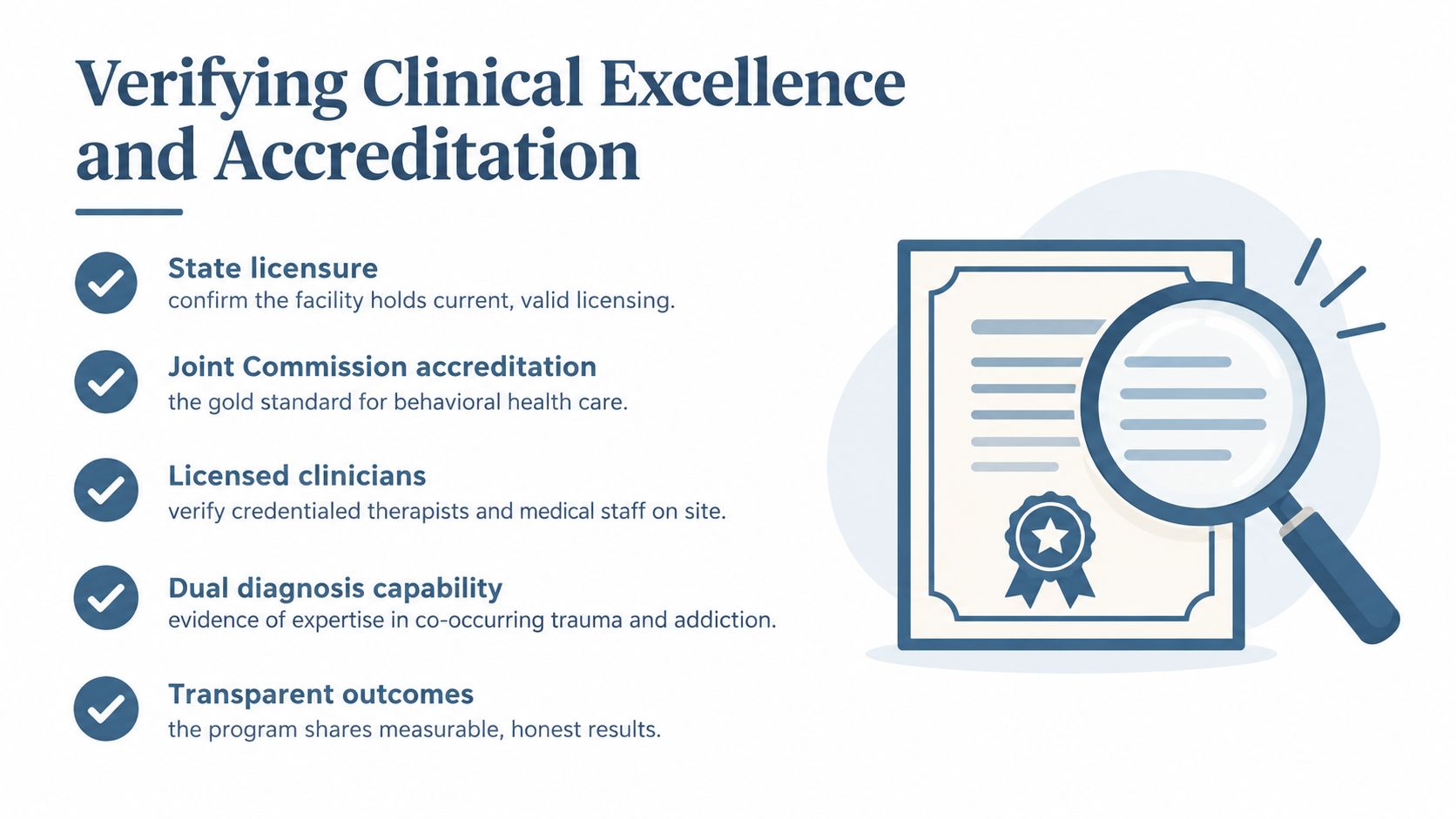
Verifying Clinical Excellence and Accreditation
An expensive private-pay program should withstand more scrutiny, not less. A beautiful property and discreet service may improve the experience, but neither proves that a facility can manage complex withdrawal, psychiatric symptoms, trauma processing, medication decisions, or relapse risk.
Joint Commission behavioral health accreditation provides one meaningful external check. The organization states that accreditation follows an onsite survey and ongoing compliance review, accredited providers are reviewed at least every three years, and its public locator includes substance use disorder treatment organizations. Details are available through the Joint Commission behavioral health provider locator.
What families and referral professionals should verify
A serious evaluation should include direct questions about:
- Licensing: Which state agency licenses the detox and residential programs, and is the license current?
- Accreditation: What behavioral-health accreditation applies, and can the facility be located in the accrediting organization's public directory?
- Clinical staffing: Which psychiatrists, psychologists, nurses, therapists, and addiction specialists participate in care, and who is physically available during stabilization?
- Dual-diagnosis competence: How does the team treat PTSD, depression, anxiety, bipolar symptoms, personality-related traits, and substance use together?
- Medical capability: How are withdrawal, medication-assisted stabilization, medication optimization, and psychiatric emergencies managed?
- Continuity: What happens after residential care, and who coordinates continuing treatment?
Accreditation isn't a guarantee of an individual outcome. It is evidence that a provider has undergone a formal review process tied to behavioral-health standards, safety, and quality. That distinction matters when a family is comparing a clinically accountable residential program with an informal retreat.
Amenities don't substitute for a multidisciplinary team
Trauma work may require psychiatric assessment, individual psychotherapy, skills groups, family sessions, nursing oversight, medication review, and experiential therapies. No single professional can provide all of those functions safely for a complex case.
The facility should explain how clinicians communicate, how treatment plans change, and how residents participate in decisions. Vague references to “healing” aren't enough. High-end care should make its clinical structure visible, including the qualifications of the team and the boundaries around trauma-focused interventions.
Transitioning into a Private Residential Program
A private residential admission is easier to manage when the family treats it as a coordinated clinical transition rather than an improvised retreat from work. The executive may be ambivalent, embarrassed, frightened about reputation, or convinced that a short interruption will cause professional damage. Those reactions deserve respect, but they shouldn't postpone medical assessment when substance use and trauma symptoms are escalating.
The first step is a confidential clinical conversation. The referring professional or family should provide an accurate account of substances used, current medications, withdrawal history, psychiatric symptoms, sleep, medical conditions, safety concerns, and recent changes in functioning. Accurate information allows the receiving team to determine whether its level of care is appropriate and what preparation may be required.
A practical admission sequence
-
Clarify the level of care. Residential treatment offers containment, daily structure, and access to an integrated team. Outpatient care may suit a person who has adequate stability, support, and safety outside a facility. A neutral outpatient versus residential guide can help families organize the decision, but a qualified clinical assessment should determine the recommendation.
-
Build a professional delegation plan. Identify who will handle operations, communications, finances, clinical duties, or board matters. The plan should state what qualifies as an emergency and who can make decisions during treatment.
-
Arrange discreet logistics. Families can coordinate confidential transportation, medication records, essential clothing, secure communication, and any required medical documentation before arrival. A private room during detox and rehabilitation can support dignity and decompression while the team provides appropriate observation and care.
-
Prepare for stabilization. Detox is a medical and psychological transition, not a test of willpower. Clinicians may address withdrawal, sleep, medication needs, anxiety, mood symptoms, and immediate safety before advancing trauma-focused work.
-
Include the family constructively. Private family sessions and educational workshops can help relatives understand triggers, boundaries, enabling patterns, communication, and relapse warning signs. Participation should support recovery, not become an additional source of pressure.
-
Plan beyond discharge. Continuing care should identify outpatient clinicians, medication follow-up, therapy goals, family supports, work boundaries, alumni resources, and a response plan for renewed cravings or trauma symptoms.
A high-end program should explain each stage before admission and maintain communication within appropriate confidentiality limits. The executive's career can be protected through delegation and structure. Health can be protected through medically supervised stabilization, individualized dual-diagnosis treatment, and a continuing-care plan that extends beyond the residential setting.
Reflections offers California-licensed, Joint Commission-accredited private residential care for adults with co-occurring mental health and substance use disorders, with private rooms in detox and rehabilitation, appropriate electronics access, multidisciplinary treatment, and trauma-informed dual-diagnosis programming. Executives, families, and referral professionals can visit Reflections to discuss confidential admission planning and determine whether the program fits the clinical and professional requirements of the case.