
No. Alcohol doesn't treat opiate withdrawal, and trying to use it as a bridge can create a second withdrawal problem because alcohol withdrawal can become life-threatening within 6 to 24 hours and often peaks around 36 to 72 hours.
At 11 p.m., this question often feels practical, not theoretical. A high-performing executive has shut the laptop, canceled one meeting already, and is staring at a drink cabinet thinking through a simple idea: if alcohol can dull anxiety and help with sleep for a few hours, maybe it can take the edge off withdrawal long enough to stay functional tomorrow.
That logic is understandable. Opiate withdrawal can feel relentless. Restlessness, sweating, stomach upset, insomnia, and cravings can make a person who usually solves problems quickly feel trapped in a body that won't cooperate. For professionals with major responsibility, the pressure gets sharper. They may worry about privacy, missed calls, deal timelines, board obligations, or family members noticing something is wrong before they're ready to talk.
The trouble is that alcohol and opioids don't solve the same problem in the brain. Alcohol may seem to soften the moment, but it doesn't treat the underlying opioid withdrawal process. It can also deepen sedation and raise safety risks, especially if opioids or other depressants are still in the system. For people who are also drinking heavily, the situation becomes more dangerous because alcohol withdrawal carries medical risks that opioid withdrawal usually doesn't.
A sedating substance can feel like relief without being treatment.
For professionals trying to protect both health and reputation, that distinction matters. Short-term numbing isn't the same as safe withdrawal management. Evidence-based care uses medications such as buprenorphine or methadone for opioid withdrawal and opioid use disorder, while alcohol-related withdrawal is managed differently, with monitored medications rather than alcohol itself.
A parallel question often sits underneath this one: whether alcohol itself can become a problem while someone is trying to cope. A useful background read on that issue is whether alcohol is physically or psychologically addictive.
Introduction Why People Ask If Alcohol Helps Opiate Withdrawal
A senior leader may spend years being the person everyone else relies on. That role can make help-seeking feel foreign. When withdrawal starts, the first instinct is often to self-manage, contain it, and keep moving.
That's why the question, does alcohol help with opiate withdrawal, comes up so often. It sounds like an efficiency question. If a drink reduces tension after a hard day, maybe it can quiet chills, cravings, panic, or insomnia after opioids stop.
Why the idea feels believable
Alcohol can produce brief sedation. That can create the impression that it's “working,” especially during a night when the main goal is to get a few hours of rest and make it through the next morning without drawing attention.
For a professional audience, the decision can become less about comfort and more about control:
- Privacy pressure: A person may want to avoid explaining sudden time away from work.
- Performance pressure: Meetings, travel, and deadlines don't pause because withdrawal begins.
- Image management: High achievers often delay care because they don't want colleagues to see instability.
Those pressures don't make the choice safer. They only make risky choices easier to rationalize.
The real issue behind the question
The question isn't usually about alcohol itself. It's about fear. Fear of losing momentum. Fear of being unreachable. Fear of entering treatment and disappearing from professional life.
That's where discreet, medically managed detox changes the equation. In a private-pay luxury setting designed for executives, treatment can protect confidentiality while addressing withdrawal with actual clinical tools rather than improvised self-medication. For professionals who need continuity, private rooms, a highly accredited clinical team, and appropriate access to electronics can make the decision more realistic. Residents can stay connected to essential career obligations by retaining cell phones and laptops, instead of choosing between treatment and total disconnection.
For many professionals, the barrier isn't whether help exists. It's whether help can fit the realities of their life.
The safer path isn't more willpower. It's treatment that respects both the biology of withdrawal and the practical demands of a high-level career.
How Opiate Withdrawal and Alcohol Affect the Brain Differently
The clearest way to understand why alcohol doesn't help is to look at what each substance is doing.
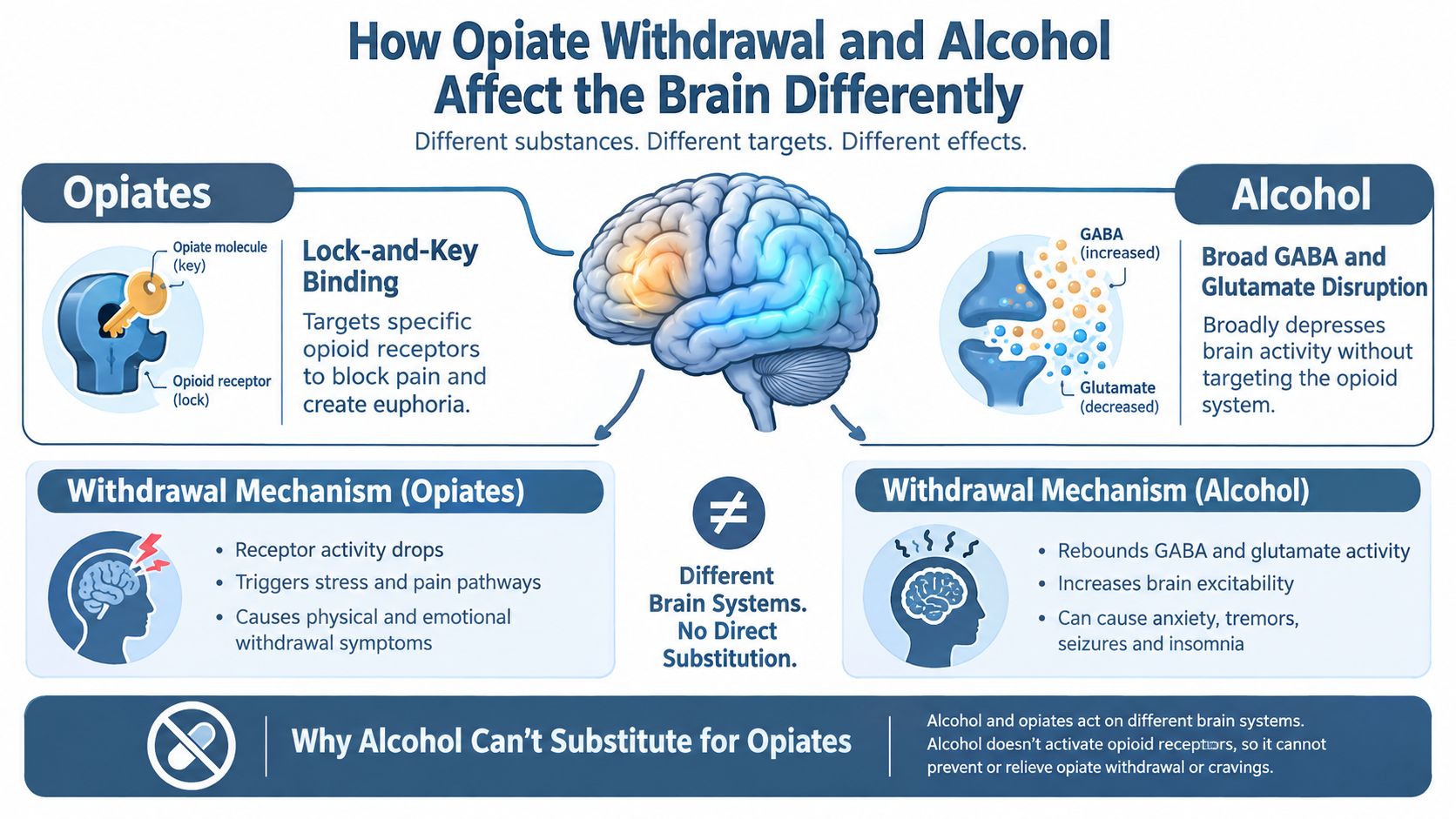
Opiates use one set of locks
Opioids act on specific opioid receptors. A simple analogy is a key fitting into a particular lock. Over time, the brain and body adjust to that key being used regularly. When the key suddenly disappears, the system becomes dysregulated. That's withdrawal.
Alcohol doesn't fit that same lock.
Alcohol acts more broadly as a central nervous system depressant. Instead of targeting the opioid system, it changes brain signaling in a wider, less specific way. It can slow things down, but it doesn't replace what the opioid system is missing. That's why a person may feel temporarily dulled while still remaining fully in opioid withdrawal.
Alcohol changes the thermostat, not the key
Another analogy helps. Opioid dependence is like a building whose doors have been programmed for one access card. Alcohol is more like turning the whole building thermostat down. It changes the environment, but it doesn't fix the access problem.
That mismatch matters because opioid withdrawal is not just “feeling bad.” It reflects a specific neurobiological state. Clinical guidance recommends medications such as methadone or buprenorphine rather than abrupt cessation, and short-acting opioid tapers commonly last about 6 to 10 days when that approach is used, according to the ASAM National Practice Guideline update hosted by Rutgers.
Core concept: Sedation can reduce awareness of symptoms without correcting the withdrawal mechanism causing them.
Why substitution fails
When someone drinks to cope with opioid withdrawal, several things can happen at once:
- Symptoms are masked, not treated. Anxiety or agitation may feel blunted for a short window.
- Cravings remain active. Alcohol doesn't satisfy opioid receptor dependence.
- A second dependence risk appears. Repeated “bridging” can turn into heavy alcohol use.
- Clinical decisions get delayed. Temporary numbing can postpone medication-based care that stabilizes withdrawal.
Many smart people get misled. They assume some relief means meaningful progress. In pharmacology, those aren't the same thing.
For executives and working professionals, that distinction is worth taking seriously. A person can still answer emails while making a dangerous physiological trade. Functioning on the surface doesn't mean the withdrawal process is being managed correctly underneath.
Why Using Alcohol for Opiate Withdrawal Increases Harm
The main danger isn't that alcohol “doesn't work.” It's that it can make an already unstable situation less predictable.
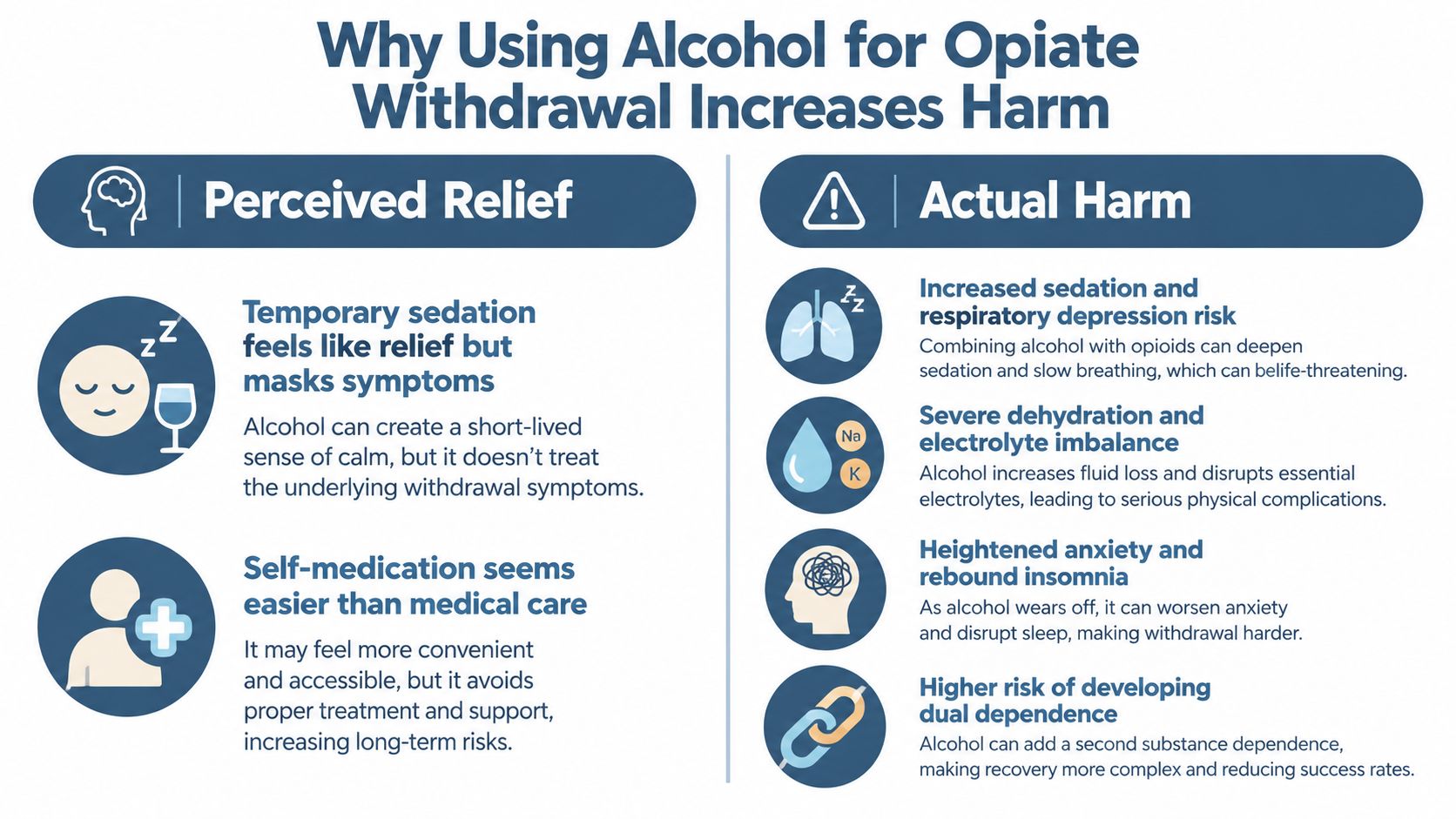
The perceived relief is misleading
Alcohol may feel calming at first because it's sedating. For someone in distress, that can look like proof that it's helping. But a nightcap effect often comes with rebound problems, especially around sleep and anxiety. For readers interested in the difference between sedation and restorative rest, this resource on how to sleep better without alcohol gives useful context.
The larger clinical issue is that alcohol doesn't address opioid dependence. It only layers another depressant effect on top of an already stressed nervous system.
Specific risks that increase with alcohol use
Clinical guidance and review literature describe several reasons this is unsafe:
- Greater sedation risk: Alcohol is a central nervous system depressant. If opioids or other depressants are still present, sedation can deepen.
- Respiratory danger: Combining depressants can worsen breathing suppression and raise overdose risk.
- More instability, not less: Alcohol can worsen dehydration and leave the body less able to tolerate vomiting, diarrhea, poor intake, and sleep loss.
- A second substance problem: Self-medicating opioid withdrawal with alcohol can create dual dependence.
A major review also notes that evidence-based care for concurrent alcohol and opioid withdrawal can be provided simultaneously in monitored inpatient settings, and it highlights a key safety problem: alpha-2 agonists alone can mask alcohol withdrawal, while undertreated withdrawal raises distress and the risk of leaving care early, as described in the PMC review on concurrent alcohol and opioid withdrawal management.
Opioid withdrawal and alcohol withdrawal are not equally dangerous
This point often gets blurred in online discussions. Opioid withdrawal is usually not life-threatening, though it can be intensely painful and clinically significant. Alcohol withdrawal is different. It can become medically dangerous and requires its own management approach, as summarized in this clinical review of opioid withdrawal management.
| Perceived benefit | What's actually happening |
|---|---|
| “It helps take the edge off” | Symptoms may be dulled briefly without treating opioid withdrawal |
| “It helps with sleep” | Sedation can be followed by rebound wakefulness and worse rest |
| “It's easier than treatment” | Risks rise while evidence-based care is delayed |
| “It's safer because it's familiar” | Familiarity doesn't reduce overdose, dual-dependence, or withdrawal complications |
For a high-functioning professional, the trap is subtle. Alcohol can preserve the appearance of coping while increasing medical risk.
The Hidden Danger of Dual Withdrawal and the Sedation Trap
The most dangerous version of this question appears when a person is trying to bridge opioid withdrawal with alcohol and isn't accounting for what happens when alcohol itself wears off.
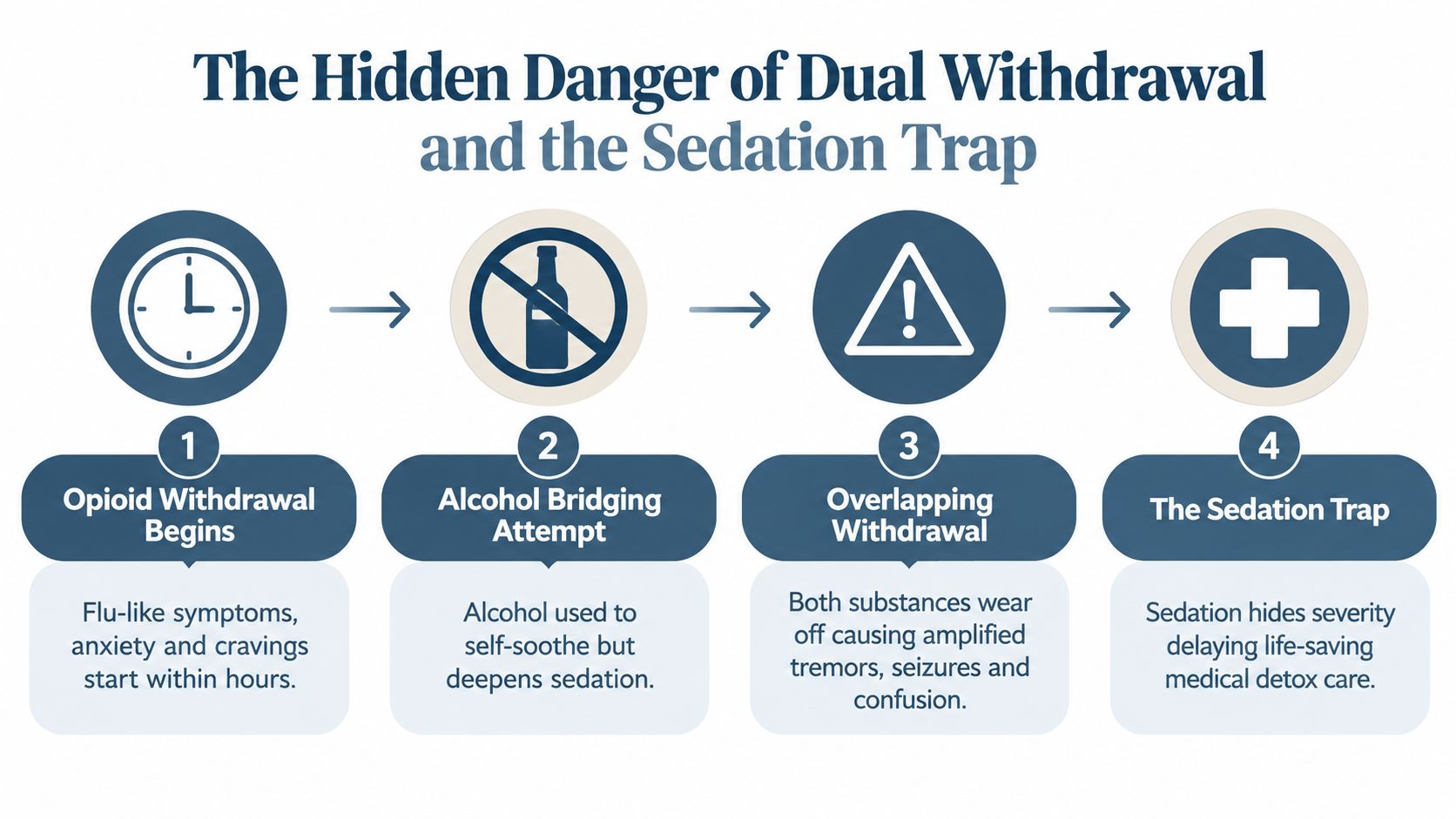
The trap starts with a few hours of relief
A person feels agitated, drinks to settle down, gets a short period of quiet, and concludes the strategy is workable. That conclusion can be dangerously incomplete.
Alcohol withdrawal can begin within 6 to 24 hours after cessation and often peaks around 36 to 72 hours. Government guidance discusses these timelines and also makes clear that alcohol withdrawal is treated with monitored medications such as diazepam, not with alcohol itself, in NCBI guidance on withdrawal management.
That means the “solution” can become a second problem on a very short timeline.
Why monitored care matters in dual withdrawal
When alcohol withdrawal risk and opioid use disorder appear together, clinical guidance favors inpatient management. First-line alcohol withdrawal treatment uses benzodiazepines such as chlordiazepoxide or diazepam, while opioid agonist treatment should generally be maintained until alcohol-assisted withdrawal is complete, according to the UK clinical guideline on drug misuse and dependence.
This is a critical point for readers who like operational clarity. The brain doesn't benefit from improvised cross-substitution. It benefits from treating each syndrome with the right medication in the right setting.
Temporary sedation can hide severity. It can also postpone the level of care that keeps a manageable situation from becoming a crisis.
Why executives are especially vulnerable to this mistake
Professionals used to solving problems privately may keep extending the experiment. One drink becomes a nighttime routine. Then a daytime stabilizer. Then an attempt to get through meetings while both withdrawal processes are developing underneath.
The person may still be dressed, logged in, and responding. That can make the danger easier to miss.
Luxury inpatient detox is particularly valuable here because it removes the false choice between safety and discretion. A private room, confidential monitoring, and a setting built for adults with serious responsibilities make it possible to step out of the sedation trap before the overlap becomes medically hazardous.
Evidence Based Alternatives That Actually Ease Opiate Withdrawal
The useful question isn't whether alcohol can numb symptoms. It's what treats withdrawal with a reasonable safety profile.
What evidence-based care uses instead
For opioid withdrawal and opioid use disorder, major guidance recommends buprenorphine or methadone rather than abrupt cessation. Withdrawal management alone also carries high relapse and overdose risk without ongoing pharmacotherapy. When first-line opioid agonist treatment isn't available, some protocols note clonidine or lofexidine as supportive options, but those are not substitutes for the core role of opioid agonist treatment.
Readers who want a clear primer on this treatment model can review medication-assisted treatment.
What helps vs what harms during opiate withdrawal
| Approach | Effect on Withdrawal | Safety Profile |
|---|---|---|
| Buprenorphine | Directly treats opioid withdrawal and can reduce cravings | Evidence-based when prescribed and monitored |
| Methadone | Stabilizes opioid dependence and withdrawal | Evidence-based when managed clinically |
| Short-acting opioid taper | Can reduce acute withdrawal intensity over about 6 to 10 days when appropriate | Requires medical oversight |
| Clonidine or lofexidine | May ease some symptoms when first-line agonists aren't available | Supportive, but not equivalent to opioid agonist treatment |
| Alcohol | May briefly sedate without treating opioid withdrawal physiology | Unsafe self-management, especially with overlap risks |
The setting matters as much as the medication
A monitored inpatient setting is especially important when alcohol withdrawal risk is also in the picture. In that situation, first-line treatments for alcohol and opioid withdrawal can be used at the same time under supervision, rather than forcing a person to guess which problem to treat first or how to balance symptoms safely.
That matters for professionals who want certainty. Good withdrawal care isn't improvised. It's structured.
A high-end private-pay program may also be a fit when the person needs medical care without sacrificing confidentiality or total work continuity. One option is Reflections, which offers clinically managed sub-acute detox, private rooms, and dual-diagnosis treatment for adults who need both withdrawal support and ongoing psychiatric care in a residential setting.
The right treatment should reduce chaos, not require more guesswork.
The larger goal is not “getting through detox.” It's leaving withdrawal with a treatment plan that lowers the chance of rapid relapse and the medical risks that often follow it.
How Luxury Private Detox Supports Executives Through Withdrawal
For executives, C-suite leaders, and working professionals, the best detox setting isn't just medically competent. It also has to respect privacy, identity, and ongoing responsibility.

Clinical strength and discretion have to coexist
A luxury residential program for this audience should solve two problems at once. It should provide high-level withdrawal management, and it should let the resident remain connected enough to prevent work obligations from collapsing.
That means features like these aren't superficial extras. They're functional supports:
- Private rooms throughout detox and rehab: Space matters when a person is physically uncomfortable and professionally visible.
- Appropriate access to electronics: Residents can keep cell phones and laptops so they can maintain essential communication and career obligations.
- A highly accredited clinical team: Complex withdrawal often overlaps with anxiety, depression, trauma, or other co-occurring conditions that require more than symptom control.
Why accreditation matters in a high-end setting
A polished environment is helpful, but it doesn't replace standards. The Joint Commission's behavioral health accreditation framework explicitly applies to addiction treatment programs including detox, residential care, outpatient care, partial hospitalization, dual-diagnosis, and mental health services, which is why Joint Commission behavioral health accreditation standards are directly relevant when evaluating an upscale residential program.
For this audience, a luxury setting should sit on top of real clinical structure, not distract from the absence of it.
What sophisticated care looks like during withdrawal
Strong executive-focused detox usually includes:
- Medication management with restraint: Clinicians use minimal effective pharmacology rather than over-sedating the resident.
- Dual-diagnosis treatment: Withdrawal may uncover or intensify panic, insomnia, grief, trauma responses, or mood symptoms.
- Private, individualized treatment planning: High achievers often need care that is designed around confidentiality, family communication, and professional obligations.
- Step-down continuity: Detox is only the first move. Residential treatment and continuing care help protect gains made during stabilization.
A closer look at that first stage is available in this overview of medical-assisted detox.
For many professionals, the luxury isn't décor. It's being able to receive serious clinical care without surrendering privacy, dignity, or every aspect of daily responsibility.
Taking the Next Step Toward Safe and Confidential Recovery
When someone asks whether alcohol helps with opiate withdrawal, the most useful answer is simple. It may sedate for a short time, but it doesn't treat opioid withdrawal, and it can make the situation more dangerous.
That's especially important for professionals who are used to carrying pressure. Self-treatment can look efficient because it happens in private. In reality, it often creates more instability, more risk, and more delay before the person receives the medication and monitoring that help.
What a safer next step looks like
A confidential clinical assessment should answer practical questions, not just medical ones:
- Withdrawal risk: Whether opioid withdrawal is the main issue or whether alcohol use has created overlap risk.
- Medication options: Whether buprenorphine, methadone, or another monitored protocol makes sense.
- Work continuity: How communication, devices, and critical obligations can be handled safely.
- Length of care: Whether the person needs detox only or a longer dual-diagnosis plan.
What preparation can look like for a busy professional
The strongest early move is often simple and quiet. Delegate urgent work decisions for a short period, identify one trusted point person, and enter treatment before symptoms escalate or alcohol gets folded into the equation.
Early treatment often protects more privacy than waiting for a visible crisis.
For high-earning individuals, private-pay luxury care can remove many of the barriers that keep treatment postponed. Private rooms, confidential admissions, access to electronics, and psychiatric support make it easier to choose medical safety without abandoning real-world responsibilities.
The goal isn't to disappear from life. It's to stabilize safely, preserve what matters, and return with a treatment plan that supports lasting recovery.
Reflections provides California-licensed, Joint Commission-accredited luxury detox and residential dual-diagnosis care for executives, C-suite leaders, and working professionals who need private rooms, discreet treatment, and appropriate access to phones and laptops during care. For someone weighing whether alcohol can manage opiate withdrawal, a confidential assessment can clarify safer medication-based options and whether monitored detox is needed. To learn more, visit Reflections.