
You're still running meetings, answering texts, and keeping the calendar moving, but the withdrawal window has started to make that impossible to ignore. That's the moment most executives face the same quiet question: step away now, or keep forcing through it and hope the problem stays hidden. Medical assisted detox is the answer when the priority is getting stable without turning recovery into a public career collapse.
For high-achieving professionals, the mistake is treating withdrawal like a personal willpower test. It isn't. It's a clinical event that needs supervision, a plan, and a clear handoff into ongoing care. In a luxury setting, that handoff is built around privacy, private rooms, work continuity, and the kind of clinical structure that lets someone stay reachable without staying exposed.
Why Executives Hesitate and What Changes the Equation
A chief operating officer can look composed in the boardroom and still be white-knuckling every evening, every flight, every dinner where alcohol is expected. The fear isn't just withdrawal, it's what happens to the deals, the team, and the image if the problem becomes visible. That fear keeps people stuck longer than it should.
Modern luxury detox changes the equation by making treatment discreet and medically structured. Reflections' executive rehab model is built for people who can't afford chaos, which is exactly why the setting matters as much as the medication plan. Private rooms, confidential care, and room to keep working turn detox from a public interruption into a controlled reset.
The real trade-off
Executives don't need a pep talk. They need a workable plan that reduces risk without creating a bigger professional mess. A private-pay setting is often chosen for that reason, not for ornament.
Practical rule: if the current plan depends on “getting through the week” one more time, the plan is already failing.
A resource such as personalized medication support can help frame the conversation before admission, because the right withdrawal plan should match the person's substance history, medical status, and need for continuity. The point is not comfort for its own sake. The point is staying clinically safe while preserving enough structure to keep the rest of life from unraveling.
What Medical Assisted Detox Means
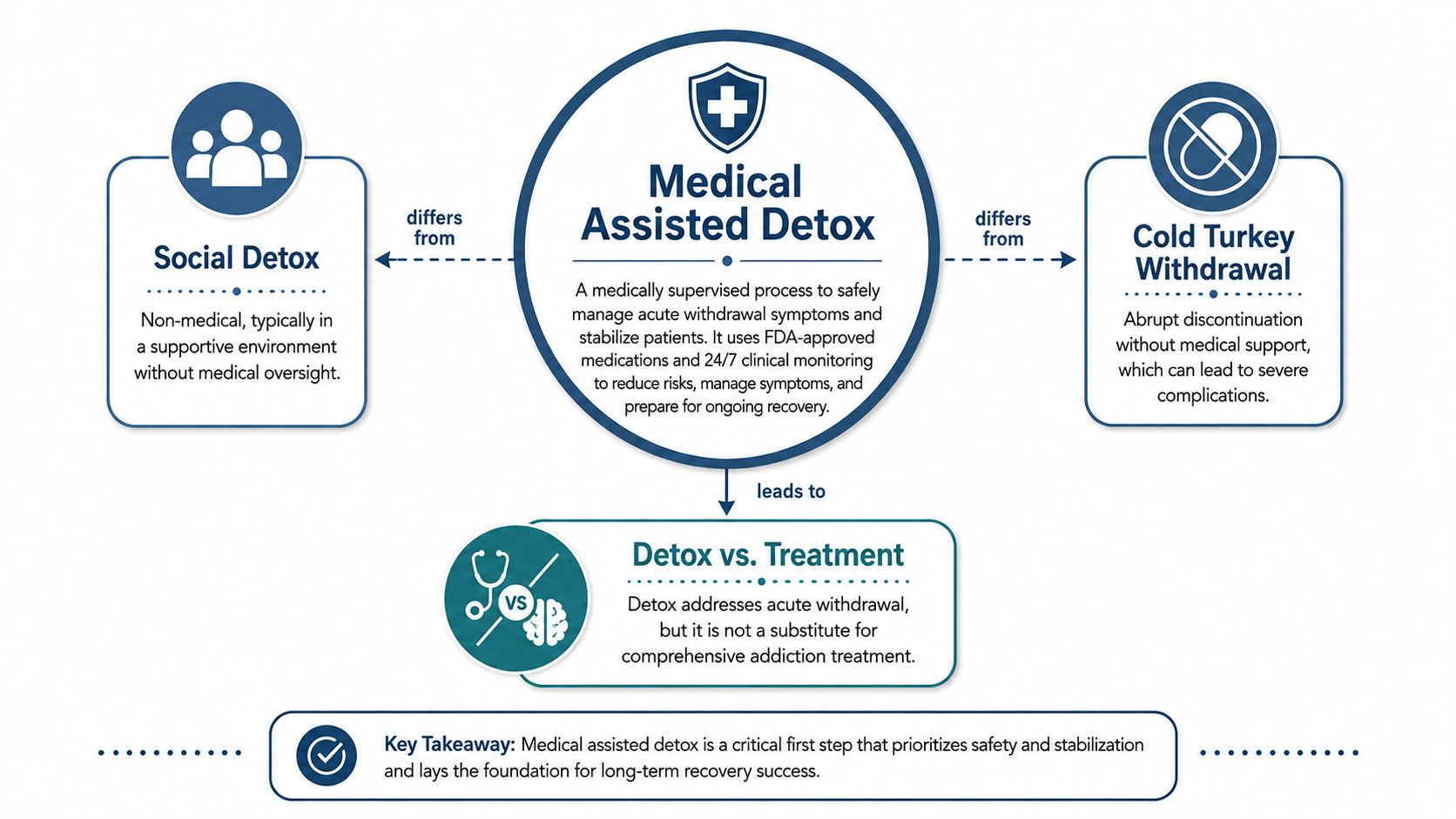
Medical assisted detox is a supervised process that clears substances from the body while managing withdrawal symptoms with medication and clinical monitoring. Formal guidance defines detoxification as a process of clearing toxins from the body of a patient who is acutely intoxicated and or dependent on substances of abuse, and it treats detox as a distinct phase of care rather than a full treatment program. The goal is stabilization before continuing treatment SAMHSA clinical guidance.
The practical trade-off
Executives do not need vague reassurance. They need withdrawal managed without turning a medical problem into a professional crisis.
Medical detox gives them a controlled setting, private accommodations, and real-time clinical oversight. That matters because withdrawal can disrupt sleep, judgment, blood pressure, and the ability to keep functioning at work. In a private-pay environment, care can be organized around discretion and continuity, not chaos.
What it is, and what it isn't
It is not cold turkey. Abrupt withdrawal without medical support can be dangerous, especially with alcohol, benzodiazepines, or opioids.
It is not social detox either. A supportive environment without medical oversight can help some people feel less alone, but it does not replace medication management or real-time clinical monitoring.
It is also not the same thing as MAT. Detox manages the acute withdrawal window. Medication-assisted treatment explained continues beyond that window when the clinical plan calls for it, especially for opioid use disorder.
The distinction matters because many professionals have already tried to tough it out alone. That approach usually fails for one simple reason, the body keeps driving the same withdrawal cycle until symptoms are treated properly. Medical detox does not reward stubbornness. It replaces guesswork with a plan.
How to think about the goal
The goal is stabilization, not a moral victory. In practice, that means lowering withdrawal severity, protecting sleep, reducing physiologic strain, and preparing for the next level of care. Detox that ends with “good luck” is incomplete care.
A useful way to judge any program is simple. If the intake process does not lead to medication decisions, monitoring, and a transition plan, it is not medical assisted detox in any meaningful sense. For people who need more than basic monitoring, personalized medication support should be part of the conversation before admission.
The Clinical Process Behind Safe Withdrawal
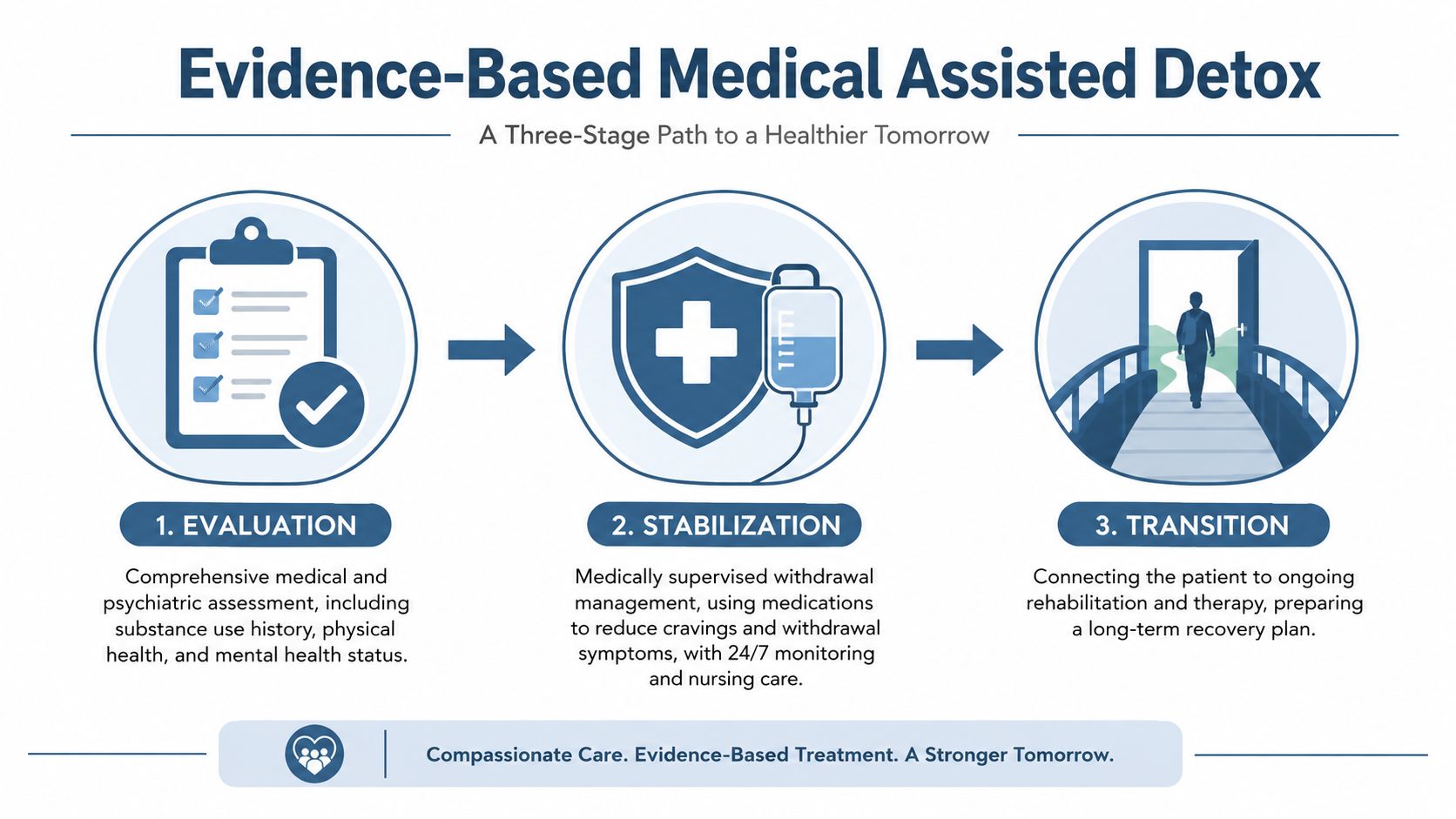
The safest detox programs move through three stages, evaluation, stabilization, and transition to ongoing treatment. SAMHSA guidance treats that sequence as the baseline because symptom relief by itself does not address relapse risk, co-occurring psychiatric illness, or whether the person stays engaged in care SAMHSA guidance.
Evaluation comes first
Evaluation is more than confirming what was used and when. The team should review substance-use history, vital signs, psychiatric symptoms, medical risks, and immediate safety concerns. That is the point where anxiety, depression, trauma, bipolar symptoms, or other instability should be identified and addressed instead of brushed past.
For executives, this stage matters because high performance can hide real danger. A person can still answer emails while blood pressure, sleep, and judgment are slipping. Good detox teams do not confuse productivity with stability.
Stabilization is medication guided, not improvised
For alcohol withdrawal, clinical guidance describes symptom-triggered benzodiazepine protocols using the CIWA-Ar scale, with repeated dosing continued until scores fall to 10 or less or the patient becomes sedated. That is a measured approach, not a one-size-fits-all dose NCBI Bookshelf.
For opioid withdrawal, clinical guidance identifies methadone, buprenorphine/naloxone, clonidine, guanfacine, and lofexidine as commonly used agents, with the choice driven by severity, cardiovascular status, and treatment goal opioid withdrawal guidance. Buprenorphine generally starts only once objective withdrawal is present, while methadone tapers fit more structured settings. Naltrexone induction often begins at 25 mg on day 1 and increases to 50 mg daily afterward opioid withdrawal guidance.
Transition is where real recovery starts
Detox without a step-down plan is unfinished work. A high-quality program leaves the patient with a clear next move, residential care, outpatient medication management, or another level of treatment matched to need. The clinical handoff is not administrative paperwork, it is the part that prevents the old cycle from restarting.
Detox that ends at discharge is a pause, not a plan.
How Luxury Detox Differs from Standard Facilities
Luxury detox is not just nicer bedding and quieter hallways. The difference is how the setting supports privacy, work continuity, and clinical attention at the same time. For executives, that combination changes whether treatment feels impossible or finally workable.
| Feature | Luxury Private-Pay | Standard Facility |
|---|---|---|
| Privacy | Private rooms and a discreet environment | Shared spaces are more common |
| Work access | Cell phones and laptops can be kept with appropriate boundaries | Electronics policies are often stricter |
| Clinical attention | Multidisciplinary team with individualized planning | More standardized workflows |
| Setting | Designed for confidentiality and reduced disruption | More clinical and less tailored to work demands |
| Aftercare focus | Strong emphasis on handoff and ongoing care | Varies widely by program |
What matters most for professionals
The highest-value feature is not décor. It's the ability to stay medically supervised without completely severing professional obligations. That matters when a CEO, partner, physician, or attorney needs to stay reachable for limited, controlled periods.
Luxury programs also tend to build in more direct clinical visibility. That's important because detox isn't a comfort contest. It's a monitored medical interval where medication choices, symptom tracking, and psychiatric input have to stay tight.
The trade-off is real
Private-pay care costs more because it usually buys more space, more discretion, and more personalized staffing. That doesn't make it automatically better for every person. It does make it a rational choice for people whose careers, security concerns, or public profiles make standard settings a poor fit.
One useful filter is this. If a program can't clearly explain how it handles privacy, phone use, and continuity of care, it's not designed for working professionals.
Why Detox Alone Is Not Enough
Detox starts the process, it does not finish recovery. A California cohort study found that 12 months after detox, 41% of patients received MOUD, 35% received residential treatment, and 13% received both, and all three post-detox pathways were associated with substantially reduced mortality compared with no treatment California cohort study. That is the part many people miss. The body may clear, but the risk remains.
Why follow-on care matters
The biggest failure point after detox is discontinuity. People leave, feel physically better for a short window, then fall back into the same triggers, same stress, same access patterns, same isolation. If the next step is not already arranged, relapse risk climbs fast.
For opioid use disorder, PCSS guidance is direct. Detoxification alone is not treatment, and if it is not followed immediately by medication treatment, it can increase relapse, overdose, and death risk. Some studies cited in that guidance report that more than 90% returned to opioid use within months after detox alone PCSS guidance. Serious programs treat detox as the doorway, not the destination.
Dual-diagnosis care is critical
For executives, co-occurring anxiety, depression, trauma, or bipolar symptoms often sit underneath the substance problem. If those conditions stay untreated, the person leaves detox with the same pressure points intact. A plan that ignores mental health is a plan built to leak.
Luxury residential treatment is often the logical next step because it can hold detox, therapy, family work, and medication optimization in one controlled setting. Reflections' approach, described in its medical detox at Reflections, links withdrawal management to ongoing residential treatment rather than treating detox as the whole answer.
If the aftercare conversation starts after discharge, the program waited too long.
Questions to Ask Before Choosing a Facility
A smart buyer asks direct questions and listens for direct answers. If the answers sound vague, the program probably is too. High-performing professionals don't need hype, they need proof that the setting can manage withdrawal safely and discreetly.
The checklist that matters
Clinical credentials. Ask whether the program is accredited and how clinical oversight is structured. Strong programs are specific about who is responsible for medical decisions and what qualifications those people hold.
Medical staff coverage. Ask who is on site, when a physician is available, and how psychiatric concerns are handled. Detox should not rely on one person's occasional availability.
Medication protocol. Ask how the team decides between alcohol and opioid withdrawal approaches, how symptoms are tracked, and how adjustments are made in real time. Good teams can explain the logic without sounding rehearsed.
Aftercare planning. Ask what happens the moment acute withdrawal ends. If the answer is vague, the facility is treating detox like a transaction instead of a clinical handoff.
What strong answers sound like
A strong facility will talk about screening, monitoring, medication titration, and transition planning without dodging the details. It should also be able to explain how privacy is protected and how people with demanding schedules stay connected to work within clinical boundaries.
A good detox program should make it easier to tell the truth, not harder.
Executives and families should also ask how co-occurring conditions are addressed, because dual-diagnosis care changes the entire course of treatment. The best answer isn't a slogan, it's a clear description of who evaluates mental health, when that happens, and what happens next.
How Reflections Integrates Detox Into Lasting Recovery
Luxury detox only works when it leads somewhere. Reflections' medical detox program is built on that principle, with clinically managed withdrawal, private rooms, appropriate electronics access for work continuity, and a multidisciplinary team led by Executive Clinical Director Dr. William Hanna. For executives, that combination matters because it protects privacy without stripping away the clinical structure needed for safe withdrawal.
What the experience is designed to do
The medical goal is stabilization. The residential goal is to keep treatment moving after stabilization ends. At Reflections, that includes evidence-based therapy, integrative support, family involvement, and continuing care planning in a California-licensed, Joint Commission-accredited setting.
The point is straightforward. Detox alone does not change the pattern that led someone there. A serious program addresses the person behind the symptoms, not just the withdrawal window.
What a strong finish looks like
A strong detox outcome is a clean transition into sustained treatment, with a plan shaped around diagnosis, schedule, privacy needs, and long-term recovery risk. For working professionals, that usually means private accommodations, structured medical care, and enough flexibility to keep career obligations from falling apart.
Reflections fits that model for people who need confidentiality and continuity. It is one option for professionals who want withdrawal managed without sacrificing the structure of their working life.
The program is designed to carry detox into the next phase of care, not treat it as a standalone event. That is the difference between temporary stabilization and a real recovery plan.
If withdrawal is starting to interfere with judgment, sleep, or work, it is time to get a real plan in place. Reflections offers medically supervised detox, private accommodations, and a direct bridge into dual-diagnosis residential treatment for professionals who need discretion and continuity. Visit Reflections to speak with a team about a treatment plan that fits the demands of real life.