

A senior leader often reaches the same point in private. Meetings are still getting done. The board deck still goes out on time. Travel, pressure, and performance continue. But alcohol, stimulants, anxiety medication, burnout, panic, depression, or a combination of them has started running the schedule behind the scenes.
For high-earning professionals, the barrier usually isn't recognizing that something is wrong. It's the fear that getting help will trigger a professional collapse. Many assume treatment means disappearing, losing confidentiality, handing control to someone else, and returning to work with visible damage to reputation or momentum. That fear keeps people in dangerous holding patterns far longer than families, colleagues, and the executives themselves realize.
The Executive's Dilemma Finding Help Without Losing Momentum
A C-suite professional rarely presents like the public stereotype of addiction. The presentation is usually polished. The problems are hidden inside overfunctioning. Sleep gets thinner. Irritability rises. Decisions become more reactive. Work becomes both the shield and the excuse.
That's why executive rehab exists. It was built for people who can't unplug from life in the same way a traditional program expects. The model is designed around privacy, professional continuity, and high-level clinical care so treatment can happen without requiring a total identity collapse.

Why high performers delay treatment
The internal argument is predictable. There's a transaction pending. A team depends on them. A client relationship would suffer. A financing event needs oversight. Family members often hear, “I can't leave right now.” What that usually means is, “I can't tolerate what stopping would expose.”
For some professionals, a broader conversation about choosing effective executive wellness can be a useful starting point before they're ready to discuss residential care directly. It helps frame treatment as a strategic health decision, not a moral failure.
The most functional person in the room can still be the least free.
A well-designed executive program acknowledges reality. High-level professionals may need access to a phone, laptop, or carefully managed communication windows. They may need to preserve key obligations while still entering detox, residential treatment, or dual-diagnosis care. A work-capable setting like a program that allows work access during treatment addresses that practical need, but the presence of electronics alone doesn't make a program clinically sound.
What the right solution actually resolves
Value isn't “luxury” in the superficial sense. It's control over variables that matter. Private rooms in detox and residential care protect rest and confidentiality. A discreet environment lowers exposure risk. An accredited clinical team can address substance use and the underlying drivers at the same time, whether that's trauma, anxiety, depression, bipolar symptoms, or severe stress exhaustion.
For executives and families, the question isn't whether treatment will interrupt life. It will. The better question is whether that interruption is structured well enough to preserve what matters while repairing what's breaking.
What Defines an Executive Rehab Program
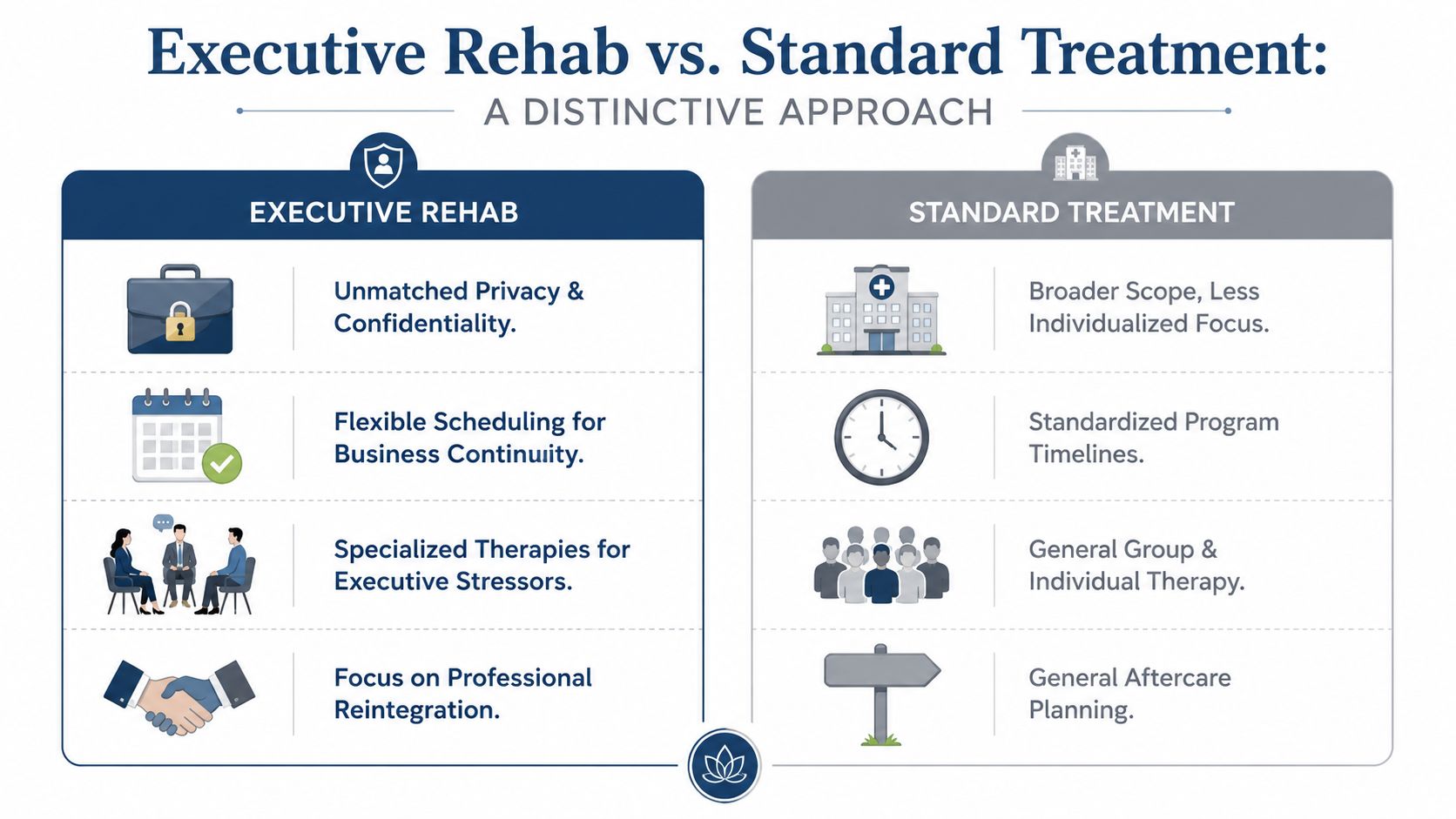
Executive rehab is often misunderstood as standard treatment with nicer furniture. That's not the clinical difference. The destination is still recovery, but the operating model is different.
A standard facility may ask clients to fit into the program. An executive program is built to account for the psychological, logistical, and reputational realities of leadership roles. That includes discreet admissions, private rooms, protected communication boundaries, and treatment planning that recognizes the client may still carry limited business responsibility.
The three features that actually matter
The phrase executive rehab should mean more than expensive lodging. In practice, it rests on three pillars.
| Pillar | What it looks like in a true executive setting | Why it matters |
|---|---|---|
| Privacy | Private rooms, discreet admissions, quiet environment | Reduces exposure, overstimulation, and status anxiety |
| Professional continuity | Managed access to electronics, meeting space, secure connectivity | Allows essential obligations without full disengagement |
| Clinical sophistication | Dual-diagnosis treatment, experienced multidisciplinary staff, tailored planning | Treats the root system, not just the symptom |
High-end treatment for executives, founders, attorneys, physicians, and other working professionals separates itself from generic “luxury” branding. The comforts have a purpose. They reduce friction so clients can do difficult psychological work without feeling stripped of all autonomy.
Amenities are clinical tools when used correctly
Spa-like environments, exercise access, and other high-end amenities are often dismissed as extras. In a serious executive setting, they support regulation, sleep, privacy, and willingness to stay engaged in care. That matters because American Addiction Centers notes that executive rehab is defined by enabling high-level professionals to maintain work responsibilities while in residential treatment, and cites NIDA's view that a stay of at least 90 days is a strong predictor of sustained recovery.
Practical rule: Comfort isn't the treatment. It creates conditions where treatment is easier to accept and harder to abandon.
A premium private-pay program for executives should also reflect the expectations of that population. Private rooms in both detox and rehab aren't indulgences for this audience. They're often necessary for confidentiality, decompression, and clinical engagement. The same applies to having access to a cell phone or laptop under structure. For many professionals, treatment becomes viable only when the program respects real-world obligations without letting those obligations dominate the day.
The best executive environments also understand peer context. A high-functioning professional may open up faster with others who understand fiduciary pressure, reputation risk, and the loneliness of leadership. That said, peer matching only works when the culture doesn't turn into a polished avoidance circle. The group has to challenge status defenses, not protect them.
Inside the Program Clinical Excellence and Therapies
The strongest executive programs don't start with the substance. They start with the system around it. A high performer may drink to shut off, use stimulants to outrun fatigue, misuse prescriptions to stabilize mood, or cycle between overwork and collapse. If treatment only removes the substance and ignores the anxiety, depression, trauma, or burnout underneath it, the old structure returns.
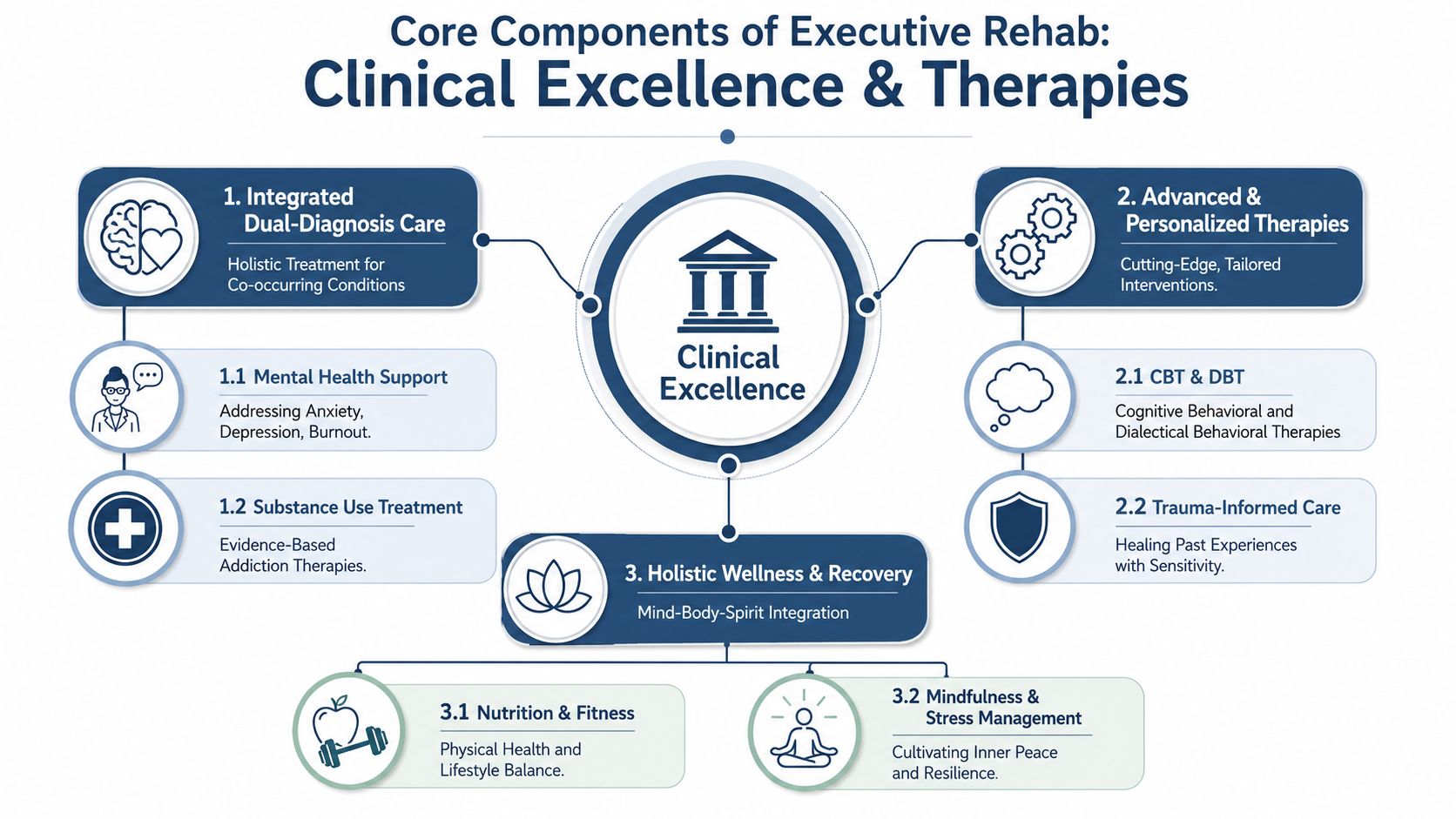
That's why integrated dual-diagnosis care is the center of executive rehab. It addresses substance use and mental health together, not in separate tracks that fail to inform each other.
What strong clinical care includes
Historical data on integrated treatment is unusually clear. Clinical findings published in the National Center for Biotechnology Information report alcohol intoxication rates falling between 67% and 91% in patients with common co-occurring disorders when dual-diagnosis treatment is integrated, and the strongest outcomes are associated with evidence-based approaches such as CBT and Motivational Interviewing.
That matters in executive populations because symptoms are often layered. The client may present with perfectionism, chronic activation, panic, unresolved grief, shame, relationship fractures, or trauma responses hidden inside a successful public life.
A well-run program usually includes:
- CBT for distorted performance thinking. This helps identify the beliefs that drive compulsive overwork, catastrophizing, rigid self-judgment, and substance-supported coping.
- DBT for regulation under pressure. Executives often need direct work on distress tolerance, emotion regulation, and interpersonal effectiveness.
- Motivational Interviewing for ambivalence. Many clients still want two incompatible things at once. Recovery and full control. MI helps reduce that split without turning treatment into a power struggle.
- Trauma-informed psychotherapy. High function doesn't rule out trauma. It often masks it.
Medication and medical oversight
Some executives arrive needing detox or medication-assisted support. That work should be overseen by licensed medical professionals who understand addiction medicine and co-occurring psychiatric symptoms. Medication can be useful when it lowers withdrawal risk, reduces cravings, stabilizes mood, or makes therapy possible.
The key is disciplined prescribing. In a serious executive setting, medication supports treatment. It doesn't replace treatment.
A premium program should be able to explain why each medication is being used, what it's targeting, and how it will be reviewed over time.
For clients with trauma histories, specialized modalities may also matter. Therapies such as EMDR for addiction and trauma recovery can become part of a larger plan when the clinical team determines that the person is stable enough for deeper processing.
Why holistic work belongs in a serious program
Executives sometimes resist mindfulness, movement, nutrition work, somatic therapies, or experiential modalities because they sound secondary. Clinically, they're often essential. This population is frequently disconnected from body cues, exhausted from chronic sympathetic activation, and conditioned to think insight alone will solve everything.
Holistic work restores capacities that boardrooms reward people for ignoring.
- Fitness and movement can improve regulation and sleep.
- Mindfulness training helps reduce automaticity and impulsive reactions.
- Nutrition support matters because erratic eating, stimulant use, and alcohol often distort appetite and energy patterns.
- Experiential therapies can reach clients who intellectualize everything.
One example of a California-based option is Reflections, which provides dual-diagnosis residential treatment in a private setting with private rooms, managed electronics access, and a multidisciplinary clinical team. The relevant point isn't branding. It's that executive treatment should combine credentialed psychotherapy, psychiatric oversight, and structured lifestyle restoration in one coordinated plan.
Balancing Recovery and Career The Technology Policy
The question most executives ask early is simple. “Can I keep my phone and laptop?” The wrong answer is either extreme. Total unrestricted access can sabotage treatment. Blanket prohibition can make admission impossible for someone carrying legitimate obligations.
A mature executive rehab program treats technology as a clinical variable, not a marketing perk.
When work supports recovery
There are healthy uses of work access in treatment. A leader may need to delegate a pending matter, reassure a key stakeholder, approve a narrow decision, or preserve business continuity during an absence. Limited contact can reduce panic and increase willingness to stay in care.
Handled correctly, that contact becomes therapeutic material. The clinical team can observe where stress spikes, what triggers urgency, and how the client reacts when they can't overcontrol every outcome.
When work becomes avoidance
The danger is subtle. High performers often use work the way other clients use denial. It looks responsible. It sounds rational. It even wins praise from family or colleagues. But clinically, it can function as a polished escape route from grief, fear, shame, or emotional fatigue.
Full connectivity can keep an executive employed while quietly preventing recovery.
That's why serious programs set boundaries. Not symbolic ones. Operational ones.
- Defined access windows: Devices may be available at specific times rather than throughout the day.
- Clinical review of obligations: The team helps separate what's essential from what feeds control or image management.
- Real-time feedback: If work contact escalates anxiety, irritability, or withdrawal from treatment, the policy changes.
- Protection of core treatment hours: Therapy, groups, psychiatric care, meals, and rest stay primary.
The goal isn't to infantilize capable adults. It's to stop a familiar pattern. Many executives have spent years proving they can function while dysregulated. Executive rehab has to test something different. Can they recover without using performance to avoid themselves?
Choosing a Reputable Program What to Look For
A discerning buyer shouldn't shop for executive rehab the way they'd shop for a hotel. The relevant question isn't who has the nicest property. It's who has the clinical depth, operational discipline, and privacy standards to treat a high-stakes client safely.
The fastest way to sort programs is to ask for specifics. Vague answers usually mean weak systems.
The non-negotiable checklist
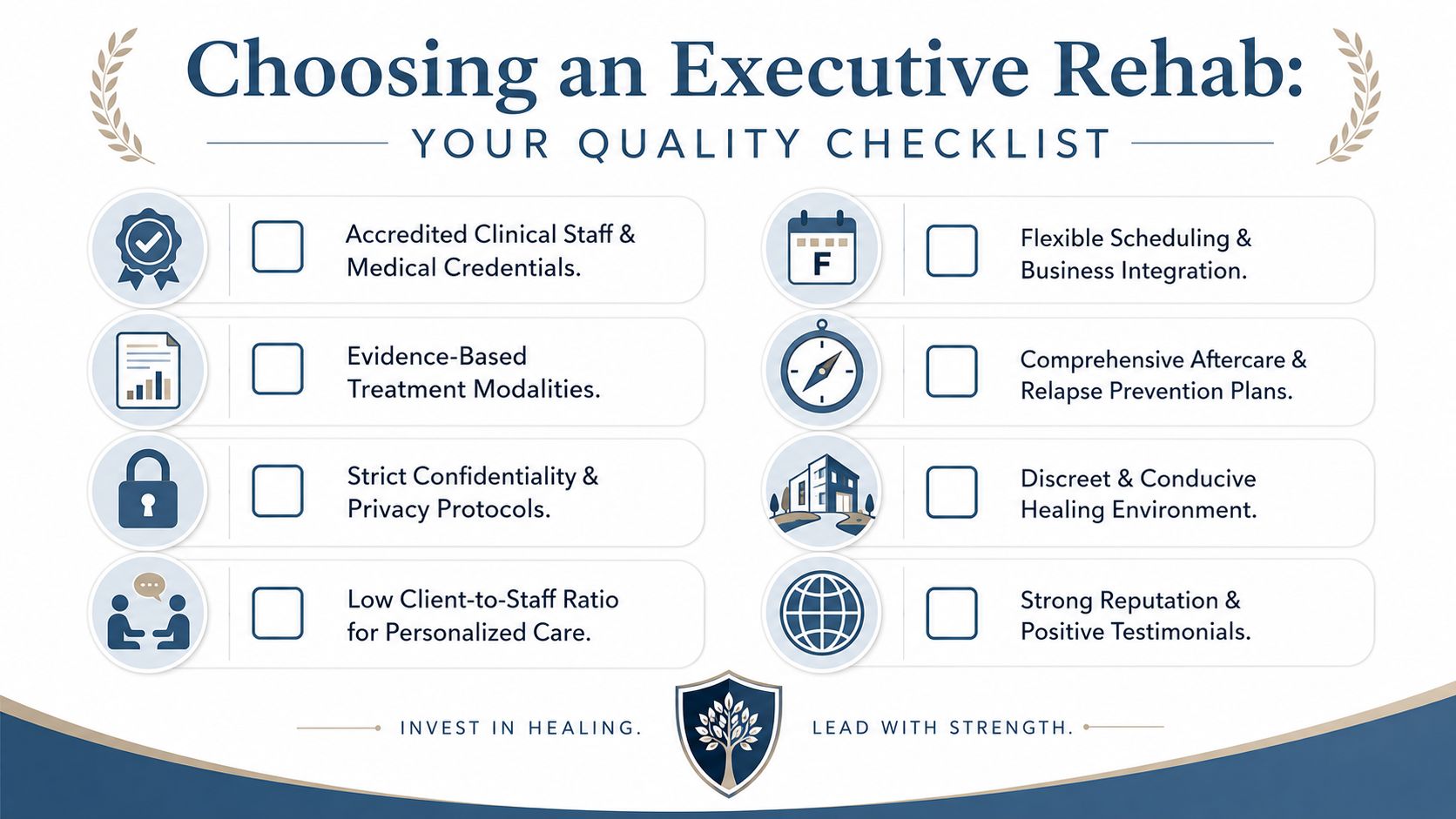
Start with accreditation. External accreditation such as Joint Commission recognition is a mandatory quality indicator because it shows the program meets a baseline level of evidence-based care and is open to random clinical audit. For executives, that matters because discretion without quality control isn't enough.
Then look deeper.
- Clinical credentials: Ask who is treating clients. Look for psychiatrists, psychologists, licensed therapists, and experienced addiction clinicians.
- Dual-diagnosis capability: The program should be able to treat mental health and substance use together, not by referral after discharge.
- Private environment: Private rooms, low census, and clear confidentiality practices matter for this population.
- Electronics policy with boundaries: “Yes, you can work” isn't sufficient. Ask how access is clinically managed.
- Detox capability: If withdrawal is a risk, the admissions team should be able to explain how that will be handled safely.
- Aftercare planning: A good discharge plan addresses family, psychiatry, therapy, work reintegration, and relapse prevention.
Questions families and advisors should ask
A family member, therapist, physician, attorney, or executive assistant can ask sharper questions than “Is it luxury?”
Try these instead:
- How do you handle a client who wants to stay fully engaged in work while in treatment?
- What happens if the client's business demands begin interfering with therapy?
- Who manages medications, and how often are they reviewed?
- How do you involve family without violating privacy?
- What continuing care do you put in place after residential treatment ends?
If a program sells privacy but can't explain its clinical model, it's selling comfort without enough substance.
A reputable high-end private-pay rehab for executives should feel like a coordinated professional service. The admissions process is organized. The expectations are clear. Staff can explain their reasoning. That's what serious care looks like.
The Investment in Your Future Costs and Insurance
Executive rehab is expensive because the model itself is expensive to run. Private rooms in detox and residential care, low client-to-staff ratios, medical oversight, psychiatric support, licensed therapy, structured work accommodation, and a discreet upscale setting all increase cost.
The current benchmark is clear. Executive rehabilitation programs in the United States commonly range from $30,000 to $100,000 per month, reflecting luxury amenities, high clinical intensity, and access to board-certified addiction specialists. That cost range is discussed in the earlier accreditation section's source.
What the investment is actually buying
This isn't just décor. The premium usually covers three things that materially affect care:
- More individualized clinical attention: High-acuity dual-diagnosis cases need experienced staff and closer oversight.
- A controlled environment: Fewer external stressors mean less interference with detox, sleep, therapy, and stabilization.
- Discretion and continuity: Executives often need a setting that can accommodate career realities without collapsing treatment structure.
For many families, the practical starting point is benefit verification. Some plans may cover part of treatment even in a private-pay setting, especially when medical and psychiatric services are involved. A confidential review of insurance coverage for addiction treatment helps clarify what may be reimbursable and what will remain out of pocket.
The framing matters. This is a health decision, but for executives it's also a career preservation decision. Untreated addiction, unmanaged mental health symptoms, and high-functioning burnout rarely stay contained.
Taking the Next Step Admissions and Key Questions
The admissions process should feel calm, private, and direct. A confidential call usually comes first. The team gathers basic clinical information, current substance use, mental health history, medication details, work obligations, and immediate safety concerns. From there, they determine whether detox, residential care, or another level of support is appropriate.
If the fit is right, the next steps are straightforward. Financial review happens privately. Arrival planning is coordinated discreetly. Family communication is discussed early so expectations are clear before admission.
Questions that matter at the finish line
Will family be involved?
In a strong program, family involvement is available and encouraged when clinically appropriate. It should support recovery, not turn into surveillance or conflict.
Why do some people stay longer than others?
Length of stay depends on acuity, co-occurring symptoms, relapse history, medical needs, and how quickly the person can tolerate deeper therapeutic work. A rushed discharge often protects comfort, not recovery.
What happens after residential treatment?
Continuing care matters. That may include outpatient therapy, psychiatry, relapse prevention planning, alumni support, family work, and structured transition back into professional life.
A private, high-end executive rehab program should make the first step easier, not more intimidating. The person calling doesn't need to have everything figured out. They only need an honest clinical assessment and a setting capable of handling both the human problem and the professional reality.
Reflections provides confidential, California-licensed dual-diagnosis treatment for adults who need a private, upscale residential setting with managed work access, private rooms in detox and rehab, and a Joint Commission accredited clinical model. Professionals and families who want to discuss options can learn more through Reflections.