

The calendar is full. The phone never stops. The board expects calm, the team expects decisiveness, and the family expects presence that's getting harder to give. Meanwhile, sleep is thinner, alcohol has become a nightly off-switch, stimulants are doing too much heavy lifting, or anxiety and depression are starting to bleed into every decision.
That profile isn't unusual. It's common among people who are very good at appearing composed.
The right response isn't denial. It's a strategic intervention. For high performers, rehab for executives should be viewed the same way any serious leader views succession planning, legal risk, or a health crisis. Act early, protect the asset, and avoid a preventable collapse.
The Private Struggle of Public Success
A senior operator can hide a lot. Morning irritability gets explained away as pressure. A few extra drinks become “standard client dinners.” Missed sleep becomes “the cost of the role.” Even obvious warning signs often stay invisible because high performers know how to keep delivering long after their private life has started to fray.

That's one reason this issue deserves blunt treatment. Executives and high-earning professionals are affected at disproportionate rates. A 2015 SAMHSA survey found that workers in management, business, and finance had one of the highest rates of past-year illicit drug use at 10.4%, compared with 8.8% among all full-time workers, as summarized in this review of substance use rates among executives and professionals.
Why successful people wait too long
Executives rarely think in terms of “needing rehab.” They think in terms of preserving optionality, limiting exposure, and keeping operations moving. That mindset can delay treatment because the problem gets framed as something to manage privately for one more quarter.
A better frame is risk containment. Untreated substance use and co-occurring mental health symptoms don't stay politely contained inside evenings and weekends. They eventually distort judgment, relationships, stamina, and credibility.
Practical rule: If a leader is already spending energy hiding the problem, the problem is already expensive.
For some, the immediate concern is digital visibility as much as health. Public records, search results, and reputational narratives matter when leadership authority is part of the job, which makes thoughtful reputation management for leaders a practical companion topic, not vanity.
The smart move is decisive, not dramatic
The strongest executives don't wait for a public event, a formal HR process, or a medical emergency. They choose a setting built for discretion, private care, and realistic continuity. A confidential option such as discreet confidential rehab for executives in California fits that reality far better than a generic program built for the mass market.
Rehab isn't a surrender of control. For the right client, it's the first serious act of control they've taken in a long time.
What Defines an Executive Rehab Program
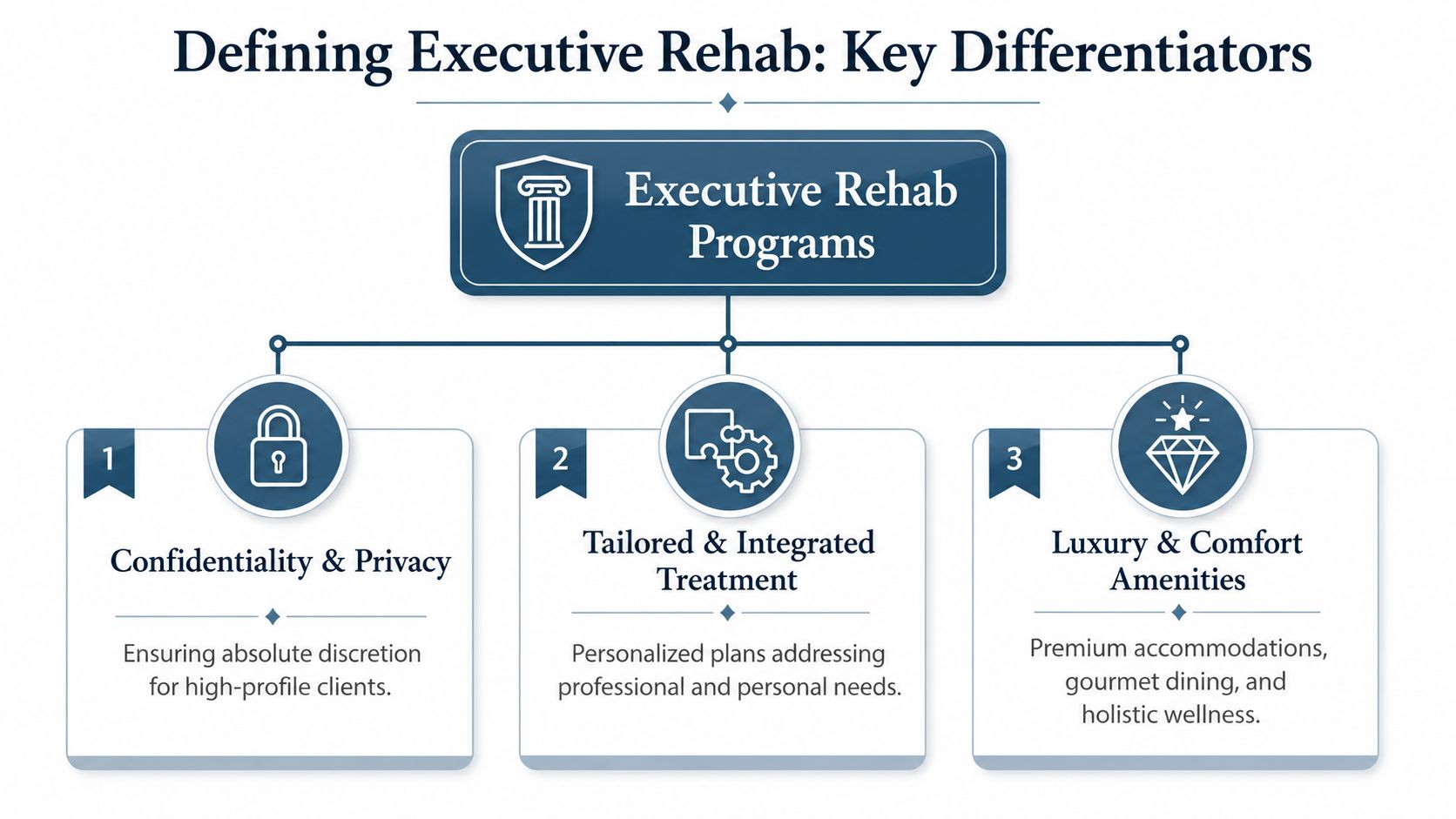
Most treatment programs say they offer privacy, individualization, and comfort. An actual executive program proves those claims operationally. It's designed around the pressures of senior leadership, not just around addiction treatment in the abstract.
Confidentiality has to be structural
Privacy isn't a slogan for this client group. It's a condition of treatment engagement.
That means the environment should limit unnecessary exposure, keep admissions discreet, protect communication, and avoid the revolving-door feel of large facilities. A high-end private-pay setting should feel controlled, calm, and selective from the first call through discharge planning.
The clinical model must fit high-functioning people
A lot of executives don't present like stereotypical addiction patients. They may still be working. They may still be earning. They may still be making major decisions. That often confuses family members and delays treatment.
The program has to understand the psychology behind that profile. Executive culture is marked by fear of disclosure and denial of vulnerability, and surveys show a substantial minority of C-suite professionals delay treatment until a crisis, as described in this overview of treatment barriers for business professionals.
That matters because treatment engagement rises when the client feels understood rather than pathologized.
The three pillars that actually matter
A serious executive rehab program should be judged against three standards:
- Discretion that survives scrutiny. Not “private enough.” Private enough that a board member, investor, attorney, or spouse would trust the process.
- Dual-diagnosis depth. Many executives aren't only managing substance use. They're also carrying anxiety, depression, trauma, burnout, grief, or mood instability.
- Work-aware structure. The program should recognize that some clients can't vanish completely without creating panic around them.
Luxury without clinical sophistication is a retreat. Clinical care without executive realism often loses the client.
What high-end should actually mean
For this audience, “luxury” shouldn't mean indulgence. It should mean reduced friction.
A private room. A quiet setting. Thoughtful food. Professional boundaries. Respectful peers. A staff that doesn't confuse status with health. Those details aren't cosmetic. They lower defensiveness and make it easier for a hard-driving person to settle enough to do difficult work.
A premium executive program earns its price by combining top-tier clinical care with operational intelligence about how leaders live.
Inside an Elite Facility The Treatment Experience
The experience inside a high-end executive rehab should feel nothing like an institution. It should feel protected, organized, and clinically serious. The setting matters because most executives arrive overstimulated, sleep deprived, guarded, and accustomed to controlling every variable around them.

The strongest luxury programs understand that comfort supports compliance. Private rooms in both detox and residential treatment, quiet common spaces, polished surroundings, and excellent food reduce resistance. They also preserve dignity, which matters more to high-profile clients than many providers admit.
Small census, serious attention
One of the clearest markers of elite care is capacity control. Luxury executive rehabs often maintain small, controlled environments, and many top programs limit their capacity to 8 to 12 residents at a time, which supports privacy and intensive personalized attention, according to this review of luxury executive rehab program size and structure.
That small-scale model changes the daily experience.
| Area | Standard expectation in elite care | Why it matters |
|---|---|---|
| Living space | Private room in detox and rehab | Protects rest, confidentiality, and decompression |
| Clinical access | Frequent individual attention | Helps high-functioning clients move past surface-level participation |
| Milieu | Limited census | Reduces chaos and social exposure |
| Scheduling | Personalized pacing | Accommodates medical, psychiatric, and professional realities |
Clinical horsepower matters more than décor
A beautiful property can distract buyers from the essential question. Who is treating the client, and how deep is the treatment model?
A premium facility for executives should offer a highly accredited clinical team with expertise in substance use and co-occurring psychiatric issues. That means psychiatrists, PhD-level psychologists, licensed marriage and family therapists, addiction counselors, and adjunctive therapists working from a coordinated plan. The work should include evidence-based psychotherapy, medication oversight when appropriate, and a clear grasp of trauma, anxiety, depression, bipolar features, grief, and stress-driven relapse patterns.
That's where luxury earns legitimacy. The environment lowers defenses. The clinicians do the essential work.
The right question isn't whether the place looks expensive. It's whether the treatment team can handle a complicated person with a complicated life.
What a day should feel like
A strong day in treatment blends structure with privacy. It may include medical check-ins, individual therapy, carefully run group work, skills-based sessions, movement, mindfulness, nutrition support, and experiential work that helps clients reconnect with a nervous system that's been running hot for years.
Some executives also evaluate treatment settings against the same standards they use for other restorative environments. For context on high-touch settings designed for privacy and reset, some families look at resources that compare 2026 executive retreat options, then use that lens to ask a smarter question: does the rehab setting offer both restoration and real clinical depth?
That distinction matters. Luxury should support recovery, not camouflage a weak program.
Balancing Career Demands with Recovery
The first objection most executives raise is simple. They can't disappear.
That concern is legitimate. It's also manageable if the program handles electronics and scheduling with discipline. High-quality executive programs integrate evidence-based therapies like CBT with flexible scheduling that accommodates work connectivity, and that design can reduce the dropout risk that comes from abrupt disconnection, as discussed in this summary of evidence-based treatment design and work connectivity.
Electronics should be permitted, not unmanaged
Allowing laptops and phones doesn't weaken treatment when it's done correctly. It strengthens engagement for the right client.
The mistake is treating work access as unlimited. That turns rehab into remote office space with therapy on the side. The better model is structured access, protected work windows, private spaces for essential communication, and clinical guardrails around when and how professional obligations get handled.
A serious executive program should provide:
- Defined access windows. Time for mission-critical communication without letting work consume the entire day.
- Private work areas. Confidential space for calls, document review, and urgent decisions.
- Therapist-guided boundaries. Clinical input on whether work is stabilizing the client or serving as avoidance.
- Escalation rules. A plan for what qualifies as urgent versus what can wait.
Continuity matters, but recovery has to stay primary
There's a practical middle ground between total disconnection and full operational involvement. That's where many executives do best.
For some clients, maintaining limited contact with the office lowers panic enough to let them participate honestly in therapy. For others, work has become so fused with identity and avoidance that access needs to be much tighter. The program should make that call case by case.
A laptop in treatment is a tool. It can support recovery, or it can help a client hide from it.
Executives who want a realistic picture of this model can review how luxury programs support working remotely while in rehab. The key isn't convenience. It's control.
What a board or family should understand
Temporary limits on access aren't a threat to the career. They're often what protects it. If every hour in treatment gets pulled back into deal flow, personnel conflict, and nonstop messaging, the client may never settle enough to address the drivers of relapse.
The best programs protect both interests. They preserve enough continuity to avoid unnecessary professional fallout, while keeping the center of gravity where it belongs: stabilization, insight, and sustainable recovery.
Typical Treatment Pathways and Program Lengths
A high-end executive program should make the path clear from the start. Ambiguity makes executives suspicious. Clarity helps them commit.
The process usually begins with a confidential assessment that reviews substance use, psychiatric symptoms, medication history, work obligations, family dynamics, and immediate risk. If withdrawal is a concern, the next step is clinically managed detox in a private room with close medical oversight and a calm, low-stimulation environment.
The usual sequence
Most executive treatment pathways follow a practical progression:
- Confidential intake and assessment. The program establishes clinical needs, privacy requirements, and communication boundaries.
- Detox if medically appropriate. The goal is safe stabilization with comfort, sleep support, and monitoring.
- Residential treatment. This phase addresses the drivers behind use, not just the use itself.
- Re-entry planning and aftercare. Return to work, family expectations, and ongoing support get mapped before discharge.
How to think about 30, 60, and 90 days
Thirty days can be enough to interrupt a crisis, stabilize mood, and start meaningful treatment. It often isn't enough for an executive with entrenched patterns, co-occurring psychiatric symptoms, or a long history of using achievement to outrun distress.
Sixty days usually gives the client more room to move beyond performance mode. The early polish wears off. Defenses soften. Treatment gets more honest.
Ninety days is where many clients finally stop treating rehab like an emergency detour and start treating it like a rebuild. That time matters. Longitudinal data from the National Institute on Drug Abuse shows that individuals who complete at least 90 days of structured treatment are 1.5 to 2 times more likely to remain abstinent at one-year follow-up, as summarized in this review of executive rehab program lengths and outcomes.
Short stays can produce insight. Longer stays are more likely to produce a different life.
What determines the right length
The right duration depends on more than calendar availability. It depends on complexity.
A program should weigh several factors:
- Psychiatric load. Anxiety, depression, trauma, and mood instability often need more time than the client expects.
- Relapse history. Prior treatment or repeated attempts at self-management usually argue for a longer stay.
- Work intensity. A role with nonstop pressure can make premature discharge risky.
- Home environment. If the client is returning to conflict, isolation, or easy access to substances, aftercare planning needs extra strength.
Executives often ask what they can “get away with” in terms of time away. The better question is what length gives them a credible chance of not having to do this again under worse conditions.
How to Evaluate and Choose the Right Program
The market is crowded with expensive facilities that know how to photograph a property and write polished copy. That doesn't mean they can treat an executive with a complex dual-diagnosis presentation and real-world career obligations.
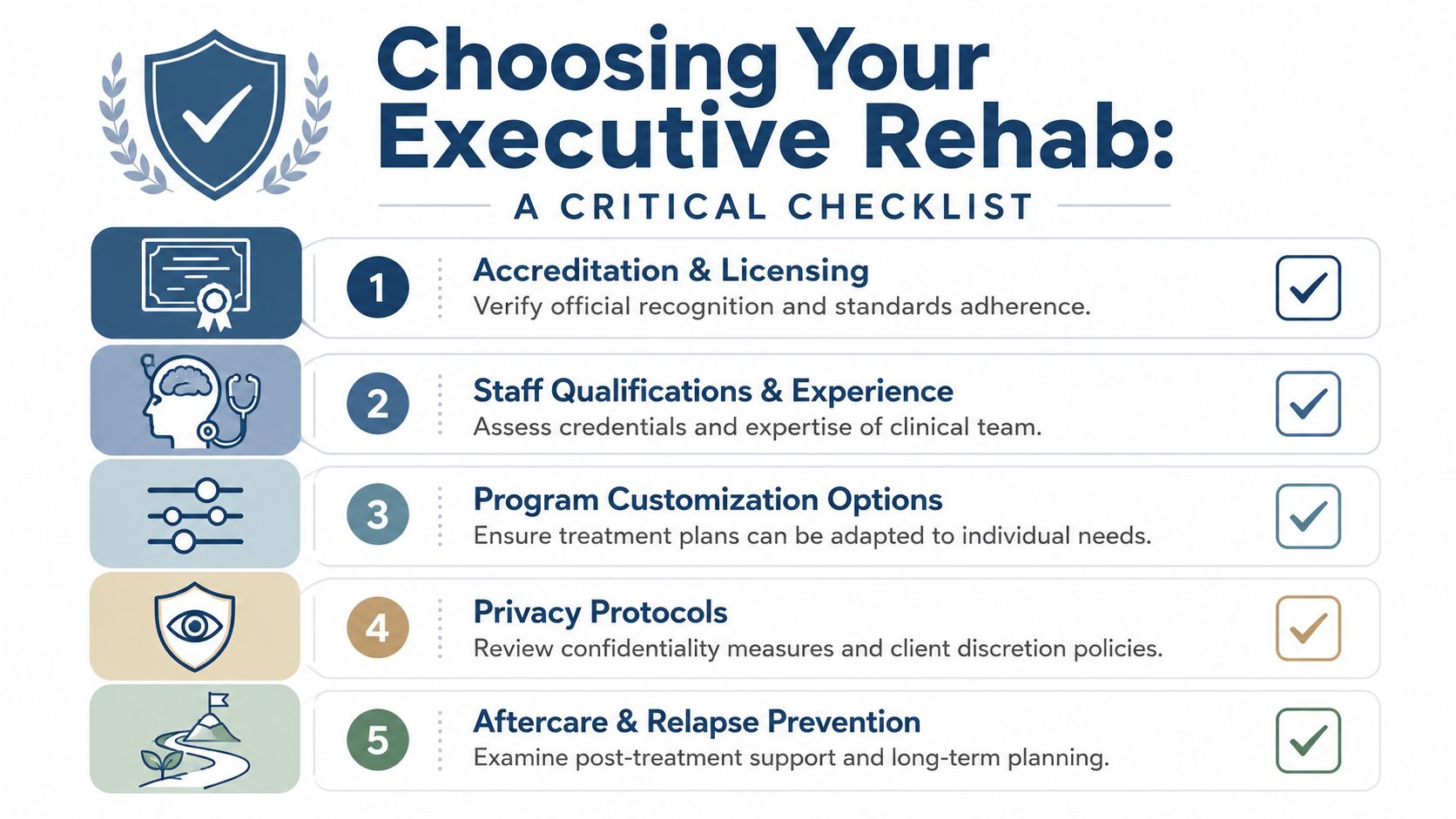
A disciplined evaluation process fixes that. The buyer should vet a rehab program the way a board vets a sensitive strategic partner.
What to verify before admission
Start with the fundamentals. If a facility can't answer these cleanly, move on.
- Accreditation and licensing. The program should be fully licensed and independently accredited. That's the baseline for safety and accountability.
- Clinical team depth. Ask exactly who provides care. Look for psychiatrists, psychologists, master's-level and licensed therapists, addiction specialists, and coordinated dual-diagnosis capability.
- Private accommodations. High-end care for executives should provide private rooms in both detox and residential treatment, not “subject to availability.”
- Electronics policy. Ask for the operational details, not a vague promise. When are phones and laptops allowed, where are they used, and who sets limits?
- Aftercare planning. The facility should have a concrete plan for continuing care, relapse prevention, and phased return to work.
The questions that expose weak programs
A polished admissions call can hide a lot. These questions usually surface the difference between an elite clinical operation and an expensive hospitality product.
| Question | What a strong answer sounds like |
|---|---|
| Who leads the clinical program? | Specific credentials, clear leadership, and direct psychiatric involvement |
| How do you handle co-occurring conditions? | An integrated dual-diagnosis model, not outsourced or secondary care |
| How is work access managed? | Structured protocols with boundaries, not unlimited device use |
| What is detox like? | Clinically managed, private, and coordinated with psychiatric assessment |
| How is family involved? | Intentional education and therapy, not occasional updates |
Cost should be viewed correctly
An expensive private-pay program isn't justified by marble countertops or gourmet meals alone. It's justified when the client gets privacy, strong clinical treatment, realistic work accommodations, and a credible plan for long-term functioning.
For some families and referral partners, one factual example of this model is luxury rehab in California, where Reflections offers California-licensed, Joint Commission-accredited residential dual-diagnosis care, private rooms, clinically managed detox, and appropriate access to electronics for adults who need discreet treatment while maintaining limited professional contact.
That's the right lens. Not “what does it cost,” but “what does it protect?”
The most expensive option is often the one that fails quietly, sends the client back too early, and creates the need for a second admission.
A final filter
Before choosing any program, the decision-maker should ask one blunt question. Is this facility optimized for people who must recover privately, thoroughly, and without being treated like a generic case?
If the answer is unclear, it's the wrong program.
Your Next Steps Toward a Stronger Future
The right next move doesn't need to be dramatic. It needs to be private, informed, and immediate.
A struggling executive should start with a confidential conversation that clarifies four things: whether detox is needed, whether there's a co-occurring mental health issue, how work access would be handled, and what length of care is clinically realistic. Those answers cut through denial fast.
Family members and trusted advisors also have a role. The strongest programs don't treat the client in isolation. They involve spouses, partners, and close relatives in a structured way so the home environment doesn't pull the client back into the same patterns. Education matters. Boundaries matter. Re-entry planning matters.
A practical short list of next steps looks like this:
- Make the private call. Gather facts before the situation becomes public.
- Confirm the clinical fit. Ask directly about dual diagnosis, detox capability, and psychiatric care.
- Review the electronics policy. Ensure career obligations can be handled in a structured way.
- Plan the leave intelligently. Tight messaging and limited disclosure protect privacy.
- Choose enough time. Selecting the shortest stay by default is often the most expensive mistake.
The central decision is simple. Continue protecting the appearance of control, or protect health, judgment, and longevity. For a serious leader, the second choice is the only rational one.
For executives, families, and referral partners seeking discreet luxury dual-diagnosis care, Reflections offers private-pay residential treatment in California with private rooms, clinically managed detox, specialized psychiatric and psychological care, and appropriate access to electronics so clients can maintain limited professional responsibilities while focusing on recovery.