
The fastest way to spot a work-life problem is not a breakdown. It's the quiet drift. The inbox gets checked before coffee, again at dinner, and once more from bed. Weekends stop feeling separate. A spouse or partner says something blunt like, “You're here, but you're not really here,” and the comment lands because it's true.
For executives, that moment usually doesn't arrive as a dramatic collapse. It shows up as numbness, irritability, disappearing focus, and the strange sense that life has become a sequence of obligations instead of a life. That is where work life balance coaching starts to matter, because it gives a structured way to look at the system around the person, not just the person's willpower.
A senior professional may also notice the practical cost. The meetings keep expanding, recovery keeps shrinking, and the body starts paying for the calendar. If the current routine already feels like it needs a rescue plan, even a small reset like MedEq Fitness longevity gear can be a reminder that performance and recovery are tied together, not separate projects.
When an Executive Realizes Work Has Taken Over
The first clue is usually boring. A senior executive opens a laptop at 5:48 a.m. and finds a thread that should have waited until business hours. A flight is supposed to create space, but the phone still vibrates through the trip. The weekend exists on paper, yet the mind stays in the next issue, the next client, the next decision.
That is why the old idea of “just get better at boundaries” fails so many high performers. The problem is rarely one weak habit. It is a pattern of constant availability, blurred roles, and decision fatigue that slowly eats away at recovery time. Coaching research has pointed to a broad work-life problem for years, including the 48.4% of adults in Great Britain who reported low satisfaction with work-life balance in the 2012 Office for National Statistics finding cited in the field (research portal).

Why coaching entered the conversation
Work life balance coaching became a formal response because too many high performers were trying to solve a structural problem with personal grit. Coaching gives the executive a place to map workload, communication habits, and recovery patterns without pretending the issue is purely emotional. It also belongs beside other executive supports, including organized wellness tracking like Recurrr balance guide, which helps someone think in systems instead of slogans. The same logic applies to MedEq Fitness longevity gear, because physical recovery and performance belong in the same operating plan.
Practical rule: if a senior professional needs to defend rest every week, the calendar is already out of control.
The smartest executives notice the signal early. They stop treating chronic overreach as a badge of honor and start asking a harder question, whether the current operating model is still sustainable.
What Work Life Balance Coaching Means
Work life balance coaching is not motivational chatter, and it is not therapy with a brighter tone. It is a structured process for changing how a person uses time, attention, energy, and boundaries so work stops swallowing the rest of life. For executives and working professionals, that means looking at the actual operating model, not just the stated intentions.
Coaching, therapy, mentoring, and consulting are not the same
The cleanest way to separate them is direct. Therapy treats emotional injury, mental health symptoms, and deeper patterns that may require clinical care. Mentoring passes on judgment from someone who has already walked the road. Executive consulting solves business strategy and organizational problems. Work life balance coaching works on performance habits and system design, so output becomes sustainable.
A better comparison is this. Coaching works like an operating manual for the way a high performer runs their week, while therapy is the place that assesses and treats injury, distress, or impairment. High-performing professionals often need both, because burnout rarely arrives alone. It tends to show up with anxiety, depression, trauma, or substance use risk, and once those are in the picture, coaching alone is not enough. If that clinical layer is present, a program with individual psychotherapy, such as Reflections' individual psychotherapy, belongs in the conversation.
What the coaching process is trying to change
The coaching literature on stress and work-life balance has been moving toward programs that address stress and balance together, including work with health researchers research portal. That matters because generic encouragement does not change a bad workload design. Real coaching changes the mechanics, how much work comes in, when it comes in, who can decide, and what gets protected.
For professionals who want a practical orientation, a clear schedule and individualized planning are core parts of the model, which aligns with guidance that emphasizes boundary management, SMART goals, and personalized time systems. A detailed overview of that approach appears in the Recurrr balance guide, and the underlying logic is the same across serious coaching work, one-size-fits-all advice fails because the workload is not one-size-fits-all.
The right question is not whether coaching sounds helpful. It is whether the person needs habit design, clinical support, or both.
The Main Coaching Methodologies Used Today
Different methodologies produce different outcomes, and executives should know the names before they sign up. The point is not to collect labels. The point is to understand what kind of change each method can drive inside a real schedule, a real team, and a real nervous system.
How the major methods differ in practice
Cognitive-behavioral coaching focuses on the links between thoughts, behaviors, and outcomes. In a work-life balance context, it helps a client catch distorted assumptions like “If I don't answer immediately, I'll lose control.” The session then turns that belief into a behavior experiment, such as delayed responses, altered meeting rules, or tighter task boundaries.
Acceptance and commitment coaching works differently. It helps the client stop fighting internal discomfort long enough to act on values. That matters for executives who already know the right move but keep avoiding it because discomfort feels expensive. This method is useful when the issue is not ignorance, it's avoidance under pressure.
Motivational interviewing is built for ambivalence. A client may say they want more balance while still protecting the same overextended habits. This method pulls that conflict into the open without turning the session into a lecture, which is useful when someone knows the cost but still resists change.
Solution-focused coaching stays tightly on goals and exceptions. Instead of dissecting every origin story, it asks what's already working, when the problem is smallest, and what pattern can be repeated. That's effective for time-poor leaders who need fast traction and clear next steps.
The systems lens is the real differentiator
Positive coaching looks for strengths, capacity, and successful routines that can be expanded. It works best when the executive already has a few sustainable behaviors but needs a better way to protect them.
System-level workload design is the most important method for high-demand roles. It targets after-hours communication, meeting density, decision rules, and delegated authority. The strongest work-life coaching programs now treat those as primary variables, not side issues, because the evidence-based logic is obvious, workload architecture shapes recovery, and recovery shapes sustainable performance.
A practical way to evaluate a methodology is to ask what it changes. If it only changes attitude, it's incomplete. If it changes workload, communication, and decisions, it's serious.
If a coach never talks about the structure of the week, the work-life problem is probably being underdiagnosed.
Inside a Typical Work Life Balance Coaching Engagement
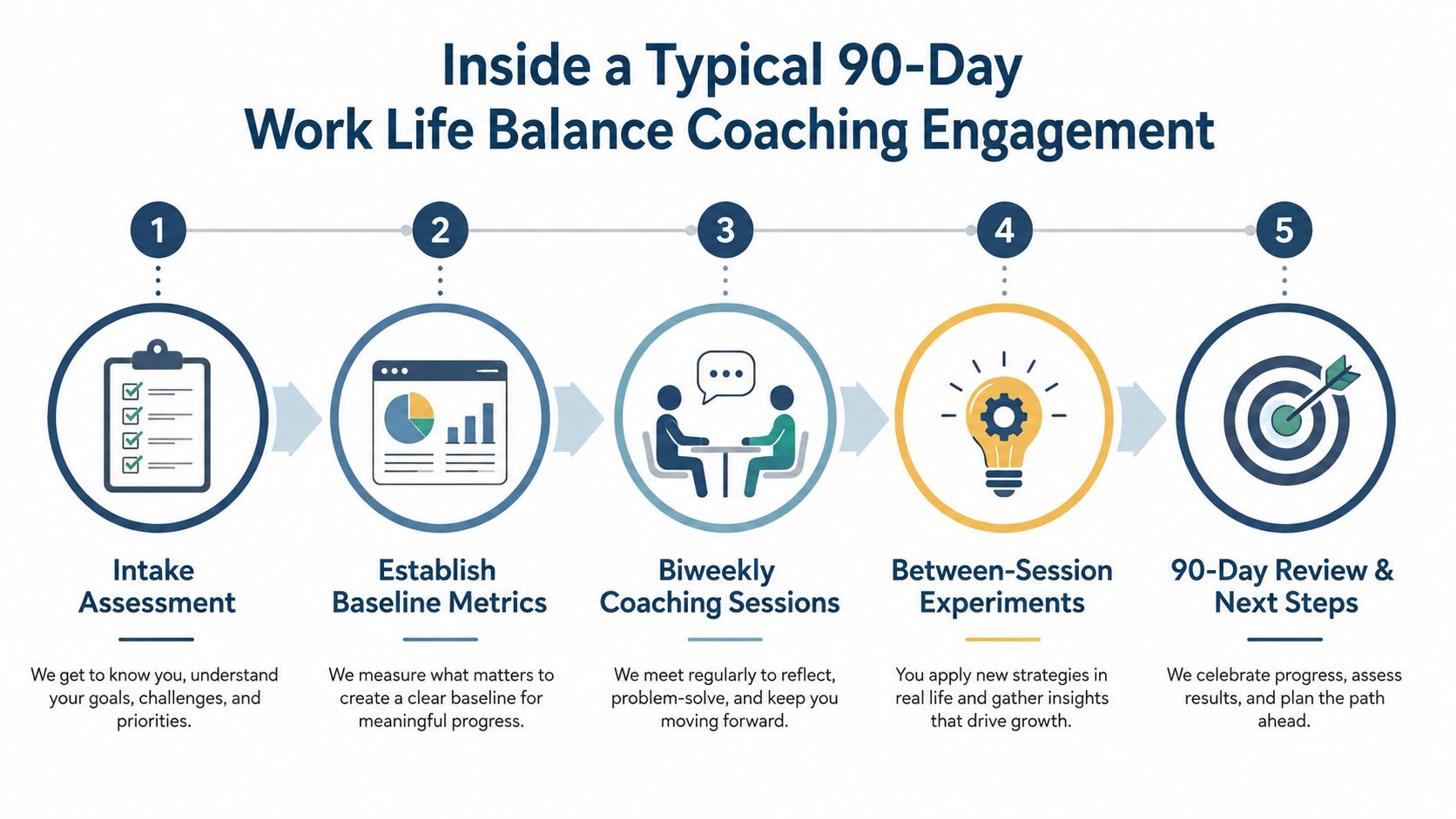
A real engagement starts with a baseline, not reassurance. The first conversation should capture work hours, stress level, task completion, and the client's own view of the pressure points. For high-demand roles, the better process also tracks after-hours communication load, meeting density, and recovery blocks, because those are the operating habits that show whether the schedule is still running the person into the ground.
What gets measured and why
The useful part of the first 90 days is measurement. Coaches who work seriously with executives watch evening logins, weekend catch-up time, the number of active priorities, and whether protected recovery blocks survive the week. Those leading indicators can then be compared with lagging outcomes like regrettable attrition, project delays, employee-relations friction, or workload-related engagement comments.
That approach fits the coaching research base, which links observable management behavior to business outcomes over time, as outlined in the research portal. It also matches guidance for high-demand roles that recommends baseline assessment and iterative monitoring, with targets such as reducing overtime or improving satisfaction, as discussed by Zigpoll.
What the cadence usually looks like
Most serious engagements use weekly or biweekly sessions. Between those sessions, the client runs experiments, one shutoff rule for messages, one meeting removed or redesigned, one scope-renegotiation script, one protected recovery block. The point is to change the operating environment, not just talk about it.
By the 90-day mark, the coach should review the same indicators from intake and decide what changed, what did not, and what still needs intervention. That review matters because coaching should be held accountable to data, not mood. A polished conversation with no behavior change is not a program.
For readers comparing service models, the difference between a coaching-only arrangement and a clinical setting becomes obvious when the executive's life is already impaired. A practical reference point for deeper clinical work is individual psychotherapy, especially when the issue has moved beyond optimization into distress that needs treatment.
How Coaching Complements Luxury Residential Treatment
A senior executive does not need another generic plan for better habits. They need a treatment structure that matches the level of strain they are carrying. High-end residential care makes sense when the executive can no longer patch the problem from the outside, and coaching belongs inside that structure as a separate layer of support.
In a luxury dual-diagnosis setting, coaching and treatment are not rival offers. They address different layers of the same breakdown. Coaching works on workload design, identity, and boundaries. Residential care stabilizes the mental health and substance use issues that keep undoing those changes.
Why the executive setting changes the model
Executives live inside obligations. Boards, clients, teams, family demands, and reputational risk do not pause because someone is exhausted or dysregulated. A private, discreet setting matters for that reason, and controlled access to phones and laptops can support treatment rather than undermine it when the program is built with clear limits.
That is also why a resident may need to keep some career contact while receiving credentialed care. The treatment plan becomes more realistic when it accounts for actual responsibility instead of pretending the person can vanish from work without consequences. For high-pressure clients, the question is not whether work disappears. The question is whether work is managed inside a setting that can still treat the underlying problem.
Reflections is one option in that category, with private rooms for all residents in both detox and rehab, along with electronics access and a highly accredited clinical team. That combination fits a simple reality, many professionals cannot step away from work for long without fallout, but they also cannot keep leading at full speed while impaired.
Why dual diagnosis changes the conversation
The issue is often bigger than overwork. The layer underneath it is usually trauma, anxiety, depression, grief, bipolar symptoms, or substance use. Coaching can improve structure and decision-making, but once symptoms are present, the work has to move into clinical territory instead of staying at the level of productivity habits.
Coaching is useful when the person can still execute. Clinical care is necessary when the person cannot reliably regulate, sleep, or stay safe.
That is where a program such as work-from-rehab becomes relevant for high-profile professionals. It respects the practicalities of their life while removing the chaos that has been eroding it. Once sleep, safety, or basic regulation are falling apart, coaching alone is the wrong tool. Residential treatment is the appropriate escalation, and coaching can then support the structure that treatment is trying to restore.
Why Most Work Life Balance Advice Misses the Key Factor
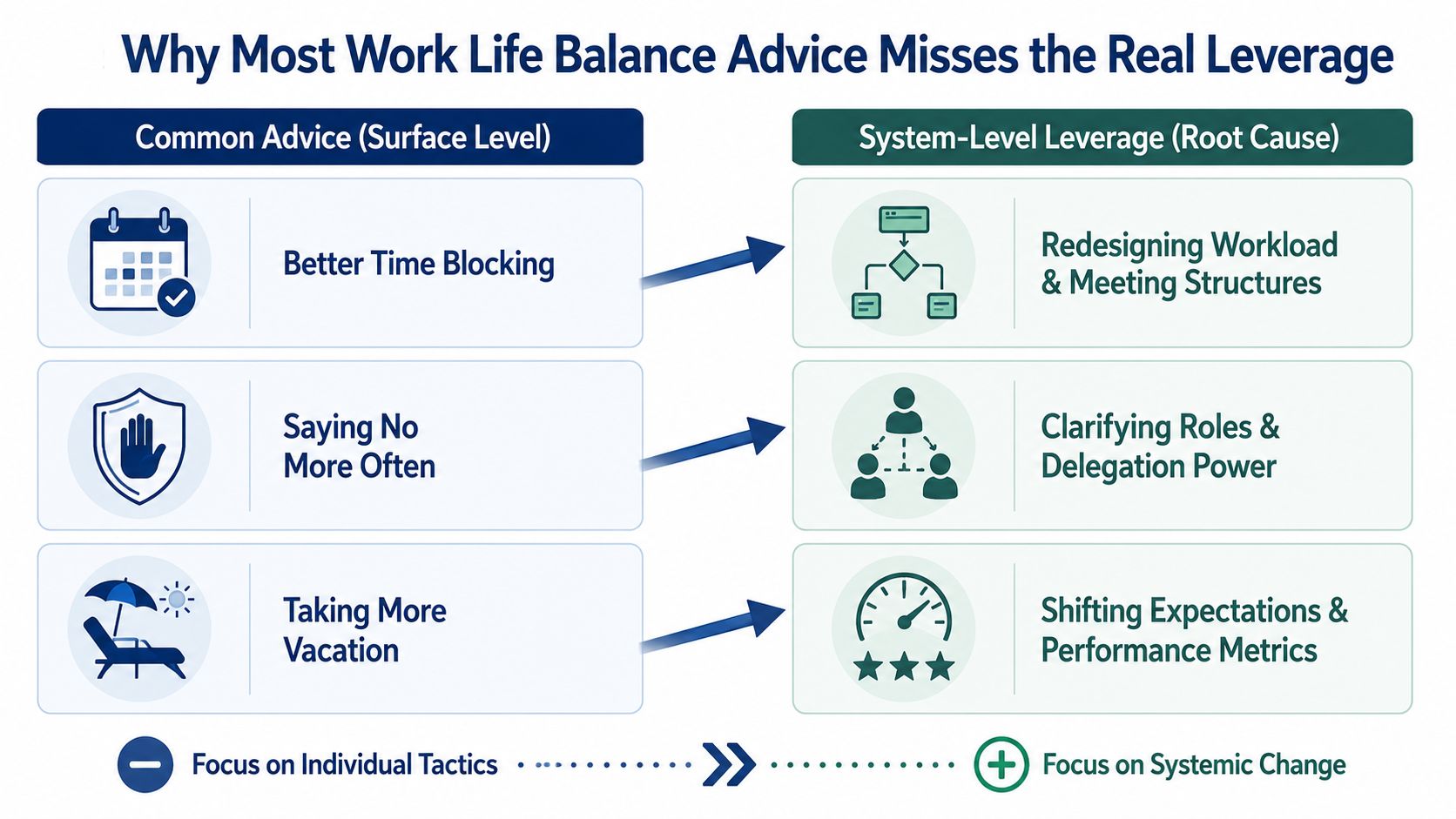
A senior executive can have a cleaner calendar, stricter boundaries, and better intentions, and still keep hitting the same wall. That happens when the workload, the reporting structure, and the expectations around availability keep producing the same pressure. Work life balance coaching helps with habits, but it cannot fix a broken operating model by itself.
The system is usually where the problem lives
The strongest interventions target workload design, after-hours norms, decision rules, and manager expectations. That is an operational issue, not a motivational one. Guidance for high-pressure roles keeps pointing back to observable behavior and boundary structure, because the week has to become more workable if any change is going to hold over time. A personal growth and awareness app can support reflection and pattern recognition, but it does not replace the need to change the system around the person.
The Canadian federal guidance on reducing work-life conflict says the same thing plainly. Limit overtime, say no when expectations are unreasonable, and reduce the amount of work taken home in the evenings (Government of Canada guidance). That is a systems message, not a mindset slogan.
Flexibility and control are not perks
A Gallup survey summary reported that many employees said control over work schedules significantly improved their work-life balance (Gallup survey summary). The point is simple, people function better when they have control over when and how they work. A coach who ignores scheduling control is treating the symptom and skipping the mechanism.
That same logic explains why a luxury residential program can keep electronics access in play. Controlled access preserves career continuity, but the program still has to change the work rules, not just the emotional response to them. For high-end clients, that matters because the aim is not temporary relief. The aim is a structure that holds after the stay ends.
The expensive mistake is paying for mindset work while leaving workload architecture untouched.
Executive coaching has to look more like operational design than encouragement. If the sessions never touch team expectations, delegation, or after-hours access, the work is too shallow for the stakes involved.
Choosing the Right Coach or Program for High-End Clients
Executives should screen providers the same way they'd screen any serious professional partner, by looking for credentials, confidentiality, method, and fit. The first call should not be about vibes. It should be about whether the provider understands high-stakes schedules, privacy, clinical boundaries, and the reality that many clients need more than coaching alone.
What to ask before enrolling
A good intake call should answer these questions quickly. Is the provider working inside a clinical framework when needed. Can they explain how they handle confidentiality. Do they have a method for tracking change over time. Will they adapt to electronics access, family involvement, and continuing care. If the answer to those is vague, the offer is probably too thin for an executive client.
| Decision Criteria | Standalone Coaching | Integrated Luxury Program |
|---|---|---|
| Clinical support | Usually limited to non-clinical coaching | Includes credentialed clinical care when symptoms or dual diagnosis are present |
| Work access | Varies by coach and client agreement | Can allow controlled phone and laptop use for limited career obligations |
| Privacy | Depends on individual practice standards | Built for discreet, private residential care |
| Measurement | Often session-based and goal-based | Can combine coaching goals with treatment planning and ongoing clinical monitoring |
| Suitability | Best when the issue is mainly workload and habit design | Best when imbalance overlaps with mental health, burnout, or substance use |
| Family involvement | Usually informal or external | Can include structured family sessions and education |
A program like recovery coaching services belongs on the shortlist when the goal is not just balance, but sustained stability after a serious disruption. That is especially true for professionals who need continuing care, not a quick reset.
The shortlist rule
A standalone coach is appropriate when the client is functional, psychologically stable, and mainly needs structure. An integrated luxury residential program is the better call when the person is impaired, exhausted, using substances to cope, or no longer maintaining basic sleep, judgment, or mood stability. For high-end clients, the question is whether the provider can handle both the executive context and the clinical risk.
Practical Takeaways and Frequently Asked Questions
The right move is simple, coach the system, not just the feelings. Measure the first 90 days, watch after-hours behavior, and escalate to clinical care when distress starts affecting sleep, judgment, safety, or substance use. High-end clients should choose providers who can protect confidentiality while still addressing the realities of executive life.
For readers who want a lightweight daily mirror, a personal growth and awareness app like Sintera can complement coaching by making patterns easier to spot between sessions, but it doesn't replace clinical judgment when symptoms are present.
FAQ
How is coaching different from therapy? Coaching targets behavior, structure, and performance. Therapy treats mental health symptoms, emotional injury, and deeper impairment. When both are present, both may be needed.
How is confidentiality handled in luxury residential care? The standard should be private rooms, discreet admissions, controlled communication, and a treatment team that understands senior-leader privacy. Anything less is a poor fit for executives.
What happens in the first 30 days? The first month should focus on assessment, stabilization, communication rules, and a realistic plan for work access. If nothing is measured, nothing is being managed.
How do dual-diagnosis clients use coaching in residential treatment? Coaching supports the practical side, workload, boundaries, identity, and re-entry planning, while clinical staff handle diagnosis, stabilization, and treatment. The two should work together, not in competition.
Reflections provides luxury, dual-diagnosis residential treatment for executives and working professionals who need privacy, structure, and clinical depth without losing all connection to their careers. If work-life imbalance has crossed into burnout, substance use, or mental health strain, visit Reflections to explore a discreet program built for that reality.