

A high performer can hide a worsening problem for a long time. Calendar still full. Deals still closing. Team still sees composure. Then the private cost starts showing up where it matters most: erratic sleep, dependence on alcohol or pills to regulate stress, missed details, strained judgment, irritability at home, and quiet fear that one bad week could become a public mess.
That's where most generic recovery advice fails. Executives, founders, physicians, attorneys, and senior operators don't need a one-size-fits-all script. They need recovery coaching services built for people whose lives are high stakes, highly visible, and often impossible to pause completely. In a luxury private-pay setting, that means discretion, deep clinical coordination, and practical support that fits real career obligations, including the ability to stay connected through electronics like cell phones and laptops when appropriate.
Beyond the Boardroom The Need for Executive Recovery Support
A familiar pattern shows up in high-end treatment. A senior executive enters care after months or years of managing symptoms in private. Publicly, there's success. Privately, there's a tightening cycle of substance use, anxiety, depression, trauma responses, or burnout. The problem isn't lack of intelligence or discipline. The problem is that high performers often build careers on endurance, and endurance can mask deterioration until the stakes become severe.

For this population, treatment has to account for more than sobriety alone. It has to protect health, decision-making, family stability, and reputation. It also has to work for people who may still need to manage urgent professional responsibilities. That's one reason many executives seek premium programs with private rooms in both detox and rehab, strong clinical depth, and enough flexibility to remain appropriately connected to work.
Why standard models miss the mark
The biggest gap is simple. Most recovery coaching wasn't built for high-profile professionals. A review focused on underserved areas notes a major underserved angle: recovery coaching services are often not specifically adapted for executives and other high-profile clients, even though this population has distinct confidentiality, scheduling, and dual-diagnosis integration needs, as outlined in this peer coaching review on underserved populations.
A generic model may tell a client to step away from all obligations, simplify life, and avoid stress. That's not realistic for many C-suite leaders or business owners. Some can delegate. Many can't, at least not immediately. Effective executive support has to deal with reality as it exists.
Practical rule: If a recovery plan ignores confidentiality, ongoing business pressure, and co-occurring mental health needs, it isn't built for an executive.
What executive support actually protects
A specialized coaching relationship should be viewed as a strategic safeguard, not a remedial add-on. It helps reduce chaos during a period when poor decisions can carry professional consequences. It also gives structure to the period after treatment, when many high performers return to demanding environments that still contain the same triggers, same access, and same expectations.
A useful way to frame the issue appears in this discussion of executive burnout and addiction as a hidden epidemic. High achievement doesn't insulate someone from addiction or mental health decline. It often gives them more ways to conceal it.
Defining Executive Recovery Coaching
Executives usually understand value fastest when a role is clearly defined. A recovery coach isn't a clinician and shouldn't be mistaken for one. The better analogy is a strategic advisor for personal recovery. The coach helps turn treatment goals into daily execution under real-world pressure.
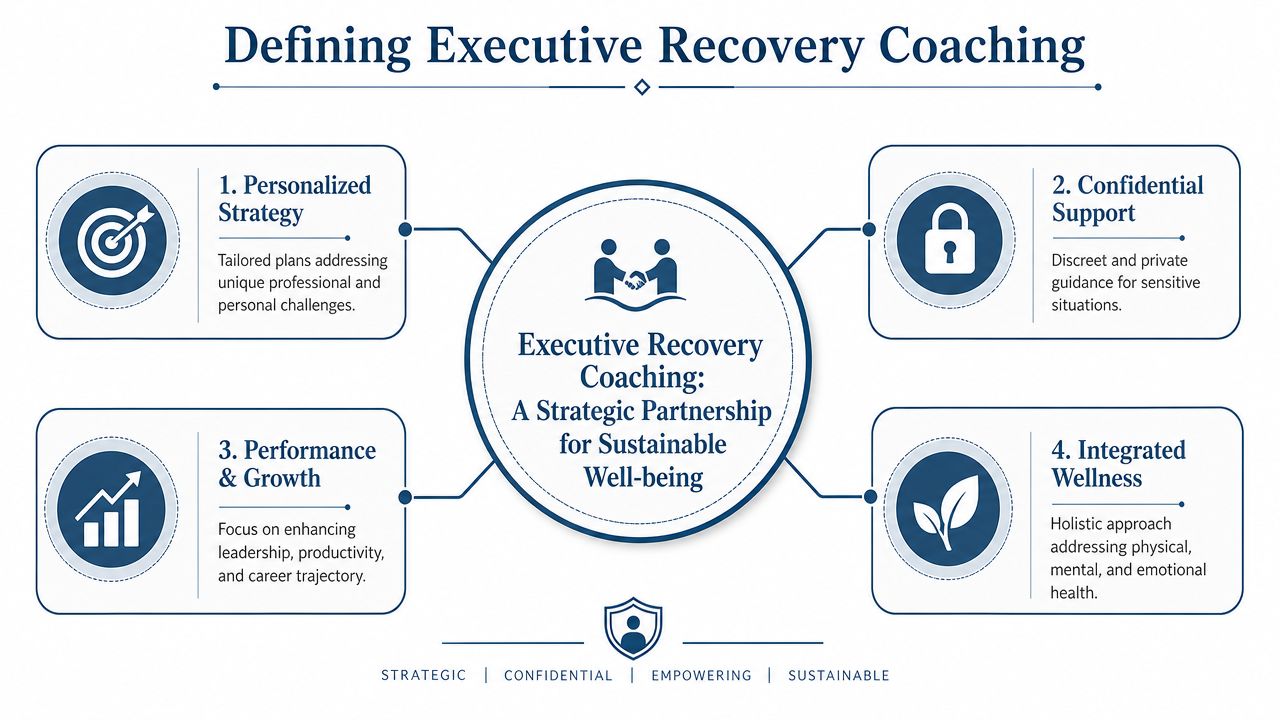
The field defines recovery coaching as a non-clinical service centered on advocacy, mentoring, recovery capital development, and emotional support, and coaches don't diagnose. They help clients work through systems and strengthen problem-solving and goal attainment, as described in this overview of recovery coach scope and training.
The four functions in executive terms
Here's what those four domains look like when the client is a high-functioning professional:
Advocacy means helping the client move through complicated systems without losing momentum. That might involve coordinating practical next steps around care access, family boundaries, transportation, legal pressures, or workplace transition planning.
Mentoring means lived-experience guidance. It's less about theory and more about helping the client avoid predictable mistakes, especially during early reintegration into a stressful professional environment.
Recovery capital development means building assets that support stability. For an executive, that can include a healthier daily structure, protected sleep, redesigned travel routines, sober supports, and more realistic expectations around availability and performance.
Emotional support means steady, grounded contact during destabilizing moments. Not therapy. Not diagnosis. Consistent reinforcement when stress spikes and old coping patterns start to reappear.
What a good coach actually does week to week
A strong coach helps translate insight into behavior. That might include:
- Pressure-point planning around earnings calls, travel, litigation, staffing crises, or board conflict.
- Boundary design for family, assistants, colleagues, and devices.
- Trigger mapping tied to work rituals such as client dinners, hotel isolation, late-night email cycles, or stimulant-driven productivity habits.
- Follow-through support so commitments made in treatment don't disappear once the calendar fills up again.
Recovery coaching works best when it's practical enough to survive a real schedule.
For executives, that practicality matters more than slogans. A client doesn't need vague encouragement. A client needs someone who can help build a recovery structure that holds under pressure.
Coaching Versus Clinical Therapy A Clear Distinction
Confusion here causes bad treatment decisions. Recovery coaching and clinical therapy are not substitutes. One addresses implementation and accountability. The other addresses diagnosis, symptom patterns, trauma, mood instability, anxiety, thought processes, and the deeper drivers of substance use.
For professionals with co-occurring disorders, both are necessary.
The difference at a glance
| Attribute | Recovery Coach | Clinical Therapist (Psychologist/Psychiatrist) |
|---|---|---|
| Primary role | Practical partner for recovery execution | Licensed clinician for assessment and treatment |
| Scope | Non-clinical support | Clinical diagnosis and treatment |
| Focus | Action, structure, accountability, daily follow-through | Insight, symptom relief, trauma work, mental health stabilization |
| Methods | Goal setting, planning, systems navigation, behavioral reinforcement | Psychotherapy, psychiatric evaluation, medication management when indicated |
| Relationship to work stress | Helps apply coping strategies in real time | Explores why stress triggers maladaptive responses and treats underlying disorders |
| Best use | Keeping recovery functional in daily life | Treating addiction and co-occurring mental health conditions |
Why executives need both
An executive may understand in therapy that unresolved trauma, anxiety, grief, or bipolar features are shaping substance use. That's essential. But insight alone doesn't restructure the next airport lounge, investor dinner, family conflict, or sleepless hotel night.
That's where coaching becomes useful. The coach helps install behaviors that support what the therapist is treating. Different roles. Same direction.
A dual-diagnosis client might work through panic patterns, trauma history, or depressive symptoms with a psychologist or psychiatrist. Then a coach helps operationalize the treatment plan:
- Before a high-stakes meeting, the coach reinforces a preplanned routine instead of impulsive coping.
- After a triggering call, the coach helps the client use agreed recovery supports instead of isolating.
- During reentry into work, the coach helps pace commitments so treatment gains aren't erased by immediate overload.
What therapy can do that coaching can't
Coaches should not diagnose addiction, depression, PTSD, or anxiety disorders. They shouldn't provide psychotherapy. They also shouldn't replace a psychiatrist when medication needs review.
That distinction matters most for clients whose substance use is tangled up with mental health. High-end care should never treat coaching as a standalone fix. It should be integrated with a serious clinical track, especially in dual-diagnosis settings such as mental health and substance abuse treatment.
When coaching replaces clinical care, complex clients get under-treated. When coaching supports clinical care, treatment becomes livable.
The Tangible ROI of Recovery Coaching for Professionals
Executives should evaluate recovery coaching services the same way they evaluate any high-cost, high-value intervention. What risk does it reduce? What continuity does it protect? What expensive failures does it help prevent?
The strongest argument isn't image or comfort. It's outcome.
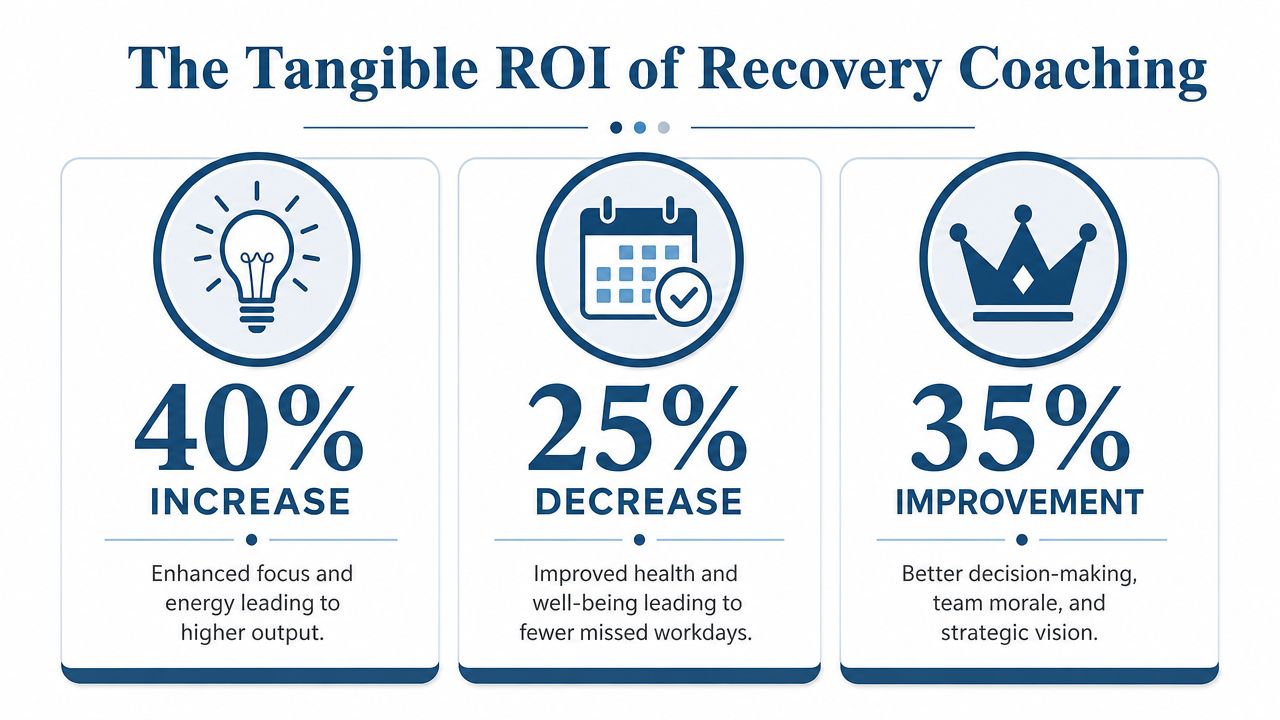
A large hospital system found that patients engaged with recovery coaches had a 44% reduction in hospitalization rates and a 46% decrease in total hospitalizations within six months, shifting care away from acute use and toward outpatient follow-through, according to this hospital-system evaluation of peer recovery coaching.
Why that matters to a professional
For a working executive, fewer crisis-level episodes means more than lower healthcare utilization. It means:
- Less operational disruption when health is no longer driving emergency decisions
- More predictable functioning during periods of professional pressure
- Better continuity of care instead of cycling between breakdown and damage control
- Lower reputational exposure tied to visible instability
This is the primary ROI. Coaching supports consistency.
Engagement is a business asset
Another reason coaching pays off is that it keeps people engaged in recovery. Clinical studies found that hospitalized individuals linked to recovery coaching showed 84% engagement in recovery support services at 30 days, compared with 34% for control groups, and 80% remained engaged at 6 months versus 24% for controls, as reported in this clinical review of recovery coaching outcomes.
That's not abstract. Engagement is the difference between maintaining a treatment trajectory and drifting back into the same private patterns that nearly destroyed performance in the first place.
For some clients, the payoff also shows up in the short window after discharge, when risk is high and judgment is fragile. The professionals who do best are usually the ones who don't treat discharge as the finish line.
Credentials and Standards for an Elite Coach
Many people assume all recovery coaches are vetted the same way. They aren't. The field still lacks federal regulation, though nearly all states have their own certification processes and standards, which creates a fragmented system that clients have to proceed cautiously, as explained in this analysis of the recovery coaching workforce and regulation.
That means credential review can't be casual, especially for high-profile clients.
What to verify first
A serious buyer should check the basics before discussing fit.
- State-recognized certification: The coach should meet the standards required in the state where services are delivered.
- Supervised experience: Training alone isn't enough. Supervised work matters because executives often present with layered risk, complicated schedules, and family systems under strain.
- Ethical boundaries: The coach should be clear about scope, confidentiality, communication limits, and when clinical escalation is required.
What separates an elite coach from a merely qualified one
For executive clients, technical eligibility is the floor. Key differentiators are harder to measure and more important in practice.
A strong executive coach understands power dynamics, privacy concerns, and the strange isolation that often comes with leadership. The coach should be calm around wealth, status, and influence. No awkward fascination. No moral posturing. No need to be impressed.
Just as important, the coach should understand when not to speak. Discretion isn't a branding term in this setting. It's part of the service.
The best coach for a public figure is usually the one who treats public status as clinically irrelevant and operationally important.
Families and referral sources should also look at institutional quality. Accreditation doesn't certify a coach directly, but it does say something about the treatment environment surrounding the work. This is why many discerning clients pay attention to standards such as Joint Commission accreditation.
Integrating Coaching at Reflections Before During and After
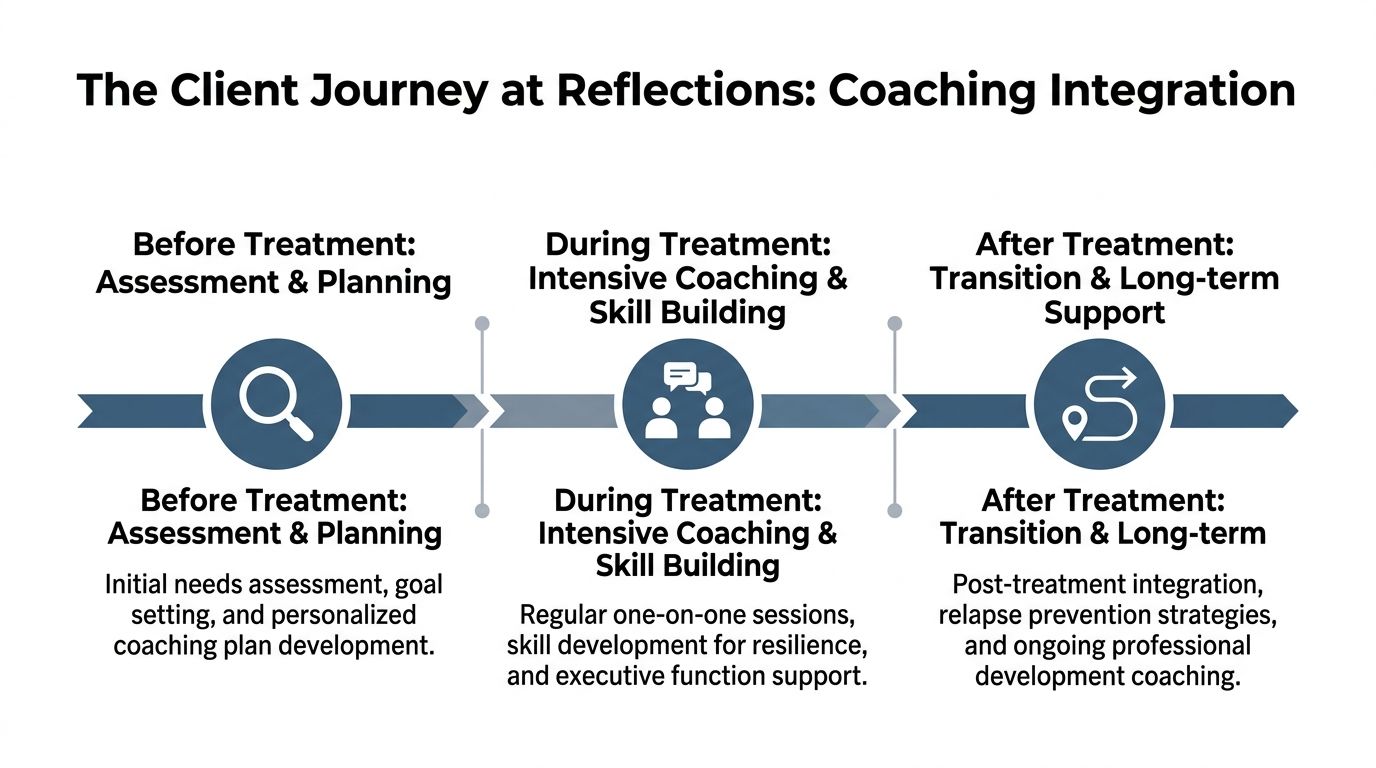
For executives, coaching works best when it isn't bolted on at the end. It should move with the client through the full arc of treatment and reentry. That includes preparation before admission, practical support during residential care, and a disciplined aftercare plan once the structure of treatment falls away.
Before treatment
Early coaching work should clarify risk, priorities, and logistics. For a high-level professional, that usually means identifying what requires immediate continuity, what can be delegated, and what has been falsely labeled “urgent” out of habit or control needs.
The pre-admission phase should also define the role of privacy, family communication, and clinical coordination. If the client is entering a luxury program, expectations around electronics, protected work access, and private accommodations need to be addressed directly. High-performing clients usually stabilize faster when those details are handled up front instead of fought over after admission.
During treatment
In residential care, the coach's function is practical reinforcement. The client may be doing intense therapy, psychiatric work, detox support, and trauma-informed treatment. Coaching helps connect that work to daily behavior.
That's especially important in an executive setting where residents may keep cell phones and laptops to continue essential career obligations. Appropriate access can protect business continuity, but it can also become a route back into stress overload if it isn't managed carefully. Coaching helps set limits, structure communication windows, and prevent work from swallowing treatment.
Private rooms also matter here. They aren't cosmetic. For many high-functioning professionals, privacy improves regulation, supports discretion, and creates enough psychological safety to do serious therapeutic work in both detox and rehab.
After treatment
The hardest part often starts after discharge. A common unresolved question in the field is how recovery coaching should evolve after 30 to 90 days of residential care for clients with co-occurring disorders. Effective aftercare shifts coaching toward ongoing needs and integrates it with clinical support rather than treating it as a standalone service, as noted in this discussion of recovery coaching after residential treatment.
That transition should include:
- Reentry planning for meetings, travel, social pressure, and family dynamics
- Clinical coordination so therapy, psychiatry, and coaching stay aligned
- Relapse prevention in context rather than generic avoidance advice
- Long-term accountability once the novelty of treatment has worn off
A luxury model should deliver continuity, not just containment. Executives don't need a dramatic reset followed by silence. They need a system that can support high performance without sacrificing stability.
Frequently Asked Questions About Executive Recovery Coaching
Is this worth the cost for someone who can still function professionally
Yes, if the goal is to protect long-term performance instead of waiting for visible collapse. High earners often stay functional far longer than they stay well. That gap is dangerous.
Cost should also be understood in context. Executive luxury rehab programs can run from over $1,000 per day to as much as $3,500 per day, reflecting personalized clinical teams, private accommodations, and continuous access to advanced care rather than surface-level amenities, as described in this overview of luxury rehab for executives.
Why not just hire a therapist and skip the coach
Because implementation fails when no one is helping translate treatment into daily execution. Therapy addresses diagnosis and root causes. Coaching helps the client live differently when pressure returns.
For executives with dual-diagnosis needs, that distinction isn't academic. It's operational.
Can a coach support someone who still has work obligations
Yes, but only if the treatment setting and coaching structure are built for it. High-functioning professionals often need discreet support while maintaining limited essential contact with work. That can be done well. It just requires boundaries, clinical oversight, and a program that understands executive reality.
How is confidentiality handled for public figures
A serious private-pay setting treats confidentiality as part of care delivery, not as a marketing promise. The right environment protects privacy through staffing discipline, controlled communication, and individualized planning. Public visibility increases the need for discretion. It doesn't change the clinical standard.
What should a family or advisor ask before recommending recovery coaching services
A short list works best:
- How is coaching integrated with clinical care: If the answer is vague, the model is weak.
- What experience does the coach have with executives or complex family systems: High-status clients bring distinct pressures.
- How are work access and electronics managed: This matters for professionals who can't disappear completely.
- What happens after residential treatment ends: The handoff is where many plans break down.
What should happen first
Assessment. Not assumptions.
The client's substance use, mental health profile, work demands, family situation, and privacy concerns should be evaluated together. Then the treatment and coaching plan should be built around those realities. High-end care earns its price by tailoring the environment, not by delivering generic programming in a nicer room.
Reflections provides discreet, California-licensed, Joint Commission-accredited luxury dual-diagnosis treatment for adults who need serious clinical care without losing sight of professional reality. Private rooms in detox and rehab, a highly accredited multidisciplinary team, appropriate access to electronics for ongoing career obligations, and a strong continuing-care model make it a fit for executives, C-suite leaders, and high-functioning professionals who want the best level of care in a private-pay setting. Learn more at Reflections.