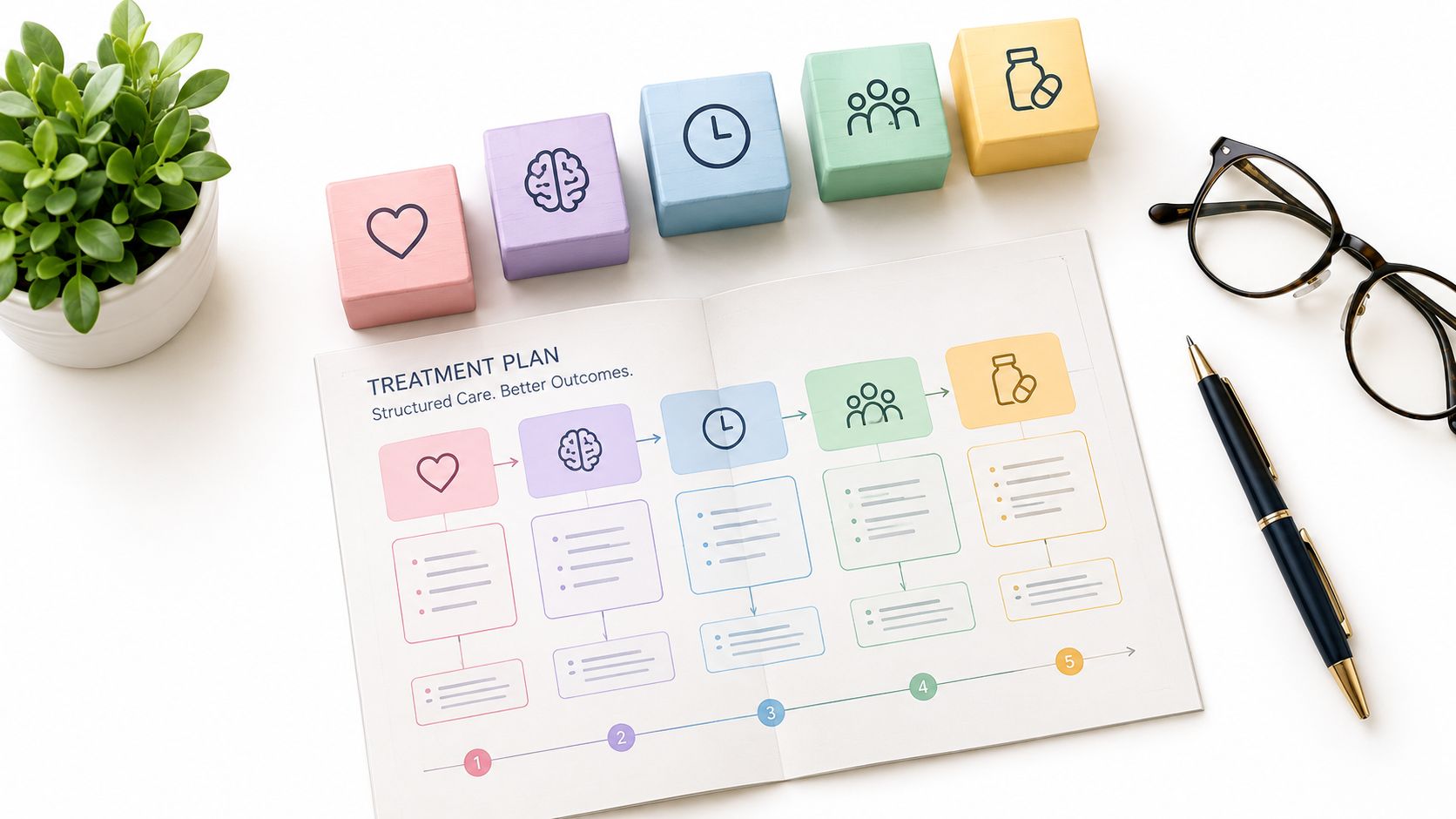

A relapse prevention group activity matters most when the client's life is still moving at full speed. For executives, founders, physicians, attorneys, and other high-performing professionals, the danger is rarely a single obvious trigger. It's the accumulation of pressure, private stress, relentless availability, and the quiet belief that performance has to come before health.
Luxury treatment has to acknowledge that reality. The right group work does more than teach coping skills, it helps a client protect reputation, sustain leadership, preserve relationships, and stay mentally clear while treatment remains discreet and clinically serious. Relapse prevention groups are built to help people anticipate, identify, and manage high-risk situations and to support broader life balance as part of long-term recovery planning, which makes them especially relevant for clients who can't just step out of life and disappear into a generic model of care (SAMHSA guidance on relapse prevention groups). For executives who need privacy, continuity, and a treatment plan that respects board meetings, travel, and family obligations, the best group activities are practical, not performative. They should feel clinically grounded, professionally intelligent, and customized to the pressures of an always-on life, including integrated options like depression and alcohol treatment.
1. Executive Peer Accountability Circles
A strong relapse prevention group activity for executives starts with peers who understand the cost of being “fine” on the outside while struggling privately. In these circles, confidential discussion is anchored in career reality, board pressure, investor scrutiny, regulatory exposure, and the exhaustion that comes from constant decision-making. When the group is facilitated by licensed addiction counselors with executive coaching fluency, participants tend to speak more directly about shame, secrecy, and the pressure to keep performing.
The structure matters. A private-pay client with a demanding calendar is less likely to engage with vague emotional sharing than with a precise framework that connects recovery to stability, credibility, and strategic thinking. That is where peer accountability lands well, because it turns relapse prevention into a shared professional discipline rather than a moral lecture.

What makes it work in a luxury setting
An executive may open up faster when the group feels comparable to a confidential advisory board. The most useful sessions include clear confidentiality agreements, non-competition clauses where appropriate, and precise scheduling that doesn't clash with professional obligations. A secure alumni network can also help, because recovery often needs maintenance after the residential phase ends.
Practical rule: Peer accountability works best when the tone is direct, the boundaries are explicit, and the conversation stays tied to what actually threatens recovery, not just what sounds therapeutic.
Reflections' peer support groups fit this need because they support the combination of honesty, structure, and continuity that high-functioning clients often require. The group also benefits from business-language framing. When participants discuss “risk management,” “decision fatigue,” and “return on recovery,” many engage more fully than they do with abstract language alone.
2. Luxury Wellness Integration Groups For Mindfulness And Performance Optimization
Executive clients usually respond well when mindfulness is presented as a performance tool, not an abstract wellness exercise. That framing fits the realities of luxury treatment, where a resident may still be checking in on teams, reading email, or managing a company transition while in care. A relapse prevention group activity built around mindfulness can therefore focus on emotional regulation, stress recovery, and sustainable output rather than only on sobriety language.
These groups work best when they feel measurable. Biofeedback, breath training, and somatic awareness can help a participant notice how quickly tension, irritation, or overcontrol build before cravings do. Mindfulness also gives the group a shared language for the moment before a relapse decision, which is often where executive clients need the most help.
The strongest sessions connect the practice to specific high-pressure contexts. Boardroom anxiety, investor calls, merger fatigue, and public scrutiny all create physiological strain. If a participant can learn to recognize the onset of dysregulation early, the activity becomes far more relevant than a generic meditation script.
Keep the practice tied to real professional life
Luxury clients often want to know how a skill translates into daily use. The most effective groups answer that question concretely.
- Morning calibration: A brief practice before email helps some participants start the day with a steadier baseline.
- Transition resets: Short breathing or grounding work between meetings can interrupt the stress spiral that leads to impulsive use.
- Device-supported continuity: Wearables and app-based prompts can extend the practice beyond the session without making it feel clinical or punitive.
Reflections' meditation for recovery aligns with this type of work because it supports continuity, not just in-room calm. For executives, the primary gain is not a temporary sense of peace. It's the ability to stay regulated enough to keep leading without using substances as a pressure valve.
3. Strategic Life Reconstruction Through Executive Mentorship And Career Navigation
Some clients don't need more reassurance, they need a roadmap. A relapse prevention group activity built around mentorship and career navigation helps executive clients rebuild identity after treatment without pretending that professional life paused cleanly. That is especially important for high-net-worth professionals who may be returning to public-facing roles, confidential responsibilities, or complex leadership positions.
The best version of this activity pairs a person in early recovery with a mentor who has lived through similar pressure and stayed well long enough to model stability. The conversation can include disclosure strategy, reputation repair, work boundaries, and the practical realities of re-entering a role without re-entering the old pattern. For luxury residential treatment, this is a major advantage, because clients can stay professionally engaged while still receiving clinically guided support.
Why mentorship lowers friction
A seasoned mentor can normalize the discomfort of rebuilding trust. That matters because many executives secretly believe they have to prove invulnerability to remain credible. A good mentor makes the opposite case, that sustainable leadership depends on honesty, structure, and enough humility to ask for help before a crisis grows.
The most useful mentorship groups are not casual. They need written expectations, clear contact rules, and ongoing education around trauma, dual diagnosis, and workplace dynamics. They also work better when career coaching is part of the process, since many executives need help with resume gaps, interview language, and whether disclosure belongs in a particular context.
Useful standard: Mentorship should always support recovery first and career reintegration second, because a polished return that ignores relapse risk is still a fragile return.
For clients who want a treatment environment that respects work obligations, this model fits naturally with Reflections' philosophy of maintaining appropriate access to electronics and balancing treatment with real life. The goal is not to detach from career identity. The goal is to rebuild it on cleaner ground.
4. Trauma-Informed Executive Processing Groups With EMDR And Somatic Relapse Prevention
Executives often present as composed while carrying unresolved trauma that fuels relapse in private. That trauma may come from early life, sudden loss of status, public humiliation, betrayal by partners, or the constant pressure of high-stakes responsibility. A trauma-informed relapse prevention group activity gives that reality a proper clinical frame instead of treating it as an optional side issue.
These groups are most effective when they move beyond discussion alone. Some high-achieving clients intellectualize pain so well that they can talk about trauma without processing it. EMDR and somatic work can help the nervous system catch up with the story the mind has been telling for years.
Why this matters for high-achieving clients
The executive profile often rewards control, speed, and composure. Those strengths can become vulnerabilities when a client uses alcohol or drugs to shut down hyperarousal, shame, or intrusive memory. A trauma-informed group can help identify that pattern early, especially when the client needs grounding before deeper processing begins.
The work has to be carefully screened. Not every person is ready for intensive trauma processing in a group format, and not every trauma response belongs in the same room at the same time. The safest groups pair shared education with individual trauma therapy and clear boundaries around confidentiality and pacing.
Reflections' EMDR therapy for addiction is relevant here because it reflects that relapse risk is often linked to unresolved trauma, not just habit or impulse. For an executive, that can include everything from a board removal to childhood perfectionism. The activity works when it treats the nervous system as part of relapse prevention, not just the mind.
5. Financial And Legal Consequences Management Groups
Few things destabilize an executive faster than legal exposure, financial damage, or reputational collapse. A relapse prevention group activity focused on consequences management helps clients face those realities without collapsing into shame or denial. That distinction matters, because shame often drives secrecy, and secrecy drives relapse.
These groups are most useful when they normalize the complexity of restitution. A client may be dealing with regulatory questions, suspended credentials, broken partnerships, or financial devastation. If the group avoids those subjects, it misses the core trigger. When the conversation is structured well, participants can move from self-protection to accountability.
Rebuilding integrity without pretending the damage is small
The clinical task here is not to minimize the consequences. It is to help a client think clearly under pressure, identify values beyond status or income, and make workable plans for repair. Cognitive distortions like “everything is ruined” or “there's no point in trying” can keep a person locked in avoidance, so the group has to challenge those patterns directly.
Practical support also matters. Specialty attorneys, financial advisors, and ethics consultants can be part of the wider care plan when the situation requires it. The group itself should reinforce accountability as a recovery behavior, not a punishment.
Standout point: The sooner an executive can speak plainly about legal or financial risk, the less room shame has to build a second crisis on top of the first.
A related focus on rebuilding trust with honest proof can help frame how integrity gets restored over time. In luxury care, the aim is not only to stabilize the person. It's to help them recover enough clarity to make ethical, durable decisions under real-world pressure.
6. Relationship Repair And Family Reintegration Groups In An Executive Context
Executive recovery rarely affects only the individual. It affects spouses, children, business partners, and extended family systems that may already be strained by years of secrecy or inconsistency. A relapse prevention group activity centered on relationship repair helps clients see how conflict, guilt, and damaged trust can become active relapse triggers.
This work is especially important in high-net-worth households, where the relational dynamics can be complicated by privacy, image management, blended families, and professional overlap. Many executive clients underestimate how much emotional volatility they carry into the recovery process. A family or partner conflict can quickly become the moment when old coping strategies start to look attractive again.
Repair has to be paced realistically
Quick repair is usually fantasy. Trust rebuilds slowly, and families need both psychoeducation and accountability to move forward in a stable way. Separate intake conversations can help determine what is safe to discuss in a group setting, and what needs individual family work first.
The most effective groups teach families how to support recovery without enabling it. That often means clearer boundaries, less rescuing, and more consistency around what is and isn't acceptable. For business partners, the discussion may also involve mediation or specialized workplace guidance, because professional consequences and family emotions can overlap in ways that are hard to untangle.
A discreet luxury program has an advantage here, because family involvement can happen in a protected setting with professional structure. That matters for executives who need to repair relationships without turning the process into a public event. The group helps them practice honesty, but it also helps them avoid the fantasy that one good conversation can undo years of damage.
7. Digital Balance And Technology Boundaries For Always-On Professionals
For many executives, the laptop and phone are part of the relapse picture. Constant connectivity can intensify stress, fragment sleep, invite comparison, and keep the nervous system on alert long after the workday ends. A relapse prevention group activity that addresses technology balance can be unusually effective in luxury treatment, especially when clients are allowed to keep their devices for legitimate career needs.
The point is not digital abstinence. The point is sustainable use. High-performing professionals need tools that protect presence, sleep, and emotional regulation while still letting them function in the everyday world. If the group gets this wrong, clients will hear it as unrealistic. If it gets it right, they often pay close attention.
Boundaries that support performance
The best groups examine how technology habits interact with cravings, perfectionism, and fear of missing out. Some participants need notification limits, some need a no-email window at night, and others need tech-free bedroom routines so sleep doesn't collapse under pressure. The group works when it treats device use as part of relapse prevention, not a side topic.
Short peer commitments can help. A “no devices at dinner” agreement or a shared plan for evening shutdown creates accountability without feeling childish. For executives who are used to managing every variable, that kind of structure can feel surprisingly relieving.
Reflections' model, which allows appropriate electronic access while maintaining a clinically serious residential setting, is well suited to this conversation. Clients do not have to choose between career continuity and recovery. They need structure that helps them use technology without letting it use them.
Relapse Prevention Group Activities: 7-Point Comparison
| Program | Implementation complexity | Resource requirements | Expected outcomes | Ideal use cases | Key advantages |
|---|---|---|---|---|---|
| Executive Peer Accountability Circles | Moderate, careful matching and confidential facilitation | Licensed addiction counselors with executive coaching, secure meeting logistics | Strong peer accountability, reduced isolation, improved career reintegration | C-suite or senior professionals needing confidential peer support | High peer relatability, sustainable professional networks |
| Luxury Wellness Integration Groups: Mindfulness & Performance Optimization | High, integrates tech, mindfulness, and coaching | Neurofeedback/HRV devices, meditation suites, mindfulness and performance coaches | Improved stress regulation, measurable wellness metrics, reduced relapse risk | Data-driven executives seeking performance-oriented recovery | Reframes recovery as performance enhancement, objective feedback |
| Strategic Life Reconstruction: Executive Mentorship & Career Navigation Groups | Moderate–High, mentor recruitment, training and structured matching | Experienced recovered mentors, executive coaches, secure communication tools | Practical career re-entry plans, restored professional identity, long-term mentorship | Executives in early recovery needing career guidance and reputation repair | Real-world role models, targeted career navigation and accountability |
| Trauma-Informed Executive Processing Groups: EMDR & Somatic Relapse Prevention | Very high, specialized clinicians, intensive screening and safety protocols | Trauma psychologists trained in EMDR/somatic work, private therapy suites | Resolution of trauma-driven triggers, faster symptom reduction, durable relapse prevention | Executives with unresolved trauma or complex PTSD driving substance use | Evidence-based trauma processing, somatic change beyond talk therapy |
| Financial & Legal Consequences Management Groups: Rebuilding Trust & Integrity | Moderate, coordination with legal/financial experts required | Counselors with legal/financial expertise or referral network, ethics consultants | Reduced shame, pragmatic restitution plans, lower relapse from legal stress | Executives facing litigation, regulatory sanctions, or financial collapse | Practical integrity rebuilding, values-based accountability frameworks |
| Relationship Repair & Family Reintegration Groups: Executive Context | Moderate–High, involves family logistics and parallel sessions | Family therapists, intake assessments for loved ones, ongoing alumni support | Stronger primary support, improved relationship trust, decreased isolation-driven relapse | Executives with damaged family or partner relationships | Restores relational supports, teaches boundary- and trust-building skills |
| Digital Detox & Technology Balance Groups: Sustaining Recovery in Always-On Cultures | Moderate, requires role-specific customization and monitoring | Digital-wellness experts, assessment tools, app-blockers, peer accountability | Better sleep, reduced compulsive connectivity, improved emotional regulation | Always-on professionals whose tech use fuels stress or relapse risk | Practical, sustainable tech boundaries aligned with performance and recovery |
Integrating Advanced Recovery Into A Sustainable Career
True recovery for an executive is not a departure from life, it's a redesign of how life is lived. The most effective relapse prevention group activity is the one that matches the client's actual pressure points, whether those involve leadership strain, trauma, family conflict, or the exhaustion of always being reachable. For high-performing professionals, the goal is not to become smaller. It's to become steadier.
The strongest programs understand that recovery has to work inside a real calendar, a real family system, and a real professional identity. Structured groups matter because they move beyond vague encouragement and teach clients how to respond when stress, shame, grief, or compulsive overwork start to rise. That is consistent with the broader evidence base, including the 2014 JAMA trial of 285 adults with substance use disorders, where both mindfulness-based relapse prevention and standard relapse prevention showed lower relapse risk than treatment as usual at 6 months, and mindfulness-based relapse prevention still showed fewer days of substance use and less heavy drinking at 12 months (Bowen et al., JAMA 2014). It also fits the 2007 alcohol-detoxification study showing early group engagement can help initially, while longer-term support remains essential (Alcohol and Alcoholism, 2007).
That is the standard for luxury dual-diagnosis care. Clients deserve more than a generic group, and they deserve more than a spiritualized version of accountability. They need clinically informed work that fits the lives they are returning to, including medication-supported aftercare when appropriate. StatPearls notes that acamprosate has evidence for alcohol relapse prevention with an NNT of 12 for preventing a return to any drinking, a useful benchmark when aftercare planning includes both therapy and medication support (StatPearls). In the same spirit, digital delivery is becoming a common component of treatment, with a broad industry report estimating that 46% of substance-use treatment programs use digital health platforms, 49% offer virtual treatment services, and 37% have adopted mobile apps for patient engagement (Fortune Business Insights).
Reflections is built for this kind of client. Its luxury setting, dual-diagnosis focus, intensive group therapy, and continuing care model create the conditions for recovery that can coexist with responsibility rather than compete with it. For executives and other discerning professionals, that combination often makes the difference between temporary stabilization and durable change.
If you're looking for a discreet, clinically grounded program that respects work obligations while treating the underlying drivers of relapse, explore Reflections. Its residential care, intensive groups, and continuing support are designed for adults who need recovery to fit a complex professional life.