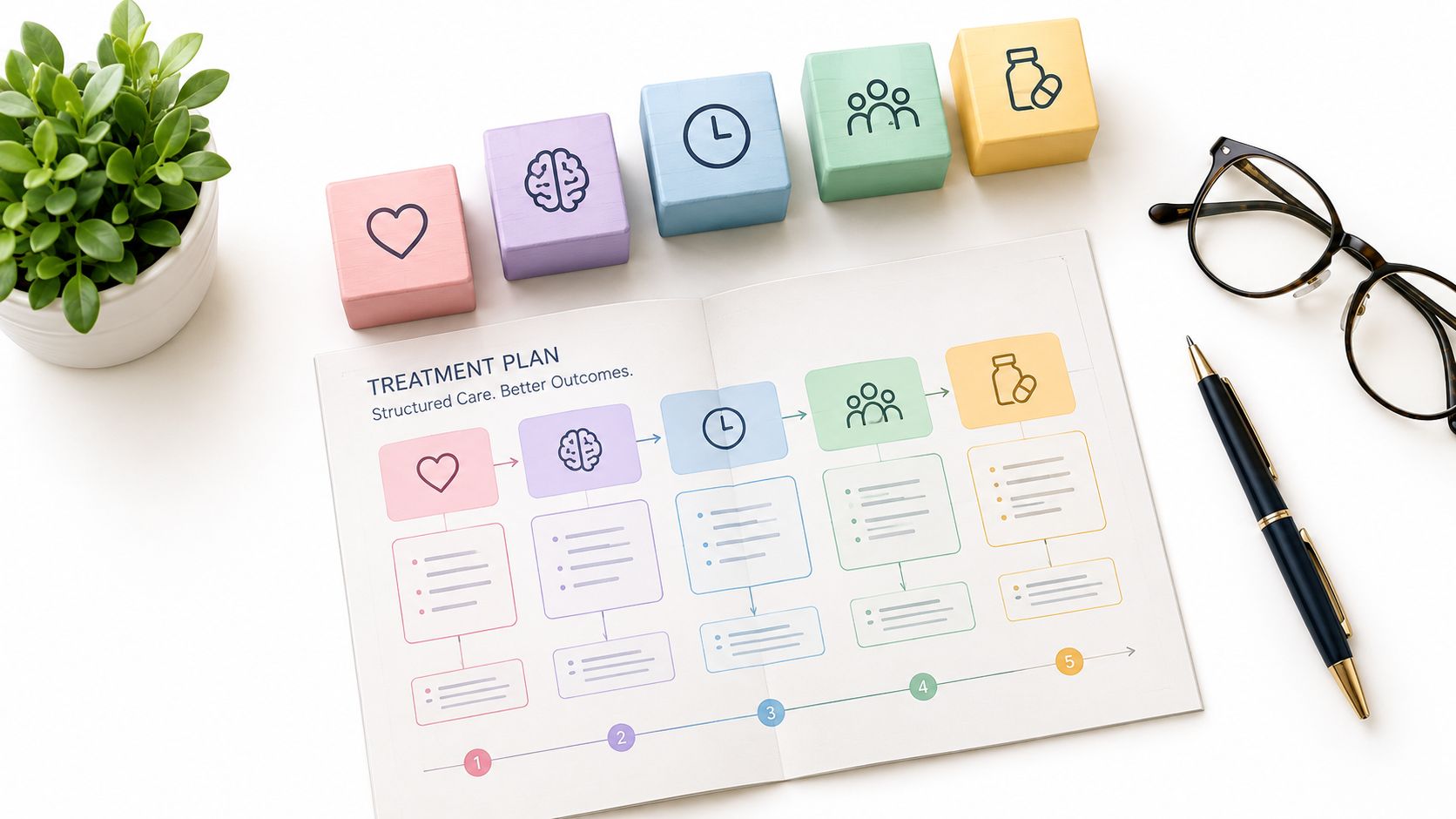

A successful executive leaves residential treatment with something others around them can't see. The visible crisis has settled. The calendar is filling again. Emails are moving. Family life is re-entering a rhythm. From the outside, it can look as if the hard part is over.
For high-performing professionals, that's usually the moment risk changes shape, not the moment it disappears.
Luxury treatment does important work at the highest level. It creates the privacy, clinical depth, and structure needed to address substance use and co-occurring mental health concerns without forcing a complete separation from real life. In a private-pay setting built for executives and working professionals, residents can often continue handling select career obligations with access to electronics such as cell phones and laptops, while receiving intensive care in private rooms during both detox and residential treatment. That combination matters because recovery has to hold up in the same world where the pressure exists.
Peer support groups belong in that next phase. Not as a generic assignment. Not as a symbolic box to check. They work best when they're treated as part of a serious continuing care strategy for people whose lives carry visibility, responsibility, and consequence.
Beyond Residential Care A Strategic Next Step
The first weeks after discharge often test a professional in ways treatment didn't need to. During residential care, the environment is controlled. The day has structure. Clinical support is close. Triggers are easier to identify because the noise level is lower.
At home and back at work, complexity returns fast.
A board meeting runs long. Travel picks up. A client crisis lands late at night. An argument at home collides with exhaustion. None of those moments automatically lead to relapse, but they do expose whether recovery exists only in a protected setting or whether it's becoming operational in real life.
Protecting the investment
High-end residential treatment is a substantial investment of time, privacy, attention, and money. Executives usually understand investment protection instinctively in every other area of life. The same principle applies here. The question after discharge isn't whether treatment “worked.” The better question is whether there's a system in place to preserve what treatment started.
Peer support groups can serve that function when chosen carefully. They provide a confidential layer of accountability between formal clinical appointments, family life, and professional demands. For many executives, the most useful frame isn't “support group.” It's a personal board of directors for recovery.
That board doesn't run treatment. It doesn't replace therapy. It does something different. It gives the person ongoing access to peers who understand ambition, pressure, reputation, fatigue, and the temptation to perform competence instead of asking for help.
Practical rule: Discharge planning should answer one question clearly. Who will notice drift early, before a lapse becomes a crisis?
What works after discharge
The most effective continuing care plans usually include several layers working together:
- Clinical follow-through: Individual therapy, psychiatric oversight when needed, and a defined schedule.
- Peer contact: Regular participation in a group that matches the person's schedule, temperament, and privacy requirements.
- Environmental planning: Clear decisions about travel, work dinners, alcohol exposure, and stress spikes.
- Family alignment: Loved ones understand what support looks like and what over-management looks like.
What doesn't work is relying on insight alone. Insight gained in treatment is important, but high-pressure lives can outrun insight quickly. Executives need repetition, reflection, and outside perspective. Peer support groups offer all three when they're integrated as part of a disciplined continuation of care.
Understanding the Power of Structured Peer Communities
A peer support group isn't group psychotherapy. That distinction matters.
In psychotherapy, a clinician directs the process, interprets patterns, and applies a treatment model. In peer support, the center of gravity is shared experience. Members speak from lived reality, not from a clinical role. The value comes from mutual recognition, practical honesty, and sustained accountability.
For executives, that difference is often what makes participation possible.
Why executives respond to peer structure
High-achievers spend much of their lives in roles that reward control, certainty, and strategic communication. Those strengths can become liabilities in recovery. A person who can manage investors, teams, litigation, or public messaging can also become very skilled at editing vulnerability.
A well-run peer group interrupts that habit.
When a room includes other accomplished professionals who understand the mechanics of pressure, members don't have to explain the culture of overperformance before they can discuss the cost of it. That shortens the distance to honesty. It also reduces the isolation that often sits underneath both substance use and post-treatment anxiety.
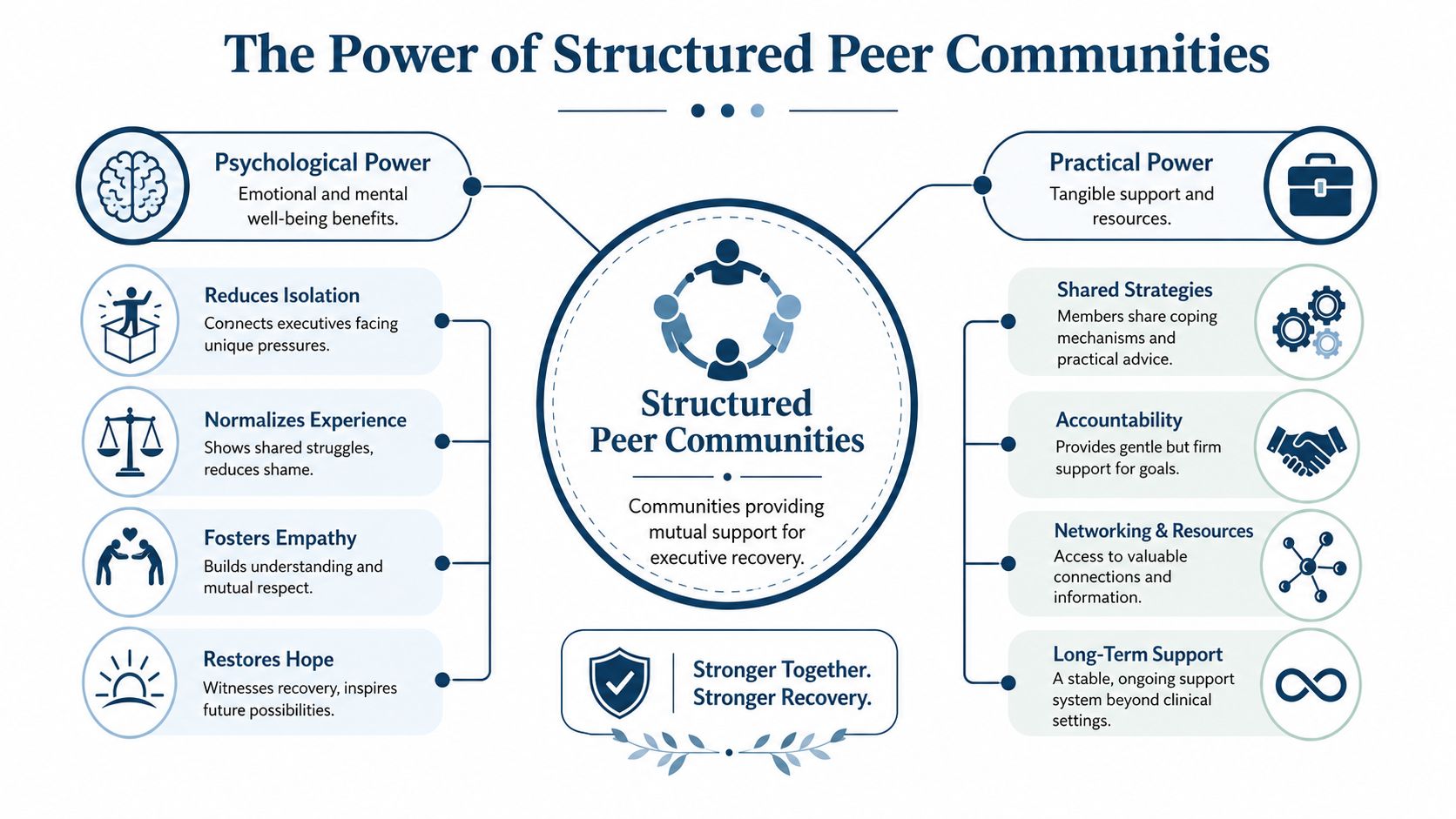
This visual captures why structured communities have such staying power.
Psychological value and practical value
The strongest peer communities do two jobs at once.
First, they normalize experience. An executive who hears another successful professional describe the same shame spiral after a stressful dinner, the same secrecy around medication, or the same resentment about slowing down often stops treating those reactions as personal defects. That shift lowers defensiveness and opens the door to better decisions.
Second, they provide practical intelligence. Members exchange concrete strategies that hold up in actual life. How to leave a dinner without explanation. How to handle conference travel. How to manage a high-stakes week without returning to old coping patterns. Those conversations aren't abstract.
Recovery becomes more durable when a person can say, “Someone else in a life like mine faced this exact situation and handled it cleanly.”
For readers familiar with the value of curated leadership circles, Founder Connects offers a useful perspective on peer groups for entrepreneurs. The business context is different, but the principle is similar. High performers often make better decisions when they have a trusted forum where candor is expected.
Where peer support fits beside treatment
Peer support works best when it sits next to formal treatment, not in place of it. Clinical care addresses diagnosis, trauma, mood symptoms, compulsive patterns, and evidence-based interventions. Peer groups reinforce day-to-day use of those skills in ordinary life.
That distinction becomes even clearer when someone has already participated in group addiction therapy. Clinical groups and peer groups can look similar from the outside, but they offer distinct forms of support. One is guided treatment. The other is community-based continuity.
Comparing Peer Support Models for the Discerning Professional
Not every peer model fits a C-suite schedule, public profile, or intellectual style. A poor fit leads to partial engagement, polite resistance, or total dropout. A good fit makes participation sustainable.
The right question isn't which model is “best” in general. It's which model best matches the person's privacy needs, travel demands, and philosophy of change.
Major models in practice
Some professionals do well in widely available mutual-help communities. Others want a more cognitive framework. Others need a tightly curated alumni network where the culture already aligns with discretion and professional maturity.
The comparison below is the simplest way to evaluate the main options.
| Peer Support Model Comparison for Professionals | Core Philosophy | Best For… | Discretion Level |
|---|---|---|---|
| 12-Step groups | Recovery through mutual aid, structure, humility, and ongoing peer accountability | Professionals who value routine, broad availability, and a clear recovery language | Varies by meeting and location |
| SMART Recovery style groups | Self-management with a practical, skills-oriented approach | Professionals who prefer a cognitive, structured, non-spiritual framework | Moderate to strong, depending on format |
| Profession-specific peer meetings | Shared recovery among people in similar fields or licensing environments | Lawyers, physicians, executives, and other professionals with industry-specific concerns | Often strong because members understand career risk |
| Clinically adjacent aftercare groups | Ongoing support connected to treatment recommendations and relapse prevention planning | Individuals who benefit from a bridge between formal care and independent peer support | Usually strong when well managed |
| Curated alumni groups | Connection with pre-vetted peers who share treatment history and similar standards of participation | High-profile individuals seeking familiarity, continuity, and a more tailored environment | Often strongest because culture and expectations are already established |
Trade-offs that actually matter
A broad community model offers access and flexibility. Meetings exist in many places, which helps professionals who travel. The trade-off is variability. One meeting may feel grounded and discreet. Another may feel too exposed, too philosophically mismatched, or too inconsistent in tone.
A cognitive-based format often appeals to professionals who want language that feels practical and less tradition-bound. The benefit is conceptual clarity. The limitation is that some people eventually discover they need more than a framework. They need durable community, not just useful tools.
Profession-specific groups can be excellent for privacy and relevance. Members usually understand licensing concerns, referral risk, leadership stress, and the deep fear of reputational fallout. The trade-off is availability. Depending on geography or specialty, access may be narrower and schedules less forgiving.
Curated alumni groups often stand out for high-end clientele because they remove one of the biggest barriers to entry. Members don't have to assess from scratch whether the room understands discretion, ambition, family complexity, or executive identity. That context is already present. For many discerning professionals, that lowers friction enough to support real engagement.
How to choose without overthinking it
A practical evaluation process helps:
- Test cultural fit: After a meeting, ask whether the room encouraged honesty or performance.
- Assess schedule realism: A great group that can't fit around travel and responsibilities won't last.
- Look at privacy behavior: Notice how members speak about anonymity, boundaries, and other people's stories.
- Check philosophical alignment: If the language of a model creates resistance, long-term participation will suffer.
- Prefer consistency over novelty: The group that can be attended regularly beats the group that sounds ideal on paper.
The best peer support group is the one a professional will actually use when stress is high, travel is heavy, and ego wants to opt out.
How Peer Support Complements Elite Clinical Treatment
Elite treatment establishes the foundation. It identifies diagnoses, stabilizes the immediate crisis, addresses substance use, and begins the deeper work around trauma, mood, personality patterns, and stress regulation. For executives and other high-functioning professionals, that work often happens in a setting that protects privacy, offers private rooms, and supports focused treatment without severing every connection to work and family.
But insight formed in treatment still has to survive ordinary life.
From clinical insight to operational behavior
A person may learn strong cognitive and behavioral tools in residential care. They may understand triggers, thought distortions, emotional avoidance, and relapse warning signs. The challenge begins when those concepts meet a delayed flight, a contentious negotiation, or a lonely hotel room after a successful presentation.
Peer support groups help translate treatment into action.
They become the place where a professional says, in real time, “This is the week the old story is getting loud,” and hears back from people who recognize that pattern before it hardens into behavior. That kind of reinforcement is especially useful for those continuing work on dual diagnosis issues, where stress, anxiety, depression, trauma, and substance use can interact in subtle ways.
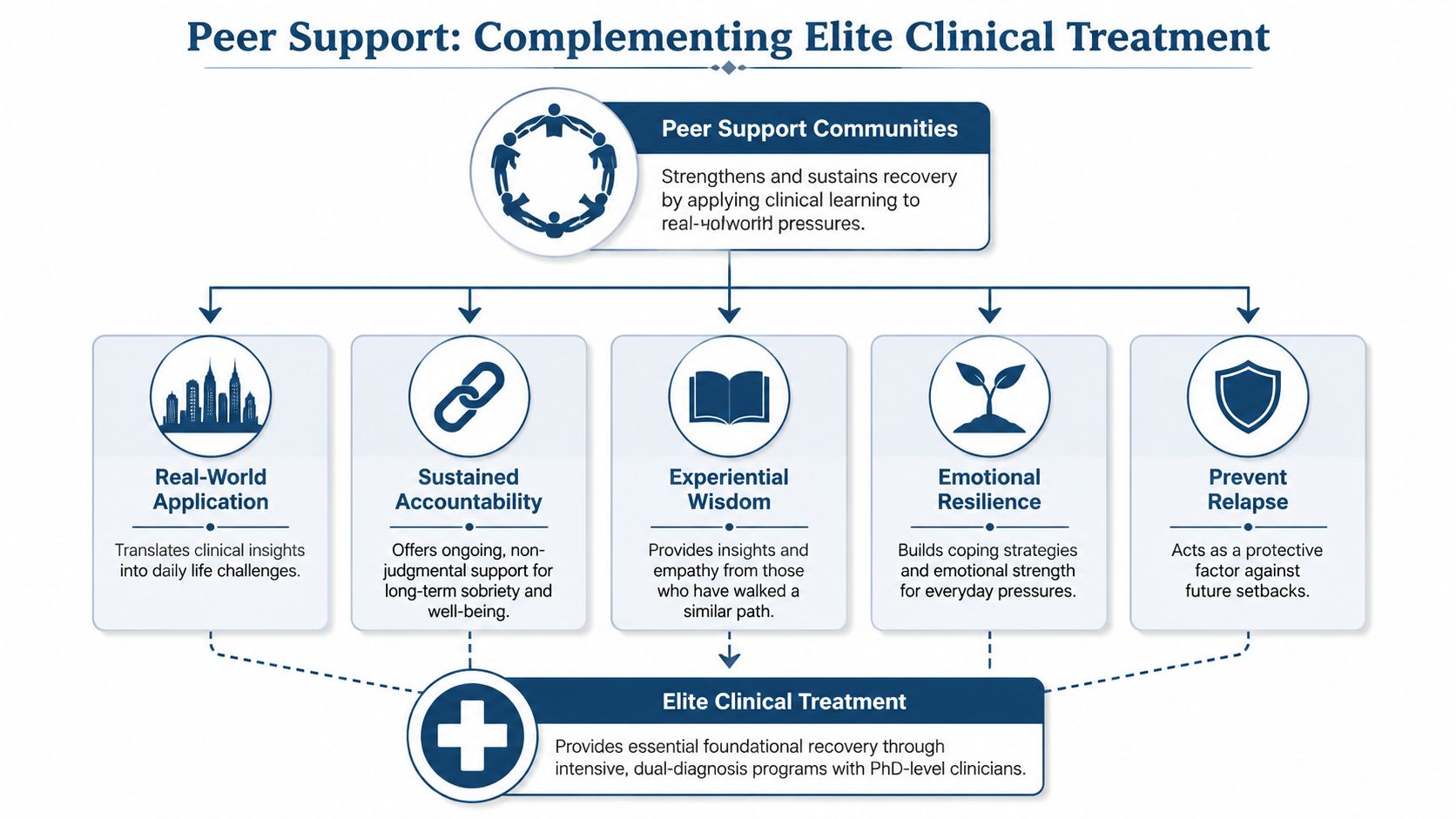
This relationship between formal care and peer participation is illustrated well here.
Peer support as a force multiplier
Peer support doesn't replace expert clinicians. It extends the life of clinical work between appointments and after discharge.
That isn't just a philosophical point. Studies published in the Journal of Substance Abuse Treatment show that individuals who pair formal clinical treatment with consistent peer support group attendance have a 50% lower rate of relapse in the first year post-treatment compared to those who rely on clinical care alone (Journal of Substance Abuse Treatment findings on peer support and relapse).
For clients on medication-assisted pathways, this complement matters too. A well-matched peer community can reduce the shame that some professionals feel around medication decisions. In a healthy group, the standard isn't ideological purity. It's honesty, stability, and responsible recovery.
Where the fit is strongest
Peer support tends to add the most value in three situations:
- After intensive residential work: It helps preserve gains while daily pressure returns.
- During major transitions: New roles, relocation, separation, grief, or licensing stress can all strain recovery.
- When isolation is the risk factor: Professionals who appear socially connected are often privately cut off from honest conversation.
Clinical treatment gives language, strategy, and stabilization. Peer support groups create repetition, belonging, and practical accountability. Together, they form a more resilient continuing care structure than either one alone.
Ensuring Absolute Confidentiality in Peer Support
Confidentiality is the first question most executives ask about peer support groups. It should be.
A senior leader, founder, physician, attorney, entertainer, or public-facing professional doesn't just worry about embarrassment. The concern is career consequence. Exposure can affect board confidence, client trust, referral patterns, licensing, family systems, and public reputation.
That fear is common, and it's grounded in reality. A 2025 survey of professionals in recovery found that 85% cited “fear of professional repercussions” as their primary hesitation in joining a support group (2025 survey of professionals in recovery).

Anonymity and privacy aren't the same thing
Executives often benefit from separating two ideas.
Anonymity usually refers to what happens inside a recovery culture. People protect identities, avoid sharing another member's story, and treat the room as confidential. Privacy is broader. It includes logistics, digital habits, meeting format, scheduling, and who even knows the person attends.
A professional may be comfortable with the culture of anonymity but still need stronger privacy controls around attendance itself. That's not resistance. It's sound judgment.
How to vet a group properly
Participation becomes much safer when the group is screened with the same rigor an executive would apply to any confidential advisory setting.
- Review the format: Online groups can offer more control over location, timing, and visibility.
- Ask about the norms: A serious group can explain how it handles confidentiality, interruptions, and member boundaries.
- Observe before committing: A professional can attend a meeting and evaluate whether members protect the room or casually overshare.
- Choose population fit: Groups for professionals often produce better trust because members already understand the stakes.
- Coordinate with a clinical team: Trusted clinicians can help identify groups that align with treatment needs and privacy requirements.
For many high-profile individuals, specialized programs for rehab for executives can help build that bridge by identifying discreet continuing-care options rather than leaving the person to search blindly after discharge.
A confidential recovery network should be curated, not improvised.
Practical discretion in real life
The mechanics matter as much as the philosophy. Professionals often do better when they choose meetings that fit naturally into the week rather than requiring dramatic schedule changes that invite questions. Some use private calendar labels. Some attend virtually from secure locations while traveling. Some keep participation limited to a small number of trusted family members and advisors.
What doesn't work is treating confidentiality as a hope. It has to become a selection criterion.
There is also a difference between secrecy and discretion. Secrecy isolates. Discretion protects. Peer support groups can support long-term recovery without compromising professional standing, but only when the person selects the setting intentionally and respects the same boundaries they expect from others.
Engaging Your Family and Transitioning to Continuing Care
Recovery isn't a solo performance. Even highly independent professionals need a support structure that extends beyond individual determination.
Family involvement becomes especially important after residential care because loved ones often feel relief and uncertainty at the same time. They want to help, but they may not know whether to ask questions, monitor behavior, stay silent, or step back completely.
The family role after treatment
Families are most helpful when they understand that peer support groups serve a distinct purpose. A spouse, parent, or adult child can offer encouragement, but they shouldn't become the person's sponsor, therapist, investigator, or compliance officer.
That shift usually helps everyone.
When family members respect the peer network's privacy, they reduce pressure on the recovering person to report every detail. At the same time, they can still support the broader continuing care plan by encouraging consistency, protecting time for meetings, and noticing changes in behavior without turning every concern into confrontation.
Boundaries that strengthen the system
A balanced transition usually includes a few clear agreements:
- Respect the closed nature of the group: Loved ones don't need a transcript of what was said in meetings.
- Focus on patterns, not surveillance: If sleep, irritability, isolation, or dishonesty begin to change, raise the concern directly and calmly.
- Keep family support separate from peer support: Each has value, but they do different jobs.
- Stay connected to continuing care resources: Alumni and aftercare structures often help families understand what progress looks like over time.
A well-designed alumni community can make this transition smoother by giving the individual a familiar bridge from treatment into everyday recovery, while allowing family members to stop carrying the full emotional load.
Family support works best when it is steady, informed, and non-intrusive.
A stronger network than family alone
Many executives have families who care but can't fully understand the pressure of leading a company, protecting a reputation, or carrying a public role while rebuilding health. Peer support groups expand the circle. They give the family relief from having to be everything, and they give the recovering person a place where explanation is shorter and understanding is faster.
That combination often creates a more durable continuing care plan than family effort alone.
Building Your Personal Board for Sustainable Success
Peer support groups deserve a more advanced frame than “one more recovery requirement.” For executives and high-profile professionals, they function more effectively as a strategic asset within continuing care.
They provide what high performers often lack most after treatment. A confidential circle of people who can recognize drift, challenge rationalization, and reinforce healthier decisions before the stakes become severe. That's why the right group isn't a downgrade from elite treatment. It's one of the ways treatment continues to protect health, judgment, and career stability over time.
The best choice is rarely the most generic one. It's the one that aligns with schedule, temperament, privacy standards, and the person's willingness to be honest. Some will benefit from broad mutual-help access. Others will do better in profession-specific or curated alumni settings. The standard should be fit, not tradition for its own sake.
The broader lesson is simple. Strong recovery systems don't rely on willpower alone. They rely on structure, relationships, and ongoing accountability. That's true in healthcare, in leadership, and in personal recovery. Even outside addiction treatment, organizations often recognize the value of standing beside people through vulnerable transitions, which is part of why community-oriented efforts like ProMD Health supports Brave Gowns resonate with many professionals.
A well-chosen peer community helps protect the most valuable assets a person has. Health. Reputation. Judgment. Future capacity. For a high-performing individual committed to sustainable success, that isn't an optional extra. It's smart infrastructure.
Reflections provides confidential, private-pay luxury treatment for executives, C-suite leaders, and working professionals who need elite dual-diagnosis care without sacrificing discretion. With a highly accredited clinical team, private rooms in both detox and residential treatment, and appropriate access to phones and laptops so residents can stay connected to essential career obligations, the program is designed for high-achieving adults who expect exceptional care. Learn more about Reflections.