
A working professional can keep a company running while losing control of sleep, mood, judgment, or substance use. That combination is common in executive treatment. Outward competence often masks private isolation, and isolation is one of the conditions addiction uses well.
That's why skepticism about group therapy deserves a serious answer. Many accomplished people hear “group” and picture a generic circle with little privacy, low relevance, and too much emotional exposure. In a properly designed private-pay setting, group addiction therapy is something else entirely. It's structured, clinically led, confidential, and intentionally matched to the pressures of leadership, visibility, and ongoing responsibility.
Rethinking Group Addiction Therapy for Professionals
High performers usually arrive with the same concern. They assume individual therapy will be useful and group therapy will be the compromise. Clinically, that assumption doesn't hold up.
A peer-reviewed survey found that over 90% of U.S. substance use disorder treatment facilities offer some form of group intervention, and clinicians reported delivering group therapy to clients more often than individual therapy in a typical month, which reflects its role as a standard treatment modality rather than an optional add-on in modern care systems (peer-reviewed literature on group treatment in addiction care).
For executives, that matters for a simple reason. The issues that sustain addiction often don't live only inside the mind. They also live in patterns with other people. Deflection. Image management. Control. Avoidance of honest feedback. Over-functioning at work while under-functioning emotionally at home. Those dynamics are hard to treat in isolation.
Why professionals often resist it
The objection usually isn't about treatment quality. It's about status, relevance, and privacy.
- Status concerns: Senior professionals don't want to be reduced to a diagnosis.
- Relevance concerns: They don't want a room full of people who can't understand fiduciary pressure, legal exposure, public visibility, or the cost of being offline.
- Privacy concerns: They need a setting that respects confidentiality as operationally, not rhetorically.
That's why executive-focused care has to build group therapy differently. A program for working professionals in treatment should understand that the client may need deep clinical work without severing every professional obligation overnight.
Group therapy works best for professionals when it stops feeling like public disclosure and starts functioning like a disciplined, confidential environment for accurate feedback.
What the reframe looks like
In a luxury clinical setting, group addiction therapy is not a surrender of autonomy. It's a strategic treatment environment where patterns become visible faster. A client hears how others with comparable demands rationalize overwork, minimize risk, hide depletion, and mistake performance for wellness. That recognition often breaks denial more efficiently than private reflection alone.
The strongest executive programs don't ask accomplished people to lower their standards. They meet those standards with rigor, discretion, and relevance. That's the right starting point for understanding what group therapy can do.
The Power of a Curated Peer Group

The value of group addiction therapy for professionals depends heavily on who is in the room. In a luxury setting, the peer group shouldn't feel random. It should feel curated.
That doesn't mean everyone has the same title, income, or industry. It means the group shares meaningful points of pressure. Leadership burden. Persistent availability. Reputation management. Family strain caused by long work hours. A habit of solving everyone else's problems while avoiding personal reality. When those factors align, the conversation changes.
More like a peer advisory room than a generic process group
A well-composed group often functions like a private advisory board with clinical oversight. Members listen differently because they recognize the cost of the roles others carry. They also challenge differently. Excuses that might pass elsewhere don't hold up when another high-functioning person can identify the same maneuver immediately.
Several therapeutic advantages show up in that setting:
- Faster credibility: Participants don't need to spend half a session explaining why stepping away from work feels impossible.
- Sharper feedback: Peers can identify rationalization disguised as responsibility.
- Useful mirroring: One person's burnout logic often exposes another person's denial.
- Real-world transfer: Skills practiced in treatment often apply directly to conflict, delegation, communication, and boundary-setting at work.
Shared caliber changes the work
The phrase “you are not alone” is true, but it can sound thin to a professional with a highly unusual life. What matters more is this: the group contains people capable of understanding complex trade-offs without romanticizing them.
One executive may be managing investor expectations while hiding escalating alcohol use. Another may be balancing litigation stress, travel fatigue, and stimulant misuse. Another may have maintained outward success for years while relationships deteriorated in private. The details vary. The underlying pattern is familiar to the group.
A curated peer group helps professionals stop performing insight and start practicing it.
That distinction matters. Many executives are excellent verbal processors. They can explain their behavior intelligently without changing it. In a strong group, peers notice the gap between language and action. That's uncomfortable, but it's productive.
What doesn't work
A group loses value when it becomes too broad, too anonymous, or too passive. Professionals disengage when:
- The mix is clinically mismatched: vastly different levels of stability or motivation can reduce trust.
- Facilitation is weak: unstructured disclosure can become performative or superficial.
- Privacy norms are vague: if boundaries aren't explicit, guardedness takes over.
- The group lacks relevance: people stop speaking candidly when the room doesn't understand the stakes.
For executives, the peer group itself is part of the intervention. It should be selected with the same care given to any other element of treatment.
Evidence-Based Group Models for Executive Function
Professionals usually respond well when the clinical method is clear. Group addiction therapy isn't one single style. Effective programs combine distinct group models for different purposes.
According to SAMHSA TIP 41 on substance use group therapy models, effective treatment uses five core models: psychoeducational, skills development, cognitive-behavioral, support, and interpersonal process groups. The strongest programs blend these models according to treatment stage and client need.
Executive Group Therapy Models at a Glance
| Group Model | Clinical Focus | Benefit for the Executive |
|---|---|---|
| Psychoeducational | Understanding addiction, relapse patterns, co-occurring mental health issues, and treatment principles | Replaces vague fear with a usable framework. Helps clients understand what's happening in the brain, behavior, and work system |
| Skills Development | Building concrete tools for distress tolerance, emotional regulation, communication, and impulse control | Gives professionals practical responses for pressure, conflict, cravings, and high-stress decision points |
| Cognitive-Behavioral | Identifying distorted thinking, triggers, routines, and relapse-linked beliefs | Helps clients challenge perfectionism, catastrophizing, entitlement, and “I can handle this alone” thinking |
| Support | Increasing connection, accountability, hope, and recovery-minded routines | Reduces isolation and creates a structure for honesty, especially for people used to carrying everything alone |
| Interpersonal Process | Exploring relationship patterns as they emerge in real time with others | Improves boundary-setting, feedback tolerance, trust, humility, and relational intelligence |
How these models translate into executive life
Psychoeducational groups are the intelligence briefings of treatment. They help clients understand the mechanics behind loss of control, mood instability, relapse risk, and co-occurring conditions. For an executive who's used to making decisions from data, this often lowers defensiveness.
Skills groups are where treatment becomes operational. Clients practice concrete tools rather than just talking about intentions. A program may use approaches such as DBT-informed regulation work to help clients manage agitation, shame, and urgency. For professionals exploring DBT therapy for addiction, this part of treatment is often where insight turns into behavior.
What each model does well, and where it falls short alone
No single model is enough by itself.
- Education alone can produce insight without change.
- Skills alone can become mechanical if deeper shame or grief stays untouched.
- Support alone may feel validating but not corrective.
- Interpersonal process alone can be too exposing early in treatment if safety and stability aren't established first.
That's why sequencing matters. Early treatment often benefits from structure, orientation, and stabilization. As clients gain footing, groups can tolerate more depth, more feedback, and more emotional precision.
The best group plan isn't the most intense one. It's the one that matches the client's stage of change, emotional capacity, and real-world responsibilities.
Executive function is often the hidden target
For professionals, substance use doesn't just affect health. It compromises executive function in the broader sense. Judgment narrows. Stress recovery worsens. Patience drops. Communication becomes brittle. Group therapy addresses those failures where they show up in human interaction.
That's one reason discerning clients often end up valuing group more than they expected. It doesn't only support sobriety. It trains better thinking, better self-management, and better relationships under pressure.
What to Expect in a Private Group Session
For many professionals, uncertainty is part of the resistance. They want to know what happens in the room. In a private executive setting, the session is usually structured, paced, and professionally contained.
The physical environment matters more than people expect. A well-appointed room with comfortable seating, acoustic privacy, and a calm atmosphere changes the tone immediately. It signals that treatment is being taken seriously. For high-functioning clients, that helps lower the reflex to scan the environment for risk and distraction.
The session usually starts with relevance
Most private group sessions begin with a focused check-in. Not a monologue. Not forced vulnerability. A concise update on mood, stress, current triggers, treatment tasks, and any pressure points from family or work.
For professionals who retain appropriate access to electronics, work contact is handled thoughtfully rather than chaotically. That balance matters. Some executive-focused programs, including intensive group therapy services at Reflections, incorporate structured therapeutic scheduling while allowing room for essential communication and continuity.
A common flow inside the room
A strong session often follows a pattern like this:
- Brief grounding: The facilitator settles the room and establishes focus.
- Confidential check-in: Each participant identifies what needs attention that day.
- Theme-based work: The group examines a specific issue such as perfectionism, resentment, control, relapse warning signs, or conflict avoidance.
- Guided feedback: Members respond to one another with facilitator support, not cross-talk or chaos.
- Takeaways: Each client leaves with a behavioral target, reflection point, or communication task.
That level of structure is important. Executives usually engage more fully when the process has a beginning, middle, and end.
The tone is direct, not theatrical
High-level facilitation changes everything. The therapist's role is not to let the loudest person dominate or to reward polished self-disclosure. The role is to identify what is clinically relevant, challenge evasion, regulate the pace, and protect the emotional safety of the group.
A typical discussion might move from “work stress” into something more accurate. Fear of irrelevance. Inability to ask for help. Anger covered by competence. Shame hidden under productivity. Those shifts happen because the room is designed to go beneath the corporate summary.
A useful session leaves the client with something specific to practice, not just something meaningful to think about.
The best private groups feel respectful of time and intelligence. They don't infantilize accomplished adults. They ask for honesty, participation, and willingness to test new behavior in a setting that can hold it.
Confidentiality and Dynamics in an Executive Group
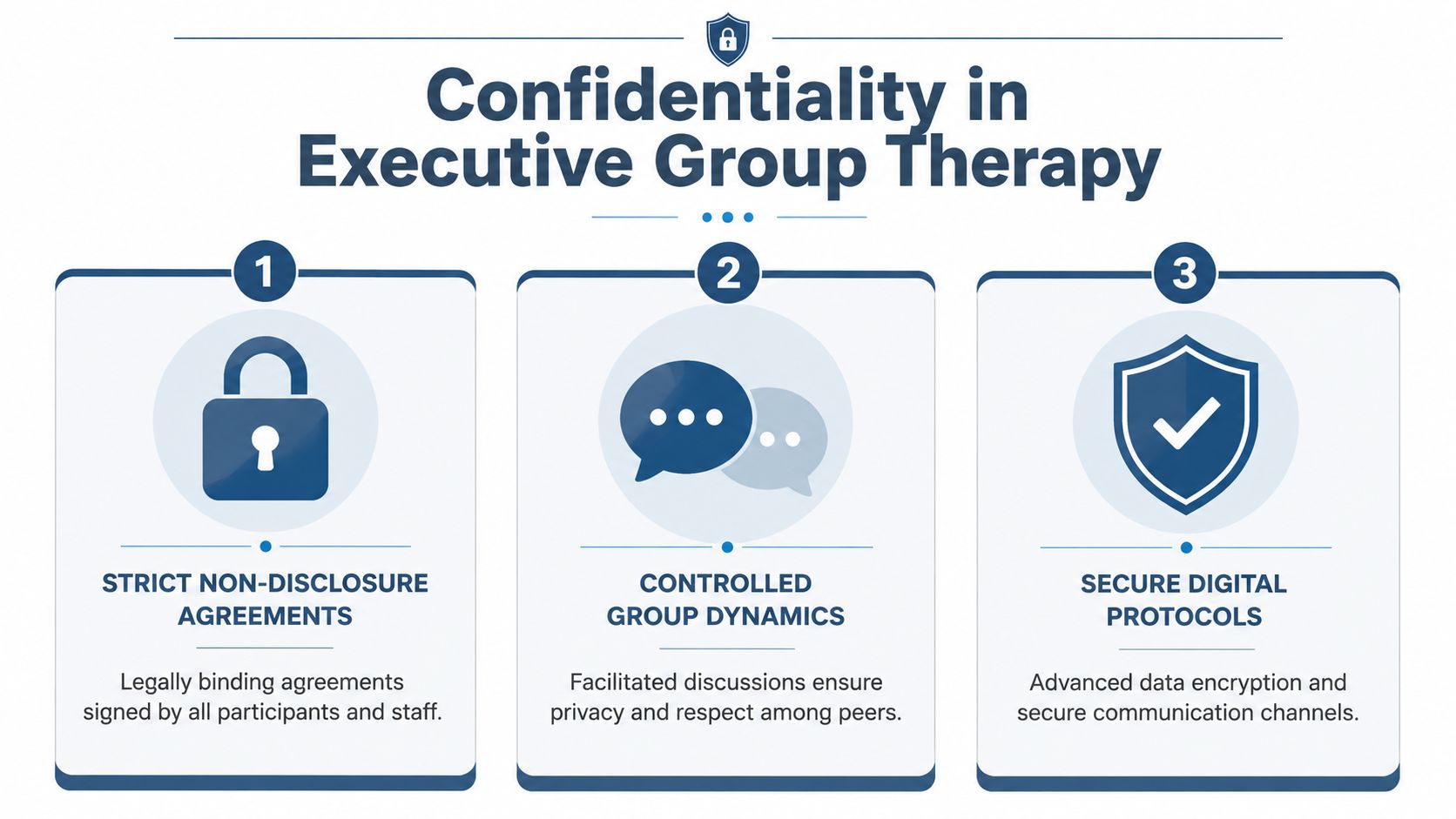
Privacy is the first filter for most high-profile clients. If the confidentiality standard feels weak, treatment won't get honest participation. In executive group addiction therapy, privacy has to be built into the legal framework, the clinical process, and the culture of the group itself.
Pillar one is formal protection
A serious program uses explicit confidentiality agreements, carefully defined privacy expectations, and disciplined handling of records and communication. For executives, public figures, attorneys, physicians, founders, and senior operators, that level of clarity isn't cosmetic. It's basic risk management.
Electronic access adds another layer. If a program allows phones or laptops for essential responsibilities, it also needs secure digital protocols and clear expectations around where, when, and how those devices are used.
Pillar two is active clinical containment
Confidentiality is not preserved by paperwork alone. It also depends on how the therapist runs the room.
A skilled facilitator sets norms early. Members don't interrogate one another. They don't trade war stories for effect. They don't use the group as an audience. They learn how to speak candidly without exposing unnecessary third-party details, business-sensitive information, or family material that doesn't belong in open discussion.
This matters in workplace-related themes too. Executives often bring in conflict patterns from teams, partnerships, and leadership roles. Resources on communication dynamics, such as this piece on dealing with difficult coworkers, can be useful for framing common interpersonal traps, but group therapy goes further by observing how those same patterns arise live between peers.
Pillar three is mutual self-interest
The final protection is the group's own culture. In an executive setting, participants usually understand discretion not as a courtesy but as a shared necessity. Everyone has something to lose from careless disclosure. That creates a form of mutual accountability that can be unusually strong.
Three dynamics tend to support that culture:
- Peer parity: members understand reputation risk firsthand.
- Boundary awareness: clients grasp the difference between honest processing and oversharing.
- Reciprocal investment: trust grows because everyone depends on the same standard being upheld.
Confidentiality isn't a side policy in executive treatment. It's the condition that makes accurate work possible.
What weakens confidentiality in practice
Even expensive programs can mishandle this if they confuse luxury with rigor. Warning signs include vague privacy language, inconsistent group rules, poorly supervised electronics, or facilitators who allow the room to drift into gossip, business posturing, or speculative advice.
The right setting does more than promise discretion. It operationalizes it at every level of the group experience.
Integrating Group Work with Your Individualized Plan
Group addiction therapy should never operate as a standalone product. In advanced treatment, it functions as one part of a tightly integrated plan that includes individual psychotherapy, psychiatric oversight when appropriate, family work, and practical recovery planning.
A useful pattern often looks like this: a client gets challenged in group for intellectualizing emotion, then takes that material into an individual session to understand where the pattern began and why it persists. The next day, that same client may practice distress-tolerance or regulation skills in another therapeutic setting so the insight becomes usable under pressure.
Group reveals patterns that other modalities can deepen
Group work is especially effective at surfacing relational habits in real time. A client may notice a tendency to dominate discussion, withdraw when corrected, rescue others, or stay emotionally opaque while sounding articulate. Those patterns can then be addressed elsewhere in treatment with more precision.
That integration often includes:
- Individual therapy: to unpack shame, trauma, anxiety, grief, or identity issues raised in group
- Family sessions: to translate group insights into healthier communication at home
- Mindfulness and somatic work: to build regulation, not just understanding
- Psychiatric review: when mood, sleep, attention, or medication issues complicate recovery
Aftercare fit matters as much as residential fit
Long-term support shouldn't be handled dogmatically. The question is not whether every client should enter the same mutual-help format. The question is what type of support fits the person's goals, beliefs, and recovery style.
As noted in this review of peer-based recovery support options, 12-step mutual-help is associated with better alcohol outcomes over time, and there's also evidence suggesting positive findings for SMART Recovery, but the two approaches differ substantially in philosophy and likely help through different mechanisms. That distinction matters for professionals who want a thoughtful match rather than a generic referral.
Good aftercare planning respects autonomy while still insisting on structure, accountability, and continued contact with recovery-oriented peers.
A quality program helps clients think clearly about fit. Some do well with spiritually framed, abstinence-oriented fellowship. Others engage better with a secular, skills-based model. Some need support that can accommodate reduction goals at a certain stage of readiness. The point is not to force sameness. It's to build continuity.
Questions to Ask Any Premier Treatment Program
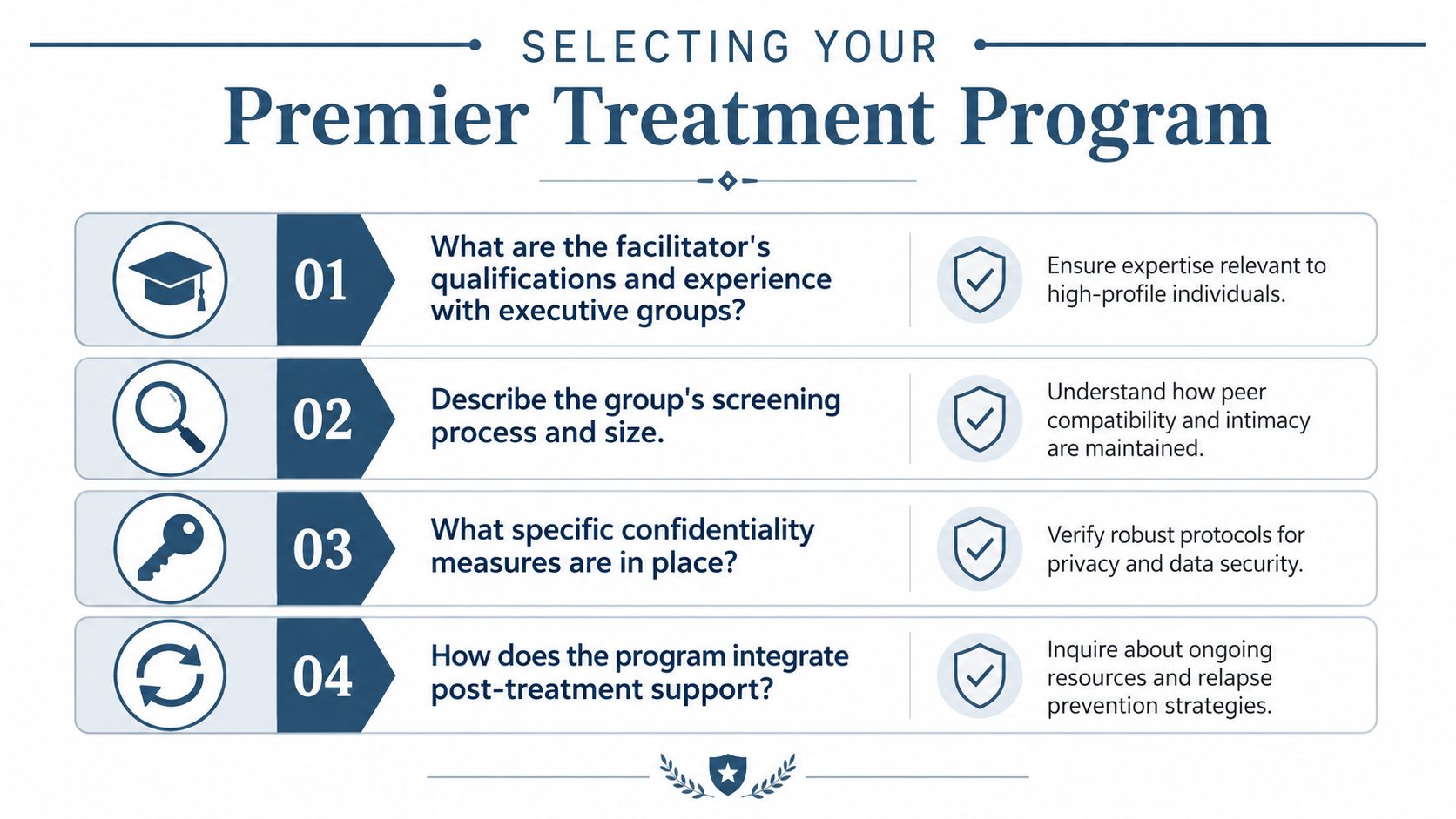
Discerning clients should evaluate treatment the same way they would evaluate any high-stakes professional engagement. Group addiction therapy can be excellent, mediocre, or actively misaligned with executive needs. The difference usually becomes obvious when the right questions are asked.
The most useful questions are operational
Ask how the group operates, not how it's described in marketing language.
- Who facilitates the groups? Look for specific clinical credentials, experience with substance use and co-occurring disorders, and real familiarity with high-profile clients.
- How are groups composed? Ask how the program thinks about compatibility, readiness, stability, and interpersonal fit.
- What does confidentiality mean in practice? The answer should cover agreements, session norms, records, devices, and communication boundaries.
- How is work connectivity handled? Professionals need a direct answer on phones, laptops, scheduling, and expectations for essential communication.
- How is group integrated with individual care? The program should be able to explain how insights move across modalities instead of staying isolated in one room.
Better questions reveal clinical maturity
It also helps to ask about trade-offs. Strong programs don't pretend every client needs the same thing or that every group format works equally well for every stage of treatment.
Consider asking:
- When would a client need more individual work before deeper group process?
- How do facilitators handle dominance, silence, resistance, or image management in the room?
- What happens if a professional has urgent work obligations during treatment?
- How are family dynamics and leadership stress incorporated into care?
- What post-treatment group support options are discussed, and how is fit determined?
What to listen for
Good answers are concrete. Weak answers are broad, flattering, or evasive.
A premier program should sound clinically disciplined, not merely luxurious. Private rooms, discreet surroundings, and professional amenities matter. But if the group model is vague, the peer composition is accidental, or confidentiality is treated as a slogan, the setting won't compensate for the clinical gap.
The right program doesn't ask accomplished people to choose between serious treatment and a serious life. It builds a plan that can hold both realities.
Reflections provides California-licensed, Joint Commission-accredited residential care for adults with co-occurring substance use and mental health conditions in a private setting designed for discretion, individualized treatment, and balanced professional connectivity. For executives, founders, physicians, attorneys, and other high-functioning professionals considering group addiction therapy, a confidential conversation can clarify how peer groups are structured, how privacy is protected, and how treatment can support both recovery and ongoing responsibilities. Learn more or request a private consultation at Reflections.