

Choosing a rehab while keeping a career moving is stressful in a very specific way. A professional might be comparing private rooms, discreet admissions, and the ability to stay connected to work, yet the essential difference often sits behind the scenes, in the quality of clinical leadership. For anyone asking what is a clinical director, the answer starts with this: the role shapes whether treatment feels coordinated, credible, and personal, or merely well marketed.
A strong clinical director is the person who turns a treatment philosophy into daily practice. In a luxury executive setting, that matters even more, because clients expect privacy, flexibility, and a level of care that respects both their health and their professional responsibilities. The title can sound administrative, but in reality it sits at the center of the therapeutic experience.
The Unseen Leader Shaping Your Recovery Journey
An executive can walk into a beautiful facility and still miss the most important question, who is guiding the care? Private rooms, elegant surroundings, and convenient technology access matter, but they only work when a capable leader is coordinating the clinical side with discipline and consistency. That's where the clinical director comes in.
In many treatment settings, the title gets used loosely. A reader comparing programs may assume every clinical director does the same job, but responsibilities shift by environment. As one career guide notes, most content answers "what does a clinical director do?" with generic duties, but fewer pages explain how the role differs by setting. It adds that responsibilities vary by facility and specialty rather than forming one universal job description Indeed career advice on clinical director interview questions.
Why that distinction matters in luxury care
A high-end executive rehab is not just a softer version of standard residential treatment. It has to support confidentiality, continuity, and individualized planning while still maintaining strong clinical guardrails. The clinical director becomes the person who protects that balance, so the program doesn't drift into either rigid bureaucracy or unstructured comfort.
Practical rule: if the leadership can't clearly explain how care is supervised, adapted, and measured, the experience may look upscale while still being clinically thin.
For professionals, that matters because treatment has to fit into a real life that doesn't stop. The right leader understands that a client may need discreet scheduling, thoughtful family boundaries, and a plan that respects work obligations without weakening the clinical process. In that setting, the clinical director is less a title on an org chart and more the architect of the entire experience.
Defining the Clinical Director's Core Responsibilities
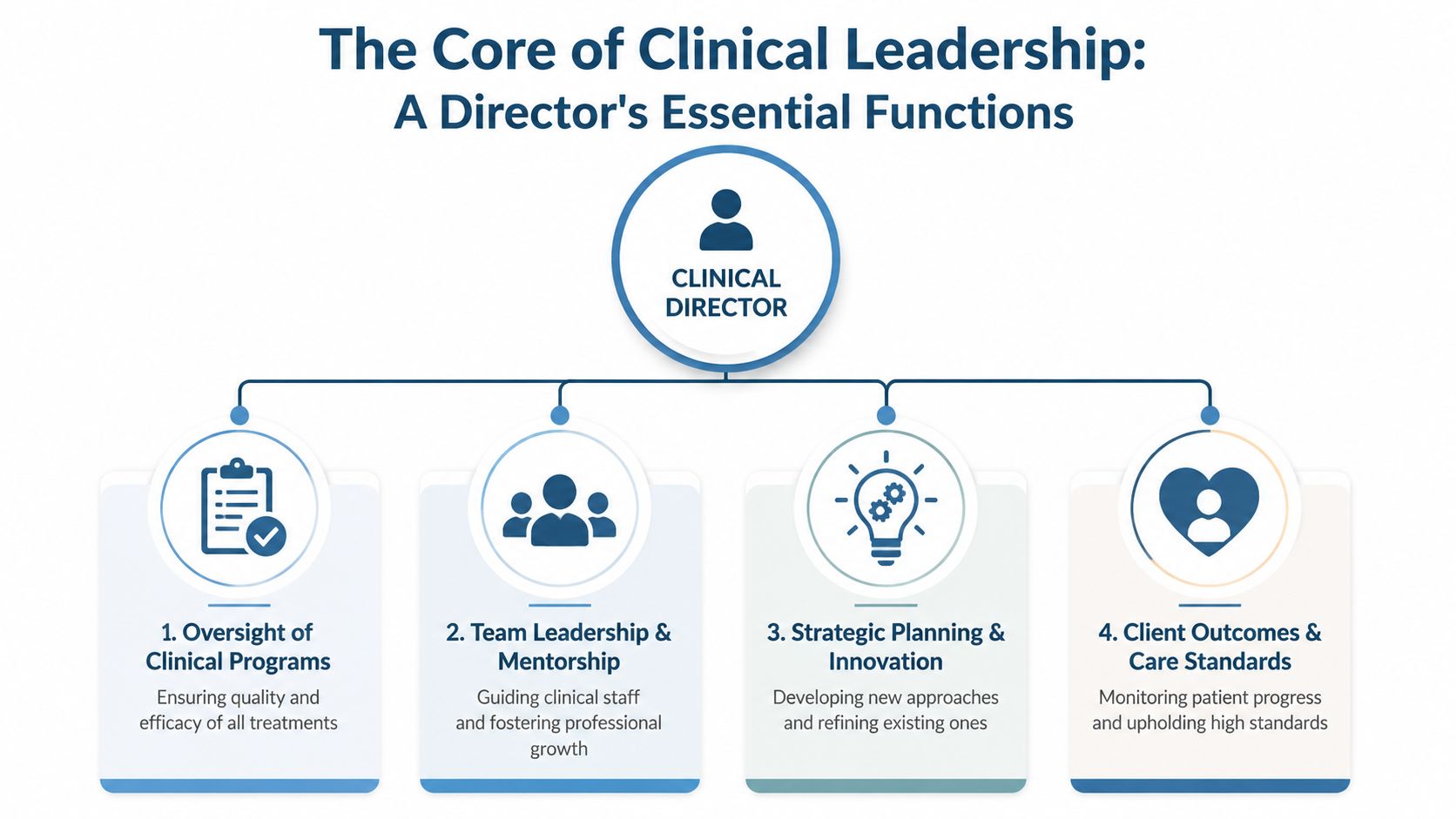
A clinical director is the operational owner of a program's clinical system. That means the role isn't limited to supervising therapists from a distance, it involves translating evidence-based protocols into how they are applied in sessions, groups, documentation, staffing, and follow-up. As one clinical job description explains, the director supervises staff, enforces regulatory compliance, and monitors quality metrics across care delivery to ensure treatment is consistent, safe, and efficient clinical director job description.
The three pillars that hold the role together
The clearest way to understand the job is to think in three layers.
Clinical program design comes first. The director shapes how treatment is organized, how interventions fit together, and how the team stays aligned with evidence-based care. In a luxury dual-diagnosis center, that also means making sure the program can support high-touch individualized treatment without becoming chaotic or inconsistent.
Team leadership is the second pillar. The director hires, trains, mentors, and supports clinicians so the program has a shared standard of care. Good leadership here isn't just about supervision, it's about helping therapists and support staff work as one team when clients present with trauma, substance use, mood symptoms, or career-related stress.
Quality assurance is the third pillar. The director watches whether the plan is working. That includes auditing records, tracking client progress, correcting gaps, and tightening procedures when something could put care quality at risk.
What the role feels like in practice
Think of the clinical director as the person making sure every part of the treatment model fits together. A client may experience that as a smooth admissions process, a coherent therapy plan, consistent communication across staff, and clinical decisions that don't feel random. None of that happens by accident.
A strong clinical director keeps the program steady when cases get complex, staff members need direction, or treatment plans need to be adjusted quickly.
How the Role Elevates in a Luxury Executive Rehab
In a luxury executive rehab, the clinical director carries a broader brief than in a standard program. The work still includes supervision, compliance, and quality control, but the expectations are higher because the clientele needs discretion, flexibility, and a therapeutic environment that respects professional life. That means the director is also shaping how care fits into a high-functioning, private-pay setting.
Privacy, scale, and individualized access
Private executive programs are often built around small census and confidentiality. One guide says occupancy is often kept at eight to twelve people maximum, with private rooms or secure offices for scheduled calls and costs that can run from $80,000 to $150,000 for a 30-day stay executive rehab guide. Those figures reflect more than luxury branding, they point to a model that requires close operational control and highly intentional clinical oversight.
That's where the director's role becomes especially visible. Smaller census allows the team to know each client well, but it also demands precision. A director has to make sure privacy protocols, communication boundaries, and scheduling decisions all support treatment rather than distract from it.
Work continuity without losing clinical focus
Executives and working professionals often need to remain reachable. In a serious treatment setting, the challenge isn't allowing electronics, it's deciding how to integrate them without letting work overwhelm recovery. A thoughtful clinical director helps set limits and structure so the client can stay responsible at work while still fully participating in care.
The best luxury programs don't treat flexibility as a perk. They build it into the clinical plan so the client can stay engaged without fragmenting attention.
Reflections is one example of a luxury residential setting that combines private accommodations with coordinated dual-diagnosis care and appropriate access to electronics, which is exactly the kind of operational detail a strong clinical director has to supervise carefully. The difference is not in the amenity itself, but in how skillfully the team uses it to support real recovery.
Confident, discreet, and clinically exacting
A high-end executive client may never want to feel like a number, and in the right program, they shouldn't. The clinical director ensures that discretion, responsiveness, and clinical seriousness all coexist. That blend is what makes a luxury setting more than a comfortable location.
Credentials and Qualities of an Elite Clinical Director
The title alone doesn't make a clinical director effective. In a discerning treatment environment, the role usually calls for a blend of advanced clinical experience, leadership judgment, and calm empathy under pressure. The best directors know how to hold boundaries, earn trust, and keep a program clinically grounded even when clients arrive with complicated histories and high expectations.
Background matters, but so does executive-level judgment
In luxury executive care, experience with trauma, co-occurring disorders, and professional stressors is especially valuable. A leader who understands the emotional cost of burnout, public pressure, and perfectionism is better equipped to support clients who are trying to recover without disconnecting from their responsibilities. That kind of insight can't be faked, it's built through years of work and careful clinical decision-making.
The broader labor market also shows that this is a serious management track, not a narrow bedside role. The Bureau of Labor Statistics groups clinical directors under medical and health services managers, a category with a median annual wage of $117,960 in May 2024 and a projected 23% growth from 2024 to 2034 BLS occupational outlook for medical and health services managers. Those figures reflect how much administrative skill now sits beside clinical expertise in the role.
What to look for in a strong leader
A strong clinical director usually brings several qualities together:
- Clinical depth. They've worked with complex cases and can recognize when a plan needs more structure.
- Operational calm. They can manage staff, documentation, and compliance without creating chaos.
- Empathy with boundaries. They understand high-pressure lives, but they don't let compassion blur standards.
- Clear communication. They can speak to clients, families, and staff in a way that reduces confusion instead of adding to it.
- Professional credibility. They know how to lead a multidisciplinary team, including doctoral-level clinicians and medical staff.
For physicians who want a concise, career-focused overview of professional growth in healthcare leadership, a practical starting point is physician career resources, which can help frame how advanced clinical roles evolve into broader leadership responsibilities.
If a program describes its leadership well, it should be able to explain who owns the clinical vision, how the team communicates, and how decisions are made when a case becomes difficult. A related example of this kind of leadership structure can be seen in the role of an onsite medical director in luxury dual diagnosis treatment, which shows how multidisciplinary oversight supports high-quality care.
Distinguishing the Clinical Director from Other Leaders
Families often hear several leadership titles during admissions and assume they mean the same thing. They don't. A clinical director, a medical director, and a program director may all be essential, but each one focuses on a different layer of care delivery.
| Role | Primary Focus | Key Responsibilities |
|---|---|---|
| Clinical Director | Clinical programming and therapeutic quality | Oversees clinicians, shapes treatment approach, monitors care standards, and keeps the program aligned with evidence-based practice |
| Medical Director | Medical care and clinical safety | Supervises medical oversight, detox protocols, prescribing decisions, and coordination of health-related concerns |
| Program Director | Daily operations and logistics | Manages schedules, admissions flow, facility coordination, and day-to-day program functioning |
A strong treatment center needs all three roles to work in sync. The clinical director focuses on the therapeutic model, the medical director handles medical decision-making, and the program director keeps the operational side steady. When those lanes are clear, clients get fewer mixed messages and more coherent care.
Why collaboration matters
In dual-diagnosis treatment, the lines between mental health, substance use, and medical stability can overlap quickly. That's why leadership has to be coordinated instead of siloed. A client may need a treatment adjustment because of withdrawal concerns, emotional volatility, or burnout symptoms, and each leader contributes a different piece of the response.
For readers who want a deeper look at how medical leadership supports this structure, onsite medical directors in luxury dual diagnosis treatment is a useful reference point. It helps show why medical oversight and clinical oversight are related, but not interchangeable.
The clearest sign of a mature program is simple. Staff members know who handles what, clients know who to ask, and decisions move through the right channel without confusion.
Evaluating Clinical Leadership When Choosing a Rehab
A polished brochure can't tell a family whether a program is well led. The better question is whether the clinical leadership can explain how care works, how it's monitored, and how it adapts for a professional client who needs discretion and individualized support. A thoughtful admissions conversation should make that visible.
Questions that reveal real substance
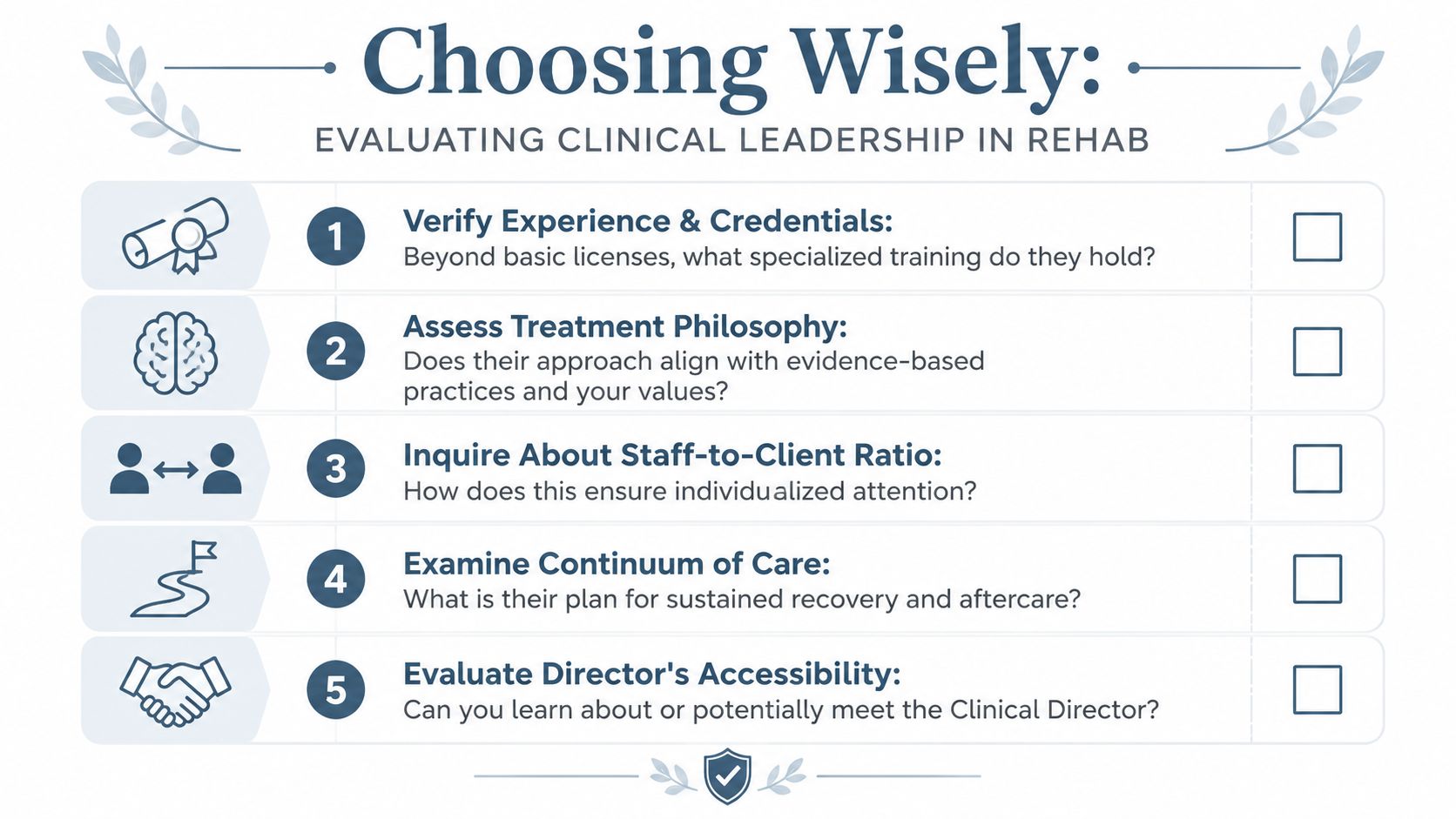
Before choosing a facility, ask direct questions:
- Experience and training. What specialized background does the clinical director bring to complex dual-diagnosis care?
- Treatment philosophy. How does the team decide when to keep a plan flexible and when to hold a firm boundary?
- Staff coordination. How do therapists, medical staff, and operations leaders communicate when a client needs an adjustment?
- Executive fit. How does the program support working professionals who need privacy, balanced access, and structured care?
- Accessibility. Can prospective clients learn about the clinical director's role, or meet the leader who will ultimately shape the treatment model?
If a program can answer those questions clearly, it usually has nothing to hide. If the answers stay vague, the leadership structure may be weaker than the marketing suggests.
Benchmarks that matter more than surface features
Operational details can also reveal whether the program is built for individualized care. Top executive rehab programs often maintain a 1:3 or 1:4 clinician-to-client ratio and track a 75% return-to-work rate within 6 months post-discharge luxury rehab for executives. Those benchmarks matter because they show whether the program is organized around attention, continuity, and practical outcomes.
A facility's accreditation and oversight structure should also be part of the conversation. A useful place to start is what Joint Commission accreditation means for a treatment center, since quality standards often tell you more than decor ever will.
Choose the place where leadership feels clear, disciplined, and personal. For executives and working professionals, that kind of structure can make treatment feel safer, more respectful, and more effective from the start.
A CTA for Reflections. If a discreet, high-touch residential setting with private rooms, dual-diagnosis expertise, and individualized clinical leadership is the right fit, reach out to Reflections to discuss whether its admissions team can match the program to your needs.