

California had 970 mental-health treatment facilities in 2020, but only 98 were residential treatment centers for adults, so executives seeking Depression Treatment Centers in California should shortlist licensed, accredited residential programs with verifiable psychiatric and dual-diagnosis capacity rather than choosing from the broader outpatient market. That distinction matters on the night a founder sits in a dark office after a board meeting, unable to sleep, unable to concentrate, and aware that stepping away could affect investors, employees, and family. A spouse or partner may be making the first calls while trying to protect a reputation built over decades. The decision isn't about finding a beautiful property. It's about finding clinical depth that holds up under scrutiny, privacy systems that work when pressure arrives, and a structure that treats depression without forcing a professional life to collapse in the process.
Why Executives Need a Different Standard for Depression Care
A managing partner hasn't missed a client deadline in years, yet simple decisions now take hours. Sleep is fragmented, appetite has disappeared, alcohol has become the fastest route to quiet, and the calendar still expects leadership every morning. Family members see withdrawal at home. Colleagues see declining presence at work. The executive sees a private problem becoming an operational and personal risk.
A Higher Bar Than Comfort
Standard outpatient counseling can help many adults, but it often assumes a predictable schedule, a safe home environment, and the ability to wait between sessions. Executives with severe depression, safety concerns, substance use, or repeated outpatient failure need a different level of oversight. Residential care removes daily triggers, concentrates psychiatric and therapeutic contact, and creates time to examine root causes without constant performance demands.
California's scale can mislead families who equate many facilities with many suitable options. The state's 2020 National Mental Health Services Survey profile for California counted 970 facilities and 198,820 clients receiving treatment on April 30, 2020, with an 86.5% response rate, yet only 98 facilities were residential treatment centers for adults. Those totals cover multiple settings and diagnoses, not depression-specific beds. A discerning search starts by narrowing the field to adult residential programs built for this exact clinical picture.
Access also can't be assumed. State reporting shows the share of California adults ever told they had a depressive disorder rose from 11.7% in 2012 to 17.8% in 2018, according to California's Let's Get Healthy depression indicator. At the same time, nearly two-thirds of adults with any mental illness didn't receive treatment in a separate California analysis cited on that page.
A luxury address doesn't treat depression. Accredited staffing, psychiatric access, and disciplined continuity do.
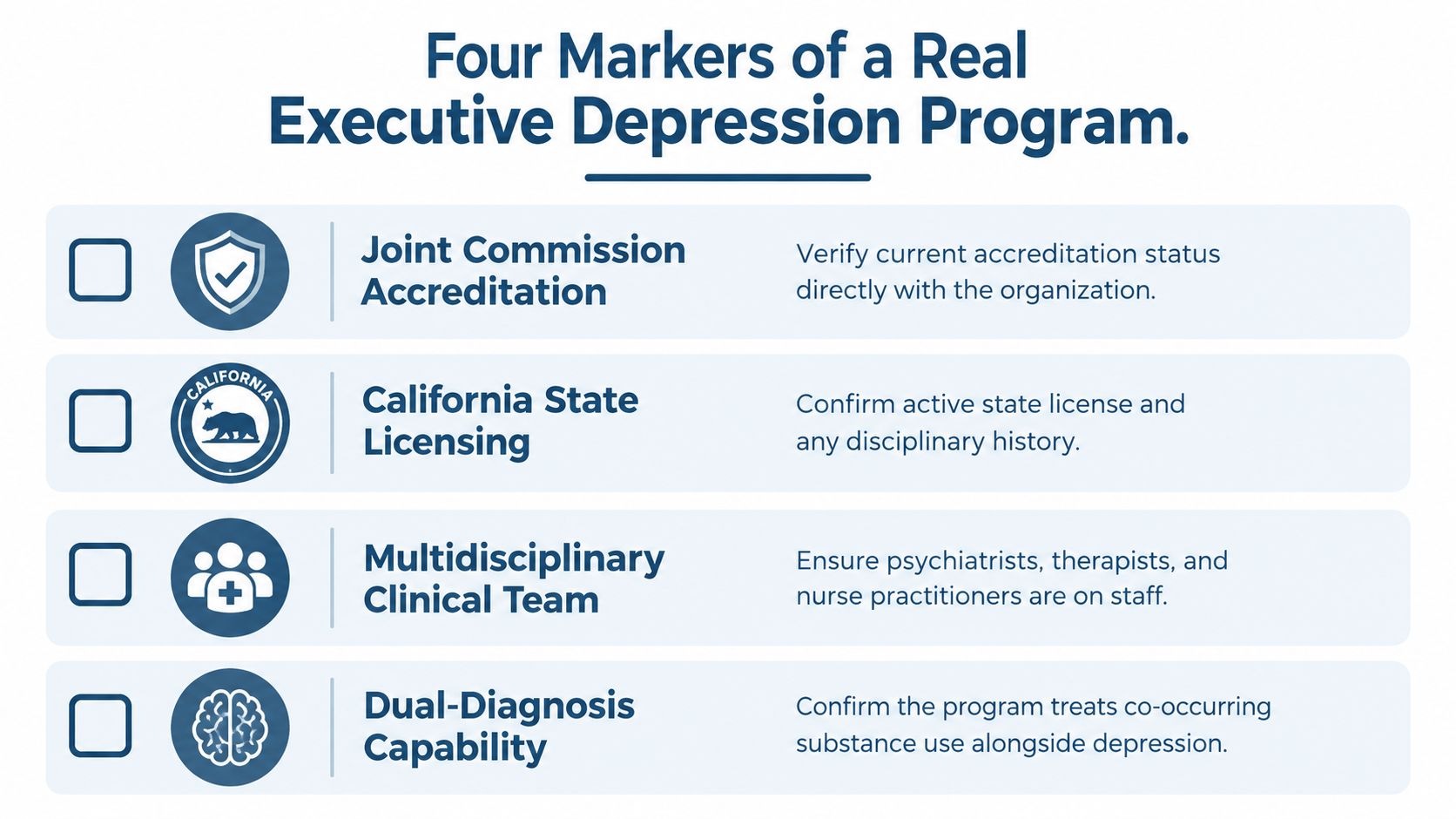
Executives should judge every program against four markers: accreditation, dual-diagnosis capability, confidentiality systems, and professional continuity. Programs that can't explain all four in concrete terms aren't executive programs, regardless of architecture, cuisine, or coastal views.
The Four Markers That Separate Real Executive Programs from Marketing
Marketing language is easy to produce. Verification takes documents, named credentials, and direct answers. Families should complete this review before touring a property or paying a deposit.
Marker One and Two
- Joint Commission accreditation: Accreditation involves an onsite survey evaluating compliance with applicable care delivery standards, as described by The Joint Commission behavioral health accreditation program. Families should confirm current status directly and ask which settings and services fall within scope.
- California licensing and certification: Licensing and certification aren't the same. The California Department of Health Care Services facility licensing overview explains that certification identifies facilities exceeding minimum service quality levels and substantially complying with state alcohol and other drug program standards. Ask for the license, its scope, and any certification that applies.
Marker Three and Four
Multidisciplinary staffing means more than a roster page. A credible team coordinates psychiatrists, psychologists, licensed therapists, addiction counselors, nursing support, and case management around one treatment plan. Admissions should identify who prescribes, who leads therapy, who manages medical concerns, and how the team communicates when symptoms change.
Documented dual-diagnosis assessment is equally essential. Depression screening alone misses substance use, trauma, anxiety, sleep disruption, and possible bipolar spectrum symptoms. Strong programs screen both mental health and substance use at intake, then build one integrated plan rather than sending the client between separate tracks.
A short admissions test exposes weak operations quickly:
- Verify credentials: Request accreditation and license details in writing.
- Test psychiatric access: Ask how often a prescriber reviews medication and responds after changes.
- Probe integration: Ask how the team distinguishes independent depression from substance induced symptoms.
- Inspect continuity: Ask what outpatient appointments and records transfer occur before discharge.
Vague answers about individualized care aren't evidence. Precise answers about staffing, review cadence, escalation, and handoffs are.
Program Structures That Fit an Executive Schedule
Structure determines whether treatment is clinically sufficient and professionally survivable. Executives usually compare full residential care, intensive outpatient programming, and a hybrid residential model that preserves controlled access to essential work.
Program Structures Compared for Working Executives
| Program Type | Clinical Intensity | Privacy Level | Work Access | Best Fit |
|---|---|---|---|---|
| Full residential | Highest, with daily programming and onsite support | High in a private room and secluded setting | Limited or clinically restricted | Safety concerns, severe impairment, detoxification, repeated outpatient failure |
| Intensive outpatient | Moderate, with scheduled sessions while living at home | Lower because daily life remains exposed | Highest flexibility | Stable symptoms, strong home support, no acute safety risk |
| Hybrid residential plus work | High, with residential structure and planned professional access | High when rooms and communications are private | Controlled phone and laptop access for essential obligations | Executives needing residential intensity without complete career disconnection |
Residential care is the right recommendation when depression impairs basic functioning, when suicidal thinking requires close monitoring, when substance withdrawal complicates treatment, or when outpatient care hasn't produced stability. Distance from board pressure, travel, alcohol access, and family conflict gives the clinical team room to assess accurately. Private rooms in both detoxification and rehabilitation also protect sleep and reduce exposure to other residents.
Intensive outpatient care can work when symptoms are stable, the home is supportive, substance use doesn't require residential containment, and the client attends consistently. It shouldn't be chosen just because it looks less disruptive. If evenings still involve drinking, missed medication, or isolation, convenience becomes a clinical liability.
The hybrid model exists for a narrower executive need. The client lives onsite, attends therapy and psychiatric care, and retains appropriate electronics access for defined career obligations. That access should be purposeful, time bounded, and reviewed clinically, not an open channel for every workplace stressor. Guidance on flexible rehab schedules for busy professionals helps families separate essential continuity from avoidance.
Practical rule: Choose the least disruptive structure that still controls safety, substance use, and symptom severity. Don't choose the least intensive option merely to protect a calendar.
Dual-Diagnosis Care for Depression That Travels With Substance Use
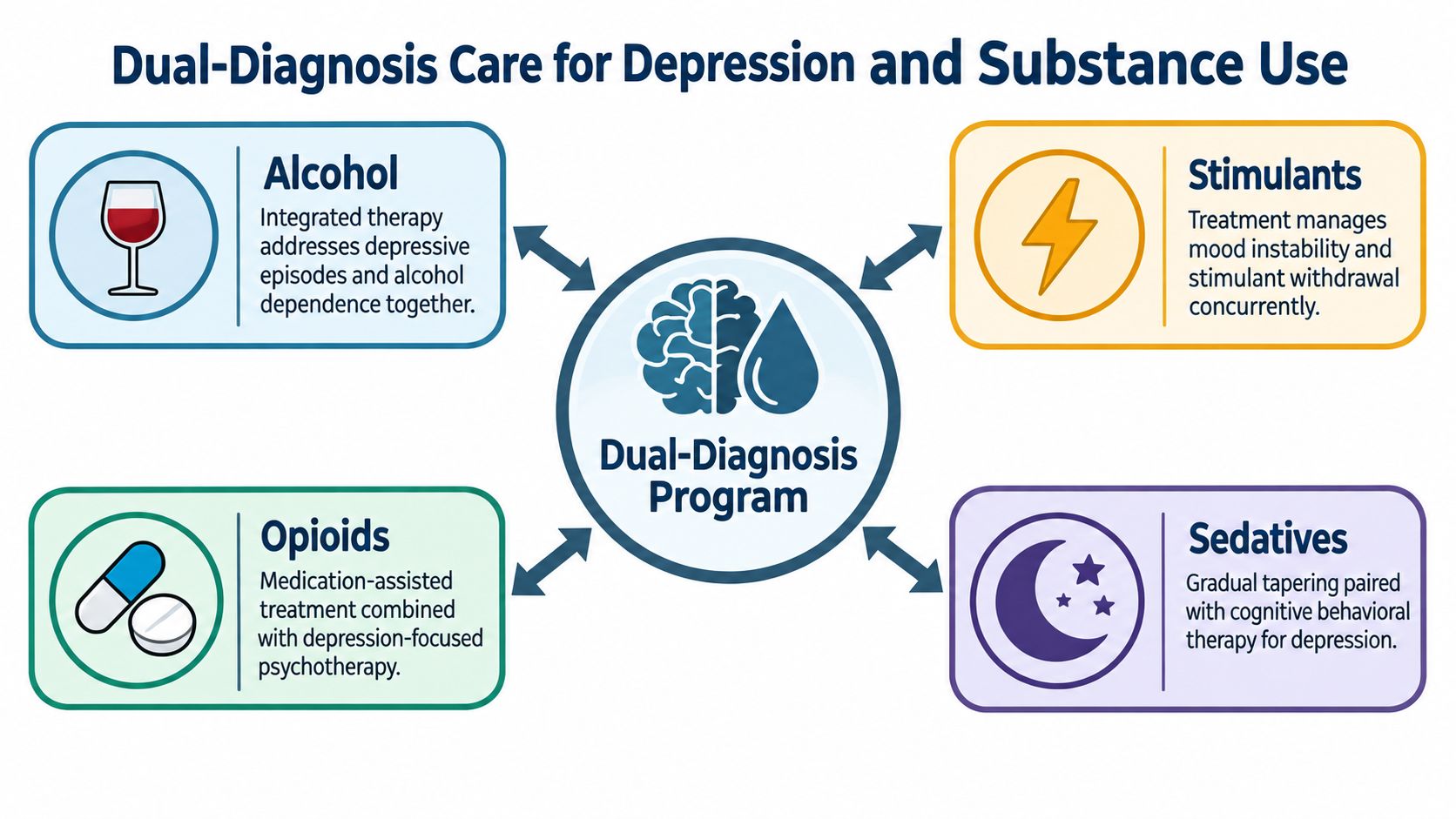
Depression in executive populations often arrives with alcohol, stimulant, opioid, or sedative use. A drink to sleep becomes dependence. A stimulant to perform becomes mood instability. Sedatives quiet anxiety while deepening cognitive slowing. Treating only the visible half leaves the other half positioned to restart the cycle.
What Integrated Care Looks Like
Integrated assessment starts with timeline work. Clinicians examine when depressive symptoms began, how they change during abstinence or heavy use, what medications have helped or failed, and whether trauma, anxiety, grief, sleep problems, or bipolar traits shape the presentation. The psychiatrist's role is central because symptoms may be substance induced, withdrawal related, medication related, or part of an independent mood disorder.
Treatment then combines CBT for distorted thinking and behavioral shutdown, DBT for emotional regulation, ACT for values based action, and motivational interviewing for ambivalence about substance use. Trauma focused work proceeds when the client is stable enough to benefit. Clinically managed medication assisted withdrawal may be used when appropriate, alongside medication optimization aimed at minimal, effective pharmacology. Programs explaining depression and substance use should show this integration clearly.
Workforce capacity makes psychiatric access a genuine differentiator. California modeling projects a 40.6% shortage of non-prescribing licensed clinicians, roughly 55,298 additional providers, and a shortage of 3,782 psychiatrists, with 39 counties projected to face a severe psychiatrist shortage of at least 50%, according to California behavioral health workforce supply and demand modeling. Residential doesn't automatically mean timely prescriber access.
Families should ask direct questions:
- Prescriber availability: Who prescribes, and how often does that clinician meet each client?
- Crisis response: What happens after medication changes, intoxication, relapse, or acute suicidal thinking?
- Diagnostic uncertainty: How does the team revise the plan if symptoms change during abstinence?
- Discharge transfer: Which outpatient prescriber receives the case, and when is contact made?
Sequential care tells the client to fix addiction first or depression first. Parallel care treats both without coordination. Integrated care assigns one team, one formulation, and one accountable plan.
Confidentiality Systems That Protect High-Profile Clients
Physical seclusion is only the visible layer of privacy. A gated property and private room reduce casual exposure, but they don't govern records, phone inquiries, digital communications, or staff behavior. High-profile clients need both layers operating without improvisation.
Information Privacy Is the Real Test
Joint Commission behavioral health standards require organizations to protect clinical and case information, disclose it only as authorized or otherwise permitted, and maintain policies for information security and access, as set out in Joint Commission behavioral health privacy requirements. That standard turns confidentiality into an auditable discipline rather than a promise from admissions.
Executives should ask who can access the chart, how identity is verified before information is released, which family members are designated contacts, and what staff say if an employer, reporter, attorney, or acquaintance calls. The answer should reference authorization, minimum necessary disclosure, secure systems, and training. It shouldn't rely on assurances that staff are discreet.
Private rooms still matter clinically. They protect sleep, reduce social performance pressure, and allow confidential work or family calls without an audience. Discreet arrival procedures, controlled visitor access, and clear electronics expectations add another layer. Guidance on how to maintain confidentiality during treatment can help executives prepare employers and families before admission.
- Records control: Ask about access permissions, audit trails, and release authorization.
- Communication boundaries: Confirm designated contacts and the exact response to outside inquiries.
- Digital discipline: Ask how laptops, phones, video calls, and document sharing are handled.
- Breach readiness: Ask whether the organization has a documented response process.
An upscale setting without information governance offers false security. Accredited confidentiality means every employee knows what cannot be shared, with whom, and under what authority.
Comparing 30, 60, and 90 Day Lengths of Stay for Executive Clients
Length of stay should follow severity, comorbidity, medication complexity, and response to treatment. It shouldn't be sold as a prestige package or compressed automatically to fit a quarterly calendar.
Length of Stay Compared for Executive Residential Treatment
| Length | Primary Purpose | Intensity | Typical Cost Band | Best Fit |
|---|---|---|---|---|
| 30 days | Stabilization, assessment, initial medication and therapy response | High | Lower total private-pay cost within high-end residential care | First residential episode, clear diagnosis, strong continuing care |
| 60 days | Deeper therapy, relapse prevention, family work, medication refinement | High and sustained | Mid-range total private-pay cost | Dual diagnosis, trauma history, slower stabilization |
| 90 days | Comprehensive trauma work, durable routines, structured transition planning | High with gradual reintegration focus | Highest total private-pay cost | Repeated relapse, complex comorbidity, treatment resistant symptoms |
A 30 day stay often establishes safety, completes diagnostic clarification, starts medication changes, and builds initial coping capacity. It can be sufficient when symptoms respond quickly and a strong outpatient team is ready. It rarely completes deeper trauma processing or resolves long standing substance patterns.
60 days gives the team time to observe medication response beyond early side effects, engage family members, and practice relapse prevention under stress. 90 days is better suited to complex dual diagnosis, repeated treatment failure, or clients who need a slower return to high pressure environments. More time isn't automatically better, but premature discharge into the same workload and access patterns is a predictable risk.
Private-pay pricing at the high end is driven less by décor than by psychiatrist coverage, doctoral level clinicians, low client volume, private rooms, nursing, and individualized programming. Families should request an itemized estimate, ask what happens if the clinical team recommends extension, and clarify whether out-of-network documentation or a single-case agreement may be available. Cost transparency belongs in the same conversation as clinical fit.
What Intake, Admission, and Continuing Care Actually Look Like
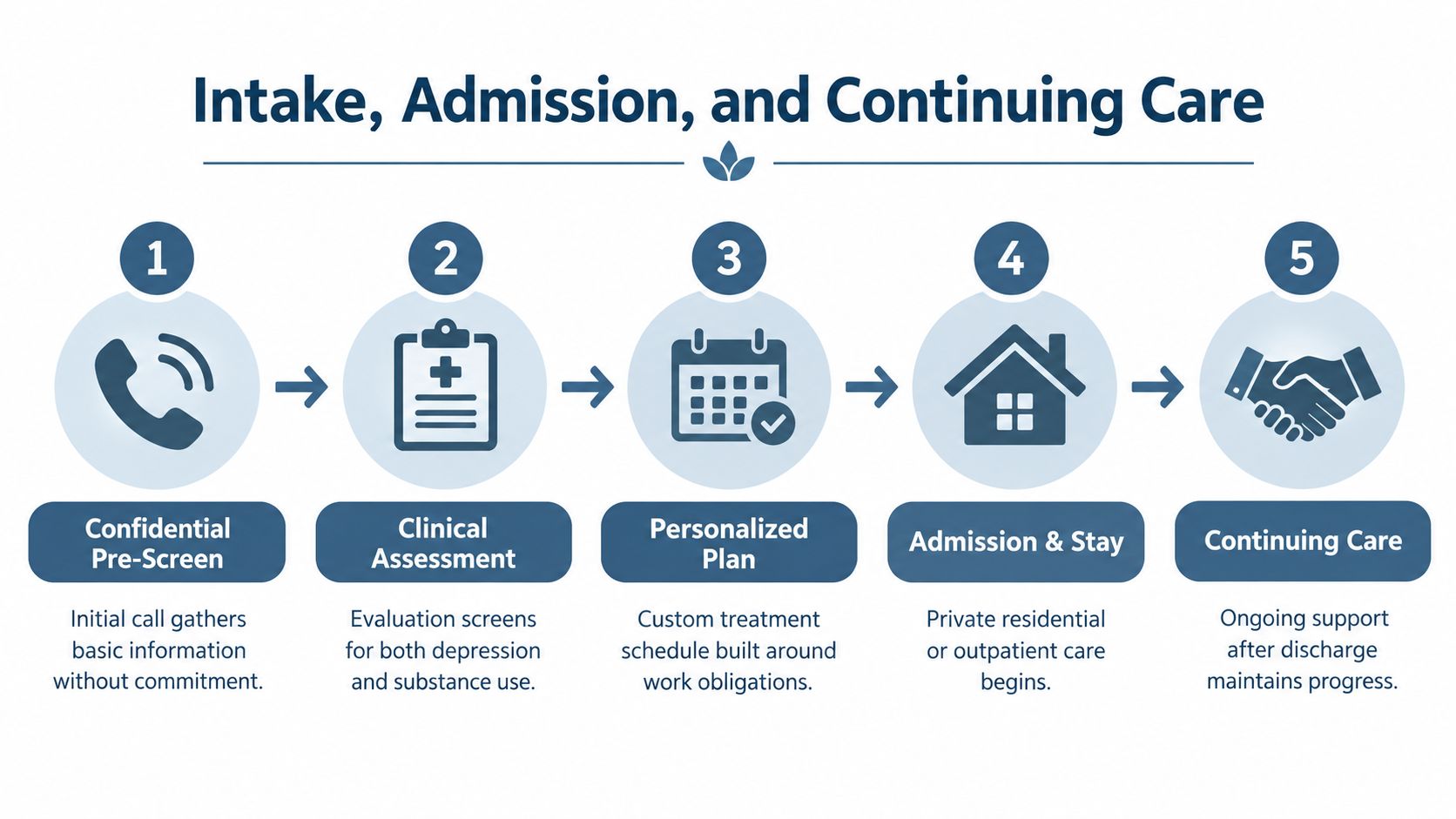
A strong admissions process reduces friction without rushing clinical judgment. Families should know exactly what happens from the first confidential call through the months after discharge.
From First Call to Admission
- Confidential pre-screen: Admissions gathers symptoms, safety concerns, substance use, medical issues, current medications, and work constraints.
- Clinical assessment: Licensed clinicians screen depression and substance use together and determine whether residential, detoxification, or another level of care fits.
- Verification and logistics: The family confirms licensing and accreditation, reviews private-pay or out-of-network options, and arranges discreet travel.
- Admission: The client settles into a private room, meets the treatment team, and begins psychiatric evaluation and individualized planning.
California access data show why speed and follow-through matter. Only 36.8% of residents with any mental illness used mental health services in the 2017 to 2019 annual average, roughly 2.1 million people, below the 43.6% U.S. average, according to SAMHSA's California Behavioral Health Barometer. Programs should track inquiry-to-assessment time, assessment-to-admission conversion, no-show rates, and documented continuing care appointments.
Coverage requires equal precision. The California Department of Managed Health Care behavioral health guidance states that commercial plans must cover medically necessary mental health and substance use treatment, including residential care, but prior approval is required before residential treatment. Families should assemble suicide risk history, functional impairment, failed lower levels of care, substance complications, medication history, and a discharge plan before utilization review begins.
Medication continuity is the discharge test many programs fail. In 2022, 75% of adults in California HMO and PPO plans remained on antidepressants through 12 weeks, but only 59% continued for six months, according to CHCF quality of care behavioral health data. Discharge paperwork should state indication, target symptoms, dose rationale, side-effect monitoring, prescriber responsibility, refill access, and follow-up date.
Continuing care should include scheduled outpatient therapy and psychiatry, family sessions, alumni support, relapse response steps, and a graded return to work. If those pieces aren't named before admission ends, continuity is being improvised.
Choosing Reflections for Executive Depression Care in California
The right choice is the program that can prove the four markers rather than repeat them as slogans. Reflections presents a factual match for executives who need California-licensed, Joint Commission accredited residential care with dual-diagnosis treatment, private rooms, and a multidisciplinary team. Its model includes psychiatrists, psychologists, licensed therapists, addiction counselors, and adjunctive clinicians working within one individualized plan.

Program features map directly to executive constraints. Residents receive private rooms in detoxification and rehabilitation, clinically managed withdrawal support when appropriate, evidence-based therapy for depression and co-occurring substance use, family programming, and continuing care planning. Appropriate phone and laptop access allows essential career obligations to continue while treatment remains the priority. That balance suits founders, partners, physicians, attorneys, and senior leaders who can't disappear completely but also can't recover through weekly appointments alone.
Before committing, decision-makers should ask admissions to confirm prescriber cadence, dual-diagnosis assessment methods, confidentiality controls, electronics boundaries, discharge medication handoffs, and the specific continuing care appointment process. Clear answers should arrive without hesitation or a pivot back to amenities. Among Depression Treatment Centers in California, that operational transparency is the luxury worth paying for.
Executives and families who need discreet, private-pay residential depression and dual-diagnosis care can contact Reflections to request a confidential assessment and review clinical fit, private accommodations, and work continuity options. The conversation should start with safety, psychiatric capacity, and continuity of care, then move to scheduling and admission logistics.