
You can be sitting in a car outside an intake entrance, phone on silent, laptop still open to a board deck, and already wondering what happens to every message, call, and family detail once treatment begins. For an executive, confidentiality isn't a background benefit. It's part of the treatment plan, because a leak can touch reputation, compensation, board confidence, family stability, and public standing at the same time.
Why Confidentiality Matters Even More for Executives in Treatment
A senior leader doesn't arrive in rehab as a blank slate. The person who walks in may be managing earnings calls, investor updates, litigation holds, family expectations, and a calendar that can't disappear for 30 days. If that admission becomes gossip, the damage isn't abstract. It can change how a board reads judgment, how a spouse feels about trust, and how a public-facing professional is talked about in the market.
That's why confidentiality has to be treated as a risk-control system, not a courtesy. In care settings, failures usually come from informal sharing, weak role definitions, or accidental linkage between records, not from advanced threats, which is exactly why structure matters from day one. A luxury program that understands executives builds those structures around real-world exposure, not around generic privacy language.
A discreet stay should also account for the fact that many high-profile clients already use outside protection. For some, executive protection services are part of a broader personal security posture, and a treatment team needs to coordinate with that reality without exposing the client's location or status. If the program can't explain who sees what, when they see it, and how they keep those details from spreading, it isn't really designed for a C-suite patient.
A private setting matters too. Reflections describes a private executive rehab setting built for adults who need clinical work without public exposure, which is the right instinct for a high-profile stay. The point isn't to sell secrecy as a luxury accessory. It's to make confidentiality ordinary, enforceable, and boring in the best possible way.
The Legal Foundation That Protects You
The legal floor is simple enough for a busy executive to understand. HIPAA sets the baseline for protected health information, while 42 CFR Part 2 adds stronger safeguards for substance use disorder records. A serious program has to treat those rules as operating requirements, not as paperwork after the fact.
Federal confidentiality law also reinforces the same principle from a different angle. CIPSEA of 2002 established that protected statistical information must be used exclusively for statistical purposes and not disclosed in identifiable form without informed consent, which captures the core idea behind regulated confidentiality systems: the identity of the person stays protected, not just the spreadsheet row. That same logic shows up in health and treatment settings, where data may be useful only if it's stripped of identifying detail before anyone outside the care circle sees it. See the legal framing in this HIPAA compliance overview.
What a legitimate program must do
A compliant program doesn't just say it follows the law. It narrows access, documents disclosure decisions, and builds consent into the workflow before clinical notes start accumulating. International and public-sector confidentiality standards point to the same model, individual data should be strictly confidential, used only for the approved purpose, and handled with restricted access and secure controls.
For an executive client, that means the program should be able to answer direct questions without hesitation. Who can open a chart. Who can return a call. Who can confirm that a person is even onsite. Those answers should be tied to policy, staff role, and written authorization, not to whoever happens to be at the front desk.
Practical rule: if the program can't explain its disclosure rules in plain English, it probably can't defend them under pressure.
Accreditation matters because it forces the organization to prove that privacy isn't a slogan. In a private-pay, licensed setting, the obligation goes beyond bare compliance. The program should have enough operational discipline to protect both the client's treatment and the client's public identity, because those two things are inseparable in high-end executive care.
Intake and Consent That Put You in Control
The first day should feel controlled, not improvisational. Before any meaningful clinical work starts, the program should separate who the client is, who may be contacted, and what may be shared. That distinction matters because a spouse, a family contact, an attorney, and a board chair are not the same disclosure category, even if they all want information.
The FTC's guidance on protecting personal information is useful here because it reflects the same privacy logic in operational terms, use ID codes instead of mixing identifiers into working files, store the master link separately, and limit access to a small number of authorized staff. That is exactly how a serious admissions team should think about a high-profile intake, the person's identity is known to the team that needs it, but it should not be spread across every form, handoff, and backup. A clean consent architecture keeps the system narrow from the start. See the workflow concept in the FTC's protecting personal information guide.
The decisions that should happen on day one
A smart admissions process asks pointed questions early. Who gets updates if there's a medication issue. Does a spouse get clinical detail, or just status. Is anyone at HR informed at all. Does outside counsel receive a medical summary, or only verification that the client is unavailable. Those choices should be written, dated, and easy to revoke or tighten later.
The client should also be told the limits up front. Professional guidance says confidentiality exceptions can include abuse, danger to self or others, and sharing with supervisors, colleagues, family members, or third-party payers, and it recommends documenting what was shared, why, and with whom. For a CEO or partner, that kind of clarity prevents the worst mistake of all, assuming silence means secrecy has been handled correctly.
A consent form is not the whole answer. It's the starting point for controlled disclosure.
High-end treatment should make revocation simple. If a client decides mid-stay that a family member should stop receiving updates, the record should reflect that immediately. If a board contact later needs only a narrow verification, that change should be documented without forcing the client to renegotiate the entire privacy plan.
Keeping Electronics Without Losing Privacy
Executives in treatment cannot always disappear from the grid. A board still expects answers. Counsel may need a status update. Family may need a calm, limited explanation. That reality is why phones and laptops are managed carefully in high-end care, with privacy controls built around the device instead of pretending the device is the problem.
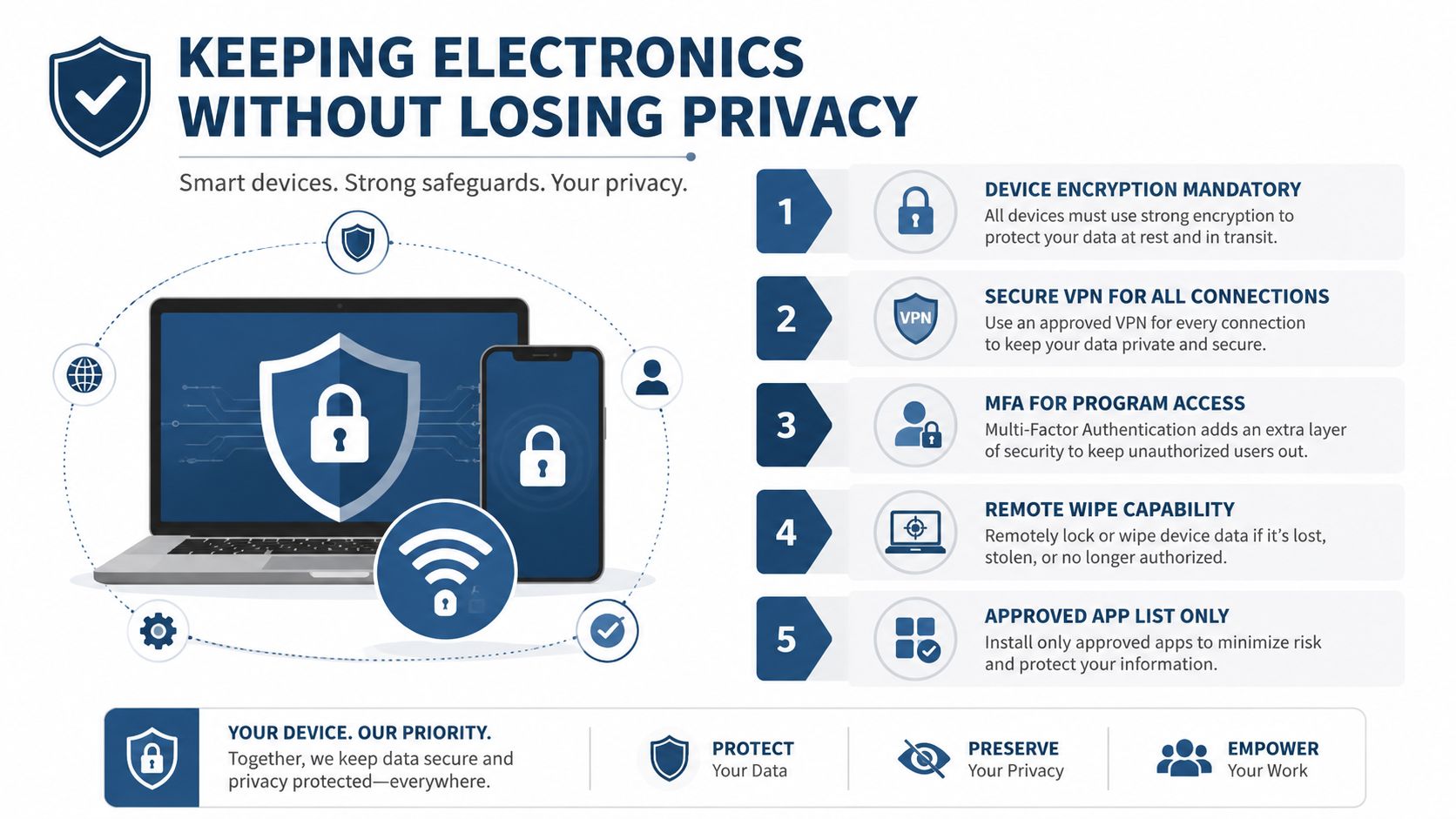
Controlled access is the standard. Digital-confidentiality guidance recommends end-to-end encrypted messaging and voice calls, multifactor authentication, and checking backup settings so sensitive messages are not copied into insecure storage without notice. For a luxury rehab client, that translates into approved devices, approved communication channels, and a clear process for handling sensitive calls without exposing location or treatment status. The internal policy should spell out when contact is allowed, what gets blocked by default, and who can see a device if it needs review.
A practical guide to protecting your privacy is useful here, because many people focus on what they post and ignore the metadata created by ordinary use. Device hardening should happen at admission, not as a favor. The program should state whether it allows a limited app list, whether social platforms are restricted, and what happens if a device is lost, replaced, or needs a remote wipe.
The phone policy matters just as much as the phone itself. If a program says executives may keep their electronics, read the details closely. Review what professionals should know about phone use in rehab before you assume access means freedom. A serious program can support board calls, investor messages, and family contact without letting work communications spill into public channels or shared devices. Reflections says clients may keep their electronics while in treatment, and that kind of operational discipline is exactly what high-profile clients should demand.
Physical and Digital Safeguards Behind the Scenes
A private room is the starting point for confidentiality. Every layer around the client's chart has to assume that a hallway conversation, a printed note, or an unattended screen can become a disclosure event. That is why the stronger facilities build confidentiality into space, access, and disposal, not just into policy binders.
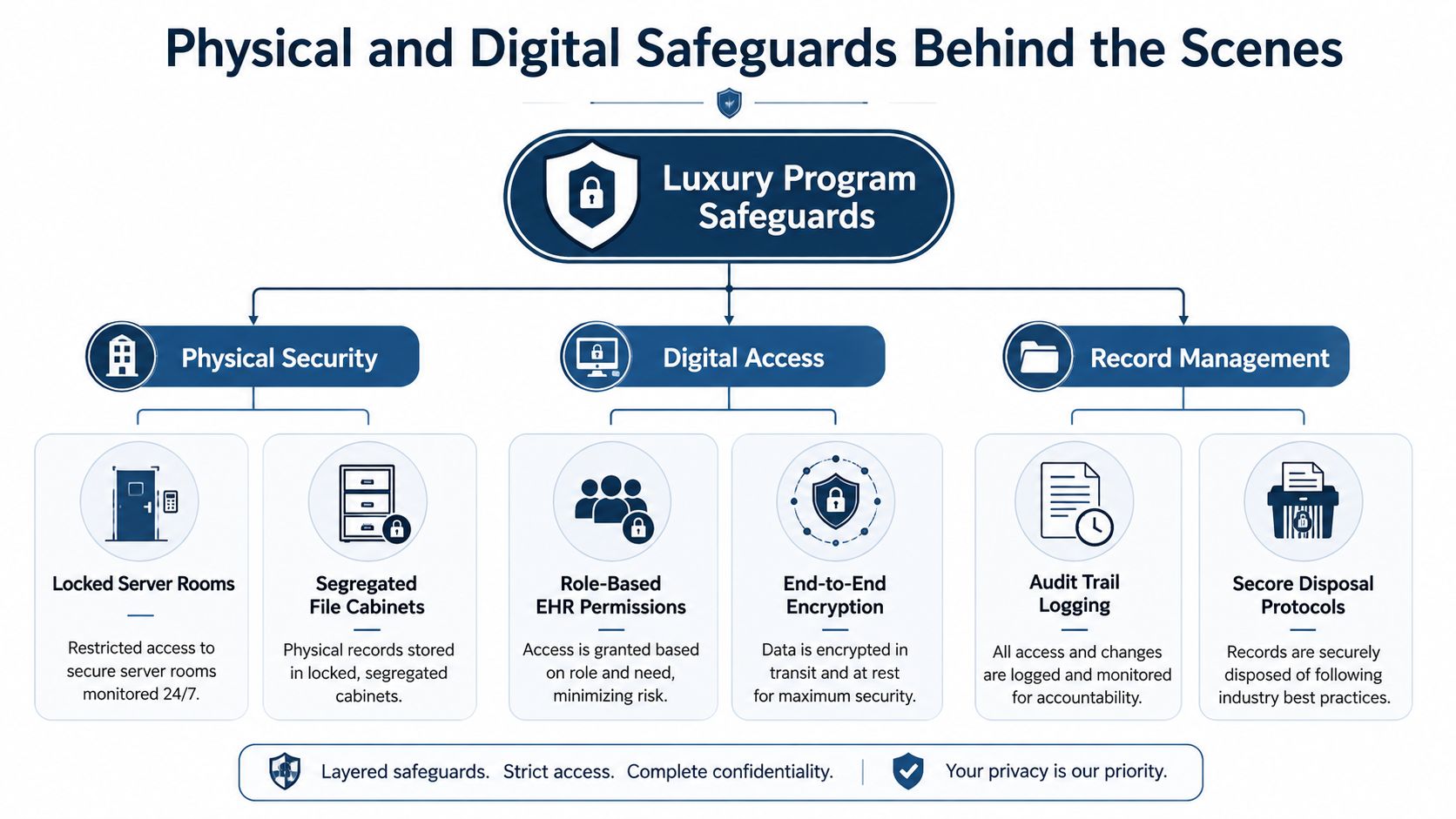
Detailed best-practice guidance recommends keeping sensitive files in locked rooms or cabinets, shredding documents instead of trashing them, sending passwords for sensitive attachments separately from the files, and password-protecting and encrypting mobile devices. That is the floor for a serious luxury program, not the ceiling. If records exist in paper form, they should be segregated. If records are digital, access should be role-based and traceable. If a file is no longer needed, it should be destroyed through a secure process, not left in a drawer for later.
Physical security deserves the same attention. Doors, visitor flow, and staff-only areas should make it hard for anyone to drift into clinical space without a reason. Facilities should also address device searches and bug sweeping where warranted, because a high-profile client's privacy risk is not limited to paperwork and passwords. A tour should make it obvious whether the building is built for discretion or merely decorated for it.
What to look for on a tour
A prospective client or advisor should verify the environment with a direct walk-through. Are charts visible at the nursing station. Are staff screens angled away from public view. Are badges required for clinical zones. Is there a clear separation between visitor areas and work areas where staff discuss care. These are small details, but they are the difference between a thoughtful privacy culture and one that relies on goodwill.
The right program should also be able to describe how it handles audit trails. Every access attempt to a record should leave a trace, because accountability is a deterrent. If a team member opens a chart without a legitimate reason, that event should be visible in the system and reviewable by leadership.
Privacy fails fastest when everyone assumes someone else is watching the hallway.
A quiet, well-run facility also manages sound. Conversations about diagnosis, medication, or family issues should never spill into shared space when a reserved room is available. If the program can't describe how it handles those handoffs, it is not fully protecting the client's identity.
Family Communications Without Unintended Exposure
A family meeting can strengthen treatment or leak more than intended. For executives, the risk usually comes from people closest to them, spouses who answer phones, adult children who post online, or relatives with their own public or board-facing roles. The safest programs treat family communication as a controlled clinical process, not as casual customer service.
Professional guidance says clients should be told at the outset about confidentiality limits, including exceptions for abuse, danger to self or others, and sharing with supervisors, colleagues, family members, or third-party payers, and that what was shared, why, and with whom should be documented. That standard should shape every family contact. If the client authorizes a spouse to receive logistical updates only, the staff should stick to logistics. If an adult child is cleared for a scheduled family session, the session stays in the therapeutic lane, not the boardroom lane.
A common mistake is over-sharing in the name of reassurance. A parent may want reassurance, an attorney may want status, and a spouse may want substance. Those are different needs, and they should be answered differently. The notes should show exactly what was disclosed and the basis for the disclosure, because memory gets fuzzy when the household is anxious and the client's reputation is already in play.
Share the minimum needed. Document the reason. Stop there.
The best luxury programs build private family sessions, reserved rooms, and clear boundaries around who gets what. That keeps support available without turning recovery into a public family project. It also protects the client from the most predictable breach pattern in high-profile care, the relative who meant well and said too much.
What Happens If Something Goes Wrong
A serious program has a breach playbook before it ever needs one. The response should start with immediate containment, followed by internal investigation, then a decision on whether the incident is clinical, technical, or legally notifiable. Those categories aren't interchangeable. A missed handoff is a clinical incident. An unauthorized chart access is an IT incident. A reportable breach may involve both, but it has to be handled as its own event.
The first job is to stop the spread. That can mean disabling access, securing devices, separating a compromised record set, or freezing outbound communications until leadership knows what happened. After that, the program should identify what was exposed, who had access, whether any identifiers were involved, and whether any family, employer, or outside party might need controlled notification. In a high-profile stay, silence is not the default. Controlled communication is.
That's where pre-authorization matters. Media inquiries, employer calls, board outreach, and family contact should be routed through a narrow approval path. No one should improvise a statement because the request sounds urgent. The client should know in advance who can be informed, under what conditions, and in what form. If a breach requires external reporting, the program should be able to say exactly what it is reporting, to whom, and why.
The client should also ask to see how the program keeps records of incidents. A clean operation maintains an incident log, not as a scare tactic, but as a quality-control tool. That log should show the timeline, the containment step, the investigation findings, the notifications made, and the remediation plan. If leadership can't produce that structure, it's not ready for executive-level privacy risk.
Before admission, a prospective client or family member should ask these questions:
- What is the legal basis for confidentiality here, and which federal and state rules apply?
- Is the program accredited, and how does that accreditation show up in daily privacy practice?
- How are intake consents written, narrowed, and revoked if family or board contact changes?
- Can the client keep a phone and laptop, and what controls apply to those devices?
- Are devices encrypted, backed up safely, and limited to approved apps and channels?
- Does the facility guarantee private rooms for detox and rehab stays?
- Who may receive family updates, and what is the rule for spouses, adult children, attorneys, and employers?
- What happens if a breach occurs, and what remediation and notification commitments are given in writing?
A luxury rehab should welcome every one of those questions. Confidentiality is not a marketing line, it's a clinical standard, and the right program will answer it like one.
If confidentiality is the deciding factor for treatment, Reflections is worth a direct conversation. The program offers private, upscale residential care with electronics access, private rooms, and a clinical model built around discretion as well as recovery. Visit Reflections to review the admissions process and ask how the program protects executive privacy from intake through aftercare.