
A chief executive can spend the morning presenting quarterly results, the afternoon answering messages from a private office, and the evening negotiating with family about treatment. The problem may be obvious to everyone around them, yet the decision still feels complicated. Alcohol or drugs may be damaging sleep, judgment, health, or relationships while also seeming to protect performance, relieve anxiety, or preserve a demanding professional identity.
Motivational interviewing in addiction treatment is designed for that in-between state. It doesn't depend on a dramatic crisis or attempt to win an argument. Instead, it helps a person examine competing priorities and identify personally meaningful reasons to change within a confidential, structured clinical environment.
The Moment Ambivalence Replaces Crisis
A senior executive arrives at a private residential program after months of concern from a spouse and medical advisor. There hasn't been a public incident. The company is still operating, important meetings are still being attended, and the executive can explain every missed commitment. Yet sleep has deteriorated, alcohol use has become difficult to control, and anxiety rises whenever the possibility of stopping is discussed.
Part of the executive wants treatment. Another part fears losing influence, privacy, momentum, and the ability to manage professional obligations. That conflict isn't proof of dishonesty or a defective character. It is ambivalence, the simultaneous presence of reasons to change and reasons to maintain the current pattern.
Clinical principle: Ambivalence is often the starting point for treatment, not evidence that treatment has failed.
Confrontation tends to push the person toward defending the status quo. If a clinician says, “You have to admit that alcohol is the problem,” the client may respond with evidence that work is still getting done. The argument becomes a contest over labels rather than an examination of health, values, risk, and future goals.
MI takes a different route. A clinician might ask what the substance provides, what it costs, and how those trade-offs fit with the executive's stated priorities. The conversation can acknowledge that alcohol reduces tension in the short term while also exploring its effects on sleep, decision-making, family trust, and long-term leadership capacity.

Why the setting changes the conversation
High-profile clients often need privacy without loss of dignity. Private rooms in both detox and rehabilitation can give residents space to sleep, reflect, and manage emotionally difficult conversations without the exposure associated with shared accommodations. Clinically supervised access to phones and laptops can also allow appropriate contact with work, family, and logistical responsibilities, provided that device use supports stabilization rather than undermines it.
That flexibility doesn't mean treatment becomes optional or unrestricted. A highly accredited program still needs clear safety procedures, individualized planning, medication oversight, and coordinated clinical care. The Joint Commission describes behavioral-health accreditation as a holistic review covering care, medication management, information management, life safety in 24-hour settings, leadership, performance improvement, and patient rights across addiction-treatment organizations.
MI creates room for the executive to participate in those decisions rather than merely comply with them. The clinician can communicate serious concerns about withdrawal, overdose, suicidality, psychiatric instability, or impaired judgment while preserving the client's voice in the path forward. That balance is especially important in luxury dual-diagnosis care, where autonomy and safety must operate together.
What Motivational Interviewing Actually Is
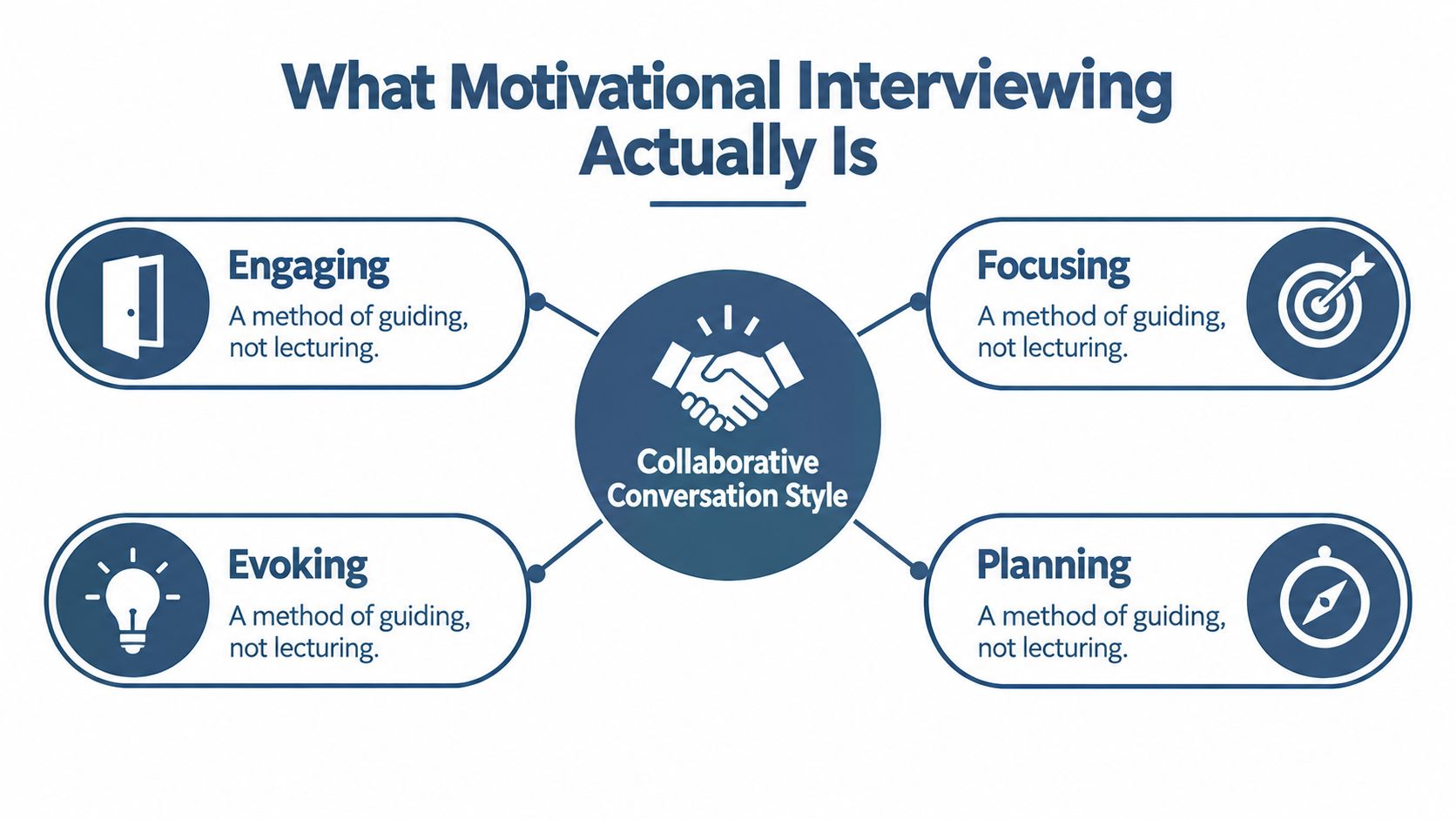
Motivational interviewing is a collaborative, goal-oriented conversation style that helps people explore ambivalence and strengthen their own commitment to change. It isn't a script, a persuasive speech, or a softer version of confrontation. The practitioner brings clinical expertise, while the client supplies personal values, priorities, concerns, and reasons for action.
The four processes provide a useful map:
- Engaging means establishing a respectful working relationship. The clinician listens for the client's experience instead of rushing to diagnosis or correction.
- Focusing means agreeing on the subject of change. The focus might be alcohol use, medication, sleep, treatment participation, or a specific risk.
- Evoking means drawing out the client's own reasons, abilities, needs, and hopes for change.
- Planning begins when the client shows enough readiness to consider practical action.
The communication skills underneath the process
The central skills are commonly summarized as OARS:
- Open questions: “What concerns you most about the way things have been going?”
- Affirmations: “Coming to treatment despite those concerns took considerable courage.”
- Reflections: “Part of the medication discussion feels like a loss of control.”
- Summaries: “The substance has helped manage pressure, but the cost to sleep, family trust, and health is becoming harder to ignore.”
These skills aren't interchangeable with ordinary kindness. A supportive counselor may listen carefully, but MI deliberately listens for the client's language about change and responds in ways that invite deeper examination.
Change talk and sustain talk
Change talk includes the client's own statements favoring movement, such as wanting better health, seeing a need for treatment, believing a different life is possible, or describing a first step. Sustain talk expresses the reasons for maintaining the current behavior, such as fear of losing productivity, concern about medication, or belief that substance use remains manageable.
MI doesn't debate sustain talk. If a client says, “Alcohol is the only thing that shuts my mind off,” an MI-consistent response might be, “It gives the mind relief quickly, and the idea of losing that relief feels frightening.” The clinician can then explore whether the client wants to examine other ways of managing activation.
MI also isn't cheerleading, forced compliance, or passive agreement. A therapist can disagree with a dangerous plan, offer evidence, recommend a higher level of care, and set program boundaries. The difference is that the clinician doesn't use shame or argument to manufacture motivation.
How a Conversation Method Became a Treatment Model
Motivational interviewing emerged from clinical work with people experiencing alcohol problems. William R. Miller's foundational 1983 paper, “Motivational Interviewing with Problem Drinkers,” described a counseling style intended to resolve ambivalence rather than confront or persuade patients as outlined in the history of MI.
The early clinical insight was practical. People who were told to defend themselves often did exactly that. People who were invited to articulate their own reasons for change could examine the conflict with less defensiveness. The therapist's role shifted from delivering the verdict to guiding a disciplined conversation.
Miller later collaborated with Stephen Rollnick. In 1991, they published the first edition of Motivational Interviewing: Preparing People to Change Addictive Behavior, establishing MI as a structured method for addressing alcohol and drug-related behavior change. That publication helped move MI from an individual clinician's described style into a teachable, evidence-informed treatment model.
Why formalization matters
A defined model can be trained, supervised, and evaluated. Programs can assess whether clinicians are using reflective listening, supporting autonomy, evoking change talk, and avoiding responses that intensify sustain talk. This distinction matters in premium residential care because an empathetic conversation isn't automatically MI.
The Motivational Interviewing Treatment Integrity code, commonly called MITI, gives supervisors a framework for evaluating competence. Audio review and structured feedback can reveal whether a clinician is asking useful questions, reflecting accurately, and maintaining a collaborative stance, or only giving advice in a warm tone.
MI later became adaptable across brief sessions, intake work, medication discussions, residential treatment, outpatient care, mental-health recovery, and preparation for cognitive and behavioral therapies. Its history explains why it can function as a focused intervention while also serving as a connective layer across a complex treatment plan.
Quality test: A program shouldn't call every supportive conversation motivational interviewing. Competence needs observable skills, supervision, and feedback.
What the Evidence Actually Shows
The evidence supports a measured conclusion. MI can produce modest reductions in substance use, particularly in the short term, and it can help people engage with treatment. It isn't consistently superior to established addiction treatments and shouldn't replace withdrawal management, medication, psychotherapy, relapse prevention, or continuing care.
A Cochrane review updated in 2024 found an SMD of 0.20, with a 95% confidence interval from 0.12 to 0.28, for substance-use reduction across MI groups involving 3,351 participants in its review of randomized studies. Against no-treatment controls, an earlier review found an immediate post-intervention SMD of 0.79, with a 95% confidence interval from 0.48 to 1.09. That effect declined to 0.17 at short follow-up, 0.15 at medium follow-up, and 0.06 at long follow-up, where it wasn't statistically significant.
A 2023 systematic review found an SMD of 0.48 versus no intervention, with a 95% confidence interval from 0.07 to 0.89, across 6 studies and 471 participants. The evidence was rated low certainty, and heterogeneity was substantial at I² = 75%, meaning outcomes varied by population, intervention intensity, provider skill, comparison condition, and follow-up period as reported in the review.
The time course matters
A synthesis of 72 trials found that average effect size declined over time from 0.77 at one month to 0.11 after twelve months or longer:
| Follow-up window | Average effect size |
|---|---|
| One month | 0.77 |
| One to three months | 0.39 |
| Three to six months | 0.31 |
| Six to twelve months | 0.30 |
| Twelve months or longer | 0.11 |
These figures describe a common clinical pattern. MI may create an early motivational or behavioral lift, but that lift can fade without reinforcement. A residential program should therefore revisit motivation at admission, readiness reassessment, discharge planning, medication changes, family sessions, and outpatient handoffs.
The practical expectation is not “one conversation cures addiction.” A more defensible expectation is that MI can help a client accept assessment, discuss medication, remain in care, participate in therapy, and identify personally meaningful reasons to reduce or stop substance use. Fidelity matters because MI-consistent skills are associated with more change talk, while MI-inconsistent skills are associated with more sustain talk.
What an MI Session Looks and Feels Like
An MI session usually feels less like a lecture and more like a structured conversation with a clear clinical purpose. The therapist doesn't begin by listing everything the client has done wrong. The opening may involve asking what brought the person to treatment, what feels most urgent, and what the client hopes will be different.
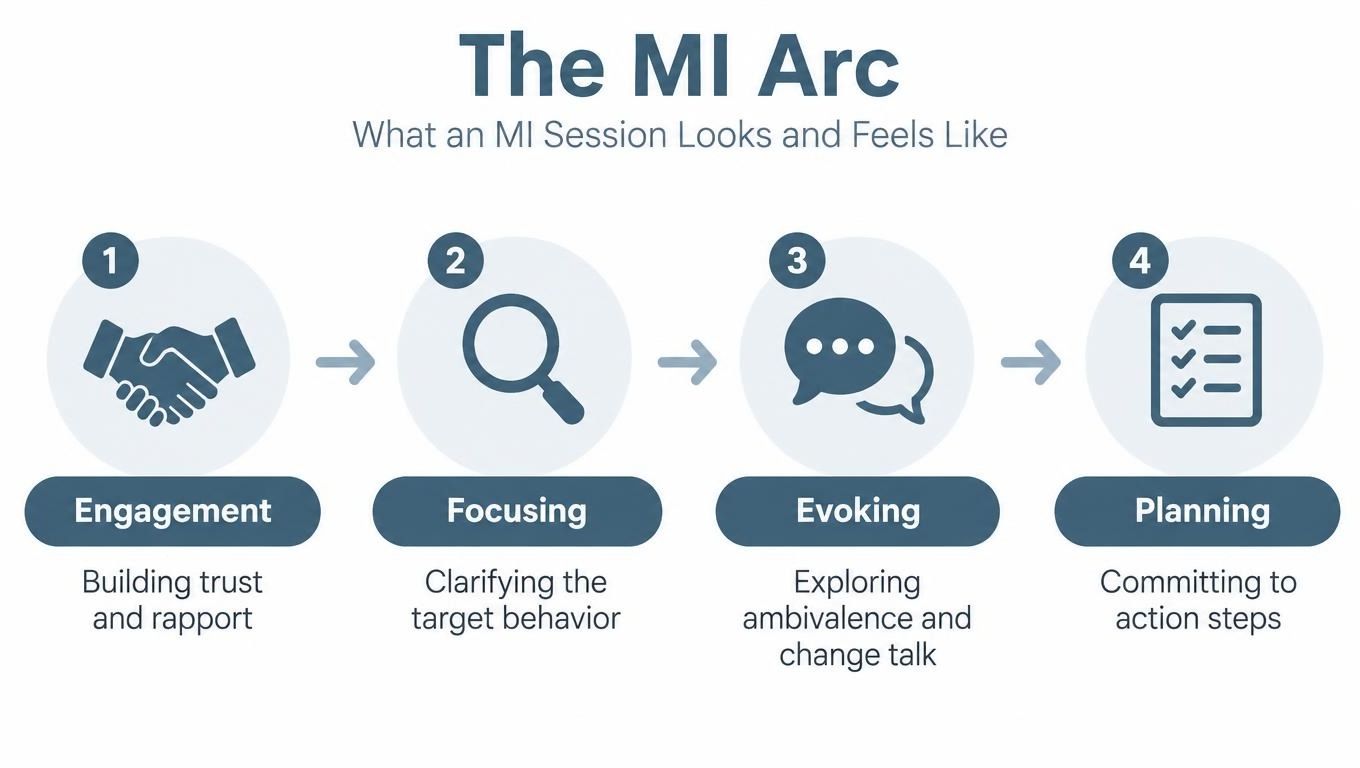
A typical arc moves through four stages:
- Engagement: The clinician establishes enough trust for honest discussion.
- Focusing: Both parties identify the behavior or decision that deserves attention.
- Evoking: The client explores personal reasons for change and concerns about staying the same.
- Planning: The client and clinician translate readiness into practical next steps.
The difference in the room
A confrontational response to a client who questions medication might sound like, “You need to take this seriously and follow the recommendation.” An MI-consistent response could be, “The recommendation raises concerns about side effects and dependence, while part of the client also wants relief and stability. Which part deserves attention first?”
The second response doesn't abandon medical expertise. The clinician can explain options, risks, and benefits, then ask permission to share information. The client remains an active participant rather than an opponent.
In a residential setting, MI can appear:
- At intake, when the client is deciding whether the program understands professional pressures.
- Before treatment planning, when priorities need to be translated into measurable goals.
- Around medication decisions, including clinically managed withdrawal and psychiatric medication optimization.
- Before CBT or DBT work, when the client is considering whether difficult skills practice is worth the effort.
- During relapse-prevention planning, when the client identifies high-risk situations and preferred supports.
- In family sessions, when relatives need to express concern without turning the meeting into a prosecution.
Autonomy within a structured program
Private rooms and appropriate electronics access can help high-earning professionals maintain essential work, family, and logistical contact. They don't remove the need for boundaries around sleep, confidentiality, group participation, clinical availability, or safety.
MI handles this tension by separating choice from consequence. A client can choose whether to discuss a recommendation, but the clinical team still has a duty to explain risks and establish safety requirements. A resident can have a voice in discharge planning, but the team must reassess whether the proposed plan is clinically sound.
That combination makes MI useful in a luxury program. Respect doesn't require the absence of structure. It requires that structure be explained clearly and implemented without humiliation.
How MI Fits With CBT, DBT, ACT, and Medication
MI works best as an engagement and behavior-change layer, not as a rival to full treatment. It helps a client decide why participation matters, while other interventions provide the skills and medical care needed to sustain recovery.
CBT can help clients identify distorted thinking, behavioral patterns, triggers, and alternative responses. MI may come first when a client understands those goals intellectually but feels uncertain about doing the work. A plain-language overview of cognitive behavioral therapy is available in the Vancouver Counselling Clinic CBT guide, which can help families understand how structured cognitive and behavioral work differs from motivational conversations.
DBT adds distress tolerance, emotion regulation, mindfulness, and interpersonal effectiveness. For a client with intense emotional activation, MI can explore whether practicing these skills aligns with goals such as preserving relationships, improving leadership judgment, or reducing impulsive decisions. The same logic applies to ACT, where MI can help surface values before the client practices accepting difficult internal experiences and taking values-based action.
Medication decisions also benefit from autonomy-supportive discussion. A psychiatrist may discuss sub-acute detox, naltrexone, buprenorphine, antidepressants, or mood stabilizers when clinically indicated. MI helps clarify what the client fears, what outcomes matter, and what information would make an informed decision possible. It doesn't substitute for prescribing expertise or safety assessment.

Integration is the clinical advantage
In a Joint Commission-accredited, multidisciplinary program, psychiatrists, psychologists, LMFTs, certified addiction counselors, and adjunctive therapists can coordinate these approaches through an individualized treatment plan. MI can prepare a client to enter trauma-focused work, CBT, DBT, ACT, medication management, family therapy, and relapse-prevention planning without presenting any single modality as a universal answer.
The CBT for addiction resource offers another way to understand how cognitive and behavioral treatment can support the motivational work. The same collaborative stance can continue into discharge planning, alumni programming, family education, and outpatient care.
For executives, the value lies in continuity. A client doesn't need to choose between motivation, skills training, psychiatric care, private accommodations, and professional privacy. The treatment plan should connect them.
MI in Dual-Diagnosis Care for Executives and Professionals
Dual-diagnosis treatment requires more than asking whether someone wants sobriety. A client may also be managing PTSD, depression, anxiety, bipolar symptoms, borderline traits, trauma activation, sleep disruption, or medication concerns. Those conditions can affect concentration, emotional tolerance, memory, and the ability to participate in standard programming.
A 2025 systematic review of eight randomized controlled trials involving people with dual diagnoses found improvements in functioning, psychiatric symptoms, medication adherence, and substance use, although most weren't statistically significant. The clearest significant benefits were fewer relapses, fewer total relapse days, and fewer alcohol-binge days as reported in the review.
That result supports a careful interpretation. MI appears most reliable for initial engagement, retention, and aftercare attendance in co-occurring care, while effects on substance use and psychiatric symptoms remain more equivocal. It shouldn't be marketed as a stand-alone cure or used instead of medication treatment, CBT, DBT, trauma-focused care, or psychiatric stabilization.
Substance and stage still matter
Expectations should also vary by substance. A 2025 review presentation reported no conclusive evidence for MI or motivational enhancement therapy in stimulant-use-disorder outcomes, while results appeared more promising when motivational approaches were combined with established interventions. A clinician should therefore ask what success means at the current stage:
- Accepting a psychiatric and substance-use assessment
- Starting an indicated medication
- Staying in residential treatment
- Attending continuing care
- Reducing use
- Achieving abstinence
For a professional who must manage sensitive responsibilities, clinical flexibility can support engagement. Reflections provides private rooms in detox and rehabilitation and allows clinically supervised access to electronics for appropriate work, family, and logistical needs. Those features should operate within individualized treatment planning, privacy controls, safety procedures, and regular reassessment, not as unrestricted connectivity.
Joint Commission behavioral-health standards emphasize privacy, authorization, restricted access, and written health-information security policies for protecting clinical and case information. That governance matters for executives whose professional reputation and employment-related confidentiality may be affected by unauthorized disclosure.
A clinically appropriate dual-diagnosis pathway can be explored through dual-diagnosis drug treatment. Family sessions, continuing care, alumni support, and measurement-based follow-up extend the motivational arc beyond the initial residential stay.
What to Ask a Program About MI and What Comes Next
Executives, families, and referring clinicians should ask specific questions:
- Training: Which clinicians have formal MI training?
- Fidelity: Does supervision include audio review and MITI-informed feedback?
- Boundaries: How does the team preserve autonomy while responding to withdrawal, overdose, suicidality, or psychiatric instability?
- Integration: How does MI connect with CBT, DBT, ACT, medication management, family work, and relapse prevention?
- Continuity: What happens after discharge, and how are motivation and participation monitored?
- Privacy: Who can access clinical information, and how are authorizations documented?
- Daily life: How are phones and laptops managed in relation to sleep, privacy, safety, and work obligations?
Families can use reflective listening, genuine affirmations, and collaborative boundary-setting without attempting to conduct therapy. Pressure, threats, and repeated arguments may increase sustain talk. A family's role is to communicate concern clearly, define enforceable boundaries, and support professional care.
The aftercare planning resource can help families and referring professionals think beyond residential treatment. Motivation is maintained through repeated conversations, appropriate clinical support, family education, alumni programming, and follow-up that measures more than attendance alone.
Reflections offers confidential, Joint Commission-accredited luxury residential care for adults with co-occurring substance-use and mental-health conditions, with MI integrated alongside CBT, DBT, ACT, psychotherapy, medication management, private rooms, and clinically supervised electronics access. Executives, families, and referring professionals can learn how this dual-diagnosis approach fits a resident's clinical needs and professional responsibilities by visiting Reflections.