

You've just left a private dual-diagnosis program, your phone is back in your hand, your laptop is open, and Monday's calendar is already full. That moment can feel polished on the surface and fragile underneath. The central question isn't whether the stay was valuable, it's whether the next week has enough structure to protect sobriety, mental health, family stability, and the demands of executive life.
Aftercare planning is the bridge between intensive treatment and everyday life. For high-profile professionals, that bridge has to carry more than abstinence, it has to hold confidentiality, work obligations, family contact, travel, and the stress that comes with being visible and responsible. When the plan is built well, it doesn't read like bureaucracy. It works like a carefully staged handoff.
Introduction to Aftercare Planning
An executive finishing luxury rehab rarely leaves into quiet conditions. The inbox is waiting, the family expects answers, and the mind is still adjusting to life without the constant container of residential care. In that setting, aftercare planning is less like a formal discharge note and more like a disciplined transition map.
A strong plan starts before discharge and already has the next steps arranged. The point is simple, the person should not have to improvise treatment, support, or safety when stress returns. In a private-pay setting, that matters even more because continuity has to match the pace and privacy expectations of a demanding career.
Practical rule: if the first follow-up is still undecided at discharge, the plan is already weaker than it should be.
For executives, aftercare planning has to do two jobs at once. It protects recovery while preserving enough professional continuity to keep life from unraveling. That combination is what makes the topic worth understanding in detail.
Understanding the Role of Aftercare in Sustained Recovery
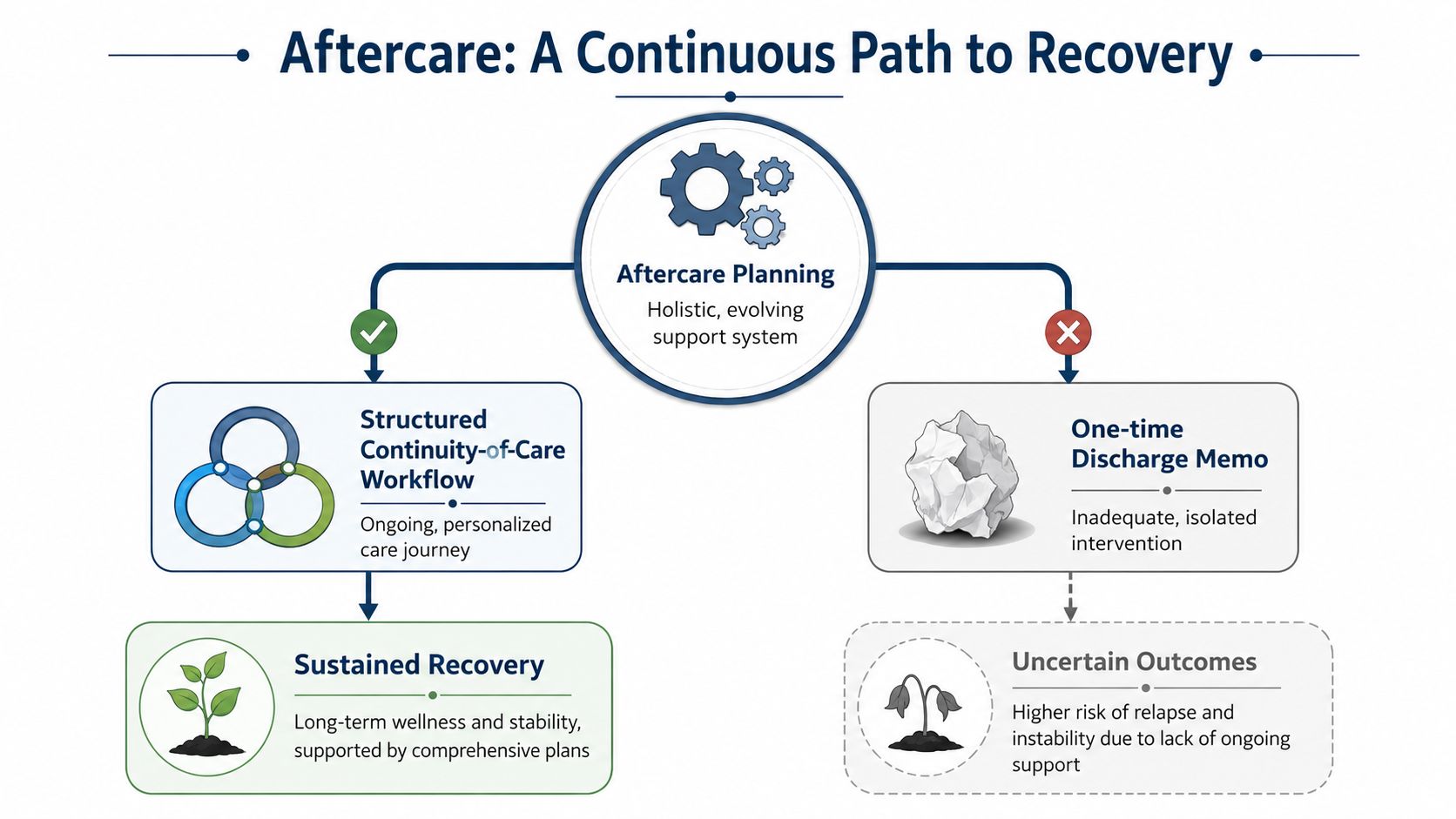
A useful way to think about aftercare planning is as a continuity-of-care workflow, not a note that gets tucked into a folder and forgotten. That distinction matters because the first phase after residential treatment is a high-friction period, especially for people balancing recovery with leadership roles, public exposure, and family responsibilities.
One 2016 study found that patients who received all three discharge-planning practices reached their first outpatient follow-up almost twice as fast as those who received none, with a hazard ratio of 1.96 and p <.001 (PubMed). That finding is powerful because it shows that structured preparation doesn't just feel organized, it speeds connection to continuing care. For an executive, that speed can be the difference between moving into support quickly and drifting into a risky gap.
What structured continuity looks like
A minimal handoff says, “follow up when you can.” A serious handoff says, “here are the appointments, the therapy cadence, the relapse plan, and the people who own each step.” The difference is not cosmetic. One relies on memory and motivation under pressure, the other lowers the chance that a stressful week will derail care.
A structured plan also makes room for different kinds of support. That can include therapy, peer support, family contact, and medication review, but the real value is that these pieces are linked before discharge. In practice, the plan behaves like an operating system, not a memo.
Bottom line: aftercare works best when it is scheduled, named, and traceable.
That logic is especially relevant for executives who cannot afford ambiguity. In a world of board meetings, travel, and constant decision-making, clarity isn't a luxury, it's a safeguard. The more precise the plan, the less mental energy the person has to spend figuring out what happens next.
Core Components and Clinical Steps for Individualized Plans
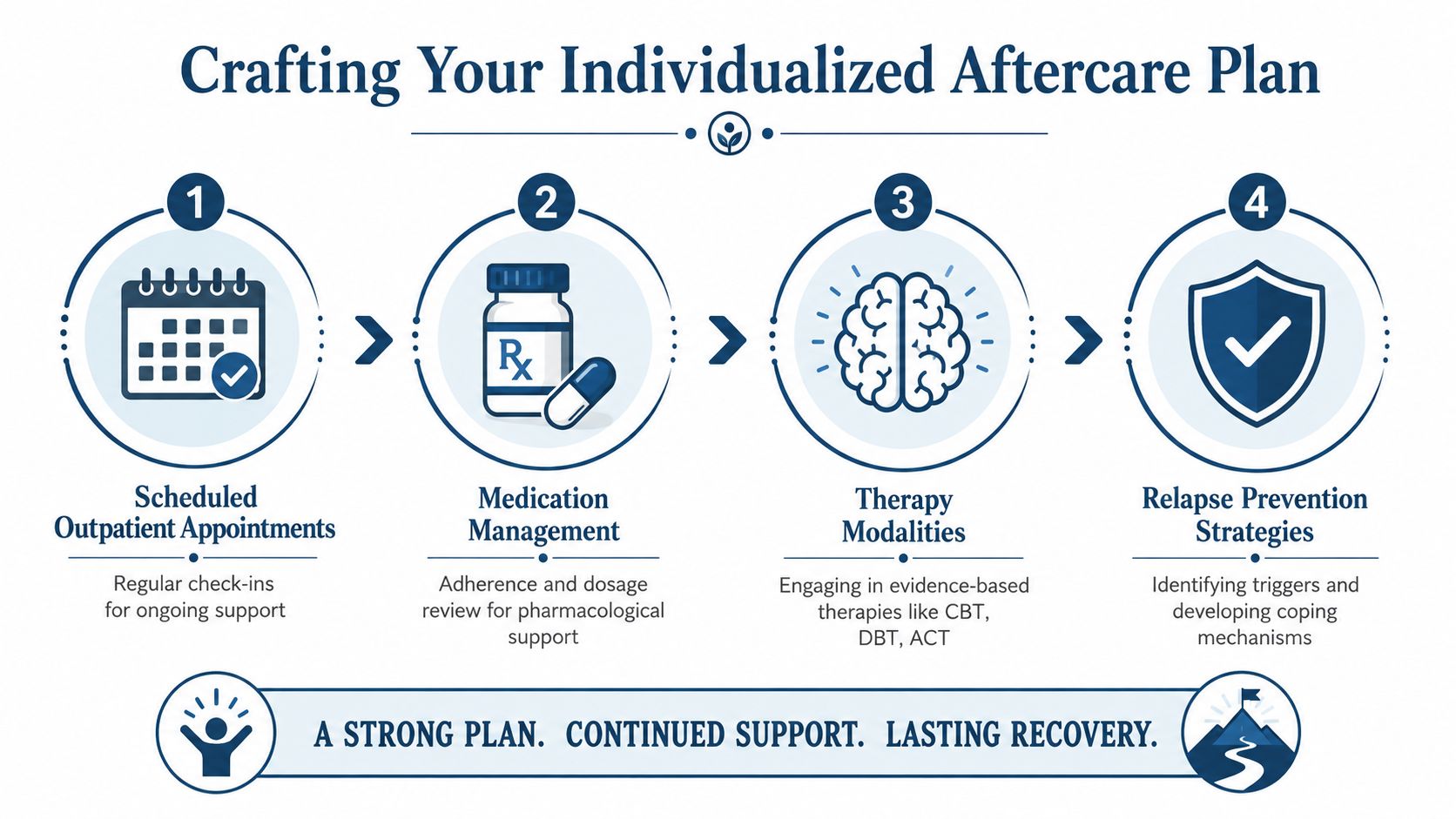
A robust plan reads like a project kickoff for a high-stakes launch. It names milestones, assigns ownership, and includes contingency steps before the first problem appears. The point is not to create paperwork, it's to reduce guesswork when the person is back in ordinary life.
The clinical sequence should begin with appointments that are already on the calendar. From there, medication management can be clarified, therapy can be matched to the person's needs, and relapse-prevention steps can be written in plain language. The strongest plans also include crisis actions so that everyone knows what to do if symptoms escalate.
High-performing plans use time-anchored reviews at 72 hours, six weeks, six months, and annually, and they document relapse triggers and crisis actions (Lincolnshire Section 117 planning template). That cadence matters because early warning signs often emerge before a person feels ready to ask for help. Scheduled reviews force the conversation to happen on time, not only when things are already strained.
The pieces that matter most
- Scheduled outpatient appointments: These should exist before discharge, with the first visit confirmed and realistic travel or virtual access in place.
- Medication management: The plan should clarify who reviews prescriptions, who monitors adherence, and what happens if side effects appear.
- Therapy modalities: A luxury dual-diagnosis setting may use evidence-based therapy, skills coaching, or trauma-informed support depending on the person's diagnosis and stress profile.
- Relapse-prevention and crisis steps: Triggers, early warning signs, and emergency contacts need to be written, not left to memory.
A practical model for human-centered support is ethical coaching methods, especially when recovery conversations need to stay respectful, grounded, and non-shaming. That fits executive care well because it supports accountability without turning the person's life into a surveillance project.
The plan should be specific enough that a substitute clinician, a spouse, or a case manager could follow it without improvising.
That level of precision is what turns a discharge document into a usable tool. It also makes the plan auditable later, which matters when the clinical team wants to know what worked and what should change.
Practical Steps with Family and Work Considerations
A serious aftercare plan has to fit real life, not an ideal version of it. Research on underserved groups shows that transition barriers often come down to practical realities such as medication cost, transportation, housing instability, limited social support, and low health literacy, and that care coordination has to actively link people to community resources to close those gaps (PubMed review). That point is especially important for families who are stretched thin or living far from specialty care.
The same logic applies to executives. If the person is expected to stay reachable for work, the plan should define when calls happen, which devices stay in use, and which contacts are reserved for clinical needs. In a luxury setting with private rooms and electronics access, that flexibility can support career continuity, but only if boundaries are explicit.
A practical checklist for balancing both worlds
- Family involvement: Hold education sessions so loved ones understand relapse signs, boundaries, and communication rules.
- Caregiver capacity: Ask who can realistically help, and who is already overloaded or uncertain.
- Geographic access: Map out virtual sessions, rides, local contacts, and backup options before the person leaves treatment.
- Work communication: Name one liaison, one approved contact window, and one method for urgent professional issues.
- Boundary setting: Decide which messages can wait, which ones should be filtered, and which ones never need a response during recovery hours.
A helpful family resource is the program's family therapy for addiction recovery, because executive recovery often depends on whether the home team understands the plan well enough to support it without crowding it. When family systems are informed, they're less likely to misread structure as distance.
The biggest mistake is assuming that a capable professional automatically has enough bandwidth for recovery tasks. Even high-functioning people can miss medication refills, overlook check-ins, or avoid difficult conversations when work pressure spikes. A good plan removes those decisions from the heat of the moment.
Useful standard: if a spouse, assistant, or chief of staff cannot describe the follow-up rhythm in one sentence, the plan is too vague.
Sample Aftercare Plans for Executives
In Scotland's residential rehabilitation system, 90% of Alcohol and Drug Partnerships reported active aftercare planning during residential placements, and 69% reported measures to ensure access to employment, work placements, or voluntary opportunities on completion of rehab (Scottish Government survey). That benchmark matters for executive care because modern continuation planning is no longer just about avoiding relapse, it's about returning to meaningful function.
A technology executive with a fast-moving role
A technology leader leaving treatment may need short, frequent touchpoints rather than long gaps. A workable plan could include early video therapy check-ins, a predictable workout schedule, and recurring recovery meetings that fit around product deadlines or investor calls. If the person's role demands rapid decisions, the plan should also define a backup point of contact for the days when concentration dips.
A finance executive who travels often
A finance professional with frequent flights needs a plan that travels well. Telehealth sessions, mobile grounding exercises, and a paired accountability contact in multiple cities can keep the routine intact when the calendar shifts. The key is not perfection, it's continuity across time zones, hotels, and client dinners.
Both examples depend on the same idea, career continuity must be coordinated, not improvised. That is where luxury aftercare can align with treatment, because private rooms, discreet scheduling, and electronics access let people keep working in a controlled way rather than disappearing from life and then trying to restart all at once.
Some plans also include private peer support, alumni contact, and work-fit scheduling so the executive can stay in motion without stepping away from clinical care. In a high-end setting, that kind of design is part of the treatment logic, not an add-on.
Setting Measurable Goals and Follow-Up Strategies
A follow-up plan works best when it can be measured without becoming rigid. The schedule recommended in one aftercare source starts with weekly check-ups for the first 30 days, moves to every two weeks through day 90, then monthly through six months, and quarterly thereafter, with extra frequency during high-risk periods. That front-loaded rhythm makes sense because early recovery usually needs closer contact than later maintenance.
The best way to use that cadence is to attach a concrete purpose to each touchpoint. A first-month call might review sleep, cravings, medication use, and calendar stress. A later check-in might focus more on travel, workload, family strain, and whether the person is still using the plan the way the team intended.
Turning goals into something trackable
- Therapy attendance: Define what counts as attended, rescheduled, or missed.
- Peer support engagement: Name the minimum participation pattern that fits the person's schedule.
- Medication adherence: Identify who confirms refills, side effects, and follow-through.
- Stress signals: Write down the personal warning signs that suggest the pace is getting too high.
One recurring barrier is that people assume access will be easy once the plan exists. It often isn't. Transportation can fail, work can interfere, and medication access can become a burden if no one has assigned the task clearly. Case management, active coordination, and practical help are what keep the schedule from collapsing.
That is why a provider link such as recovery coaching services belongs in the conversation only when it supports the follow-up rhythm and the person's real-world needs. The service matters less as a label and more as a way to keep accountability active between appointments.
Simple standard: every goal should have a date, an owner, and a next step if the person misses it.
Measurable planning gives executive clients something very useful, a way to see progress without relying on mood or guesswork. It also helps the clinical team adjust quickly if follow-up starts slipping.
Leveraging Reflections Continuing-Care Resources
For executive clients, aftercare has to feel discreet, coordinated, and clinically serious. That is why continuing-care options such as alumni workshops, family education, telehealth check-ins, on-campus retreats, and private peer support can be useful, especially when they are tied to a clear recovery roadmap. A program like extended care can function as the next layer of support after residential treatment ends.
The value of those services comes from consistency. A client who stays engaged after discharge is less likely to treat recovery as a one-time achievement and more likely to treat it as a maintained routine. That mindset matters in dual-diagnosis care, where stress, mood, and substance risk can rise and fall together.
Reflections is one option for this kind of transition support, because its model combines continuing care with private residential treatment, electronics access, and individual follow-through. In a setting like that, the same clinical team that helped build the discharge plan can help refine it once work, family, and travel are back in play.
A mini example is easy to understand. An executive who attends alumni support after discharge may notice rising stress during a heavy travel month and use the scheduled check-in before that stress spills into sleep loss or isolation. Another client may use family education to reduce conflict at home, which then makes it easier to keep the follow-up schedule intact. The point is not perfection, it's early correction.
Luxury amenities matter here too, but only because they support compliance. Private rooms lower noise and disruption. Electronics access allows continuity with work and selected supports. A highly accredited clinical team can use those conditions to keep the plan realistic instead of idealized.
Conclusion and Next Steps
Aftercare planning works when it starts early, follows a schedule, includes crisis steps, and adapts to family and work realities. For executives, the strongest plans protect recovery without forcing a false choice between sobriety and professional life. That balance is what makes continuity sustainable.
If a discharge is approaching, the next step is a confidential conversation about the follow-up roadmap, the level of family involvement, and the kind of continuing care that fits the person's pace. Reflections can help build that plan around dual-diagnosis needs, privacy, and career continuity.
If an executive needs a recovery plan that respects both clinical seriousness and professional responsibility, Reflections offers luxury dual-diagnosis care with continuing support built in. Reach out through Reflections to discuss a confidential aftercare roadmap that fits work, family, and long-term sobriety.