
A senior executive checks a final work message in the car before walking into treatment. The spouse carries the overnight bag, answers two texts from family, and tries to act calm. By the time both sit with the admissions clinician, the question is no longer whether treatment is necessary. The question is whether the marriage, the household, the children, and the professional life can hold together while treatment does its work.
That's where most families misunderstand family therapy goals.
In high-end dual-diagnosis care, family work isn't a courtesy service tacked onto residential treatment. It's part of risk management. Adults with substance use and mental health symptoms don't discharge into a vacuum. They go back to a spouse, a home, a calendar, a company, a board, a team, and often children who have already adapted to instability in ways that keep the problem going.
For high-achieving professionals, the stakes are sharper. Privacy matters. Reputation matters. Role preservation matters. Treatment has to stabilize the patient without blowing up the life they're returning to. That's why luxury residential programs that serve executives need more than weekly family check-ins. They need clear, written, practical family therapy goals that can survive real life.
Why Family Goals Matter in Luxury Dual-Diagnosis Care
A couple arrives at a private residential program after a month of concealed drinking, insomnia, panic symptoms, and one disastrous board meeting. The executive wants discretion, a private room, and enough access to a phone and laptop to protect critical responsibilities. The spouse wants one straight answer. Will treatment help, or will everyone be managing another temporary crisis in thirty days?
That intake conversation usually turns on one issue. The household already has a system. Someone covers. Someone minimizes. Someone starts policing behavior. Someone avoids conflict to keep the children calm. If treatment only addresses the patient, the family system stays intact and the old pressure returns the minute discharge planning starts.
SAMHSA's guidance on substance use disorder treatment and family therapy makes the point plainly. Family therapy is designed to use family support to reduce substance use while also changing family-context variables such as communication, reinforcement patterns, and conflict that can maintain use. SAMHSA also frames the core objectives as influencing change, involving families in treatment, changing family behaviors that support misuse, and preventing intergenerational transmission of substance use disorders in its TIP 39 guidance.
Why this matters more for executives
Luxury care for professionals has to solve two problems at once. It has to protect health, and it has to protect function.
That means family therapy goals often include issues that generic content ignores:
- Professional continuity: A spouse may need clear rules for when work contact is allowed and when it isn't.
- Privacy control: The family needs one plan for what is told to children, relatives, staff, or colleagues.
- Role preservation: Recovery has to support a return to marriage, parenting, and leadership, not strip those roles away.
Practical rule: If a family can't state what must change at home before discharge, the treatment plan isn't finished.
Some families benefit from reviewing how outpatient family support is structured before residential admission. A practical overview of Uptown Psychology family counseling can help families understand how family work differs from general advice-giving and why structured sessions matter.
What Family Therapy Goals Actually Are
Most families arrive with emotional concerns, not clinical language. They say things like, “communication is broken,” “nobody trusts anyone,” or “the house feels tense.” Those concerns are real, but they aren't yet goals.
Family therapy goals are written treatment targets. In plain terms, they specify what the family and the patient are trying to change together during treatment, who is involved, how progress will be recognized, and when that progress should happen.
What a usable goal includes
A strong goal has four parts:
The behavior
The goal names what has to change. Not “be closer.” Something observable, such as fewer blowups, no more covering for missed obligations, or a weekly recovery check-in.The participants
The chart identifies who is responsible. That may be the spouse, both parents, one sibling, or the household as a whole.The marker of progress
In family work, progress is tracked by what people do. Attend sessions. Use a script. Follow a boundary. Complete a written relapse response plan.The timeframe
Treatment needs a deadline. Residential care moves quickly, especially when professionals are balancing clinical work with retained career obligations.
Process goals and outcome goals
Clinicians usually separate two kinds of goals.
- Process goals track participation and skill practice. Examples include attending family sessions, learning a communication format, or completing psychoeducation.
- Outcome goals track what changes because of that work. Examples include fewer conflict episodes, better adherence to psychiatric care, or a cleaner handoff into outpatient treatment.
Families often understand this distinction after reviewing examples of family therapy in addiction recovery, then seeing how a residential program turns those ideas into actual treatment planning. A more treatment-specific view appears in this overview of family therapy for addiction recovery, which shows how family sessions fit inside a broader recovery plan.
Better communication isn't a goal. “Spouse and client complete one structured check-in each week without argument or shutdown” is a goal.
What professional families should expect to see
High-functioning families sometimes resist written goals because they sound formal. They shouldn't. Formality is what keeps treatment from drifting into vague conversation.
A family goal should be clear enough that everyone can answer three questions at any point in the stay:
| Question | What the family should know |
|---|---|
| What is changing | The exact pattern being targeted |
| Who is responsible | Which family members are participating |
| How progress shows up | The observable behavior that signals movement |
That level of clarity is especially important in private-pay luxury rehab, where families aren't paying for generic support. They're paying for structured, individualized treatment that respects privacy, preserves dignity, and solves the actual problem.
The Core Goals Clinicians Set in Residential Programs
Most residential family work for adults with dual diagnosis comes back to four targets. The names are simple. The consequences of ignoring them aren't.
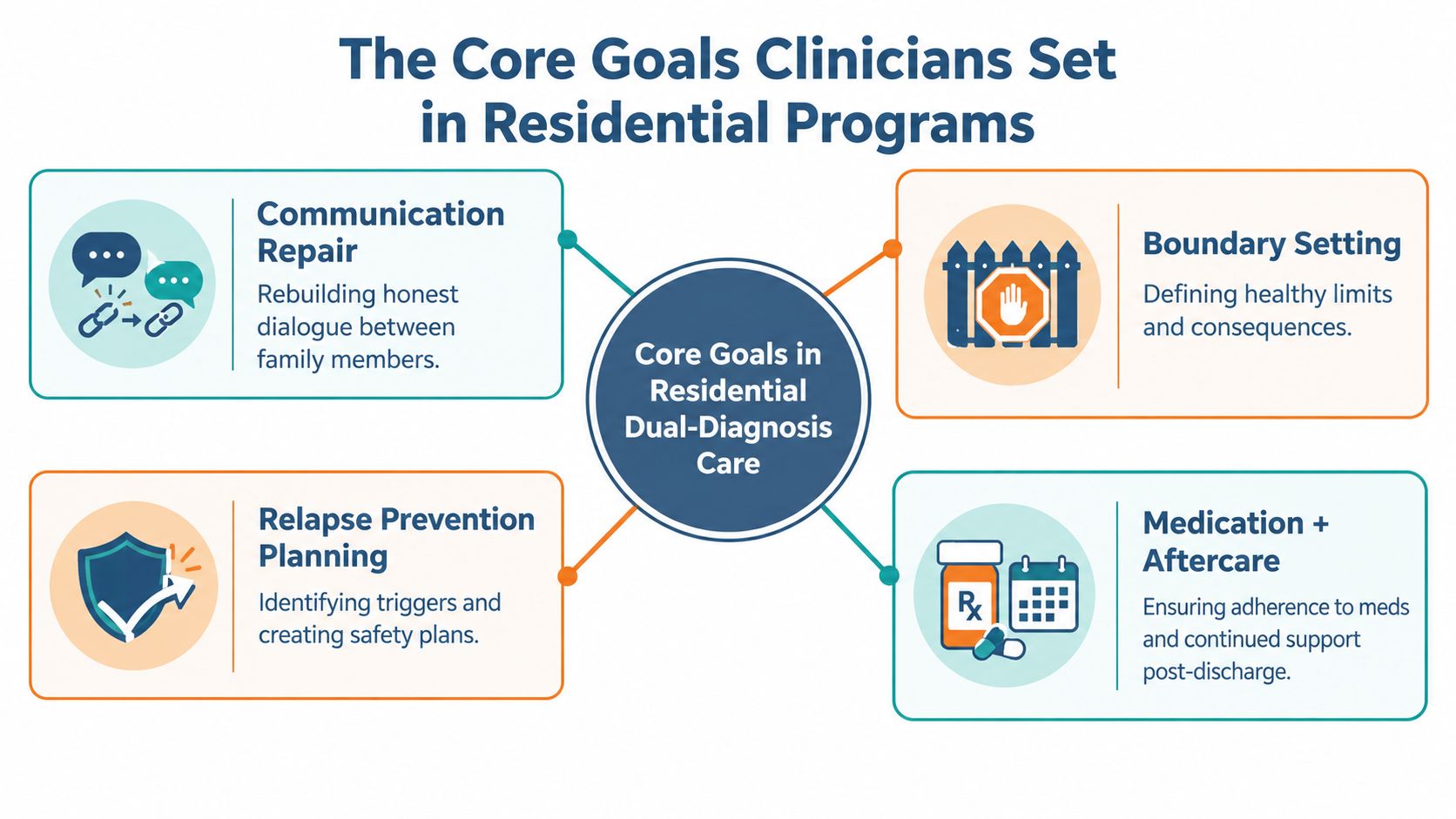
Communication repair
Substance use and psychiatric symptoms thrive in families that have shifted into silence, interrogation, or repetitive arguments. One partner asks a fair question. The other deflects. Then both escalate. After enough rounds, nobody says anything honest until the situation is already dangerous.
Communication repair isn't about making the family warm and expressive. It's about making the family accurate. They need to say what is happening, ask direct questions, and tolerate uncomfortable answers without turning every conversation into a courtroom.
Risk it addresses: concealed use, concealed mood symptoms, treatment resistance.
Progress sign: family members start naming concerns early instead of after a blowup.
A controlled trial involving family intervention for people with co-occurring severe mental illness and substance use disorders found that both a brief education model and a longer model produced improvements across psychiatric symptoms, alcohol and drug severity, functional status, and relatives' knowledge. The longer model added explicit communication and problem-solving skills training, which reflects a practical path toward better adherence, reduced burden, and more stable outcomes over time in this NCBI study.
Boundary setting
High-performing families are often terrible at boundaries. The executive keeps taking calls during detox. The spouse keeps smoothing over consequences. A parent wires money after every crisis. A sibling becomes the emotional first responder. Everyone says they're helping. Often, they're helping the illness stay in charge.
Boundary work defines what each person will and won't do during treatment and after discharge.
Risk it addresses: enabling, work overreach, codependent caretaking, chronic instability.
Progress sign: support becomes predictable instead of reactive.
Relapse prevention planning
Many families think relapse prevention belongs to the patient alone. It doesn't. The family usually sees the early signs first. Sleep shifts. Irritability spikes. Isolation increases. Medication gets skipped. Meetings stop. Work becomes the excuse for everything.
A good family goal turns those warning signs into a response plan. Who speaks up. How they speak up. What happens next. What threshold triggers a clinical call. What access gets restricted if safety drops.
Risk it addresses: delayed intervention, chaotic responses, crisis-driven readmission.
Progress sign: the family can describe the early-warning protocol without guessing.
A focused look at couples and family sessions for healing relationships for high-performing executives is useful here because executive households often need relapse plans that account for travel, confidentiality, and leadership obligations, not just home routines.
Medication and aftercare support
In adult dual-diagnosis care, this category gets neglected at great cost. A family may work hard on emotional repair, then unravel after discharge because nobody aligned around psychiatric follow-up, medication consistency, scheduling, or living arrangements.
Medication and aftercare support means the household understands the plan well enough to support it without becoming controlling. The spouse knows the outpatient calendar. The family knows what side effects matter. Travel gets reviewed. Recovery routines are protected.
Risk it addresses: nonadherence, fragmented outpatient care, post-discharge drift.
Progress sign: the home can support the discharge plan without constant clinician rescue.
Families don't need to become clinicians. They do need to stop operating as if discharge is the end of treatment.
How Clinicians Turn Goals Into Measurable Targets
Broad goals are easy to agree on. Measurable targets are harder. That's where actual treatment begins.
The first two weeks do most of the heavy lifting
In a well-run residential program, clinicians build family targets early. They don't wait for a late-stage “family weekend” and hope clarity appears on its own.
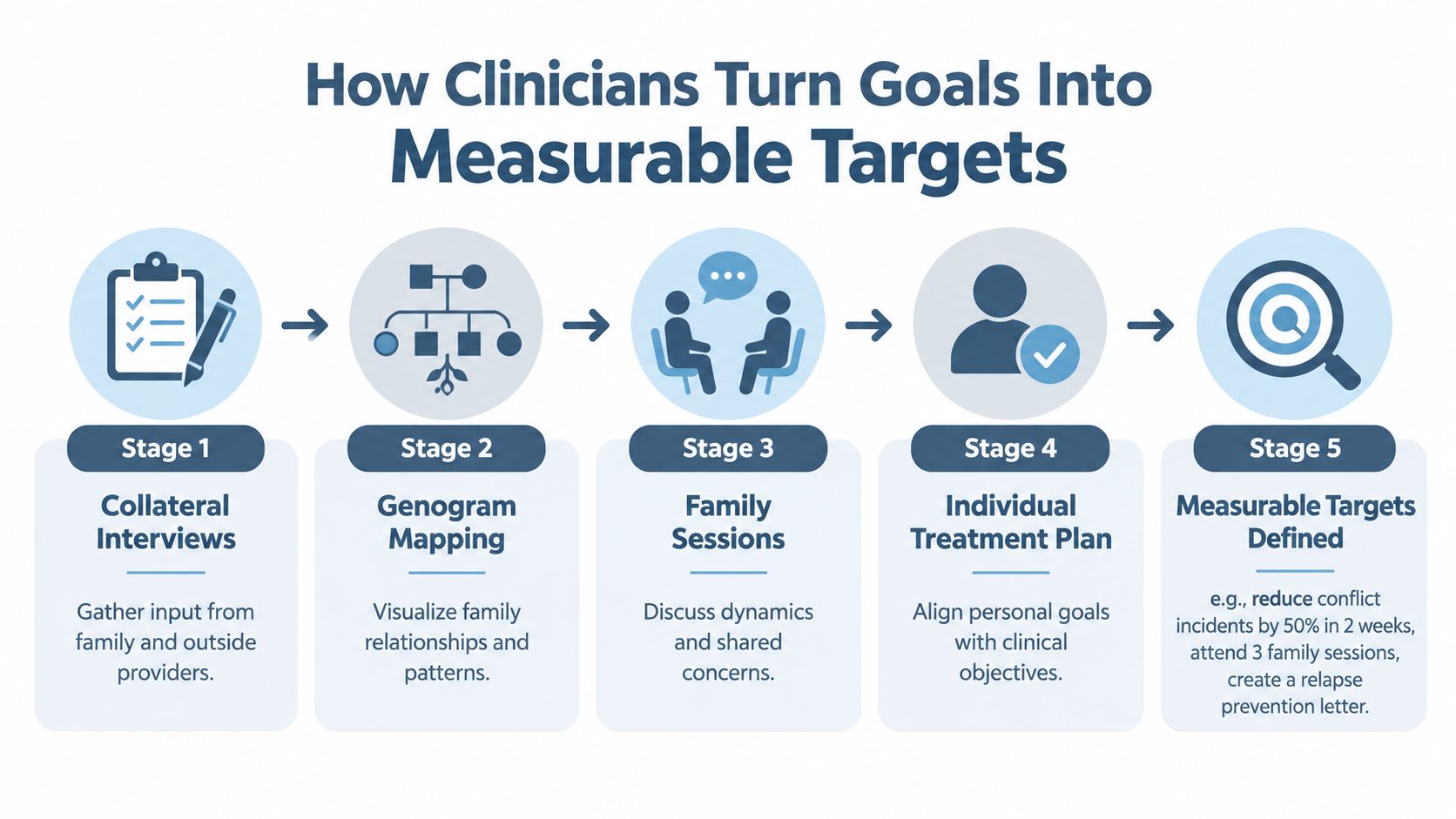
The process usually includes:
- Collateral interviews: Staff gather the family's version of the problem, not just the patient's.
- Relationship mapping: Clinicians identify alliances, ruptures, caretaking roles, and recurring conflict loops.
- Early family sessions: The team tests what happens when hard subjects are discussed in real time.
- Alignment with the individual plan: Family targets must support the patient's primary psychiatric and substance use treatment, not distract from it.
What measurable language sounds like
Good chart language is specific. It sounds plain because it has to be usable.
Examples include:
- Communication target: Spouse initiates one weekly check-in using the agreed structure, with no interruption or accusation.
- Boundary target: Family members stop contacting the patient during restricted treatment hours except for approved clinical reasons.
- Relapse target: Household identifies early warning signs and documents the response sequence before discharge.
- Aftercare target: Family confirms transportation, schedule protection, and telehealth privacy for outpatient follow-up.
A luxury program serving executives should also account for practical realities that standard programs often can't accommodate. For example, some private residential settings allow appropriate access to electronics so clients can maintain limited work continuity while staying engaged in treatment. That's clinically useful only when the family target is clear. Otherwise, the laptop becomes a loophole for avoidance.
Review points matter
Targets shouldn't sit in the chart untouched. They need scheduled review.
Clinical test: If progress can't be observed in session or described clearly at review, the target is still too vague.
Most families improve faster once the work becomes behavioral instead of interpretive. “Be more supportive” creates confusion. “Stop calling the office to cover missed obligations” creates accountability.
Adapting Goals to Different Family Situations
The framework stays stable. The emphasis changes based on who is in the room and what role they play in the patient's life.
A spouse has different influence than an estranged parent. An adult sibling raises different risks than a co-parent in a blended household. Clinicians who use the same family plan for all four are doing boilerplate, not treatment.
Four common configurations
For married or partnered executives, the work usually centers on trust, discretion, and the reality that one partner has often become part spouse, part monitor, part crisis manager. Family therapy goals need to restore the marriage without pretending the damage didn't happen.
For estranged parents, the issue is usually not daily management but re-entry. The question isn't how to supervise recovery. It's how to participate without slipping into old authority struggles or financial overreach.
Adult siblings often come in carrying old family roles. One became the fixer. One became the successful one. One stayed close to the parent with the addiction or mental illness. Recovery work between siblings usually has less sentimentality and more resentment than people expect.
Blended families with teens add a second layer. The family is managing adult recovery while also protecting children from confusion, divided rules, and overheard conflict.
| Family Configuration | Communication Focus | Boundary Focus | Relapse Prevention Focus | Aftercare Focus |
|---|---|---|---|---|
| Executive and spouse | Honest discussion of trust, work strain, and disclosure decisions | Limits on monitoring, rescuing, and work intrusion | Shared recognition of changes in mood, sleep, and secrecy | Protected routines, telehealth privacy, marriage support |
| Estranged parent | Respectful re-engagement without parental overcontrol | Clear rules around visits, money, and emotional access | Defined role in reporting concerns without taking over | Limited but consistent contact after discharge |
| Adult siblings | Direct communication without triangulating through other relatives | Stop fixer-victim roles and financial overfunctioning | Coordinated response if one sibling notices decline | Shared expectations about contact and accountability |
| Blended family with teens | Age-appropriate explanations and co-parent alignment | Unified house rules and reduced child exposure to adult conflict | Clear plan for who manages safety if symptoms escalate | Parenting consistency and child-focused support |
A practical review of family engagement examples can help families see how these configurations change session goals without changing the larger clinical framework.
What shouldn't change
Whatever the family structure, clinicians still need the same core ingredients:
- A named problem: vague concern wastes time
- Role clarity: each person needs a lane
- A response plan: families need to know what happens when symptoms return
- A discharge bridge: no family session should act as though treatment ends at the front door
The family system doesn't need to look traditional to be clinically relevant. It just needs to influence the patient's life after discharge.
When Family Therapy Is Not the Right Tool
Family therapy isn't always the right move. Some programs push it anyway because it sounds thorough. That's a mistake.
Three situations usually require caution or a full stop. First, active domestic violence or credible intimidation. Joint sessions can increase danger. Second, unresolved legal conflict such as custody litigation or a hostile divorce process. Treatment can get hijacked by strategy, blame, or evidence-gathering. Third, a participating family member whose untreated mental health or substance use destabilizes every session.
What clinicians do instead
In those cases, the patient still needs recovery planning. The family format just isn't the safest vehicle.
Alternatives often include:
- Individual relapse planning: the patient builds a personal early-warning and response plan
- Supervised updates only: the clinical team shares limited information with consent
- Designated liaison contact: one person communicates with staff instead of convening the full family
- Parallel treatment: a family member gets their own therapy before joint work resumes
This approach fits what the broader literature describes. Family-centered care is often underused, but it also requires attention to consent, confidentiality, bias, and role clarity rather than assuming everyone should be brought together. A review of family-centered substance use treatment also notes that implementation remains inconsistent even though the approach can improve substance use outcomes and family functioning, as summarized in this NCBI Bookshelf review.
The right question isn't “How soon can the family meet?” The right question is “What level of family involvement protects recovery rather than disrupts it?”
Why Family Work Improves Treatment Outcomes
Families often ask whether this level of involvement is worth it. The answer is yes, provided the work is structured.
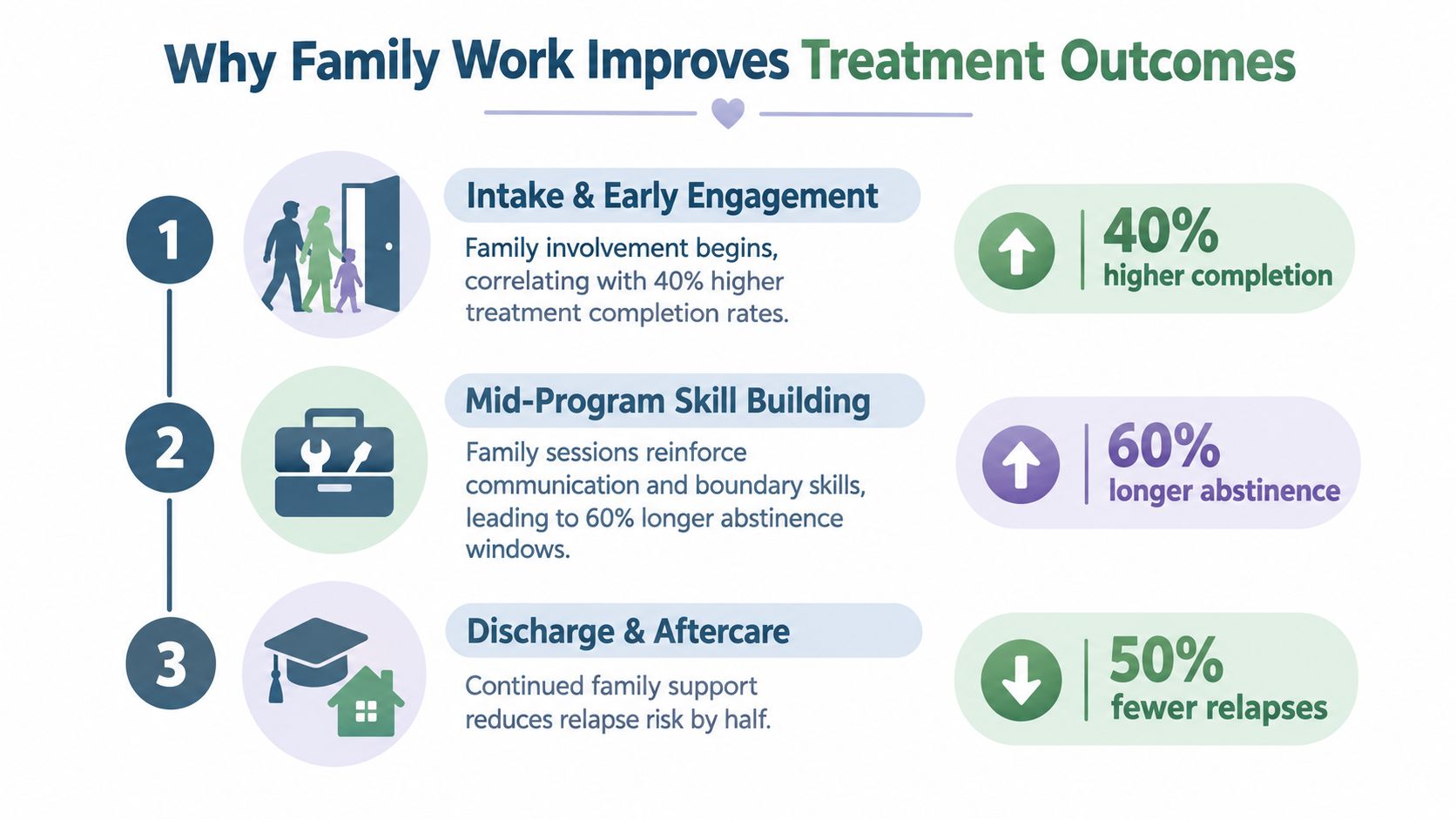
A review summarized in the search results reported that a 2013 meta-analysis covering 39 studies and more than 3,500 participants found that family involvement increased treatment completion rates by an average of 33% compared with individual-only treatment, as described in this summary of family involvement in addiction treatment.
What that means in practice
For an executive in a luxury residential stay, treatment isn't just symptom reduction inside a protected setting. The test is whether the home, schedule, and closest relationships can support the gains after discharge.
Family sessions during residential care help prepare that environment. They give the spouse or key family member a defined role. They reduce mixed messages. They make the aftercare plan harder to ignore once normal life resumes.
What continuing care should include
Strong continuing care usually keeps family work alive through a simple structure:
- Scheduled telehealth sessions: enough continuity to catch drift early
- Written relapse planning: so the household doesn't improvise during stress
- Timed check-ins after discharge: regular review of what is and isn't holding
For high-profile professionals, this matters even more. The external life often restarts faster than the internal recovery process. Family work is what helps the household hold that tension without collapsing into secrecy, resentment, or overcontrol.
Preparing Your Family Before Intake
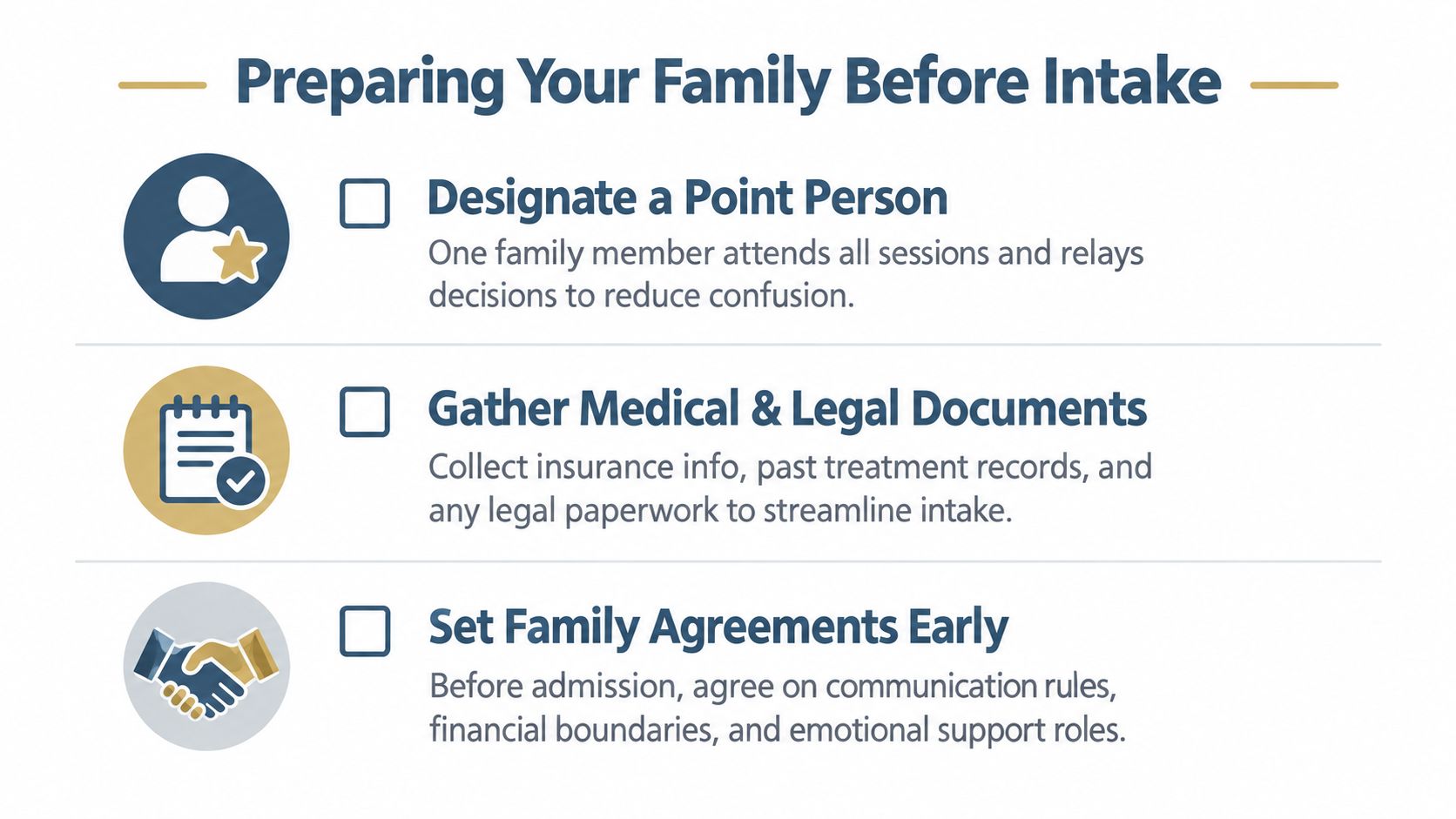
Families can do useful work before admission. They shouldn't wait for the program to create order from chaos.
Three actions that make treatment smoother
Designate one family point person
One person should attend sessions consistently and relay decisions to others. Without that structure, relatives start freelancing. Messages get distorted, and the patient receives three versions of every conversation.Complete the intake history carefully
Prior treatment, psychiatric symptoms, medication history, relationship ruptures, legal stress, and active conflict all shape the family goal set. In a high-end residential setting with private rooms, discreet care, and a highly credentialed team, that information helps clinicians tailor treatment early instead of correcting course later.Set two or three essential home changes before admission
Remove access to problem substances or unsecured prescriptions. Adjust travel or social obligations that undermine treatment. Pause recurring stressors that everyone knows trigger chaos. These are family decisions, not rewards the patient has to earn.
The three trade-offs executive families should weigh
Before intake, most professional households are weighing the same three issues:
| Decision area | What to settle early |
|---|---|
| Privacy protections | Who will know, what will be shared, and who speaks for the family |
| Children's needs | What children will be told and which routines must stay stable |
| Work continuity | What contact is necessary, what can wait, and who will buffer demands |
Some families find it helpful to review outside materials written for parents and loved ones before admission. The therapy guide for Coral Gables parents is one example of family-oriented preparatory reading that can help relatives organize questions before the first clinical meeting.
A luxury private-pay program should also answer practical concerns directly. High-functioning professionals often need a setting where electronics can be retained with clinical oversight, where private rooms are standard in both detox and residential rehab, and where family sessions are integrated into treatment rather than bolted on. Reflections is one example of a California luxury dual-diagnosis program that structures care around those realities for adults who need privacy, strong clinical oversight, and continuity with work and family life.
Families don't need to have the whole plan figured out before intake. They do need to arrive organized, honest, and willing to change their own part of the system.
Reflections provides private-pay luxury detox and residential dual-diagnosis treatment for adults who need serious clinical care without sacrificing privacy, dignity, or continuity with work and family life. Family therapy goals are built into that process through private sessions, structured planning, and continuing care that prepares the household for discharge. Families considering this level of care can learn more by visiting Reflections.