
Family involvement isn't automatically helpful because it's present. A major U.S. review found that family participation is positively associated with children's literacy and math skills, with the strongest effects usually linked to involvement at home rather than school-based participation. The review also connects family involvement with outcomes such as attendance, homework completion, behavior, grades, test scores, and graduation-related measures.
In executive dual-diagnosis treatment, the same principle requires a more deliberate design. Privacy, demanding schedules, travel, board responsibilities, complex family systems, and the resident's clinical needs all shape what meaningful participation can look like. The following family engagement examples show how curated retreats, secure virtual therapy, executive-focused education, confidential consultation, partner treatment, preparation before admission, and continuing-care planning can turn family involvement into a workable clinical process. Reflections' private residential setting, highly accredited multidisciplinary team, private family sessions, monthly educational workshops, private rooms in detox and rehab, and balanced access to cell phones and laptops provide relevant context for professionals who can't step away from every career obligation.
1. Executive-Exclusive Family Retreat Weekends With Clinical Integration
A family retreat can bring an executive's most important relationships into treatment without requiring the resident to abandon weekday professional responsibilities. The strongest version isn't a luxury getaway with a therapy session added. It's a clinically planned weekend that combines private family therapy, psychoeducation, structured conversations, and carefully protected personal time.
Reflections can use the retreat format to help families understand co-occurring mental health and substance use disorders while preserving clinical boundaries. Sessions with Dr. William Hanna and the multidisciplinary team can explore how trauma, anxiety, depression, grief, bipolar symptoms, or substance use patterns affect the family system. Separate meetings with family members, followed by sessions that include the resident, can reveal concerns that might remain hidden in a joint conversation.
Preparation determines the value of the weekend
Families should receive a clear agenda before arrival. A pre-retreat consultation call can identify urgent questions, define appropriate participation, and prevent the weekend from becoming an unstructured confrontation. The team can also ask relatives to document observations about communication, medication concerns, work stress, household responsibilities, and previous attempts to help.
Technology access needs equally careful planning. Reflections' published executive-rehab materials describe structured access to cell phones and laptops, with communication managed clinically rather than granted casually. Executive treatment planning at Reflections describes the need to balance professional obligations with a quiet, discreet treatment environment.
Useful design choices include:
- Scheduled communication windows: The resident can address urgent business matters without allowing work to consume clinical time.
- Family feedback documentation: Clinicians can integrate relevant observations into individualized treatment planning.
- Virtual follow-up sessions: Relatives who can't travel can remain involved after the retreat.
- Clear boundaries: Family members should know which topics belong in therapy and which require separate legal, financial, or business advice.
Practical rule: A retreat works best when the family arrives prepared to participate, not merely to visit.

2. Technology-Enabled Concurrent Family Therapy Sessions
Distance shouldn't automatically exclude a spouse, adult child, or parent from treatment. Secure, clinically managed video sessions can allow family members to participate from home, an office, or another private location while the resident remains in residential care.
The key word is concurrent. A family session shouldn't operate as a disconnected add-on delivered by someone who doesn't understand the resident's treatment plan. When the resident's therapist or connected clinical team leads the session, family-systems work can be coordinated with individual psychotherapy, medication optimization, group treatment, and discharge planning. Families can ask informed questions, practice communication skills, and process difficult interactions while the resident receives support immediately afterward.
Reflections' family therapy for addiction recovery can be positioned within that coordinated model, particularly for high-level professionals whose families are spread across regions or managing their own businesses.
Make virtual participation clinically usable
A technology-enabled session requires more than sending a meeting link. Before the first appointment, staff should conduct a technical orientation and confirm that each participant understands the platform. Family members need private rooms, closed doors, reliable audio, and an agreement not to record or allow unapproved people to listen.
Practical safeguards include:
- Time-zone coordination: Offer several appointment windows rather than expecting the entire family to conform to the resident's schedule.
- Preparatory materials: Send relevant educational documents before the session so relatives can arrive with specific questions.
- Screen sharing: Use visual materials to explain treatment concepts, communication patterns, and agreed-upon next steps.
- Immediate debriefing: Give the resident space after the session to process emotions, clarify misunderstandings, and identify useful clinical themes.
- Secure documentation: Store clinical notes according to privacy requirements, and don't create recordings unless the treatment provider has an appropriate policy and consent process.
Virtual therapy also has limits. A family member who joins from a busy office may appear present while remaining emotionally unavailable. A clinician should address that directly rather than treating attendance as proof of engagement.

3. Customized Executive Family Education Series With C-Suite Peer Learning
Generic addiction education often leaves executive families with unanswered questions. They may understand the basics of substance use disorders yet still need help managing a company, protecting privacy, responding to a partner's absence, or discussing recovery with adult children who have lost trust.
A monthly workshop designed for executive families can address those practical pressures without turning treatment into a business seminar. Reflections' family programming includes private sessions and monthly educational workshops for clients and loved ones. A PhD-level multidisciplinary team can adapt the content to co-occurring conditions, including trauma, PTSD, anxiety, depression, grief, bipolar symptoms, and personality-related traits.
Replace lectures with role-specific problem solving
An executive roundtable format allows families to work through situations that don't fit a standard classroom. One session might address whether a spouse should notify a board. Another might examine how a family can protect children from adult conflict while maintaining honest communication. A separate discussion could focus on succession planning, business-manager communication, or the difference between clinical disclosure and operational disclosure.
The program should also recognize that attendees have different responsibilities:
- Spouses and partners: Managing household decisions, emotional strain, and communication with children.
- Adult children: Supporting a parent without becoming a substitute therapist or business operator.
- Parents: Responding to an adult child's treatment while respecting autonomy.
- Trusted professional advisors: Understanding the limits of clinical information and the need for written authorization.
Families connected to biotech executive leaders may face particularly sensitive questions about leadership continuity, intellectual property, investor communication, and workplace confidentiality. Those matters still require qualified legal and financial advice, but clinical education can help families communicate more effectively with the resident and treatment team.
A workshop should end with a concrete plan, not just insight. Workbooks, role-specific breakout groups, follow-up questions, and a documented family-engagement objective can help clinicians determine whether education is changing participation, communication, or readiness for continuing care.
4. Confidential Family Clinical Consultation Model With Direct Board-Level Communication
Some executive families need a clinical consultation that includes more than immediate relatives. A spouse may be coordinating with corporate counsel. A sibling may be the designated decision-maker. A trusted mentor or business manager may need to understand how communication with the resident should be handled during treatment.
That doesn't give the treatment team permission to discuss protected information freely. The resident must authorize appropriate disclosures, and the clinical team must define what can be shared, with whom, and for what purpose. Family engagement becomes safer when those boundaries are established before a crisis forces rushed decisions.
Reflections' guidance on maintaining confidentiality is relevant to families balancing privacy with legitimate coordination. A clinical consultation can explain treatment structure, communication expectations, warning signs, and family participation without turning clinicians into corporate advisors or legal representatives.
Designated contacts need a documented role
At intake, the resident and treatment team should identify approved family members and clarify whether any external advisors may participate. Each person's role should be recorded, along with consent parameters and limits on clinical disclosure.
A disciplined model may include:
- Stakeholder intake conversations: Understand who manages household, legal, financial, and business responsibilities.
- Separate family consultations: Give key relatives space to raise concerns without placing the resident in the middle of every discussion.
- Resident-inclusive planning: Align operational conversations with treatment goals when the resident can participate productively.
- Written summaries: Provide appropriate recaps to the resident and authorized participants, avoiding unnecessary clinical detail.
- Milestone reviews: Revisit communication needs at the end of detox, during residential treatment, and during discharge planning.
Confidentiality isn't an obstacle to family care. It's the structure that makes sensitive family care possible.
Accreditation can reinforce the seriousness of this process. The Joint Commission's behavioral health standards are assessed through an onsite survey by one or more surveyors who evaluate an organization's compliance with applicable standards. For executive families, external review offers a meaningful quality signal, although it doesn't replace individualized clinical judgment.
5. Integrated Spousal and Partner Dual Enrollment Treatment Option
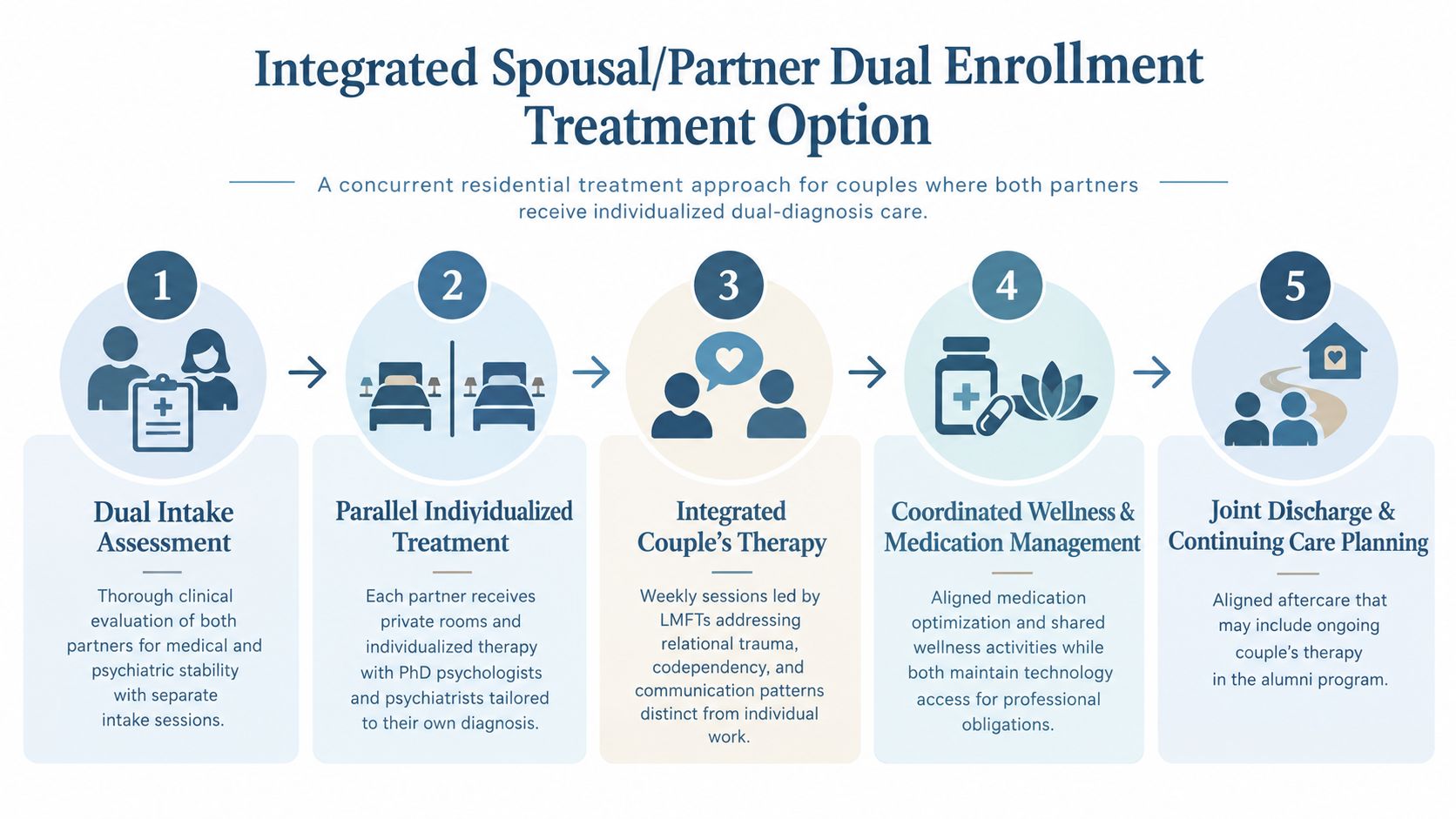
When both partners have co-occurring mental health and substance use disorders, treating only one person may leave important drivers of instability untouched. A couple may share trauma, use substances together, reinforce avoidance, or experience intertwined anxiety, depression, or mood symptoms. In those circumstances, concurrent residential treatment can be considered after separate medical and psychiatric assessments.
The model must not collapse two treatment plans into one. Each partner needs a private room, an individual therapist, independent group participation, and personal peer relationships. Couple's therapy should remain a distinct clinical intervention, led by experienced LMFTs who can assess attachment patterns, codependency, conflict, trauma responses, and enabling behavior.
Reflections' private residential setting offers private rooms for residents in both its detox and rehab programs. That arrangement can support discretion and separation while allowing carefully planned joint work. Residents may also maintain balanced access to electronics, cell phones, and laptops when clinically appropriate, which can help working professionals manage defined obligations without making work the center of treatment.
Separate care protects the couple's treatment
Couple's sessions should be scheduled when both partners have enough emotional capacity to participate. A session immediately after an intense individual process may increase defensiveness or exhaustion. Clinicians should monitor whether one partner is pressuring the other, controlling information, minimizing symptoms, or using treatment access to continue an unsafe dynamic.
A responsible assessment addresses:
- Clinical stability: Determine whether both partners can participate safely in residential care.
- Independent treatment: Keep therapists, groups, and recovery relationships separate.
- Shared-risk patterns: Identify substance access, mutual triggers, financial conflict, and family stressors.
- Children and relatives: Assess how the couple's treatment affects caregiving and support systems.
- Business relationships: Separate marital repair from decisions involving shared companies or professional obligations.
- Continuing care: Create separate recommendations while arranging ongoing couple's therapy where clinically appropriate.
The central trade-off is intensity. Joint treatment may reveal patterns quickly, but it can also amplify conflict. The clinical team should be prepared to pause conjoint sessions and revise the plan if shared participation threatens either partner's safety or progress.
6. Pre-Treatment Family Systems Assessment and Multi-Session Preparation Protocol
Family engagement often fails before admission because relatives arrive with conflicting expectations. One family member expects immediate disclosure. Another expects the resident to return home unchanged. The resident may want privacy, while relatives want answers about finances, parenting, or previous relapses.
A pre-treatment family-systems assessment gives the clinical team time to understand those pressures before residential care begins. Reflections can use virtual or in-person preparation sessions with the resident and selected family members, led by the assigned therapist and treatment-planning team. The assessment should explore family roles, communication habits, trauma history, substance-use patterns, psychiatric concerns, safety issues, and each person's readiness to participate.
Preparation should produce a usable family plan
Families need a written guide explaining what treatment can address, what information requires authorization, how contact will work, and how relatives can raise urgent concerns. The team should also identify relatives whose involvement may be unsafe or clinically disruptive, including people who enable substance use or have engaged in abuse.
The preparation process can include:
- Family mapping: Identify significant relationships, sources of support, conflict patterns, and practical responsibilities.
- Expectation setting: Clarify the difference between supporting recovery and controlling the resident's treatment.
- Readiness assessment: Determine whether a relative needs individual counseling, coaching, or another support resource before joining family sessions.
- Contact planning: Establish appropriate communication frequency, participants, privacy limits, and escalation procedures.
- Treatment integration: Record the family-engagement plan so it remains visible throughout residential care.
- Admission check-in: Revisit questions shortly before arrival and adjust the plan when circumstances change.
The process also needs flexibility for executives. Travel, board meetings, caregiving, and time-zone differences can make in-person preparation difficult. Virtual participation can improve access, but clinicians should still prioritize privacy and avoid conducting sensitive sessions from airports, offices, or shared hotel spaces.
7. Alumni and Continuing Care Family Integration With Tiered Engagement Options
Discharge shouldn't be the point at which family involvement disappears. Residential treatment creates a protected setting for new communication patterns, but families still face work transitions, holidays, anniversaries, social pressure, and uncertainty after the resident returns home.
A tiered continuing-care model lets families choose the appropriate level of involvement instead of forcing every household into the same schedule. Options may include ongoing couple's therapy, family coaching, educational workshops, alumni family events, and targeted booster sessions. Some couples may continue with the original LMFT in an outpatient format. Other families may need periodic coaching or a private virtual event rather than weekly therapy.
Reflections describes treatment lengths that typically range from 30 to 90 days, followed by continuing care, alumni programming, and flexible services. Aftercare planning at Reflections can help families connect residential goals with the routines and pressures waiting after discharge.
Measure participation by usefulness, not attendance alone
A family member can attend every meeting and still reinforce avoidance. Another relative may participate less often but communicate clearly, respect boundaries, and respond appropriately to warning signs. The care team should therefore evaluate whether continuing-care participation supports treatment adherence, family functioning, communication, and safety.
A practical discharge plan can include:
- Family meeting: Review relapse-risk signals, communication boundaries, medication questions, and emergency contacts.
- Assigned coordinator: Provide a consistent point of contact for scheduling and family questions.
- Flexible access: Offer virtual and in-person options for geographically dispersed families.
- Predictable support: Schedule booster sessions around known stressors such as holidays or major work changes.
- Private alumni connection: Use a password-protected community when peer contact is clinically appropriate.
- Escalation protocol: Define what happens if the team observes warning signs during continuing-care contact.
Family engagement is not a promise that every downstream outcome will improve. A systematic review of randomized controlled trials found favorable outcomes across 11 studies, including reduced substance use and improved family functioning, and one synthesis translated the pooled effect into a 5.7% reduction in substance-use frequency sustained for up to 12 to 18 months after treatment. The review supports structured involvement while also underscoring the need to track concrete outcomes rather than assume that more contact is always better.
7-Point Comparison of Family Engagement Models
| Model | Implementation complexity | Resource requirements | Expected outcomes | Ideal use cases | Key advantages |
|---|---|---|---|---|---|
| Executive-Exclusive Family Retreat Weekends with Clinical Integration | High, coordination of weekends, clinical scheduling | Very high, luxury suites, PhD clinicians, wellness staff | Strong family alliance, improved aftercare adherence | High-profile executives needing discretion and minimal work disruption | Discreet, upscale environment; direct family observation of care |
| Technology-Enabled Concurrent Family Therapy Sessions | Moderate, telehealth workflows and scheduling | Moderate, secure platform, clinician time, tech support | Greater access and continuity; reduced travel burden | Geographically dispersed families and international executives | Flexible, scalable, cost- and time-efficient; session documentation |
| Customized Executive Family Education Series with C-Suite Peer Learning | Medium-high, curriculum design and confidentiality management | Moderate-high, educators, peer facilitators, materials | Reduced stigma, increased family competence and accountability | Executive families seeking peer learning and business-specific guidance | Targeted content, peer credibility, professional framing |
| Confidential Family Clinical Consultation Model with Direct Board-Level Communication | High, strict protocols, legal and ethical oversight | High, senior clinicians, secure HIPAA channels, advisor coordination | Stabilized business operations; reduced executive anxiety | C-suite clients with business/legal implications or board concerns | Strategic clinical input for decision-making; preserves confidentiality |
| Integrated Spousal/Partner Dual Enrollment Treatment Option | High, synchronized individual and couples programming | Very high, double residential capacity, specialized clinicians | Systemic healing, lower mutual relapse risk, strengthened relationships | Couples where both have co-occurring disorders and resources to enroll | Treats both partners simultaneously; addresses shared trauma and dynamics |
| Pre-Treatment Family Systems Assessment and Multi-Session Preparation Protocol | Moderate, scheduling multiple pre-admission sessions | Moderate, clinician time pre-admission, assessment tools | Clear expectations, tailored family plan, fewer early discharges | Complex family/business systems and high-stakes admissions | Early alliance-building; targeted risk identification and planning |
| Alumni/Continuing Care Family Integration with Tiered Engagement Options | Moderate, ongoing program management and tiers | Moderate-high, coordinators, events, telehealth infrastructure | Sustained recovery support, relapse prevention, long-term monitoring | Post-discharge families needing ongoing support and accountability | Long-term engagement options; flexible tiers and alumni community |
Turn Family Participation Into a Recovery Continuum
The most useful family engagement examples follow a sequence rather than a single event. Before admission, the team can assess family dynamics, identify safe and appropriate participants, explain confidentiality, and establish expectations. During residential treatment, the family can join an in-person retreat, secure virtual therapy, private consultation, or education workshop, depending on clinical need, geography, and schedule.
Privacy should remain central throughout. An executive may need to manage a limited business obligation, but that access should be structured so urgent work doesn't displace treatment. Reflections' published luxury-rehab materials state that executives can keep working with structured access to cell phones and laptops while in residential treatment, and that the facility provides private family sessions, education, and private rooms for residents in both detox and rehab. Reflections' executive residential care information presents those features as part of a discreet setting for professionals who need individualized coordination.
The clinical team should also distinguish family participation from family control. Relatives can provide valuable history, learn how to respond to symptoms, and support discharge planning. They can't make every treatment decision, override the resident's privacy rights, or substitute business advice for clinical care. The best plans define roles clearly and revisit them as the resident stabilizes.
Evidence supports a measured approach. A research brief on Brief Strategic Family Therapy reported 93% family engagement and 75% treatment completion, compared with 42% engagement and 25% completion under usual approaches, and reported a meta-analytic finding of a 6% greater reduction in substance use when family or significant-other approaches were used instead of individual-only treatment. The research brief illustrates why engagement methods should be intentional, not merely available.
For affluent executives and C-suite professionals, individualized care may require private rooms, discreet admissions, managed technology access, flexible scheduling, secure communication, and a continuing-care plan that includes the family before discharge. A luxury dual-diagnosis provider such as Reflections can be evaluated on whether its accredited clinical team aligns those operational needs with evidence-based treatment, confidentiality, and long-term recovery planning.
Reflections offers private residential detox and rehabilitation, private family sessions, monthly educational workshops, managed access to cell phones and laptops, and continuing-care planning for adults with co-occurring mental health and substance use disorders. Families seeking discreet, individualized support for an executive or working professional can visit Reflections to explore how family participation can be coordinated with clinical needs and professional responsibilities.