
The call often comes after months of strain. A spouse has been covering missed dinners with polished excuses. An adult child has noticed irritability, secrecy, or drinking that starts too early. The professional at the center of it all is still performing well enough in public that outsiders would never guess anything is wrong.
That combination is common in executive households. Success can hide deterioration for a long time.
Families in this position usually aren't asking for drama. They're asking for a way forward that protects dignity, respects privacy, and works. That's where family therapy for addiction recovery becomes far more than a supportive add-on. In a high-end residential setting, it becomes a structured clinical process that helps the whole household stop reacting to the crisis and start changing the conditions that keep it going.
An Introduction to Family Healing in Addiction Recovery
When addiction enters a high-functioning family, the damage rarely looks chaotic at first. It looks controlled. Calendars stay full. Deals close. Children get to school. The person struggling may still sound sharp on conference calls and still show up in well-fitted clothing, even while the family system is subtly reorganizing around substance use.
One person starts smoothing over conflicts. Another stops bringing up concerns because every conversation turns defensive. Someone else becomes hypervigilant, checking tone of voice, sleep patterns, and whether a glass has been refilled. Over time, the family stops relating naturally and starts managing around the addiction.
That's why family therapy isn't a lecture session or a formalized confrontation. It's a clinical method for understanding how the family has adapted, what those adaptations are costing everyone, and how to rebuild a healthier home environment before the executive or professional returns from treatment. Families who want a basic introduction to the broader counseling process can also review Interactive Counselling's family therapy, which gives a helpful picture of how structured family work differs from everyday conflict resolution.
What family healing actually targets
A well-run program looks beyond blame. It addresses patterns such as:
- Protective secrecy: Family members conceal problems to preserve reputation, avoid embarrassment, or keep work and social circles insulated.
- Role distortion: A spouse becomes a monitor instead of a partner. A child becomes a peacekeeper. The professional with the substance problem becomes the emotional center of every room.
- Communication collapse: Conversations become tactical rather than honest. People speak to prevent escalation, not to tell the truth.
Family therapy works best when the question shifts from “Who caused this?” to “What pattern are all of us stuck in?”
For affluent families, the setting matters. Privacy, discretion, and thoughtful scheduling reduce the likelihood that family work becomes another source of stress. Programs that integrate private family services during treatment can help loved ones participate without turning recovery into a public event or disrupting essential obligations more than necessary.
Why Family Therapy Is Essential for Lasting Recovery
Family involvement changes outcomes. That isn't wishful thinking. It's one of the clearest findings in addiction treatment.
A landmark 2013 meta-analysis published in Addictive Behaviors found that family involvement in addiction treatment increases completion rates by an average of 33%, and Behavioral Couples Therapy has been shown to cut relapse rates roughly in half over a 12-month period compared to individual treatment alone, according to the cited summary of that research. For families of executives, that matters because treatment only helps when the person remains engaged long enough to do the work.
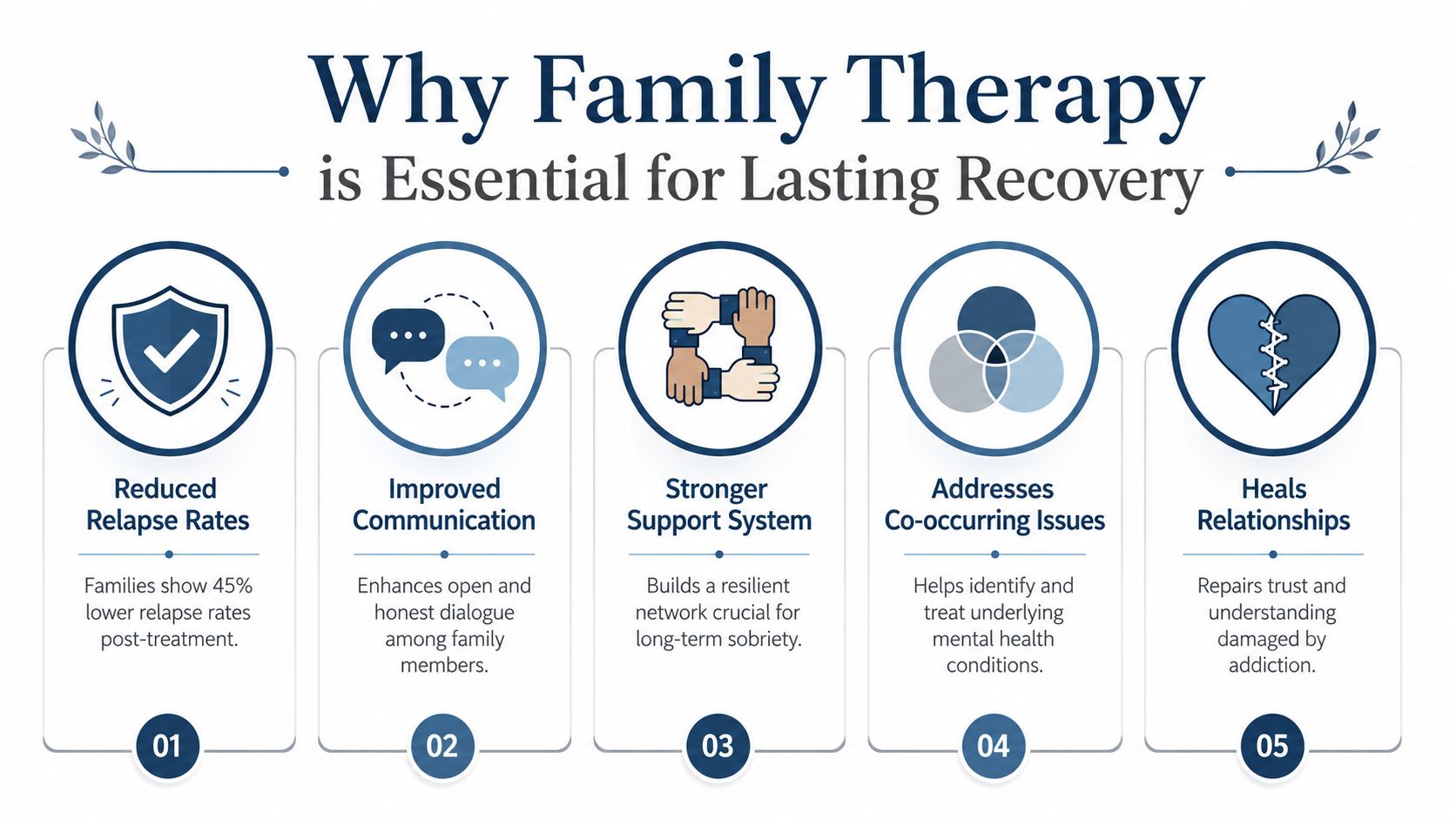
The phrase “family disease” can sound accusatory, but clinically it means something simpler. Addiction changes the whole system. It alters trust, routines, emotional tone, boundaries, and decision-making. If treatment focuses only on the individual and sends that person back into an unchanged environment, the household often resumes the same pressure points that supported use in the first place.
Why retention and relapse are tied to the household
The family often controls key parts of the recovery environment after discharge. That includes whether limits are clear, whether alcohol or other substances remain present in the home, how conflict gets handled, and whether early warning signs are ignored or addressed.
In practical terms, family therapy helps relatives stop doing three things that commonly undermine progress:
- Reacting only at the point of crisis: Waiting for another blowup, binge, or work incident keeps the family in emergency mode.
- Confusing support with rescue: Paying for consequences, cleaning up messes, or softening every impact can preserve the problem.
- Expecting trust to return instantly: Families often want reassurance fast. Recovery rarely works on that timetable.
What families gain from participating
The biggest shift is that loved ones stop guessing. They learn what supports recovery and what subtly undermines it.
A strong family process can help relatives:
- Recognize relapse risk earlier: Not by policing, but by learning what changes in mood, routine, and communication often come first.
- Respond consistently: Mixed messages create openings for manipulation, avoidance, and resentment.
- Rebuild credibility slowly: Trust returns through repeated behavior, not emotional promises.
Practical rule: The goal isn't to make home feel comfortable on day one. The goal is to make home predictable, honest, and safe enough for recovery to continue.
For high-achieving families, this structure is especially important. Executive households often have more resources, but they also face more image pressure, more scheduling complexity, and more temptation to treat treatment as a contained event rather than a systemic reset.
Exploring Evidence-Based Family Therapy Models
Families often hear the phrase “family therapy” as if it were one thing. It isn't. Different models solve different problems. In high-caliber treatment, the clinician chooses the model based on the patient's substance use pattern, relationship structure, psychiatric history, family roles, and readiness for change.
Behavioral Couples Therapy
Behavioral Couples Therapy, often called BCT, is one of the most useful models when the primary family unit is a committed couple and both people are willing to work in a structured way. It doesn't rely on vague promises. It uses concrete routines, including a daily Recovery Contract, to reinforce abstinence and medication adherence.
According to the clinical review on BCT and related family approaches, this model is associated with increased abstinence rates, improved relationship functioning, and decreased domestic violence. That combination matters because sobriety and relationship safety often rise or fall together.
A simple way to think about BCT is this: it replaces emotional guesswork with agreed behavioral steps. Instead of asking a partner to become a detective, it gives both people specific responsibilities that support recovery.
CRAFT and family engagement
Community Reinforcement and Family Training, or CRAFT, is often helpful when a loved one is resistant, ambivalent, or not yet fully participating. Rather than pushing the family to argue harder, CRAFT teaches people to respond more strategically.
This can include:
- Reinforcing healthy behavior: Family members learn to notice and strengthen moments of responsibility, honesty, and treatment engagement.
- Reducing unhelpful reinforcement: Relatives stop accidentally rewarding intoxication, avoidance, or manipulation.
- Improving communication timing: Hard conversations are moved away from moments of crisis and into calmer, more productive windows.
CRAFT is especially useful in executive families because power struggles can become intricate very quickly. A highly verbal, high-status professional can out-argue worried relatives while still avoiding treatment. CRAFT changes the family response so the discussion doesn't depend on winning a debate.
Adolescent and whole-family models
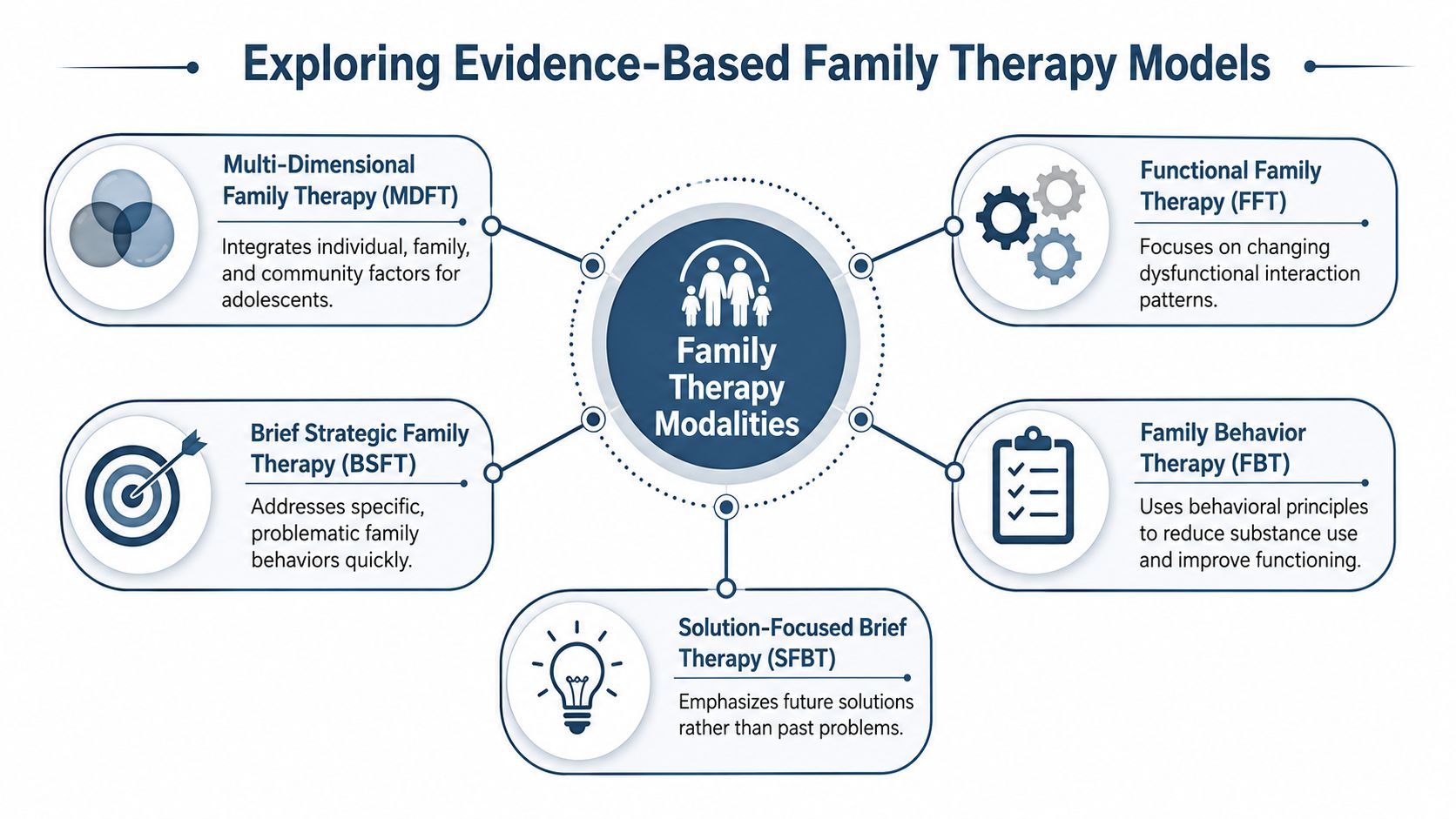
When the patient is younger, or when the household is intricately entangled, broader family models may be more appropriate. Approaches such as MDFT and BSFT focus on engagement, relationships, reframing, and changing family interactions. They aim to alter the patterns that keep conflict, avoidance, and substance use locked together.
Some programs also use behaviorally grounded work such as Family Behavior Therapy in addiction treatment, which is useful when the family needs practical tools for changing daily routines, home expectations, and reinforcement patterns.
The most effective model is the one that matches the family's actual structure, not the one with the most appealing name.
For executives and other professionals, the clinical question isn't just which model is evidence-based. It's which model can be delivered confidentially, with enough precision to fit a family that may be spread across cities, juggling work demands, and carrying significant reputational concerns.
What to Expect in Family Therapy Sessions
Most families arrive with two fears. The first is that the session will turn into a blame exercise. The second is that the therapist will force disclosures before anyone is ready. In a competent program, neither should happen.
Family sessions are structured, confidential, and guided by a clinician whose job is to manage process as much as content. That means setting limits on interruptions, slowing down accusations, identifying what's factual versus assumed, and keeping the discussion tied to treatment goals rather than old arguments that go nowhere.

The first sessions
Early sessions usually focus on assessment. The therapist is listening for roles, pressure points, and recurring loops. Who withdraws when tension rises? Who over-functions? Who softens consequences? Who speaks for everyone else?
Families are often surprised that the clinician pays as much attention to process as to story. The exact details matter, but so does how the family talks about them. Tone, timing, interruption patterns, and emotional alliances often reveal more than the argument itself.
A first phase may include work such as:
- Mapping communication patterns: The therapist identifies how conflict escalates, stalls, or gets redirected.
- Clarifying roles: Families learn where caregiving, rescuing, monitoring, and avoidance have replaced healthier boundaries.
- Setting immediate agreements: This may include rules about honesty, home triggers, finances, and communication after discharge.
The middle phase
Once the family understands the pattern, sessions become more active. People practice new language in real time. A spouse may learn how to state a limit without threat. A parent may learn how to stop interrogating and start asking direct, answerable questions. The patient may practice acknowledging harm without collapsing into shame or defensiveness.
This work can feel deceptively simple. It isn't. Changing a long-standing family pattern is emotionally demanding because each person has to give up a role that once felt necessary.
A useful session doesn't always feel comfortable. It often feels clearer.
A common misconception is that a short stay should be enough to repair the family system. Clinical guidance on family therapy outcomes indicates that 90 days or more on average is the minimum effective treatment duration for positive outcomes because the family needs time to restructure its social environment and dismantle dysfunctional communication patterns, as outlined in the SAMHSA treatment guidance excerpt. That doesn't mean every family needs the same format for the same length, but it does mean meaningful change usually outlasts an initial residential episode.
What helps sessions work
The families who benefit most tend to do a few things consistently.
| Focus | What helps | What gets in the way |
|---|---|---|
| Honesty | Speaking plainly about impact | Protecting image at all costs |
| Boundaries | Following through on limits | Making emotional exceptions |
| Pace | Accepting gradual trust repair | Demanding immediate normalcy |
For high-achieving families, the hardest part is often tolerating a slower timeline than their professional lives reward. Recovery doesn't move at the pace of a board decision or a legal response. It moves at the pace of earned stability.
Choosing a Program for the High-Achieving Family
Most family therapy content assumes the family can clear the calendar, attend open programming, and operate without concern for confidentiality. That doesn't reflect the reality of executives, public-facing professionals, physicians, attorneys, founders, or senior leaders whose names, roles, and responsibilities create additional risk.
Mainstream literature also leaves a major gap here. It doesn't offer much guidance on privacy-preserving family therapy protocols for high-profile professionals who need work continuity during a 30 to 90 day residential stay, as noted in this discussion of family therapy limitations for executives. For many families, that gap is the difference between seeking treatment and delaying it.

What matters in an executive-focused program
A high-end private-pay setting should solve practical problems, not just provide comfort. For this clientele, the essential questions are clinical and operational.
A family evaluating a program should look for:
- Private rooms in detox and rehab: Privacy reduces stress and supports discretion from the first day forward.
- Electronics access with clinical structure: Some professionals can't vanish from work entirely. Programs should have a thoughtful framework for cell phones and laptops rather than a rigid all-or-nothing stance.
- High-acuity dual-diagnosis capability: Executive performance often masks trauma, anxiety, depression, PTSD, or other psychiatric issues that need integrated treatment.
- Family scheduling flexibility: Sessions may need to happen privately, sometimes virtually, and around demanding calendars.
- A credentialed multidisciplinary team: Family work involving high-conflict dynamics, image sensitivity, and co-occurring disorders requires experience, not generic facilitation.
Cost and meaning in luxury care
Luxury treatment is expensive, and families should be clear-eyed about why. Executive luxury rehab programs typically cost over $1,000 per day, with some facilities reaching up to $3,500 daily, according to this overview of executive luxury rehab pricing. In a serious program, those costs reflect individualized clinical staffing, privacy protections, and continuous access to complex care rather than décor alone.
That distinction matters. A household dealing with addiction, trauma, and professional exposure doesn't need hospitality masquerading as treatment. It needs a confidential environment where family work can happen without spectacle and without forcing the client to abandon every career responsibility overnight.
One option in this category is Reflections, a California-licensed, Joint Commission-accredited residential program for adults with co-occurring mental health and substance use disorders that includes private family sessions, monthly family education, appropriate electronics access, and private rooms in both detox and rehab. Those are practical features for families who need discretion and ongoing work continuity while treatment is underway.
In executive care, privacy isn't a luxury feature. It's part of clinical access. If a program can't protect confidentiality, some families won't engage fully enough for treatment to work.
How to Participate for Maximum Impact
Family members often enter treatment focused on one question: how to help the person who's struggling. That instinct is understandable, but it's incomplete. The most helpful relatives also examine their own patterns, because family therapy for addiction recovery works best when every participant is willing to change something.
The mindset that helps
Families usually make the strongest contribution when they:
- Stay honest without becoming harsh: Clear language works better than emotional overstatement.
- Practice skills between sessions: A good session creates direction. Real change happens at home, on calls, and during ordinary conflict.
- Respect boundaries even when anxious: Repeated checking, over-monitoring, or bargaining often re-creates instability.
- Accept that repair is behavioral: Trust comes back through repeated consistency, not one dramatic conversation.
A useful way to support the process is to rebuild healthy connection outside crisis mode. Structured, low-pressure activities can help families relearn cooperation without turning every interaction into a treatment discussion. Resources like Soul Shoppe's cooperative game guide can give families simple ways to practice teamwork and shared attention.
What to avoid
Some habits look caring but often backfire.
- Don't make every contact a status check: The relationship can't survive if every call feels like surveillance.
- Don't demand reassurance on command: The recovering person may need to show stability before they can speak about it convincingly.
- Don't ignore your own support needs: Family members who neglect themselves often become reactive, resentful, or depleted.
Families who want to understand the relational side of this work better can explore guidance on relationships during recovery, especially when trust, intimacy, and daily expectations are all being renegotiated at once.
Frequently Asked Questions About Family Therapy
Can family therapy help when trauma or PTSD is part of the picture
Yes, but families should be realistic about the evidence base. There's minimal data on how family sessions specifically address co-occurring trauma or PTSD symptoms that fuel substance use. Still, trauma-informed family therapy guidance supports examining family structures and communication patterns that may inadvertently maintain trauma responses. In practice, that means the therapist watches for trigger cycles, control struggles, emotional shutdown, and home environments that keep the nervous system on alert.
What if one family member refuses to participate
Treatment can still move forward. A resistant spouse, parent, or adult child doesn't cancel the process. The therapist can work with the participating members first, clarify boundaries, improve communication, and reduce behaviors that reinforce substance use. Resistance often softens when the tone shifts from blame to structure.
Are family sessions the same as family support groups
No. Family sessions are clinical, confidential, and designed for one household's dynamics. Support groups can be valuable, but they're broader, less individualized, and not designed to address the specific interaction patterns, psychiatric concerns, or privacy needs of a particular executive family.
How private are family sessions in a residential setting
That depends on the program design. High-achieving professionals often need controlled scheduling, limited exposure, and a setting that doesn't force them into public-facing family programming. The more visible the client's role, the more important it is that the family process be discreet, clinically managed, and adaptable to work obligations.
Families don't need to choose between serious clinical care and professional discretion. Reflections provides private-pay, luxury dual-diagnosis treatment for adults who need confidential residential care, private rooms in detox and rehab, appropriate access to electronics for work continuity, and structured family involvement that supports long-term recovery without unnecessary exposure.