

A 30-day luxury residential program in the U.S. typically runs $30,000 to $90,000 in 2026, and boutique California programs can sit in the $40,000 to $70,000 monthly range, with ultra-premium executive tiers going far higher. The spread is wide because luxury pricing isn't just about therapy, it's about privacy, staffing, detox capability, room type, and whether the client needs a program that can coexist with real career obligations.
That's the reality for the executive who can't disappear for three months without planning, the family member trying to compare brochures, and the referral source trying to separate a true clinical program from a polished facility. The right question isn't whether luxury rehab is expensive. The right question is what the premium buys, and which parts are essential.
What Luxury Treatment Actually Costs in 2026
Luxury treatment sits in a completely different price band from standard residential care. A 30-day stay is commonly $30,000 to $90,000 in the U.S., while standard residential or inpatient care is often $15,000 to $38,000. Some ultra-luxury programs can exceed $100,000 for a month, and the ultra-premium single-client tier can reach $500,000 per month or more in rare cases. Those aren't cosmetic differences, they reflect a different cost structure altogether, from staffing intensity to privacy architecture to the kind of clinical infrastructure a program maintains.
The practical way to read a quote is simple. If a facility is closer to the low end of luxury, the premium usually comes from upgraded housing, a strong clinical team, and better privacy. If the number climbs fast, it usually means more fixed costs are being absorbed by fewer clients, especially in single-occupancy or near-private settings.
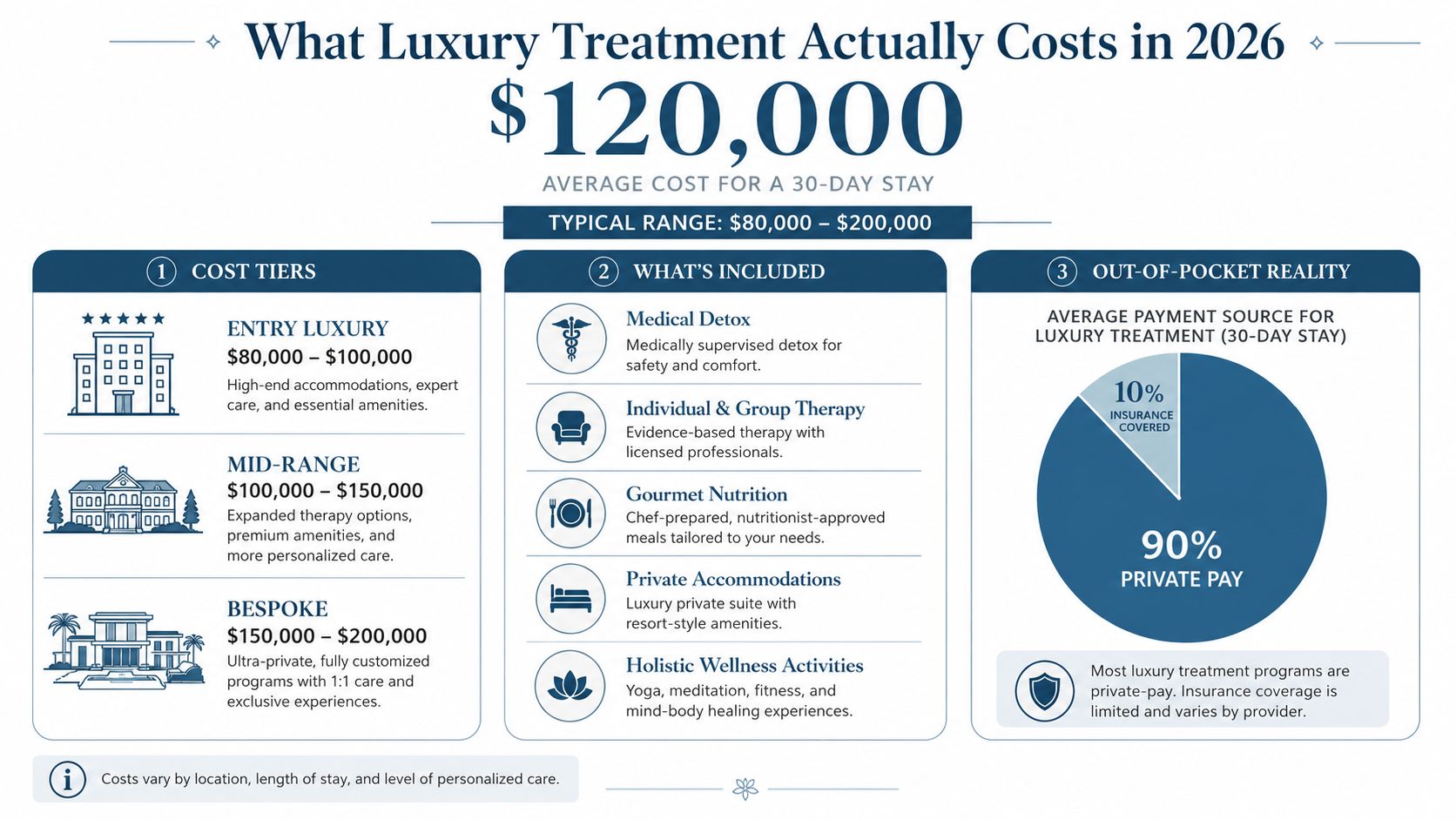
The best starting point is to compare the sticker price against the level of care, not against a brochure headline. A luxury program can look expensive until it's matched against the cost of private rooms, a lower client census, and clinically managed detox. For context on broader treatment pricing, a general rehab cost guide can be useful for comparison through this average cost of addiction treatment overview.
Practical rule: if a quote doesn't tell a buyer whether the number includes detox, psychiatric support, and continuing care planning, it's incomplete.
For executives and high-earning professionals, that gap matters. A program that allows work continuity, keeps information discreet, and maintains a high clinical standard will almost always cost more than a plain residential bed. The buyer should budget for the environment that's needed, not the environment that looks nicest in a photo gallery.
The Real Cost Drivers Behind the Price Tag
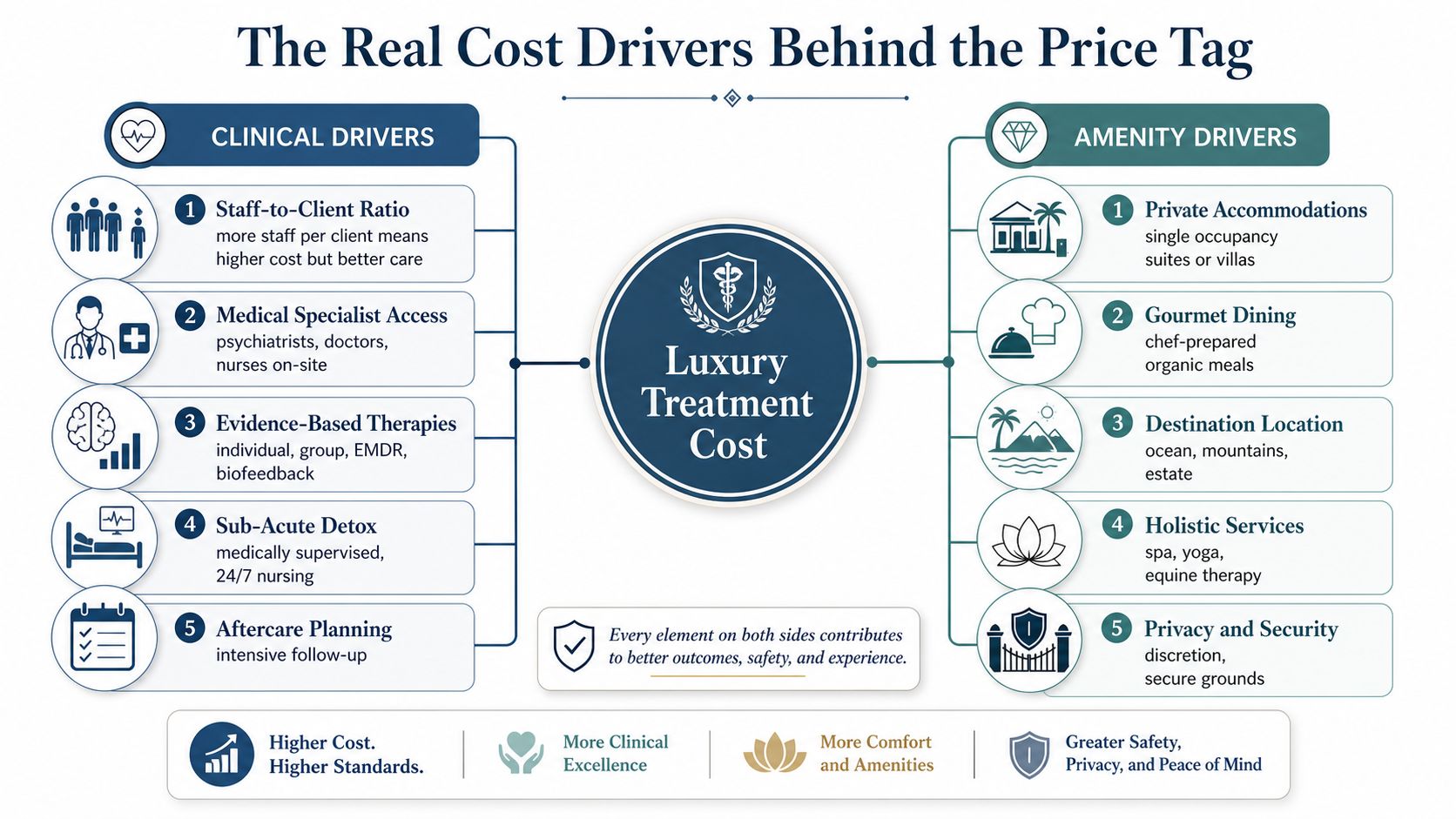
Luxury rehab pricing gets inflated by two different categories of expense, clinical drivers and amenity drivers. Buyers need to separate them fast. A program can be clinically excellent without being extravagant, and it can be lavish without being clinically strong. The quote only makes sense when those layers are pulled apart.
Clinical drivers that move the number
The first major driver is staff-to-client ratio. More clinicians per resident means more direct attention, more one-on-one time, and a higher payroll burden. The second is medical specialist access, because psychiatrists, physicians, nurses, and medication management all add real operating cost. Sub-acute detox raises the price as well, since around-the-clock monitoring and withdrawal management are more resource-intensive than therapy alone.
Other clinical cost drivers are easier to overlook. Evidence-based therapies such as individual therapy, group work, trauma treatment, and adjunctive modalities require licensed staff and structured programming. Aftercare planning also adds cost when it's done well, because discharge coordination, family work, and step-down planning take time and expertise. Historical cost data show how much structure matters, with one peer-reviewed study finding an average daily cost of $618, but $758 per day in for-profit programs versus $357 per day in nonprofit programs, and upfront requests of about $17,434 versus $5,712 respectively (peer-reviewed residential program cost study).
Amenity drivers that raise the premium
The second category is all the nonclinical expense layered on top. Private accommodations cost more than shared rooms, especially when every resident gets a single suite. Gourmet dining and chef-led meal service add labor and food cost. Destination location matters too, because coastal, mountain, and estate-style settings carry a higher overhead than plain institutional space.
Privacy and security are a major line item in executive care. So are concierge services, transportation coordination, and residential design that supports discretion. For working professionals, electronics access is not a perk, it's often part of the purchase, because maintaining career obligations can be the reason treatment is possible at all. A program like Reflections, which keeps clients connected with appropriate electronics access and uses a multidisciplinary clinical team, fits that executive-care model rather than a resort-only model.
A buyer should ask one blunt question, what part of this price is clinical necessity, and what part is hospitality.
That distinction matters because a gorgeous property doesn't make a program worth the premium by itself. A strong admissions team should be able to explain exactly why the cost is higher, line by line, without hiding behind vague language. If they can't, the buyer is probably paying for branding rather than substance.
Luxury Tiers Compared
The phrase “luxury rehab” covers more than one market tier, and that's where buyers get misled. The everyday private-pay program, the boutique dual-diagnosis program, and the ultra-premium executive residence are not interchangeable. Each one solves a different problem, and each one carries a different privacy standard, staffing model, and ceiling on price.
Luxury Treatment Tiers at a Glance
| Tier | Staff-to-Client Ratio | Privacy Level | 30-Day Price Range |
|---|---|---|---|
| High-end private rehab | Lower than standard residential | Private or semi-private | $30,000 to $90,000 |
| Boutique luxury dual-diagnosis care | Higher-touch, more individualized | Private rooms, discreet setting | $40,000 to $70,000 in boutique California markets |
| Ultra-premium executive or single-client residential | Full team per client or near-singular attention | Maximum privacy, sometimes single-client care | $100,000+, with some programs reaching $500,000 per month or more |
The first tier is the most common luxury bucket. It usually offers upgraded housing, better staffing, and a private-pay structure that still resembles mainstream residential treatment. The second tier is where the clinical and privacy premium becomes obvious. That's the level many executives need, because co-occurring mental health and substance use disorders require more than a pleasant room.
The third tier is a different product entirely. It's built for people who need the highest level of discretion, exceptional staffing density, and full-service residential management. For a client who must remain operational, protected, and clinically supported at the same time, that tier can make sense. For someone who mainly wants a nicer setting, it's usually overkill.
The useful question is not “What's the fanciest option?” It's “What level of privacy and clinical intensity does this person need?” A family paying for executive care should not pay for a single-client model unless there's a genuine privacy or clinical reason to do so. The most expensive room in the market is not automatically the smartest placement.
For buyers comparing programs, a useful reference point is how a program explains its clinical model and privacy structure. A clear overview of what distinguishes a true luxury setting from a decorated residential home is available through this luxury rehab centers comparison guide.
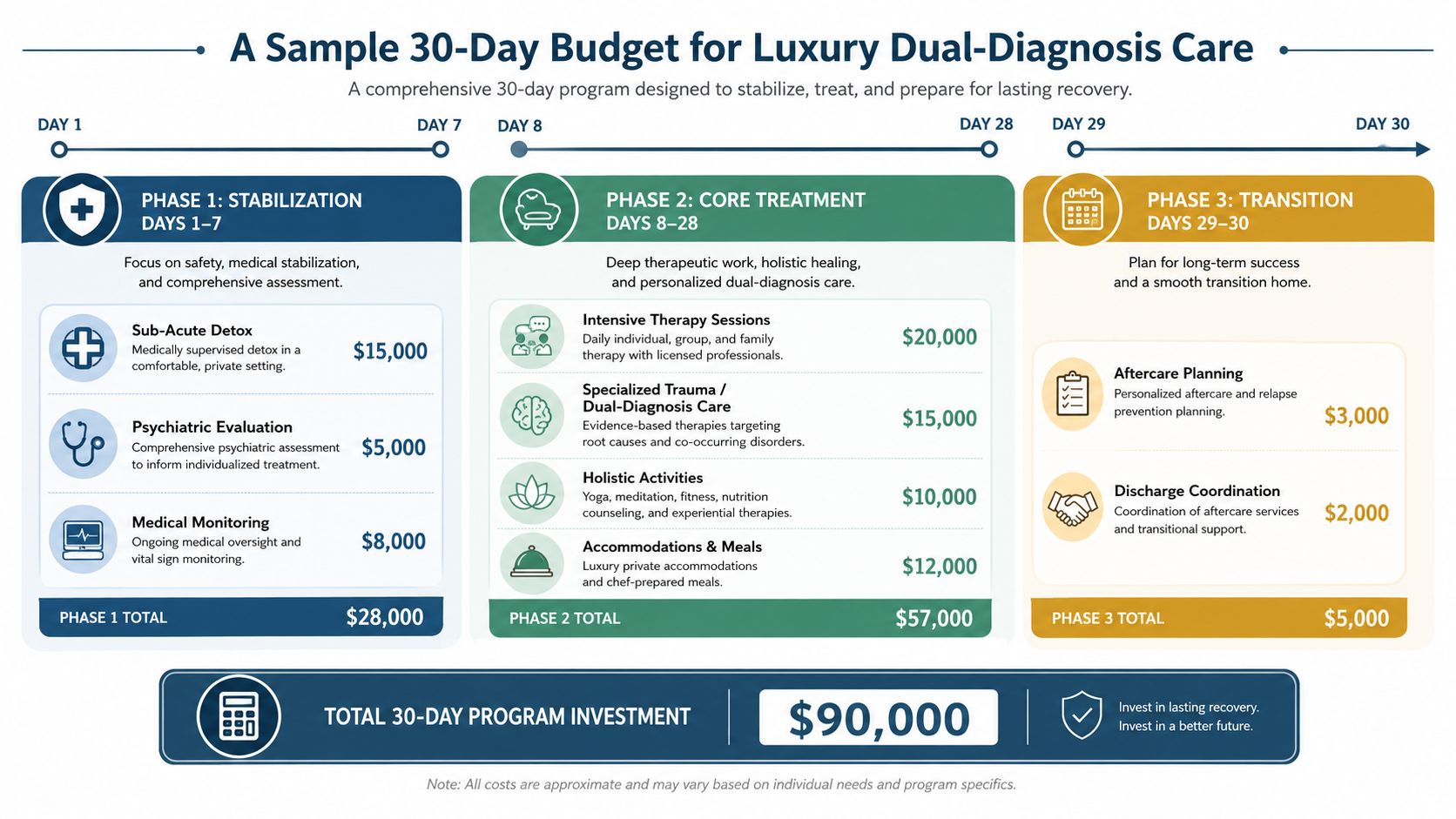
A Sample 30-Day Budget for Luxury Dual-Diagnosis Care
A realistic 30-day luxury dual-diagnosis stay should be budgeted as a bundle, not as a single line item. For a working professional, the bill is usually driven by several pieces at once, detox, psychiatric oversight, therapy, housing, and transition planning. That's why a quote that looks high at first can make sense once the program starts stacking real services.
How the month usually breaks down
The first week is stabilization. If the resident needs sub-acute detox, medical monitoring, and a psychiatric evaluation, the cost starts moving quickly because the program is absorbing medical risk right away. The middle of the month is where the clinical labor concentrates, individual therapy, group work, trauma treatment, and medication optimization if needed. The last days are about discharge planning, aftercare coordination, and family alignment so the person doesn't leave blind.
The available cost ranges show why the total climbs as soon as length of stay extends. Independent treatment-cost research places adult residential substance-use treatment at $607 to $918 per week and $2,907 to $11,260 per episode, while therapeutic community residential care can reach $14,818 to $32,361 per episode (treatment cost research). Luxury programs sit above that because they layer privacy, hospitality, and higher staffing intensity on top of residential treatment economics.
The biggest multiplier is still length of stay. A 30-day stay is one thing, 60 and 90 days change the budget fast because the daily rate keeps compounding.
Here's how to think about it without pretending every program prices the same way. If a 30-day stay is already in the luxury tier, then 60 days is not a mild extension, it's a second month of housing, staffing, therapy, and oversight. 90 days is a serious commitment, and for executives with dual diagnoses it often reflects the time required to stabilize, treat, and transition without rushing the process.
A budget-savvy buyer should ask for a written estimate that separates clinical services from room and board. That makes it easier to see whether the highest part of the bill is coming from medical work, privacy, or extras. It also keeps families from comparing a luxury quote to a standard residential quote as if they were the same product.
Insurance, Verification, and Financing the Investment
Most luxury programs are still private pay at the core, even when they accept insurance. That's the part families need to understand before they assume the brochure and the billing desk will tell the same story. The premium setting may be fully justified clinically, but insurance rarely erases the gap between a luxury fee and mainstream coverage.
The right first step is verification of benefits. Insurance should be checked for behavioral health coverage, out-of-network benefits, deductible status, and any preauthorization requirements before admission. A good admissions office will spell out what part of care is clinically billable and what part is a private-pay responsibility. For a straightforward billing explanation from a treatment provider, the Empire Medical Wellness billing details page is a useful example of how admissions teams often outline fees, coverage, and payment expectations.
What to verify before a deposit is made
- Coverage scope: confirm whether detox, residential care, and psychiatric services are covered.
- Network status: ask whether the program is in-network, out-of-network, or self-pay only.
- Resident responsibility: get the expected out-of-pocket amount in writing.
- Payment timing: clarify deposit terms, payment schedules, and refund rules.
- Aftercare costs: budget for step-down care, because discharge doesn't end the financial plan.
There are practical financing options, but none of them should be treated as magic. HSAs and FSAs may help with eligible medical expenses, and some families use payment plans or self-pay structures to manage timing. The bigger mistake is assuming the insurer will pay for the luxury layer in full. Insurance may help with medically necessary services, but private rooms, enhanced privacy, and concierge-style features are often where the gap remains.
For a deeper look at how coverage is handled in addiction treatment settings, use this insurance coverage overview for addiction treatment. It helps buyers separate benefit verification from wishful thinking. That distinction saves time, money, and a lot of false confidence.
Key Questions to Ask Any Luxury Program
A luxury brochure can look polished and still tell a buyer almost nothing about quality. The questions that matter are the ones that expose clinical depth, not wallpaper. Admissions teams should answer them directly, and if they dodge, the buyer should keep moving.
Start with accreditation and leadership. Ask whether the facility is Joint Commission accredited, who runs the clinical program, and whether the lead clinicians are on-site or remote. Then ask about staffing ratios, because an upscale room means little if the clinical contact is thin. A program serving executives should be able to explain how physicians, psychiatrists, therapists, and addiction counselors coordinate care.
The next group of questions should target actual treatment capability.
Ask what happens on day one, not just what the campus looks like.
The buyer should know whether the facility handles detox in-house, how it approaches medication-assisted treatment, and whether it has a clear philosophy around medication optimization. For dual-diagnosis clients, the program should also be able to explain how it treats trauma, depression, anxiety, bipolar symptoms, or other co-occurring concerns without fragmenting care.
Then ask the practical questions that matter to working professionals. Can the resident keep electronics? Is there an electronic access policy that allows career continuity without compromising treatment? Is there private room availability in both detox and rehab? Are family sessions built in, and is continuing care arranged before discharge? A program that takes executive care seriously should have a clear answer to all of that.
Red flags are easy to spot once the questions get specific. Vague answers about staffing, no clear detox plan, unclear privacy rules, or a marketing pitch that never mentions aftercare should all raise concern. The strongest programs sound organized, not evasive. They know that families are buying clinical credibility, not just an upscale address.
Making the Right Decision for Executives and Families
The right luxury program is the one that matches clinical need, privacy need, and work reality. For an executive, that usually means a program that can manage dual diagnosis, preserve confidentiality, and allow appropriate electronic access without turning treatment into a distraction. For families, it means choosing care that is rigorous enough to address the problem instead of only softening the environment.
A smart decision starts with one simple filter. If the person needs detox, psychiatric support, and structured dual-diagnosis treatment, the buyer should not shop on aesthetics alone. If the person is a high-profile professional, privacy and staffing density may justify a higher tier. If the person just needs a stable reset, the most expensive option is not automatically the best one.
Reflections fits that executive-and-family use case by combining a private residential setting, clinically managed sub-acute detox when appropriate, dual-diagnosis treatment, and appropriate access to electronics so residents can stay connected to work and family obligations. That is the kind of structure many high-earning clients need, because treatment has to work in the real world, not in a brochure.
The next step is straightforward. Compare the quote against the actual clinical package, confirm what insurance might reduce, and decide whether the program can support the person's life as well as their recovery. A luxury price only makes sense when it buys the right level of care, privacy, and continuity.
If the goal is discreet, high-touch residential treatment for an executive or working professional, Reflections offers private, accredited dual-diagnosis care in California with clinically managed detox when appropriate, private rooms, and appropriate electronics access. Visit Reflections to review the program and start a confidential conversation about fit, pricing, and next steps.