

A senior executive usually starts this search in a quiet, tense moment. The calendar is still full. The phone is still buzzing. The outside world still sees competence, control, and performance. Behind that image, alcohol, stimulants, prescription medication, or another dependency has started to interfere with judgment, sleep, relationships, and credibility.
At that point, the question isn't what the average cost of addiction treatment is. For a high-performing professional, the main question is which level of care protects health, privacy, and professional continuity at the same time.
Investing in Recovery The True Cost of Executive Addiction Treatment
A managing partner is up at 4:30 a.m., checking email before anyone else wakes up, and searching one question in a private browser window: what does addiction treatment cost? The wrong answer is a generic average. For executives and other high-visibility professionals, price alone obscures the underlying issue. They are not buying a bed for 30 days. They are buying the best chance to stabilize health, protect privacy, and keep a hard-earned life from coming apart.
The term “average” is ambiguous here. It may refer to the fee for one program, one phase of care, or the total spend across several levels of treatment. It may also ignore the cost of a poor fit, which is often far higher than the initial invoice.
That distinction should guide the whole decision.
For a high-performing client, cheap treatment often becomes expensive treatment. A program that lacks psychiatric depth, privacy controls, executive-appropriate case management, or enough clinical structure can trigger early discharge, relapse, workplace fallout, family disruption, or the need to start over somewhere else. Paying less up front does not protect capital if the result is fragmented care and a second admission.
Practical rule: Judge treatment by fit, discretion, and clinical quality first. Price only matters after those standards are met.
Executive clients usually need a program that can do several jobs at once:
- Protect confidentiality so treatment does not create avoidable reputational exposure
- Treat complexity including substance use, anxiety, depression, trauma, sleep disruption, and burnout in the same plan
- Preserve continuity so the client can step out of active dysfunction without unnecessary professional collapse
- Contain risk quickly before impairment turns into a legal, financial, medical, or family crisis
This establishes the cost framework. In this market, higher pricing should reflect stronger medical oversight, better clinician access, more thoughtful case management, tighter privacy, and an environment where serious people can stay engaged in care. If those elements are absent, the premium is hard to justify. If they are present, the investment makes sense.
The cost that rarely appears on a spreadsheet is delay.
Another quarter of impaired judgment. Another incident at home. Another prescribing concern. Another avoidable hit to credibility with colleagues, partners, or family. For someone who has spent decades building a career and a reputation, treatment should be evaluated the way any major strategic decision is evaluated. By the quality of the outcome, the protection of the downside, and the likelihood of getting it right the first time.
What a Premier Rehab Investment Actually Buys
A senior executive disappears from the office for 30 days. The wrong program leaves a gap that widens into rumor, operational confusion, and a weak clinical result. The right program protects privacy, stabilizes health, and preserves the parts of life that still need to function.
High-end treatment earns its price when each expense improves outcome, discretion, or continuity. That is the standard.
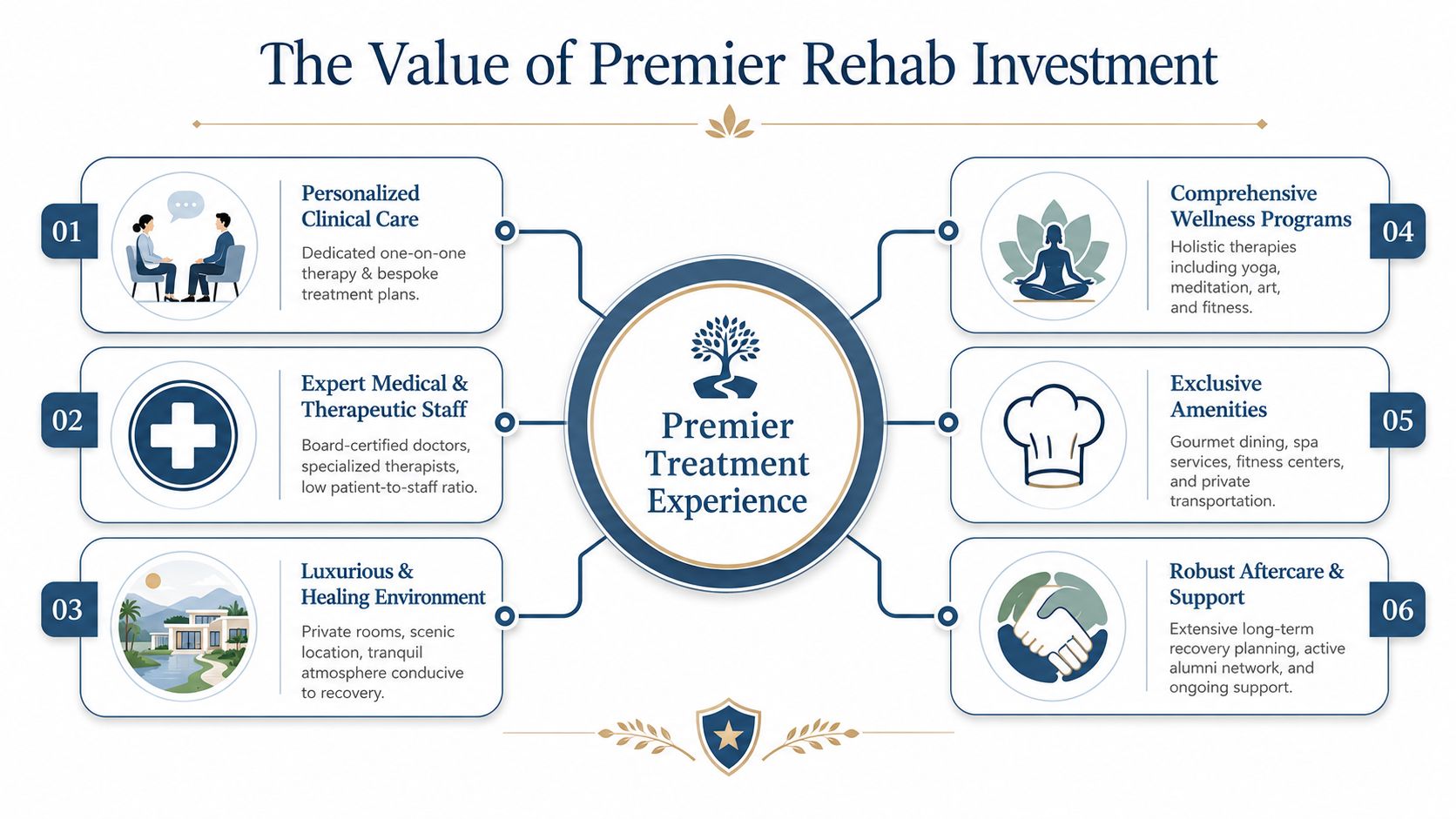
It buys a coordinated episode of care
Families often focus on the residential stay and miss the rest of the clinical path. As outlined by rehab pricing for the full continuum of care, treatment costs can include medically supervised detox, residential treatment, and step-down planning after discharge. In a premier setting, those pieces are designed to work together.
That coordination matters more than many people realize. Poor handoffs waste time, break trust, and create relapse risk right when the client should be building momentum.
It buys privacy that protects engagement
Private accommodations are not a vanity line item for a high-performing adult. They support sleep, reduce overstimulation, and give the client room to process shame, fear, anger, and exhaustion without an audience.
For public figures, founders, physicians, attorneys, and senior operators, privacy also protects treatment adherence. People stay in care when they feel safe enough to do honest work.
It buys clinical range for complicated cases
High-functioning addiction is rarely a standalone issue. It often arrives with anxiety, depression, trauma history, burnout, grief, sleep disruption, relationship strain, or long-term self-medication that has become structurally embedded in daily life.
That requires more than generic counseling. It requires psychiatric assessment, experienced primary therapists, medication oversight when appropriate, family involvement, and a treatment plan that addresses why the substance use became useful in the first place.
The right program does not stop at what the client is using. It identifies the job the substance has been performing, then builds healthier ways to meet that need.
It buys professional continuity with boundaries
Executives do not benefit from a fantasy version of treatment that ignores real responsibility. Some clients need limited, structured access to a phone or laptop to protect a company, communicate with counsel, manage a transition, or prevent avoidable fallout at home or work.
Handled poorly, that access keeps the old pattern alive. Handled well, it preserves stability while treatment remains the priority. That distinction is what separates hospitality from executive-focused luxury rehab features that support real recovery.
It buys time used well
Premier care should compress trial and error. The client gets a sharper assessment, more individualized treatment planning, stronger family work, and a discharge strategy built for re-entry rather than wishful thinking.
That is the investment. Better clinical judgment. Better containment. Better odds of getting treatment right the first time.
How Location Clinical Depth and Amenities Shape the Final Cost
Two luxury rehabs can both call themselves executive programs and still deliver very different value. Cost inside the premium tier changes for concrete reasons. Some are environmental. Some are clinical. The serious buyer needs to separate useful cost drivers from decorative ones.

Location changes both privacy and operating cost
A private, desirable setting often costs more to run. That is obvious. What matters is whether the location contributes to treatment.
For executives and public figures, the right environment can reduce exposure, limit random encounters, and create enough separation from daily triggers to make treatment possible. California remains attractive for this reason. It offers privacy, climate, and a recovery ecosystem that supports residential treatment and step-down planning.
But location alone doesn't justify premium pricing. It must be paired with real clinical capability.
Clinical intensity is the biggest pricing lever
The strongest pricing divide in addiction treatment comes from care intensity. According to episode and annualized treatment cost benchmarks, standard outpatient care can average $8,386 per person annually, while residential treatment is estimated at $50,469 and medically supervised detox can reach $141,001. That gap reflects staffing, medical monitoring, medication support, and 24-hour structure.
That is why residential executive care should never be compared casually with outpatient treatment. They solve different problems.
What clinical depth usually includes
Programs at the upper end of the market should justify cost through capability such as:
- Dual-diagnosis treatment: integrated care for substance use plus mood, anxiety, trauma, or personality-related issues.
- Medication management: careful psychiatric review and minimal, effective prescribing where appropriate.
- Trauma-informed modalities: deeper work for clients whose substance use is tied to unresolved stress or trauma.
- Discharge architecture: a step-down and relapse-prevention plan that fits real life, not an idealized version of it.
Amenities matter when they support outcomes
Amenities are often dismissed as fluff. That is too simplistic. Some amenities are marketing decoration. Others materially improve treatment adherence.
Private rooms, chef-prepared meals, exercise access, calming spaces, and a comfortable setting can lower resistance and help high-stress clients stay engaged long enough to do difficult work. The key is whether the environment serves regulation, sleep, confidentiality, and emotional bandwidth.
A treatment setting should lower unnecessary stress so the client can face necessary stress.
That is the distinction.
A useful way to think about this is the difference between hospitality and therapeutic design. The first impresses visitors. The second helps residents remain in treatment, regulate their nervous system, and participate sincerely. Readers comparing options can use this overview of what sets luxury rehab centers apart as a practical filter.
Length of stay also shapes cost because it shapes depth
A short stay may stabilize a crisis. It may not resolve the pattern that created the crisis. The final price rises with time, but so does the opportunity for deeper psychiatric assessment, family work, habit interruption, and relapse-prevention practice.
That doesn't mean every client needs the longest possible stay. It means duration should match complexity, not convenience.
Sample Investment Tiers 30 60 and 90-Day Programs
This is the part most readers are searching for. They want a number. Fair enough. But the number only makes sense when tied to what the stay is supposed to accomplish.
A market-facing benchmark places the average cost of drug rehabilitation per person at $13,475, and notes that a high-quality 30-day inpatient program is commonly estimated at $14,000 to $27,000, while 60- to 90-day programs can range from $12,000 to $60,000 or more. It also notes that luxury residential treatment often starts where the average tops out, which is why average pricing can mislead executive buyers looking at premium care in these treatment cost estimates.
Executive Treatment Investment Levels
| Program Length | Typical Investment Range | Primary Clinical Focus & Outcome |
|---|---|---|
| 30 days | $14,000 to $27,000 | Stabilization, detox or post-detox transition, psychiatric evaluation, early therapy, containment of immediate professional and personal risk |
| 60 days | $12,000 to $60,000 or more | Deeper behavioral work, stronger relapse-prevention planning, dual-diagnosis treatment, family repair, more realistic restructuring of work and recovery routines |
| 90 days | $12,000 to $60,000 or more | Extended treatment for entrenched patterns, trauma and mood-related work, stronger habit formation, fuller reintegration planning, more durable recovery foundation |
What 30 days can and can't do
A 30-day stay is often enough to interrupt the immediate cycle. It can create safety, complete detox if needed, clarify diagnosis, and start treatment in a meaningful way. For a busy professional in acute trouble, that can be the right first move.
It is often not enough for long-standing addiction with major psychiatric overlap. The danger is treating the first month like a complete solution when it's an opening phase.
Why 60 days is often more realistic
Many executive clients don't begin to open up until the first few weeks have passed. Once sleep improves, withdrawal settles, and defensive performance drops, the actual work starts. That is why 60 days often gives treatment enough room to become clinically useful rather than merely crisis-oriented.
For clients with complex histories, extended care options in a structured setting often make more sense than a rushed discharge built around calendar convenience.
The right length of stay is the one that gives the client enough time to stop managing appearances and start participating in treatment.
When 90 days earns its value
A 90-day stay is not necessary for everyone. It is often appropriate when there is a long history of relapse, severe burnout, trauma, unstable medication use, family strain, or a life structure built around chronic overwork and chemical coping.
That duration allows treatment to move beyond symptom control. It gives clients time to practice a different way of living before returning to the same high-pressure environments that helped fuel the problem.
For executive populations, that extra time can protect far more than sobriety. It can protect judgment, leadership capacity, and long-term credibility.
Financing Your Recovery Maximizing Insurance and Private Pay
Private-pay treatment doesn't always mean the client pays the full sticker price alone. That's one of the biggest misconceptions in this category. A detailed admissions process can uncover meaningful insurance support, especially for professionals carrying strong PPO benefits.
As explained in this California rehab cost and insurance overview, the Affordable Care Act requires coverage for substance use treatment, and for a client with a good PPO plan, a $25,000 residential stay could be reduced to a fraction of that price after deductible and out-of-pocket maximum obligations are met. The same source notes that an expert admissions team plays a key role in verifying and maximizing those benefits.
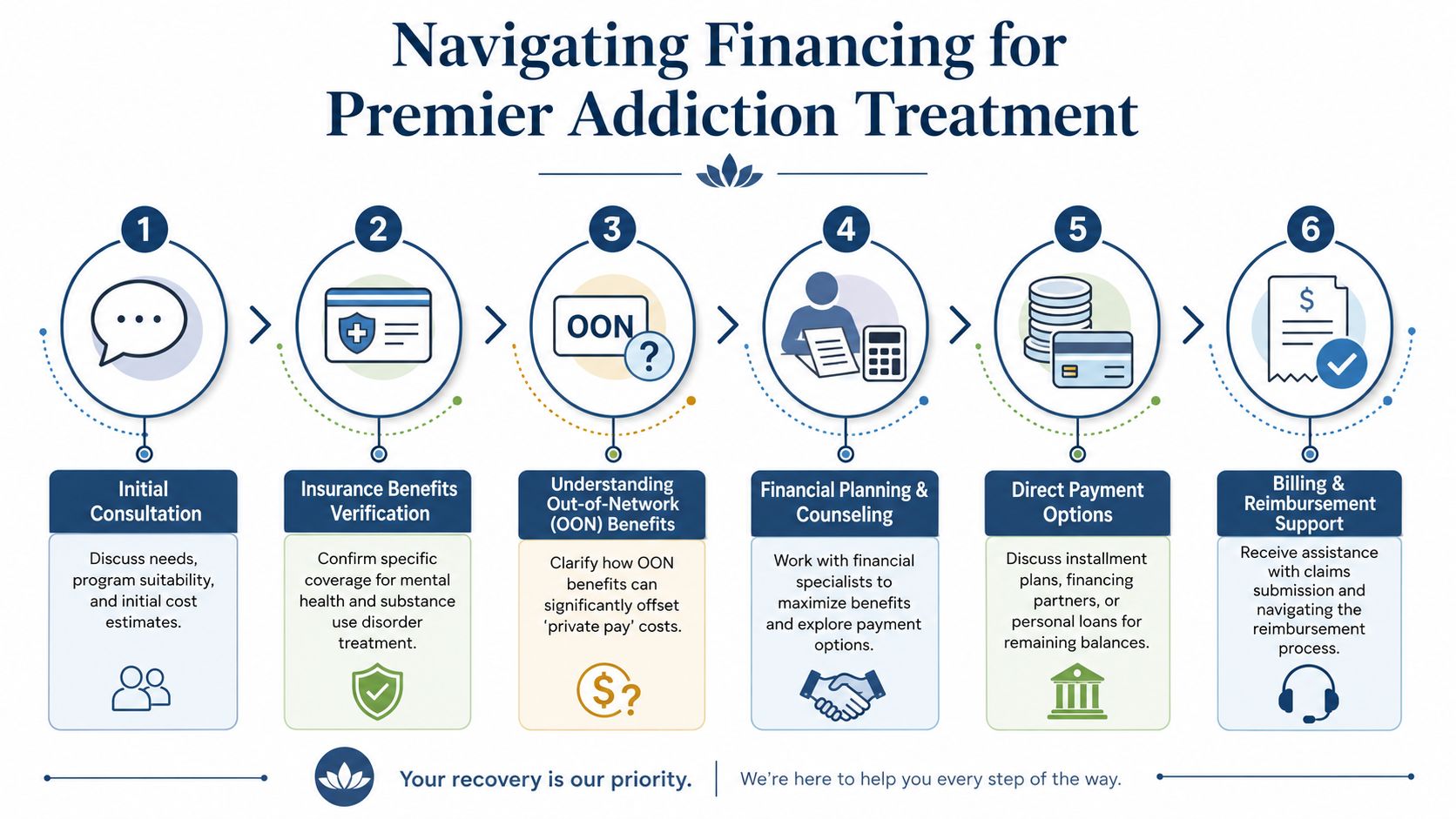
The terms that matter most
Busy professionals don't need insurance jargon. They need a fast operational summary.
- Deductible: the amount a policyholder may need to pay before fuller benefits begin.
- Out-of-pocket maximum: the cap on certain covered spending after which the plan may pay more fully for eligible services.
- Verification of benefits: the process of checking what the plan may cover, under what conditions, and with what restrictions.
- Out-of-network benefits: reimbursement provisions that may still help with a private-pay or non-contracted facility.
How a serious admissions team reduces friction
The financing process should feel organized, not chaotic. Strong programs handle this in a sequence:
- Clinical screening first. The program determines fit before talking numbers in the abstract.
- Benefits verification next. Staff contact the insurer and review mental health and substance use coverage details.
- Utilization review support. The facility helps document medical necessity where required.
- Clear private-pay discussion. The family sees the likely net responsibility, not just a gross estimate.
- Billing guidance after admission. Claims and reimbursement support continue rather than disappearing.
A helpful companion resource for families sorting through coverage questions is this guide to practical steps for health insurance. It gives a useful framework for understanding how to use benefits more effectively before treatment begins.
Private pay still has a purpose
Some executive clients choose private pay even when partial coverage is available. They may want more discretion, faster admission, greater program flexibility, or a setting designed specifically for high-acuity dual-diagnosis residential care.
That choice should be made with eyes open. It should also be informed by actual benefit verification, not assumptions.
For readers evaluating options, executive rehab programs that work with insurance can be a practical place to start. The important point is simple. Insurance may reduce net cost substantially, but someone has to do the work of confirming that rather than guessing.
Choosing Value Over Price The ROI of Premier Addiction Treatment
At 6:30 a.m., a founder is answering Slack messages from detox, telling the board he is "handling a medical issue," and hoping a bargain program can get him stable fast. Three weeks later, he is discharged with his cravings reduced but his insomnia, anxiety, and decision fatigue untouched. Then the true bill arrives. Missed deals, another leave of absence, more damage at home, and a second admission that should have been avoided.
That is why price alone is a poor filter.
For executives, physicians, attorneys, business owners, and other high-responsibility adults, the better question is return on the treatment decision. A premier program costs more upfront because it is built to reduce expensive failure points. It aims to stabilize substance use, treat the psychiatric drivers underneath it, protect privacy, preserve professional footing where appropriate, and prepare the client for a real return to life rather than a short-lived interruption.
What executives are actually buying
Premier treatment is not expensive because the furniture is nicer. It is expensive because the care model is deeper, more coordinated, and less likely to leave major problems untreated.
That investment usually includes:
- Safer, better-managed stabilization: especially when withdrawal risk, sleep disruption, or heavy burnout are part of the clinical picture.
- Integrated dual-diagnosis care: substance use and mental health are treated together instead of in parallel tracks that never fully connect.
- A setting built for discretion: privacy protections, lower exposure, and staff who understand the stakes of professional reputation.
- Support for life continuity: appropriate communication structure, planning around leadership responsibilities, and realistic re-entry work before discharge.
- Stronger aftercare planning: discharge is handled as a continuation of treatment, not the end of it.
A failed low-cost episode is rarely a bargain. It often becomes two admissions, two disruptions, and twice the strain on the family and the business.
The admission question that actually protects value
Ask how the program handles a client with this exact profile. Heavy alcohol use with panic symptoms. Stimulant misuse with depression. Benzodiazepine dependence with executive burnout. Trauma history with public-facing professional risk.
That conversation separates real clinical capability from luxury branding.
A serious admissions team should be able to explain how detox is managed, how psychiatric assessment is integrated, what level of physician involvement exists, how work access is handled, and what continuing care will look like before the client leaves. If those answers are vague, the lower rate is not a savings. It is a warning sign.
Recovery feels costly if you compare it to short-term comfort. It is far less costly than losing a marriage, a license, a leadership role, or years of earning power.
For this audience, the average cost of addiction treatment is not the central issue. Clinical fit is. The right program buys time, privacy, stability, and a better chance of returning to work and family life with judgment intact.
Reflections provides California-licensed, Joint Commission-accredited residential dual-diagnosis treatment for adults who need discreet, high-accountability care with private rooms, clinically managed detox, integrated psychiatric support, and appropriate access to electronics for professional continuity. A confidential call with the admissions team can clarify clinical fit, likely length of stay, and how private pay and insurance may apply before any commitment is made.