
A chief executive can be leading a company, answering investor questions, and managing a family while privately relying on alcohol, stimulants, sedatives, or another substance to get through the day. When anxiety, depression, trauma, post-traumatic stress, or mood instability sits underneath the substance use, stopping without integrated clinical care can create a second crisis. The executive may fear exposure, missed decisions, loss of authority, and an abrupt break from professional responsibilities.
The right residential treatment centers in California for executives address those concerns without treating convenience as a substitute for medicine. They combine privacy, private accommodations, dual-diagnosis expertise, structured therapy, and carefully governed access to electronics. The standard should be more demanding than attractive surroundings. A serious program must protect clinical safety while helping a working professional preserve essential relationships, responsibilities, and long-term function.
The Executive Challenge, Recovery Without Leaving Work Behind
An executive can spend the morning approving a board document, responding to international teams, and managing a family crisis while privately relying on alcohol, stimulants, sedatives, or another substance. If anxiety, trauma, depression, sleep disruption, or mood instability is also present, stopping without integrated care can create another medical and professional crisis. The executive may fear exposure, missed decisions, loss of authority, and the consequences of stepping away from work.
Entering residential care therefore becomes a matter of risk management as well as recovery. Confidential information, fiduciary duties, travel obligations, and staff expectations all influence the decision. Those concerns deserve a practical response, but they should not delay clinically necessary treatment.
Why conventional models create resistance
Many residential programs use uniform schedules, shared rooms, group-heavy programming, and strict device restrictions. Distance from triggers can support some residents, yet a rigid model may create resistance for a C-suite professional who must address limited family matters, protect business continuity, or communicate with a small number of trusted colleagues.
A more suitable plan sets boundaries around technology instead of treating all access as incompatible with treatment. Personal devices may be permitted when clinically appropriate, with defined hours, approved contacts, and staff oversight. The purpose is controlled continuity, not unrestricted work. A phone or laptop should not provide a route to avoidance, intoxication access, workplace conflict, or constant stimulation.
Practical rule: Electronics should support recovery and limited professional continuity, not recreate the unmanaged life that made treatment necessary.
Clinical care must remain primary
Career continuity has value only when the treatment plan addresses why substance use developed and persisted. Dual-diagnosis assessment should examine mood symptoms, trauma responses, anxiety, sleep, impulsivity, grief, and medication needs alongside substance use. Depending on the clinical picture, care may include cognitive behavioral therapy, dialectical behavior therapy, acceptance and commitment therapy, motivational interviewing, individual psychotherapy, intensive groups, and trauma-informed treatment.
High-acuity needs require clear medical oversight, appropriate withdrawal management, psychiatric evaluation, and a plan for changes in risk. Privacy supports that work. A private room can reduce exposure, protect confidential conversations, and provide space for sleep and stabilization during early treatment. It should accompany structure and accountability, not replace them.
Work may continue in a limited, governed form. Guidance on working from rehab can help frame the issue, but the clinical team must decide what contact is safe. The relevant question is whether carefully restricted engagement can coexist with medical stabilization, therapy, rest, and behavioral change. For an executive, the strongest program protects professional discretion while keeping clinical care in control.
Navigating California's Luxury Residential Treatment Landscape
California has a substantial behavioral health infrastructure, but scale doesn't guarantee executive-level care. The state auditor reported that, as of June 30, 2023, California had about 530 licensed residential treatment facilities and nearly 860 nonresidential treatment facilities with active certifications. When small facilities were included, the total residential count was roughly 1,000 facilities. The auditor's review also showed modest continued residential growth, from 494 small and 459 larger facilities in 2021 to 500 small and 480 larger facilities in 2023 in the categories it examined. These figures come from the California State Auditor report on behavioral health treatment facilities.
That broad system includes programs with very different staffing, clinical capabilities, environments, and admission processes. A private address, attractive furnishings, or concierge-style language doesn't establish that a program can safely manage withdrawal, trauma, psychiatric symptoms, or medication complexity.
The capacity gap matters
Access to higher-acuity residential care remains uneven. A California behavioral health assessment found that 70% of counties reported an urgent need for residential treatment services, while 75% reported insufficient youth residential beds. It also found that 22 counties had no residential substance use disorder facilities. The same assessment identified only 36 clinically managed, population-specific ASAM Level 3.3 facilities across nine counties, with half located in Los Angeles. The findings are documented in the California behavioral health assessment.
These facts matter to executives because “residential” can describe very different levels of support. A person with alcohol dependence and severe anxiety may need a different model from someone requiring medically supported withdrawal, psychiatric medication optimization, and trauma treatment. Admissions staff should explain who provides medical oversight, how emergencies are handled, and whether the program can manage co-occurring psychiatric needs without an avoidable transfer.
Location isn't a quality shortcut
California's geography offers privacy and separation, but a remote setting can complicate family participation, referral coordination, and post-treatment planning. An urban setting may improve access to specialists while creating more exposure and distraction. The correct choice depends on the client's risks, family system, travel requirements, and need for discretion.
Executives comparing levels of care can also consult this practical discussion of residential versus outpatient programs in Yuba City to clarify the difference between living onsite and attending treatment while remaining at home. For high-acuity dual diagnosis, the deciding issue is whether the setting provides enough containment and clinical access to support stabilization, not whether it appears luxurious.
Luxury vs. Standard Residential Treatment, A Strategic Comparison
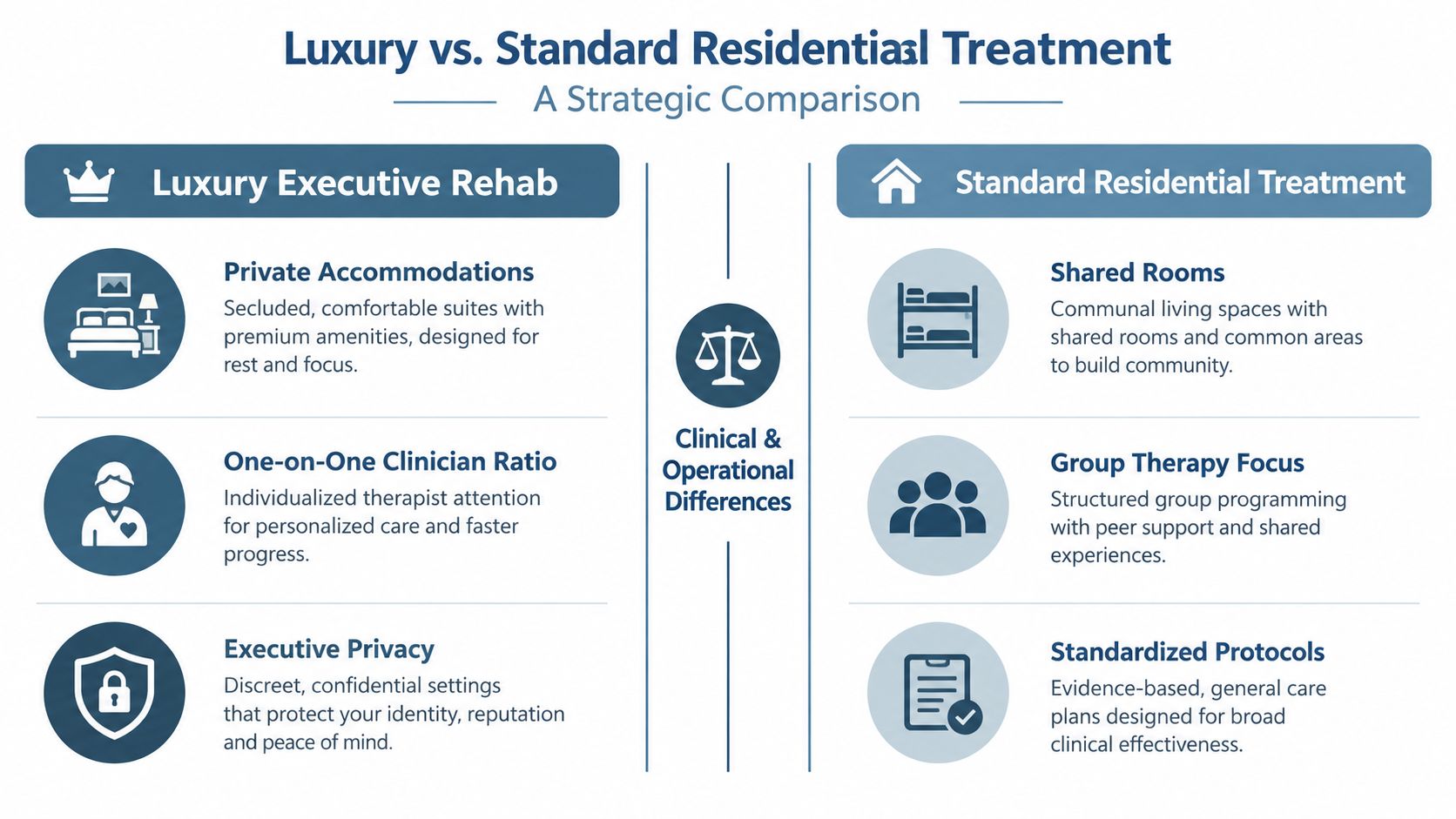
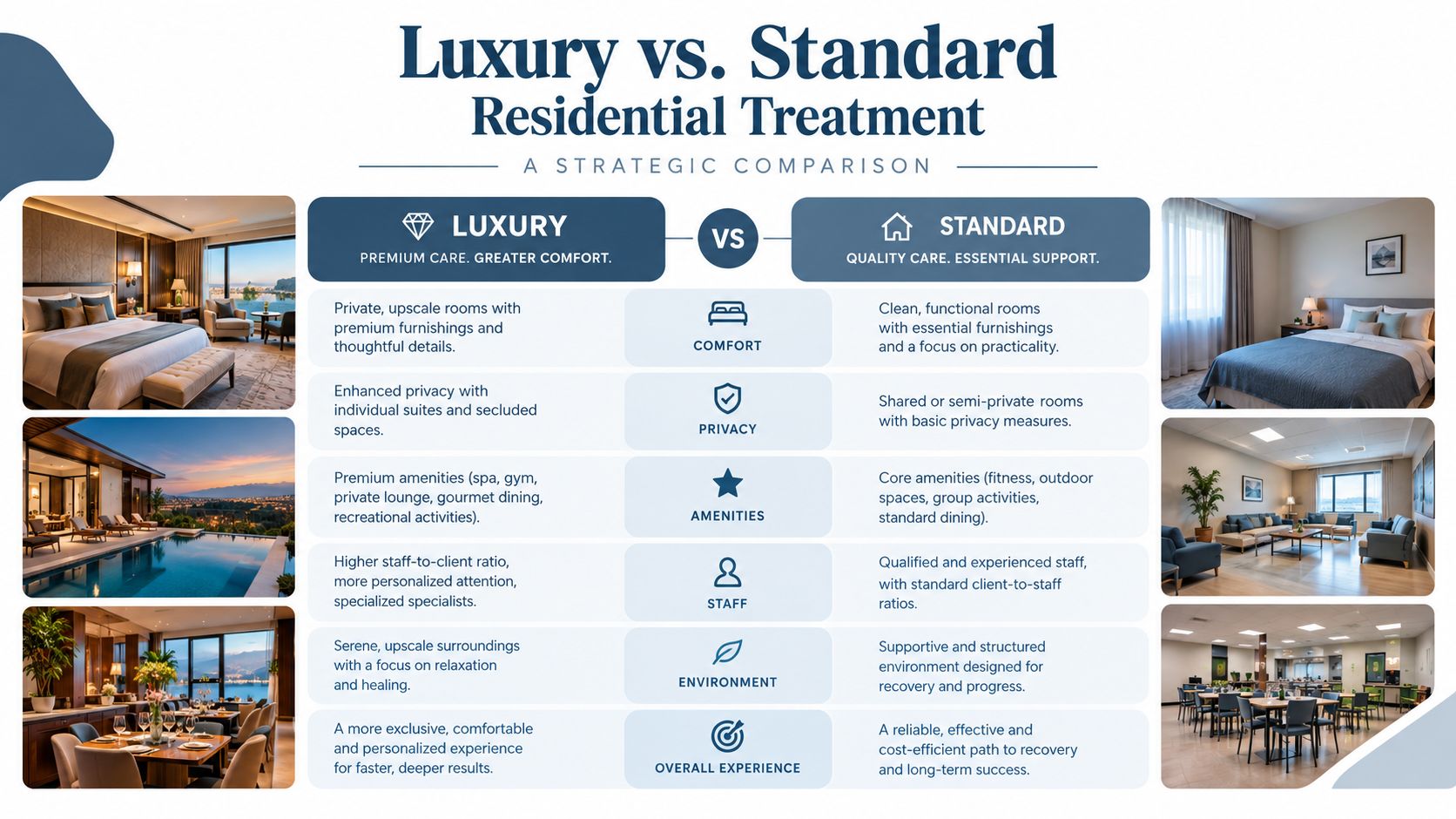
An executive may need trauma treatment, psychiatric medication management, and substance-use stabilization while remaining reachable for a board decision or family emergency. That combination makes the comparison between luxury and standard residential treatment operational, not cosmetic. Clinical and operational performance should determine the choice. A private room can protect sleep and confidentiality. Controlled electronics access can preserve professional continuity without allowing work to displace treatment. A polished setting has value when it reduces avoidable stress and supports participation, but it cannot correct weak psychiatric assessment or generic planning.
Standard residential care may suit residents who benefit from shared living, intensive group work, and a consistent schedule. Executive-focused care is more appropriate when the client requires discreet accommodations, individualized attention, protected communication, or coordinated treatment for trauma and co-occurring conditions. The right model depends on acuity, safety, privacy, and the structure needed to sustain engagement.
The operational differences executives notice
| Criterion | Luxury Executive Rehab | Standard Residential Treatment |
|---|---|---|
| Accommodation | Private rooms and a quieter setting organized around confidentiality, sleep, and recovery | Shared or more communal living may form part of the treatment structure |
| Clinical planning | Individualized assessment coordinating psychiatric, addiction, trauma, and family work | Structured protocols may be less individualized for executive responsibilities |
| Professional continuity | Governed access to cell phones and laptops when clinically appropriate, with defined limits | Device restrictions may be broader or applied more uniformly |
| Privacy | Discreet admissions, controlled communication, and private clinical interactions | Privacy protections vary according to the facility and its operating model |
| Therapy format | Individual therapy, intensive groups, and selected experiential modalities such as mindfulness, art, and somatic work | Group programming often carries more of the treatment schedule |
| Room availability | Private rooms may be available through detox and rehabilitation when the program is designed to provide them | Room arrangements may be shared or dependent on availability |
| Dual diagnosis | Integrated attention to substance use, psychiatric symptoms, trauma, and medication needs | Co-occurring care may be available but should be verified directly |
Personalization has practical limits
A customized plan does not allow a resident to avoid every difficult intervention. Effective treatment still requires attendance, honest clinical disclosure, medication review, behavioral accountability, and clear communication boundaries. The value of luxury care is the ability to adjust the setting and delivery of treatment without weakening those requirements.
Cognitive behavioral therapy can help an executive identify links among thoughts, stress, and substance use. Dialectical behavior therapy can address emotional intensity, impulsivity, and interpersonal conflict. Trauma-focused work may be appropriate after clinicians determine that stabilization is sufficient. Mindfulness, fitness, nutrition, art, music, somatic work, and massage may support regulation, but they should supplement evidence-based psychotherapy and medical oversight.
The relevant question is not whether a program offers the most amenities. It is whether each feature helps the client become more stable, more honest, and more capable of sustaining recovery after discharge.
What works and what doesn't
A private room without meaningful clinical contact can become isolation. A laptop without boundaries can become an escape into crisis management. A beautiful setting with a weak aftercare plan can provide temporary relief without durable change.
A written agreement is more useful. It should define device access, approved work hours, protected therapy periods, emergency contacts, and the circumstances requiring temporary restriction. The same precision should govern family participation, medication management, clinical communication, and discharge planning. Executives are accustomed to clear governance. Treatment should provide that clarity while preserving room for clinical judgment and therapeutic flexibility.
Evaluating Accreditation and Clinical Excellence
Accreditation is a starting point for due diligence, not a substitute for interviewing the clinical team. The Joint Commission states that it accredits nearly 15,000 healthcare organizations and certifies or verifies more than 4,600 programs across the United States, as described in its directory of accredited organizations. A facility's status should be verified directly, along with the scope of the accreditation and the services covered.
Four questions that reveal clinical depth
Who leads the treatment plan? Ask whether the program has a psychiatrist, psychologists, licensed therapists, certified addiction counselors, nursing support, and a clearly defined clinical director. Credentials matter, but so does availability. A senior clinician whose name appears on a website but rarely sees residents isn't equivalent to an engaged multidisciplinary team.
How are co-occurring conditions assessed? The intake should examine substance use, psychiatric symptoms, trauma history, sleep, medications, medical concerns, safety risks, and family dynamics. A program that treats every client through the same recovery script may miss the condition driving relapse.
What happens during detox or medication changes? Staff should explain who makes medication decisions, how withdrawal symptoms are monitored, and when a higher medical level of care is required. California residential SUD services under DMC-ODS must meet ASAM medical-necessity criteria, and counties must authorize residential SUD requests within 24 hours, according to this California Medi-Cal services guide. Private-pay clients should still ask how the facility handles its own authorization, admission, and transfer processes.
How is quality measured? Ask how the program reviews incidents, client feedback, medication errors, discharge outcomes, family participation, and continuity of care. Accreditation is meaningful when it reflects active systems rather than a framed certificate.

Verify the details before admission
Families and referral professionals can use a facility's published licensing and accreditation information as a prompt for direct verification. A useful example of how an adolescent provider presents California Teen Center accreditation information is the type of transparency decision-makers should look for, even when evaluating adult executive care.
A clinically credible program should also explain its approach to medication-assisted treatment. California guidance requires residential facilities under CalAIM to offer MAT onsite or refer externally and keep naloxone available at all times, as summarized in the cited Medi-Cal guide. For an executive with opioid use, alcohol use, depression, trauma, or another co-occurring concern, medication policy can directly affect safety and continuity.
The overview of Joint Commission accreditation can help families understand the purpose of accreditation before they ask a facility for its current status. The final decision should rest on verified clinical capacity, privacy procedures, staffing, and an individualized plan.
Key Criteria for Choosing Executive-Focused Rehab
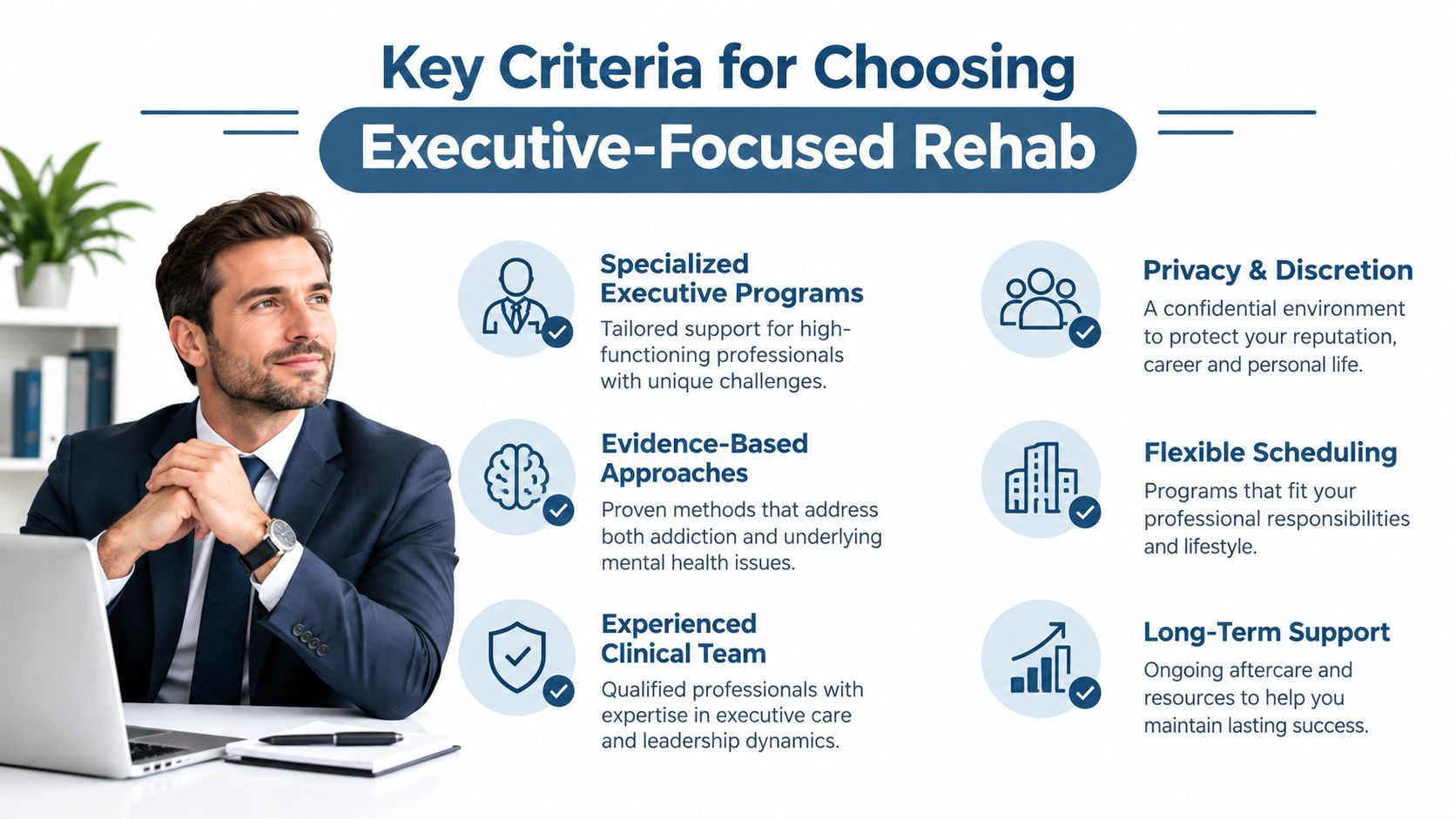
A strong selection process weighs clinical fit, privacy, professional continuity, and transition planning together. An executive shouldn't choose a center because it permits a laptop if the program can't manage psychiatric symptoms. Nor should the client select a highly medical environment that treats every professional obligation as evidence of resistance. The right setting creates boundaries that protect treatment while respecting the person's real responsibilities.
Start with acuity and privacy
The first call should establish whether the program can safely address withdrawal risk, dual diagnosis, trauma, suicidality, psychosis, mood instability, and medication changes when relevant. Admissions staff should answer plainly, without promising that every condition can be managed onsite.
Privacy requires more than a private room. Ask who receives information, how calls are handled, whether visitors are screened, how records are protected, and whether the facility has a plan for a high-profile client whose presence could attract attention. Private rooms in both detox and rehabilitation can support confidentiality and rest, but they must sit within an active clinical environment.
Define professional continuity
Electronics can help a C-suite client maintain essential work and family contact, but the arrangement should be individualized. A written plan might address:
- Device access: Whether cell phones and laptops are permitted, stored, monitored, or restricted at specific times.
- Work boundaries: Which obligations are urgent, who can act as a delegate, and when therapy and sleep are protected.
- Confidentiality: How sensitive company information is kept separate from treatment communications and shared spaces.
- Clinical review: How the team will respond if work contact increases anxiety, interferes with therapy, or reinforces compulsive behavior.
A program that says “anything goes” may be avoiding clinical responsibility. A program that refuses to discuss any professional contact may not understand the needs of an executive population.
Examine the full treatment arc
Treatment length should reflect clinical need rather than a convenient calendar. The plan should include individual therapy, groups, psychiatric care, family work, trauma treatment when appropriate, nutrition, movement, and practical relapse prevention. Integrated services are useful when they reinforce regulation and healthy routines, not when they replace core care.
Family involvement deserves specific attention. Private family sessions can address communication, boundaries, financial concerns, and safety planning, while educational work can help relatives stop enabling without abandoning the client. After discharge, continuing care should identify therapists, psychiatrists, peer supports, medication prescribers, work boundaries, and emergency contacts before the resident leaves.
Reflections is one California-licensed, Joint Commission-accredited option that provides private residential care for adults with co-occurring mental health and substance use disorders, including clinically managed medication-assisted withdrawal, individualized therapy, family involvement, and appropriate electronics access. Families should compare those features with the specific clinical needs and privacy expectations of the person seeking admission.
Investing in Discrete, High-Impact Recovery
An executive may need detox, psychiatric care, trauma treatment, a private room, and reliable access to electronics while protecting sensitive work relationships. Private-pay residential treatment is therefore a significant financial decision. Market examples range from approximately $34,000 for 30 days to $69,500 to $79,500 for a five-week executive tier.
The fee should correspond to a coherent clinical system. Assess staff qualifications, medication management, dual-diagnosis capability, trauma treatment, privacy controls, private accommodations, family participation, and professional continuity. A program that emphasizes furnishings while outsourcing psychiatric decisions or providing vague discharge planning may not justify its premium.
For C-suite professionals, untreated substance use and psychiatric symptoms can affect employees, investors, patients, and family members. A residential setting can support high-acuity care while preserving dignity and carefully managed contact with work. That balance requires clear limits, candid clinical assessment, secure electronics policies, and active participation from the executive.
The transition after discharge deserves the same planning as admission. A structured aftercare planning approach should connect residential gains with outpatient therapy, medication management, family support, sober routines, and a gradual return to executive responsibilities.
Reflections offers California-licensed, Joint Commission-accredited residential treatment for adults with co-occurring substance use and mental health disorders. Its services include private rooms, clinically managed withdrawal, individualized therapy, family involvement, and appropriate access to electronics. Visit Reflections to discuss confidential admission planning for an executive or professional who needs high-acuity care without abandoning a sustainable life.