
A successful executive rarely makes a major decision on instinct alone. For significant decisions, the process usually looks the same. Verify the credentials. Review the systems. Ask who is accountable if something goes wrong.
Choosing a residential treatment program should be approached with that same discipline.
For high-achieving professionals and their families, the question usually isn't just whether a program looks comfortable or sounds high-quality. The crucial question is whether the organization behind the amenities has the operational rigor to protect health, privacy, and continuity of care. That's where Joint Commission accreditation matters. It gives a serious buyer a way to separate polished marketing from verified clinical standards.
A luxury setting can be meaningful. Private rooms, discretion, strong boundaries around confidentiality, and the ability to stay appropriately connected to work can all matter greatly for executives and other high-functioning adults. But none of those features should be accepted as proof of quality on their own. The safer approach is to ask a more disciplined version of the same question many families are already asking online. What is Joint Commission accreditation, and why should it influence where care happens?
Making the Most Important Executive Decision
A senior leader can spot the difference between branding and substance. In most parts of life, that skill protects time, money, and reputation. In treatment, it can also protect safety.

When a founder, physician, attorney, or C-suite executive starts evaluating rehab options, the search often happens under pressure. A family member may be worried. A board calendar may still be active. Sensitive information may need to stay tightly contained. In that setting, the most expensive mistake is assuming that a beautiful website or upscale property equals reliable care.
That assumption fails because treatment quality lives inside systems that clients don't immediately see. Medication handling. Documentation. supervision. Safety protocols. Escalation plans. Clinical leadership. Communication between detox, psychiatry, therapy, and aftercare planning. Those details determine whether a program functions well when a case becomes complex.
Due diligence matters more than image
For discerning clients, accreditation should be treated as a due diligence screen. It helps answer whether an outside body has evaluated the organization against recognized standards instead of asking the family to rely on promises alone.
A practical way to think about it is this:
- Amenities affect comfort. Private rooms, executive-friendly scheduling, and appropriate electronics access can reduce unnecessary disruption.
- Accreditation speaks to systems. It addresses whether the organization is built to deliver care safely and consistently.
- Both matter. High-end treatment should feel refined, but refinement without clinical discipline is a risky purchase.
The right question isn't whether a facility feels premium. It's whether premium conditions sit on top of sound clinical operations.
For professionals comparing options, the same mindset used in executive rehab decision-making in the Bay Area applies here. Verify first. Trust second.
Defining the Gold Standard in Healthcare
What is Joint Commission accreditation? It is a third-party review process used to evaluate whether a healthcare organization meets established standards for safe, effective, well-managed care.
For a business-minded reader, the simplest analogy is this. It functions like an external validation of operational quality. Not a marketing award. Not a self-issued claim. A structured review of whether the organization has the systems needed to perform at a high level.
Why The Joint Commission carries weight
The Joint Commission is not a new or niche body. It is a long-established U.S. healthcare quality program that began with the organization's founding in 1951, and the organization says it now accredits more than 20,000 healthcare programs and organizations in the United States and many other countries, as summarized in the NCBI overview of Joint Commission accreditation. Its mission is to continuously improve health care by evaluating organizations and inspiring them to provide safe, effective care of the highest quality and value.
That matters because established standards create a common language for quality. A hospital, behavioral health program, or residential treatment center can all describe themselves as excellent. Accreditation asks a harder question. Can that claim be backed by documented systems, accountable leadership, and an organization-wide commitment to improvement?
Why executives should care about the distinction
In luxury treatment, buyers often encounter two very different types of value signals.
| Signal type | What it tells a family |
|---|---|
| Comfort signals | The environment may be private, attractive, and less disruptive |
| Accreditation signals | The organization has undergone external review against recognized healthcare standards |
The strongest programs aim for both. A comfortable setting can support recovery, especially for professionals who need privacy and a setting that respects their daily realities. But luxury without operational discipline is still just presentation.
For readers who want more context on how healthcare organizations build and maintain improvement systems, this comprehensive guide to healthcare QI offers helpful background on the quality improvement mindset that sits behind strong accreditation performance.
Accreditation should be viewed as evidence that the organization takes quality seriously enough to let outsiders inspect it.
The Accreditation Survey A Look Behind the Curtain
Many families assume accreditation is a one-time inspection. It isn't. The process is more demanding than that, and that difference is one reason it matters.
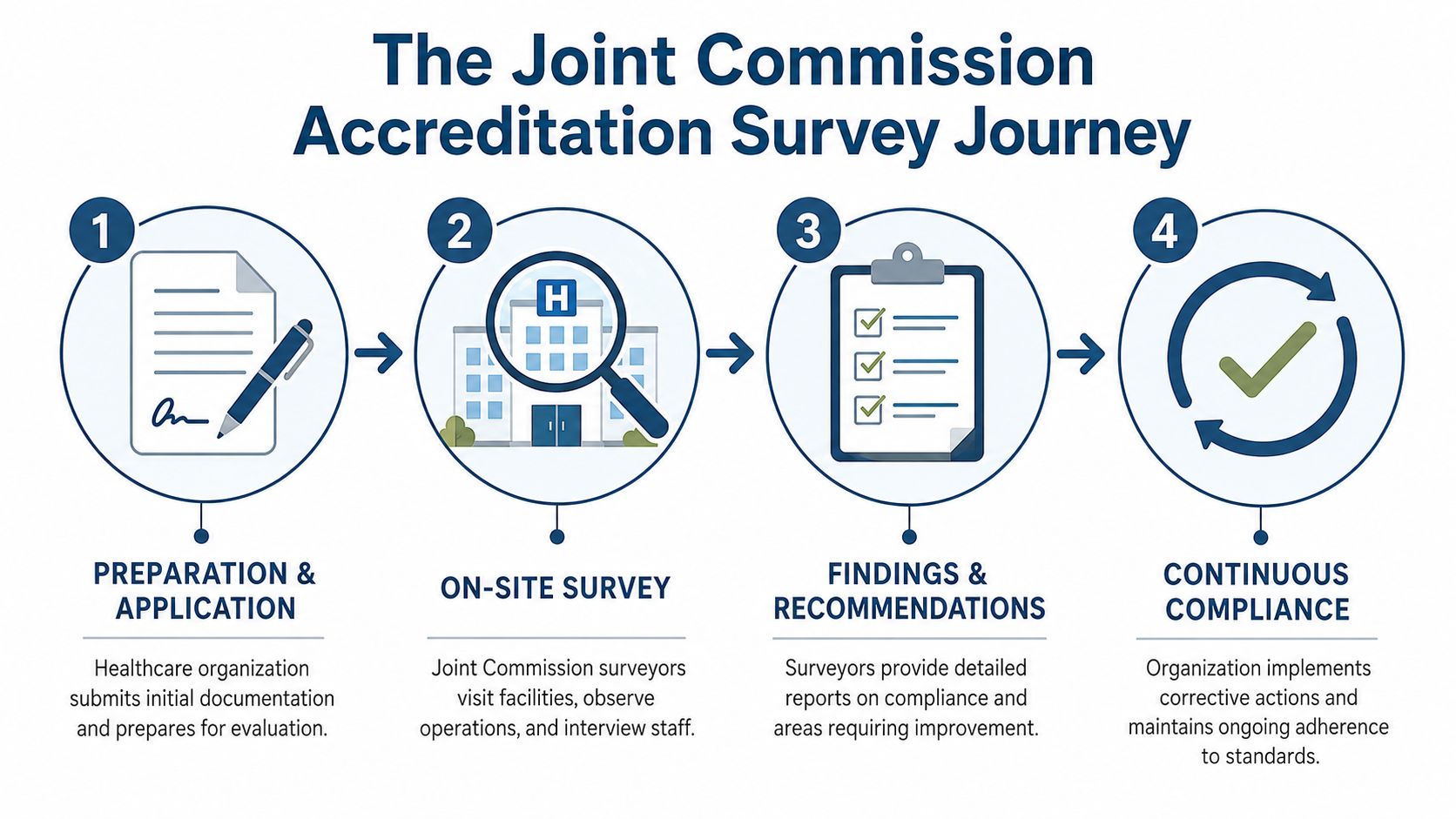
The Joint Commission explains that the main event is an on-site survey where specially trained surveyors assess compliance with standards and relevant CMS and OSHA requirements. After that review, the final accreditation decision is issued later and, once granted, is generally valid for approximately three years. Accredited organizations are also required to submit standardized performance data, making accreditation an ongoing quality-assurance process through the Joint Commission accreditation process.
What survey readiness really means
The practical trade-off becomes clear: a program can't rely on one polished day. It needs systems that hold up under observation.
Surveyors don't just look at the obvious. They may review how policies translate into real practice, whether staff understand procedures, whether documentation is complete, and whether leadership has built a structure that supports consistent care. For executives, that should sound familiar. A strong organization isn't measured by the slide deck. It's measured by daily execution.
Three parts of the process are especially relevant:
Operational review
Surveyors assess whether the organization is following standards in practice.Decision after review
Accreditation isn't handed over at the end of a walkthrough. The decision follows the broader evaluation.Ongoing data submission
The organization remains accountable beyond the visit through standardized reporting requirements.
Why the process matters in behavioral health
Behavioral health treatment becomes unstable quickly when systems are weak. A communication gap between prescriber and therapist, sloppy medication workflows, or inconsistent documentation can create real risk. Accreditation doesn't guarantee perfection, but it does indicate that the organization has agreed to operate inside a framework built around measurable compliance and continuing review.
A facility that must stay ready year-round is less likely to rely on appearances and more likely to rely on process.
For a family evaluating private-pay options, that's an important distinction. The most reassuring environment is one where calm presentation reflects disciplined internal operations rather than hiding the absence of them.
What Joint Commission Accreditation Actually Evaluates
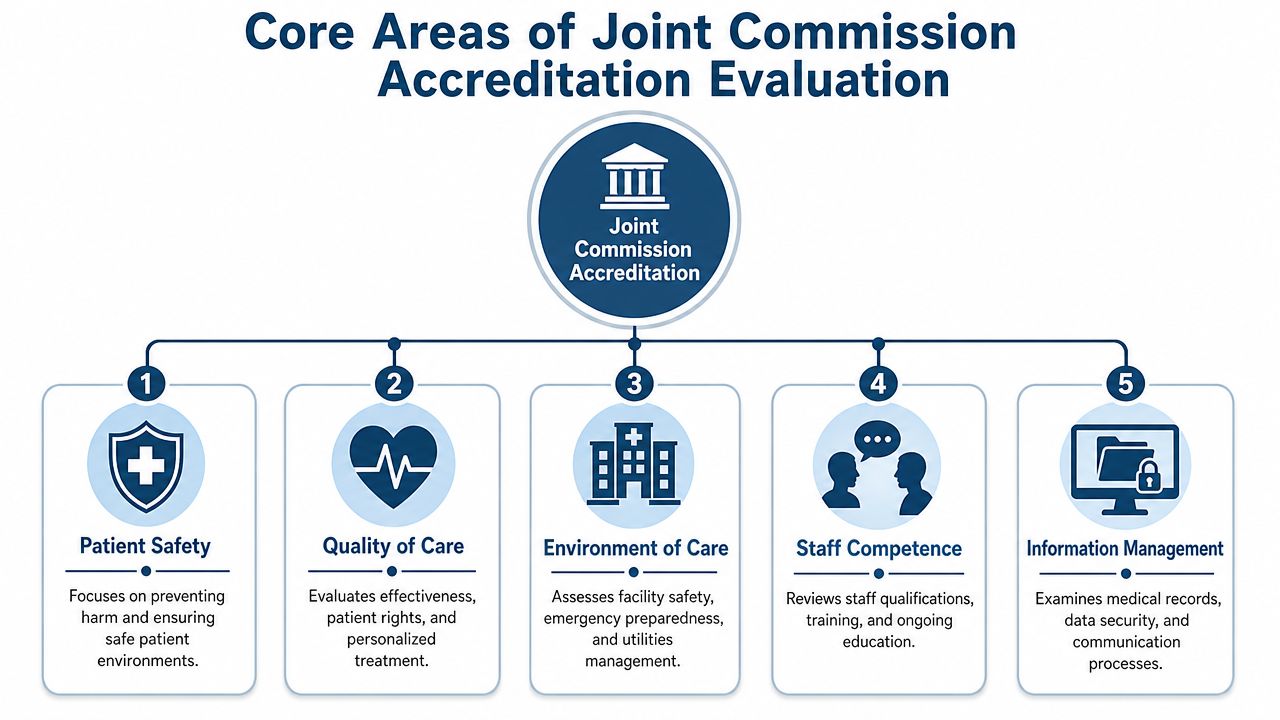
The practical value of accreditation becomes clearer when the standards are translated into everyday treatment realities. Joint Commission standards address operational domains that shape whether care is safe, organized, and respectful. The organization identifies areas such as patient rights and education, infection prevention and control, medication management, leadership and governance, staff competence, and preventing medical errors in its overview of Joint Commission accreditation standards.
Five areas that matter most to families
A luxury treatment program may advertise comfort, privacy, and individualized care. Accreditation asks whether the organization has the structure to deliver those promises responsibly.
Patient rights and education
This is about more than courtesy. It includes respect, informed participation, and clarity around treatment. For professionals and families, it supports a treatment environment where the client isn't managed in a vague or paternalistic way.Medication management
Medication decisions carry obvious consequences in detox, psychiatric stabilization, and dual-diagnosis treatment. A well-run program needs disciplined processes for ordering, storing, administering, documenting, and reviewing medications.Leadership and governance
Good clinical care depends on visible accountability. If leadership is weak, quality problems tend to drift rather than get solved.Staff competence
Credentials alone don't carry a program. The organization also needs appropriate training, supervision, and role clarity.Infection prevention and operational safety
This is often overlooked by families until something goes wrong. Safe care depends on systems that reduce preventable risk across the treatment environment.
Why this matters more than polished language
Many families ask whether clinicians are talented. That's a reasonable question, but it's incomplete. An excellent individual clinician can still work inside a disorganized system.
A helpful parallel appears in One For All Medical Billing's credentialing guide, which explains the importance of verifying professional qualifications. Accreditation goes further. It evaluates whether the whole organization is structured to support safe, coordinated care rather than exclusively employing people with licenses.
Strong treatment doesn't come from isolated talent alone. It comes from a system that helps skilled clinicians practice safely and consistently.
That distinction is especially important in behavioral health and residential treatment, where patient safety, communication, and continuity of care are tightly linked.
Why Accreditation Is a Non-Negotiable for Discerning Clients
For affluent professionals and their families, accreditation isn't a decorative credential. It's a risk-management tool.

A high-performing adult entering treatment usually has more at stake than symptom relief alone. There may be legal sensitivity, career visibility, family complexity, financial exposure, or the simple reality that stepping away from work has consequences. In that context, choosing an unaccredited program introduces uncertainty where there doesn't need to be uncertainty.
Recent public guidance highlights that maintaining accreditation requires continuous readiness for recurring and potentially unannounced surveys, which typically happen every 2 to 3 years, as described in this overview of maintaining Joint Commission accreditation readiness. That ongoing burden matters because it pushes organizations to build durable quality systems instead of preparing for a single showpiece inspection.
What discerning clients are really buying
Private-pay treatment at the high end is never just a bed and a schedule. The investment should purchase confidence in the surrounding operation.
A discerning client should expect:
Verified structure
Not just claims about excellence, but evidence that the organization has chosen outside scrutiny.Respect for privacy
Confidentiality depends on disciplined information handling and professional boundaries, not simply a promise of discretion.Consistency under pressure
Treatment settings reveal their quality when cases become complicated, not when everything is easy.A managed environment
Executive-friendly features only work when the program can balance autonomy with clinical containment.
The real trade-off
Some programs market freedom aggressively. Others market intensity without flexibility. Neither extreme serves a discerning client well.
The strongest residential settings understand that high-functioning adults often need nuanced care. They may need private space, practical accommodation for ongoing responsibilities, and treatment that respects intelligence rather than stripping away agency. But those benefits only work inside a stable clinical structure.
Luxury should reduce unnecessary stress. It should never replace clinical discipline.
That is why accreditation deserves a place near the top of any evaluation checklist. It doesn't tell a family everything, but it does help answer whether the organization takes quality seriously enough to operationalize it.
Accreditation in Action The Reflections Difference
Accreditation matters most when it shows up in actual client experience. In a well-run executive-focused treatment setting, the standards behind accreditation should shape the day-to-day design of care.
How standards translate into practice
For working professionals, one common tension is the need for treatment without total collapse of outside responsibilities. Appropriate access to electronics can be clinically reasonable when the environment is structured, expectations are clear, and the treatment team manages boundaries intentionally. In the wrong setting, technology access can undermine treatment. In the right setting, it can reduce avoidable disruption while preserving engagement.
Private rooms raise a similar issue. They aren't just a luxury feature. For executives, public figures, attorneys, physicians, and other high-visibility adults, private space can support confidentiality, decompression, and emotional safety. But private accommodations only add value when the clinical program remains cohesive and accountable.
What a buyer should look for
A serious buyer should ask how an accredited program applies its standards to the realities of dual-diagnosis care.
That includes questions such as:
Clinical leadership
Who directs treatment, and how are complex psychiatric and substance use issues coordinated?Staff caliber
Are care plans being delivered by a multidisciplinary team with clear roles and professional oversight?Patient rights in practice
How does the program respect autonomy while maintaining therapeutic structure?Environment design
Do privacy and comfort support treatment, or are they being used to distract from a weak clinical core?
One factual example in this category is Reflections, a California-licensed, Joint Commission-accredited luxury rehabilitation provider that offers private rooms, allows appropriate electronics access, and delivers dual-diagnosis care through a credentialed multidisciplinary team. The key point isn't the brand name. It's the alignment between accreditation principles and the way care is structured.
The most credible luxury programs don't separate clinical rigor from client experience. They build the experience around the rigor.
How to Verify Accreditation and Avoid Misleading Claims
Families shouldn't have to guess whether a program is accredited. Verification should be direct.
The safest approach is to ask the program for its exact accreditation status and then independently confirm it through The Joint Commission's public verification tools. A trustworthy organization shouldn't resist that question or answer it vaguely.
A practical verification checklist
When evaluating a treatment center, use a process like this:
Ask for the exact accrediting body
Some organizations speak in broad terms about being inspected, certified, or compliant. That isn't the same as naming Joint Commission accreditation clearly.Request the current status
The question should be simple. Is the program currently accredited, and under what service line?Verify independently
Use The Joint Commission's public quality-checking resources rather than relying only on sales materials or brochure language.Check for specificity
Serious programs can usually explain how accreditation connects to their operations, not just display a seal.Watch for evasive language
If a program redirects the conversation toward décor, testimonials, or generic quality claims, that is useful information.
Common misconceptions to avoid
A few misunderstandings show up often in this market.
| Misconception | Better interpretation |
|---|---|
| State licensure and accreditation are the same | State licensure is a baseline legal requirement. Accreditation is a separate quality signal |
| Any accreditation means the same thing | Families should still ask which accrediting body is involved and what it evaluates |
| Luxury features prove clinical excellence | Amenities can improve comfort, but they don't verify systems or standards |
Another good safeguard is to compare a program's public claims with educational material focused specifically on which luxury dual diagnosis rehabs in Northern California are Joint Commission accredited. The value of that exercise isn't promotion. It's clarity. Once a family learns how accreditation is described and verified, weak claims become easier to spot.
A discerning client should leave every admissions call with a clearer picture, not a foggier one. If the answers are precise, transparent, and easy to verify, that's a good sign. If they sound polished but hard to confirm, the family should keep looking.
Reflections provides Joint Commission-accredited, California-licensed luxury dual-diagnosis treatment for adults who need private, clinically structured care with appropriate support for real-world responsibilities. Families and professionals who want to evaluate whether that model is the right fit can review the program directly at Reflections.
Created with Outrank app