
You may be staring at a calendar full of board meetings, investor calls, and family obligations, while also knowing that something has to give. If sleep has gone sideways, anxiety is bleeding into performance, or substance use has started to sit under the surface of “just getting through the week,” the search for mental health inpatient facilities California turns into a reputation question as much as a clinical one. For executives and high-profile professionals, the core issue is not whether help exists, it's whether treatment can happen without disappearing from work, privacy, or leadership responsibilities.
California makes that search harder than many expect. The state's inpatient mental-health system is large, but it's also structurally constrained, and the pressure shows up in over-occupied beds, uneven county access, and a shortage of settings designed for adults who still need to function in the world. In other words, the right answer is rarely the nearest hospital bed. The right answer is the setting that matches acuity, protects discretion, and gives a working professional enough structure to stabilize without derailing the rest of life.
Why California Inpatient Mental Health Is a Harder Search Than It Looks
A senior partner in Los Angeles can't just “take a break” the way a brochure suggests. The person still has board responsibilities, client obligations, and a reputation to protect, so the decision usually lands between two bad options, wait until the problem worsens, or enter a setting that feels too public, too chaotic, and too disconnected from real life. That's why the search for mental health inpatient facilities California is never just about beds, it's about fit, timing, and discretion.
California's system reinforces that reality. SAMHSA's 2020 State Profile counted 970 mental health treatment facilities statewide serving 198,820 clients on April 30, 2020, with 121 24-hour hospital inpatient programs, 196 24-hour residential programs, and 12,209 beds total across hospital and residential settings, while hospital inpatient utilization hit 122.3% (SAMHSA California state profile). That utilization figure is the tell. When capacity runs above design, access becomes a negotiation.
What that means for a high-profile client
A public psychiatric unit may be clinically appropriate in a crisis, but it's usually the wrong environment for an executive who needs calm, confidentiality, and continuity. California's bed supply has also fallen over time, with a documented decline from 9,353 short-term inpatient psychiatric beds in 1995 to 6,777 in 2017, a 28% decline, and a reported shortfall of 4,767 psychiatric beds across acute and subacute care (California Hospital Association report; RAND analysis). That shortage shapes everything from admissions speed to transfer options.
Practical rule: If the goal is to keep work and life from unraveling, the smartest move is not to chase the closest bed. It's to choose the safest confidential setting that can actually admit, stabilize, and continue care.
The market pressure is visible in utilization too. In 2020, behavioral health diagnoses accounted for 1,144,835 inpatient hospitalizations in California and 2,090,085 ED treat-and-release visits, while HCAI reported that in 2024 the share remained high at 29% of inpatient stays and 12% of ED visits, with mood disorders leading inpatient diagnoses and anxiety disorders leading ED diagnoses (HCAI inpatient and ED visualization; HCAI patient demographics visualization). The takeaway is blunt. Demand is high, supply is tight, and executives need a model built for speed without spectacle.
Levels of Inpatient Mental Health Care Explained
The word inpatient gets used loosely, and that creates bad decisions. A CEO in crisis doesn't need jargon. He or she needs the right level of containment, fast, with the least disruption that still keeps the person safe and moving forward.
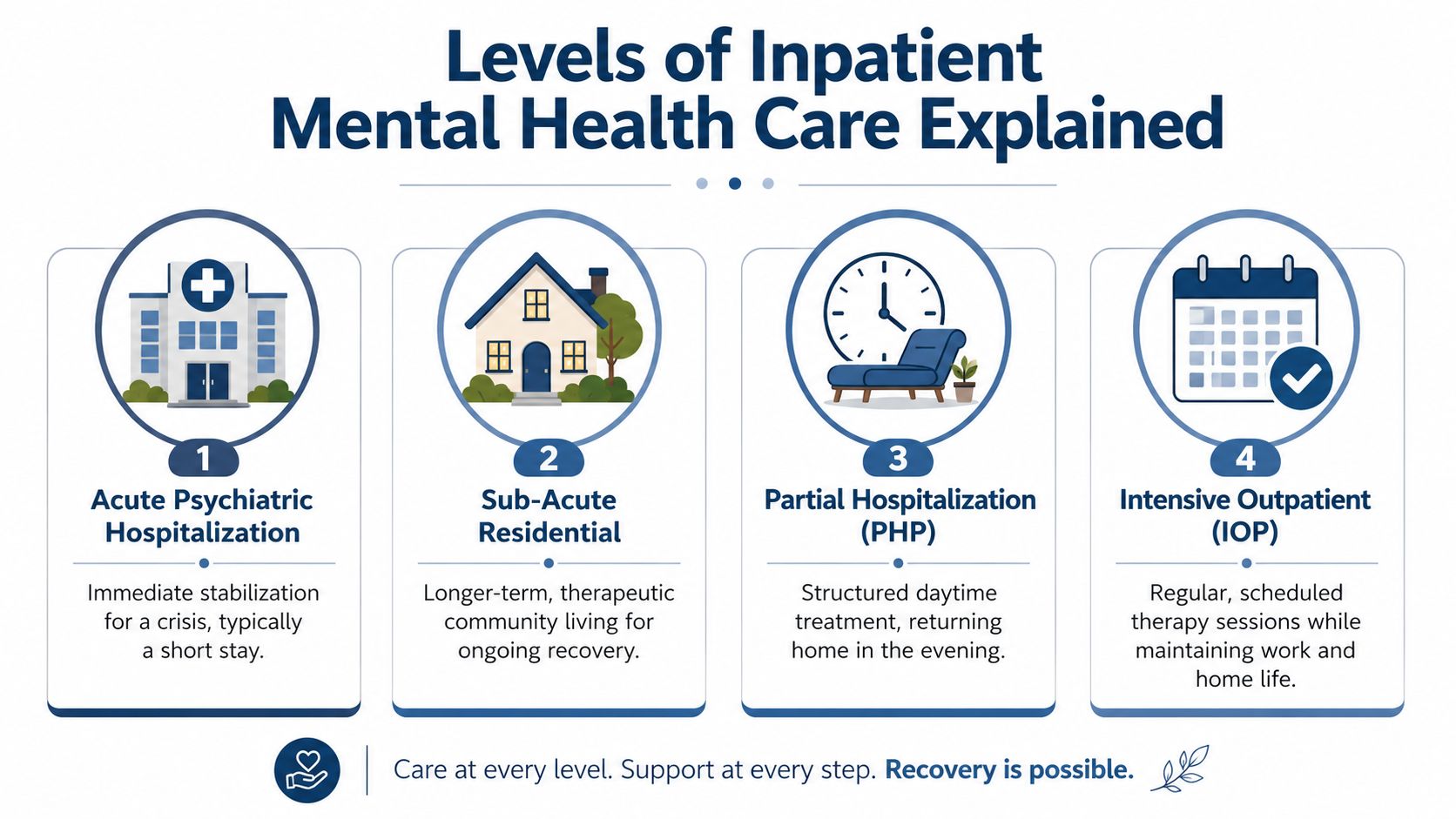
Acute psychiatric hospitalization
This is the crisis level. It's for immediate stabilization when there's danger to self, danger to others, severe disorganization, or an inability to function safely. The environment is clinical, public, and tightly controlled, which is exactly why it exists, but it's rarely the setting a working professional wants if there's any way to safely choose something more private.
Sub-acute residential care
A luxury residential model fits best here. The setting is structured, therapeutic, and residential rather than hospital-like, so a client can receive intensive care without the sensory chaos of an acute unit. For executives, this is often the practical middle ground, enough containment to stabilize, enough privacy to preserve dignity, and enough continuity to keep a career from falling apart.
PHP and IOP
Partial hospitalization and intensive outpatient programs sit farther down the continuum. PHP is daytime treatment with evenings back home, while IOP keeps the person in work or family life with scheduled clinical support. They matter when someone no longer needs 24-hour care but still needs a disciplined step-down plan.
Good judgment beats labels: if sleep is collapsing, medications are changing, and risk is still active, residential care usually makes more sense than trying to “power through” with outpatient sessions alone.
A credible California program should define where it sits on that continuum and say so plainly. For a private-pay executive, the strongest fit is usually a sub-acute residential setting with private rooms, psychiatric oversight, and the ability to step down later into PHP or IOP. That mix protects both clinical depth and business continuity.
Licensing, Accreditation, and Why Credentialing Matters for Private-Pay Clients
A glossy website is not a trust signal. In this market, credentialing is the trust signal, because executives are not just buying comfort, they're buying clinical reliability, medication safety, and documentation discipline.
California's shortage makes that more important, not less. RAND estimated that the state had 5,975 acute beds and 4,724 subacute beds in 2021, while it would need 7,945 acute and 7,518 subacute beds to meet observed demand patterns, leaving a combined shortfall of more than 7,700 psychiatric beds across the acute care continuum (RAND report). In a constrained system, bad operators survive on branding. Good operators prove their standards.
What licensing and accreditation actually tell you
DHCS licensing shows that a facility is operating under California's behavioral-health framework. Joint Commission accreditation adds another layer, because it speaks to how the program handles safety, staffing, documentation, medication processes, and continuous quality review. The distinction matters even for private pay, because the client is still trusting the facility with clinical decisions and sensitive records.
A useful primer on why that accreditation matters is available in this Joint Commission accreditation overview. The point isn't ceremony. The point is accountability.
What a CEO should ask about
A real executive-friendly program should be able to answer three questions quickly. Who is the clinical director, what are the staff credentials, and how does the facility manage dual diagnosis when anxiety, depression, trauma, and substance use overlap? If those answers come back vague, the operation is probably more polished than it is rigorous.
A private-pay client should never have to guess whether the care team can manage psychiatric medications, withdrawal risk, and co-occurring conditions in a coordinated way.
The best facilities also know how to keep admissions discreet, document clearly, and communicate with outside professionals only when authorized. That matters because a private-pay stay is still a medical event, not a consumer luxury purchase. When the system is this tight, credentialing is what separates a safe residential program from a very expensive mistake.
Dual-Diagnosis Treatment for Executives With Co-Occurring Conditions
Many executives don't walk in saying, “There's a substance use problem.” They walk in describing insomnia, panic, irritability, a bad quarter, a marriage under strain, or a need to get “back on track.” The issue often sits underneath that language, depression or anxiety layered with alcohol, stimulants, benzodiazepines, or opioids. Treat one side and the other side comes back.
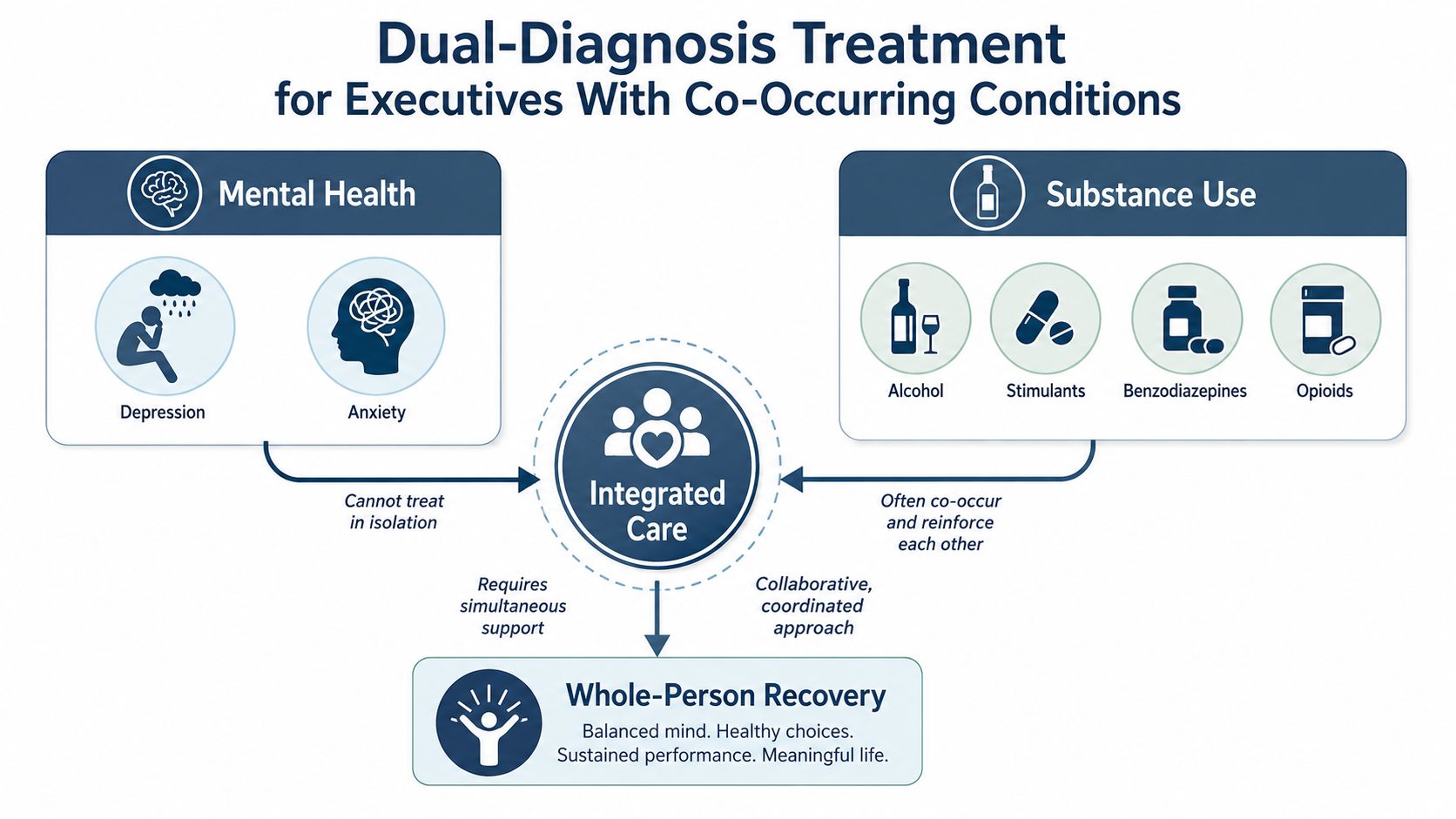
Integrated care is the non-negotiable
A credible luxury program should run CBT, DBT, ACT, motivational interviewing, individual psychotherapy, and intensive groups together, not as disconnected add-ons. If withdrawal management or medication optimization is clinically indicated, it belongs in the plan from the start, under psychiatric oversight, not as an afterthought.
The reason is simple. Co-occurring conditions don't heal in silos. A polished residential environment can still fail if the team is fragmented, because the client ends up with separate conversations instead of one coherent treatment plan.
What high-quality dual-diagnosis care looks like
The strongest programs pair evidence-based therapy with adjunctive work that supports the whole person, somatic practices, mindfulness, art, equine work, fitness, nutrition, and structured family involvement. That combination matters for executives because leadership stress is rarely purely cognitive. It lives in the body, in habits, in sleep, and in how the person performs under pressure.
PhD-level psychology and psychiatry staffing also matter here, because co-occurring disorders often require precise psychopharmacology and careful monitoring. A single clinical director coordinating the plan is a better structure than a stack of referrals, because it keeps the treatment coherent.
Browse the dual-diagnosis program details if the care model needs to include both psychiatric stabilization and substance use treatment in one residential setting.
For executives, the practical test is this. Can the program treat mood, trauma, and use together while preserving enough privacy and routine for a return to work? If the answer is no, the model is too shallow for high-stakes clients.
How Admission and Evaluation Actually Work in a High-End Setting
The first call should feel quiet, not chaotic. In a strong private-pay program, the intake process starts with a confidential pre-screen, then moves to clinical evaluation, medical review, and a clear plan before arrival. That sequence matters because executives don't need a dramatic handoff, they need a controlled one.
What happens first
A serious admissions team asks direct questions about symptoms, safety, recent substance use if relevant, medications, sleep, work commitments, and family support. The point is to decide whether residential care is appropriate and whether detox support is needed first. Once that's clear, the team can prepare a treatment plan rather than improvising after arrival.
The first day should not feel like an ER hallway. It should feel organized, private, and medically grounded. That means admission paperwork, psychiatric evaluation, a plan for medication continuity, and a schedule that begins restoring sleep and lowering risk right away.
The executive difference
High-end residential care should also address the reality of communication. Controlled access to phones and laptops is not a perk for vanity, it's a practical requirement for many working professionals who need to keep a business alive while they stabilize. The line still has to be clear, though. Electronics should support continuity, not become a loophole that keeps the client half in treatment and half in the office.
Admission should lower stress on day one, not multiply it. If the process feels disorganized, loud, or opaque, that facility will probably feel that way throughout the stay.
| Step | Luxury Residential Admission | Typical Acute Pathway |
|---|---|---|
| First contact | Confidential pre-screen with discretion | Often urgent, routed through crisis channels |
| Clinical review | Psychiatrist and psychologist evaluation | Rapid triage focused on immediate safety |
| Medical handling | Planned clearance and medication review | Fast medical containment, less personalization |
| Arrival experience | Calm intake, private room, structured start | Public, high-activity hospital environment |
| Work continuity | Supervised electronics access when appropriate | Usually minimal to no work access |
The right question is not whether a client can work during treatment. It's whether work is being managed in a way that protects care. For the right executive, a high-end setting can do both.
Insurance, Private Pay, and Legal Considerations for High-Profile Clients
Private pay is common in this tier of care because the model is built around discretion, individualized staffing, and residential continuity. That does not mean insurance is irrelevant. It means the financial structure needs to be discussed frankly, along with what may be reimbursable out of network and what has to be handled directly.
The legal side matters just as much. Confidentiality is not a marketing slogan, it's a duty under HIPAA, and the facility should be able to explain how it handles employer communication, family updates, and outside coordination. For a broader legal lens on confidentiality, it's worth having counsel or a trusted advisor review Ciphar's confidentiality resource alongside the facility's own policies.
What executives actually need answered
A high-profile client usually wants to know four things fast, whether the stay can be structured around FMLA, whether short-term disability can be coordinated, whether ADA issues come into play, and how much information will ever reach an employer or board. Those are fair questions. Any program serving this population should answer them without sounding evasive.
Financially, the right conversation is about structure, not surprise. If a client is considering a 30-, 60-, or 90-day stay, the admissions team should be able to explain what services are included, what the billing posture is, and how outside reimbursement might work if applicable. No one wants hidden ambiguity when the person is already carrying a heavy workload.
A well-run program protects privacy by default and shares information only on a need-to-know basis, with written authorization doing the rest.
The cleanest approach is straightforward. Use private pay when the clinical model demands it, check whether any portion can be submitted for reimbursement, and keep HR communication minimal and factual. For executives, the legal goal is simple, preserve treatment access without creating unnecessary exposure.
How to Choose the Right California Facility for an Executive or High-Profile Client
The wrong facility will sell atmosphere. The right one will show process. For a senior leader, the vetting should happen in one call or one visit, and it should focus on things that can be verified, not mood-board language.
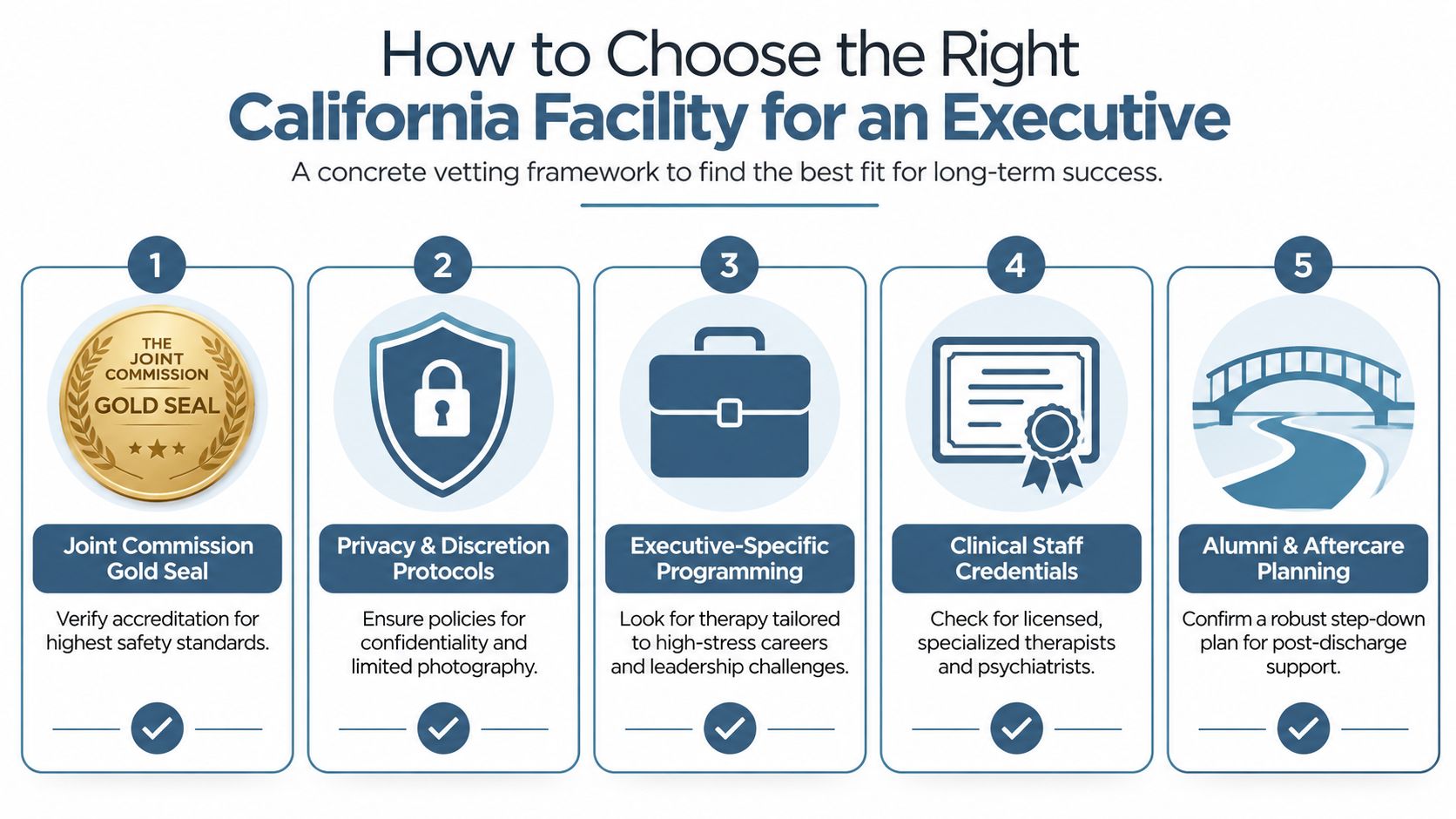
The five markers that matter
- Joint Commission accreditation. Verify that the facility can show it, not just talk around it.
- Privacy and discretion protocols. Ask how photography, visitor flow, communications, and staff confidentiality are handled.
- Executive-specific programming. The treatment plan should account for work stress, leadership burden, and return-to-duty planning.
- Clinical staff credentials. Named psychiatrists, psychologists, and licensed therapists should be visible and verifiable.
- Alumni and aftercare planning. Discharge should already have a step-down path attached.
The presence of private single rooms in detox and rehab is another important marker for this clientele, because shared sleeping space raises friction and can slow stabilization. So does the ability to keep electronics in a supervised way, since many executives need controlled continuity with work and family. A strong facility should also offer family programming, because the aftercare gap is where many high-performing people lose traction.
The facility's public material should also make dual-diagnosis depth obvious. If it looks broad but not deep, or luxurious but thin on clinical detail, keep looking. California's care is too constrained to waste time on a beautiful intake brochure.
Review a luxury residential treatment model in California if the decision needs to be grounded in a private, structured setting with real clinical staffing.
Questions to ask before admitting
Ask how the program handles staff coverage at night, how it coordinates medication changes, what its continuing-care plan looks like, and how confidentiality is protected when outside professionals are involved. Then ask who leads treatment day to day. If the answers are vague, the facility is not ready for a high-profile client.
Aftercare, Alumni Programming, and Taking the First Confidential Step
Discharge is not the finish line. For executives, it's the handoff point where structure has to continue or the old pattern creeps back in. The strongest programs step clients down into PHP or IOP, keep matching them with an individual clinician, and continue medication management and family work in a way that fits real schedules.

Alumni programming matters because it gives high-functioning clients a place to return without embarrassment or reinvention. Flexible check-ins help when travel, leadership demands, or family obligations get messy. For a practical look at privacy expectations during treatment transitions, the 2026 patient privacy guide is a useful companion read.
The first confidential step should be simple. Call admissions, be direct about symptoms, work obligations, and any substance use concerns, and ask whether residential care, detox, or a step-down model is the better fit. A well-run team will ask the right safety questions, explain the next move clearly, and keep the process discreet from the start.
Reflections offers California residential care for adults with co-occurring mental health and substance use disorders in a private, structured setting with individualized treatment and supervised electronics access when appropriate. If you need a confidential option that can support both stabilization and career continuity, visit Reflections and speak with admissions about the right level of care.