

The board meeting ends, but the executive's mind doesn't. After a day of decisions, travel, conflict, and uninterrupted availability, a drink, stimulant, sedative, or prescription medication may appear to offer a reliable way to shut down or stay functional. The problem emerges when the coping strategy starts controlling the schedule, judgment, relationships, and health. For a high-performing professional, the warning sign often isn't a visible collapse. It's the growing effort required to keep appearing composed.
Cognitive behavioral therapy in addiction offers a structured way to examine that pattern without reducing it to a failure of discipline. In a private residential setting, treatment can address substance use, anxiety, trauma, depression, and executive pressure while preserving appropriate access to work and communication. The standard is not comfort. It's clinical precision, discretion, and a plan that can survive real professional demands.
Redefining Recovery for High-Performing Professionals
A senior executive may notice the change during an ordinary workday. The inbox still gets cleared, presentations remain polished, and decisions are made quickly, but the evening routine has become fixed. A substance once used to manage pressure now determines whether the executive can sleep, travel, socialize, or face the next morning. Telling that person to “just stop” ignores the operational system supporting the behavior.
CBT gives the problem a more useful structure. Instead of asking only why someone lacks control, clinicians examine the sequence that precedes use: the demanding meeting, the automatic thought about failure, the surge of anxiety or exhaustion, and the behavior that produces short-term relief. That sequence can be analyzed, tested, and changed.

A treatment model that respects responsibility
High-end executive treatment doesn't require a resident to abandon every professional responsibility. Some executive programs provide controlled device access, secure workspaces, business centers, and scheduling support for calls and deadlines, allowing clients to remain connected while participating in care (executive rehab resources). Private rooms can also create a controlled environment for confidential communications and focused work.
That flexibility isn't a substitute for treatment. It's a way to remove the false choice between receiving help and protecting a leadership role. Clinical staff still determine whether work access supports recovery or becomes another method of avoidance.
Practical rule: Work access should be structured around treatment, not allowed to compete with it.
From willpower to cognitive resilience
Executives already understand systems, feedback loops, and risk management. CBT translates those instincts into recovery work. The client learns to identify the assumptions that turn pressure into substance use, then develops alternative responses that protect judgment and long-term performance.
Evidence supports CBT as a legitimate component of substance use disorder care. A meta-analysis of 34 randomized controlled trials involving 2,340 patients found moderate overall efficacy, with an effect size of d = 0.45 (meta-analysis of CBT for substance use disorders). The purpose of luxury care isn't to make addiction look elegant. It's to provide a setting where rigorous treatment can occur with privacy, comfort, and sufficient clinical attention.
The Core Mechanics of Cognitive Restructuring
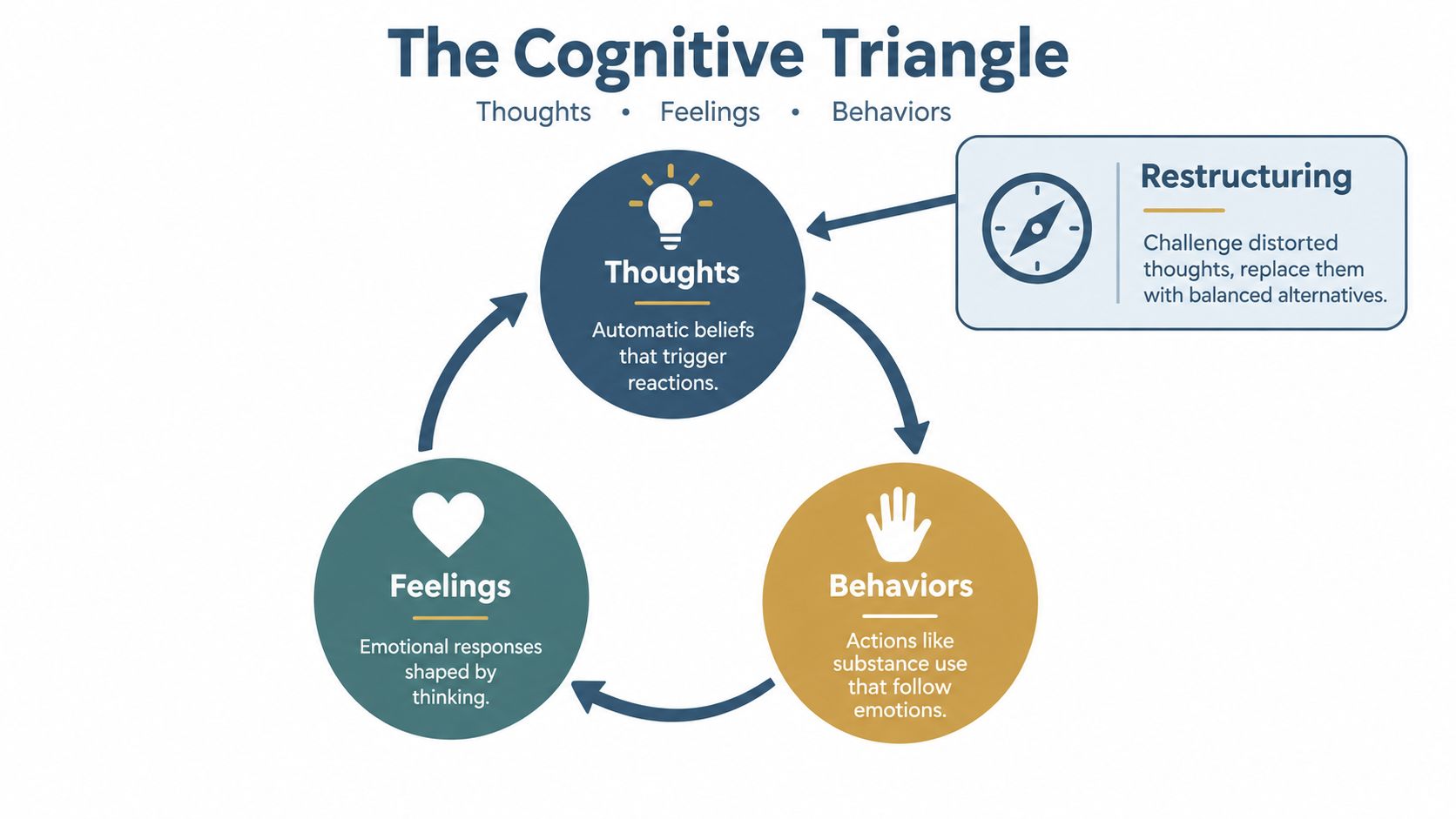
CBT begins with a practical premise: thoughts, feelings, and behaviors influence one another. A thought such as “this deal will fail unless the executive stays chemically alert” can intensify fear or urgency. Those feelings can prompt substance use, which may provide immediate relief while strengthening the original belief.
For analytical professionals, this resembles a faulty decision loop. The brain records short-term relief as evidence that the behavior worked, even when the longer-term result includes impaired sleep, secrecy, withdrawal, or escalating risk. CBT interrupts the loop by making each stage visible.
Mapping the operating pattern
A clinician may ask the client to record several elements surrounding a high-risk episode:
- The trigger, such as an argument, deadline, flight, social event, or difficult memory.
- The automatic thought, including predictions, judgments, or perceived obligations.
- The emotional and physical response, such as agitation, shame, fatigue, craving, or racing thoughts.
- The behavior, including obtaining, using, hiding, or recovering from the substance.
- The consequence, separated into immediate relief and later cost.
This functional analysis changes the discussion from morality to information. It also reveals that the same behavior may serve different purposes on different days. Alcohol might be used to reduce social anxiety, while stimulants might be used to overcome exhaustion, and sedatives might be used to force sleep.
Challenging distorted logic
Cognitive distortions often sound plausible because they contain part of the truth. “The company needs the executive fully operational” may be accurate, but it doesn't follow that substance use is the only way to remain effective. “No one can know” may protect privacy in the short term, but it can also prevent appropriate support and increase isolation.
During individual psychotherapy, clinicians help clients test these beliefs rather than replace them with forced optimism. The objective is a balanced alternative that can withstand pressure, such as: “The deadline matters, and preserving clear judgment matters too. A structured pause and clinical support are operational decisions, not evidence of weakness.”
Turning insight into behavior
Cognitive restructuring isn't complete when a client understands a pattern. The new response must be practiced under conditions that resemble professional life. A resident might rehearse declining a drink at a client dinner, responding to a confrontational message without using, or leaving a high-pressure setting before craving reaches its peak.
A highly accredited clinical team can track these exercises through written records, session feedback, and behavioral observation. The work doesn't erase stress responses. It builds a more reliable response architecture, one that gives the executive more choices before an automatic behavior takes over.
Evidence-Based Techniques and Session Structure
The strongest CBT programs are active rather than purely conversational. A resident doesn't describe a difficult week and receive reassurance. The clinician identifies a maintaining cycle, selects a skill, tests it, and reviews the result.
Functional analysis in practice
Functional analysis is the central diagnostic exercise. The client and therapist reconstruct what happened before, during, and after substance use. They look for antecedents, internal cues, environmental cues, short-term rewards, and delayed consequences.
A professional who drinks after investor calls may initially describe the pattern as a response to workload. Detailed review could reveal a narrower trigger, such as perceived criticism, fear of losing authority, or an evening transition with no decompression routine. That distinction matters because the intervention can then target the precise vulnerability instead of prescribing generic stress management.
Building replacement responses
CBT skills should be specific enough to use during a live trigger. Common exercises include:
- Urge observation: Notice craving as a changing internal event rather than an instruction.
- Thought testing: Examine evidence for catastrophic or all-or-nothing conclusions.
- Behavioral rehearsal: Practice a different response before a difficult meeting, trip, or social obligation.
- Problem solving: Separate controllable business problems from emotional discomfort that cannot be solved immediately.
- Relapse planning: Identify early warning signs, support contacts, environmental changes, and next actions.
A group setting adds another layer. Executives often discover that secrecy has narrowed their perspective, while structured peer work provides feedback without requiring public exposure outside the clinical environment. A targeted relapse prevention group activity can turn abstract intentions into a written response plan.
A work-compatible residential day
A luxury residential schedule should protect therapeutic intensity and personal privacy at the same time. A resident may have individual therapy, clinical groups, medical monitoring, nutrition, fitness, and restorative activities, with designated periods for approved calls or focused work. Private rooms offer a confidential place to decompress, complete work tasks, or speak with family.
Some upscale executive programs specifically describe private rooms, personal balconies, working spaces, and computer access during free time for meetings or work responsibilities (executive residential care example). The principle is useful even when programs differ: career continuity must remain subordinate to medical safety and clinical priorities.
CBT can be delivered with flexibility, but not casually. A clinical director should know when device access is stabilizing and when it is perpetuating hypervigilance, avoidance, or exposure to workplace triggers. The schedule must be adjusted accordingly.
Navigating Dual-Diagnosis Care and Clinical Realities
Substance use rarely exists in isolation for the executive who relies on it to manage internal distress. Anxiety may drive constant activation. Depression may make ordinary responsibilities feel unreachable. Trauma may turn criticism, conflict, or loss of control into a physiological emergency. Treating only the substance behavior leaves the operating conditions intact.
Dual-diagnosis care coordinates treatment for both substance use and mental health concerns through one clinical strategy. CBT can identify the thoughts and behaviors that maintain use, while other modalities address emotional regulation, trauma processing, interpersonal patterns, and medication needs. DBT, EMDR, ACT, motivational interviewing, and medication optimization may each have a role when clinically appropriate.
What the evidence supports
The evidence for CBT is meaningful, but it deserves accurate framing. A 2023 systematic review of five CBT meta-analyses found small-to-moderate effects on substance use compared with inactive treatment, with the largest gains appearing one to six months after treatment and diminishing by eight months or more (systematic review of CBT meta-analyses). The review strongly recommended CBT as an empirically supported treatment for substance use disorders, while also noting that CBT doesn't consistently outperform every other evidence-based therapy.
That distinction matters in private care. A program shouldn't present CBT as a universal replacement for medication, contingency management, agonist treatment, trauma therapy, or medical stabilization. The appropriate question is how CBT fits the individual's substance type, psychiatric profile, safety needs, and recovery environment.
The mental-health gap
A 2025 meta-analysis of 47 randomized trials found that cognitive-behavioral interventions for co-occurring substance use and mental health disorders improved substance-consumption outcomes compared with usual care or controls, but did not improve psychosocial outcomes (meta-analysis of co-occurring disorders). When compared with treatment focused only on substance use or only on mental health, effects weren't significant.
For a client asking whether CBT will reduce trauma, anxiety, depression, or quality-of-life problems, this is an important answer. CBT can help build coping and reduce use, but broader recovery may require additional, individualized treatment. A PhD-level psychologist, psychiatrist, and multidisciplinary team should determine whether trauma processing, medication management, somatic work, family therapy, or other interventions belong in the plan.
Clinical perspective: A reduction in substance use is a vital outcome, but it isn't the same as resolution of the pain that made use attractive.
Stimulant treatment also illustrates why clinical nuance matters. A 2025 meta-analysis of stimulant-use trials found that standalone CBT improved short-term abstinence versus minimal-treatment controls, with an odds ratio of 2.88 and a 95% confidence interval of 1.08 to 7.70, across 9 randomized controlled trials. The analysis reported substantial heterogeneity, I² = 75.62%, and no dropout advantage (meta-analysis of CBT for stimulant use). Those findings support CBT as a useful component, not a guarantee of durable standalone remission.
The Executive Advantage of Immersive Residential Care
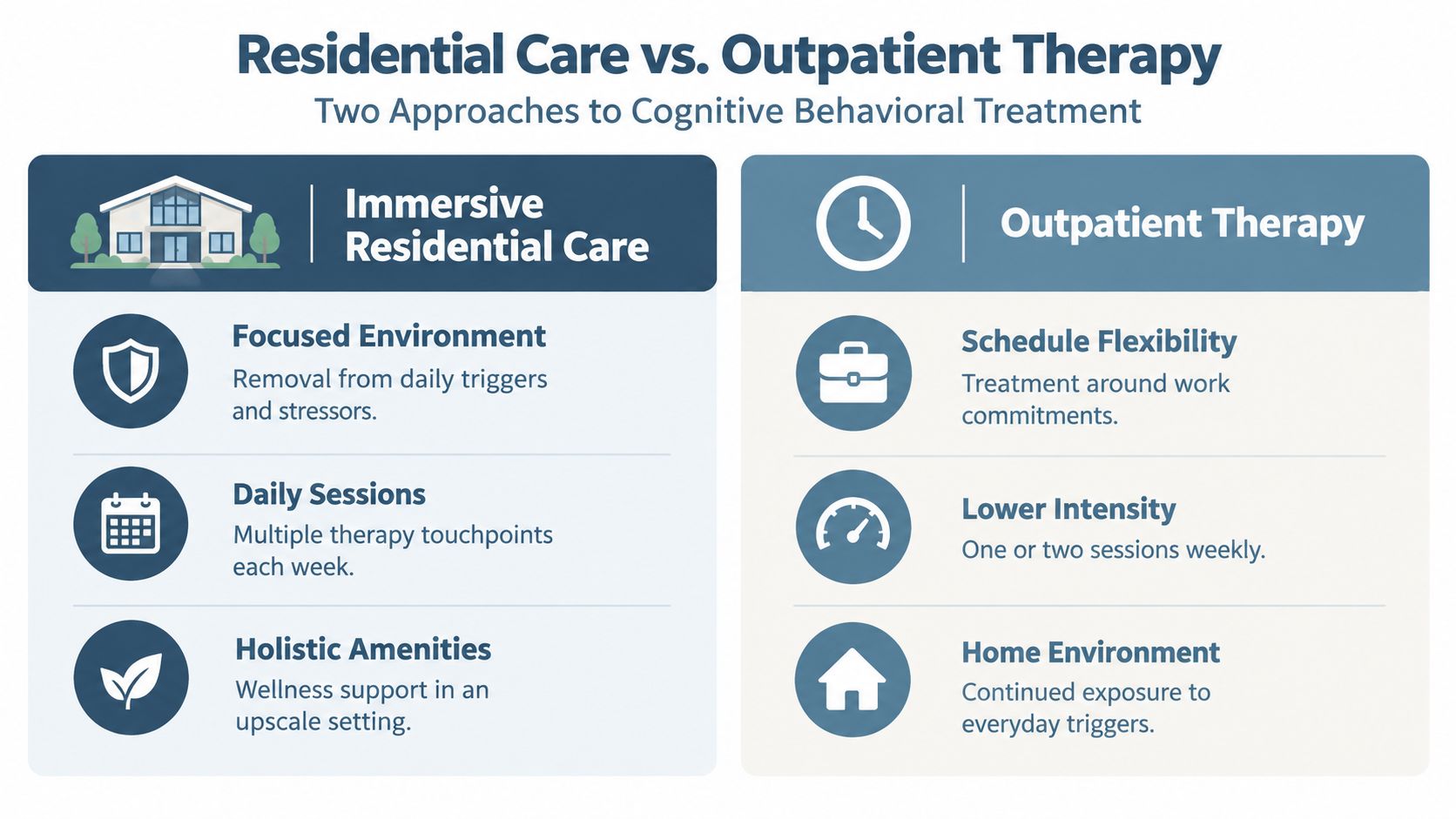
Outpatient CBT offers a practical route for professionals who remain medically and psychologically stable in their existing environment. It can accommodate work demands, family responsibilities, and established housing. Its limitation is equally clear: the client returns after each session to the same office, relationships, routines, access, and triggers that may reinforce substance use.
Residential treatment changes the setting in which cognitive work occurs. The client has distance from immediate pressures, daily clinical contact, medical oversight when needed, and repeated opportunities to practice alternatives. That concentration can be particularly valuable when substance use is tied to travel, leadership conflict, irregular sleep, or a home environment that has become difficult to manage.
Choosing the level of care
| Outpatient CBT | Luxury residential CBT |
|---|---|
| Treatment takes place around existing obligations. | Treatment becomes the central daily structure. |
| The client remains exposed to familiar triggers. | The client gains distance from immediate triggers while practicing new responses. |
| Contact may be limited to scheduled sessions. | Therapy, groups, medical care, and wellness support can be coordinated throughout the day. |
| Privacy depends partly on the client's home and work environment. | Private rooms and controlled communication can support discretion. |
Neither setting is automatically superior. Residential care is more appropriate when outpatient structure cannot contain risk, when the home environment reinforces use, or when co-occurring symptoms require concentrated evaluation. Outpatient care may fit a client with reliable safety, strong support, and sufficient control over triggers.
Privacy without isolation
Luxury amenities have clinical value when they support regulation rather than distraction. Quality nutrition, fitness, mindfulness, massage, and experiential therapies can help residents restore routines that substance use disrupted. They shouldn't replace psychotherapy or medical care, but they can make daily practice more sustainable.
High-end care also allows practical privacy measures. Private rooms, discreet arrival procedures, controlled device access, and secure spaces for work can help a public-facing leader engage without turning treatment into another source of professional exposure. A resident may continue selected career responsibilities, but the clinical team should define boundaries that prevent work from consuming the therapeutic environment.
Decision point: Residential care earns its place when the uninterrupted environment changes what the client can safely practice, not merely where the client sleeps.
The financial commitment of private pay treatment also requires disciplined evaluation. The relevant return isn't a promised outcome or a luxury label. It's whether the program provides the clinical depth, medical safety, privacy, and continuity needed to address the factors that outpatient sessions cannot contain.
Evaluating Clinical Excellence and Accreditation
A polished facility can create a reassuring first impression. That impression isn't enough. Executives and families should examine the clinical model with the same scrutiny applied to an important professional decision.
Credentials that deserve attention
Joint Commission accreditation is a meaningful quality marker used by addiction-treatment providers. Accredited programs describe adherence to formal standards, quality processes, and organizational accountability. State licensing also matters because it establishes a regulatory baseline for the facility and its services.
Accreditation doesn't guarantee a particular individual's outcome, and it shouldn't be treated as a substitute for clinical fit. It does, however, give families a more substantive criterion than décor, branding, or hospitality alone. Providers should be willing to explain accreditation status, licensing, medical coverage, emergency procedures, staffing, and how treatment plans are reviewed.
Questions for the clinical director
A discerning prospective client can ask:
- Who directs care? Request the credentials and roles of the medical director, psychiatrists, psychologists, therapists, and addiction counselors.
- How is dual diagnosis integrated? Determine whether one coordinated team addresses mental health and substance use or whether services operate as disconnected tracks.
- How is CBT individualized? Ask how clinicians adapt cognitive and behavioral work to the client's substance, triggers, psychiatric symptoms, and professional environment.
- What happens after discharge? Look for continuing care, family involvement, alumni support, and flexible outpatient options.
- How are work and devices managed? Clarify when phones and laptops are available, who approves access, and how privacy is protected.
Some residential providers explicitly combine Joint Commission accreditation with integrated treatment for co-occurring substance use and mental health conditions. Other clinically oriented programs identify CBT and DBT within a licensed, accredited treatment model. These are useful reference points for the questions families should ask, not reasons to select a program without a direct assessment.
Operationally complex practices may also benefit from administrative support. For a general overview of a service category that can help medical organizations manage nonclinical workflows, families and professionals can review Medical virtual assistants, while keeping the treatment decision focused on clinical qualifications and patient care.
Luxury should serve the treatment
The right luxury program uses comfort to protect concentration, dignity, and recovery routines. It doesn't use luxury language to obscure thin staffing, vague outcomes, or an uncoordinated approach to psychiatric care.
A highly accredited team should be able to explain why CBT is being recommended, what it can realistically accomplish, what it cannot address alone, and how progress will be evaluated. That transparency is more valuable than a promise of effortless transformation.
Building Long-Term Cognitive Resilience
Discharge doesn't mean the executive has permanently solved every trigger. It means the client has developed a working set of cognitive and behavioral tools, practiced them in a protected setting, and needs to apply them under changing conditions.
A common high-achiever misconception is that therapy should end once insight arrives. Insight is useful, but relapse prevention depends on repeated execution. The executive must recognize early warning signs, protect sleep and recovery routines, communicate limits, and respond to stress before the old loop becomes automatic.
Returning to the executive suite
A continuing-care plan should translate residential work into specific professional situations. That may include:
- Travel protocols: A written plan for airports, hotels, client dinners, and disrupted routines.
- Leadership triggers: Strategies for criticism, uncertainty, conflict, and perceived loss of control.
- Communication boundaries: Clear rules for after-hours contact, confidential support, and recovery time.
- Clinical follow-up: Flexible therapy and medication appointments that preserve continuity.
- Family participation: Private sessions and education that help close relationships support recovery without policing it.
Reflections offers residential dual-diagnosis care that integrates CBT with DBT, ACT, motivational interviewing, individual psychotherapy, intensive groups, medication optimization, and complementary therapies. Its California-licensed, Joint Commission-accredited program provides private residential treatment, controlled access to electronics for appropriate work and family engagement, and continuing care after discharge through flexible services and alumni programming.
The evidence argues for maintenance
The earlier evidence shows why maintenance matters. CBT's strongest measured gains often appear early and may attenuate over time, so a client shouldn't interpret initial improvement as permission to abandon support. The more durable goal is a shift in how stress is interpreted, how cravings are handled, and how decisions are made when professional stakes feel high.
Residential treatment lengths can be individualized, with programs commonly ranging from 30 to 90 days when clinically appropriate. The essential question isn't the calendar alone. It's whether the client has enough stability, practice, medical oversight, and continuing care to return to leadership without returning to the same coping system.
Long-term standard: Sustainable sobriety requires a recovery operating system that remains usable on the hardest workday, not only during treatment.
For executives and C-suite leaders, seeking care can be framed as a strategic act of preservation. Cognitive behavioral therapy in addiction helps make hidden decision loops visible, then replaces automatic coping with deliberate responses. With privacy, accredited clinical oversight, and a carefully designed transition home, recovery can support sharper judgment and more sustainable leadership.
Reflections provides discreet, private residential treatment for adults with co-occurring mental health and substance use disorders, including executive clients who need structured access to work and family responsibilities. Visit Reflections to explore its accredited dual-diagnosis programs, CBT-based care, private rooms, and continuing support.