

The calendar is full. The inbox never stops. Sleep has become shallow, patience has narrowed, and the edge that once felt like ambition now feels closer to strain. For many executives, that pressure stays hidden behind polished presentations, controlled language, and a schedule that leaves no room for collapse.
In that environment, individual psychotherapy isn't a retreat from performance. It's a disciplined, private process for restoring judgment, emotional range, stamina, and clarity. In a luxury residential setting designed for high-achieving professionals, that work becomes even more precise. Treatment can address anxiety, trauma, depression, substance use, burnout, and relationship fractures without forcing a client to abandon professional identity or real-world obligations.
Beyond the Boardroom Understanding Individual Psychotherapy

At the executive level, distress rarely arrives as a simple complaint. It shows up as shortened patience in negotiations, compulsive overwork, alcohol use that has become too central to the evening routine, or a private sense that success no longer feels stabilizing. Outward competence can coexist with inward exhaustion for a long time.
Individual psychotherapy is a confidential, one-to-one clinical relationship built to examine that gap. It gives a client protected space to identify patterns that aren't visible in the boardroom, including perfectionism, trauma-driven control, emotional numbing, chronic vigilance, and the use of substances to regulate stress. For high-performing adults, that level of privacy matters because real progress usually starts only when image management ends.
Why the one-to-one format matters
A strong therapist does not merely listen. A strong therapist tracks behavior, language, defenses, values, decision patterns, and the difference between what a client says matters and what daily life reveals runs the system. In a residential executive program, that work can move quickly because the clinician sees the whole context, not just one hour cut out of an overloaded week.
The quality of that relationship isn't secondary. The clinical literature on fidelity and therapist impact notes that the therapeutic relationship accounts for 30% of total outcome variance, and that the therapist's expertise has a substantial effect on results beyond the specific treatment model.
Practical rule: For executives, the therapist isn't a passive sounding board. The therapist is a strategic clinical partner who can challenge blind spots without destabilizing dignity.
What it is and what it isn't
Many professionals avoid therapy because they associate it with passivity, vague conversation, or a loss of control. Effective individual psychotherapy isn't any of those things. It is structured, evidence-based, and customized.
It often includes work such as:
- Clarifying the underlying problem: separating surface symptoms from root issues like unresolved trauma, grief, bipolar features, anxiety, or substance dependence.
- Building emotional range: helping a client move beyond suppression, irritability, or over-intellectualization.
- Improving performance under pressure: strengthening judgment, boundaries, and recovery after high-demand periods.
- Repairing the private cost of public success: addressing marriage strain, family disconnection, and identity loss outside achievement.
For executives, mental health treatment works best when it's framed accurately. This isn't about brokenness. It's about restoring the internal conditions that allow leadership, relationships, and personal life to remain sustainable.
Core Therapeutic Modalities for Executive Challenges
Some executives ask which therapy works best. The better question is which therapy fits the actual problem. A client struggling with panic before investor calls needs a different intervention than a client whose leadership style is shaped by old trauma, or a client who uses alcohol to mute chronic self-criticism after work.
Matching the modality to the pressure point
A useful way to think about modalities is to view them as different instruments in the same clinical toolkit.
| Modality | Core Focus | Best Suited For Addressing |
|---|---|---|
| CBT | Thoughts, beliefs, and behavior patterns | Perfectionism, imposter syndrome, performance anxiety, relapse triggers |
| DBT | Emotional regulation and distress tolerance | Reactivity, conflict escalation, impulsivity, dual-diagnosis instability |
| ACT | Values-based action with psychological flexibility | Burnout, avoidance, identity conflict, rigid control |
| Psychodynamic therapy | Unconscious patterns and relational history | Repeated relationship failures, self-sabotage, control issues, shame |
| Trauma-focused therapy | Processing unresolved traumatic experiences | Hypervigilance, emotional numbing, intrusive responses, survival-driven leadership style |
CBT for distorted thinking under pressure
Cognitive behavioral therapy is often highly relevant for professionals because executives tend to normalize distorted thinking when it produces short-term results. Common examples include all-or-nothing standards, catastrophizing, and the belief that rest equals weakness. CBT helps identify those thought loops, test them, and replace them with more accurate interpretations.
A leader who thinks, "If I delegate this, quality will collapse," often isn't stating a fact. That person is revealing a belief system. Structured CBT treatment in residential care can help translate that belief into observable behavior, then challenge it with evidence and practice.
DBT for emotional control that doesn't become emotional shutdown
Executives are often praised for composure. But composure and emotional suppression aren't the same. Dialectical behavior therapy helps clients regulate emotion without flattening it. That's especially useful when someone swings between intense control at work and impulsive behavior in private, including substance use, anger, or abrupt withdrawal.
DBT teaches skills that matter in real executive life:
- Distress tolerance: staying grounded during conflict, legal stress, or sudden reputational pressure.
- Emotion regulation: reducing the build-up that leads to late-night drinking, rage, or collapse.
- Interpersonal effectiveness: handling confrontation without passivity or domination.
A leader doesn't need less emotion. A leader needs more skill in using emotion without being driven by it.
ACT, psychodynamic, and trauma-focused work
Acceptance and commitment therapy often helps professionals whose life has narrowed around obligation. These clients may still be productive, but they're no longer connected to meaning. ACT doesn't ask them to wait for perfect certainty before changing course. It helps them act in line with values even while discomfort is present.
Psychodynamic therapy is useful when a client's current problems are repetitive rather than situational. If every success is followed by sabotage, every relationship becomes adversarial, or every criticism feels annihilating, the issue is usually deeper than stress management.
Trauma-focused therapy matters when the nervous system remains organized around old threat. In those cases, overwork, hyper-control, and emotional distance may be adaptations, not personality traits. Treatment then targets the source rather than merely coaching around symptoms.
The Evidence for Lasting Recovery
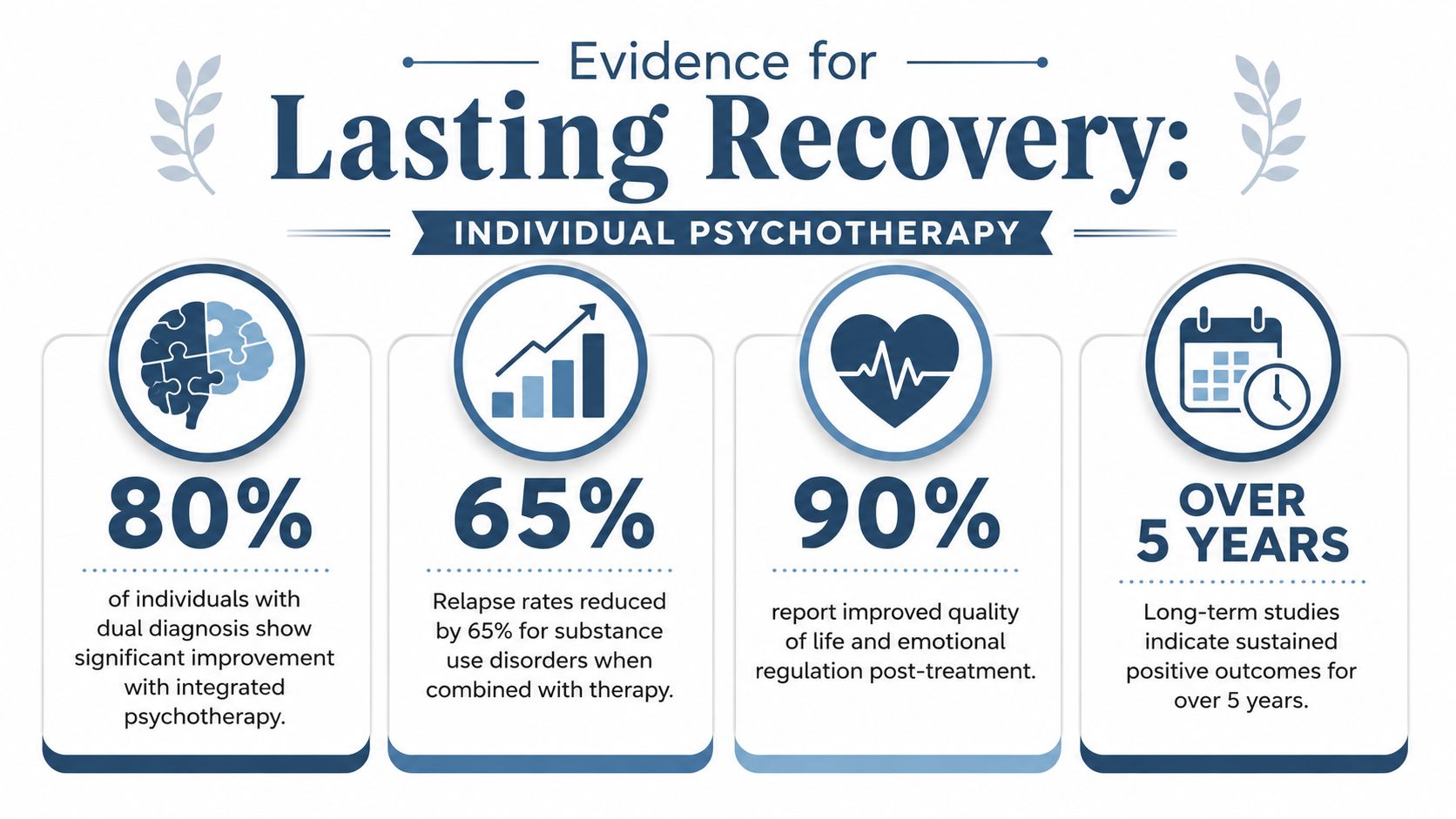
Executives usually want to know whether psychotherapy produces measurable change. It does, but the answer needs precision. Good therapy doesn't just create insight. It reduces symptoms, improves functioning, and supports changes that continue beyond the residential stay.
What the research supports
The reported outcomes on psychotherapy effectiveness show that about 75% of people who enter individual psychotherapy experience significant benefits. The same source states that the average therapy client is better off than 79% of individuals who don't receive treatment, and that anxiety disorders may respond with success rates ranging from 60% to 80%.
That matters in executive treatment because many clients don't arrive with a single issue. They present with overlapping patterns such as anxiety plus alcohol dependence, trauma plus insomnia, or depression plus compulsive overperformance. In those cases, durable recovery depends on treating the system as a whole rather than trying to solve one symptom in isolation.
Why integrated psychotherapy holds up
For dual-diagnosis care, isolated advice rarely works. A client can understand the risks of substance use and still return to it if the underlying drivers remain untouched. Individual psychotherapy helps connect the dots between internal states and external behaviors.
In practical terms, that means exploring questions such as:
- What function is the substance serving? Sleep, emotional shutdown, social confidence, reward, relief.
- What triggers destabilization? Shame, conflict, boredom, loneliness, success, travel.
- What pattern repeats after progress? Overconfidence, secrecy, work overload, disengagement from support.
The best outcomes don't come from symptom suppression alone. They come from understanding what the symptom has been doing for the client.
What lasting recovery usually requires
Results tend to hold when treatment includes several elements working together:
- A precise diagnosis that includes both mental health and substance use patterns.
- Consistent individual psychotherapy with enough depth to uncover root causes.
- Behavioral practice so insight becomes action outside the therapy room.
- Continuity after discharge so gains aren't left unsupported during re-entry.
For high-achieving professionals, this evidence has a straightforward implication. Therapy isn't a vague wellness exercise. It's a clinically grounded intervention that can improve mood, thinking, coping, and executive functioning when it is delivered well and integrated into a broader recovery plan.
Psychotherapy in an Executive Treatment Program
A private executive program should feel less like institutional care and more like a protected operating environment. The point isn't indulgence for its own sake. The point is to remove noise, preserve dignity, and create enough stability for difficult psychological work to happen without unnecessary friction.
What the day often looks like
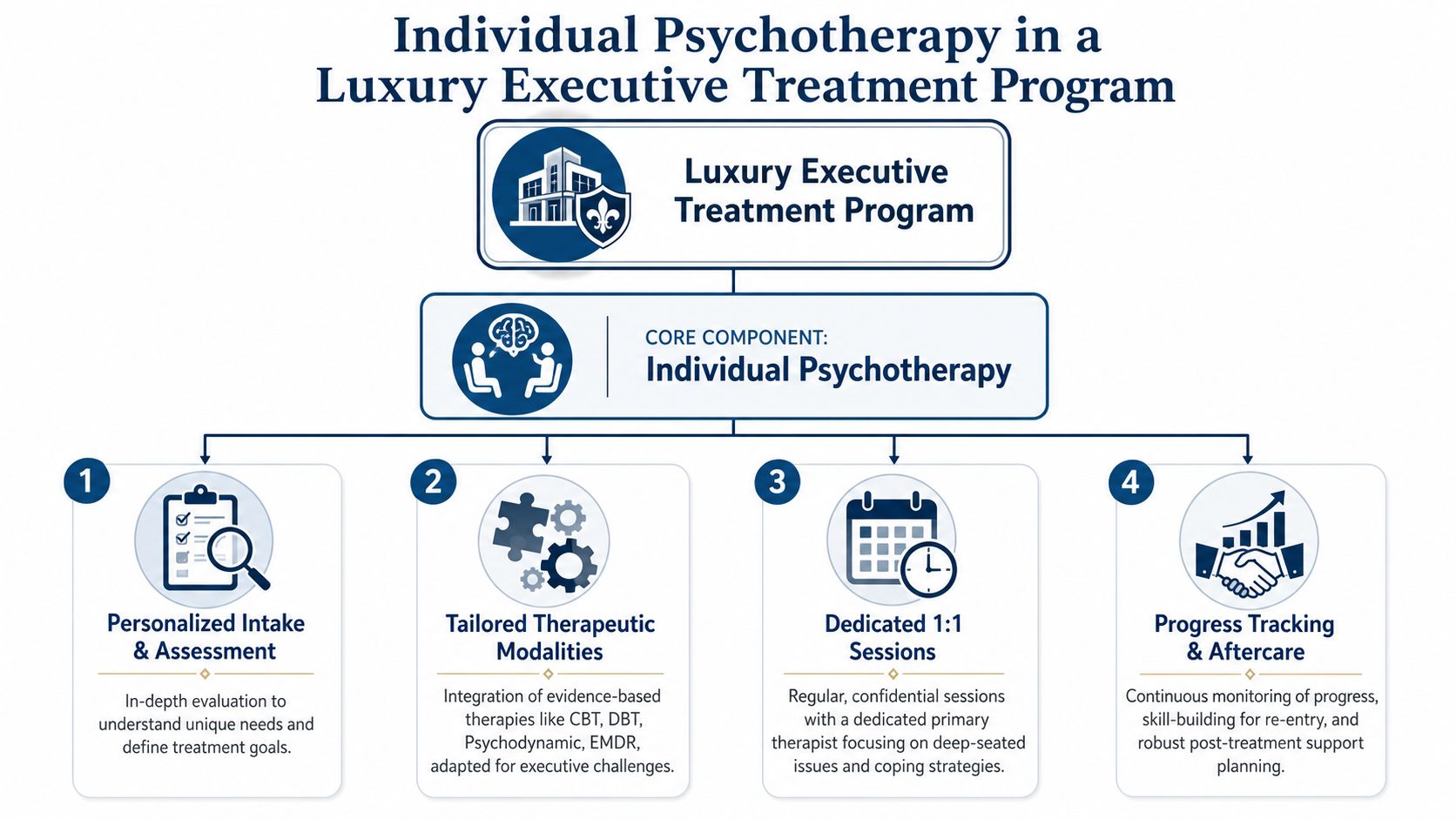
In a luxury residential setting, individual psychotherapy sits at the center of the schedule. The client begins with a detailed assessment that looks beyond presenting symptoms. Clinical staff evaluate mood, trauma history, substance use, family dynamics, professional stressors, medical factors, and prior treatment responses. That allows the primary therapist to shape a plan that reflects the client's actual life, not a generic protocol.
From there, the day is structured, but not chaotic. A client might move from a private therapy session into psychiatry, then into a skills-based group, then into a somatic or mindfulness practice that helps regulate the nervous system. Work obligations are handled intentionally rather than impulsively.
A closer look at individual psychotherapy in residential care shows how one-to-one therapy is often used as the anchor for this broader treatment design.
Professional continuity without therapeutic drift
Many executives delay treatment because they assume rehab requires total professional disappearance. In high-end executive care, that assumption doesn't always hold. The policies described for top-tier executive rehab state that clients may retain access to cell phones, laptops, and Wi-Fi, allowing them to continue handling critical work responsibilities during treatment.
That feature helps only when it is clinically contained. Unlimited work access can easily become organized avoidance. Effective programs don't only hand over electronics and hope for balance. They help clients build boundaries around use so treatment remains primary.
Examples of healthy use include:
- Time-blocked communication: handling essential matters at defined intervals rather than living in the inbox.
- Delegation planning: using treatment to reduce unhealthy centralization of responsibility.
- Trigger monitoring: noticing whether work contact increases clarity or merely spikes anxiety.
The residential environment matters
For senior professionals, environment has clinical value. Privacy lowers defensiveness. Quiet supports sleep and concentration. Predictability reduces the cognitive burden that often keeps clients in high alert.
In a private-pay, luxury setting focused on executives and other high-functioning professionals, the atmosphere is designed around discretion and serious clinical work. That includes upscale accommodations, careful scheduling, and a treatment culture that understands the difference between healthy ambition and self-destruction disguised as commitment.
The aim isn't to pull a client away from real life. The aim is to create enough protected space that real life can be rebuilt on stronger internal footing.
Integration Confidentiality and Holistic Care
A chief executive can tolerate difficult clinical work far more readily than preventable exposure. In residential treatment, that reality shapes how individual psychotherapy is delivered, how information moves, and how the full treatment plan stays aligned.
Individual therapy as the clinical hub
Individual psychotherapy is the organizing center of executive care. It is where symptoms, history, pressure, and behavior are interpreted in context rather than treated as separate problems by separate disciplines. Without that anchor, medication management, family work, physical wellness services, and trauma treatment can drift into parallel tracks that never fully connect.
A primary therapist keeps the plan clinically coherent. If psychiatry adjusts medication, therapy tracks the effect on sleep, focus, irritability, and judgment. If a client participates in mindfulness practice, movement-based work, or family sessions, therapy turns those experiences into decisions, habits, and language the client can use under pressure.
That coordination matters even more in dual-diagnosis treatment. Executive clients often present with overlapping patterns that can look similar on the surface. A short temper may reflect trauma activation, alcohol withdrawal, depression, chronic sleep loss, or strain inside a marriage or leadership team. Individual psychotherapy gives the treatment team a disciplined place to sort signal from noise.
Inside a discreet residential setting, information sharing should be limited to what improves care. Each clinician needs enough detail to do the job well, not unrestricted access to everything disclosed in therapy.
Privacy is part of the treatment model
For executives, founders, attorneys, physicians, and public-facing leaders, confidentiality affects whether they can engage fully at all. Concerns are rarely abstract. They involve reputation, board relationships, investor confidence, legal exposure, family systems, and the simple fear of being seen at a vulnerable moment.
Programs designed for this population should build privacy into daily operations. Private rooms matter because they give clients space to sleep, decompress after difficult sessions, journal, and conduct approved personal or professional calls without unnecessary exposure to other residents. Quiet also lowers vigilance, which often makes deeper therapeutic work possible.
Clients evaluating rehab designed for working professionals should examine how privacy is handled. Ask who has access to clinical information, where sessions take place, how arrivals and departures are managed, whether scheduling reduces visibility, and how staff are trained to protect high-profile clients.
Confidentiality depends on systems. Paperwork alone does not protect a person whose role carries public consequences.
Integrated care only works when every service has a clear job
Luxury settings often include a wider range of clinical and restorative services. That can be useful, but range is not the same as precision. Every element of care should serve a defined purpose tied to the client's diagnosis, stress profile, relationships, and performance demands after discharge.
Mindfulness work should improve self-observation and emotional regulation. Fitness should stabilize energy, reduce stress reactivity, and help restore healthy physical rhythms. Family sessions should address roles, resentments, communication patterns, and boundary failures that can destabilize recovery once the client returns home.
I have seen high-achieving clients respond well when treatment is carefully coordinated around these goals. I have also seen programs overload the schedule with attractive extras that dilute focus and give clients more activity without more change. Individual psychotherapy is what keeps the work honest. It connects each service to a specific clinical objective and removes what does not meaningfully support recovery, resilience, or sustained executive functioning.
How to Choose the Right Clinician and Program
A CEO can spot a weak advisor in one meeting. Treatment deserves the same level of scrutiny.
Choosing an individual psychotherapist within a residential program is not a branding decision or a hospitality decision. It is a clinical decision with operational consequences. For executives and founders, the right match affects candor, pace of progress, protection of privacy, and the realism of the return-to-work plan. The wrong match often produces polished participation with very little real change.
What to verify before admission
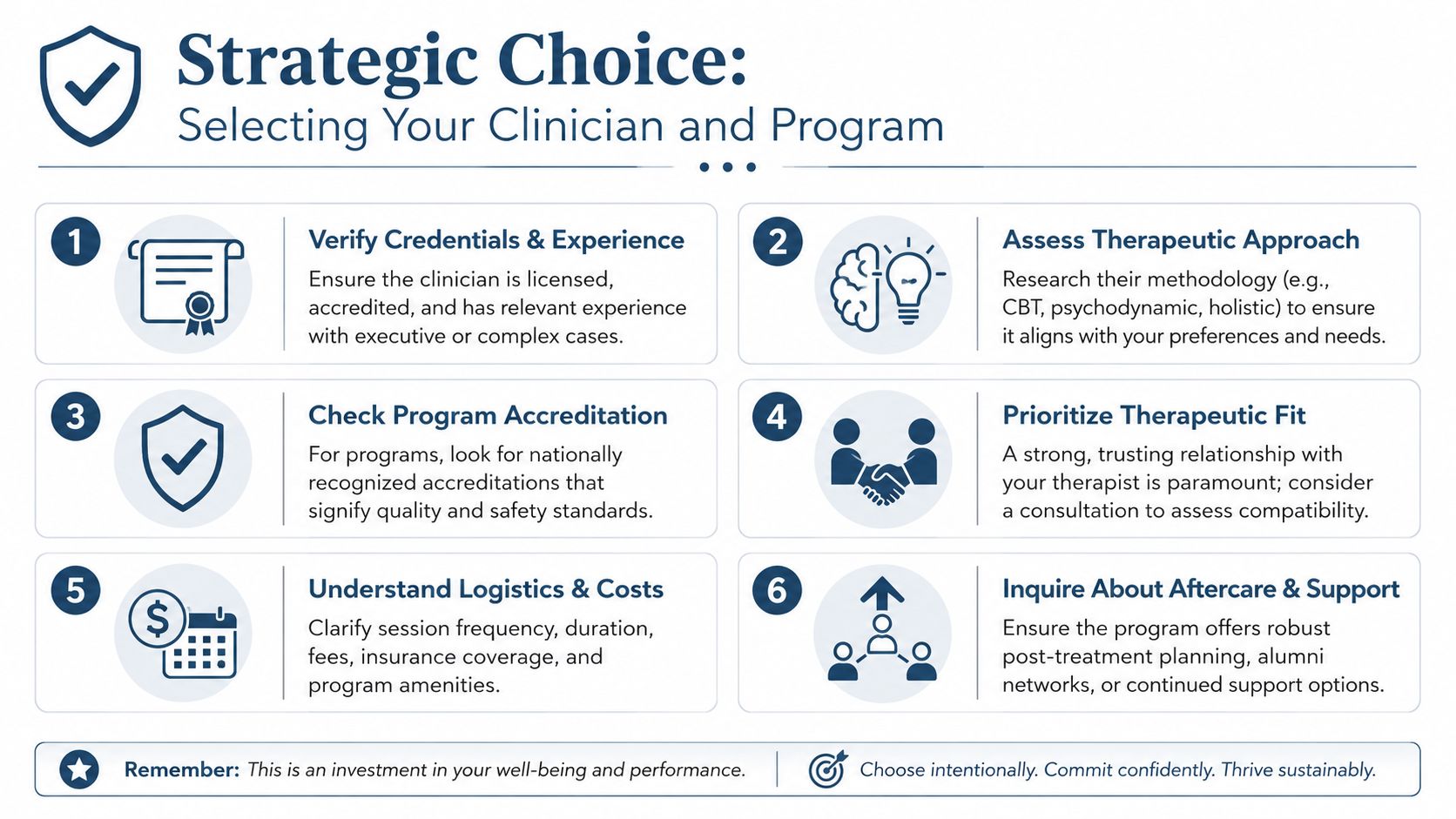
Start with the clinician, not the amenities. In a strong executive program, individual psychotherapy drives the treatment plan, sets priorities, and determines which additional services are useful.
A disciplined review should cover five areas:
- Clinical experience: Confirm that licensed therapists have direct experience with co-occurring psychiatric and substance use conditions, not just general counseling backgrounds.
- Program oversight: Verify state licensure, recognized accreditation, psychiatric access, and clear medical leadership.
- Executive-specific design: Ask whether the program can accommodate professional realities such as restricted communications, limited business continuity, and the pressure of returning to a visible role.
- Range of methods: The team should be able to use different evidence-based approaches based on the client's presentation, personality style, and risk factors.
- Discharge planning: The program should build an aftercare plan early, with attention to travel, family strain, board pressure, and relapse triggers tied to status and performance.
Questions that reveal program quality
The best answers are concrete. Vague reassurance usually signals a standardized program dressed up as personalized care.
| Question | What the answer should clarify |
|---|---|
| How is the treatment plan individualized? | Whether the program builds care around the client's diagnosis, patterns, and executive stressors rather than using a preset schedule |
| Who provides primary therapy? | The credentials, availability, and consistency of the clinician doing the central work |
| How are co-occurring disorders treated? | Whether psychiatric symptoms, trauma, and substance use are addressed together |
| How is professional continuity handled? | Whether the program has clear boundaries for communication, device access, and urgent business contact |
| What happens after residential treatment ends? | Whether the discharge plan is realistic enough to hold under real-world pressure |
Length of stay is part of this decision. Executive residential care often runs from several weeks to a few months, depending on diagnostic complexity, response to treatment, medical needs, and how much work is required before re-entry is safe and stable. A short stay can stabilize a crisis. It may not be enough to change entrenched patterns that have been reinforced for years by achievement, secrecy, and adrenaline.
The business case for clinical fit
Clinical fit matters because high-functioning clients rarely present in obvious ways. They may be articulate, persuasive, and externally disciplined while remaining guarded in the exact places that need attention. A strong individual therapist can identify where insight is genuine, where it is performative, and where success has become part of the defense structure.
I look for a clinician who can hold authority without turning treatment into a power contest. That balance matters with senior leaders. If the therapist is too passive, the client can control the process. If the therapist is too rigid, the client may comply on the surface and withhold the material that would make treatment useful.
One factual example in this category is Reflections, a California-licensed, Joint Commission-accredited luxury residential program focused on dual-diagnosis care for adults who need individualized treatment in a private setting.
Frequently Asked Questions About the Process
Executives usually reach the point of inquiry after a long period of private debate. By then, the main question isn't whether something is wrong. The main question is how treatment works in practice.
How is progress measured in individual psychotherapy
Progress isn't measured by whether every day feels good. It is measured by whether the client's functioning becomes more stable, more honest, and less dependent on avoidance. That may include better sleep, reduced substance use, stronger emotional regulation, improved decision-making, less secrecy, and greater capacity for direct conversation with family or colleagues.
Clinicians also look at pattern interruption. If a client previously responded to shame, fatigue, or conflict with drinking, withdrawal, rage, or compulsive work, progress means those sequences begin to change.
What happens after residential care ends
Residential treatment is a concentrated phase, not the whole journey. Strong programs prepare clients for re-entry before discharge. That usually includes a continuing care plan, outpatient therapy recommendations, psychiatric follow-up when needed, family work, and practical relapse-prevention planning tied to travel, deadlines, social obligations, and home stress.
For executives, aftercare should be realistic. A plan that ignores professional pressure won't hold for long.
A discharge plan should fit the client's actual calendar, actual family system, and actual triggers. Anything less is paperwork, not continuity of care.
How involved is the family
Family involvement can be highly valuable when it is thoughtful and well-timed. Many spouses and relatives have been living with confusion, fear, anger, or accommodation for a long time. Structured family sessions can help clarify what has happened, what recovery requires, and which boundaries now need to be respected.
Family work isn't about assigning blame. It's about reducing distortion and improving the recovery environment after discharge.
Can a client keep working during treatment
In executive-focused residential care, some work continuity is often possible when handled within clear limits. The key issue isn't whether a client can answer messages. The key issue is whether that contact supports stabilization or keeps the client fused to the same cycle that made treatment necessary.
What if the client is still unsure
Ambivalence is common, especially among people who are used to solving problems alone. Waiting for certainty usually prolongs the cost. A more useful question is whether the current approach is still working. If success now depends on emotional suppression, substance use, chronic overwork, or damage control at home, the answer is usually already clear.
Reflections provides confidential, luxury residential care for adults with co-occurring mental health and substance use disorders who need individualized treatment in a private setting that respects professional obligations. Those considering executive-focused treatment can learn more about the program, clinical team, and admissions process at Reflections.