

The executive's day ends, but the work does not. The phone lights up at dinner, a family member asks for emotional presence that isn't available, and a late-night message pulls attention back to the office just as sleep should begin. For high-functioning professionals, setting healthy boundaries is rarely about learning to say no. It's about building a system that protects attention, recovery, and judgment when other people keep reaching for more.
Why Healthy Boundaries Are an Executive Skill
A senior leader can look composed in the boardroom and still be running on fumes by bedtime. The calendar stays full, the phone stays close, and the people who depend on that leader, at work and at home, learn that access is always available. In that environment, boundaries stop being a personal preference and become part of operational discipline.
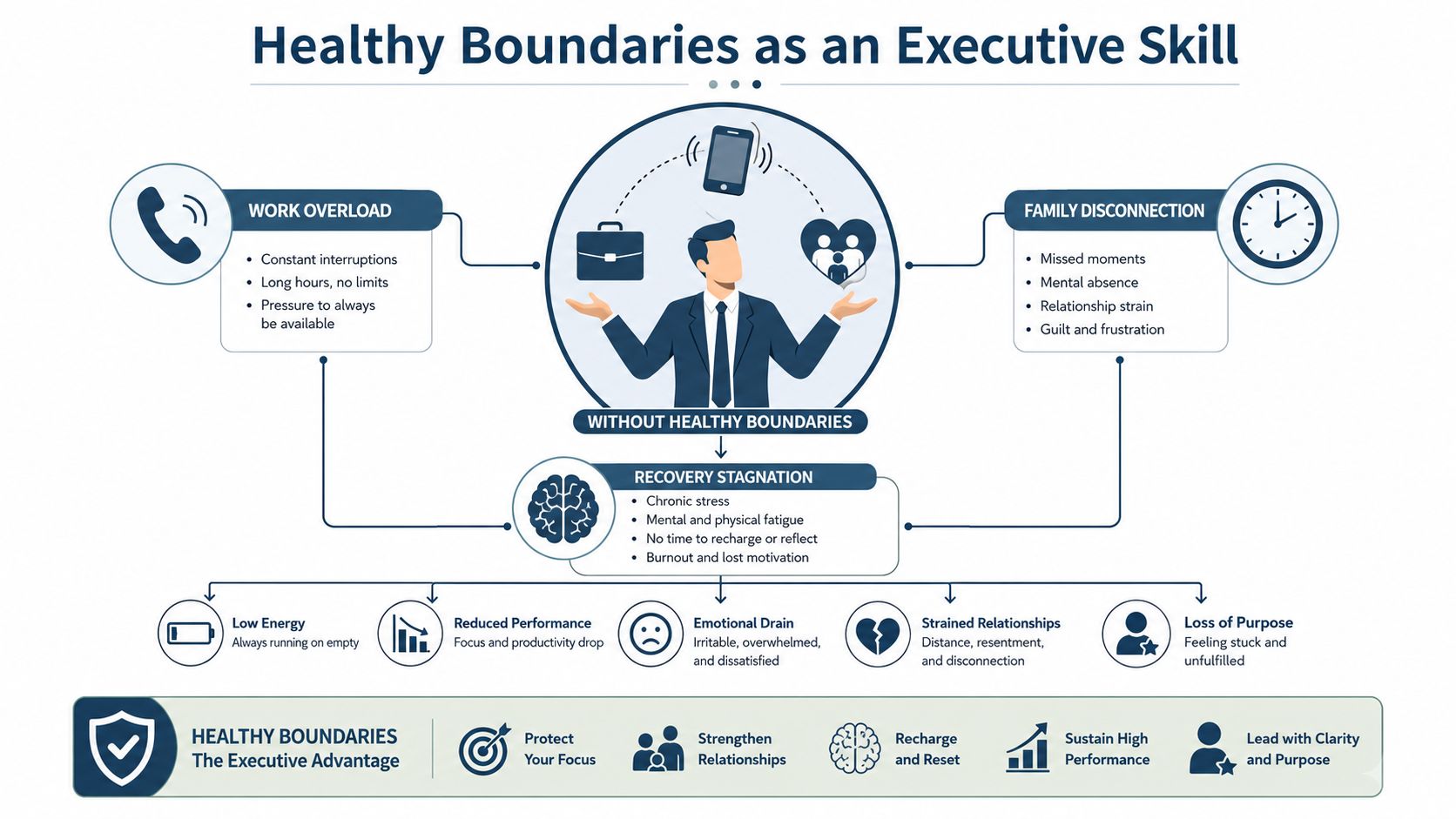
A useful way to think about healthy boundaries is as a behavioral system with four parts, identification, communication, consequence, and consistency. That framing matters because a boundary is not a personality trait and it is not a single hard conversation. It is a repeatable pattern that tells other people what is available, what is not, and what happens when the line is crossed.
The executive version of a boundary
For professionals in high-stakes roles, the question is rarely whether life is busy. The question is whether attention is being assigned on purpose or taken by whoever is loudest. That is why boundary work belongs in the same category as strategic planning, because both determine where limited energy goes.
The clinical and practical literature points to the same conclusion. When work-life boundaries blur too much, emotional exhaustion rises and happiness declines, which is one reason the earlier work on role conflict matters so much in modern leadership work-life boundary theory research. Boundaries help reduce that overlap by clarifying when the mind is at work and when it belongs elsewhere.
Executive competence shows up here. A leader who can define limits, state them cleanly, and hold them with consistency is not being rigid. That person is protecting the conditions required for sound decisions, family presence, and real recovery.
For leaders who also care about public trust and discretion, the same discipline applies outside the family system too. A resource on reputation strategies for leaders reinforces the larger principle, clear limits are part of protecting what matters.
That standard becomes even more important in settings where role conflict is constant and privacy has to be guarded on purpose. In those cases, balancing recovery and responsibility in professional treatment settings is not a slogan, it is the daily work of deciding what gets access and what does not.
The rule is simple, the role is real, and the follow-through is visible.
Practical rule: if a boundary cannot be repeated in one sentence, it is probably too complicated to hold under stress.
How Work-Life Boundary Theory Shapes Daily Choices
A leader who runs on constant access is usually making boundary decisions by default. Calls spill into dinner, personal time gets treated like overflow, and recovery is whatever fits after everyone else is done taking from the day. Segmentation keeps work and personal life in separate compartments. Integration lets them blend, but in executive life that blend often happens because no one has set a rule.
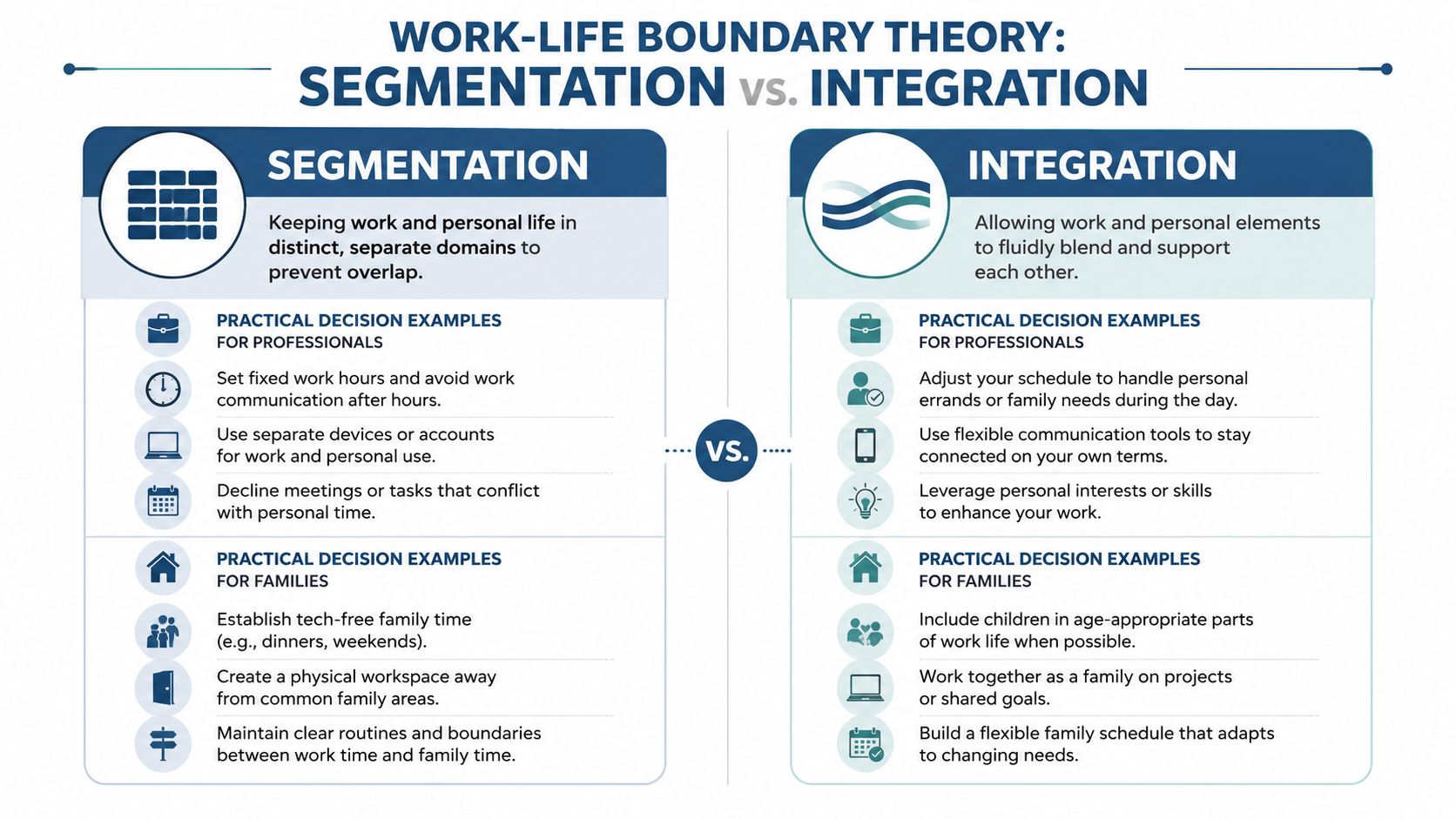
A Dutch cross-sectional study published in 2020 found that blurred work-life boundaries predicted negative changes in happiness through increased emotional exhaustion the study on blurred work-life boundaries. The practical lesson is straightforward. When the boundary keeps shifting, exhaustion rises, and well-being drops with it. That is a decision problem as much as a stress problem.
Segmentation and integration are design choices
Segmentation is not a moral badge, and integration is not a mistake. Each has a place when it matches the demands of the role. A physician executive may need some integration on a travel day, while a client in residential treatment may need tighter segmentation to protect sleep, focus, and emotional stabilization.
High performers usually do better when they stop treating boundaries as all-or-nothing. A hybrid plan often works better. One part of the day can belong to work, another to family, and another to clinical or recovery work, with device rules set to match each block.
That structure gives the household a shared map. It also keeps a professional from answering every message in the name of flexibility, then finding that sleep, mood, and concentration have been drained.
The rule is direct. If a calendar block is meant for family or recovery, the device rules need to support it. If a work window is protected, the people around that leader need to know when response is likely and when it is not.
A useful external frame for balancing competing demands is Approved Experiences balance insight, which matches the practical point that balance comes from choices, not wishful thinking.
Boundary design works best when the household and the workday both know what kind of time they are in.
Balancing recovery and responsibility for professionals becomes much more realistic when segmentation is treated as a schedule decision, not a personality test.
A Clear Calm and Brief Script for Hard Conversations
The strongest boundary statements are clear, calm, firm, respectful, and brief. That guidance appears in military behavioral health materials, along with an important point, the person setting the boundary is not responsible for the other person's reaction healthy boundary guidance from military behavioral health. That single idea removes a lot of unnecessary guilt. A boundary is not a referendum on the other person's mood.
The four-part sequence that holds up under pressure
The first step is to identify the limit in plain language. That means defining what is off limits before the conversation starts. The second is to script it in first person, so the statement sounds like ownership, not accusation.
The third step is to name the consequence if the limit is crossed. The fourth is to exit or enforce when needed. That sequence matters because people who are used to overreaching often test whether the limit is real.
A partner who wants more access can be told, “I don't take work calls after 9 p.m. If something urgent comes up, text me, and I'll respond in the morning.” A colleague who escalates after hours can hear, “I review nonurgent requests during business hours. If this can wait, send it then.” A relative whose pressure increases relapse risk can be met with, “I'm not discussing this tonight. If the conversation turns into pressure, I'm ending the call.”
The power of those scripts comes from restraint. They don't argue. They don't defend. They don't over-explain. That is the point.
Useful habit: speak as if the boundary will be repeated tomorrow, because it probably will be.
The military guide is blunt that people don't need a speech, they need a limit. That aligns with Cleveland Clinic's emphasis on identifying the limit, saying it directly, and enforcing it consistently how to set boundaries guidance. Mayo Clinic Health System adds another practical layer, regular review during stressful periods, because even a good boundary can drift when capacity is low Mayo Clinic Health System boundary guidance.
For professionals in recovery, a boundary script should also fit the environment. Relationships during recovery often require shorter conversations, fewer justifications, and faster exits than people expect.
Setting Boundaries When You Hold a Dual Role
The hardest boundary problems usually appear when one person holds two roles at once. A manager may also be a parent. A caregiver may also be an executive. A spouse may also be in treatment. In those situations, the problem is rarely a lack of vocabulary. It is a role conflict.
Why the standard refusal script breaks down
A simple “no” works poorly when the other person depends on the professional, reports to them, lives with them, or shares a treatment plan. The same sentence can sound cold in one setting, evasive in another, and insufficient in a third. That is why dual-role boundaries need more than generic assertiveness.
The better approach is role-specific. Emotional support can be separated from problem-solving. A response window can be defined for work requests. Expectations can be documented when the relationship carries real stakes. And in some households, identity-based language works better than permission-based language, so “I don't take calls after dinner” is more stable than “I can't right now.”
A senior leader in treatment may need to renegotiate duties with a spouse without turning the conversation into a crisis. That conversation works better when it is staged. First comes the factual update about capacity. Then comes the new response window. Then comes the practical agreement about what gets handled by whom during treatment hours and what waits.
The Georgetown nursing resource supports that procedural style, write the boundary down, state it directly, define the consequence, and have a plan to exit safely if the conversation turns unsafe boundary-setting guidance from Georgetown University nursing. That is especially useful in high-stakes homes, where improvisation usually leads to either over-giving or abrupt withdrawal.
Work from rehab for professionals becomes manageable when the role is named directly instead of being overextended without acknowledgment.
A dual-role example
A chief operating officer in treatment may still need to remain reachable for a narrow set of business matters. That doesn't mean unlimited access. It means a defined check-in window, a named backup contact, and a clear rule that the laptop closes when therapy starts. The spouse gets the same clarity. The executive is still present, but not endlessly interruptible.
That model protects both dignity and function. It also keeps the boundary from becoming a moral drama. The rule is simple, the role is real, and the follow-through is visible.

The Enforcement Loop That Makes Boundaries Stick
A boundary without consequences is a request. That distinction matters. HelpGuide is explicit that consequences need to be clear and enforceable, and that they should only be stated if the person is willing to carry them out setting healthy boundaries guidance. Otherwise, the other person learns that crossing the limit is low-cost.
Make the consequence observable
The most effective consequences are behavioral, not dramatic. End the call. Pause replies. Leave the room. Close the laptop. Escalate to HR or a sponsor when the pattern belongs in a larger system. Each of those responses gives the boundary an observable control point.
That is why the main failure is usually follow-through, not wording. People can say the right thing and still teach the wrong lesson if they cave the next time pressure rises. Consistency is what gives the limit weight.
Stress makes boundary drift more likely. Busy executives are especially vulnerable because the calendar gets reorganized around whoever pushes hardest. A five-minute weekly review can stop that drift before it hardens into a pattern. The question is simple, where did the limit hold, where did it slip, and what needs to change next week?
A practical review can include three checks.
- Was the limit stated before the situation got heated? If not, the script was probably too late.
- Was the consequence used? If not, the boundary may have sounded optional.
- Did the response stay the same across similar situations? If not, inconsistency is training the other person to keep testing.
If a consequence never happens, the boundary has no enforcement loop.
High performers often overestimate willpower and underestimate systems. A leader does not need more moral pressure. That leader needs a default response that kicks in when tired, annoyed, or cornered. The more automatic the follow-through becomes, the less room there is for negotiation under stress.
How a Luxury Dual-Diagnosis Setting Operationalizes Boundary Work
Boundary work becomes much easier when the environment supports it. In residential treatment, boundaries are not just verbal. They are structural. That is where a luxury dual-diagnosis setting can matter for executives and high-profile professionals who need both privacy and accountability.
Structure, privacy, and clinical access
Reflections is a California-licensed, Joint Commission–accredited program directed by Executive Clinical Director Dr. William Hanna and a multidisciplinary team of PhD-level psychologists, psychiatrists, LMFTs, and certified addiction counselors. The clinical design includes private rooms in both detox and rehab, which gives residents the physical separation needed to rest, stabilize, and think clearly.
The treatment model also includes clinically managed medication-assisted withdrawal when appropriate, along with evidence-based modalities such as CBT, DBT, ACT, MI, and individual psychotherapy. Family involvement is built in through private sessions and monthly educational workshops, which matters because boundary work in treatment usually extends beyond the resident alone.
Treatment lengths typically range from 30 to 90 days, with continuing care and alumni programming supporting the next phase after residential care. That longer runway matters because boundary change rarely happens in a single conversation or a single week.
Residents maintain appropriate access to electronics, including cell phones and laptops, so they can continue career obligations while in care. That feature should not be treated as a perk. It is a boundary-system feature. It allows the resident to keep professional limits intact, answer what needs attention, and leave the rest alone while clinical work is underway.
A treatment environment works best when it reinforces the same logic described earlier, identify the limit, communicate it, attach the consequence, and enforce it consistently. In residential care, the “consequence” may be as practical as device access windows, room-based privacy, or the structure of the day. The point is not punishment. The point is containment.
The setting matters because insight alone doesn't hold when pressure returns. A well-designed environment reduces the number of opportunities to drift, overcommit, or rescue other people at the expense of recovery.
Putting It All Together and Knowing When to Escalate
The system is simple enough to remember. Identify the limit. Write it down. Script it in first person. Pre-specify the consequence. Review it weekly. That sequence gives a professional something stronger than goodwill, it gives them a repeatable boundary process.
Escalate to clinical support when boundary collapse keeps happening alongside substance use, when guilt makes enforcement impossible, when conflict gets worse after a limit is set, or when trauma and PTSD symptoms surface during these conversations. Those are signs that the issue is no longer just communication. It is a deeper treatment question.
For executives, family members, and professionals carrying more than one role at once, the safest next step is a confidential conversation with a clinical team that understands how recovery, responsibility, and leadership collide.
Reflections offers confidential, luxury dual-diagnosis care for professionals who need real structure, private rooms, and the ability to keep working while they heal. For anyone whose boundaries are collapsing under the weight of leadership, family, or recovery, Reflections can be a place to reset the system with clinical support and discretion.