

You know the moment. The board meeting is on the calendar, the family group chat is moving, the inbox won't stop, and the question sitting underneath all of it is blunt, not philosophical, can treatment happen without blowing up a career? For executives, founders, and high-earning professionals, admissions requirements are rarely about forms alone. They're about whether a program can handle privacy, speed, medical reality, and the fact that life does not politely pause.
Luxury rehab admissions should feel clinical, discreet, and decisive. The process should protect the person's health without stripping away the professional identity that still has to function on the other side. That's the standard that matters for a Joint Commission–accredited California program built around private rooms, continued device access, and residential care that works around real-world obligations, not against them. Reflections' executive rehab approach fits that model because it treats entry as a clinical decision with logistical precision, not a bureaucratic obstacle course.
What Makes Reflections' Admissions Process Different
An executive doesn't walk into treatment with empty hands. There are investors, clients, employees, children, and obligations that don't vanish because somebody finally got honest about substance use or co-occurring mental health symptoms. The best admissions process acknowledges that tension immediately and deals with it like adults do, directly.
Clinical seriousness without unnecessary friction
Luxury rehab admissions are not supposed to feel like a corporate compliance audit. They're supposed to feel like a careful intake handled by people who understand that discretion matters as much as timing. In a private-pay setting, that usually means faster clarification of fit, tighter coordination around travel and medical records, and fewer dead ends than the insurance-driven model many expect.
The point is simple. Admission is not about proving worthiness. It's about making sure the right person gets the right level of care without wasting time or creating avoidable exposure. That matters especially for public-facing professionals who cannot afford gossip, delays, or a process that treats their work life like an inconvenience.
Practical rule: A strong admissions process should answer three questions quickly, whether the client can be safely treated now, whether the setting preserves privacy, and whether the plan supports the life the client is returning to.
Private rooms in both detox and rehab change the experience dramatically. So does the ability to keep cell phones and laptops, because many high-functioning clients still need to field limited work communication, coordinate family logistics, or keep business from collapsing while they stabilize. That's not a luxury add-on. For this population, it's part of how treatment becomes feasible.
The key difference lies in tone. A credible executive-facing admissions process does not shame urgency, and it doesn't pretend that a founder or C-suite leader can disappear into a generic program and hope the fallout sorts itself out later. It screens for clinical readiness, then builds an intake path that respects the client's actual life.
Core Eligibility Criteria for Entry
Eligibility starts with the basics, but the basics matter. Adult status, a primary substance use disorder, and a willingness to engage in treatment are not bureaucratic boxes. They determine whether residential care is likely to help or whether a different level of support is needed first.
The first filter is clinical fit
A residential program needs a primary substance use concern at the center of the picture. For dual-diagnosis care, there also needs to be a co-occurring mental health condition that belongs in the treatment plan. That can include trauma, anxiety, depression, bipolar symptoms, or other psychiatric complexity that needs integrated care rather than a piecemeal approach.
Medical stability matters just as much. A client can be brilliant, successful, and highly motivated, but if withdrawal risk or another medical condition requires a higher-acuity setting, residential treatment isn't the first stop. That's not rejection. It's sequencing. Good admissions protects the person from entering the wrong level of care and then decompensating after arrival.
Willingness is part of eligibility
No residential program can force meaningful participation. Clients do not need to arrive enthusiastic, but they do need to be willing to enter treatment voluntarily and participate in the structure. That distinction matters because luxury rehab isn't a holding pattern for someone being dragged through the door. It's an active clinical setting.
The admissions team also needs to decide whether detox belongs before rehab or whether the client can go straight into the residential track. That decision is made from the medical picture, not from how polished the applicant looks on paper. Some people need stabilization first. Others are already stable enough to move directly into therapy and programming.
When a different setting is the better move
If a person is in acute crisis, medically unstable, or too high-acuity for sub-acute residential care, the responsible answer is stabilization elsewhere first. That protects the client and keeps families from mistaking speed for safety. Executives often want the fastest path in. The right path is the one that won't collapse on day two.
Clinical and Medical Screening at Intake
The screening process needs to be more than a phone call and a gut check. A strong admissions team looks at the whole person, because substance use and mental health rarely sit in separate boxes. A client may present as organized and articulate while still carrying trauma, depressive symptoms, sleep disruption, or medication issues that shape the treatment plan from the start.
What the team evaluates
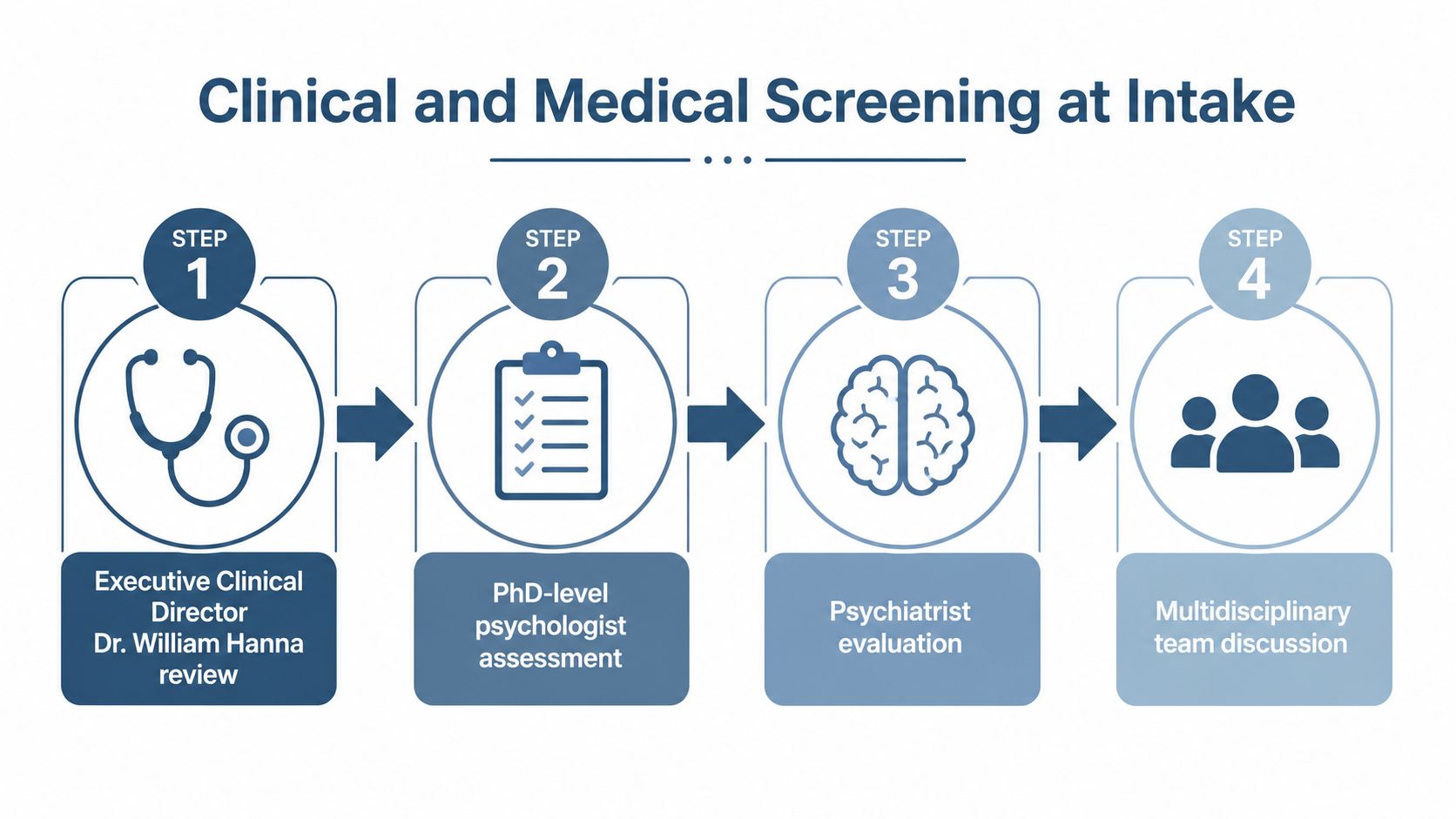
The clinical review typically starts with an executive clinical director, then moves through psychological assessment, psychiatric evaluation, and multidisciplinary discussion. That layered process matters because no single clinician should carry the whole decision alone when a client has medical, psychiatric, and lifestyle complexity. A PhD-level psychologist may focus on behavior patterns, coping style, and history. A psychiatrist may evaluate medications, risk, symptom burden, and whether withdrawal management is needed.
Current medication review is not a formality. It tells the team what is already onboard, what may need adjustment, and whether the person is stable enough for residential treatment or needs sub-acute, clinically managed medication-assisted withdrawal first. The goal is minimal, effective pharmacology, not piling on medication because that feels proactive.
Detox is an admissions question, not a side note
For high-functioning clients, wishful thinking usually gets exposed. Someone may insist they're fine to skip detox because they can still work, travel, or host a dinner meeting. That says nothing about withdrawal risk. If the clinical picture suggests sub-acute detox, that has to be handled first.
The team also looks for co-occurring psychiatric complexity, including trauma, PTSD, anxiety, depression, bipolar traits, and borderline traits. Those concerns shape pacing, supervision, therapy selection, and how much structure the client needs in the first days. A polished résumé doesn't lower the clinical threshold.
A clear screening process prevents a dangerous mistake, placing a medically fragile client into a setting that was never meant to manage that level of acuity.
Required Documentation and Intake Forms
Admissions for high-profile clients should be exacting, not invasive. The paperwork exists to build an accurate treatment record, confirm logistics, and prevent avoidable delays after arrival. It should feel purposeful at every step.
What gets requested and why
Identification establishes who the client is and supports safe recordkeeping. Insurance information may still be collected, but in a private-pay setting it's often relevant mainly for possible out-of-network reimbursement rather than for authorization to enter care. Medication and pharmacy records help the team reconcile what the client is already taking, which reduces the risk of gaps, duplication, or abrupt changes.
Recent medical records and lab work matter because appearance can be misleading. A healthy-looking executive can still have a medication issue, a lab abnormality, or another medical concern that changes treatment planning. Prior treatment summaries, when available, keep the clinical team from starting blind and help identify what has already worked, what hasn't, and where the relapse pattern has been hiding.
A structured intake questionnaire fills in the story that charts never capture. It gives the team a clean view of symptoms, triggers, family context, work pressures, and practical concerns like travel timing or confidentiality needs. For clients who need a template to understand the logic of intake paperwork, a patient intake form template can be a useful reference for how organized these forms are meant to be.
Typical documents requested at intake
| Document Category | Purpose in Clinical Planning |
|---|---|
| Identification | Confirms identity and supports accurate records |
| Insurance information | Helps assess possible reimbursement pathways |
| Medication list and pharmacy history | Supports medication reconciliation and safety |
| Recent medical records and lab work | Shows current medical stability and risks |
| Prior treatment summaries | Clarifies what has or hasn't helped before |
| Clinical intake questionnaire | Captures symptoms, history, and practical needs |
Confidentiality is nonnegotiable for executives, celebrities, founders, and family office principals. Intake records should be handled as protected health information, with only the minimum necessary sharing and a clear chain of custody. What to bring to treatment should be practical, not theatrical, and the admissions team should explain exactly what is needed before arrival.
Insurance, Private Pay, and Prior Authorization
Private-pay admissions work differently from insurance-first admissions, and that difference is the point. In a high-end residential setting, the client is paying for speed, discretion, room privacy, better coordination, and a treatment experience that isn't shaped primarily by insurer utilization rules. That doesn't mean insurance is irrelevant. It means insurance is not the boss of the admission.
What private pay actually changes
With private pay, the admissions conversation can focus on clinical fit and logistics instead of building a case for a narrow number of covered days. The team can assess whether detox, residential rehab, or another step is the right fit without waiting for a payer to bless every move. That makes a huge difference for professionals whose schedules and public exposure require precision.
Out-of-network benefits may still matter. Some clients pursue reimbursement after the fact, depending on their plan and documentation. In that scenario, clean records, coded services, and organized treatment summaries become important because they support whatever claims the client chooses to submit later. The admissions team should help prepare that paperwork, not promise recovery of any specific amount.
What executives should ask before admission
- What is the private-pay structure? The client needs a straight answer on cost, timing, and what is included.
- Can any out-of-network benefits apply? The answer depends on the plan, but the possibility should be reviewed early.
- Will HSA or FSA funds be usable? That's a financial planning question worth asking before travel.
- Does insurance control length of stay? In private pay, the clinical team determines length of stay based on need, not a fixed insurer schedule.
The difference is operational, not cosmetic. Insurance-driven care often bends toward authorization, documentation for payment, and stay limits. Private pay allows the program to center privacy and clinical judgment first, which is exactly why high-end clients choose it. Insurance coverage for addiction treatment should be viewed as a financial support question, not the organizing principle of admission.
Medical Exclusions and When Stabilization Is Needed First
Good admissions teams say no when safety demands it. That's a strength, not a weakness. Families often want quick placement, but a program that accepts everyone regardless of acuity is not being flexible. It's being careless.
When residential care is not the first move
Active suicidal ideation, severe medical instability, or withdrawal risk beyond what sub-acute detox can support all require a higher-acuity setting first. Those situations belong in a setting that can stabilize the immediate risk before residential treatment is considered. Trying to force a luxury admission through that kind of crisis is the wrong move clinically and morally.
The same principle applies when acute psychiatric symptoms are too unstable for a residential environment. A person who cannot safely participate in a therapeutic milieu may need inpatient stabilization before any residential program can work. That doesn't disqualify them from treatment. It just changes the sequence.
How transition back into care works
Once the person is medically appropriate, coordination with hospitals or acute programs can move quickly. Referring providers should be part of that handoff, because continuity matters. The admissions team should understand the clinical picture that led to stabilization and whether the client still needs detox, medication adjustment, or a slower entry plan.
Safety thresholds are not optional, even in a luxury setting. A private room and discreet arrival don't override a medical need for higher-level care.
Families and attorneys sometimes push hardest when they're most anxious. That's understandable, but it can't become the standard. Admissions requirements exist to keep a client from entering too soon, too sick, or into the wrong clinical lane.
Intake Day and the First 72 Hours at Reflections
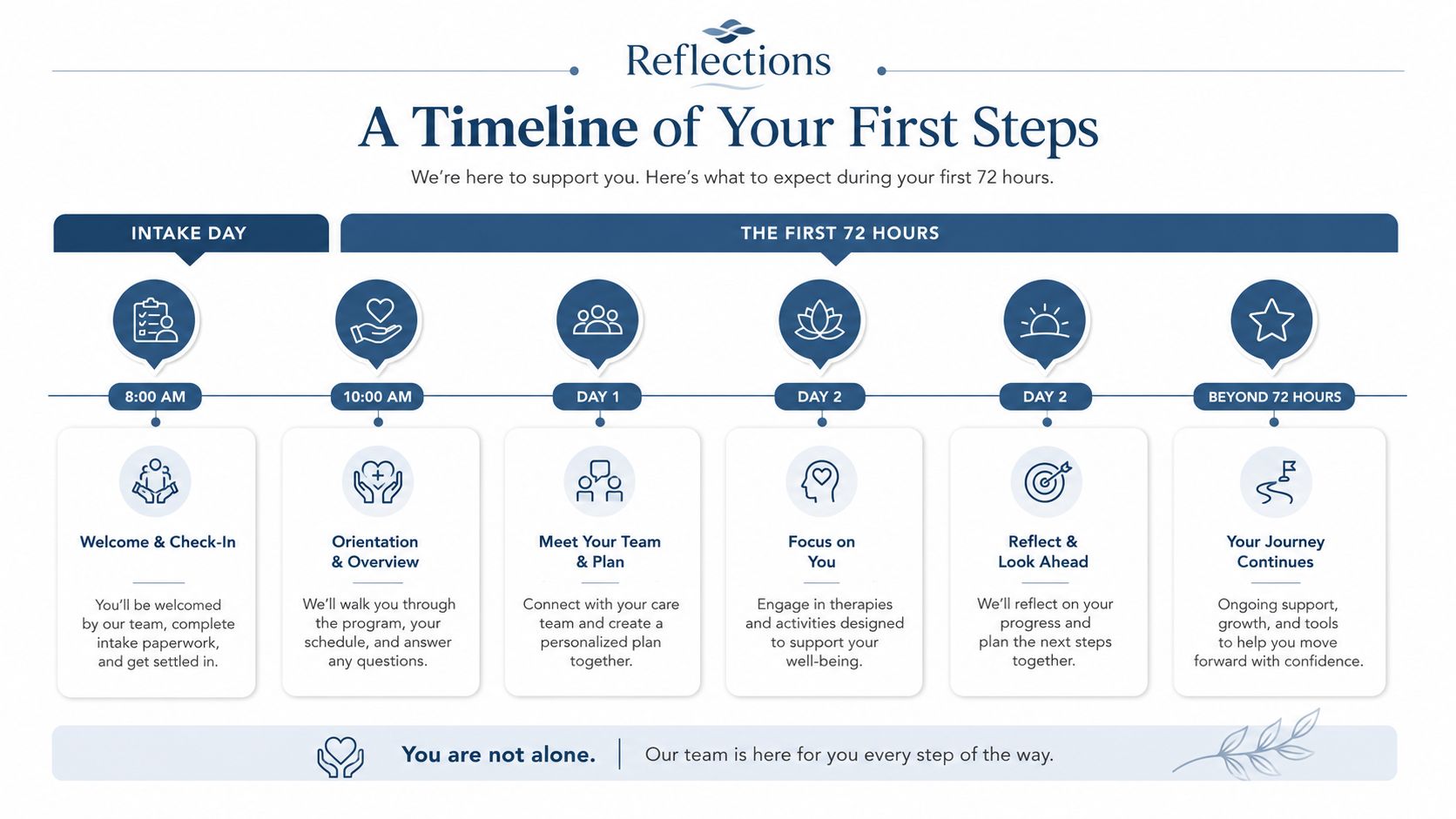
The best intake days feel orderly, discreet, and calm. A client arrives already overwhelmed by the decision to enter treatment, so the program has to reduce chaos immediately. The first hours should make it obvious that the place knows how to handle adults with real responsibilities.
What the first day usually looks like
Travel coordination is handled before arrival so the transition isn't noisy or confusing. On intake, the client is oriented, shown to a private room in detox or rehab depending on the admission plan, and introduced to the clinical team. Medication reconciliation happens early, because the staff needs to confirm what has been taken, what should continue, and what should change.
Family communication boundaries are usually clarified at the start. That doesn't mean families are shut out. It means the program sets the rules for appropriate contact so the client can settle in without constant interruption. For executives, the fact that cell phones and laptops are allowed is a major operational difference, because it lets them stay connected enough to preserve critical obligations without turning treatment into a work retreat.
The first few days are structured on purpose
The opening 72 hours usually include individual sessions, introduction to group programming, and a careful read on how the client is responding physically and emotionally. Experiential options like mindfulness, massage, fitness, and equine work may be introduced as the clinical team calibrates what supports engagement. That pacing matters. It keeps the first days from feeling either chaotic or performative.
Clients also learn how their schedule will work, what communication is appropriate, and how treatment will be personalized. Families often feel better once they see that the process is not improvised. It's structured enough to be serious, but flexible enough to account for what the client needs.
Family, Referral, and Frequently Asked Questions
Families almost always want the same assurances. Will the client be safe? Will they stay connected to work? Will someone explain what's happening? Will this end with a plan that holds after discharge? Those are the right questions, and admissions should answer them plainly.
Who can initiate the referral
Therapists, psychiatrists, and attorneys often begin the referral process when they can see that residential care is the correct next step. They need enough information to coordinate with the admissions team, confirm the client's willingness, and provide the relevant clinical or legal context. The more organized the referral, the faster the intake can move without creating avoidable confusion.
Family involvement should be built in early through private sessions and educational workshops, not added as an afterthought. That gives loved ones a way to understand addiction, boundaries, and recovery support without turning the client into a project. It also keeps the admissions conversation grounded in what the family can do once treatment begins.
The questions professionals ask most often
- Can clients keep phones and laptops? In a high-end executive setting, yes, that access is often part of the model because work cannot always stop.
- Are private rooms standard in detox and rehab? They should be, especially when privacy is part of the value proposition.
- How long does treatment usually last? In this setting, the common residential range is 30 to 90 days, depending on clinical need and progress.
- Can professional obligations continue? They can, with boundaries. The best programs allow enough access for essential responsibilities without letting work take over treatment.
Continuing care should begin during admissions, not at discharge. Alumni planning, aftercare coordination, and realistic relapse-prevention thinking belong in the intake conversation because executives need a path that extends beyond the residential stay. In other words, admissions is not just the front door. It's the start of the recovery architecture.
For executives, founders, and families who need a discreet, clinically serious entry point, the next move is straightforward. Contact Reflections to review fit, clarify logistics, and start a private-pay admission conversation that respects both the clinical picture and the life that still has to keep running.