

A board meeting starts in an hour. The chief executive has slept badly for weeks, relies on alcohol to shut off at night, and reaches for pills or stimulants to stay sharp by morning. Family members see the change. Colleagues see irritability, missed details, and sudden disappearances. The executive sees one overriding problem: getting help can't become a public event, and treatment can't feel like walking away from an entire company.
That's the moment when standard rehab often stops making sense. Many traditional programs are built for full disengagement from outside life. For a C-suite leader, physician, founder, attorney, or investor, that model can create a second crisis on top of the first. Privacy concerns rise. Urgent decisions pile up. The person who needs treatment delays admission because the structure feels operationally impossible.
Luxury executive rehab exists for that exact gap. It combines discreet residential care with conditions that high-profile professionals often require: private rooms, secure communication boundaries, access to electronics when clinically appropriate, and a treatment plan rigorous enough to address substance use and mental health at the same time. In high-end settings, the question isn't just whether recovery happens. It's whether recovery can happen without unnecessary career collapse, family chaos, or exposure risk.
For executives and families, the harder question is whether the premium price reflects true clinical value or comfort. That's where careful evaluation matters. A serious program for this clientele has to deliver both. It should protect confidentiality, support essential work continuity, and maintain strong dual-diagnosis care rather than treating therapy as an accessory to amenities.
Introduction to Luxury Executive Rehab
A managing partner finishes another day of negotiations, gets home late, promises family members that things will slow down soon, then returns to the laptop after midnight. Sleep doesn't come without a drink. Anxiety rises before major calls. Concentration starts slipping. The person still looks successful from the outside, which is why many executives keep delaying treatment long after symptoms become obvious.
For high earners and public-facing professionals, rehab isn't just a health decision. It's also a reputation, logistics, and risk-management decision. A standard residential setting may feel too exposed, too inflexible, or too disconnected from real-world obligations. If a leader believes admission means vanishing from all responsibility, that leader often keeps functioning until functioning breaks.
Luxury executive rehab is designed for this narrow but important reality. It serves executives, C-suite professionals, founders, physicians, attorneys, and other working professionals who need a private-pay, high-end treatment setting with real clinical depth. In that model, private rooms aren't just a comfort feature. They support dignity, confidentiality, sleep, and decompression. Access to a cellphone or laptop isn't just a convenience either. For the right client, it can reduce resistance to treatment by allowing carefully bounded contact with work.
Why this population needs a different environment
The central challenge is competing pressures. The client needs detox, psychiatric assessment, therapy, and structure. At the same time, that client may still need to review a document, approve a decision, or protect a company during a temporary absence.
A well-built executive program responds to both realities:
- Private accommodations: Every resident has a private room in detox and rehab, which lowers exposure and creates space for rest.
- Work continuity: Electronics such as cellphones and laptops may remain available within clear clinical boundaries.
- High-end care environment: The setting is private pay and intentionally upscale, built for clients who expect discretion and a high-touch treatment experience.
- Clinical seriousness: Accreditation, dual-diagnosis capability, and individualized planning matter more than appearances.
Recovery for executives works best when treatment removes excuses to delay care without watering down the clinical work.
Understanding Luxury Executive Rehab
At 6:15 a.m., a CEO is checking into treatment while a board packet still needs final approval and a spouse is asking the same hard question every family asks. Will this program treat the addiction and mental health issues, or will it just make a difficult month more comfortable?
That question gets to the heart of luxury executive rehab. The setting is premium, but its primary purpose is practical. A well-designed executive program works like a hospital-grade treatment plan placed inside an environment that protects privacy, reduces friction, and allows limited work continuity without letting work take over recovery.
In other words, the investment is not for appearances. It is for better odds of admission, retention, and follow-through among people who often delay care because the usual barriers are higher. For executives, founders, physicians, attorneys, and business owners, luxury rehab should function like a pressure-controlled room. It limits outside disruption so the clinical team can do serious work.
What the “executive” part actually means
Families sometimes hear “executive rehab” and assume it means lighter rules or a resort with therapy on the side. Credible programs are structured more carefully than that. The executive element usually means treatment is organized around two realities at once. The client needs intensive clinical care, and the client may also have limited responsibilities that cannot disappear overnight.
That changes how the setting is built and how the day is managed.
| Program element | Why it matters in practice |
|---|---|
| Private room or suite | Improves rest, lowers social exposure, and gives the client space to regulate after therapy |
| Secure technology policies | Allows tightly bounded contact with work instead of chaotic, hidden device use |
| Small census and higher staff attention | Makes individualized planning easier, especially for complex psychiatric and professional needs |
| Space for confidential calls | Helps clients handle urgent responsibilities without leaving the treatment frame |
The key distinction is clinical control. A strong program does not hand the client a laptop and hope for the best. It sets rules around timing, purpose, supervision, and emotional impact. One short work window to approve payroll is very different from spending four hours reliving the stress patterns that helped drive substance use in the first place.
Why luxury can improve treatment adherence
Busy professionals often enter care with a specific fear. If they step away completely, they may lose authority, income, reputation, or a company they built. If a program ignores that fear, the client may postpone admission, leave early, or stay physically present while remaining mentally at work.
Luxury executive rehab addresses that problem by lowering resistance without lowering standards. Better food, quieter rooms, physical training, and refined surroundings are not the treatment itself. They support the conditions that make treatment more likely to work. Sleep improves. Irritability drops. Defensiveness softens. A client who would reject a chaotic setting may stay long enough to complete psychiatric assessment, therapy, and recovery planning.
That is the business case many families and stakeholders need to understand. Premium amenities only justify their cost when they protect the clinical mission and improve work-integration outcomes.
A simple way to evaluate a program is to ask whether each comfort feature serves one of three jobs: protect privacy, support nervous-system regulation, or keep limited professional obligations from disrupting care. If the answer is no, it may be decoration rather than treatment design.
How this differs from standard residential rehab
Standard residential care can be very effective, but it is not always built for people whose absence affects a company, a medical practice, a law firm, or a large team. Executive rehab adapts the container around the same core recovery tasks: stabilization, diagnosis, therapy, medication management, relapse prevention, and discharge planning.
The difference is less about luxury for its own sake and more about fit.
For example, a founder with alcohol dependence and panic symptoms may need detox, psychiatric review, and daily therapy. That same person may also need one scheduled call with a chief operating officer to transfer authority clearly and prevent an avoidable business crisis. A program built for executives can handle both needs without letting the second one overwhelm the first. If you want a clearer picture of how mental health and substance use are treated together in that setting, this guide explains what to expect in a dual-diagnosis rehab program.
Practical test: Luxury executive rehab is worth the investment when comfort, privacy, and limited work access are used as tools that strengthen clinical care, not substitutes for it.
Clinical Standards for Dual Diagnosis Care
High-end surroundings don't treat addiction, panic, trauma, or depression. Clinical integration does. That's why dual-diagnosis capability is the center of any credible luxury executive rehab program for working professionals.
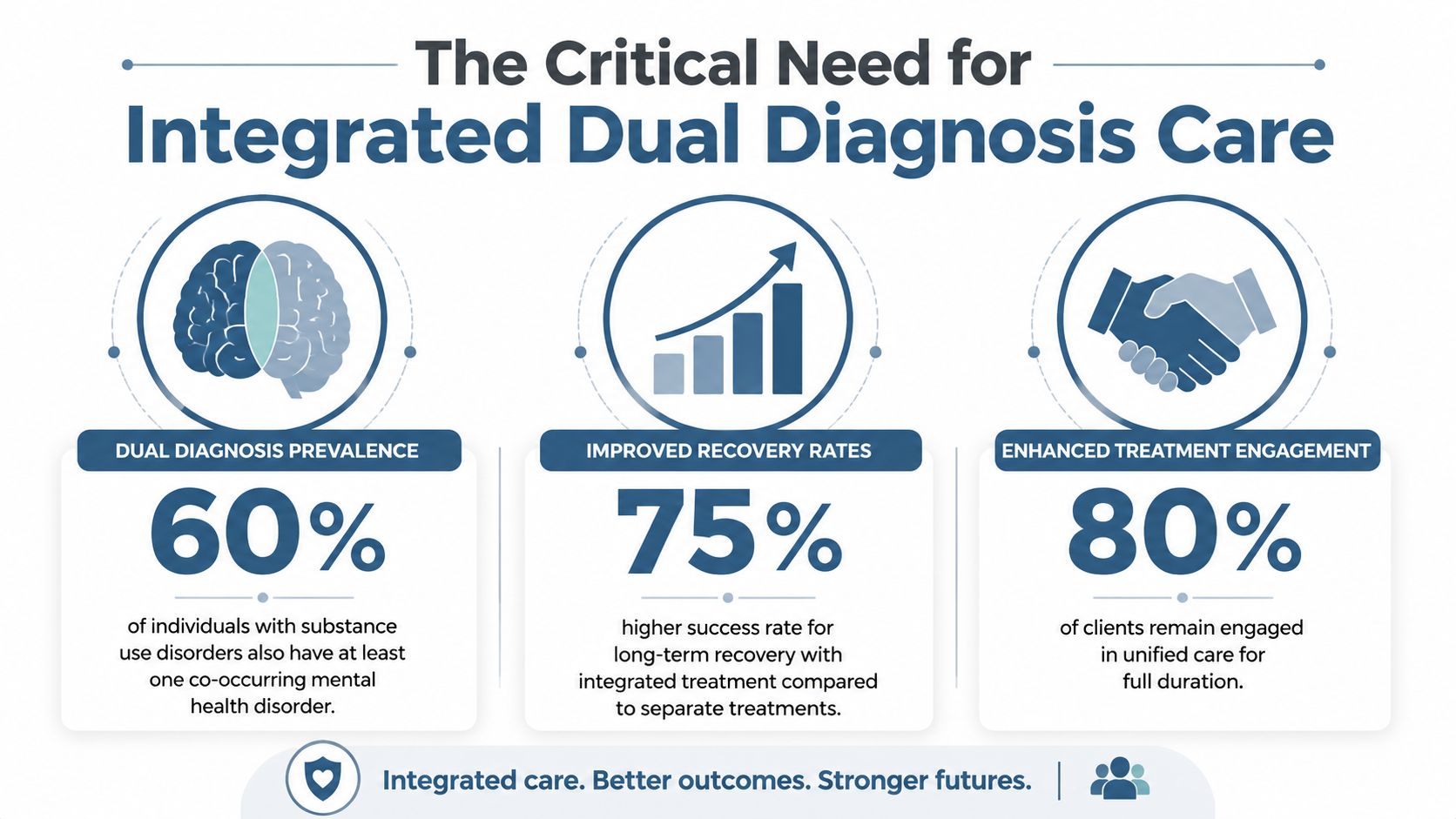
Integrated dual-diagnosis treatment means one clinical team addresses substance use and mental health together, with one plan rather than two disconnected tracks. That matters because executives rarely arrive with a single issue. They may present with alcohol dependence and major anxiety, stimulant misuse and depression, or trauma symptoms masked by work intensity and substance use. Treating one while postponing the other usually creates instability.
What integrated care looks like in practice
A unified team may include psychiatrists, PhD-level psychologists, LMFTs, addiction counselors, and adjunctive therapists working from the same formulation. Instead of one provider focusing on sobriety while another separately addresses trauma or mood symptoms, the team coordinates timing, goals, medication decisions, and therapeutic interventions.
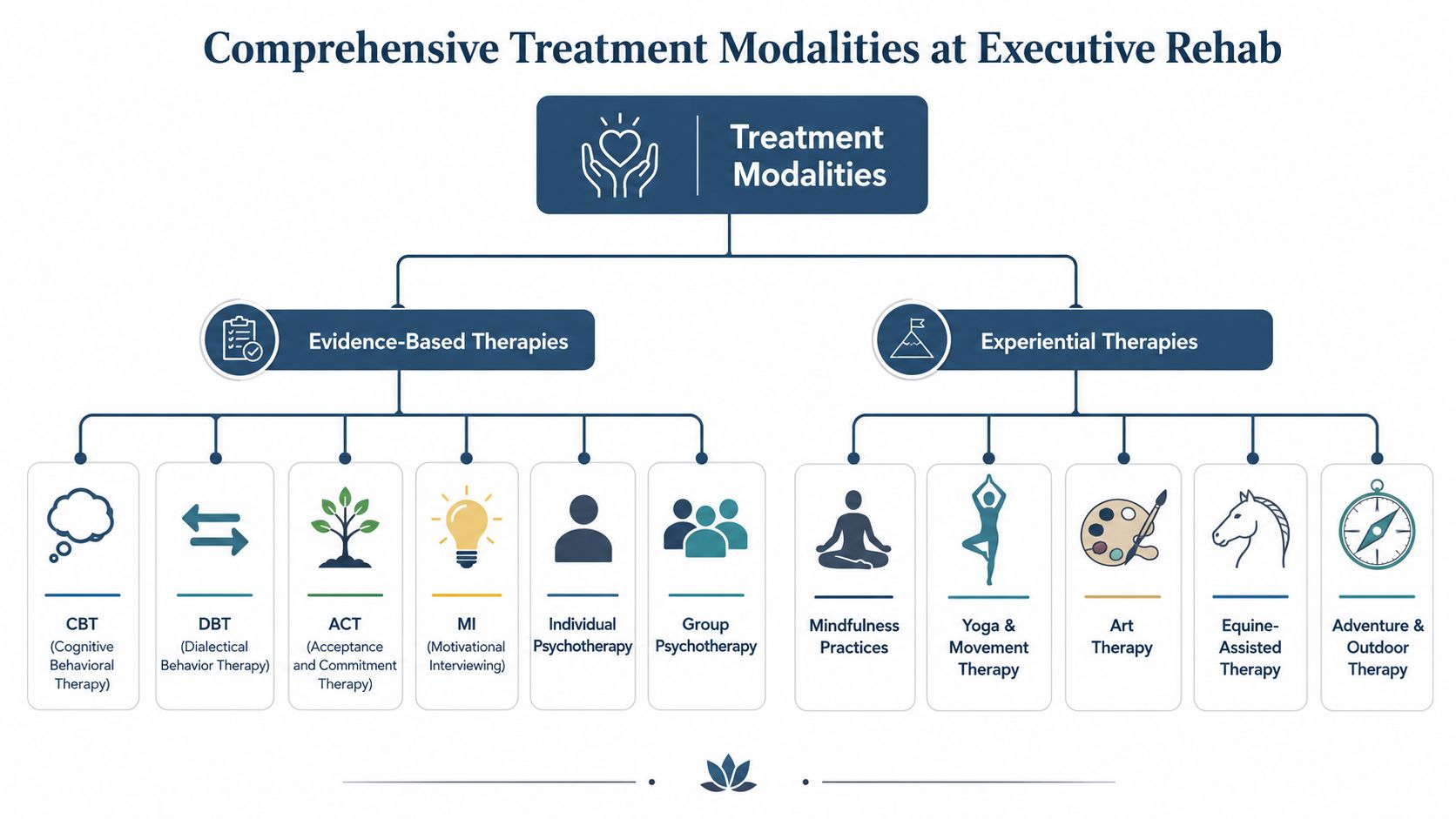
Core modalities usually include:
- CBT: Helps clients identify distorted thinking, high-risk situations, and behavior loops.
- DBT: Builds distress tolerance and emotional regulation, especially useful for impulsivity or intense mood swings.
- ACT: Teaches values-based action instead of avoidance-driven coping.
- MI: Helps clients move from ambivalence to commitment without power struggles.
- Individual and group psychotherapy: Individual work addresses private history and role-specific pressures. Group work challenges isolation and image management.
A more detailed overview of that process appears in what to expect in a dual diagnosis rehab program.
Why concurrent treatment changes outcomes
The strongest clinical point in this area is simple. When a single team treats both conditions together, relapse risk falls because the drivers of relapse aren't left untreated. According to integrated dual-diagnosis treatment data, this approach yields 30 to 50 percent lower relapse rates and reduced psychiatric hospitalizations compared to separate care models.
That finding makes intuitive sense. An executive who stops drinking but leaves panic untreated may return to alcohol during the next high-stakes conflict. A professional who completes detox but receives no real treatment for trauma may look stable for a short period, then unravel once work pressure resumes.
Specialty interventions in a premium setting
Luxury programs often add specialty interventions such as neurofeedback, EMDR, TMS, mindfulness-based work, and somatic therapies. These don't replace the clinical backbone. They supplement it. The value is personalization, especially for clients with complex trauma, chronic stress activation, or treatment-resistant symptoms.
Separate treatment tracks often force clients to keep explaining the same problem to different providers. Integrated care reduces that fragmentation.
For executives, this level of coordination matters because fragmentation is already part of the problem. Work life is compartmentalized enough. Treatment shouldn't be.
Privacy and Confidentiality Measures
A CEO checks into treatment on a Tuesday and still needs the board to believe operations are stable by Wednesday. That is the privacy test. If admissions, transportation, device use, visitor access, and record handling are vague, treatment can feel too risky to start. For many executives and families, confidentiality is part of the clinical decision because a privacy failure can disrupt recovery, reputation, and business continuity at the same time.
Strong executive programs treat privacy the way a well-run company treats cyber security. It is built into daily systems, limited by role, documented clearly, and reviewed case by case. The point is not luxury for its own sake. The point is to protect treatment while preserving enough work continuity that stakeholders can justify the investment.
How confidentiality works in daily operations
The practical question is simple: who can know what, and under what conditions?
A serious program answers that with specific procedures. Intake is handled discreetly. Information is shared internally on a need-to-know basis for care and safety. Outside communication is controlled through approved contacts, approved times, and clear consent rules. Private rooms also matter because recovery is hard enough without turning rest, phone calls, or decompression into public events.
Transport planning is part of the same system. Arrival and discharge create visibility risks that families sometimes underestimate. For executive assistants or relatives arranging discreet transfers, MLR Worldwide's executive travel solutions illustrate the level of coordination many professionals expect during sensitive transitions.
Device access should support treatment, not reopen the office
This is the point that often confuses families and boards. They hear "executive rehab" and assume unlimited phone and laptop use. That approach can turn treatment into remote work with therapy added around the edges. They hear "residential rehab" and assume total device bans. That can create panic, especially when a client has fiduciary duties, urgent legal exposure, or a narrow circle of trusted decision-makers.
The better model uses boundaries. A client may keep limited access to a phone or laptop, use secure Wi-Fi during designated periods, and stay in contact with a deputy for specific operational matters. The rule is functional, not indulgent. Handle what only the client can handle. Leave everything else outside treatment hours.
A private, medically supervised setting often makes those boundaries easier to maintain because the environment is quieter and less exposed. This overview of a Bay Area medical resort setting shows the kind of physical setup that can support confidential care, protected downtime, and structured work integration without turning the program into an extension of the office.
Privacy promises are easy to print on a brochure. Operational privacy is what matters. Ask how the program handles calls, records, visitor approvals, transportation, and device access every day. That is where executives and families can tell whether premium amenities are matched by clinical discipline.
Core Services and Therapies Offered
An executive program should offer more than a polished setting and a therapy schedule. The treatment menu needs depth because high-functioning clients often arrive with layered problems. Substance use may be the most visible issue, but under it sit chronic stress, trauma, perfectionism, grief, depression, anxiety, or relationship collapse.
The strongest luxury executive rehab programs combine evidence-based psychotherapy with experiential and body-based work. That combination matters because some clients can explain their problem in perfect professional language while staying emotionally defended. Talk therapy opens insight. Experiential work often reveals what the intellect keeps hidden.
Evidence-based therapies that form the backbone
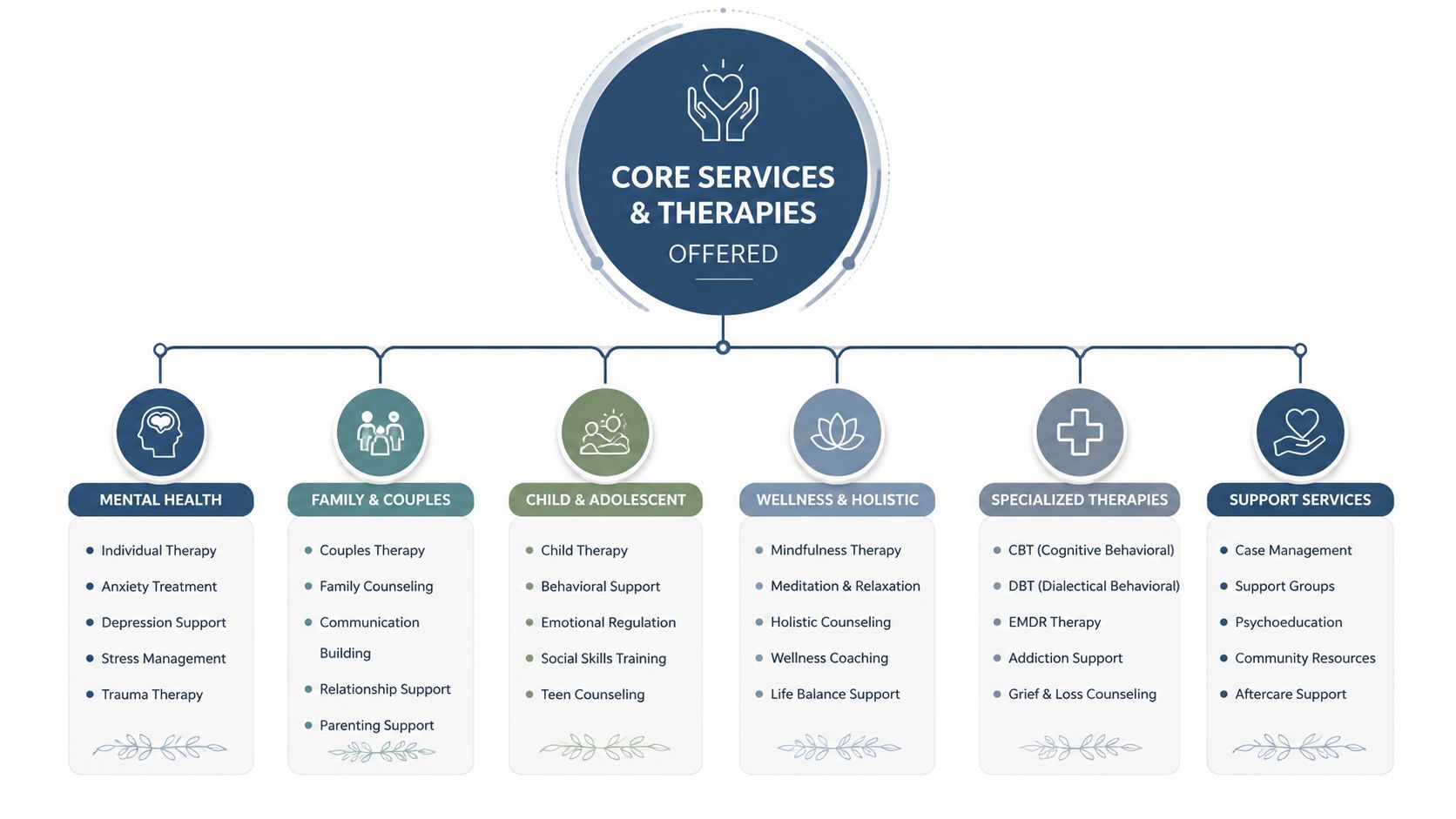
The clinical core usually includes individual psychotherapy, intensive process groups, and structured modalities such as CBT, DBT, ACT, and motivational interviewing. Each serves a different purpose.
A finance executive with relentless catastrophic thinking may benefit from CBT to challenge assumptions like “If performance drops, everything collapses.” A client who reacts to stress with rage, shutdown, or impulsive use may need DBT skills to regulate emotions before those states become relapse triggers. ACT is often useful for clients who've built entire identities around avoidance of uncertainty or vulnerability.
Experiential therapies that reach what insight alone can't
Experiential work isn't decorative. It often gives clients a safer route into difficult material.
- Mindfulness and meditation: Useful for clients whose nervous systems stay in constant threat mode.
- Yoga, movement, and fitness training: Help reconnect body awareness with emotional regulation.
- Art and music therapy: Offer nonverbal expression when shame or image management blocks direct disclosure.
- Somatic work and massage: Support down-regulation for clients carrying chronic tension, hypervigilance, or trauma responses.
- Nutrition counseling: Rebuilds routine, energy, and physical stability after prolonged stress or substance use.
Equine therapy is a good example. A client may think the session is about learning calm presence around a horse. What often surfaces instead is control, fear, frustration, or the need to dominate uncertainty. Those patterns can mirror how the same client handles people, conflict, and internal distress.
What to ask when reviewing a program
A polished brochure doesn't reveal whether therapies are integrated or listed. Families and advisors should ask:
- How are modalities connected: Does the team explain why each therapy was chosen for this client?
- Who delivers care: Are licensed clinicians directing the process, or are therapies loosely attached to the schedule?
- How does work access affect treatment: Are business obligations contained so therapy remains primary?
One California-based option in this category is Reflections, which provides dual-diagnosis residential care for adults with co-occurring disorders in a private setting and includes evidence-based, integrated, and work-compatible treatment elements.
Program Structure Detox and Medication Management
A CEO arrives with two urgent fears at once. One is physical: withdrawal, insomnia, panic, or the crash that follows weeks or months of pushing through. The other is operational: Who needs to know? What happens to medications? How much work contact is realistic without turning treatment into a remote office? A strong luxury executive rehab program answers those questions in a clear sequence, because premium amenities only matter if the clinical structure is sound and the return on treatment includes a safer re-entry to work.
Before admission, the program should gather the pieces of the case the way a board reviews material before a major decision. Clinicians screen for substance use patterns, psychiatric history, current prescriptions, withdrawal risk, medical concerns, and immediate safety issues. That early sorting matters. Exhaustion can look like depression. Stimulant misuse can look like anxiety. Alcohol withdrawal can distort mood, sleep, and judgment enough to confuse the whole picture.
The typical flow from arrival to residential treatment
Some executive programs start with a brief assessment period instead of placing every client into the same timetable on day one. That extra evaluation window helps the team separate primary psychiatric symptoms from withdrawal effects, burnout, trauma responses, or medication problems. For executives and stakeholders, this is part of the investment case. Better sorting at the front end reduces avoidable medication changes, weak treatment matching, and disrupted step-down planning later.
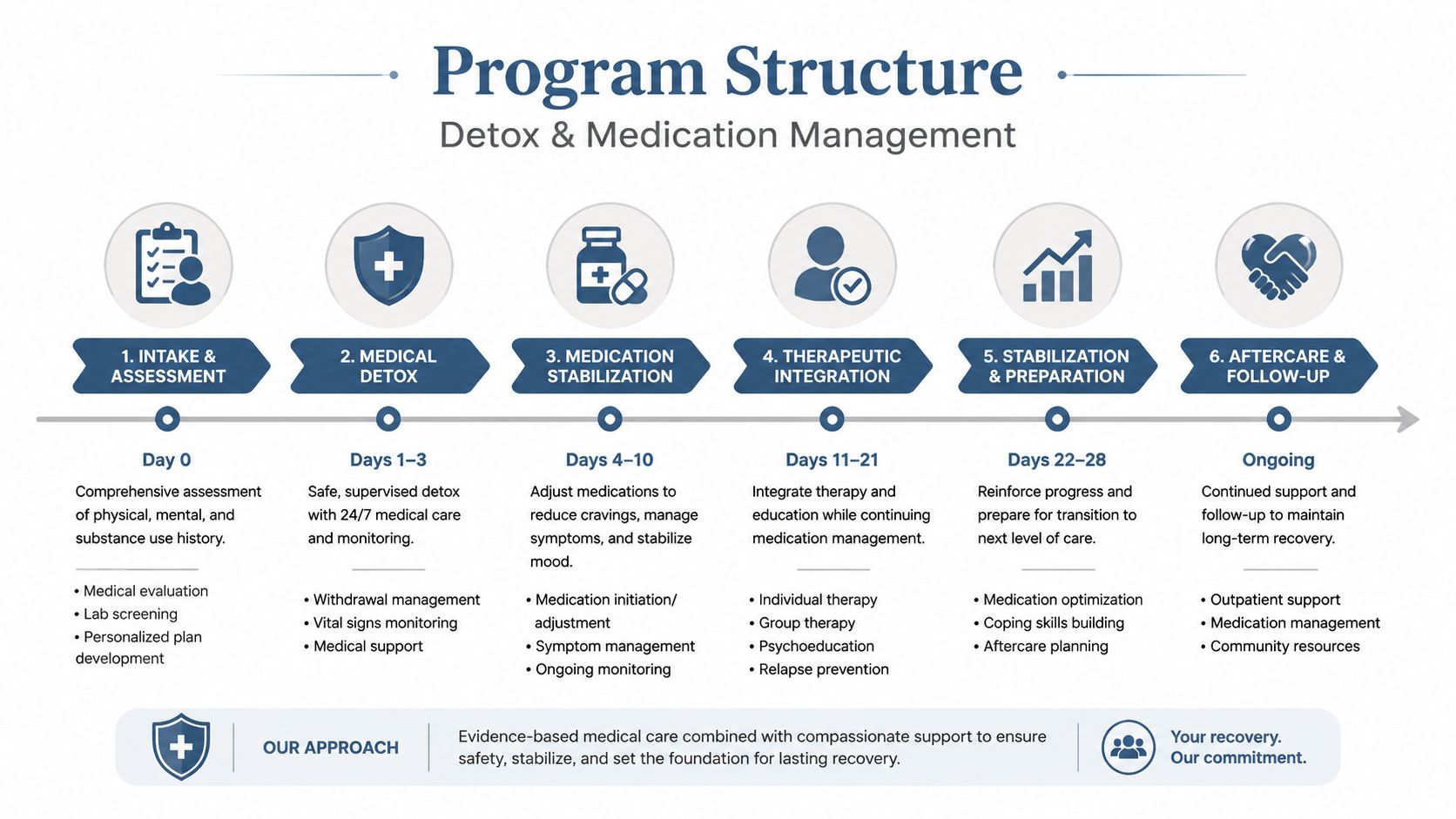
A typical progression includes:
Arrival and stabilization
Medical and psychiatric staff assess withdrawal risk, sleep loss, blood pressure, agitation, mood symptoms, and immediate safety concerns.Detox, if clinically indicated
Detox is a medical phase, not a character test. The goal is safe stabilization, symptom monitoring, and reduction of avoidable distress so the client can participate in treatment as soon as possible.Medication review
Clinicians examine what the client is taking, why it was prescribed, what may be interacting poorly, and what may no longer fit the current diagnosis. A careful approach to psychiatric medication management in residential treatment should support concentration, sleep, mood stability, and safety.Residential treatment with a defined daily structure
Once the client is medically steadier, the program can shift toward therapy, skills work, case coordination, and limited work access when that access supports treatment instead of disrupting it.Continuing care planning
Discharge planning should begin early enough to connect psychiatry, therapy, family expectations, recovery monitoring, and the client's work re-entry plan.
Medication decisions deserve plain language. The aim is not heavy sedation or a quick cosmetic fix for visible distress. The aim is the lowest level of medication that safely addresses withdrawal, stabilizes acute symptoms, and gives the treatment team a clearer view of the underlying clinical picture.
Daily rhythm in a high-touch setting
In a well-run executive program, the day works like a controlled operating schedule. There is enough structure to contain chaos, but not so much rigidity that treatment becomes mechanical.
Mornings often carry the highest clinical load because attention is better and medical monitoring is easier to coordinate early in the day. That may include medication check-ins, individual therapy, process groups, and psychiatric follow-up. Midday can shift toward nutrition, movement, skills training, or rest if the client is still physically recovering. Later blocks may include family contact, specialty sessions, and a tightly defined business window approved by the clinical team.
That last point often confuses families and employers. Work access is not a luxury perk. It is a risk-managed clinical decision. Used carefully, it helps preserve key responsibilities without letting urgency reclaim the client's full attention. Used poorly, it turns treatment into a quieter version of the same environment that helped drive the crisis.
Medication management should support clarity and stability. It should also protect function, so the client can return to leadership with better judgment, steadier mood, and a treatment plan that can hold up after discharge.
Family Involvement Outcomes and Accreditation
A common executive treatment failure starts after discharge, not during the stay. The client may leave medically stable and motivated, then return to a home system that still runs on secrecy, crisis management, or blurred roles. For boards, spouses, and advisors trying to justify the cost of luxury rehab, this is a practical point. Premium surroundings do not protect outcomes if the people around the executive are left unprepared.
Family involvement works like resetting the operating environment around the client. The goal is not to turn relatives into therapists or monitors. The goal is to help each person understand what has been happening, what recovery requires, and how home life can either support stability or pull the executive back into the same cycle.
In executive cases, the family system is often wider than a spouse and children. It can include ex-partners, parents, adult children, business partners, or a trusted assistant who has been shielding the executive from consequences. That role confusion matters. A spouse can slip into the role of investigator. A colleague can become the only person hearing the truth. A parent can keep funding damage control. Good treatment addresses those patterns directly because they affect what happens after the client returns to work and home.
What meaningful family involvement includes
Useful family participation usually has three parts, and each one solves a different problem.
- Private family sessions: These sessions address specific conflicts, betrayals, resentments, communication breakdowns, and practical questions that a general education group cannot resolve.
- Psychoeducation: Families learn how substance use, trauma, depression, anxiety, or bipolar symptoms can distort judgment, memory, reliability, and relapse risk.
- Discharge and aftercare planning: The household needs a clear plan for communication, boundaries, travel, medication support, follow-up care, and what to do if warning signs return.
This is one area where luxury rehab can justify its higher cost, if the program uses its resources well. Private scheduling, discreet meeting formats, and more individualized coordination can make family participation easier for high-profile households and complex calendars. That added convenience only has value if the clinical work is sound.
Why accreditation matters more than presentation
Accreditation is a quality control check, not a marketing badge. It works like an external audit. Families and stakeholders are not expected to inspect every clinical process themselves, so they look for signs that an outside body has reviewed core standards for safety, documentation, staffing, and operations.
State licensure and recognized accreditation can help separate a clinically grounded program from one that sells privacy and comfort first, then treats care as a secondary feature. They do not guarantee a perfect match. They do show that the program has met defined standards beyond its own advertising.
That distinction matters in the luxury segment. A private room, fine dining, or business accommodations may improve engagement and make admission more acceptable to an executive who would otherwise refuse treatment. Those features can protect continuity of care and reduce dropout risk. They are not proof that the clinical model is stronger.
A better buying question is simple. Are you paying for amenities alone, or for a program that pairs premium conditions with disciplined psychiatric care, family work, and a realistic return-to-work plan?
Families and advisors should separate two decisions. First, is the program clinically credible. Second, does it fit the executive's privacy needs, professional obligations, and home environment well enough to support follow-through.
That is where family outcomes and accreditation meet. One shows whether the treatment extends beyond the individual. The other helps confirm that the program has a real clinical foundation under the luxury layer.
Choosing Financing and Admission Next Steps
Once a family or advisor decides that luxury executive rehab is the right level of care, the next task is comparison. The process gets easier when the decision is broken into a few core considerations: clinical fit, privacy fit, work-integration fit, and financial fit.
How to compare programs efficiently
A practical admissions review often starts with these questions:
- Is the program accredited and licensed: This helps confirm a legitimate clinical framework.
- Does it treat co-occurring disorders in one integrated plan: Many executives need more than detox alone.
- Are private rooms standard: For high-profile clients, this is often essential.
- How are electronics handled: The answer should include both access and boundaries.
- What does admissions require: A good program should explain the assessment process, arrival logistics, and what family or professional contacts can expect.
Cost and Insurance Comparison
| Price Range | Insurance Coverage |
|---|---|
| $30,000 to $100,000 per month in luxury executive settings | Coverage varies by plan and by program. Many high-end centers operate on a private-pay model and may offer limited insurance support or out-of-network review rather than broad in-network access. |
| Over $1,000 per day, with some programs reaching $3,500 daily | Clients and advisors should verify benefits directly, ask what portions may be reimbursable, and request a clear explanation of private-pay responsibilities before admission. |
What usually happens during admission
Admissions interviews are typically confidential and focused. The team will ask about substances used, mental health symptoms, safety risks, prior treatment, medications, work obligations, and family involvement. For executives, the admissions conversation should also cover who needs contact during treatment, what device access may look like, and how privacy will be protected from the first call forward.
Financing discussions should be direct. A private-pay, high-end program should explain what is included, what isn't, and what level of deposit or authorization is required. Families shouldn't have to infer the total cost from broad promises about a premium experience.
For executives, families, and referring professionals seeking a California-licensed, Joint Commission-accredited option for private, high-end dual-diagnosis residential care with private rooms, appropriate access to electronics, and clinically managed detox and medication support, Reflections offers confidential admissions guidance and program information.