

A senior executive usually reaches this decision at the worst possible time. A board meeting is on the calendar, a transaction is moving, litigation deadlines are live, and alcohol has crossed from a coping mechanism into a medical risk. At that point, the question isn't whether treatment is warranted. The question is how to enter care without creating a second crisis.
For high-income professionals evaluating alcohol detox in California, the right answer is rarely the cheapest option and never the most casual one. The correct setting protects three things at once: medical stability, confidentiality, and functional continuity. That requires more than a nice room. It requires a clinically dense, private-pay residential environment built for adults whose health needs immediate attention and whose professional obligations won't disappear.
The Executive's Dilemma When Considering Alcohol Detox
The executive dilemma is straightforward. Drinking has become unsafe, but stepping away from work feels dangerous too. That tension keeps people stuck far longer than it should.
In practice, three pressures collide at once. First, there is clinical urgency. Alcohol withdrawal isn't something to improvise through a long weekend at home. Second, there is professional exposure. A sudden disappearance, visible deterioration, or erratic communication creates exactly the kind of scrutiny most executives are trying to avoid. Third, there is family and stakeholder coordination. A spouse, business partner, board chair, or outside counsel often needs a credible plan quickly.
What matters in the next decision
Most executives don't need a motivational speech. They need a framework that converts uncertainty into an admission decision.
That framework should answer four questions:
- Is withdrawal risk real enough to require medical management: If there's escalating morning drinking, shakiness, autonomic symptoms, prior failed attempts to stop, or rapidly rising anxiety after cutting back, the answer is usually yes.
- Can work obligations be contained without public fallout: The right program should allow controlled communication, not total chaos or unrestricted access.
- Will the setting protect privacy in a practical way: Shared rooms, busy lobbies, and loosely managed visitor access are poor fits for high-profile clients.
- Is there a direct handoff into residential treatment: Detox alone is a medical stabilization step, not a recovery strategy.
Practical rule: If a family is still debating “home detox versus admission” while symptoms are already building, the decision is late.
Why improvised detox is a bad executive move
Senior professionals often assume they can white-knuckle withdrawal because they've performed under pressure before. That confidence is misplaced. Alcohol withdrawal is a medical process, not a test of discipline.
Los Angeles County's own treatment data shows that withdrawal management is a meaningful part of real-world alcohol treatment access. In FY 2022 to 2023, there were 6,083 treatment admissions for withdrawal management involving 4,651 patients, representing 11.2% of all substance use treatment admissions. Among primary alcohol admissions, withdrawal management accounted for 22.2%, and the average length of stay was 6.8 days according to the Los Angeles County annual treatment report.
That's the practical takeaway. Detox is usually short, but it's clinically intense. Executives should treat the next 72 hours as a controlled medical and operational event, not a scheduling inconvenience.
What Medically Managed Alcohol Withdrawal Actually Involves
Medically managed withdrawal means continuous observation, repeated symptom scoring, and medication guided by clinical change. It doesn't mean a bed, a bottle of water, and a once-daily check-in. That distinction matters.
In California, residential detox standards are operationally clear. State guidance requires personnel trained in detoxification to perform face-to-face physical checks at least every 30 minutes, with vital signs monitored at least once every 6 hours during the first 72 hours after admission. Staffing rules also require at least 1 awake, CPR/first-aid-trained staff member for every 15 detox residents at all times, as outlined in the California withdrawal management guidance.
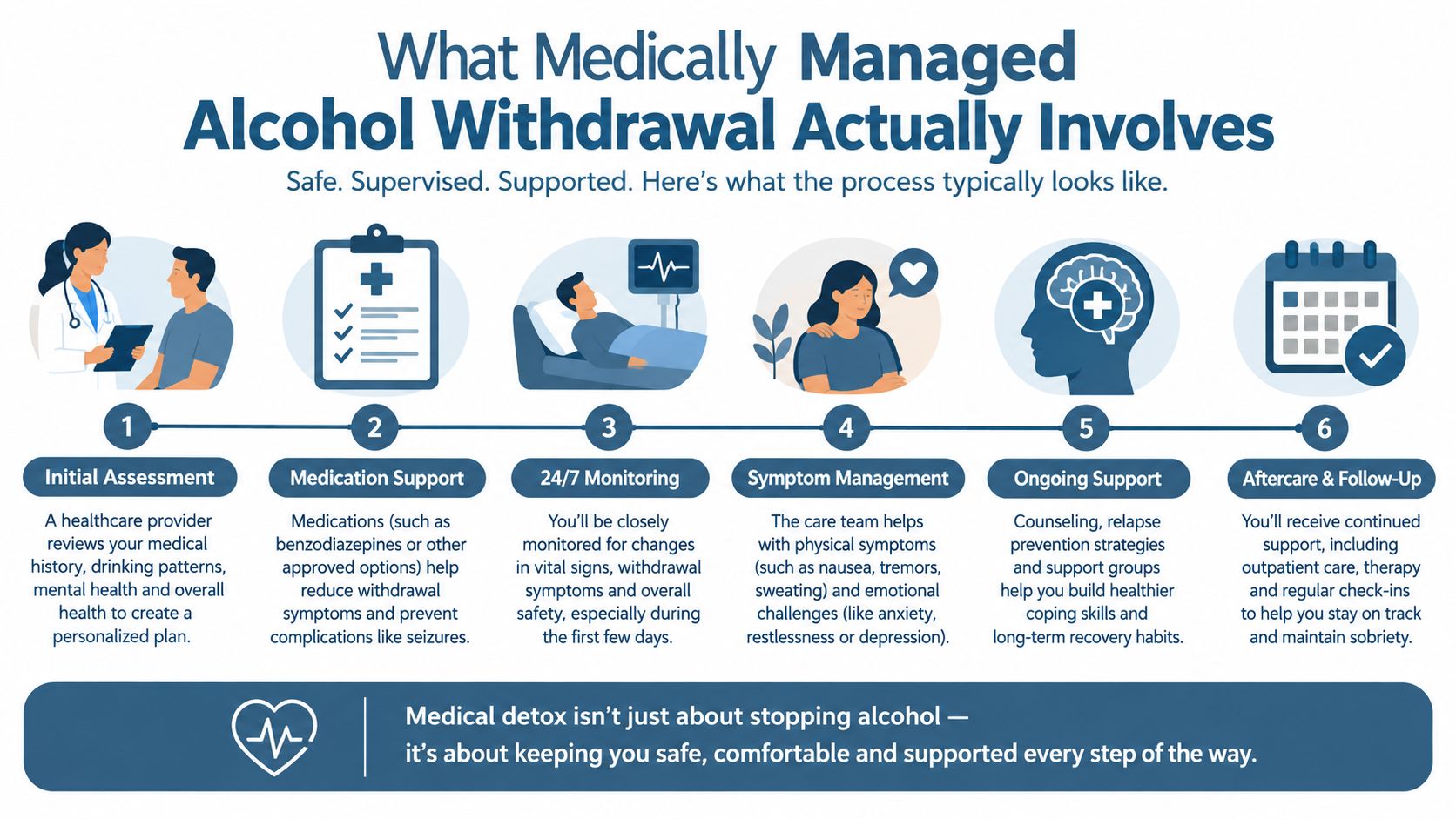
A high-end program should apply that standard inside a discreet residential setting, not dilute it with hospitality language. Readers comparing options can review how a residential medical-assisted detox program is typically structured.
The withdrawal curve is predictable, not harmless
Alcohol withdrawal often begins with tremor, anxiety, insomnia, nausea, and autonomic activation. Then it can intensify. Hallucinations, seizures, and delirium can emerge as the nervous system destabilizes.
The operational mistake is assuming a client who seems composed on arrival is therefore low risk. Many executives remain outwardly polished long after their physiology has become unstable. A person may look intact, answer emails, and still deteriorate quickly.
Why CIWA-Ar matters
The CIWA-Ar is the standard symptom scale used to track withdrawal severity and guide medication decisions. It gives clinicians a structured way to measure agitation, tremor, nausea, sweating, sensory disturbance, anxiety, and orientation instead of relying on guesswork.
According to the ASAM alcohol withdrawal guideline, treatment should begin with determining whether the patient is at risk for severe or complicated withdrawal. California clinical guidance also identifies benzodiazepines as the treatment of choice in appropriate outpatient cases to raise the seizure threshold, and one California care guide notes lorazepam when CIWA-Ar is above 8 to 10. In practical terms, prior seizures, prior delirium tremens, unstable vital signs, and a rising CIWA-Ar trend matter more than self-reported drinking volume.
A polished presentation does not equal a safe withdrawal course. Clinical trend matters more than appearance.
Detox also isn't therapy. It isn't trauma work, relapse prevention, or the place where root causes get resolved. It is the phase where the body is stabilized safely enough for meaningful treatment to begin.
Levels of Care for Alcohol Withdrawal in California
Executives evaluating alcohol detox in California usually face three realistic settings. Each serves a different risk profile. Choosing correctly matters more than choosing quickly.
Hospital-based detox is the right answer when medical risk is high. Standard residential detox works for some moderate-risk cases. A luxury executive detox can be an excellent choice, but only when its clinical structure is serious enough to justify the comfort and privacy it sells.
The setting should match the risk
A client with prior withdrawal seizures, severe cardiovascular instability, major liver concerns, or other acute medical complications shouldn't be in a boutique environment no matter how discreet it looks. That client belongs in a hospital or hospital-affiliated unit.
For the executive with moderate withdrawal risk and no immediate medical instability, a properly staffed luxury residential setting usually offers the best balance of monitoring, privacy, and controlled work access.
| Setting | Observation Intensity | Privacy Architecture | Work Engagement | Best Indication |
|---|---|---|---|---|
| Hospital-based detox | Highest. Appropriate for severe or medically complicated withdrawal, with medical-unit monitoring and rapid escalation capacity | Often limited. More staff traffic, broader visibility, and less control over environment | Minimal. Clinical stabilization takes priority over work continuity | Prior withdrawal seizures, suspected delirium risk, unstable medical status, significant comorbidity |
| Standard residential detox | Moderate to high if properly licensed and staffed | Variable. Some programs still use shared rooms or less protected admission processes | Limited to moderate, depending on program rules | Moderate withdrawal risk without acute medical complications |
| Luxury executive residential detox | High when clinically legitimate, with close monitoring inside a private setting | Strongest fit when private rooms, controlled entry, and confidentiality procedures are documented | Best option for selective work engagement if electronics access is permitted and clinically appropriate | High-functioning professionals with moderate risk who need discretion and operational continuity |
What executives should ask directly
A polished website won't answer the important questions. Admissions should.
- Observation standards: Ask how often staff perform face-to-face checks, who scores withdrawal symptoms overnight, and how physician decisions are made after-hours.
- Privacy design: Ask whether the admission process avoids shared waiting areas, whether all rooms are private, and how visitor records are handled.
- Work functionality: Ask whether phones and laptops are allowed, under what conditions, and whether the team can help contain communications rather than ban them.
A luxury executive program should function like a protected clinical environment first and a comfortable residence second. If that order is reversed, it's the wrong setting.
Medication Protocols and the First 72 Hours
The first 72 hours determine whether detox stays controlled or turns chaotic. Medication strategy matters. So does restraint.
The right approach is symptom-triggered care. Medication should respond to actual withdrawal severity, not to a prewritten blanket schedule that sedates everyone the same way. Executives care about safety, but they also care about being cognitively usable as quickly as possible. Those goals aren't in conflict when the protocol is disciplined.
What the medication plan should do
California public guidance makes several points clear. Alcohol withdrawal may require symptom-triggered benzodiazepine treatment, repeated CIWA-Ar reassessment, and thiamine before glucose. County guidance also states that withdrawal-management settings should start medication for alcohol use disorder during admission when clinically appropriate, as described in the California care guide for substance withdrawal and intoxication.
That means the medication plan should accomplish four things:
- Prevent seizures and escalating withdrawal.
- Avoid over-sedation.
- Correct nutritional risk.
- Set up the next phase of treatment before detox ends.
What a disciplined protocol looks like
Benzodiazepines remain first-line treatment for alcohol withdrawal. In many residential settings, clinicians use symptom-triggered dosing based on CIWA-Ar and bedside assessment. Lorazepam may be used when indicated, especially when symptom scores rise into the threshold noted above. Severe cases need higher-acuity care.
Thiamine should be given before any glucose-containing support because neurologic injury risk matters in heavy alcohol use. Folate and other nutritional supports are commonly addressed as part of basic stabilization. Antipsychotics are not first-line treatment for alcohol withdrawal itself.
| CIWA-Ar Score | Benzodiazepine Response | Adjunctive Medication | Monitoring |
|---|---|---|---|
| Low or minimal symptoms | Usually observation and reassessment rather than aggressive sedation | Nutritional support and hydration as clinically indicated | Regular symptom checks and vital-sign review |
| Above 8 to 10 | Lorazepam may be used according to California guidance for appropriate cases | Thiamine before glucose, with other supportive medications when indicated | Increased reassessment frequency and close nursing observation |
| Rising moderate symptoms | Symptom-triggered escalation under medical supervision | Supportive care for sleep, autonomic symptoms, and nutritional deficits when clinically appropriate | More frequent scoring and physician review |
| Severe symptoms or complicated presentation | Higher-acuity management may be required rather than continued residential detox | Broader medical management based on condition | Intensive monitoring and transfer if risk exceeds residential capability |
The goal isn't to medicate aggressively. The goal is to use the minimum effective pharmacology that keeps the withdrawal safe.
For executives, that matters. Heavy sedation may quiet symptoms, but it can also blur cognition, complicate handoffs, and delay the transition into meaningful residential work.
Accreditation, Licensing, and What to Verify on Paper
Luxury branding is easy to buy. Clinical legitimacy isn't. Families should verify the paperwork before any deposit is wired and before any transportation is booked.
The first check is basic. The facility should be appropriately licensed for the services it claims to provide. The second check is external accreditation. The third is the actual medical scope on the ground, not the version described by admissions in broad terms.
The non-negotiable document review
For executive clients, the minimum verification list should include:
- State licensing: Confirm that the facility is California-licensed for the level of service being offered.
- Current accreditation: Verify that Joint Commission or CARF accreditation is current, active, and relevant to the program.
- Medical leadership: Request the medical director's credentials and the actual structure of medical oversight.
- ASAM designation: Ask which withdrawal management level of care the program is providing.
- Written scope: Compare the marketing language to the documented services the facility is authorized to deliver.
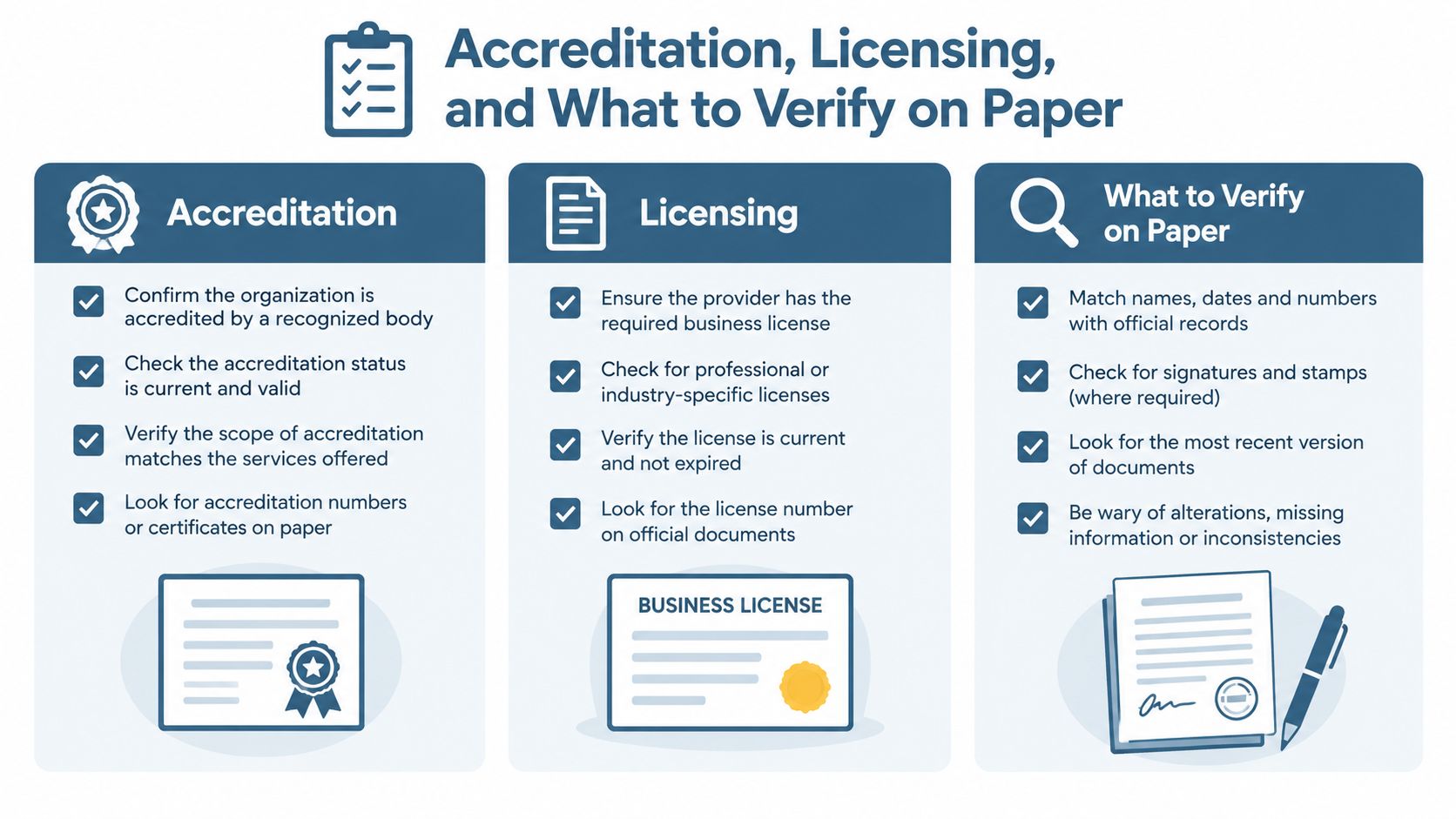
A useful starting point for families who want context on standards is this overview of Joint Commission accreditation.
Red flags that should end the conversation
Some warning signs are obvious once a family knows what to look for.
- No license transparency: If a facility won't clearly identify its licensure status, move on.
- Vague medical coverage: “On-call support” is not the same thing as meaningful detox capacity.
- Inflated claims: If a program markets itself as medical detox but can't explain its overnight monitoring process, the label is doing too much work.
- No written answers: Verbal reassurance is not enough for a high-risk medical admission.
Reflections states that it is a California-licensed, Joint Commission-accredited residential provider serving adults with co-occurring mental health and substance use disorders in a private upscale setting, according to its program overview. That's the kind of fact pattern families should verify with any private-pay option they consider.
Insurance, Private Pay, and the Real Cost of Discretion
Executive detox in California is usually a private-pay decision, and that's not an accident. Programs built around private rooms, discreet admissions, higher staffing intensity, and work-compatible accommodations often provide features that standard insurance reimbursement doesn't prioritize.
That doesn't mean insurance is irrelevant. It means families should separate medical necessity coverage from executive-grade customization.
What private pay is really buying
Private pay typically buys control. That includes room privacy, quieter operations, more individualized scheduling, protected communication, and the type of environment a senior professional can enter without feeling exposed or destabilized by the setting itself.
Insurance may still help with parts of treatment such as medically necessary withdrawal management, physician services, laboratory work, and some medications. But many of the features executives care about aren't the features insurers tend to reimburse in full.
| Cost Component | Private-Pay Range | Insurance Coverage |
|---|---|---|
| Medically managed withdrawal episode | Varies by facility and clinical complexity | May cover medically necessary components depending on plan and authorization |
| Private room differential | Usually built into premium pricing | Often limited or excluded as an elective accommodation feature |
| Physician and psychiatric oversight | May be included or billed within program structure | May be partially covered depending on network and medical necessity |
| Labs and medications | Sometimes included, sometimes separate | Often more likely to receive coverage than hospitality-related features |
| Executive accommodations and discretion features | Common in premium programs | Commonly not treated as reimbursable medical necessities |
Price matters less than failed placement
The expensive mistake isn't choosing a high-end setting. The expensive mistake is choosing the wrong setting, destabilizing medically, and then paying twice after a failed detox or emergency escalation.
For families comparing private-pay admission against trying to manage symptoms outside of a formal setting, this discussion of medical detox vs home-based care is useful because it frames the practical safety tradeoff clearly.
Discretion costs money. A preventable medical crisis costs more, and it leaves a much larger professional footprint.
The financially serious question isn't “What's the cheapest detox available?” It's “Which setting can solve the problem correctly the first time while protecting health, privacy, and future earning capacity?”
Choosing a Safe, Discreet Luxury Detox Setting
A luxury label means very little on its own. Some programs sell ambiance. Executives need clinical precision with privacy infrastructure.
The correct facility should feel quiet, contained, and operationally competent. It should also make it possible for a client to protect urgent professional obligations without turning treatment into a remote office with a medication cart.
What actually separates real executive detox from dressed-up residential care
A legitimate executive setting should offer private rooms in detox and residential treatment, not shared accommodations disguised with soft language. It should also have controlled entry, limited unnecessary foot traffic, and an admissions process that doesn't put high-profile clients in public-facing environments.
Electronics policy matters more than many families realize. Some executives need controlled access to a phone or laptop to delegate, approve time-sensitive items, or preserve stability in a company or family system. That access should be structured, clinically appropriate, and confidentiality-aware.
Reflections states that residents are allowed access to phones and laptops during treatment so they can manage business and family responsibilities, according to its executive and professionals program page. For the right client, that's a practical advantage, not a luxury gimmick.
The checklist that matters more than décor
Independent descriptions of executive-style California treatment commonly note features such as private rooms, desks, Wi-Fi, and 24/7 clinical support, showing that this model is designed around discreet, high-comfort care for professionals who may continue limited remote work, as reflected in this executive-style rehab listing.
Families should verify these points in writing:
- Private sleeping space: Bedroom and bathroom arrangements should be explicit.
- Clinical coverage: Overnight nursing and same-day medical response should be clearly defined.
- Confidentiality workflow: Ask how admissions, billing, transportation, and visitor logs are protected.
- Technology boundaries: Clarify whether electronics are allowed and how use is managed during acute withdrawal.
- Arrival logistics: Confirm whether transportation and intake can occur discreetly.
Marketing terms such as “executive program” or “private suite” should trigger more questions, not fewer. In this market, comfort is easy to advertise. Safe discretion is harder to build.
From Detox Into Dual-Diagnosis Residential Care
Detox stabilizes physiology. It doesn't resolve the drivers of compulsive drinking. Executives who treat detox as the finish line usually end up revisiting the same crisis under worse circumstances.
The deeper issue is often not alcohol alone. It may be trauma, anxiety, depression, insomnia, bipolar symptoms, grief, or a long-standing pattern of high-functioning distress. When those conditions remain untreated, sobriety becomes fragile fast.
The handoff should be planned before detox begins
A proper admission plan should already include the next residential step. That matters even more for private-pay executive clients because disruption is expensive, and momentum is difficult to recreate once a client leaves a contained setting.
Recent California and bridge-care guidance emphasizes that acute withdrawal treatment should be paired with medication for protracted withdrawal and relapse reduction, including naltrexone or gabapentin when appropriate, while also noting contraindications such as acute liver injury or decompensated cirrhosis, according to the California bridge-care guide for acute alcohol use disorder treatment.
That's the nuance many detox programs underplay. Medication planning after withdrawal is not optional for many patients. It's part of competent continuity.
What strong post-detox planning includes
Executives should insist on a written transition plan that includes the following:
- Dual-diagnosis residential placement: The program should be able to treat co-occurring psychiatric conditions, not monitor abstinence.
- Medication strategy: If medication for alcohol use disorder is appropriate, the plan should specify whether it will be initiated, continued, or deferred for a clear reason.
- Home-market continuity: Outpatient referrals should be concrete and geographically relevant.
- Long-term accountability: Ongoing check-ins matter because early stability can fade once business pressure returns.
Families evaluating continuity should look closely at how a program handles aftercare planning before admission, not as an afterthought during discharge.
California's broader alcohol-treatment environment has long shown a gap between need and care. The state's public health picture includes 111,961 people enrolled in substance use treatment in a single-day count in 2015, down from 132,562 in 2011 to 2013, with 16.5% enrolled for alcohol only and 38.3% for both alcohol and drugs. A separate planning report estimated 11,026 annual alcohol-attributable deaths in California during 2011 to 2015, with males accounting for 71% of those deaths, according to the California alcohol and drug statistics summary. The practical conclusion is simple. Waiting rarely improves the situation.
Reflections offers California-licensed, Joint Commission-accredited residential care for adults who need medically supported alcohol detox and continued dual-diagnosis treatment in a private, upscale setting. Its model is built for professionals who need private rooms, clinically serious care, and appropriate access to electronics while treatment protects both health and discretion. To evaluate whether that fit makes sense for a current situation, visit Reflections.