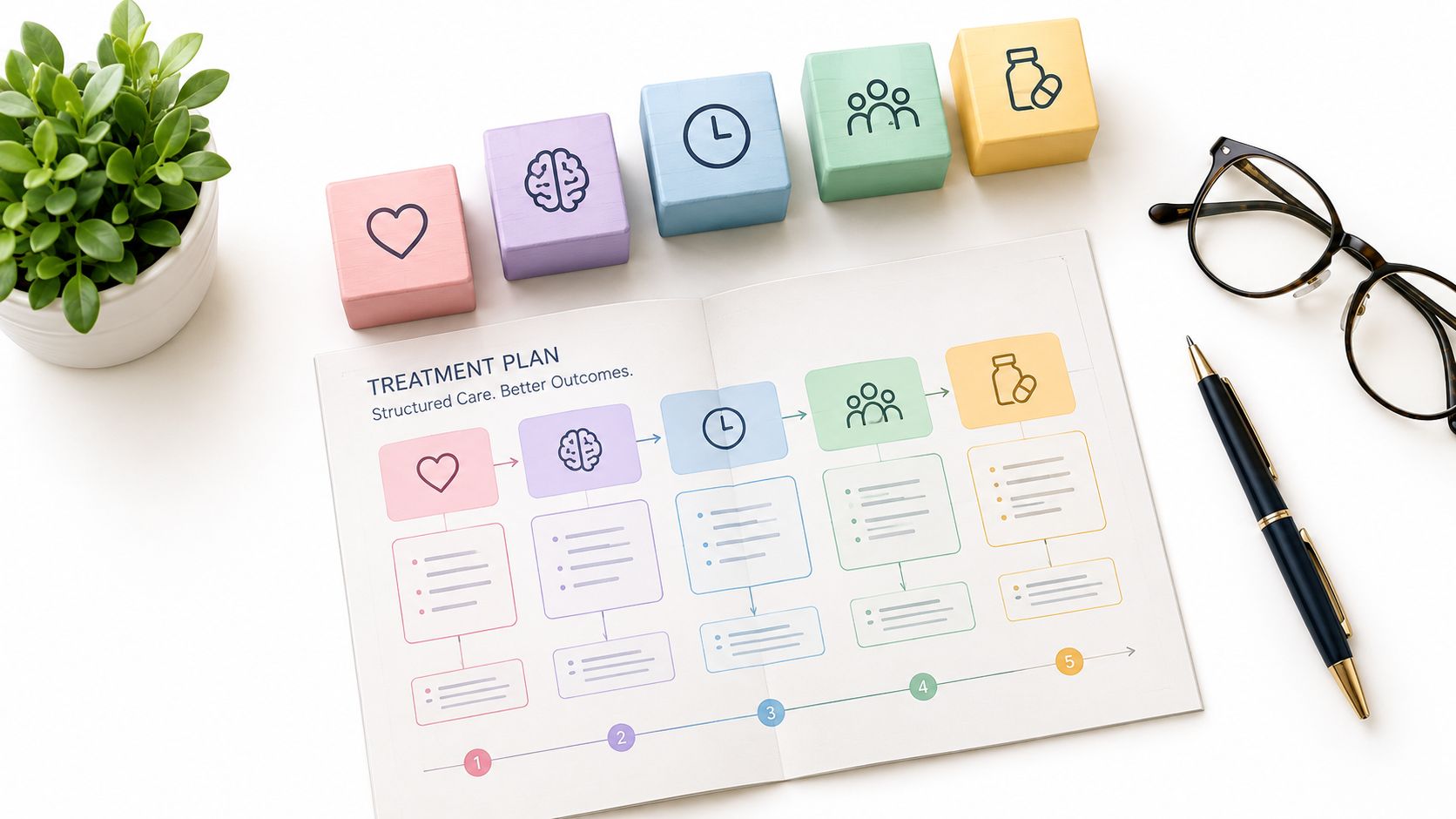

A CEO can spend months protecting a company's reputation while losing control of sleep, judgment, relationships, and substance use. A family member may then face a difficult choice: compare private residential programs that offer ocean views, discreet service, private rooms, and work access, or examine whether the clinical system underneath those amenities can address addiction and a co-occurring mental health condition.
Luxury matters when it protects privacy, dignity, and continuity. It doesn't replace disciplined treatment. The standard for high-end residential care should be clear: evidence based modalities must provide the clinical scaffolding, while the setting removes avoidable barriers to engagement. Executives may need supervised access to phones and laptops, private accommodations during detox and rehabilitation, and a treatment schedule that supports essential career obligations without allowing work to become an escape from recovery.
What Evidence Based Modalities Mean in Luxury Rehab
When a CEO, founder, or family member compares private residential programs, familiar acronyms can blur together. CBT, DBT, ACT, MI, MAT, trauma therapy, and care may appear on several websites, but the names alone reveal little. The useful question is whether the program can explain which modality fits which clinical presentation, who delivers it, how often it occurs, and how the team measures progress.
Evidence based modalities are treatments supported by systematic evaluation for particular conditions and treatment goals. That evidence may come from randomized trials, replicated outcomes, and meta-analyses. The framework itself combines the best available research evidence with clinical expertise and patient values, a definition reflected in WHO-linked treatment materials on substance use disorder interventions.
The clinical standard comes before the luxury standard
A credible program should move through four decisions:
- Identify the presentation. The team evaluates substance use, mood symptoms, anxiety, trauma, sleep, personality traits, medical risks, and current functioning.
- Select the active tools. Clinicians choose modalities that match the person's symptoms, motivation, cognitive capacity, risk profile, and prior treatment response.
- Build a coordinated schedule. Individual therapy, groups, psychiatric care, family work, and experiential services should reinforce the same treatment objectives.
- Adjust based on response. A modality isn't retained because it's familiar or prominent in the brochure.
WHO materials identify multiple evidence-based approaches for drug use disorders, including CBT, motivational interviewing, contingency management, mindfulness-based cognitive therapy, ACT, trauma-focused CBT, and family therapy. WHO guidance also includes brief psychosocial interventions, withdrawal management, digitally delivered interventions, and supervised dosing with long-acting opioid medication for prescription opioid dependence.
Terms such as "trauma-informed," and "evidence-informed" can describe useful principles, but they aren't interchangeable with proof that a specific intervention works for a specific condition. A luxury setting can add mindfulness, fitness, nutrition, massage, art, music, or somatic work. Those services should support the clinical plan, not substitute for it.
Accreditation adds an operational layer. The Joint Commission's behavioral health accreditation program covers substance use treatment across residential, outpatient, partial hospitalization, and detox settings, including dual-diagnosis programs. Accreditation follows an onsite survey and uses organization-wide standards involving care, safety, leadership, medication management, and patient rights. The thread count and view may improve comfort, but modality rigor remains essential.
Core Psychotherapy Modalities Used in Dual Diagnosis Care
A senior executive arrives at residential care with a full calendar, private concerns, and limited tolerance for vague treatment plans. The clinical team should explain which modality addresses which problem, how sessions fit around work continuity, and what privacy boundaries apply to electronics and outside communication. CBT, DBT, ACT, and MI serve different functions. A strong program combines them around the client instead of presenting them as competing brands.
CBT turns patterns into operational decisions
CBT examines the link between thoughts, emotions, and behavior. Its value is practical change. A client might identify the belief that “a drink is the only way to handle a board crisis,” test that assumption, trace the behavior that follows, and rehearse another response.
Sessions commonly include an agenda, review of recent situations, skill practice, and a between-session assignment. For an executive with generalized anxiety and alcohol use, CBT can address catastrophic forecasting, overwork, avoidance, sleep disruption, and the drinking routine that temporarily reduces tension. A useful CBT approach for addiction connects treatment to specific triggers and relapse-prevention behaviors rather than generic conversation.
The modality also fits a demanding residential schedule. The team can set protected therapy periods, define when electronics remain available, and translate each assignment into decisions the client faces at work, home, or during travel. Privacy depends on the program's policies, so prospective families should ask who can receive updates and whether phones or laptops are permitted between sessions.
CBT has a broad research base. A major review examined 269 meta-analytic studies and a representative sample of 106 meta-analyses across conditions that included substance use disorder, depression, bipolar disorder, anxiety disorders, personality disorders, insomnia, and chronic pain. Among 11 studies comparing response rates, CBT showed higher response rates than comparison conditions in 7 reviews, and lower response rates in only 1 review. Those findings are reported in the published CBT review.
DBT builds control under pressure
DBT suits clients whose substance use is closely tied to emotion dysregulation, impulsivity, interpersonal conflict, or borderline traits. Its working skills include mindfulness, distress tolerance, emotion regulation, and interpersonal effectiveness.
A session may teach a skill, review a recent crisis, analyze the sequence leading to substance use, and rehearse a replacement response. For a professional misusing stimulants while cycling through agitation, shame, and impulsive decisions, DBT creates a structured pause before the pattern becomes a business, relationship, or safety crisis.
The trade-off is scope. DBT should not be presented as universal addiction treatment or as a replacement for broader programming. Evidence supports a narrower role, particularly for high-risk and emotionally unstable presentations. The DBT systematic review and meta-analysis found no significant advantage over 12-step programs, while showing beneficial effects against treatment as usual in the short and long term.
A luxury setting should also show how DBT handles executive realities. Skills coaching may address a hostile meeting, an urgent message, restricted access to substances, or pressure to remain constantly reachable. Privacy and electronics rules should support stabilization without turning treatment into unnecessary isolation.
ACT addresses values and avoidance
ACT helps clients notice difficult thoughts without automatically obeying them, then act according to chosen values. An executive may understand the consequences of alcohol or cocaine use yet feel trapped between professional identity, family responsibility, performance pressure, and fear of slowing down.
ACT uses values clarification, acceptance, mindfulness, cognitive defusion, and committed action. The client creates distance from thoughts such as “the company will collapse without constant availability,” then takes a concrete action consistent with health, family, or leadership values.
MI earns engagement before demanding change
MI helps a pre-contemplative or treatment-fatigued executive who entered care under pressure. Its focus is resolving ambivalence. The clinician examines the gap between current behavior and stated goals while strengthening the client's own reasons for change, rather than arguing the client into recovery.
MI works well early, during transitions, and when adherence weakens. The recommended sequence is direct: MI opens engagement, CBT builds a relapse-prevention system, DBT stabilizes high-risk emotional patterns, and ACT connects daily choices to a durable professional and personal identity.
Medication Assisted Treatment and Medication Optimization
Medication is the biomedical pillar of dual-diagnosis care, but luxury treatment shouldn't confuse more medication with better treatment. The correct standard is minimal effective pharmacology, selected for safety, tolerability, cognitive clarity, interaction risk, and the client's actual recovery needs.
For alcohol use disorder, clinicians may evaluate FDA-approved options including naltrexone, acamprosate, and disulfiram. For opioid use disorder, established options include buprenorphine, naltrexone, and methadone. These medications serve different purposes and require individualized assessment, particularly during withdrawal, when medical risks can change quickly.
A program's medication-assisted treatment explanation should distinguish evidence-supported treatment from off-label adjuncts. Gabapentin and topiramate may have a role in selected cases, but evidence is thinner than for the better-established medications listed above. Psychiatric co-medications can also be necessary for depression, bipolar disorder, anxiety, sleep, or trauma symptoms, yet active substance use complicates the evidence and the risk-benefit calculation.
The executive-specific medication question
Executives often need clear thinking, stable energy, and reliable decision-making. That doesn't mean medication should be withheld. It means prescribers should explain:
- Purpose: Which symptom or substance-use risk is the medication targeting?
- Timing: What should the client expect during detox, early stabilization, and step-down care?
- Cognitive effect: Could sedation, activation, or emotional blunting interfere with work or therapy?
- Monitoring: How will the team assess benefit, side effects, cravings, sleep, and adherence?
- Continuity: Who will manage prescriptions during travel, work transitions, and continuing care?
Under-prescribing is a failure when a client needs evidence-supported medication or medically managed withdrawal. Over-prescribing is also a failure when sedation replaces psychological work or creates unnecessary cognitive burden. The strongest programs use medication to make therapy safer and more effective, not to make the client easier to manage.
How a High End Residential Program Integrates These Modalities
A residential schedule should feel clinically intentional, not like a collection of attractive activities. For an executive, the key test is whether the week creates enough therapeutic exposure to change behavior while preserving limited, supervised contact with essential professional responsibilities.
A representative week
A Monday may begin with an individual CBT or ACT session. The therapist reviews the weekend pattern, identifies a trigger connected to performance or family pressure, and assigns a behavioral experiment. A midday DBT group then converts that insight into a skill the client can use during distress. An afternoon somatic or experiential block may help the client recognize bodily signs of escalation before the familiar substance-use response takes over.
Tuesday can add psychiatric rounds, medication review, and a family session. Wednesday may emphasize trauma stabilization, relapse-prevention planning, and an evening community meeting shaped by MI principles. Thursday and Friday can revisit the same themes through individual therapy, process groups, fitness, mindfulness, and practical planning. The weekend shouldn't become therapeutic dead time. It should provide structured practice, peer connection, family contact when clinically appropriate, and review of the next week's objectives.
Work continuity needs boundaries
A private-pay executive program can allow residents to retain cell phones and laptops, but access must be structured. Protected windows may support a board call, a client obligation, or essential family coordination. Unrestricted access can let a resident avoid exposure, monitor markets compulsively, or remain psychologically embedded in the crisis that treatment is meant to address.
Private rooms in both detox and rehabilitation can protect sleep, confidentiality, and decompression. Private session rooms support candid work. On-site prescriber rounds and secure tele-psychiatry can help address sleep, medication questions, and travel planning without disrupting the treatment arc.
Executive-care rule: Work access should preserve essential continuity, not preserve the behaviors that made treatment necessary.
The primary therapist should track themes across individual work, groups, psychiatry, family therapy, and experiential services. A multidisciplinary team approach matters because the client shouldn't receive contradictory messages from separate departments. The weekly mix should change as stabilization improves, motivation strengthens, and the client prepares for life outside the residence.
Strength of Evidence for Co Occurring Disorders
Evidence supports several modalities, but it does not support a fixed protocol for every dual-diagnosis client. That distinction matters in luxury residential care, where privacy, electronics access, work continuity, and clinical needs must fit the same treatment plan. CBT has one of the broadest quantitative foundations across substance use, depression, anxiety, bipolar disorder, personality disorders, insomnia, and chronic pain. In adult anxiety disorders, the evidence shows a substantial average benefit across many CBT-versus-control comparisons, as reported in the CBT evidence review.
For substance use disorders, CBT produces small-to-moderate reductions compared with inactive controls. Benefits are strongest during early follow-up and weaker later. Residential care should therefore establish skills, practice them under supervision, and transfer them into continuing care. A private setting and controlled electronics access can support that work, but neither replaces post-discharge reinforcement, consistent with the systematic review of CBT for substance use disorders.
DBT fits emotion dysregulation, borderline traits, impulsivity, and repeated crisis behavior. Its evidence base is narrower than CBT's, yet its practical value is clear when instability interferes with sobriety or treatment participation. ACT addresses chronic avoidance and conflict between behavior and personal values. MI works best as an engagement and adherence method, not as a complete treatment plan. For an executive, that may mean using brief motivational work to address resistance while protecting privacy and setting firm boundaries around work access.
Trial evidence versus clinical matching
Reviews of cognitive-behavioral interventions for co-occurring substance use and mental health disorders found modest consumption benefits, without consistent psychosocial benefits or clear superiority over single-disorder treatment. A 2025 Swedish systematic review concluded that psychological and psychosocial treatments can reduce substance use and psychiatric symptoms, while evidence for pharmacological treatment in this population remains significantly limited. The findings are summarized in the systematic review of concurrent disorders.
Trauma-focused care requires careful sequencing. Recent commentary describes integrated trauma-focused treatments for PTSD and SUD as safe and effective while emphasizing patient matching and implementation. A 2026 comparative-effectiveness study found trauma-focused psychotherapy and integrated trauma-focused psychotherapy superior to treatment as usual for alcohol-use severity. Effects were stronger in veterans than civilians, with no clear differential response by veteran status for PTSD or drug-use severity. The JAMA Network Open commentary shows why programs need a clear matching rationale rather than a branded, one-size-fits-all pathway.
| Presentation | CBT | DBT | ACT | MI | Integrated |
|---|---|---|---|---|---|
| Anxiety with alcohol use | Strong fit for thought and behavior patterns | Useful when crises drive use | Useful for avoidance | Supports engagement | Often appropriate |
| Emotion dysregulation with stimulant misuse | Helpful for relapse planning | Strongest clinical fit | Supports values-based action | Helps address ambivalence | Often necessary |
| PTSD with substance use | Useful, including trauma-focused forms | Supports stabilization | Helps reduce avoidance | Supports readiness | Prioritize careful matching |
| Treatment resistance | Useful when structured | Useful when impulsivity dominates | Useful when identity conflict dominates | Core engagement tool | Combine according to response |
The practitioner-level conclusion is firm: modality selection should follow patient variables, severity, and prior response history, not program familiarity. A high-end residential program should be able to explain that choice in plain language, including how the plan protects confidentiality, limits avoidance through devices, and preserves only the work continuity that supports recovery.
Matching Modalities to Co Occurring Presentations
Families don't need to diagnose a loved one or choose a therapy before admission. They do need to recognize whether a program can explain its matching logic. A fixed protocol is convenient for an institution. An individualized blend is more credible for a complex executive whose substance use may serve different functions across anxiety, trauma, mood instability, or interpersonal distress.
| Co Occurring Presentation | Primary Modality | Secondary Modality | Integration Pattern |
|---|---|---|---|
| PTSD plus alcohol use | CBT with integrated trauma work | MI or DBT stabilization | Trauma processing follows safety assessment and readiness |
| Bipolar disorder plus stimulant use | Medication optimization | CBT for adherence and MI for engagement | Psychiatric monitoring anchors behavioral change |
| Borderline traits plus benzodiazepine misuse | DBT-first sequencing | CBT relapse prevention | Skills and crisis planning precede deeper processing |
| Depression plus alcohol use | CBT | ACT or MI | Behavioral activation connects recovery to daily functioning |
| Generalized anxiety in a high-functioning professional | ACT | MI and targeted pharmacology | Values work, exposure to discomfort, and careful symptom control |
The match must remain iterative
A client with PTSD and alcohol use may initially need stabilization, sleep support, and MI before trauma processing. A client with bipolar symptoms and stimulant misuse may require medication review before cognitive work can be reliable. A professional with anxiety may appear highly motivated while still using work to avoid emotional exposure, making ACT and MI more useful than an information-heavy approach.
The team should revisit the formulation as new information emerges. Treatment history, withdrawal course, family observations, response to medication, group participation, sleep, and willingness to practice skills all matter. The right blend, not the most fashionable acronym, determines whether residential care becomes a turning point.
A luxury setting should make that reasoning visible. The clinical director and primary therapist should be able to tell a family why CBT is primary, why DBT is added, why trauma work is delayed or integrated, and what evidence would prompt a change.
Questions to Ask a Luxury Rehab About Clinical Depth
Luxury admissions calls often emphasize privacy, architecture, cuisine, and discretion. Those features matter to executives and families, but clinical depth is easier to evaluate through specific questions than polished language.
Ask about modality depth
A family should ask how many individual and group sessions use CBT, DBT, ACT, and MI, who delivers them, and what licenses or certifications those clinicians hold. The program should explain whether the modalities are full treatment models, occasional techniques, or labels applied broadly to general counseling.
Ask how integration works
The important question isn't whether a facility has psychiatrists, therapists, and experiential clinicians. It's how they coordinate. Ask whether one primary therapist tracks themes across services, how medication changes reach the therapy team, and how family observations influence the treatment plan.
Ask about dual-diagnosis competence
Request a clear explanation of how the program handles PTSD, bipolar symptoms, borderline traits, depression, anxiety, withdrawal risk, and medication-assisted treatment. Ask whether trauma processing begins immediately or follows stabilization, and what criteria determine that decision.
Ask about executive continuity
A credible program should state its electronics policy plainly. Families should ask how cell phones and laptops are supervised, how privacy is protected, how essential calls are scheduled, and how work accommodations avoid undermining treatment. Private rooms in detox and rehabilitation should be described as part of the care environment, not merely a hospitality feature.
| Category | Key Questions | Green Flag | Red Flag |
|---|---|---|---|
| Modality depth | Who delivers each modality and how is it used? | Named clinicians, defined applications, clear schedule | Acronyms without clinical detail |
| Integration mechanics | How do psychiatry and therapy coordinate? | Shared treatment planning and regular case review | Separate services with no visible handoff |
| Dual-diagnosis care | How are trauma, mood, and substance use treated together? | Individualized sequencing and risk assessment | One protocol for every client |
| Executive continuity | What are the device and work policies? | Limited, supervised access with privacy safeguards | Unlimited access or total disconnection without rationale |
| Accreditation and outcomes | Which accreditation applies and what results are shared? | Joint Commission or CARF documentation, transparent measures | Vague “accredited” language and no explanation |
The Joint Commission's behavioral health provider information states that accredited substance use providers undergo review at least every three years against hundreds of national safety and quality standards. Organizations applying for accreditation must have provided care to at least three individuals, with at least two active during the initial onsite survey, according to the Joint Commission eligibility documentation. A willingness to answer these questions in writing is itself a meaningful quality signal.
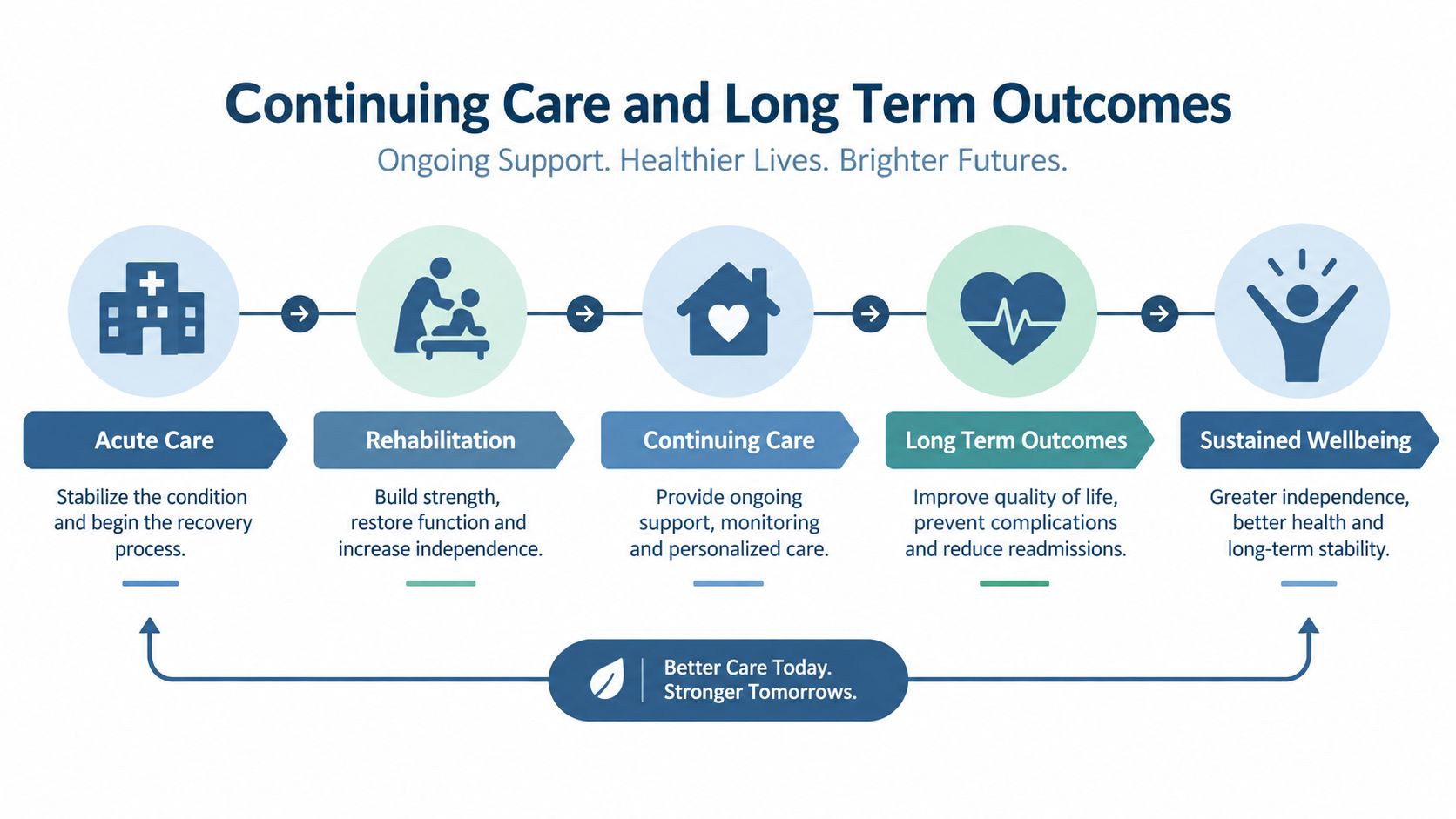
Continuing Care and Long Term Outcomes
Residential treatment is the first chapter, not the entire recovery plan. The executive who returns to a full calendar, frequent travel, family pressure, and confidential professional demands needs a discharge architecture that protects treatment gains in ordinary settings.
A credible plan may include structured step-down through PHP, IOP, or sober living; scheduled individual therapy; ongoing CBT or DBT skills groups; medication management; peer support; family programming; and a named alumni contact. Concierge psychiatry or telehealth can help clients manage travel, sleep, prescriptions, and changing work demands, but convenience shouldn't replace clinical accountability.
The first 90 days require deliberate design
Before discharge, the client and family should establish:
- Calendar protection: Recurring therapy and recovery blocks should be scheduled before work expands again.
- Travel protocols: The clinician and client should identify medication logistics, meeting access, high-risk locations, and emergency contacts.
- Relapse response: A written plan should specify warning signs, first actions, clinician notification, and family involvement.
- Family continuity: Education and private sessions should continue after residential care rather than ending at discharge.
Long-term outcomes depend on sustained participation, not a single residential experience. The evidence supports continued attention to medication adherence, CBT and DBT skills practice, and peer support, while broad marketing promises about permanent transformation deserve scrutiny. A program should explain what happens when cravings return, a flight is delayed, a board conflict escalates, or a family member sees warning signs first.
Reflections offers private-pay dual-diagnosis residential care with private rooms in detox and rehabilitation, appropriate electronics access for work continuity, medication-assisted withdrawal and medication optimization when clinically appropriate, and a multidisciplinary program built around CBT, DBT, ACT, MI, individual therapy, intensive groups, family involvement, and continuing care. Executives and families evaluating evidence based modalities can visit Reflections to discuss confidential admission planning and determine whether the clinical structure fits the individual's needs.