

A chief executive who has never missed a quarterly close suddenly cancels a board call, ignores investor emails, and is found drinking before lunch. At home, sleep has collapsed, irritability has become routine, workouts have disappeared, and evening wine has progressed into mid-day pours. A spouse is preparing an intervention while the executive insists the problem is temporary.
That collision is often the first visible point in a much longer process. Change in recovery isn't a single decision, detox admission, signed contract, or discharge date. It's a measurable shift in behavior, mental health, relationships, physical stability, and daily function. For executives, the treatment environment must also address discretion, clinical rigor, family trust, and the practical need to manage limited professional obligations without allowing work to consume the recovery plan.
When the Ground Shifts Under a High-Performing Life
The executive in this scenario may still be answering selected messages, approving major decisions, and appearing composed in public. That surface competence can delay treatment because professional performance hides deterioration elsewhere. The more reliable indicators are cumulative: fragmented sleep, escalating anxiety, missed exercise, secrecy around alcohol or medication, emotional volatility, and a household that has reorganized itself around avoiding conflict.
A spouse often sees the pattern before the executive accepts it. Children may notice unpredictability. Colleagues may describe missed deadlines as an unusual lapse rather than a health crisis. The client may interpret each warning sign separately, while the family sees a system failing across several domains.
The first recommendation is to stop debating labels
Families shouldn't wait for perfect agreement about whether the executive is “addicted,” “burned out,” or “depressed.” The immediate question is functional: What has changed, how quickly has it changed, and what risks are now present? A private clinical assessment can examine substance use, withdrawal risk, mood symptoms, sleep, trauma, medications, medical conditions, and the effect on family and work.
Recovery should then be treated like a performance system that requires stabilization, measurement, and adjustment. The target is not just to remove alcohol or drugs. It's to restore judgment, emotional regulation, health, relationships, and a sustainable professional role.
Why executives seek residential care
High-performing clients commonly delay treatment because they fear exposure, lost control, and career disruption. A suitable residential setting answers those concerns without weakening clinical boundaries. Private rooms support confidentiality and decompression, while structured electronics access can allow carefully limited contact with a board, legal team, family, or delegated operations staff.
That convenience isn't the treatment. It removes avoidable friction so the client can focus on treatment rather than hiding symptoms, managing logistics, or pretending the crisis doesn't exist. The sections that follow map the process from recognition through aftercare, including the setbacks that families should expect and the markers that indicate genuine progress.
Clinical rule: Privacy should protect treatment participation, not protect the illness from honest assessment.
What Change in Recovery Actually Means
Change in recovery is a dynamic process across several domains. Neurobiology, identity, relationships, emotional regulation, physical health, and routine all move at different speeds. An executive might stop drinking quickly yet continue to experience insomnia, irritability, shame, or impaired concentration. Another client might show better family engagement before cravings have fully settled.
Authoritative recovery reviews describe recovery as an ongoing trajectory involving relatively stable improvement in biopsychosocial functioning, health, social functioning, well-being, and purpose in life. That framework supports tracking substance use alongside retention and adherence, mental and physical health, social connectedness, and quality of life, rather than treating abstinence as the only meaningful outcome. The clinical review of recovery measurement also emphasizes assessment at entry, discharge, and follow-up because change becomes clearer across time.
A label is not a baseline
“Recovered” can sound like a permanent status. In practice, a client's baseline keeps shifting. Cravings may become less frequent. Sleep may become more restorative. A partner may begin trusting calendar commitments again. The executive may stop taking work calls during therapy, delegate operational decisions, and tolerate difficult emotions without using substances to shut them down.
A high-functioning client can think of this as recalibrating a precision instrument after repeated overload. The instrument isn't fixed because one component was replaced. It requires testing under different conditions, including travel, conflict, fatigue, public pressure, and professional disappointment.
Events end, processes continue
Detox is an event. Admission is an event. Discharge is an event. Recovery change is the repeated process that gives those events meaning. A client may complete withdrawal safely but remain vulnerable to insomnia, anxiety, impulsivity, or an unexamined belief that leadership requires constant self-medication.
Progress therefore includes plateaus and reversals. A strong month can be followed by a flat week without erasing the underlying gains. Clinicians should ask whether the client returns to healthy behavior faster, communicates earlier, accepts support more readily, and causes less damage when stress rises.
A nationally representative recovery survey found that among people in remission from alcohol use disorder, roughly one-third were abstinent, one-third drank within low-risk guidelines, and one-third drank above low-risk thresholds while still identifying as in recovery. That finding, reported in the Recovery Research Institute's discussion of treatment outcomes, doesn't make controlled use appropriate for every client. It does show why functioning, remission, harm reduction, and life stability deserve careful clinical attention alongside a client's agreed substance-use goals.
The Stages of Change and What Each One Asks of You
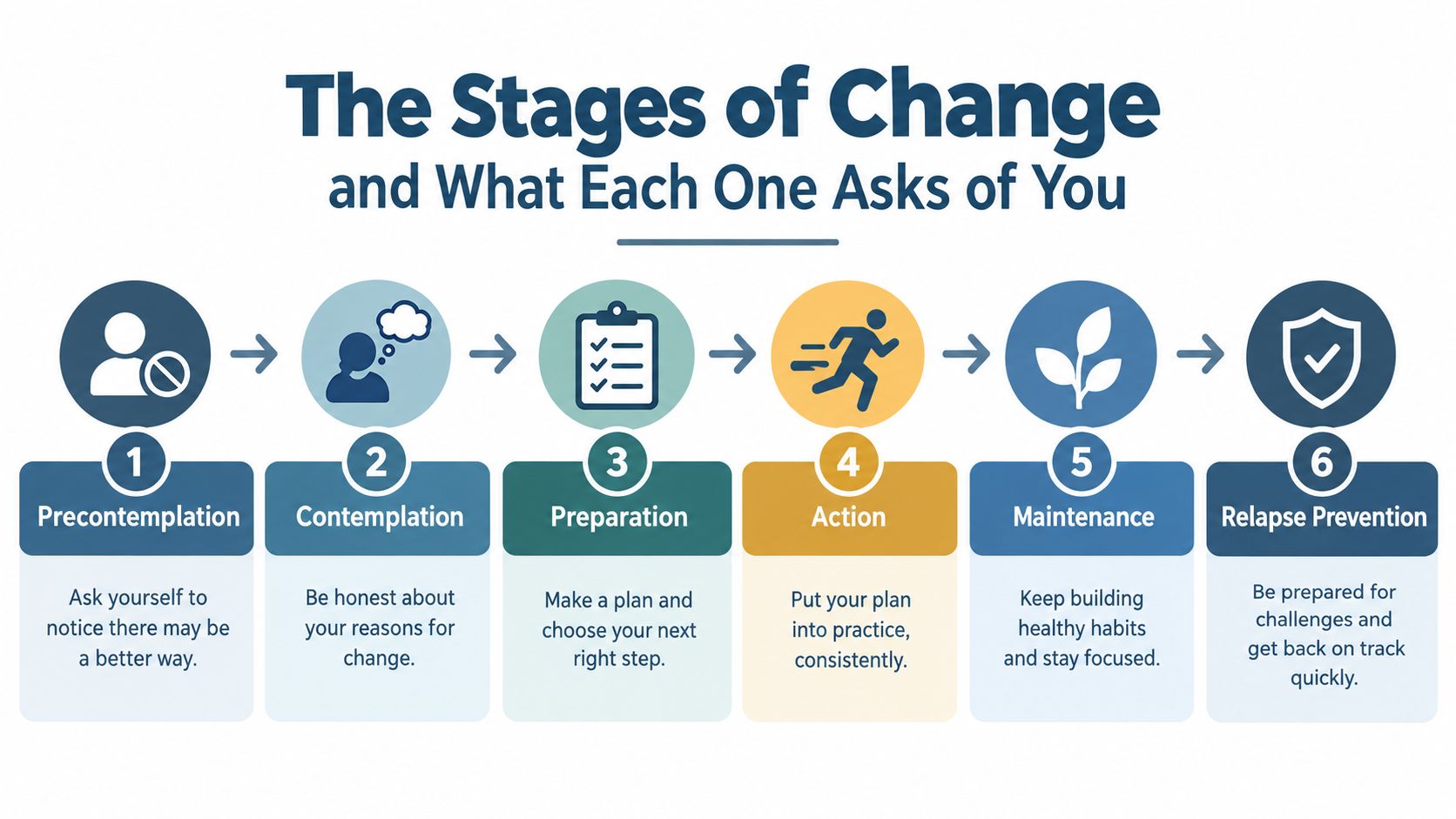
The stages associated with Prochaska and DiClemente are useful because they describe readiness as movement, not character. The stages include precontemplation, contemplation, preparation, action, maintenance, and relapse prevention. They aren't a staircase that every client climbs once. A person can move forward in one area, regress in another, and return to treatment with better information.
Readiness appears in observable behavior
- Precontemplation: Secret drinking, defensive explanations, missed obligations, or refusal to discuss treatment suggest low readiness. The family should document safety concerns without turning every conversation into prosecution. The clinical team's task is assessment and engagement, not forced optimism.
- Contemplation: The executive recognizes costs but remains ambivalent. Questions about privacy, treatment length, work access, and family consequences often appear here. The client needs accurate information and a space where uncertainty can be discussed without losing dignity.
- Preparation: Scheduling an assessment, arranging coverage at work, reviewing medications, identifying triggers, and agreeing to a treatment date indicate movement. The family should help with logistics while avoiding rescue behaviors that conceal consequences.
- Action: Admission, detox participation, therapy attendance, honest disclosure, sleep stabilization, and acceptance of clinical structure demonstrate active change. Surrendering some control is often necessary, even when electronics remain available under an agreed plan.
- Maintenance: The client practices new responses outside the protected setting. Alumni contact, therapy, family sessions, recovery coaching, and consistent routines become behavioral evidence that recovery is being carried into ordinary life.
- Relapse prevention: The client identifies early warnings, rehearses responses, and communicates before a crisis. Vigilance here isn't fear. It's an operating discipline that protects gains during travel, conflict, insomnia, and professional pressure.
The family has work at every phase. It must set boundaries, stop financing harmful behavior, participate in appropriate education, and distinguish support from surveillance. The client must accept responsibility without treating a setback as moral failure. The team must match interventions to readiness and reassess when the client's symptoms, motivation, or environment changes.
A practical explanation of how these stages relate to recovery appears in Reflections' guide to the stages of recovery. The useful measure isn't whether the executive can repeat the right language. It's whether conduct, insight, health, and relationships show consistent movement.
What a Luxury Residential Setting Changes in the Trajectory
Luxury residential care changes the conditions around recovery. It doesn't remove cravings, repair trust instantly, or substitute amenities for psychiatric and addiction treatment. Its value lies in reducing distractions and logistical obstacles that can keep an executive stuck in avoidance.
| Variable | Typical Setting | Luxury Executive Setting |
|---|---|---|
| Privacy | Shared spaces and broader exposure may increase self-consciousness | Private rooms support discretion and decompression |
| Work contact | Access may be inconsistent or incompatible with treatment | Scheduled electronics and business-call windows can preserve limited continuity |
| Clinical complexity | Mental health and substance use may be addressed in separate systems | Dual-diagnosis coordination can keep both conditions in the same plan |
| Daily structure | The client manages more external logistics | Protected time concentrates attention on assessment, therapy, and skills |
| Family involvement | Participation varies by availability and program design | Private sessions and planned education can organize family support |
Reflections describes a California-licensed, Joint Commission-accredited program for adults with co-occurring mental health and substance use disorders. Its stated model includes private accommodations and electronics access for residents who need to manage limited career obligations, which is materially different from promising unrestricted availability or allowing work to displace clinical care.
The environmental advantage
A private room can give a client enough psychological distance to sleep, reflect, and speak candidly. Electronics access can prevent unnecessary professional fallout when a chief operating officer or legal department must receive a controlled update. Concierge medical coordination can also reduce the burden of arranging medication reviews, withdrawal management, and follow-up appointments across disconnected providers.
The distinction matters. A standard setting may force the client to choose between treatment and every professional obligation. A luxury executive setting can create a narrower, clinically governed channel for essential communication.
What the setting cannot do
Comfort accelerates disclosure for some clients, but comfort doesn't create accountability. The executive still has to examine denial, tolerate emotional discomfort, change routines, repair relationships, and accept limits. A protected setting can make that work more feasible. It cannot complete the work on the client's behalf.
Executives assessing options should examine how a luxury rehab may influence recovery outcomes through concrete mechanisms, not marketing language. The relevant questions concern clinical accreditation, dual-diagnosis capability, privacy policies, device rules, family involvement, discharge planning, and what happens when symptoms worsen.
Setbacks, Recurrences, and the Year That Follows Discharge
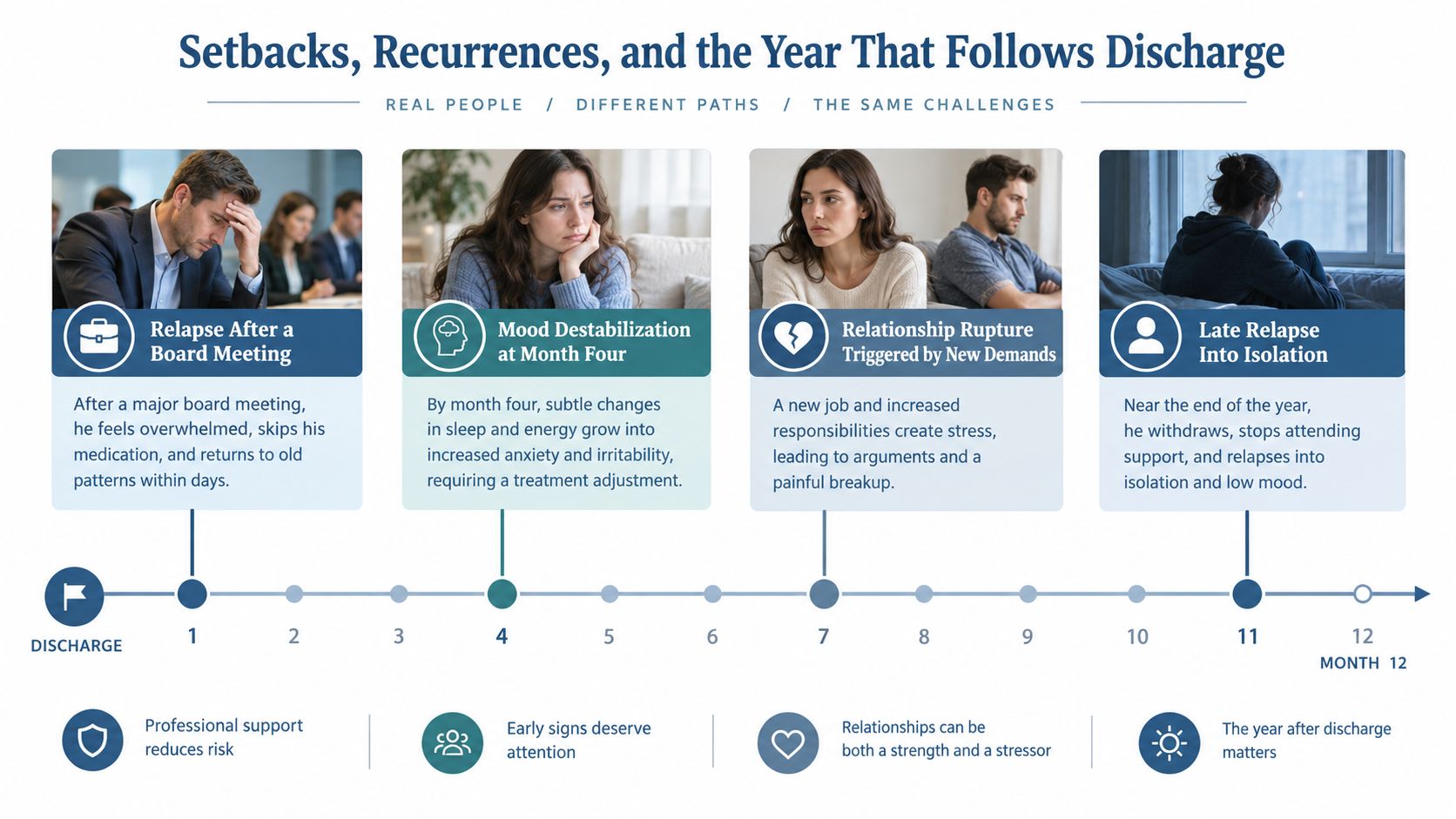
A chief executive leaves residential care stable, returns to a board meeting, receives unexpected criticism, and drinks afterward. A different client reaches the fourth month, sleeps poorly for several nights, becomes unusually energized and irritable, and begins missing therapy. Another establishes sober boundaries at home, triggering a relationship rupture because the partner interprets reduced availability as rejection.
These aren't identical events. A lapse is a brief return to a behavior. A recurrence is a more sustained return to problematic use or symptoms. A treatment-stage regression occurs when the client loses readiness, stops engaging, or returns to denial even before substance use resumes. Each requires assessment, especially when anxiety, depression, insomnia, trauma symptoms, or mood instability are present.
The risk windows are predictable enough to plan for
The second week at home can expose how much structure residential care was providing. The third month may introduce travel, client dinners, or a return to a demanding operating rhythm. Later, an anniversary, loss, legal conflict, or family event can activate grief that the client had postponed.
Longitudinal research supports a non-linear view. In a Canadian study of 855 adults who identified as being in recovery, 51.2% reported no recurrence after their initial recovery start, 14.3% reported one recurrence, 19.4% reported two to five, and 15% reported six or more before stable recovery. These findings are available in the longitudinal recovery study. The implication is direct: recurrence planning belongs in treatment before discharge, not after a crisis.
The response should be fast and unemotional
A high-functioning aftercare plan doesn't rely on willpower or family improvisation. It specifies:
- Same-day contact with the treating clinician or designated clinical lead.
- A family briefing that separates confirmed facts from assumptions.
- Medication and safety review, including sleep and mood symptoms.
- Temporary reduction of travel, alcohol-centered events, and high-risk work demands.
- A revised change plan with explicit follow-up dates.
A recurrence is data, not defeat. It identifies a trigger, a missing support, an inaccurate boundary, or an untreated symptom. Aftercare planning at Reflections should be evaluated by the same standard. The plan must say who responds, how quickly, and what level of care becomes appropriate if outpatient support no longer contains the risk.
Practical Tips for Executives and Families in Transition
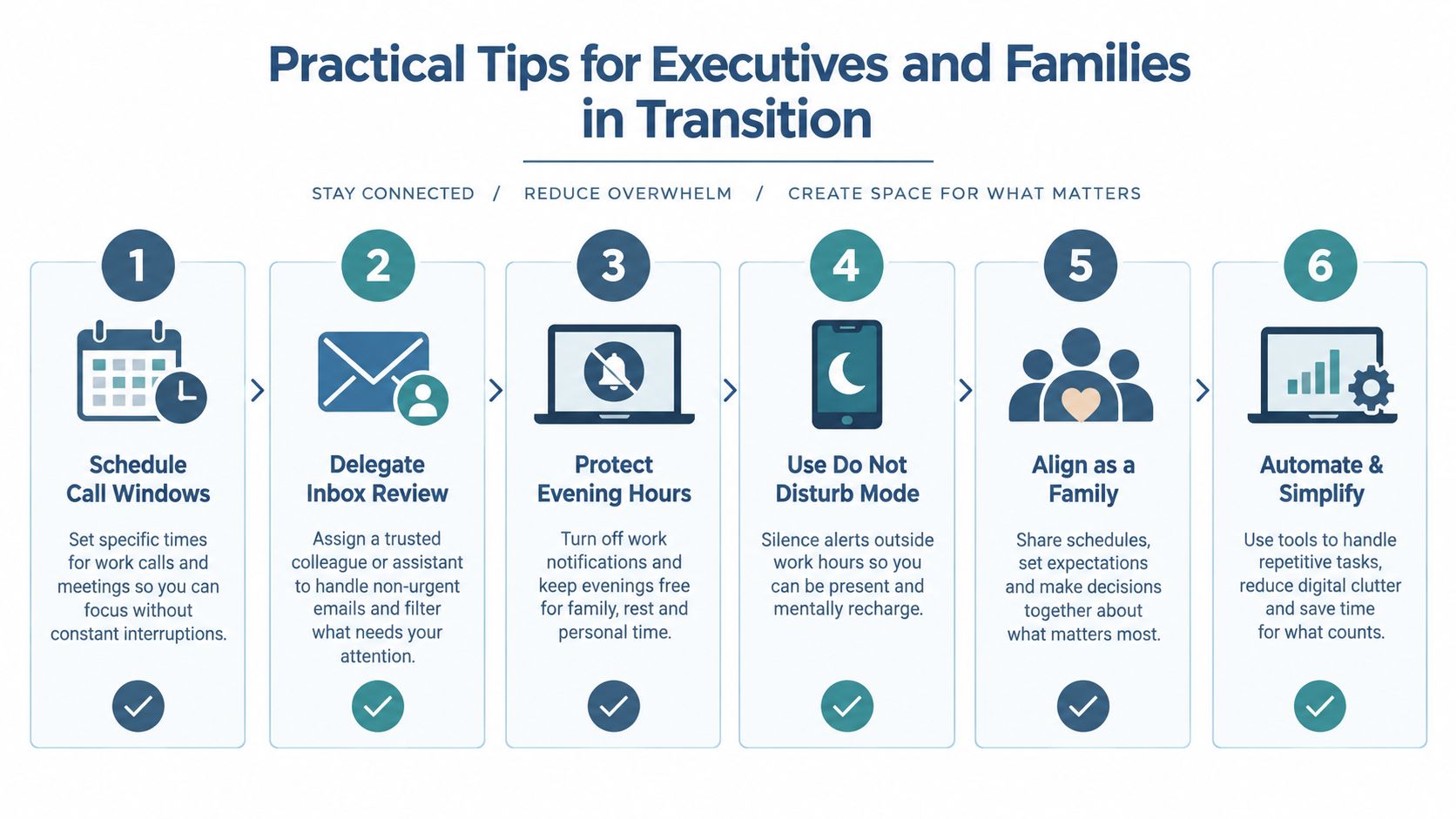
The first ninety days after discharge should be managed like a controlled operational transition. The executive shouldn't return to the old calendar and hope new coping skills survive inside it. The family and clinical team should create visible guardrails before the first major stressor arrives.
Build the first thirty days deliberately
- Set electronics windows: Schedule specific periods for calls and inbox review. Keep treatment hours and protected evenings free from business demands.
- Delegate triage: Assign a trusted executive assistant or operations leader to screen messages, summarize decisions, and escalate only essential matters.
- Write the communication protocol: Define what the clinical lead may share with the family, what the family should report, and how urgent concerns will be handled.
- Control the home environment: Agree on alcohol rules before discharge. Remove ambiguous supplies and avoid making the returning client negotiate this issue while exhausted.
- Protect sleep: Put consistent sleep and wake times on the calendar, reduce late calls, and address insomnia promptly. Executives who need a broader framework can review this sleep-first executive burnout plan alongside clinical guidance.
The second month should test stability without manufacturing pressure. Therapy appointments, medication refills, family sessions, exercise, nutrition, and peer support belong on the calendar before travel and social obligations fill it.
Rehearse the difficult conversations
The executive needs a short script for friends, clients, and colleagues. It can state that a health matter required time away and that professional contact will remain structured. Family members need their own script so they don't disclose details impulsively or become informal crisis managers.
Before the first work trip, the client and clinician should rehearse airport routines, hotel exposure, client dinners, emergency contacts, and what happens if sleep deteriorates. A relapse drill should include the exact call list, transportation plan, medication review, and family notification sequence.
Review every week
A weekly review should examine sleep, cravings, mood, therapy attendance, work intensity, family conflict, and moments of isolation. The aim isn't to create a surveillance system. It's to detect small deviations while the response remains simple.
Operational rule: A plan that exists only in the discharge summary isn't a plan. It must appear in calendars, contact lists, travel documents, and household agreements.
Reading the Long Arc of Change in Recovery
The long arc becomes visible when executives stop asking whether they feel “fixed” and start tracking whether their systems function better under pressure. A useful dashboard can be private, concise, and reviewed by a clinician, coach, or designated family member without exposing sensitive details to the workplace.
Track the first ninety days
The early record should focus on stabilization:
- Sleep: Record regularity, duration, awakenings, and whether poor sleep predicts mood or craving changes.
- Emotional regulation: Note how quickly the client identifies anger, anxiety, shame, or grief and how effectively those states are managed.
- Treatment adherence: Track therapy attendance, medication refills, clinical communication, and participation in family work.
- Work reintegration: Measure whether responsibilities return in stages rather than all at once, with delegation still active.
- Relationships: Record concrete repairs, such as keeping commitments, tolerating difficult conversations, and reducing secrecy.
Physiological markers may add useful clinical context. A treating professional can determine whether measures such as heart-rate variability, liver function, blood pressure, or medication effects belong in the client's monitoring plan. These indicators should inform care, not become another performance score.
Review the twelve-month pattern
At twelve months, the question is whether healthy responses have become more automatic across different settings. A strong month followed by a flat week isn't necessarily deterioration. The clinician should examine the cause, the speed of recovery, the presence of warning signs, and whether the client sought help before consequences escalated.
Population data reinforce the scale of recovery. A major U.S. survey found that in 2021, 70.0 million adults aged 18 or older reported ever having a substance use and/or mental health problem, and 72.1%, about 50.2 million people, said they were in recovery or had recovered, according to the SAMHSA survey report. The same report found that 72.2% of 29.0 million adults who had ever had a substance use problem reported recovery or recovered status, while 66.5% of 58.7 million adults who had ever had a mental health problem reported the same for mental health. Recovery is therefore not a marginal outcome, and it shouldn't be evaluated as though one setback cancels the entire trajectory.
Long-term stability comes from repeated adjustments: earlier disclosure, better sleep protection, more honest delegation, faster clinical contact, and stronger relationships. The executive who learns to read that arc can respond to a difficult week without mistaking it for a failed life.
Reflections provides private-room detox and residential rehabilitation, dual-diagnosis care, individualized clinical treatment, and structured electronics access for executives managing limited career obligations. Families and professionals can visit Reflections to discuss confidential assessment, treatment fit, and continuing-care planning before the next crisis forces a rushed decision.