
A senior executive leaves the office late, promises the family that this week will calm down, then pours a drink just to get the mind to stop racing. A physician finishes another impossible shift and takes medication in a way that no longer feels controlled. A founder keeps performing in public, while privately cycling through anxiety, insomnia, alcohol, stimulants, or both. From the outside, everything still looks intact. Inside, the margin for error is gone.
That's the professional's trap. Success gives cover. It also raises the price of asking for help.
For high-achievers, treatment can sound like an unacceptable interruption. They worry about confidentiality. They worry about phones being taken away. They worry about clients, board meetings, licensing issues, investors, staff, and family trust. They assume rehab means disappearing from real life right when real life seems least able to function without them. That assumption keeps many professionals sick far longer than necessary, and the cost of delaying rehab for professionals is rarely just personal. It spreads into leadership, judgment, marriage, parenting, and reputation.
There's a better option. Specialized treatment centers for working professionals are built for people whose lives can't be put on hold. The clinical system around this kind of care is expanding too. The U.S. Bureau of Labor Statistics projects 18% growth from 2022 to 2032 for substance abuse, behavioral disorder, and mental health counselors, compared with 3% average growth for all occupations, which supports a broader treatment infrastructure that includes programs designed to accommodate employed adults in outpatient and residential settings (BLS employment projection for mental health-related roles).
Professionals dealing with burnout, anxiety, trauma, or substance use often need more than generic therapy. They need treatment calibrated to pressure, privacy, and performance. For women in leadership roles, support can also include resources like a therapist for high-achieving women leaders when executive stress, identity, and recovery overlap.
The Professional's Dilemma When Seeking Help

A high-performing professional rarely reaches out at the first sign of trouble. Most wait until the system around them starts slipping. Sleep worsens. Mood becomes unpredictable. Alcohol use, prescription misuse, or compulsive coping starts shaping the day. Work still gets done, but at a rising internal cost.
Why professionals wait too long
Executives and licensed professionals often tell themselves they can manage it privately. That logic sounds disciplined, but it usually isn't discipline. It's fear dressed up as responsibility.
Three pressures dominate:
- Career exposure: They fear colleagues, boards, clients, or referral sources finding out.
- Loss of control: They assume treatment means surrendering schedule, communication, and decision-making.
- Identity threat: People used to being competent don't like entering a setting where they feel vulnerable or dependent.
Treatment is often seen as a disruption. For professionals, the more accurate frame is risk management.
Why specialized care changes the equation
Generic rehab treats everyone as if the same structure works for every life. It doesn't. A professional with fiduciary responsibility, licensing exposure, or a tightly managed public identity needs a more precise model.
Treatment centers for working professionals are distinct because they account for the realities of leadership. They're built around discretion, higher-touch coordination, and a treatment plan that respects real-world obligations without letting work become an escape hatch. That balance matters. If a program can't protect privacy, support meaningful continuity, and still deliver strong clinical care, it isn't an executive program. It's standard treatment with nicer branding.
What Defines an Executive Treatment Center
Luxury alone doesn't define executive treatment. Private rooms, excellent food, attractive surroundings, and concierge service matter, but they are support features, not the model itself. An executive treatment center earns that label when it removes the exact barriers that keep high-achievers from entering care and staying in it.
Privacy is clinical, not cosmetic
For a CEO, attorney, physician, pilot, founder, or public-facing professional, privacy isn't a preference. It's a condition of entry. If confidentiality feels weak, treatment gets delayed.
A real executive program should include:
- Private accommodations: Private rooms reduce exposure, overstimulation, and constant social strain.
- Discreet operations: Admissions, communications, and family coordination should be handled with precision.
- Protected environment: The setting should support distance from unnecessary visibility and interruption.
Privacy improves treatment participation. People disclose more when they don't feel watched, exposed, or lumped into a chaotic environment.
Peer environment matters more than people admit
Executives often resist treatment because they assume they won't relate to anyone there. That concern is valid. A peer group made up of other professionals changes the tone of treatment immediately.
When clients sit with people who understand leadership fatigue, high-stakes decision-making, perfectionism, regulated careers, and image pressure, the defensiveness drops. They stop performing. They start telling the truth.
That peer match also improves group usefulness. Conversations move beyond generic relapse language into concrete issues such as delegation failures, burnout cycles, secrecy, overwork, professional shame, and the use of achievement as camouflage.
The right peer group can collapse weeks of guardedness into a few honest sessions.
Clinical sophistication separates premium care from expensive lodging
An executive center should feel calm, but it also needs real depth. High-end treatment for professionals should be clinically dense, not merely comfortable.
The most important markers include:
- Multidisciplinary care: Psychology, psychiatry, addiction treatment, family work, and trauma-informed care must work together.
- Individualized planning: High-functioning clients often present with layered issues that don't fit a single-track plan.
- Efficient intensity: Professionals need concentrated, well-organized treatment that addresses root causes quickly and thoroughly.
Smaller, well-run programs often support stronger engagement. In one study of outpatient drug-free programs, smaller size and accreditation were associated with better client engagement, while work-friendly access features were designed to reduce barriers that lower attendance and retention (study on engagement and access features in outpatient treatment).
An executive program should also make logistics almost invisible. The less time a client spends navigating friction, the more energy goes into recovery.
Navigating Program Types Without Pausing Your Career
Professionals don't need vague advice about “getting support.” They need a decision framework. The right level of care depends on two things. Clinical severity and actual work demands. One should never be used to deny the other.
Nationally, the treatment system is already structured around flexibility. There are nearly 14,700 substance use treatment facilities in the U.S., and 83% offer outpatient services. Residential non-hospital facilities remain a smaller but important part of the system, with a median of 31 clients, which helps explain why these settings can offer more individualized structure for professionals who need immersion without hospital-style disruption (KFF overview of substance use and mental health treatment facilities).
Residential care for when the problem is bigger than willpower
Residential treatment is the right choice when someone needs distance from daily triggers, medical oversight, or a full reset in structure. For many executives, this is the level they resist most and benefit from most.
The key distinction is whether the residential setting is built for professionals. A standard residential program may treat work as a distraction only. A specialized executive program uses guarded, clinically appropriate access to allow essential responsibilities while still protecting the therapeutic container.
Outpatient and IOP when stability already exists
Intensive outpatient and standard outpatient care can work well when the person is medically stable, has a safe home environment, and can reliably engage without constant supervision. These formats fit professionals who need treatment but don't require overnight care.
For some, outpatient is the right starting point. For others, it's the right step-down after residential. The mistake is choosing outpatient because it feels less disruptive when the issue is that the condition has already outgrown that level of care. A useful comparison is this guide on inpatient vs outpatient rehab.
Comparing treatment programs for professionals
| Program Type | Structure & Intensity | Work/Career Flexibility | Ideal for Professionals Who… |
|---|---|---|---|
| Residential | Full-time, immersive care with medical and clinical structure | Moderate when the program permits protected technology and scheduled work access | need stabilization, privacy, containment, and relief from triggers |
| Intensive Outpatient | Several structured sessions each week while living at home or in supportive housing | High, if schedule and commute are realistic | are stable enough to function outside treatment but need significant clinical support |
| Standard Outpatient | Ongoing therapy and recovery support at lower intensity | Highest | need maintenance, relapse prevention, or long-term follow-through after higher levels of care |
The Clinical Edge of a Professionals Program
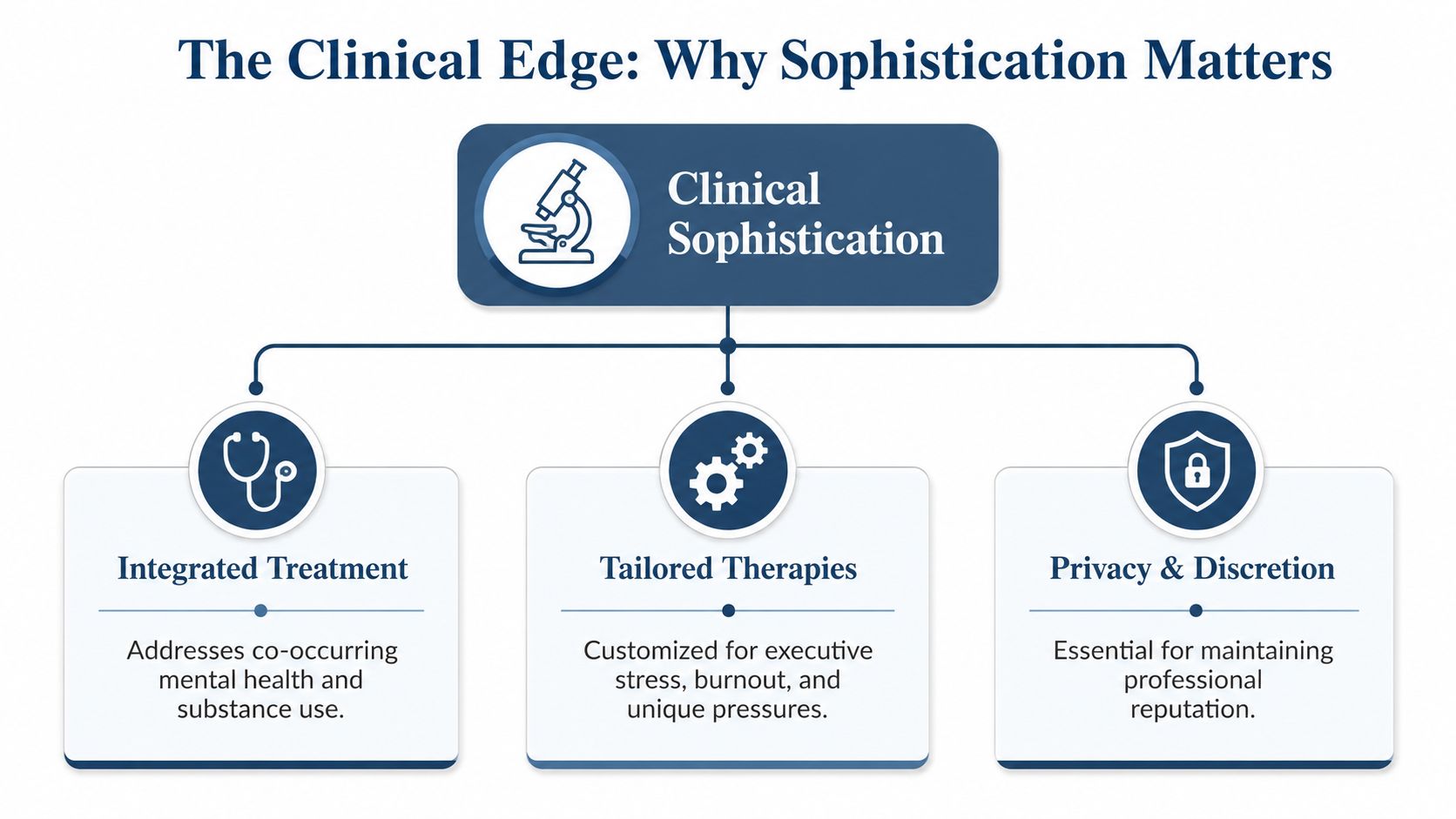
High-achievers often arrive in treatment with more than one problem. Alcohol or drug use may be obvious, but underneath it there is often anxiety, depression, trauma, panic, grief, burnout, bipolar symptoms, or relentless insomnia. If treatment addresses the substance and ignores the psychiatric load, the person may leave polished, compliant, and still fundamentally unstable.
That's why executive treatment should be judged first by clinical sophistication.
Dual diagnosis care is the standard, not an add-on
Professionals don't need a program that treats addiction in one lane and mental health in another. They need integrated care from the beginning. That means psychiatric evaluation, medication management when appropriate, relapse-prevention planning, and continuing care that extends well beyond discharge.
Professional-specific models go even further. One specialty model includes three additional weekly process groups with peer professionals plus monitoring and advocacy with licensing boards for up to five years after treatment, which reflects the long-term occupational risk many licensed clients face (professional program model with peer groups and long-term monitoring).
Therapy must match executive psychology
A professional who lives in constant performance mode often doesn't need more advice. That person needs treatment capable of reaching the systems underneath the performance.
That usually means a blend of approaches, such as:
- CBT: useful when distorted thinking, overcontrol, catastrophizing, and perfectionistic beliefs drive stress and use.
- DBT: helpful when emotional intensity, impulsivity, relational conflict, or self-defeating coping patterns are present.
- ACT and motivational work: effective when the client feels split between professional identity and personal reality.
- Somatic and experiential therapies: important when the body is carrying chronic stress, trauma activation, or shutdown.
A center like Reflections is one example of a program that combines dual-diagnosis treatment, psychiatry, individual psychotherapy, intensive groups, and complementary therapies while allowing appropriate access to electronics for clients who need balanced engagement with work and family.
Professionals often ask whether treatment will protect their career. The stronger question is whether untreated illness still can.
Occupational support isn't optional in licensed careers
A licensed professional doesn't just face relapse risk. That person may face reporting issues, credential concerns, and intense fear about reputation. Programs built for professionals should understand these realities and address them directly.
The strongest programs include peer process with other professionals, family involvement, clear continuing-care planning, and support around monitoring or advocacy when occupational oversight is part of the picture.
How to Evaluate and Choose the Right Center
Marketing in this category is full of soft language. “Executive.” “Luxury.” “Work-friendly.” None of those words mean much unless the admissions team can answer precise questions without evasion.
Some work-friendly programs offer limited access only. In certain programs, work time is capped at three hours per day, which is exactly why professionals should ask for specifics on technology access and scheduling before admission.
Questions that expose the difference quickly
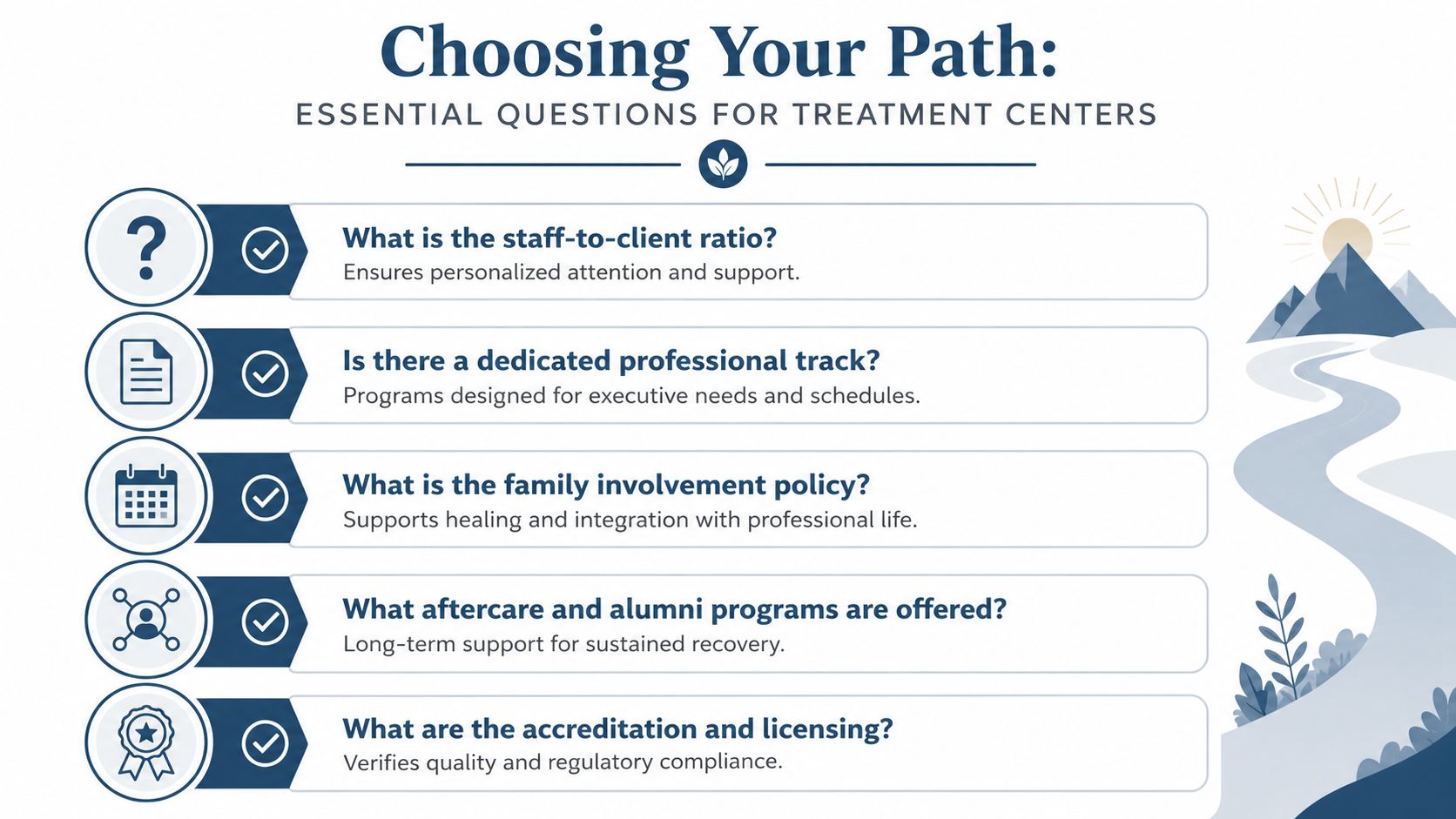
A serious buyer should ask questions that can't be answered with branding language.
- Technology access: Is phone and laptop use allowed daily, and is access flexible or limited to preset windows?
- Protected work time: What does a typical day permit for urgent calls, email, and deadlines?
- Private accommodations: Are all rooms private, including detox and residential?
- Clinical leadership: What are the credentials of the clinical director, psychiatrist, and primary therapist?
- Dual diagnosis depth: How are anxiety, trauma, depression, bipolar symptoms, and substance use treated together?
- Family integration: How are spouses or family members included in treatment and planning?
- Aftercare design: What support exists after discharge for ongoing therapy, relapse prevention, and accountability?
What to listen for on the admissions call
The content of the answer matters, but the style matters too. Well-designed programs answer operational questions cleanly. They don't dodge, oversell, or collapse clinical nuance into sales language.
Good signs include:
- Specific daily structure: The team can describe how work access fits into treatment without sounding defensive.
- Clear accreditation discussion: They can explain standards and oversight. For example, professionals comparing facilities should understand the value of Joint Commission accreditation in rehab.
- Real clinical sequencing: The center can explain what happens in detox, psychiatric evaluation, therapy, family work, and discharge planning.
Practical rule: If a program can't explain how it balances confidentiality, electronics, and intensive treatment in plain language, it probably doesn't do it well.
Red flags professionals should take seriously
A polished website can hide a generic model. Warning signs include broad promises with no policy detail, vague answers about psychiatrist access, no mention of family systems, and a heavy focus on amenities with little discussion of dual diagnosis treatment.
The standard should be simple. If the center can't protect privacy, preserve essential career continuity, and deliver advanced clinical care at the same time, it isn't built for this population.
A Day in the Life at an Executive Rehab
A well-designed executive residential day doesn't feel like punishment or chaos. It feels structured, protected, and purposeful. The client isn't sitting idle, nor is the day so rigid that treatment becomes another performance contest.
Morning structure that lowers noise
The day often begins with quiet, not urgency. Breakfast, light movement, mindfulness, and medication support when needed create a calmer baseline. That matters for professionals who have spent years waking directly into stress chemistry.
Clinical work starts early. Group sessions may focus on emotional regulation, relapse triggers, trauma patterns, family dynamics, or the role work has played in avoidance and identity. Individual therapy then goes deeper, often into the material that would never be voiced in a boardroom or at home.
Midday work access with boundaries
In a true executive setting, work time is planned rather than improvised. The client may use a laptop, answer email, join essential calls, or communicate with key stakeholders in a private space. The point isn't to keep running the entire business from treatment. The point is to preserve critical continuity without allowing work to derail care.
In these centers, luxury becomes functional. A private room, reliable technology access, and confidential workspace aren't indulgences. They reduce friction and panic. They make it possible for a professional to stay in treatment long enough to benefit from it.
Afternoon and evening focused on rebuilding capacity
Later in the day, the schedule often widens. Psychiatric follow-up, process groups, fitness, somatic work, meditation, art-based therapy, or restorative practices help the nervous system recover from chronic overdrive.
Evenings tend to be quieter. Family contact, reflection, reading, journaling, or educational programming can replace the old cycle of work, alcohol, collapse, repeat.
A good executive program doesn't just interrupt self-destructive habits. It teaches a different way to function. The client leaves with better insight, stronger boundaries, and a more realistic relationship to pressure.
Investing in Your Future with Aftercare and Alumni Support
Executive treatment's value isn't that it gets someone through a difficult month. It's that it protects the next decade. Health, judgment, emotional stability, family trust, and leadership capacity all depend on what happens after discharge as much as what happens during residential care.
That's why aftercare should never be treated as a formality. A strong plan often includes step-down treatment, ongoing individual therapy, psychiatric follow-up when needed, relapse-prevention work, family support, and a credible alumni network that keeps recovery active in real life. Professionals do better when support continues as they reenter demanding environments.
Recovery as sustained self-leadership
High-achievers usually understand investment when it's framed correctly. They protect assets, reduce risk, and allocate resources toward long-term performance. Treatment belongs in that category.
The wrong center asks a professional to choose between career and recovery. The right center protects both. It does that through discretion, private accommodations, advanced dual-diagnosis care, meaningful work compatibility, and continuing support after the residential stay ends.
The bottom line is simple. Treatment centers for working professionals should be judged by whether they preserve dignity, tell the truth clinically, and build a recovery plan strong enough to hold under real pressure.
For professionals who need private, dual-diagnosis residential care with appropriate work access, private rooms, and a clinically advanced treatment model, Reflections is one option to consider. The program is California-licensed and Joint Commission-accredited, with treatment designed for adults who need discreet, intensive care without abandoning essential career responsibilities.