
A senior executive can walk into a luxury residential program with one question on their mind, “What kind of room will I get?” The better question is quieter and more important, “What exactly is driving the drinking, pill use, panic, insomnia, or shutdown that brought this person here?”
In high end rehab, the room matters less than the first 72 hours of clinical sorting. Private accommodations, discretion, and the ability to keep work moving can reduce friction, but the core value comes from a careful assessment that separates substance use, mood symptoms, trauma, medical risk, and family strain into a usable plan. That is why the strongest programs treat intake like the start of diagnosis, not a paperwork stop.
Luxury treatment sits in a very expensive segment for a reason. Industry reporting places private luxury residential care at $30,000 to $100,000 per month, with standard facilities usually at $5,000 to $20,000 per month. Another source puts the average U.S. residential rehab price at about $30,000 per month and outpatient rehab around $2,500 per month. That price gap only makes sense when the program delivers a more intensive clinical process, not just a prettier setting.
What a High End Rehab Assessment Really Involves
A chief financial officer arrives late at night, tired, guarded, and already apologizing for the time away from the office. The suite is private, but the first thing that happens is not a tour. A clinician asks about sleep, alcohol, anxiety, medications, trauma history, and the pressure points that made functioning look intact on the outside while life was coming apart inside.

The first impression is clinical, not decorative
In a high end rehab setting, the assessment starts before the client settles in. Staff are looking for patterns, not polish. A person can be articulate, high-performing, and still be clinically unstable, so the interview has to go deeper than surface success.
The most useful programs spend the first one to three days gathering enough detail to answer three questions. What substances are involved, what mental health symptoms are present, and what level of care is safe right now. That structure matters because high-cost residential care only earns its place when it produces a clearer diagnosis and a more precise plan, not when it offers privacy.
Practical rule: If the intake sounds like a sales conversation, the clinical work is probably too thin.
For families, this is often the first reassuring sign. A serious program does not promise instant transformation. It tries to understand the problem well enough to avoid guessing.
Why the assessment justifies the premium
The premium price in luxury residential care is tied to service intensity, discretion, and continuity, not just comfort. The wider treatment system also makes the need plain. A SAMHSA-linked estimate cited in industry reporting found 23.5 million people needed treatment for drug or alcohol abuse, but only 2.6 million received it, showing how large the access gap has been. High end programs developed inside that gap, where clients often need individualized staffing and a setting that can hold work, family, and recovery at the same time.
That is why a rigorous intake is the core product. Without it, luxury rehab is just expensive housing. With it, the program starts to become a clinical map.
The Intake Process for Executives and Working Professionals
The intake sequence should feel orderly, private, and direct. A strong program starts with secure contact, then moves into pre-screening, then into arrival logistics that protect confidentiality and preserve work obligations where appropriate. For executives and working professionals, the point is not to create a bubble. It's to make treatment possible without adding chaos to an already fragile situation.
The first conversation usually focuses on immediate safety, current use, medications, and what the client can realistically maintain during treatment. That includes work responsibilities, family obligations, travel concerns, and whether the person needs support using electronics to stay connected. Reflections' executive-focused program describes balanced engagement with work and loved ones, with appropriate access to electronics, which matches the needs of many high-responsibility clients (executive rehab program).
What happens before arrival
The most efficient admissions teams gather information before the client reaches the front door. They ask about medical history, psychiatric history, prior treatment, current prescriptions, sleep, recent substance use, and any recent crisis events. That lets the team decide what needs to happen first, what can wait, and whether detox should begin immediately.
Privacy is handled through limited access, secure communication, and a small admissions footprint. High-profile clients often need fewer people involved, not more. A thoughtful intake team keeps the process narrow and disciplined so that the person does not have to repeat sensitive details to a long list of staff.
Confidentiality is not a perk in executive treatment. It's part of the clinical environment, because shame and exposure can make people minimize symptoms or leave care too early.
What day one should feel like
Arrival should feel like orientation, not interrogation. The client meets a nurse or admissions clinician, then a therapist or psychiatrist depending on urgency. In a private residential setting, the client is also oriented to the rules for communication, medication handling, therapy timing, and room placement.
A careful intake also explains what is being evaluated and why. That reduces confusion later when a psychiatrist asks a very direct question about suicide, a nurse orders labs, or a therapist asks for family collateral. Each step is doing a different job.
How luxury logistics support clinical work
Private rooms for all residents, discreet movement through the property, and the ability to keep phones and laptops when clinically appropriate can reduce resistance and help the person stay connected to family or business obligations. Those details matter for executives, but only because they support retention. They don't replace the assessment. They make the assessment easier to complete.
Mental Health and Substance Use Screening Tools Explained
A client can sit across from the team, answer politely, and still be carrying a much larger clinical picture than a first conversation reveals. Screening tools help turn that early story into something the psychiatrist can test, compare, and explore in more detail. They do not diagnose by themselves. They show severity, highlight symptom clusters, and point the interview toward the right questions. In high end rehab, that matters because high-functioning clients may appear organized while still scoring high for depression, anxiety, trauma, or substance-related impairment.
The PHQ-9 screens for depressive symptoms. It helps the clinician see whether low mood, sleep disruption, appetite changes, concentration problems, or thoughts of self-harm are present, and how intense they seem. The GAD-7 does a similar job for anxiety, especially worry, tension, restlessness, and physical agitation. The PCL-5 screens for PTSD symptoms, including intrusive memories, avoidance, hypervigilance, and sleep disruption. These tools work like a set of clinical markers, each one pointing to a different part of the picture.
Substance use tools show the pattern, not just the presence
The ASI, or Addiction Severity Index, maps how substance use affects health, work, family life, legal stress, and psychiatric symptoms. That broader view matters because addiction rarely stays in one area. A person may describe drinking as stress management, while the ASI shows missed responsibilities, conflict at home, and repeated attempts to cut down that did not hold.
Alcohol-specific tools such as CAGE and AUDIT focus on drinking patterns. They help separate casual use from risky use, dependence patterns, and consequences that may not surface in a short conversation. A client can still attend meetings, answer emails, and keep up appearances while scoring in a range that signals significant harm.
For practitioners who want a broader reference point for structured mood tracking, a guide to the POMS for practitioners can help explain how repeated symptom ratings are used in plain terms.
How clinicians interpret scores
A score is the starting point, not the conclusion. A psychiatrist reads the questionnaires alongside the interview, collateral history, current medications, and observed behavior. That combination matters because people in demanding roles often underreport symptoms, normalize stress, or describe addiction only in terms of productivity loss.
| Tool | What It Measures | Typical Use |
|---|---|---|
| PHQ-9 | Depressive symptom severity | Screens for mood, energy, sleep, and self-harm concerns |
| GAD-7 | Anxiety severity | Identifies worry, tension, and physical anxiety symptoms |
| PCL-5 | PTSD symptom burden | Flags trauma-related intrusion, avoidance, and hyperarousal |
| ASI | Multi-domain addiction impact | Reviews substance use, health, work, and family effects |
| CAGE | Alcohol risk pattern | Quick screen for problematic drinking |
| AUDIT | Alcohol use severity | More detailed look at drinking consequences and risk |
A strong program uses these tools together because no single questionnaire gives the full answer. The value is in the pattern they form when the clinician compares them with the interview and the person's day-to-day functioning.
Suicide Risk and Safety Evaluation
Safety assessment is separate from symptom screening because risk can change faster than diagnosis. A client may be successful at work and still be vulnerable to self-harm, especially when substances, insomnia, shame, and untreated depression stack together. Clinicians therefore ask direct questions about suicidal thoughts, self-harm history, impulsivity, access to means, and recent losses.

Why direct questions matter
People often expect clinicians to hint around the topic. That's not how a sound risk evaluation works. Clear questions reduce ambiguity and give the client a chance to answer truthfully without trying to manage the clinician's discomfort.
The assessment examines three levels. Acute suicidal intent, history or urges of self-harm, and medical risk from withdrawal, intoxication, or destabilizing psychiatric symptoms. If risk is heightened, the team adjusts observation, room placement, and the pace of treatment initiation.
Monitoring matches the level of risk
A person at low risk may move through standard residential orientation and begin therapy and medical review. A person at higher risk may need closer observation, more frequent check-ins, or a slower start while withdrawal, medication changes, or sleep disruption are stabilized.
That's especially important in high end rehab, where the setting may look calm enough to hide urgency. Success, status, and verbal control can mask danger. Clinicians have to rely on structured questions and observed behavior, not on how polished the client sounds.
If someone seems too composed while reporting severe depression, the safest move is to slow the process down and verify the details.
Families sometimes worry that direct questioning will plant ideas. In practice, the opposite is true. Asking plainly gives the team a safer, clearer picture and allows the program to build a protective plan before the first night becomes a crisis.
Labs, Toxicology, and Medication Review
Objective data turns a subjective intake into a clinical record. Lab work, urine toxicology, and medication reconciliation help the team see what the interview can miss. That matters in dual-diagnosis care because alcohol, sedatives, stimulants, and psychiatric medications can interact in ways that alter mood, sleep, blood pressure, and withdrawal risk.
Medication review is especially important when the person has been seeing multiple prescribers or self-adjusting doses. A psychiatrist needs the full list, including prescriptions, over-the-counter products, supplements, and any recent changes. In complex cases, the review can uncover why a client feels flat, agitated, foggy, or physically unwell even before treatment starts.
What the medical picture adds
Labs and toxicology help confirm recent substance exposure, identify medical instability, and guide detox decisions. Physical health screening also helps the team look for complications that could change the treatment timeline. A person may describe “fatigue” when the actual issue is withdrawal, liver stress, sleep deprivation, or medication mismatch.
Objective findings and psychiatric judgment must work together. A client who appears functional may still show a concerning pattern on toxicology or medication review. A client who looks highly distressed may present with both mental health symptoms and a medical driver that needs correction before psychotherapy can be effective.
The review process is usually more useful when the program has a psychiatrist actively involved in medication management, because medication changes in dual diagnosis are not administrative tweaks. They are part of stabilization.
For a closer look at how medication decisions are integrated into care, the internal psychiatric medication management page outlines the kind of coordination that belongs in a serious residential setting.
Clinical takeaway: The best assessment doesn't just ask what a person is using. It asks what the body, brain, and medication list are doing together.
Family Involvement in the Assessment Process
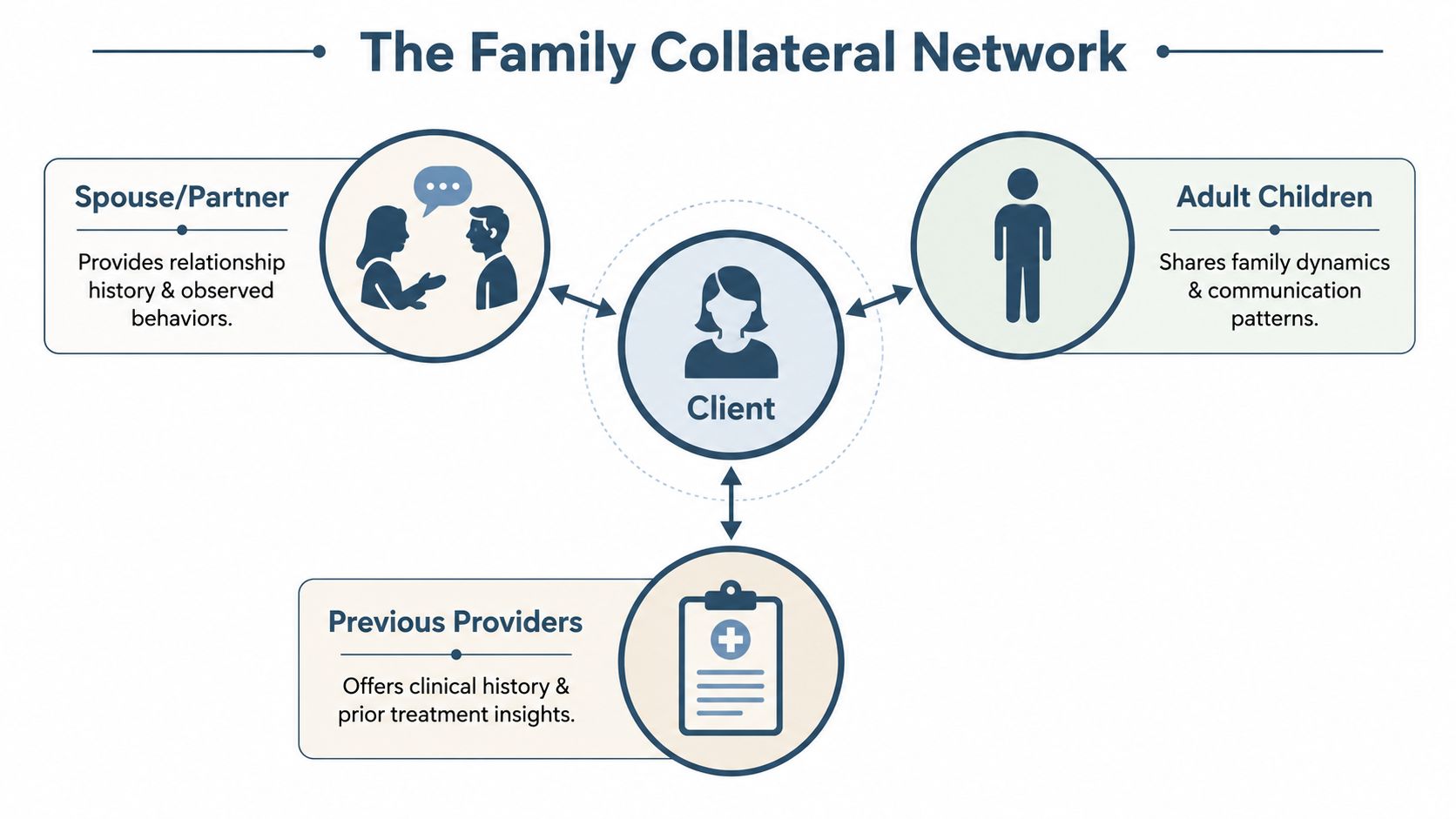
A spouse called late in the evening and described a pattern that the client had minimized for months. At work, the person looked sharp. At home, sleep had collapsed, drinking had escalated, and anger had become unpredictable. That's why family collateral matters. It fills in the blind spots that a single interview almost always leaves behind.
What family collateral actually does
Collateral history from a spouse, partner, adult child, or prior provider helps clinicians understand changes over time, not just the last crisis. It can show when sleep changed, when mood shifted, when promises began to fail, or when family members started covering for symptoms. That context often sharpens the diagnosis.
Families are usually invited into private sessions or structured interviews, but confidentiality still matters. The team shares what the client permits and uses the family's account to build a better clinical map, not to turn treatment into a trial.
Why the family phase is part of evaluation
Family involvement also starts education early. Monthly workshops that cover dual diagnosis, trauma, and recovery timelines help loved ones understand why symptoms don't resolve on a clean schedule. That keeps expectations realistic and reduces the cycle of panic, pressure, and disappointment that can follow discharge.
In executive families, this part can be delicate because work, reputation, and family dynamics often overlap. The best programs keep the conversation calm and practical. They explain what support helps, what undermines treatment, and how the family can respond without taking control of the client's recovery.
A high-end program that handles this well gives loved ones something concrete to do. Listen, document concerns, attend education, and avoid making assumptions based on a polished public image. That kind of involvement often improves follow-through after discharge.
From Findings to an Individualized Treatment Plan
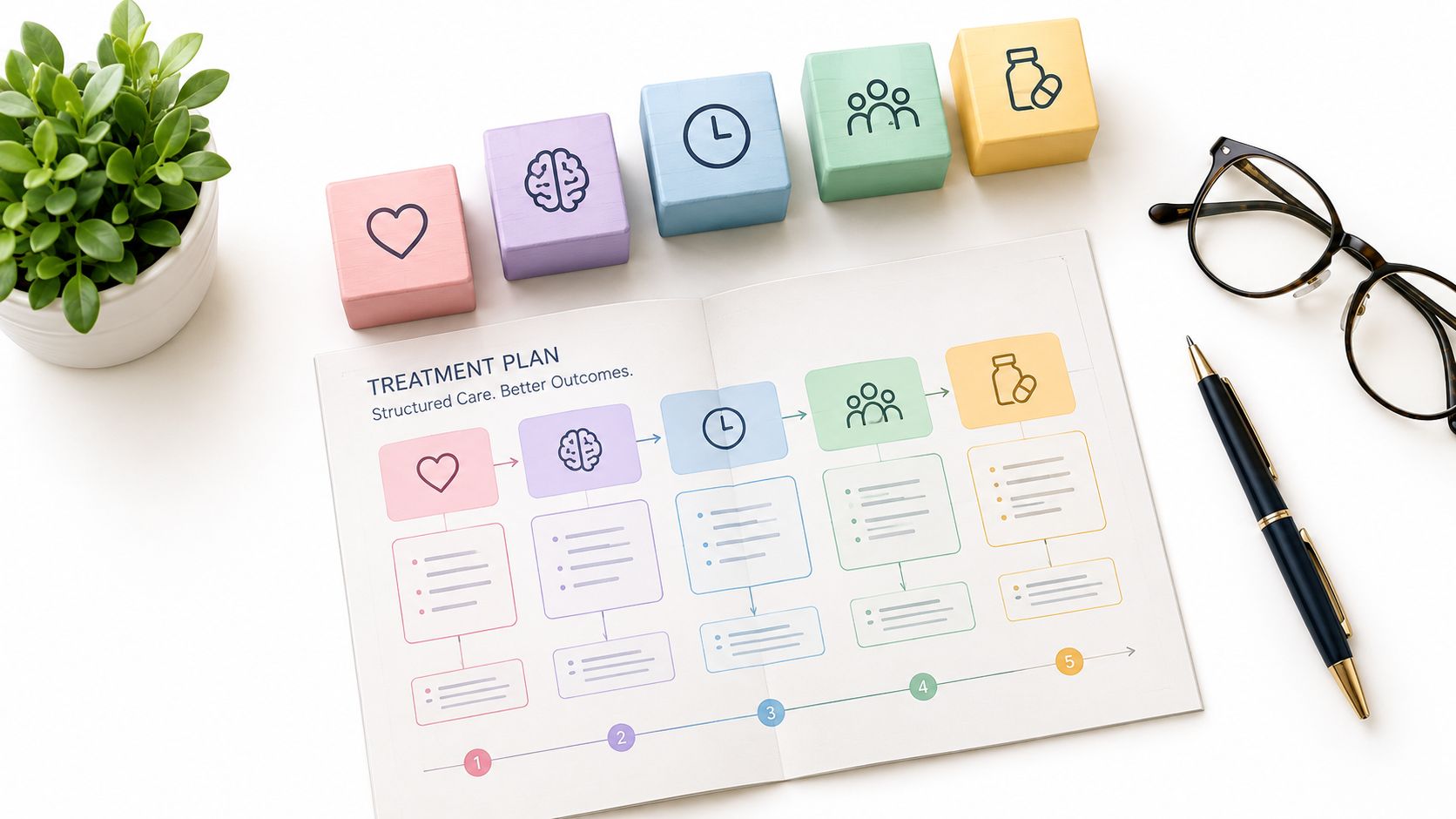
The treatment plan should read like a synthesis, not a brochure. Once the assessment is complete, the team gathers psychiatric findings, substance use patterns, medical data, risk level, and family input into one written plan. That plan should name the problems being treated, the order they'll be treated in, and the methods chosen for this specific client.
How modalities are matched to the person
A good program doesn't hand out the same package to everyone. It selects therapies based on findings. CBT may be used when distorted thinking and relapse triggers need structure. DBT can help when emotional volatility, self-harm risk, or impulsive behavior is present. ACT can support people who need values-based work after years of avoidance. MI, or motivational interviewing, is useful when ambivalence is still high.
Individual psychotherapy, intensive groups, and family sessions are then layered in according to need. Experiential work, such as mindfulness, meditation, somatic therapy, art, music, and equine work, can support engagement when they're tied to the clinical picture rather than offered as decoration. In a private residential setting like Reflections, these elements sit inside a broader dual-diagnosis model that includes evidence-based therapy, medication support when appropriate, and continuing care planning (personalized treatment planning).
How progress should be measured
A serious plan is not static. Clinicians update it as symptoms change, withdrawal resolves, sleep improves, or family information shifts the understanding of the case. That can mean adjusting session frequency, refining medication, or changing the balance between individual and group work.
A treatment plan is only useful if the team is willing to revise it when the data changes.
For executives and working professionals, this matters because they often arrive with a high tolerance for stress and a strong desire to “push through.” Recovery doesn't reward that instinct. It rewards accurate measurement, honest reassessment, and continuity after discharge.
What strong continuing care looks like
A 30 to 90 day stay should produce a clear discharge plan, not a vague promise. Continuing care, alumni support, and flexible outpatient services carry the work forward when the residential setting ends. Families should ask whether the program tracks goals, revisits them during the stay, and prepares the client for the return to normal life with structure already in place.
If the answer is yes, the luxury setting is doing real clinical work. If the answer is mostly about comfort, the price tag is carrying more weight than the treatment.
If an executive or family member needs a calm, clinically grounded review of next steps, Reflections offers private residential dual-diagnosis treatment with assessment, medication support, family involvement, and individualized planning in a discreet setting. Visit Reflections to review the program and speak with a clinical admissions team about whether this level of care fits the situation.