

The calendar is full, the board expects clear decisions, and the phone rarely leaves the hand. Yet the pressure behind the polished performance has changed. Alcohol, prescription medication, or another substance may now be doing the work that sleep, emotional processing, and professional support once did. For an executive or high-net-worth professional, the problem is not stopping substance use. The harder task is treating the trauma that keeps driving the urge while protecting privacy, judgment, relationships, and career continuity.
When Trauma and Addiction Share a Room
A senior executive can spend the morning leading a difficult negotiation and the afternoon appearing composed in front of a team. Later, alone in a hotel room or behind a closed home-office door, the same person may use alcohol or medication to quiet intrusive memories, irritability, hypervigilance, or emotional numbness. The substance provides short-term relief, but the relief fades. Sleep deteriorates, concentration becomes less reliable, and the next day requires even more effort to maintain the appearance of control.
That pattern often survives longer in high-performing professionals because success can conceal impairment. A respected title, financial resources, and strong operational skills don't protect someone from post-traumatic stress disorder or substance use disorder. They can, however, make it easier to postpone treatment, arrange care privately, and keep serious symptoms hidden from colleagues and family.
Clinical distinction: The substance may be the visible crisis, while untreated trauma remains one of the forces sustaining it.
A conventional addiction program may focus on withdrawal, cravings, and abstinence without adequately examining the memories, beliefs, and nervous-system responses that make substances feel necessary. A trauma-only program may help someone process painful experiences without providing enough structure for relapse prevention, medication management, or medically supervised withdrawal. Neither approach fully matches a patient whose conditions interact every day.
Why executive care requires more precision
The executive client often needs a setting that can manage several priorities at once:
- Medical stability: Withdrawal and medication decisions require qualified clinical oversight, particularly when substance use has become physiologically entrenched.
- Trauma assessment: Clinicians need to distinguish PTSD symptoms from intoxication, withdrawal, depression, anxiety, sleep disruption, or other psychiatric conditions.
- Confidentiality: Privacy must be operational, not merely part of a brochure. Intake, communication, room assignments, and family contact all require discretion.
- Professional continuity: Essential work responsibilities may need boundaries, scheduling, and clinical approval rather than either unrestricted access or an absolute digital ban.
Integrated luxury care addresses the full picture. The purpose of premium treatment isn't comfort alone. It is to create enough privacy, clinical depth, and environmental control for the patient to stop managing appearances and begin addressing the mechanisms behind the addiction.
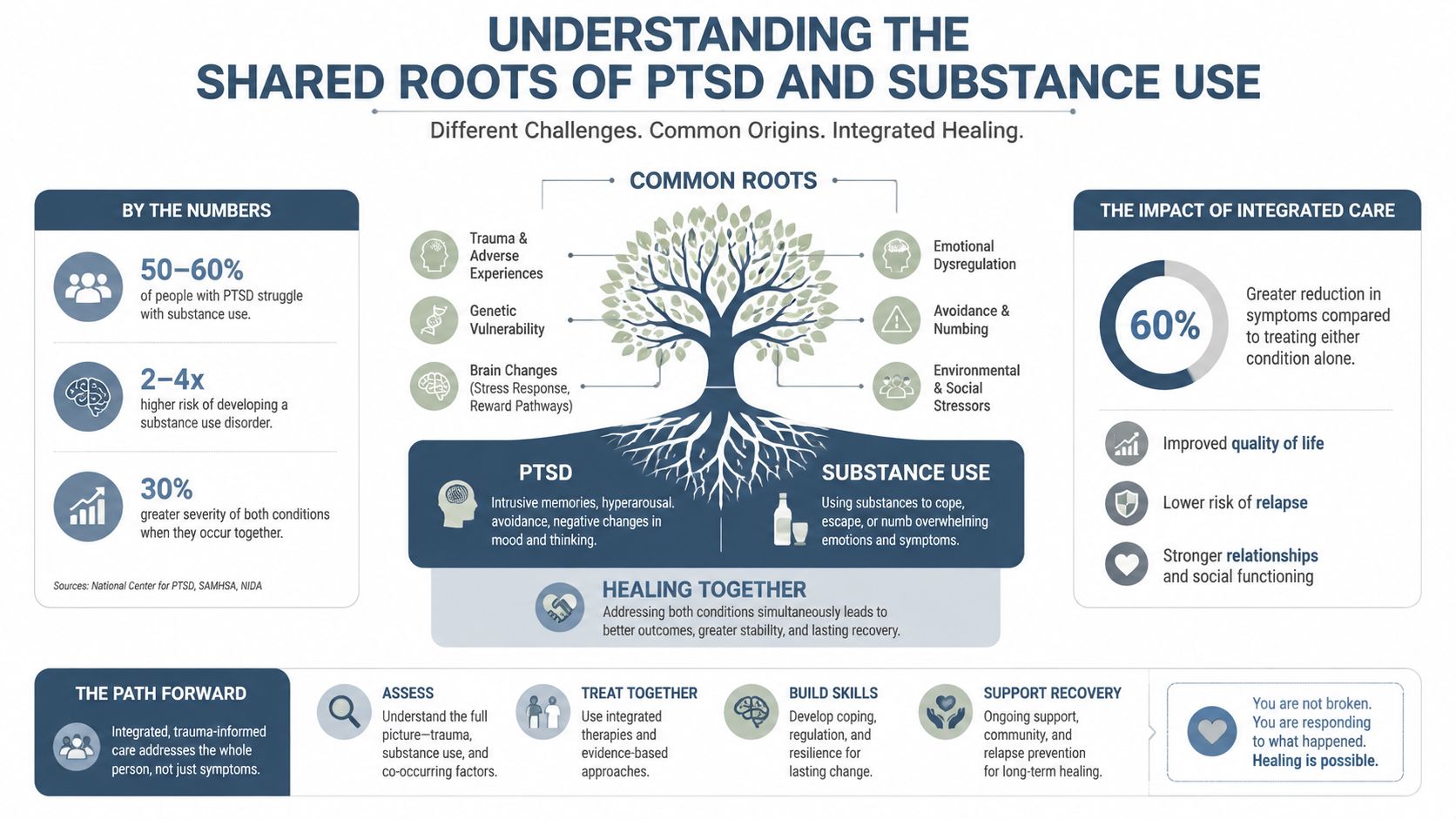
Understanding the Shared Roots of PTSD and Substance Use
An executive may arrive at treatment describing insomnia, irritability, overwork, or reliance on alcohol or medication to stay functional. Underneath, unresolved trauma and substance use disorder may be reinforcing each other. PTSD can bring fear, agitation, shame, emotional detachment, and intrusive recollections. Substance use may temporarily suppress those experiences, while intoxication, withdrawal, and exposure to risky situations add further instability.
The overlap is substantial. A peer-reviewed review found that PTSD co-occurs with substance use disorders among roughly 40% of civilians and veterans (SAMHSA's treatment data on PTSD and trauma). Another clinical review reported that 44.6% of people with lifetime PTSD also met criteria for alcohol use disorder or another substance use disorder.
The clinical logic behind screening in both directions
SAMHSA's 2010 treatment guide identified screening, assessment, and integrated management as core principles for people with co-occurring disorders. Its 2012 pharmacologic guideline addressed PTSD with co-occurring opioid use disorder and recommended proactive screening in both directions. Patients with opioid use disorder should be screened for PTSD, and patients with PTSD should be screened for opioid use disorder (SAMHSA's pharmacologic guidance for PTSD and co-occurring opioid use disorder).
National data show why this screening cannot be limited to one diagnosis. Among people with lifetime trauma exposure, past-year any substance use disorder was 10.1%, compared with 7.7% among those without such exposure. Past-year receipt of substance use treatment was 1.9% versus 1.0%, respectively.
Treating only one condition risks missing the trigger for the other, leaving gaps in trauma processing and relapse prevention. For executives and high-net-worth professionals, that gap can also affect judgment, confidentiality, work demands, and the timing of return to leadership responsibilities. A private program must therefore assess both conditions at intake and continue monitoring how each changes during recovery.
Evidence-Based Therapies for Integrated Recovery
Effective PTSD and addiction treatment combines trauma-focused psychotherapy with substantial substance use care. That care may include craving management, relapse-prevention planning, psychiatric evaluation, and medical support when appropriate. For executives and high-net-worth professionals, the treatment plan must also protect privacy and accommodate the practical demands of leadership without weakening clinical structure.
A 2022 systematic review and meta-analysis found that trauma-focused intervention delivered alongside SUD treatment improved PTSD symptoms after treatment, with a standardized mean difference of -0.36 and a 95% confidence interval of -0.64 to -0.08. At 6 to 13 months, the sustained PTSD benefit was -0.48, with a 95% confidence interval of -0.81 to -0.15. Alcohol use also improved, with an effect of -0.23 and a 95% confidence interval of -0.44 to -0.02 (the systematic review and meta-analysis).
The evidence also defines a practical boundary. Trauma-focused work shows clearer benefit for PTSD than for substance use beyond standard addiction treatment. Relapse prevention must therefore remain part of the plan, rather than leaving trauma therapy to carry the full burden of addiction care.
Matching the therapy to the patient
Treatment may draw from several established modalities:
- Cognitive Behavioral Therapy: Identifies thoughts, avoidance patterns, and behavioral loops that connect trauma reminders with substance use.
- Dialectical Behavior Therapy: Develops distress tolerance, emotional regulation, interpersonal effectiveness, and crisis-management skills.
- Eye Movement Desensitization and Reprocessing: May help process traumatic memories within a structured clinical plan. A focused overview of EMDR therapy for addiction explains how trauma work can fit within broader recovery.
- Prolonged Exposure: Uses planned exposure to trauma memories and reminders, supported by preparation, pacing, and clinical monitoring.
- Cognitive Processing Therapy: Examines trauma-related beliefs involving guilt, shame, danger, trust, and responsibility.
Active substance use does not automatically exclude a patient from evidence-based PTSD treatment. Clinical guidance states that SUD should not preclude PTSD treatment, and reviews describe PE, CPT, and COPE as safe and effective when integrated with SUD care (clinical guidance on PTSD and SUD treatment). Clinicians should assess readiness, safety, craving intensity, withdrawal status, and the timing of each intervention.
Professionals living abroad or managing trauma across cultures may find a trauma recovery guide for expats useful before a private consultation. It cannot replace diagnostic assessment. It may, however, clarify how relocation, isolation, language, and identity can affect recovery, particularly when treatment must fit around demanding professional responsibilities.
The Executive Pathway to Private Residential Care
Standard residential care often prioritizes a uniform schedule and broad population management. That structure can be appropriate for many patients, but a C-suite executive may need a more controlled and confidential pathway. The relevant comparison isn't luxury versus discipline. It is whether the environment can preserve therapeutic structure while accommodating essential responsibilities.
A high-end private-pay program may offer private rooms for every resident, including both detox and rehabilitation phases. Single occupancy can reduce unwanted exposure, support sleep, and give the patient a protected space for decompression after difficult clinical work. It also limits the social visibility that can concern high-profile professionals.
Electronics access requires clinical boundaries
Unrestricted phone and laptop use can undermine treatment through constant work demands, concealment, or exposure to triggering communication. An absolute ban can create its own problems when a patient has urgent family, legal, fiduciary, or operational responsibilities. The more defensible approach is managed access.
One independent guide describes a 24-to-72-hour therapeutic hold at intake, followed by limited, scheduled access windows after medical stabilization and engagement in treatment (the guide to rehabilitation programs that allow cell phones). The point isn't to let a resident run a company from a treatment bed. It is to create predictable, clinically supervised opportunities for essential communication.
A workable policy should answer practical questions:
- Who approves access during detox?
- What happens if a business crisis interrupts therapy?
- Can the patient communicate with family privately?
- Are work periods scheduled outside core clinical sessions?
- What boundaries prevent electronic access from becoming avoidance?
Executive-oriented care should also coordinate with authorized family members, attorneys, medical professionals, or business representatives when the patient requests that support. A discreet executive rehab pathway can help families and referral professionals evaluate how privacy, clinical intensity, and career obligations are balanced.
Selecting an Accredited Dual-Diagnosis Facility
Accreditation, clinical rigor, and operational discretion should guide facility selection. Executives seeking PTSD and addiction treatment should verify credentials, program design, staffing, privacy procedures, and total costs before admission. The right facility must support intensive dual-diagnosis care while allowing a carefully defined process for managing legitimate career obligations.
The Joint Commission maintains a provider locator for accredited behavioral health organizations. Its accreditation materials describe the Gold Seal of Approval as a symbol of quality and trust. Joint Commission status therefore offers an externally recognized reference point, rather than relying solely on a facility's marketing claims (the Joint Commission behavioral health provider locator).
A practical due-diligence sequence
-
Verify accreditation directly. Confirm the organization and specific location through the accrediting body's provider information. Ask which services and sites the accreditation covers. A respected brand does not automatically validate every program it operates.
-
Review the clinical team. Identify the psychiatrists, psychologists, licensed therapists, addiction counselors, and medical staff who treat trauma and substance use disorders. Ask who directs treatment planning, how often progress is reviewed, and who makes medication decisions.
-
Examine the detox model. Determine whether withdrawal is medically managed, what monitoring is available, and how the facility responds if medical or psychiatric acuity changes.
-
Ask how trauma treatment is integrated. The program should explain its assessment process, criteria for introducing exposure-based work, and coordination between PTSD therapy and relapse prevention. Timing matters. Trauma processing may require stabilization first.
-
Request privacy policies in writing. Review private-room availability, visitor controls, secure communications, confidentiality procedures, and the process for handling sensitive professional information.
-
Demand transparent pricing. Private-pay programs may separate accommodation levels, medical services, and executive support. Published luxury pricing examples range from $12,500 to over $80,000, depending on room type and services included. Another published schedule lists $25,500 for a shared luxury room, $29,500 for a private room, and $69,500 to $79,500 for an executive luxury tier over a 5-week stay (the published private-pay luxury pricing).
These figures illustrate market segmentation, not a universal fee schedule. Before admission, request a written statement identifying included clinical services, room type, medical care, family work, aftercare, and administrative support. Ask how the program handles confidential work communication without allowing professional demands to displace treatment.
Why Integrated Luxury Care Delivers Lasting Results
Premium care earns its place when it removes barriers that would otherwise keep treatment superficial or short-lived. For an executive, those barriers may include fear of exposure, inability to step away from a company, discomfort with communal housing, and concern that trauma therapy will destabilize substance recovery.
An integrated program addresses those issues through one coordinated plan. Medical professionals manage withdrawal or medication optimization when clinically appropriate. Psychologists and therapists work on trauma symptoms, emotional regulation, shame, avoidance, and relationship patterns. Addiction specialists build relapse-prevention skills around the patient's actual triggers, schedule, family system, and professional environment.
Privacy can support honesty
Private rooms and controlled communications aren't substitutes for therapy. They can, however, reduce distractions and give residents more control over recovery-related disclosure. That matters when a patient has spent years protecting a public identity and may initially fear that vulnerability will affect leadership credibility.
Balanced electronics access can serve the same purpose when it remains structured. A resident may handle essential family or business communication without turning every treatment hour into an executive meeting. The clinical team can help determine when work supports stability and when it functions as avoidance.
The treatment environment also needs to support life beyond abstinence. Family sessions, education, psychiatric follow-up, continuing care, and clear post-residential boundaries help translate insight into daily behavior. Trauma work isn't complete when memories become less intense. The patient also needs a plan for sleep, travel, conflict, alcohol-centered events, medication decisions, and the pressure of making consequential decisions while emotionally activated.

Reflections is a California-licensed, Joint Commission-accredited luxury rehabilitation provider offering dual-diagnosis care, private rooms, managed electronics access, clinically managed sub-acute detox when appropriate, and multidisciplinary treatment for adults with co-occurring mental health and substance use disorders. For a high-performing professional, the value lies in combining confidentiality and career-aware structure with psychotherapy that addresses trauma rather than asking the patient to manage symptoms indefinitely.
Reflections offers private residential PTSD and addiction treatment with accredited dual-diagnosis care, private rooms across detox and rehabilitation, and clinically managed access to essential electronics. Visit Reflections to discuss confidential treatment options designed for executives and high-net-worth professionals who need clinical rigor without abandoning responsible career obligations.