
An executive can recognize the need for treatment and still worry about what admission might cost professionally. A board meeting may be approaching, a team may depend on a single decision-maker, and a public absence may invite questions that feel impossible to answer. For a high-profile professional, the challenge isn't only stopping substance use. It also involves finding care that protects privacy, preserves dignity, and addresses the experiences driving the symptoms.
That's where what is trauma-informed care becomes a practical question rather than a slogan. Trauma-informed care shapes the entire treatment environment, from the first phone call to clinical assessment, staff communication, living arrangements, device policies, and continuing care. In a luxury residential setting, private rooms, controlled access to electronics, and clear clinical boundaries can become part of a thoughtful recovery design for people who need intensive help without surrendering their professional identity.
Why Trauma-Informed Care Matters for Working Professionals
A chief executive arrives at a residential program after months of sleeping poorly, drinking privately, and using medication to remain productive. The admission team could treat the substance use as the only urgent problem. A trauma-informed team asks a broader set of questions: What makes treatment feel unsafe? Which interactions could trigger withdrawal or defensiveness? How can the client participate in care without feeling stripped of autonomy?
That distinction matters for professionals who have built careers around control, discretion, and performance. A standard environment that removes every personal choice, dismisses work responsibilities, or treats guardedness as resistance may intensify the very responses that interfere with treatment. The client may attend sessions physically while remaining psychologically absent, withholding information about PTSD symptoms, substance use, or past experiences.
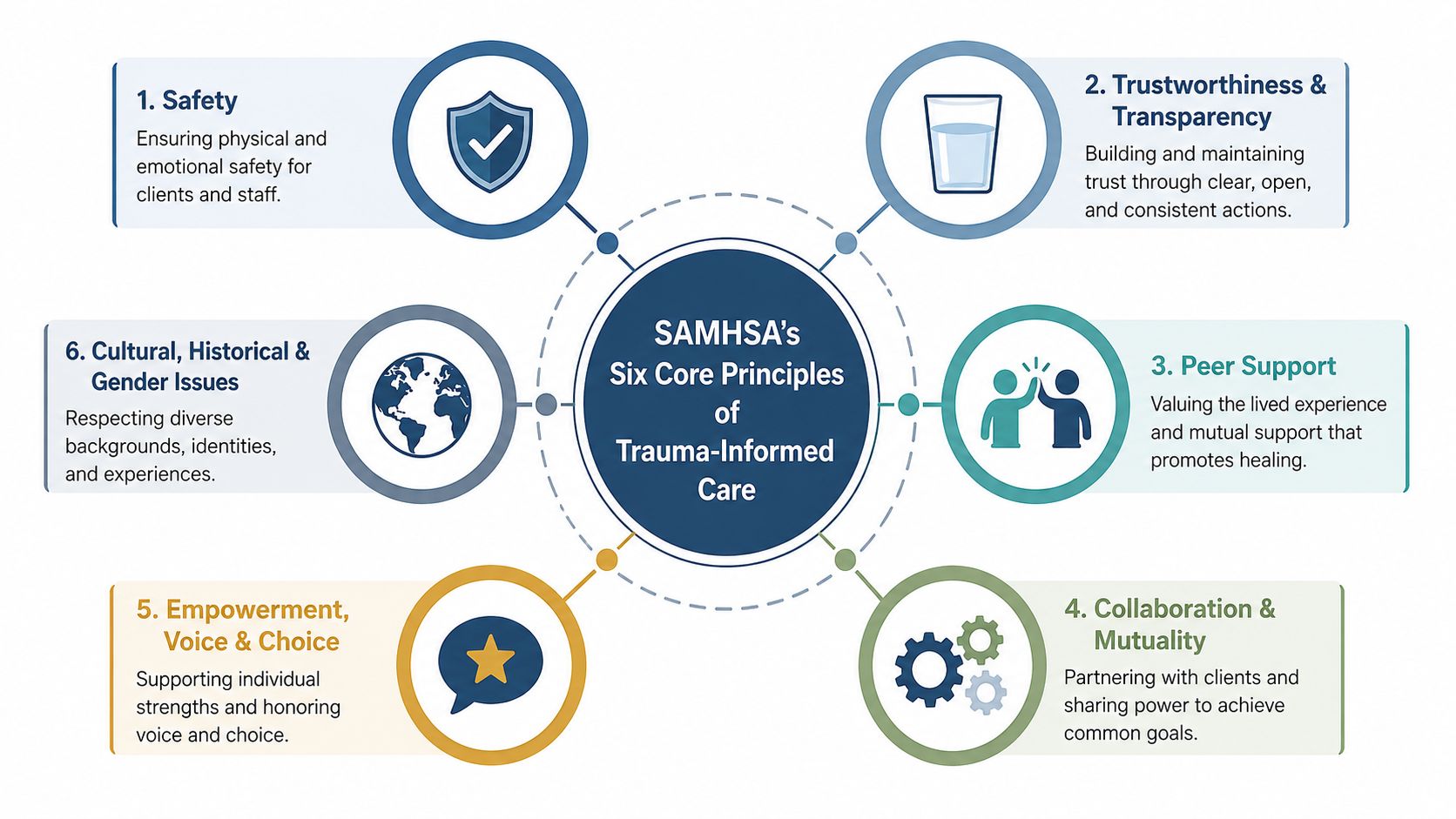
SAMHSA defines trauma-informed care as a system that recognizes trauma's widespread impact, identifies signs and symptoms in clients, families, staff, and others, and integrates trauma knowledge into policies, procedures, and practices. Its framework rests on safety, peer support, trustworthiness and transparency, collaboration and mutuality, voice and choice, and cultural, historical, and gender responsiveness (SAMHSA's trauma-informed guidance).

Precision, not permissiveness
Trauma-informed care isn't a promise that every preference will determine treatment. Medical safety, detoxification needs, medication management, and therapeutic structure still require professional judgment. The difference is that staff explain decisions, invite appropriate participation, and avoid using unnecessary control as a substitute for clinical leadership.
Trauma exposure can influence treatment engagement, perceived safety, willingness to disclose, and responses to authority. In dual-diagnosis care, those factors may affect whether a client discusses cravings, panic, dissociation, depression, or trauma symptoms openly. A program that addresses these realities can create better conditions for therapeutic alliance and sustained participation.
Clinical principle: A client's guarded behavior may be a protective response, not a character flaw. Skilled staff investigate what the behavior communicates before deciding how to respond.
For an executive, the most credible program doesn't confuse comfort with avoidance. It offers a private, discreet environment while maintaining clinical accountability. It recognizes resilience without requiring the client to perform strength every hour of the day, and it treats professional responsibilities as information to integrate into a safe plan rather than obstacles to recovery.
The Six Principles That Define Trauma-Informed Care
SAMHSA's six principles work as design requirements, not decorative values. A luxury residential program demonstrates them through ordinary operational details, including how staff greet a client, explain a schedule, respond to a request, and handle disagreement.
Safety
Safety includes physical surroundings, emotional tone, privacy, and predictability. Private quarters can give a resident control over rest and decompression, while clear expectations reduce the uncertainty that can activate hypervigilance. Staff should also explain who enters a room, how medication checks occur, and what happens during an urgent clinical event.
Trustworthiness and transparency
Trust grows when staff explain policies before enforcing them. If electronics are available during defined work periods, the program should describe the schedule, privacy limits, and clinical rationale in advance. If a client can't follow a request because of withdrawal risk or acute symptoms, the team should explain the decision rather than presenting it as arbitrary authority.
Peer support
Peer support gives residents access to shared experience without requiring public disclosure. In an executive track, group design may need to account for confidentiality, professional identity, and differences in leadership responsibility. The principle doesn't require forced intimacy. It requires a culture where residents can receive support from others who understand recovery challenges.
Collaboration and mutuality
A client accustomed to leading organizations may react strongly to one-sided instructions. Collaboration means the treatment team retains clinical responsibility while involving the resident in appropriate decisions about goals, routines, family participation, and continuing care. The relationship becomes a partnership with defined roles, not a contest for control.
Empowerment, voice, and choice
Choice can involve selecting among clinically appropriate therapy options, deciding how to prepare for a family session, or identifying which professional obligations require careful planning. This approach doesn't mean choosing whether medically necessary care occurs. It means helping the resident understand options and participate meaningfully in the plan.
Cultural, historical, and gender responsiveness
A client's identity and history shape how safety, authority, privacy, and disclosure are experienced. Staff should consider culture, gender, discrimination, family expectations, and professional context when planning care. This principle also requires the program to review whether its language, routines, and assumptions create barriers for particular residents.
A therapy room can apply these principles, but a single therapist can't implement them alone. Admissions, nursing, residential staff, clinicians, food service, and leadership all influence whether the environment feels safe and coherent. Readers seeking a clinical explanation can also review trauma-informed therapy and its core approach.
Trauma-Informed Care Versus Trauma-Focused Treatment
A senior professional arrives at a residential program with insomnia, hypervigilance, and alcohol dependence. Staff use predictable routines, explain privacy limits, and coordinate decisions with the resident. Those practices may make treatment possible, but they do not, by themselves, treat post-traumatic stress disorder.
Trauma-informed care describes how an organization designs and delivers care. It shapes policies, communication, physical space, boundaries, and relationships across the program. Trauma-focused treatment refers to specific clinical interventions aimed directly at trauma symptoms, memories, beliefs, and related responses.
The distinction matters in luxury rehabilitation, where privacy and professional responsibilities can affect clinical participation. Private rooms, controlled device access, and clear contact policies can reduce avoidable stress for high-profile professionals. They are organizational design choices that support safety and continuity, while clinicians still determine whether a structured trauma intervention is appropriate.
A program may communicate in a trauma-informed way without offering a structured PTSD treatment. A clinician may also provide trauma-focused therapy within an organization whose rules feel confusing or coercive. For a resident with PTSD and a substance use disorder, both layers have a role: the setting supports engagement, and targeted treatment addresses symptoms and patterns that require focused clinical work.
Evidence-based PTSD treatments include cognitive processing therapy, prolonged exposure, and trauma-focused cognitive behavioral therapy. Current guidance distinguishes these interventions from the broader trauma-informed model and identifies trauma-focused treatments as having the strongest support for reducing PTSD symptoms (American Psychological Association guidance on PTSD treatment).
| Aspect | Trauma-Informed Care | Trauma-Focused Treatment |
|---|---|---|
| Scope | Organization-wide approach affecting policies, communication, environment, and relationships | Specific clinical intervention directed at trauma-related symptoms |
| Primary purpose | Promote safety, trust, choice, and avoidance of re-traumatization | Reduce PTSD symptoms and process trauma-related beliefs, memories, or responses |
| Methods | Screening, staff training, collaborative planning, predictable procedures, respectful boundaries | Structured psychotherapy such as cognitive processing therapy, prolonged exposure, or trauma-focused CBT |
| Timing | Begins at intake and continues across every level of care | Introduced when assessment indicates readiness, clinical appropriateness, and sufficient stabilization |
| Outcome focus | Engagement, perceived safety, therapeutic alliance, and coordinated care | Trauma symptom reduction and improved psychological functioning |
A comfortable setting alone does not treat PTSD. Intensive trauma processing also requires attention to stabilization, substance use, sleep, medication, and the resident's ability to remain present.
A dual-diagnosis plan may begin with safety and stabilization before adding trauma-focused work. Some residents need a carefully paced approach; others can begin targeted treatment earlier. The team should explain its reasoning and revisit the plan as symptoms change.
Readers exploring a specific trauma therapy connected with addiction treatment can review EMDR therapy for addiction. During admissions, ask how the program's organizational practices connect with its trauma-focused clinical capabilities.
How Trauma-Informed Care Works in Dual-Diagnosis Settings
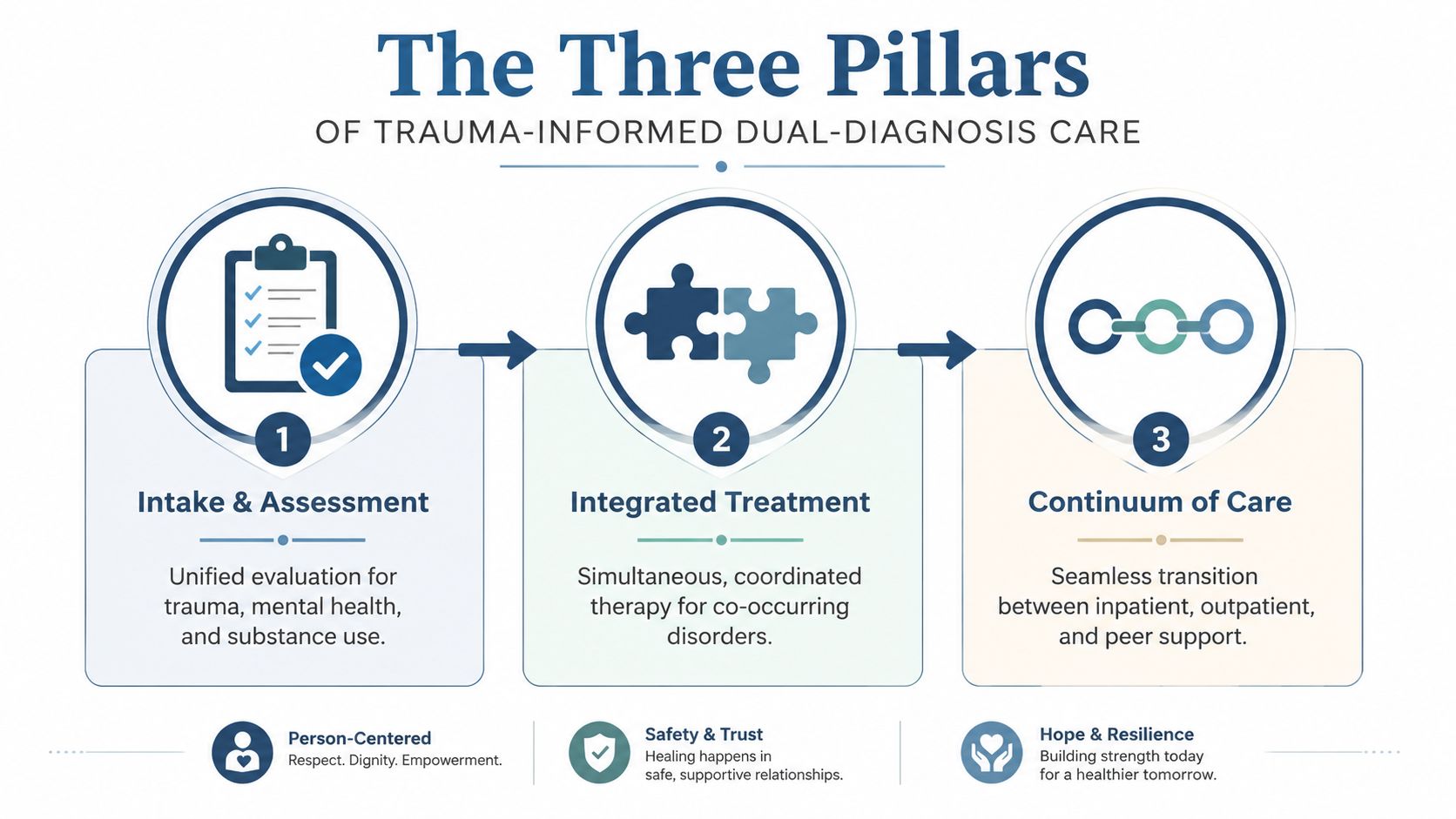
Dual-diagnosis treatment becomes more coherent when trauma, mental health symptoms, and substance use are assessed together. A client may use alcohol to blunt intrusive memories, stimulants to counter depression and exhaustion, or sedating medication to reduce panic. Treating only the substance can leave the maintaining cycle intact.
A recent systematic review of 15 studies found positive findings involving substance use, mental health and trauma symptoms, and treatment retention across community and residential settings, while also noting variation in study quality, including 5 low-quality, 1 moderate-quality, and 6 high-quality studies among the included research (2025 systematic review of trauma-informed care in substance-use settings). The findings support careful implementation, not automatic promises. Outcomes depend on the client profile, the treatment model, staff competence, and whether the organization applies the approach consistently.
Intake and assessment
Universal routine trauma screening can identify relevant history without demanding a detailed narrative before trust exists. Good screening asks about symptoms, current safety, substance use, medical needs, and treatment preferences. It also clarifies what the client wants staff to know now and what can wait until a stronger therapeutic relationship develops.
Integrated treatment
The clinical team coordinates care rather than placing PTSD, depression, anxiety, and addiction into separate silos. Depending on assessment, treatment may include CBT, DBT, motivational interviewing, medication optimization, EMDR, somatic work, mindfulness, or other appropriate interventions. These modalities should support a unified plan rather than appear as disconnected amenities on a service list.
Continuum of care
Discharge planning begins before the final day. The team connects residential gains with outpatient therapy, medication follow-up, family involvement, peer support, and practical safeguards around work and travel. A professional may need a carefully structured return to leadership, not a general instruction to “avoid stress.”
Staff training must extend beyond therapists. Admissions coordinators need to avoid interrogative language, residential staff need to recognize escalating distress, and every employee needs to understand privacy and boundary expectations. A single trauma-trained clinician can't compensate for an organizational culture that ignores re-traumatization risk.
Evidence also requires candor. Another 2025 systematic review found only 12 studies across 16 publications, all with high risk of bias, and concluded that evidence was insufficient to determine effects on any outcome (review of trauma-informed care effectiveness). The same source reports that a meta-analysis of 13 randomized trials found moderate-to-large gains in trauma-related knowledge and mental health outcomes for providers and recipients, particularly in clinical settings. Those findings don't establish that every whole-program model works, or which components matter most. A credible provider should explain that uncertainty rather than promise guaranteed results.
Why Private Rooms and Device Access Are Clinical Choices
Luxury features can look superficial when separated from clinical design. In a trauma-informed program, privacy and controlled autonomy can support safety, regulation, and engagement. They don't replace therapy, medical oversight, or accountability. They help create conditions in which those services can work.
Private rooms offer a resident a reliable place to sleep, decompress, and organize thoughts without constant social exposure. That can be especially relevant for someone who has spent years managing public visibility or who experiences hypervigilance, shame, or difficulty relaxing around unfamiliar people. Private space also supports confidentiality, which matters when a professional is concerned about colleagues, clients, family, or public reputation.
Private-room residential care is a documented feature in accredited behavioral-health programs. One Joint Commission-accredited adult residential provider states that adult residential clients receive private bedrooms and bathrooms, demonstrating that private accommodations can coexist with formal behavioral-health standards.

Autonomy with boundaries
Device access requires more nuance than either unrestricted use or total confiscation. Executives may need limited contact with a board, business partner, family member, or legal adviser. A structured policy can define work blocks, prohibit disruptive use during therapy, protect other residents' privacy, and allow staff to reassess access when clinical risk changes.
Published residential policies describe a common distinction between standard and executive programming. Standard residential programs may restrict electronics during the first one to three weeks, while executive programs may permit continued but controlled phone and laptop use during defined periods with clinical boundaries.
The purpose isn't to help a resident avoid recovery by staying permanently online. It's to reduce the anxiety associated with abrupt professional disappearance while preserving the schedule and relationships required for treatment. Staff should ask what work contact is necessary, what contact is compulsive, and what boundaries protect sleep, therapy, and emotional regulation.
Design test: An amenity becomes clinically meaningful when the team can explain how it supports safety or engagement, what limits apply, and how staff will adjust it when treatment needs change.
For executives evaluating the role of personal space in care, private rooms in luxury rehab for executives provides a focused discussion of this design choice. The strongest programs don't market autonomy as unlimited freedom. They build bounded autonomy, enough control to preserve dignity and enough structure to support recovery.
How to Evaluate Whether a Program Is Genuinely Trauma-Informed
The phrase trauma-informed care appears in many program descriptions, but the label alone doesn't reveal how a facility operates. A serious evaluation should move from branding to observable practice. Admissions staff should be able to answer detailed questions without becoming defensive or vague.
Ask about the operating system
The following questions help distinguish organization-wide implementation from one therapist's training:
- Screening process: How does the program identify trauma history and current trauma symptoms without pressuring a client to disclose details prematurely?
- Staff preparation: Which departments receive training, and how does the program supervise staff responses to distress, dissociation, anger, or avoidance?
- Policy rationale: How are rules about phones, visitors, medication, searches, room access, and emergency procedures explained to residents?
- Clinical integration: How are PTSD, depression, anxiety, withdrawal, cravings, and other co-occurring concerns represented in one treatment plan?
- Client participation: Which decisions can residents influence, and how does the team document preferences, consent, and changes in readiness?
- Family involvement: How can family members participate while respecting confidentiality and the resident's boundaries?
- Continuing care: What happens after residential treatment, and who coordinates therapy, medication follow-up, peer support, and professional reintegration?
Accreditation can provide one useful verification point, but it isn't a substitute for asking how care is delivered. The Joint Commission's provider locator includes accreditation options for substance-use-disorder treatment organizations, making accreditation a verifiable marker rather than a purely promotional phrase (Joint Commission behavioral-health provider locator).
Notice the red flags
A program deserves closer scrutiny if staff can't explain its screening process, if different departments give contradictory answers about policies, or if the facility treats questions about re-traumatization as criticism. Another warning sign is a treatment plan that lists trauma therapy but doesn't explain stabilization, consent, pacing, or coordination with addiction care.
A luxury setting should also be evaluated clinically. Private rooms, fine furnishings, and device access may improve comfort, but the decisive questions concern staffing, credentials, medical coverage, supervision, confidentiality, and the connection between amenities and treatment goals.
Reflections is a California-licensed, Joint Commission-accredited residential provider that offers dual-diagnosis care, private accommodations, structured electronics access, and integrated clinical services for adults with co-occurring mental health and substance use disorders. Prospective residents and families can use that information as a starting point, while still asking direct questions about individual assessment and treatment fit.
Taking the Next Step Toward Trauma-Informed Treatment
A discreet consultation should begin with the practical realities of the professional's situation. The prospective resident can describe substance use, trauma symptoms, medical concerns, work obligations, privacy needs, and any immediate safety issue. The provider should explain the assessment process, detox or withdrawal management when relevant, room arrangements, electronics policy, clinical modalities, family participation, cost structure, and continuing care.
Families and employers don't need every clinical detail. A resident can prepare a limited communication plan that identifies who receives updates, what information remains private, and how essential work responsibilities will be handled. That planning often reduces the uncertainty that makes treatment feel impossible.
People interested in complementary, experiential approaches may also find value in resources such as horse healing for therapists, particularly when exploring how guided interaction with horses can support reflection and professional wellbeing. Such resources should complement, not replace, licensed assessment and evidence-based treatment.
Seeking residential care isn't a failure of leadership. It's a strategic decision to protect health, judgment, relationships, and long-term capacity. A trauma-informed program respects the intelligence and resilience that helped a professional succeed while creating enough safety to address what performance alone could never resolve.
Reflections provides discreet, luxury residential dual-diagnosis treatment with private rooms, structured access to phones and laptops, and a highly accredited multidisciplinary clinical team. Visit Reflections to discuss trauma-informed care, professional obligations, and an individualized path toward recovery.